
2026 Cadillac Fleetwood Is Finally Here… This Luxury Comeback Will Blow Your Mind

The Fleetwood name is back, and it is arriving with confidence. After years of speculation, Cadillac has officially revived one of its most iconic luxury sedans for 2026, blending heritage styling with modern design and technology. This is not a nostalgia act but a bold statement about where full-size American luxury is headed next. A Legendary Name Returns With Purpose For decades, the Fleetwood represented the pinnacle of comfort and prestige under the Cadillac badge. The 2026 model reclaims that position by focusing on presence, refinement, and quiet authority rather than chasing trends. Cadillac appears determined to remind buyers what traditional luxury feels like, while still meeting modern expectations. Design That Commands Attention Without Shouting The new Fleetwood carries unmistakable Cadillac DNA, yet it avoids looking retro. Long, clean body lines give it a stately stance, while modern lighting and subtle chrome accents add contemporary polish. The proportions emphasize elegance and road presence, making it clear this sedan is meant to be noticed without being flashy. Interior Comfort Built for Effortless Luxury Inside, the Fleetwood prioritizes space, calmness, and craftsmanship. Every surface feels intentionally designed to reduce stress and enhance comfort, whether the owner is driving or being driven. The cabin balances advanced digital displays with physical controls, creating an environment that feels both modern and reassuringly familiar. The interior experience is defined by: Technology That Serves, Not Overwhelms Cadillac has taken a measured approach to technology in the Fleetwood. Instead of flooding the cabin with unnecessary features, the focus is on systems that genuinely improve comfort, safety, and ease of use. Screens are large and clear, but they do not dominate the space or distract from the driving experience. Key technology highlights include: A Statement About Cadillac’s Future Direction The return of the Fleetwood sends a clear message. Cadillac still believes in large luxury sedans and the customers who value them. While the brand continues to explore electric and performance-focused models, the Fleetwood stands as a reminder that classic luxury, when done right, still has a powerful place in the modern lineup. Final Report The 2026 Cadillac Fleetwood is more than a revived nameplate. It is a confident return to the values that once defined American luxury, updated for today’s world without losing its soul. For buyers who want comfort, presence, and timeless appeal, this comeback is likely to leave a lasting impression.
Goodbye to Retiring at 67 – UK Government Approved the New State Pension Age

The UK State Pension age is changing, and millions of people are paying close attention to what the government will decide next. The current State Pension age is rising from 66 to 67 between 2026 and 2028, but there has not been a confirmed decision in 2026 to replace the current timetable with a new higher age. The government is carrying out another review of the State Pension age. This review could affect future retirement planning, but the existing legal timetable remains in place for now. Under current law, the State Pension age is due to rise from 67 to 68 between 2044 and 2046. What Is the UK State Pension Age in 2026? The State Pension age is the earliest age at which most people can start receiving their State Pension, provided they meet the relevant National Insurance requirements. For many years, the State Pension age was 65 for men and women, but it has gradually increased. It reached 66 for both men and women in October 2020. The next increase began in April 2026. The age is gradually moving from 66 to 67, with the full increase due to be completed by April 2028. This means there is not one single retirement age for everyone during the transition. Your exact State Pension age depends on your date of birth. Period State Pension age under current law Before the 2026 increase 66 April 2026 to April 2028 Gradually increases from 66 to 67 After the increase to 67 67 April 2044 to April 2046 Gradually increases from 67 to 68 After the current 2044-46 timetable 68 People should therefore avoid assuming that everyone turning 66 in 2026 will automatically receive their State Pension at 66. Has the Government Approved a New State Pension Age? No new State Pension age above 67 has been approved as of August 2026. This is an important difference between a government review and an actual change in the law. The government launched the third State Pension age review in July 2025. The review is looking at whether the existing pension age rules remain suitable, using evidence such as life expectancy and other economic and social factors. The review does not itself change the State Pension age. Under the current law, the State Pension age is still scheduled to reach 67 between 2026 and 2028 and then 68 between 2044 and 2046. This means headlines suggesting that the government has already approved a completely new retirement age should be treated carefully. Why Is the State Pension Age Being Reviewed? The State Pension age has to be reviewed regularly under the Pensions Act 2014. The reason for these reviews is simple. The government needs to consider whether the pension system remains affordable and fair as the population changes. People are living longer than previous generations, while the number of people reaching older ages is also changing. The government must consider how these trends affect the cost of paying the State Pension. The review also considers the effect of a higher pension age on workers. For some people, working longer may be manageable. For others, especially those who have spent many years in physically demanding jobs, working until a later age may be much more difficult. The current third review is therefore looking at a range of evidence rather than simply deciding that everyone should work longer. When Will the State Pension Age Reach 67? The increase from 66 to 67 is already happening. It is being introduced gradually between April 2026 and April 2028. People born during the transition period can have a State Pension age of 66 years and a number of additional months. The official timetable gives different pension ages depending on the person’s date of birth. Date of birth State Pension age 6 April 1960 to 5 May 1960 66 years 1 month 6 May 1960 to 5 June 1960 66 years 2 months 6 June 1960 to 5 July 1960 66 years 3 months 6 July 1960 to 5 August 1960 66 years 4 months 6 August 1960 to 5 September 1960 66 years 5 months 6 September 1960 to 5 October 1960 66 years 6 months 6 October 1960 to 5 November 1960 66 years 7 months 6 November 1960 to 5 December 1960 66 years 8 months 6 December 1960 to 5 January 1961 66 years 9 months 6 January 1961 to 5 February 1961 66 years 10 months 6 February 1961 to 5 March 1961 66 years 11 months 6 March 1961 onward during the transition 67 The official government timetable should be used to check an individual’s exact position because the date of birth determines the result. Could the State Pension Age Rise to 68 Earlier? This is one of the biggest questions being considered in the current review. The current law already provides for a rise from 67 to 68 between April 2044 and April 2046. However, previous reviews have considered whether the increase should happen earlier. The 2017 review recommended bringing the increase to 68 forward to 2037 to 2039. That earlier timetable was not put into effect. The 2023 review then confirmed that the existing legal timetable would remain unchanged for the time being. It kept the increase to 68 between 2044 and 2046 while saying that another review should reconsider the issue. Therefore, people should not treat an earlier increase to 68 as a confirmed 2026 rule. What Is the Third State Pension Age Review? The third State Pension age review was launched in July 2025. It is required under the Pensions Act 2014 and is intended to examine whether the existing rules around pensionable age remain appropriate. The review includes an independent report and a report from the Government Actuary’s Department. The Government Actuary’s work looks at the latest life expectancy projections and their relationship with pensionable age. The independent review is also considering issues such as whether State Pension age should be linked more closely to life expectancy and how changes
UK Govt Officially Confirmed Free TV Licence for Over-60s – How to Apply Under New Rules

A claim that the UK Government has officially confirmed a free TV Licence for everyone over 60 is not correct. As of August 2026, there is no general free TV Licence for people simply because they are aged 60 or over. The current rules are more specific. A free TV Licence is available to people aged 75 or over who receive Pension Credit, or whose partner living at the same address receives Pension Credit. The licence fee for most other households is now £180 a year from 1 April 2026. Is there a free TV Licence for everyone over 60? No. Being aged 60, 65, 70 or even 74 does not by itself qualify someone for a free TV Licence. The current concession is mainly linked to two conditions: the person must be aged 75 or over and they, or their partner living at the same address, must receive Pension Credit. The official TV Licensing guidance specifically confirms that there is no general free TV Licence for over-60s. Age and circumstances TV Licence position Under 75 Normally pay the licence fee if one is required 60 to 74 No automatic free licence 75 or over, receiving Pension Credit Free TV Licence available 75 or over, partner receives Pension Credit Free TV Licence available Blind or severely sight impaired 50% discount may be available Qualifying residential care Special concession may apply Who can get a free TV Licence in 2026? People aged 75 or over can apply for a free TV Licence if they receive Pension Credit. The same applies where their partner who lives at the same address receives Pension Credit. The free licence covers the household’s main address. Younger people living at the same address can also be covered by the licence while it remains valid. Pension Credit is separate from the State Pension. It is an income-related benefit designed to provide additional financial support to people who have reached the qualifying age and have a low income. Importantly, having savings, owning a home or receiving another pension does not automatically mean someone cannot qualify for Pension Credit. Eligibility depends on the individual’s circumstances. How much is the TV Licence in 2026? The standard TV Licence fee increased to £180 from 1 April 2026. This applies to households that need a licence but do not qualify for a concession. The increase followed the Government’s existing licence-fee settlement, under which the fee rises in line with inflation during the current Charter period. Licence type 2026 cost Standard colour TV Licence £180 per year Free licence for qualifying over-75s £0 Blind or severely sight impaired concession 50% discount Qualifying residential care Special concession may apply How do over-75s apply for the free licence? A free licence does not automatically appear simply because someone reaches their 75th birthday. Eligible people need to apply so their circumstances can be checked. The application requires the applicant to provide information confirming their age and Pension Credit entitlement. If there is already a TV Licence at the address, the applicant may need to sign in to that licence before completing the application. Eligible households can use the official TV Licensing application service to apply for the concession. Apply for a free TV Licence What if you are over 60 but under 75? This is where many online headlines can be misleading. Someone who is 60, 65, 70 or 74 does not receive a free TV Licence simply because of their age. If they watch or record live television or use BBC iPlayer in a way that requires a licence, they normally need to pay for one unless another concession applies. However, people aged under 75 who are on a low income should check whether they qualify for Pension Credit. If they later reach 75 while receiving Pension Credit, they may then qualify for the free TV Licence concession. Pension Credit could be important For older households struggling with living costs, checking Pension Credit may be more important than simply looking for a free TV Licence. Pension Credit can provide additional income to eligible pensioners and may also help with other household costs. The Government’s Pension Credit guidance explains that it is an income-related benefit for people who have reached the qualifying age. TV Licensing also encourages people who are over 75 and do not currently receive Pension Credit to check whether they might be eligible. Check Pension Credit eligibility on GOV.UK Other people may qualify for a TV Licence discount The over-75 Pension Credit concession is not the only TV Licence concession available. People who are registered blind or severely sight impaired may qualify for a 50% reduction. Certain residents of qualifying residential care or sheltered accommodation may also be covered by a different licence arrangement. These concessions have their own eligibility rules, so households should check the specific conditions rather than assuming that every older or disabled person automatically receives a free licence. Do you need a TV Licence to watch television? Age does not determine whether someone needs a TV Licence. In general, a licence is required to watch or record live television programmes on any channel or service, including live online TV. A licence is also required to watch or stream programmes on BBC iPlayer. Someone who only watches certain on-demand services and does not watch live TV or use BBC iPlayer may not need a TV Licence, depending on exactly what they watch. What should older households do now? People aged 60 and over should not assume that a new rule has made TV Licences free for everyone in their age group. The simplest approach is to check your individual circumstances: The bottom line The claim that the UK Government has officially introduced a free TV Licence for everyone over 60 is not supported by the current rules. In 2026, the free concession remains targeted at people aged 75 or over who receive Pension Credit, including cases where their partner at the same address receives Pension Credit. The standard TV Licence
No Compensation for WASPI Women? – UK Government’s FINAL Decision Explained!
The UK Government has made its latest and clearest decision on compensation for WASPI women, and the answer is currently no. The Government has decided not to create a financial compensation scheme for women affected by delays in communication about changes to State Pension age. The decision follows the Parliamentary and Health Service Ombudsman’s findings that the Department for Work and Pensions was guilty of maladministration in the way the pension-age changes were communicated. However, the Government has accepted the communication failures while rejecting the recommendation to pay compensation. What is the Government’s final decision? The Government has decided against introducing financial compensation for 1950s-born women affected by the delay in sending individual State Pension age letters. In its latest response, the Government accepted that there was a 28-month delay in starting the direct mailing of letters to affected women. It also apologised for not sending the letters earlier. However, ministers concluded that a compensation scheme would not be fair or practical. The Government said it would be difficult to identify which individual women were actually affected by the delay and what difference an earlier letter would have made to their decisions. Issue Government position Was there maladministration? Yes, the Government accepts this Was there a 28-month delay? Yes Has the Government apologised? Yes Will a compensation scheme be created? No Will all WASPI women receive a payment? No Is the campaign completely over? No Why were WASPI women seeking compensation? WASPI stands for Women Against State Pension Inequality. The campaign represents women born in the 1950s who were affected by increases in the State Pension age. The State Pension age for women was originally 60. Legislation passed in the 1990s began the process of bringing women’s State Pension age into line with men’s. Later legislation accelerated the timetable, eventually bringing the State Pension age to 66 for both men and women. The WASPI campaign has focused specifically on how the changes were communicated, rather than simply opposing the increase in the pension age itself. The Ombudsman found that the Department for Work and Pensions failed to act quickly enough on plans to send individual letters to affected women. This resulted in a 28-month delay before the direct mailing exercise began. What did the Ombudsman recommend? The Parliamentary and Health Service Ombudsman found maladministration and injustice relating to the communication of the 1995 State Pension age changes. For six sample complainants, the Ombudsman said it would have recommended compensation at level 4 of its scale, which was between £1,000 and £2,950. It also recommended that other 1950s-born women who suffered injustice because of the maladministration should receive an appropriate remedy. However, the Ombudsman’s recommendation did not automatically force the Government to create a nationwide compensation scheme. The Government ultimately had to decide how it would respond to the findings. Why has the Government refused to pay? The Government’s main argument is that it cannot reliably identify which women suffered an injustice that would have been avoided if they had received an earlier letter. Ministers point to evidence showing that many 1950s-born women already knew that the State Pension age was increasing. Government evidence cited awareness levels rising substantially among women in the relevant age groups during the 2000s. The Government also says that even if a woman had received an earlier letter, it cannot be established in many cases whether she would have read it, remembered it or changed her financial or retirement plans because of it. The Government therefore concluded that creating a flat-rate scheme could result in taxpayers paying compensation to people who did not actually suffer the type of injustice identified by the Ombudsman. How much could compensation have cost? The potential cost was one of the major issues surrounding the dispute. The Ombudsman’s 2024 report estimated that a flat-rate payment at level 4 to all 1950s-born women could have cost between £3.5 billion and £10.5 billion, depending on the amount used. That is very different from saying every WASPI woman was personally entitled to thousands of pounds. The proposed figures were part of the Ombudsman’s remedy framework, while the Government has argued that a universal payment would not properly reflect individual circumstances. Who are the women affected? The dispute mainly concerns women born in the 1950s who were affected by the increase in State Pension age under the Pensions Act 1995. The Government’s latest document confirms that all women born in the 1950s reached State Pension age by 5 April 2026. The dispute is therefore about the historical communication failures and possible remedy, rather than a future increase in their State Pension age. It is also important to understand that WASPI is not simply a campaign against equalising State Pension age. The Ombudsman’s investigation was concerned with the way information about the changes was communicated by the DWP. Does this mean the WASPI campaign is over? No. The Government’s decision means there is currently no Government compensation scheme, but the campaign has continued. In May 2026, WASPI campaigners announced plans for a fresh legal challenge against the Government’s decision. The campaign has argued that there were legal errors in the Government’s handling of the issue. That means the Government’s decision is final in terms of its current policy position, but it should not be described as the absolute end of every legal or political avenue available to campaigners. What has the Government promised instead? Although ministers have rejected financial compensation, the Government has accepted that lessons need to be learned from the way State Pension information was communicated. The latest response says the Department for Work and Pensions will develop an action plan focused on State Pension communications. The aim is to improve how information about future State Pension matters is communicated and to provide clearer and more timely information about any future changes. This means the Government’s response has two separate parts: an apology and acknowledgement of past communication failures, but no financial payment for affected women. What does this mean for WASPI women
How To Claim The New 2026 Home Energy Grant For UK State Pensioners

A new wave of UK home energy support is available in 2026, but there is an important point that pensioners need to understand: there is not a single new nationwide “£20,000 Home Improvement Grant” that every UK State Pensioner can automatically claim. Instead, several government-backed schemes can help eligible households pay for energy-saving improvements. The main support in England includes the Warm Homes: Local Grant, while other schemes apply to heating and insulation. Eligibility depends on factors such as income, benefits, property type, location and the home’s Energy Performance Certificate rating. What Is the 2026 Home Energy Grant? The UK government’s 2026 home energy support is part of a wider plan to make homes warmer and cheaper to heat. One of the key schemes is the Warm Homes: Local Grant. It is available in England and is designed to help low-income households improve the energy efficiency of their homes. Support can include energy-saving improvements and low-carbon heating, depending on the property and the result of an assessment. Being a State Pensioner does not automatically qualify someone for the grant. Pensioners may qualify if they meet the scheme’s other conditions. The government is also investing in a wider Warm Homes Plan, which includes support for home upgrades such as insulation, heat pumps and other energy improvements. Can State Pensioners Get the Grant? Yes, some pensioners can qualify, but there is no automatic payment simply because someone receives the State Pension. For the Warm Homes: Local Grant in England, the main eligibility rules focus on household income, benefits, property type and energy efficiency. The scheme is aimed at low-income households living in privately owned or privately rented homes. The property generally needs to have an EPC rating between D and G. Requirement Warm Homes: Local Grant Location England Household income Low-income households may qualify Benefits Certain benefits can help establish eligibility Property Privately owned or privately rented EPC rating D, E, F or G State Pension alone Does not automatically qualify Type of help Energy efficiency and low-carbon heating improvements The exact eligibility decision is made through the relevant local authority and the scheme’s rules. Receiving Pension Credit or another qualifying benefit can be important, but pensioners should still check their individual circumstances. What Improvements Could Be Covered? The purpose of these grants is to make homes warmer and more energy efficient. Depending on the scheme, property and assessment, support can include insulation and heating improvements. Some households may also qualify for low-carbon heating measures. The exact work is not simply chosen by the homeowner. A home assessment may be needed to determine which improvements are suitable. Possible improvements can include: Not every household will receive every improvement, and funding is not guaranteed for every type of work. Is There Really a £20,000 Grant? This is where pensioners should be especially careful. Claims about a new universal £20,000 home improvement grant for State Pensioners are misleading. The government has announced large-scale funding for its wider Warm Homes Plan, but that does not mean every pensioner can claim £20,000 in cash. The amount of support available depends on the specific scheme and the improvements required at the property. Some individual energy schemes can provide substantial support. For example, the Boiler Upgrade Scheme provides funding toward eligible heat pump installations, with the maximum grant for certain eligible properties increasing to £9,000 from July 2026. That is different from receiving a £20,000 payment directly into a bank account. Pensioners should therefore be cautious about websites, social media posts or videos that promise a guaranteed £20,000 payment simply for being over State Pension age. How the Warm Homes: Local Grant Works The Warm Homes: Local Grant is delivered through local authorities in England. A homeowner or private renter can check whether the scheme is available in their area and whether their household meets the eligibility conditions. If a household qualifies, the home may need to undergo an assessment. The assessment helps identify which energy improvements could provide the most benefit. The work is then arranged through the relevant delivery process rather than simply handing the homeowner a cash payment to spend freely. This distinction is important. The grant is designed to fund eligible home improvements, not provide unrestricted money for any home renovation. What About Pension Credit? Pension Credit can be important when checking eligibility for help with energy costs and home improvements. However, pensioners should not assume that receiving Pension Credit automatically means they will receive every available energy grant. Each scheme has its own rules. A pensioner who receives Pension Credit should check the specific conditions of the grant available in their area. It is also worth checking whether the household could qualify for other support separately from home improvement funding. What If You Live in Scotland, Wales or Northern Ireland? The Warm Homes: Local Grant is an England-only scheme. If you live in Scotland, Wales or Northern Ireland, different programs and rules can apply. This means a pensioner should not use an England-specific eligibility rule to decide whether they qualify for help elsewhere in the UK. Where you live What to do England Check the Warm Homes: Local Grant and other England schemes Scotland Check Scotland’s energy support programs Wales Check Welsh energy efficiency support Northern Ireland Check Northern Ireland’s available schemes The availability of funding can also depend on local programs and the type of property. How to Check If Your Home Qualifies The first step is to check your home’s EPC rating. An EPC shows how energy efficient a property is. For the Warm Homes: Local Grant, properties with an EPC rating of D, E, F or G can fall within the scheme’s eligibility requirements. You should also have information about your household income and any benefits you receive. The application process can vary by local authority. Some councils provide an online eligibility checker, while others direct residents to a local delivery partner. The safest approach is to use the official government service and your local authority rather than paying
3 PAY RAISES ARE COMING FOR UK PENSIONERS — Most Only Know About One

UK pensioners have seen an important change in their income during 2026. The headline increase is the State Pension rise under the Triple Lock, but that is not the only pension-related payment that has gone up. From April 2026, several pension and benefit rates increased. For some older people, the change means more money each week. However, the exact increase depends on the type of pension or benefit a person receives. It is also important to understand that these are not three extra payments that every pensioner will receive. They are increases to different types of pension and support. 1. State Pension Has Increased by 4.8% The biggest change most pensioners will notice is the April 2026 State Pension increase. The full new State Pension rose by 4.8% from April 2026. The weekly rate increased from £230.25 to £241.30. That is an increase of £11.05 per week for someone receiving the full rate. Over a full year, the full new State Pension is now £12,547.60. People receiving the older basic State Pension also received an increase. The full basic Category A or B pension rose from £176.45 per week to £184.90. State Pension 2025-26 weekly rate 2026-27 weekly rate Full new State Pension £230.25 £241.30 Full basic State Pension £176.45 £184.90 Increase – 4.8% The actual amount someone receives can be different from the full rate because State Pension payments depend on their National Insurance record and individual circumstances. Why Did the State Pension Rise? The increase is linked to the State Pension Triple Lock. Under the Triple Lock, the State Pension is normally increased each year by whichever is highest of average earnings growth, inflation or 2.5%. For the 2026-27 increase, earnings growth produced the highest figure, resulting in a 4.8% increase. The government said more than 12 million pensioners would benefit from the April 2026 increase, with some receiving up to £575 more over the year. This is why the State Pension increase is the payment most people are talking about. But there is another increase that some lower-income pensioners could be receiving. 2. Pension Credit Has Also Gone Up Pension Credit is separate from the State Pension. It is designed to provide extra financial support to people who have reached State Pension age and have a low income. The Pension Credit Standard Minimum Guarantee also increased by 4.8% from April 2026. This is particularly important because some pensioners may qualify for Pension Credit even if they have another source of retirement income. The amount a person receives depends on their circumstances, including their income and whether they are single or part of a couple. Support 2025-26 2026-27 Pension Credit Standard Minimum Guarantee – single £227.10/week £238.00/week Pension Credit Standard Minimum Guarantee – couple £346.60/week £363.25/week These are the standard minimum guarantee amounts. A person’s actual Pension Credit payment can be different depending on their income and circumstances. Why Pension Credit Is So Important Many pensioners focus only on their State Pension and may not realize that they could qualify for additional help. Pension Credit is means-tested, which means the amount of money coming into the household is considered when deciding eligibility. Someone who has a relatively small State Pension and limited other income may be able to receive Pension Credit. Receiving Pension Credit can also help with access to some other forms of support, depending on the person’s circumstances and the rules of the relevant scheme. This is why pensioners who have never checked their entitlement may want to review their circumstances after the 2026 rate changes. 3. Public Service Pensions Have Also Increased The third increase applies to a different group. People receiving certain UK public service pensions can also see their pension payments rise. Public service pensions that have been in payment for a year are being increased by 3.8% from April 2026, in line with the September-to-September Consumer Prices Index measure used for the annual increase. This can affect retired people who receive pensions from qualifying public service schemes. The increase is not the same as the 4.8% State Pension increase because the two payments are governed by different rules. Someone can also receive both a State Pension and a public service pension. In that situation, the two parts of their retirement income can increase at different rates. Payment type 2026 increase New State Pension 4.8% Basic State Pension 4.8% Pension Credit Standard Minimum Guarantee 4.8% Eligible public service pensions 3.8% This is why there is no single percentage increase that applies to every pensioner in the UK. Who Gets All Three Increases? This is where the headline needs some clarification. A pensioner does not automatically receive all three increases. The State Pension increase applies to people receiving the relevant State Pension. Pension Credit is only paid to people who meet its eligibility rules. The public service pension increase applies to people who receive a qualifying public service pension. Some people can receive more than one of these payments. For example, someone could receive a State Pension and a public service pension. Another pensioner could receive a State Pension plus Pension Credit. But having a State Pension does not automatically mean that someone qualifies for Pension Credit. How Much More Could Pensioners Receive? The increase varies from person to person. Someone receiving the full new State Pension gets £11.05 more per week compared with the previous weekly rate. Over 52 weeks, that is £574.60 more if the person receives the full rate for the whole year. The government has described this as an increase of up to £575 over the 2026-27 year. Someone receiving less than the full State Pension will normally see a smaller increase. The same principle applies to Pension Credit and public service pensions. The amount of extra money depends on the payment a person already receives. Why Some Pensioners May See a Bigger Change The State Pension is only one part of retirement income. A pensioner’s total household income can include several different payments, such as the State Pension,
DVLA & DVSA Update August 2026: New Rules UK Drivers Need to Know
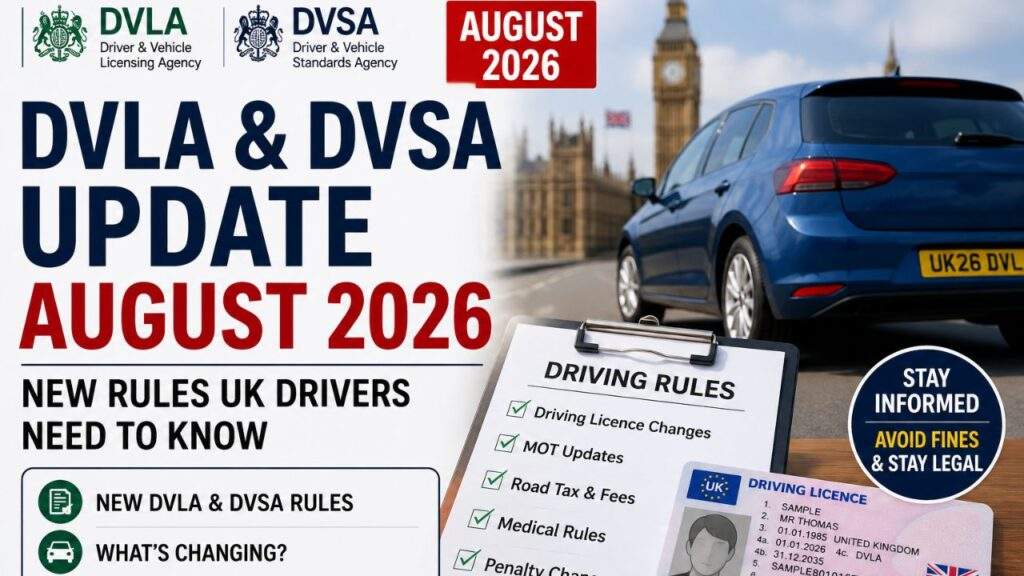
UK drivers are facing several important changes in 2026, and some of the biggest updates are already in force. The changes cover driving test bookings, MOT testing, vehicle records and how drivers deal with the DVLA and DVSA. August is particularly important for MOT customers because a new photo feature started its national rollout on 3 August 2026. At the same time, new driving test booking rules introduced earlier this year are now fully affecting learner drivers across England, Scotland and Wales. Here is what drivers need to know now and what the changes mean in everyday terms. New Driving Test Rules Are Already in Force One of the biggest DVSA changes in 2026 affects people taking a car driving test. The new rules were introduced in stages. Since 31 March 2026, learners can make only two changes to their car driving test booking. Since 12 May, only the learner can book, change, cancel or swap their own car driving test. Since 9 June, a learner can only move their test to one of the three nearest test centres. These rules apply to car driving tests in England, Scotland and Wales. They do not apply in the same way to motorcycle, lorry or bus tests. Driving test change New rule Date introduced Number of changes Maximum of 2 changes 31 March 2026 Who can book The learner must book their own test 12 May 2026 Who can change or cancel The learner must manage their own booking 12 May 2026 Test centre changes Only one of the 3 nearest centres 9 June 2026 Unofficial booking services Not allowed to scan DVSA booking system 12 May 2026 The official GOV.UK driving test booking rules explain the changes and how they apply to learners. Learners Can Only Change Their Test Twice Learners now need to think carefully before booking a practical car driving test. Under the new system, you can make only two changes to your booking. A change includes moving the date or time, changing the test centre, or swapping your appointment with another learner who already has a test booked. Changing more than one detail at the same time still counts as one change. For example, if you move your test to a different date and a different test centre in one transaction, that counts as one change rather than two. If you use both changes and then need another change, you normally have to cancel the existing test and book a new one. DVSA says a full refund is available when a test is cancelled at least 10 full working days before the test date. This makes it more important for learners to speak with their instructor before booking and choose a date when they are reasonably confident they will be ready. You Must Book and Manage Your Own Test Another major change is who is allowed to manage a car driving test. Under the new rules, the learner taking the test must book it themselves. Driving instructors can no longer book the test for their pupils. The learner must also manage changes, cancellations and appointment swaps. This change was introduced to reduce problems caused by unofficial booking services and systems that search for appointments automatically. DVSA has also warned against unofficial services that scan the driving test booking system for available appointments. The agency can take action when bookings or management of tests break its terms and conditions. For learners, the safest approach is simple: use the official government booking service and keep control of your own appointment. You Cannot Move Your Test to Any Centre You Want The rules around changing test centres have also become much stricter. Since 9 June 2026, learners can only move their car driving test to one of the three nearest test centres to the centre where their test is booked. This means a learner can no longer book a test at one location and repeatedly move it across the country to look for an earlier appointment. The rule is designed to make the booking system fairer and reduce the use of test appointments at centres where the learner does not actually intend to take their test. Learners should therefore choose a test centre they are genuinely prepared to use before making a booking. New MOT Photo System Starts Rolling Out in August There is also a new MOT-related development for vehicle owners. From 3 August 2026, DVSA started the national rollout of a system allowing MOT testers to take and upload a photograph of a vehicle at the time of its MOT. The first phase covers around 2,500 garages across Great Britain. The rollout is being introduced in stages rather than at every MOT garage at the same time. The purpose is to provide extra evidence that the vehicle was actually at the garage when the MOT took place. The photo system is intended to help reduce fraudulent MOT activity, support vehicle identity checks and increase confidence in MOT records. For motorists, this does not mean they need to download an app or take the photograph themselves. The MOT tester handles the process. Do All MOT Garages Have to Take Photos Yet? No. This is an important point for drivers. The August rollout is being introduced in phases. Some garages will receive access to the photo feature before others. DVSA says the feature is currently optional during this stage. If a garage cannot take or upload a photo, the MOT test can still be recorded using the appropriate reason in the MOT testing service. The new feature does not replace the normal MOT inspection. It is an additional part of the system designed to provide evidence that the vehicle was present at the test location. Drivers therefore should not be concerned if their garage does not yet use the photo system. What the MOT Photo Could Mean for Drivers The new photo system is mainly aimed at improving the reliability of MOT records. An MOT certificate is supposed to show
How to Start Electrical Transformer Manufacturing Business in India (Up to 20,000 kVA, 36 kV)

Electrical Transformer Manufacturing Business Simple as this is, India requires more power each and every year and this is where one of the most stable manufacturing business ideas of today is booming in the industrial sector; the manufacturing of electrical transformers. Transformers rated up to 20,000 kVA at 36 kV are needed by all distribution utilities, industrial plants, and renewable energy developers, and demand continues to grow, even in the wake of other sectors experiencing a slowdown. This is a unique combination of consistent orders, policy support, and long product life cycles for entrepreneurs looking into business ideas that have the active support of the government. This article provides insight into why time is crucial, the schemes that truly benefit new manufacturer, and the specific business ideas that fit a first-time promoter. Why This Sector Is Growing Fast The demand for power in India continues to grow. Peak electricity demand is already at 240 GW and will soon exceed 400 GW within this decade. This means that state utilities and private developers must purchase thousands of new transformers annually, simply to provide new connections, as well as to replace old transformers that are no longer efficient. This demand is being propelled in greater and greater numbers by three forces. First, the government’s distribution reform programme is upgrading old feeders and substations in various states, thereby generating new orders for transformers on an ongoing basis. Second, the number of inverter-duty and solar step-up transformer demand is huge for renewable energy projects, and this market was barely present 10 years ago. Third, the blooming growth in pharma, data centre, steel and cement industries is creating direct demand for dedicated power and distribution transformer. In the meantime, the fact of dependence on imports is an issue to consider. In the past, Chinese manufacturers have been known to secure a number of big tenders from utilities at cheaper rates, which has prompted the authorities to actively promote domestic capacity development. This means that new players that are interested in quality, test facilities, and on time delivery are able to secure contracts more easily than many other capital goods businesses. What’s rare about manufacturing business ideas is that the demand for transformer manufacturing is predictable and backed by the government instead of consumer sentiment. The demographic aspect can be a point of interest also. A number of well-known transformer producers were founded in a single generation and a few are now facing succession or capacity issues. This leaves space for new, efficient operators to be able to secure tender bids for units that can’t service them on time. That is, it’s not a market in need of consolidation, it’s an expanding pie that can be carved up by new entrants who deliver and are properly certified. Get Detailed Project Report (DPR): Electrical Transformer & Power Equipment Guide Government Policies Supporting New Businesses A capital-intensive manufacturing plan can make or break on the basis of good or bad policy support. Fortunately, transformer manufacturing is a field that falls into the crosshairs of multiple government programmes, and most first-generation business owners can connect two or three of them together at least. PLI Scheme for Electrical Equipment The Production Linked Incentive scheme for white goods and capital goods manufacturing directly helps the manufacturers of the components of transformers. The primary aim of the PLI scheme is the big manufacturer, but MSMEs can still benefit by being approved component or material suppliers to PLI linked companies. This is an indirect route suitable for a new winding or assembly unit, especially for a new one supplying to another larger original equipment manufacturer (OEM) under an approved PLI project. PMEGP for First-Generation Entrepreneurs New manufacturing units have been provided with margin money subsidy under the Prime Minister’s Employment Generation Programme (PMEGP) of Khadi and Village Industries Commission, Ministry of MSME. The 15 to 25 percent subsidy for General category applicants and 25 to 35 percent for women and special category applicants (SC, ST, OBC, etc.) will depend on the location of the unit. The costs for the manufacture of the units are up to fifty lakh rupees, at present, under this scheme, therefore it is a genuine option for a small distribution transformer plant. It is always advisable for the entrepreneurs to check the updated subsidy slabs on the official site before applying. Credit Guarantee Cover Without Collateral The Credit Guarantee Fund Trust for Micro and Small Enterprises wave offs the one most important obstacle in the way of most new entrepreneurs – collateral. In this scheme, these are loans of working capital or term loans that are disbursed without any property being pledged and this is of much importance in a business where the capital equipment is a significant portion of the total investment, especially in the case of machinery. State-Level Incentives In addition to central schemes, states like Gujarat, Maharashtra, Uttar Pradesh and Rajasthan have their own industrial policies for electrical equipment manufacturers. Usually, this involves capital subsidies, power tariff concessions and stamp duty exemption for land acquisition of new manufacturing units. In a few instances, state incentives, in addition to central schemes, can reduce the effective project cost by as much as fifteen to thirty percent for a qualified project. Make in India and Import Substitution Transformers have been identified as a component of high value addition required in India under the Make in India initiative by the Department for Promotion of Industry and Internal Trade. In the same way, the Revamped Distribution Sector Scheme is also compelling the state discoms to upgrade the infrastructure and this will directly mean new transformer procurement during the coming couple of years. Multiple Business Ideas for Startups Transformer making is not a monolithic industry. Rather, it is broken up into a number of distinct product lines and service niches, each with a different level of investment and buying profile. Here are some business ideas that you can consider before you finalize your project report. Small Distribution Transformer Unit (up to
NEW Mercedes AMG GT 63 Coupe (2026) – Interior and Exterior Walkaround

The new Mercedes AMG GT 63 Coupe for 2026 brings a sharper, more confident presence that blends luxury with unmistakable performance intent. A full interior and exterior walkaround reveals how this latest evolution refines design, technology, and driver focus without losing its aggressive AMG identity. A More Purposeful Exterior Design At first glance, the 2026 AMG GT 63 Coupe looks wider, lower, and more planted on the road. The design leans heavily into modern performance cues while keeping the coupe silhouette clean and fluid. Every surface appears sculpted with airflow and stance in mind, giving the car a strong visual balance between elegance and power. Key exterior highlights include: These elements work together to create a coupe that looks equally suited for city streets and high-speed highways. Interior Walkaround: Luxury Meets Performance Focus Step inside the AMG GT 63 Coupe and the cabin immediately feels more driver-centric than before. The interior walkaround showcases a cockpit designed to wrap around the driver while still offering premium comfort for daily use. Materials, layout, and digital elements feel carefully layered rather than overwhelming. The seating position is low and sporty, with thick bolsters that hint at performance while remaining comfortable for longer drives. Soft-touch surfaces, brushed metal accents, and detailed stitching give the cabin a refined yet purposeful atmosphere that aligns with the AMG badge. Technology and Driver Interface Evolution The 2026 update places strong emphasis on digital clarity and usability. Screens are seamlessly integrated into the dashboard, creating a modern yet cohesive look. Controls remain intuitive, ensuring that performance-focused driving does not come at the cost of distraction. Notable interior technology features include: This combination keeps the driver informed, engaged, and in control at all times. Cabin Comfort and Practical Touches While the AMG GT 63 Coupe is clearly performance-driven, the walkaround highlights its everyday usability. The cabin offers improved storage solutions and thoughtful details that make it easier to live with than previous generations. Visibility feels better balanced, and the overall layout feels less intimidating for new drivers stepping into the AMG lineup. Rear seating remains best suited for short trips or extra storage, but the space is more usable than expected for a coupe of this class. The trunk area also appears well-shaped, reinforcing the car’s role as a true grand tourer. Design Philosophy Behind the 2026 Update Mercedes-AMG’s approach with the 2026 GT 63 Coupe is about refinement rather than reinvention. The exterior evolves with sharper lines and stronger proportions, while the interior focuses on digital sophistication and tactile quality. The walkaround makes it clear that this model aims to appeal to both driving enthusiasts and luxury buyers. Backed by the design language of Mercedes-Benz’s performance division, the AMG GT 63 Coupe positions itself as a bridge between everyday usability and high-end sports car drama. Final Thoughts on the Walkaround Experience The 2026 Mercedes AMG GT 63 Coupe makes a strong impression during a full interior and exterior walkaround. It feels more polished, more confident, and more focused than before, without sacrificing comfort or visual appeal. For buyers seeking a luxury performance coupe that looks as serious as it drives, this latest AMG offering sets a high standard. FAQs What stands out most in the 2026 AMG GT 63 Coupe exterior? The wider stance, redesigned front grille, and sculpted rear give the car a more aggressive and planted look. Is the interior more driver-focused than before? Yes, the cockpit layout, steering wheel controls, and digital displays are clearly designed around the driver. Does the AMG GT 63 Coupe still offer luxury comfort? Despite its performance focus, the cabin features premium materials, comfortable seating, and refined design elements. How practical is the AMG GT 63 Coupe for daily use? It offers improved usability with better storage, a usable rear area, and a well-shaped trunk for a performance coupe Who is the 2026 AMG GT 63 Coupe best suited for? It is ideal for drivers who want high-performance capability paired with luxury design and everyday comfort. .
2026 MANSORY Ferrari Purosangue – The Future of Ultra-Luxury Performance SUVs

The 2026 MANSORY Ferrari Purosangue arrives as a bold statement in the world of high-end performance SUVs, blending Italian engineering with extreme luxury customization. Designed for buyers who want exclusivity without compromise, this model pushes the Purosangue concept into an entirely new realm. A New Chapter for Ferrari’s SUV Vision When Ferrari entered the SUV space, expectations were already sky-high, but the transformation by Mansory takes things even further. The Purosangue retains its unmistakable Ferrari DNA while gaining a more aggressive and personalized character that clearly separates it from the standard factory version. This is not just an upgrade; it is a full reinterpretation aimed at collectors and enthusiasts who demand rarity and presence. Exterior Design That Commands Attention Mansory’s approach to the 2026 model focuses on visual dominance and refined aggression. Carbon fiber elements are used extensively to reshape the SUV’s stance while maintaining aerodynamic balance and luxury appeal. Interior Crafted for Individual Expression Step inside and the transformation becomes even more dramatic. The cabin moves beyond traditional luxury, offering a handcrafted environment where materials, colors, and textures are selected to reflect the owner’s personality. Premium leather, Alcantara, and carbon accents are combined with meticulous stitching and unique trim layouts, creating an interior that feels both sporty and indulgent without losing everyday comfort. Performance Meets Prestige While the Ferrari Purosangue is already known for its thrilling performance, the Mansory treatment elevates the experience through refined tuning and enhanced driving dynamics. The focus is not only on speed but also on delivering a smoother, more confident drive across different conditions. This balance makes the SUV equally suited for spirited drives and long-distance luxury travel. Exclusivity in Every Detail What truly defines the 2026 MANSORY Ferrari Purosangue is its exclusivity. Each vehicle is built in limited numbers, ensuring that no two examples are exactly alike. From exterior finishes to interior layouts, every detail is tailored, making ownership as much about personal expression as it is about performance. Final Report The 2026 MANSORY Ferrari Purosangue represents the future of ultra-luxury performance SUVs by merging Ferrari’s engineering excellence with Mansory’s bold customization philosophy. It stands as a symbol of status, craftsmanship, and power, designed for those who want more than just a luxury SUV and are willing to own something truly extraordinary. FAQs What makes the 2026 MANSORY Ferrari Purosangue different from the standard model? The Mansory version features extensive exterior redesigns, custom interiors, and enhanced performance tuning that set it apart visually and dynamically. Is the interior fully customizable? Yes, buyers can personalize materials, colors, stitching, and finishes to create a one-of-a-kind cabin. Does the Mansory upgrade affect everyday usability? The SUV remains practical and comfortable, balancing high performance with daily driving comfort. Is the 2026 MANSORY Ferrari Purosangue produced in limited numbers? Yes, production is intentionally limited to maintain exclusivity and individuality. Who is the ideal buyer for this SUV? It is designed for luxury car enthusiasts and collectors who want extreme performance, personalization, and rarity in a single vehicle.