
Just Released: Handbook on Electric Vehicles Manufacturing
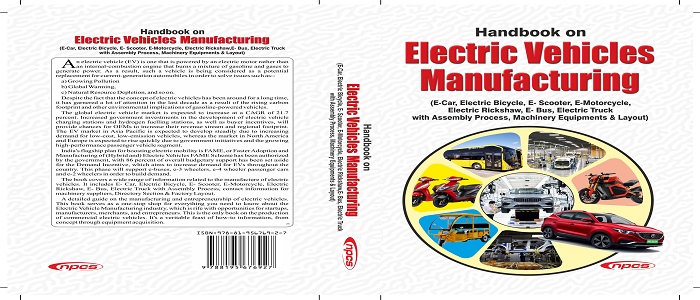
As the world shifts toward cleaner, more sustainable transportation, electric vehicles (EVs) are no longer a futuristic concept—they are a present-day revolution. India, driven by government initiatives like FAME (Faster Adoption and Manufacturing of Hybrid and Electric Vehicles) and increased environmental awareness, is experiencing a surge in electric vehicle adoption. For entrepreneurs, manufacturers, and investors, this evolving sector offers an enormous opportunity. Whether you aim to manufacture electric two-wheelers, cars, buses, or EV components, this handbook on electric vehicle manufacturing will guide you through the key steps, infrastructure needs, and strategic decisions involved in building an EV business. Visit this Page for More Information: Start a Business in Electric Vehicle Industry Understanding the EV Manufacturing Ecosystem The electric vehicle manufacturing industry isn’t just about assembling cars—it’s an ecosystem comprising battery technology, power electronics, motor production, software integration, and charging infrastructure. Each component offers a business opportunity. From building a full-fledged EV assembly line to supplying batteries, motors, or software systems, this sector allows entry at multiple levels based on budget and expertise. Read Similar Articles: E- Vehicle Projects 1. Types of Electric Vehicles to Manufacture Depending on market demand and your investment capacity, you can choose to manufacture one of the following types: Electric Two-Wheelers (E-Scooters, E-Bikes): High in demand due to affordability and lower regulatory hurdles. Electric Cars: A capital-intensive segment requiring advanced R&D and safety compliance. Electric Commercial Vehicles (Buses, Trucks): Often government-backed with larger profit margins. Three-Wheelers (E-Rickshaws, Cargo Loaders): Popular in urban and semi-urban logistics. Each segment has its own target customer base, technology requirements, and compliance norms. Read our Books Here: Electric Vehicles Manufacturing 2. Core Components of EV Manufacturing To manufacture an electric vehicle, you need to integrate multiple sub-systems, each of which plays a critical role: a. Battery Pack The battery is the heart of any EV. Lithium-ion batteries dominate the market due to high energy density. Key factors include: Cell Sourcing (local or imported) Battery Management System (BMS) design Thermal management for safety Swappable battery architecture (for 2-3 wheelers) b. Electric Motor Motors convert electrical energy into mechanical motion. Common types include: Brushless DC (BLDC) motors – used in scooters and bikes Induction motors – used in larger vehicles Permanent Magnet Synchronous Motors (PMSM) – efficient but expensive Related Feasibility Study Reports: E- Vehicle, E-Rickshaw c. Controller & Inverter These components regulate the power supply from battery to motor and influence vehicle speed, efficiency, and safety. d. Chassis & Body Design You can design your own chassis or use existing templates. Materials range from aluminum alloys to reinforced plastics. e. Software Systems Includes dashboard displays, mobile app integration, vehicle diagnostics, and battery monitoring. Download PDF: Handbook on Electric Vehicles Manufacturing 3. Manufacturing Setup and Investment Setting up an EV manufacturing plant involves: Location selection (industrial area with logistics support) Land and building cost Machinery: welding units, painting booths, assembly lines, testing equipment Tooling and fixtures R&D and testing labs Labor and automation Estimated investment: ?1–2 crore for small-scale e-bike or e-rickshaw manufacturing ?10–50 crore for mid-sized car or commercial vehicle manufacturing Government subsidies and state-level EV policies can reduce initial capital requirements A detailed guide on Handbook on Electric Vehicles Manufacturing 4. Licensing, Certification & Compliance Manufacturing EVs in India requires adhering to several standards: Central Motor Vehicle Rules (CMVR) ARAI or ICAT certification (for safety, emission, and performance) Pollution Control Board clearance FAME-II Subsidy Compliance (for accessing incentives) BIS certification for battery and electronic components Additionally, you’ll need: GST registration Udyam MSME registration Factory and labor law compliance 5. Sourcing and Supply Chain Management The EV manufacturing ecosystem depends heavily on both domestic and imported components. Key supply chains include: Battery cells and electronics – mostly imported from China, Korea, or Japan Motors and controllers – can be sourced from Indian OEMs or built in-house Plastic and fiber body panels Wiring harnesses, tires, and lighting systems To reduce dependency and costs, many companies are now investing in localizing component manufacturing under the “Make in India” initiative. 6. Testing, Quality Control & R&D EVs must undergo rigorous testing for: Battery performance Vehicle safety Crash testing Range, charging time, thermal management Setting up an in-house R&D facility or collaborating with certified labs like NATRiP, ARAI, or ICAT can enhance product quality and credibility. 7. Branding, Distribution & After-Sales Service Once your EV is ready for market, strong branding and distribution networks are critical. You can: Sell via dealerships or franchise models Set up exclusive experience centers Leverage e-commerce for two-wheelers Partner with fleet operators or delivery companies After-sales service is a key differentiator. Offering warranty, battery replacement, and remote diagnostics can increase customer trust. 8. Government Incentives and Financial Support India offers several incentives to promote Handbook on Electric Vehicles: FAME-II subsidies for manufacturers and buyers State EV policies offering tax exemptions, capital subsidies, and land allotments PLI Scheme for ACC batteries and auto components Interest subsidies and soft loans via SIDBI, NABARD, and EV-focused NBFCs Staying updated with policy changes can help in cost planning and expansion. Final Thoughts Electric vehicle manufacturing is not just a business—it’s a transformation. With increasing demand, supportive government schemes, and global environmental urgency, this is the perfect time to step into the EV sector. Whether you’re an established manufacturer looking to pivot or a startup founder passionate about clean mobility, EVs offer a sustainable, profitable path forward. This handbook on electric vehicles manufacturing is just the beginning. Success lies in strategic planning, quality control, and a deep understanding of both technology and market needs. With the right vision and execution, you can become a key player in India’s electric revolution. See More Links: Start a Business in Asia Start a Business in Potential Countries for Doing Business Best Industry for Doing Business Business Ideas with Low, Medium & High Investment Looking for Most Demandable Business Ideas for Startups Startup Consulting Services Start a Business in Africa Start a Business in India Start a Business in Middle East Related Videos Related Books Related Projects Related Market
Handbook on Electric Vehicles Manufacturing
The global shift toward sustainable energy and reduced carbon emissions has accelerated the adoption of electric vehicles (EVs). What was once considered an experimental concept has now become a rapidly growing industry, with EVs dominating future mobility discussions. From startups to established automobile manufacturers, businesses around the world are investing in electric vehicle manufacturing. India, too, is experiencing a surge in EV interest, driven by favorable government policies, rising fuel prices, and increased environmental awareness. If you are an entrepreneur, engineer, or investor eyeing the EV space, this handbook on electric vehicles manufacturing will guide you through the fundamentals of EV production—from components and processes to setup, cost, and compliance. Visit this Page for More Information: Start a Business in Electric Vehicle Industry Understanding Electric Vehicle Manufacturing The process of manufacturing an electric vehicle is significantly different from that of traditional internal combustion engine (ICE) vehicles. EVs require a deep integration of mechanical engineering, electrical systems, software, and clean energy components. The major parts of an electric vehicle include a battery, motor, power control systems, chassis, and an interface system. The EV ecosystem includes: Electric two-wheelers (scooters, bikes) Three-wheelers (rickshaws, loaders) Four-wheelers (cars and vans) Heavy commercial vehicles (buses, trucks) Each segment offers opportunities based on investment, target market, and technology capabilities. Read Similar Articles: E- Vehicle Projects 1. Core Components of an Electric Vehicle Manufacturing EVs involves assembling and integrating multiple critical systems. Here’s a breakdown: a. Battery Pack Usually made of lithium-ion cells Determines the range and performance of the vehicle Includes a Battery Management System (BMS) for monitoring, temperature control, and safety b. Electric Motor Converts electric energy into mechanical power Common types: BLDC (Brushless DC Motor), PMSM (Permanent Magnet Synchronous Motor), and Induction Motor Motor selection depends on vehicle size and usage c. Controller and Inverter Controls power flow between the battery and the motor Affects vehicle speed, torque, and energy efficiency d. Vehicle Chassis and Body Can be modified from traditional automotive platforms or newly designed for lightweight and better battery housing e. Software and IoT Integration Enables diagnostics, battery monitoring, smart dashboards, GPS, and mobile app integration Plays a crucial role in customer experience and maintenance Read our Books Here: Electric Vehicles Manufacturing 2. EV Manufacturing Process Flow EV manufacturing is a blend of mechanical assembly and electronic integration. The typical steps include: Design and Prototyping CAD design and digital simulations Performance, battery capacity, and safety tests Component Sourcing Motors, batteries, controllers, chargers, wiring, and software systems Components can be locally sourced or imported Body Fabrication Sheet metal or fiber molds for the vehicle body Integration of lightweight materials for efficiency Assembly Line Setup Frame welding, motor fitting, battery placement Wiring and control unit installation Quality Testing Road tests for stability, range, charging time Electrical safety and emissions compliance Branding and Finishing Logo placement, body paint, accessory fittings Packaging and Distribution Ready vehicles are distributed through dealerships or direct-to-consumer platforms Related Feasibility Study Reports: E- Vehicle 3. Plant Setup and Infrastructure Establishing an EV manufacturing plant requires the following: Land and Factory Building Area needed: 10,000–50,000 sq. ft. (depending on output) Should have space for R&D lab, assembly area, testing zone, and inventory storage Machinery and Tools Welding machines, hydraulic lifts, painting booths Assembly stations, testing benches, power backup systems Manpower Requirements Electrical engineers, mechanics, software developers, quality controllers, assembly workers Utilities High-load electrical connection, water treatment, dust-free environment Download PDF: Handbook on Electric Vehicles Manufacturing 4. Licenses and Regulatory Compliance Before launching your EV manufacturing business, acquire the following licenses: Company Registration (Private Ltd., LLP, or MSME) GST Number Factory License Pollution Control Certificate FAME-II Eligibility Certification (if availing subsidies) Approval from ARAI or ICAT for vehicle compliance and roadworthiness BIS Certification for battery safety standards 5. Government Policies and Subsidies India is aggressively promoting EV adoption. You can benefit from: FAME-II (Faster Adoption and Manufacturing of Hybrid & Electric Vehicles) Offers subsidies for both manufacturers and buyers State-level EV Policies (Delhi, Maharashtra, Tamil Nadu, Gujarat offer capital subsidies, tax rebates, and power discounts) Production-Linked Incentive (PLI) Scheme For battery and auto component manufacturing Startup India Incentives for innovative EV technologies Watch other Informative Videos: Automobile Industry 6. Target Market and Business Models You can enter the EV market through several approaches: OEM Manufacturing Design and produce complete vehicles under your brand White Labeling Manufacture EVs that other companies sell under their brand Component Manufacturing Specialize in batteries, chargers, BMS, or motors EV Conversion Kits Offer kits to convert petrol/diesel vehicles into electric Franchise or Dealership Models Sell ready-made EVs via distributor channels 7. Cost Estimation and ROI Cost of setting up an EV manufacturing unit: Small-Scale Unit (2-wheelers, 10–20/day): ?1.5 to ?3 crore Mid-Scale (3-wheelers or 100 units/month): ?5 to ?10 crore Large-Scale (cars, buses, or exports): ?25 crore and above ROI Timeline: 2 to 4 years depending on production capacity, sales model, and market demand. Margins can range between 15%–35%, with higher profits in niche or B2B segments (e.g., delivery vehicles, fleet services). 8. Marketing and Distribution Strategy To sell electric vehicles successfully, consider: Building a strong brand identity Creating product demo videos and test ride events Listing on EV directories and B2B platforms Partnering with last-mile delivery companies and ride-share platforms Setting up service stations and charging points for brand loyalty Digital platforms (website, YouTube, LinkedIn, and Facebook Ads) are powerful tools for reaching early adopters and sustainability-conscious consumers. 9. Challenges in EV Manufacturing Despite the opportunities, several challenges persist: Battery sourcing and cost volatility Lack of charging infrastructure Skilled manpower shortage Compliance complexities and testing delays Limited access to high-end EV software tech Overcoming these requires innovation, strategic partnerships, and continuous improvement. Final Thoughts The electric vehicle manufacturing business is a golden opportunity for forward-thinking entrepreneurs and investors. As India aims to make 30% of vehicles electric by 2030, the demand for high-quality, affordable EVs is exploding. This handbook on electric vehicles manufacturing outlines the fundamentals of entering and growing in this industry. By focusing on quality production,
E-Rickshaw Manufacturing Business
The E-Rickshaw manufacturing business has emerged as a lucrative and sustainable venture in India’s evolving transportation landscape. As the government and consumers alike push for eco-friendly mobility solutions, electric rickshaws have become a preferred mode of transport in urban and semi-urban areas. Affordable, efficient, and emission-free, e-rickshaws are transforming last-mile connectivity while creating thousands of micro-entrepreneurial opportunities. Surge in Demand for Electric Mobility Solutions India’s rising focus on electric vehicles (EVs), coupled with fuel price volatility and pollution control efforts, has significantly increased the demand for E-Rickshaws. These battery-powered three-wheelers provide an economical and clean alternative to traditional auto-rickshaws, especially for short-distance transport. Major state governments have also initiated subsidy programs and eased policies to promote the manufacturing and adoption of e-rickshaws. What is an E-Rickshaw? An e-rickshaw is a battery-operated three-wheeler designed for passenger or goods transport. It typically runs on a 48V or 60V lead-acid or lithium-ion battery and offers a range of 80 to 120 kilometers per charge. Lightweight, silent, and cost-effective, e-rickshaws require minimal maintenance and are easy to operate, making them ideal for small-scale drivers and fleet owners. Types of E-Rickshaws in the Market The e-rickshaw industry caters to diverse consumer needs. Major types include: Passenger E-Rickshaws – 4+1 seating, mostly used for city rides Loader E-Rickshaws – For transporting goods, with a payload of 300–500 kg Customized Rickshaws – Designed for vending, cargo, delivery services, or school transport Solar-powered E-Rickshaws – Integrated with rooftop solar panels for auxiliary charging Manufacturers can choose to specialize or offer a range of variants under a single brand. Raw Materials and Components Required To set up an e-rickshaw manufacturing unit, the following components are needed: Mild Steel Chassis and Frame Electric Motor (850W to 1500W) Controller Unit and Throttle System Lead-Acid or Lithium-Ion Battery Pack Tyres and Alloy Wheels Suspension and Shock Absorbers Axles, Brakes, and Wiring Harness Roof, Windshield, Seats, and Cabin Accessories Digital Meters, Lights, and Indicators Most of these components are available from domestic suppliers, although some high-performance batteries and controllers are imported. Manufacturing Process of E-Rickshaws The e-rickshaw manufacturing process involves multiple assembly stages: Chassis FabricationMild steel pipes and sheets are cut, welded, and shaped to form the base frame. Motor and Suspension InstallationThe electric motor, axles, brakes, and suspensions are mounted on the chassis. Battery and Electrical AssemblyBattery packs, wiring harness, lights, and digital systems are installed. Bodywork and PaintingRoof, windshield, seating, and doors are added, followed by paint and finishing. Quality Check and Test DriveEach unit undergoes performance testing, load testing, and braking analysis. Branding and PackagingFinal assembly includes company branding, registration documentation, and logistics planning. Manufacturing can be done in semi-automated units or manual assembly workshops depending on investment levels. Plant Setup and Machinery Required A basic e-rickshaw plant setup includes: Welding and Fabrication Tools Hydraulic Press and Pipe Bending Machines Spray Paint Booth or Powder Coating Station Battery Charging and Testing Station Motor and Controller Testing Bench Assembly Line with Trolleys and Jigs Inspection Tools and Quality Testing Instruments A plant area of 5,000 to 10,000 sq. ft. is sufficient for a unit manufacturing 200–500 rickshaws per month. The investment ranges from ?25 lakhs to ?2 crores depending on automation and scale. Licensing and Compliance Requirements To legally operate an e-rickshaw manufacturing business, the following registrations and certifications are essential: Company Registration and GST Number MSME/Udyam Registration BIS Certification for Product Quality Central Motor Vehicles Rule (CMVR) Compliance Type Approval from ARAI/ICAT Pollution Control NOC (for paint booth) Insurance and Road Worthiness Certificates Each model must pass approval tests for road safety, braking, lighting, and structural integrity. Marketing and Distribution Strategy E-rickshaws are sold through: Dedicated Dealership Networks in cities and towns Tie-ups with Microfinance Institutions for driver financing B2B Sales to Aggregators and Fleet Operators Direct Sales to Retail Buyers via Exhibitions and Online Platforms Government Tenders for Public Transport Initiatives Marketing strategies include social media campaigns, showroom demonstrations, EMI offers, and on-road test drives. Profitability and ROI The e-rickshaw manufacturing business offers excellent profit margins: Production Cost per Unit: ?80,000 – ?1,25,000 Selling Price per Unit: ?1,40,000 – ?2,00,000 Gross Margin: ?30,000 – ?70,000 per vehicle Break-even Period: 1.5 – 2 years for small units Value-added services like after-sales support, spare parts, and extended warranties boost customer retention and revenue. Sustainability and Future Outlook E-rickshaws contribute significantly to sustainable mobility by: Reducing CO? emissions in congested cities Lowering dependence on imported fuel Offering cost-effective transport for low-income commuters Creating green jobs and empowering rural entrepreneurship The future outlook remains strong with government incentives under FAME II, state EV policies, and rising battery innovations. Conclusion The E-Rickshaw manufacturing business is a future-ready opportunity aligned with India’s EV revolution. With rising demand, policy support, and market acceptability, it promises strong profits and long-term sustainability. Entrepreneurs who combine quality engineering with smart branding and robust distribution will find great success in this high-potential sector. Niir Project Consultancy Services An ISO 9001:2015 Company 106-E, Kamla Nagar, Opp. Spark Mall, New Delhi-110007, India. Email: npcs.ei@gmail.com , info@entrepreneurindia.co Tel: +91-11-23843955, 23845654, 23845886, 8800733955 Mobile: +91-9811043595 Website: www.entrepreneurindia.co , www.niir.org Contact Us