
How to Start Banana Powder Manufacturing Business Unit
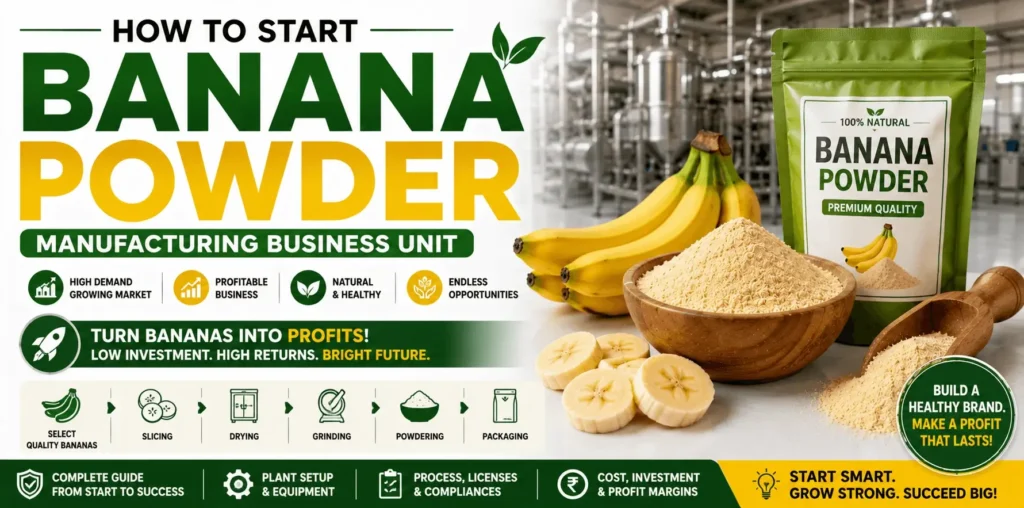
Banana powder is a versatile product with growing demand in the food processing, baby food, bakery, and pharmaceutical industries. Derived from processed bananas, it serves as an excellent natural flavoring and nutritional enhancer. Entrepreneurs looking to enter the agro-processing industry will find banana powder manufacturing business a lucrative opportunity, especially in banana-producing regions. This article offers a complete guide on how to set up a banana powder manufacturing business unit, covering everything from raw material procurement to market strategy. Understanding the Banana Powder Manufacturing Business India is one of the largest producers of bananas globally, making it a natural hub for banana powder manufacturing business. The industry benefits from abundant raw material availability, government support for agro-based industries, and a steadily increasing demand in both domestic and export markets. The manufacturing process involves cleaning, slicing, drying, milling, and packaging bananas in powdered form, which retains much of the fruit’s nutritional value and taste. Market Potential and Applications Banana powder is widely used in baby food, bakery products, ice creams, milkshakes, health supplements, and as a natural sweetener. Its long shelf life, easy transportability, and high nutritional content make it ideal for both B2B and B2C segments. With increasing awareness around health foods and the shift toward natural additives in food products, the global demand for banana powder is expected to rise. The product also sees export demand from countries in the Middle East, Europe, and Africa. The key market drivers include convenience, affordability, and the growing popularity of organic and plant-based food products. Key Steps to Set Up a Banana Powder Manufacturing Business Unit 1. Market Research and Business Plan Begin with in-depth market research. Analyze demand trends, competitor analysis, pricing strategy, and customer expectations. A well-researched business plan should include production capacity, investment outlay, machinery and technology needs, financial projections, and a marketing roadmap. 2. Location and Infrastructure The ideal location for a banana powder manufacturing unit is near banana-growing regions to minimize transportation costs and ensure the freshness of raw materials. The infrastructure should include: Space for processing unit and storage Water supply and power backup Waste disposal system Good connectivity to markets You’ll need about 1,500–2,000 sq. ft. of space for a small-scale setup. 3. Legal and Regulatory Requirements Register the business as an MSME or under any other suitable business entity. Obtain the following: GST registration FSSAI license (Food Safety and Standards Authority of India) Pollution Control Board clearance Factory license from the state government Trademark for branding (optional but recommended) Compliance with food safety regulations is critical for building trust and expanding your reach. 4. Procurement of Raw Materials Procure fully ripe and blemish-free bananas directly from farmers or wholesalers. It’s best to develop long-term relationships with reliable suppliers to ensure year-round availability. Organic bananas are in high demand, so sourcing certified organic produce can help cater to premium markets. Additional raw materials include: Food-grade packaging materials Preservatives (optional and based on regulatory standards) Cleaning and sterilizing agents 5. Machinery and Equipment For a small to medium-scale banana powder manufacturing business unit, you will need the following equipment: Banana peeler Slicer or cutter Blanching tank (optional) Dryer or dehydrator (solar or electric) Pulverizer or grinder Sieving machine Packaging machine Weighing scale Machinery should meet food-grade standards. Automation can significantly increase efficiency and output. 6. Manufacturing Process The production process typically follows these steps: Sorting and Cleaning – Select and clean the bananas thoroughly to remove dust, dirt, and surface contaminants. Peeling and Slicing – Peel and cut the bananas into uniform slices to ensure even drying. Drying – Dry the slices using solar, hot air, or freeze drying methods. This step is crucial for shelf life and product quality. Grinding – Dried slices are ground into fine powder using a pulverizer. Sieving – The powder is sieved to remove coarse particles and ensure uniformity. Packaging – The final product is packaged in moisture-proof and food-grade containers. Strict quality control at every stage ensures the consistency, flavor, and safety of the product. 7. Manpower Requirement For a small unit, 6–10 employees are sufficient. This includes machine operators, quality controllers, packaging staff, and administrative personnel. Trained workers improve efficiency and reduce waste. 8. Investment and Profitability Setting up a small-scale banana powder manufacturing business unit may require an investment of ?10–20 lakhs depending on scale and automation level. The cost breakdown includes: Machinery: ?5–10 lakhs Infrastructure: ?3–5 lakhs Raw materials and working capital: ?2–5 lakhs Profit margins range between 20%–35%. With consistent quality and strong market demand, breakeven is possible within 1–2 years. 9. Branding and Packaging Effective branding plays a major role in attracting customers, especially for retail sales. Focus on: Eye-catching logo and packaging design Nutritional information and usage instructions Eco-friendly packaging materials Retail packs of 100g, 250g, 500g, and 1kg are popular. Bulk packaging (25kg, 50kg) is used for industrial customers. Marketing Strategy and Distribution A robust marketing strategy helps you penetrate the market and build a loyal customer base. Target the following: B2B Segment Food processing companies Bakeries Ice cream manufacturers Baby food brands Exporters and traders B2C Segment Health food stores Supermarkets and online retailers Organic and natural product outlets Direct-to-consumer (via website or marketplaces) Use digital marketing, SEO, social media, and product sampling to build awareness. Participation in food expos and industry events boosts visibility and networking. Government Support and Schemes The Indian government offers several schemes for agro-based and food processing industries, including: PMFME (Pradhan Mantri Formalization of Micro Food Processing Enterprises) NABARD subsidies and low-interest loans Stand-Up India Scheme for SC/ST and women entrepreneurs NSIC and MSME support for machinery procurement Leverage these schemes for funding, training, and infrastructure development. Challenges and Solutions Banana powder manufacturing business comes with its own set of challenges, including: Raw material perishability – Tie-ups with local farmers and cold chain logistics can minimize waste. Price fluctuations – Long-term procurement contracts and buffer stock help maintain cost stability. Quality control – Invest in testing equipment and follow standard operating procedures to maintain consistency.