
Ink Manufacturing Process for Printing & Industrial Applications | How Ink is made for Writing, Printing, Offset & Inkjet.
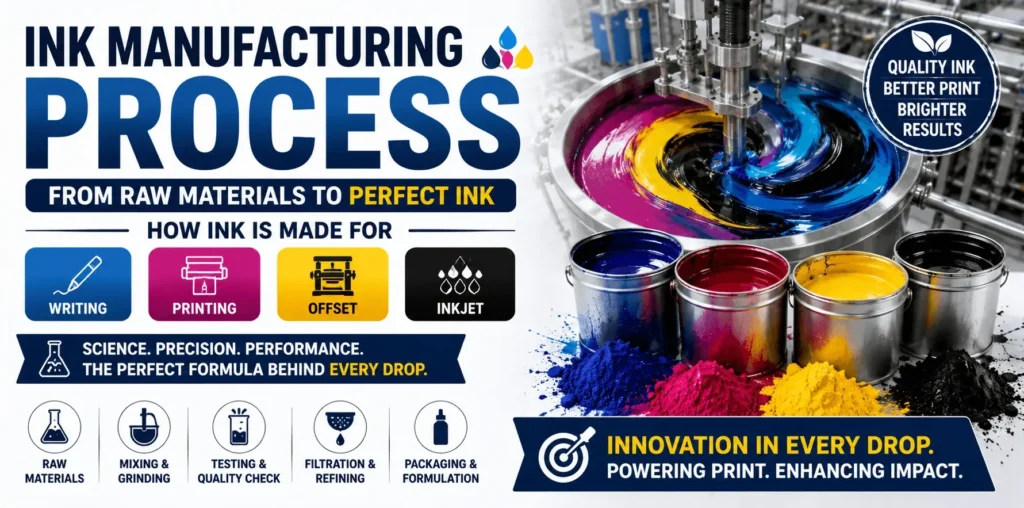
The ink manufacturing process is a sophisticated industrial procedure involving pigments, binders, solvents, additives, and advanced processing technologies to produce inks used in writing, printing, packaging, publishing, and industrial applications. Ink is an essential component of communication and artistic expression. Ink has a significant role in human history from Traditional pen inks to modern offset and inkjet printing systems, inks play a vital role in communication, branding, and commercial printing industries. Modern printing ink manufacturing combines chemistry, material science, and precision engineering to create products with high color consistency, durability, drying performance, and print quality. Different ink formulations are developed for offset printing, gravure printing, flexographic printing, screen printing, and digital inkjet applications. Offset Ink Manufacturing Process Offset printing inks are oil-based formulations designed for commercial high-speed printing applications. The process involves pigment dispersion, varnish preparation, milling, viscosity adjustment, filtration, and quality testing for smooth printing performance. Printing Ink Manufacturing Process Printing ink manufacturing involves mixing pigments, solvents, binders, and additives followed by dispersion, milling, filtration, and packaging to create industrial-grade printing inks. Inkjet Ink Manufacturing Process Inkjet ink manufacturing requires ultra-fine particle control and filtration to ensure smooth flow through printer nozzles without clogging. Water-Based Ink Manufacturing Process Water-based inks use water as the primary solvent and are widely used in eco-friendly packaging and flexographic printing applications. Gravure Ink Manufacturing Process Gravure inks are low-viscosity solvent-based inks used in packaging, magazines, decorative laminates, and publication printing industries. The Science Behind How Ink Is Made The process of how ink is made combines a rich blend of art, chemistry, and technology. Ink is not just a simple fluid with color; it is a carefully engineered product designed to meet specific demands based on its application—whether for writing, printing, or painting. The quality and composition of ink vary depending on the medium it is used with, such as pens, offset printers, or inkjet printers. Key Raw Materials Used in Ink Production The primary materials required to manufacture ink fall into four main categories: colorants, binders, solvents, and additives. Each of these components, moreover, plays a crucial role in determining the ink’s behavior, color consistency, and longevity. In particular, colorants define the hue and vibrancy, while binders ensure the pigment adheres to the surface. Meanwhile, solvents control the ink’s flow and drying time, and finally, additives enhance specific properties such as UV resistance, gloss, or durability. 1. Colorants (Pigments and Dyes) Colorants are the agents responsible for the ink’s hue. There are two main types: pigments and dyes. Pigments are finely ground particles that remain suspended in the binder, providing opacity and UV resistance. Dyes, on the other hand, dissolve in the liquid medium, offering brighter and more vibrant colors, though they are often less fade-resistant. Examples of pigments include: Carbon black (for black ink) Titanium dioxide (for white ink) Phthalocyanine (for cyan and green tones) Common dyes include: Eosin (red) Methylene blue Acid yellow 2. Binders Binders are substances that hold the pigment particles together; moreover, they ensure proper adhesion to the paper or printing surface. In the ink industry, typical binders include natural gums, resins, or synthetic polymers. The choice of binder is critical; in fact, it can significantly influence properties such as drying time, durability, and glossiness of the ink. Therefore, manufacturers must carefully select binders based on the desired performance characteristics. Examples: Shellac Alkyd resins Acrylic resins Polyvinyl acetate 3. Solvents Solvents help to dissolve or disperse the ink ingredients and adjust the ink’s viscosity. Depending on the type of ink being produced, the solvent can either be water-based or oil-based. The volatility of the solvent also influences how quickly the ink dries. Examples: Water (used in most modern inkjet and eco-friendly inks) Ethanol Isopropyl alcohol Petroleum distillates 4. Additives Additives are optional ingredients added to modify specific properties of the ink. These include agents for improving flow, preventing clogs, enhancing UV resistance, or providing waterproof capabilities. Common additives include: Surfactants (for reducing surface tension) Dispersants Preservatives Defoamers UV stabilizers Step-by-Step Ink Manufacturing Process The manufacturing process of ink is both art and science, involving mixing, dispersion, milling, filtering, and packaging. Below is a breakdown of the primary stages in ink production: 1. Formulation and Mixing The process starts with selecting the appropriate raw materials and measuring them precisely. The pigments, binders, solvents, and additives are weighed based on the type of ink and its intended use. These materials are then mixed in a large batch mixer. The goal at this stage is to ensure the preliminary blending of components. 2. Dispersion of Pigments Since pigments are insoluble particles, they must be evenly dispersed throughout the mixture. This is achieved using high-speed dispersers or bead mills. Proper dispersion ensures that the ink maintains a uniform color and texture without clumping or settling. This is one of the most crucial steps when ink is made because poor dispersion can lead to quality issues like streaking, clogging, or inconsistent color application. 3. Milling and Grinding After dispersion, the ink mixture is subjected to a milling process using three-roll mills or ball mills. This step further breaks down pigment particles to micron or even nanometer sizes. The smaller the pigment particle, the smoother and more consistent the ink’s application. The milling process also enhances the ink’s gloss, transparency, and drying characteristics. It’s during this step that the full potential of the ink is unlocked. 4. Filtration Subsequently, once the ink has been milled to the desired fineness, it is carefully filtered to eliminate any unwanted solid residues or large particles. As a result, the ink remains stable over time and does not clog fine nozzles in printers or pens. 5. Quality Control Testing Before packaging, the ink undergoes rigorous quality control tests. Parameters such as pH, viscosity, color consistency, drying time, and rub resistance are measured. If any of these values fall outside acceptable ranges, adjustments are made to the formulation. For example: pH is adjusted using acids or bases Viscosity is changed by adding solvents or thickeners Color matching