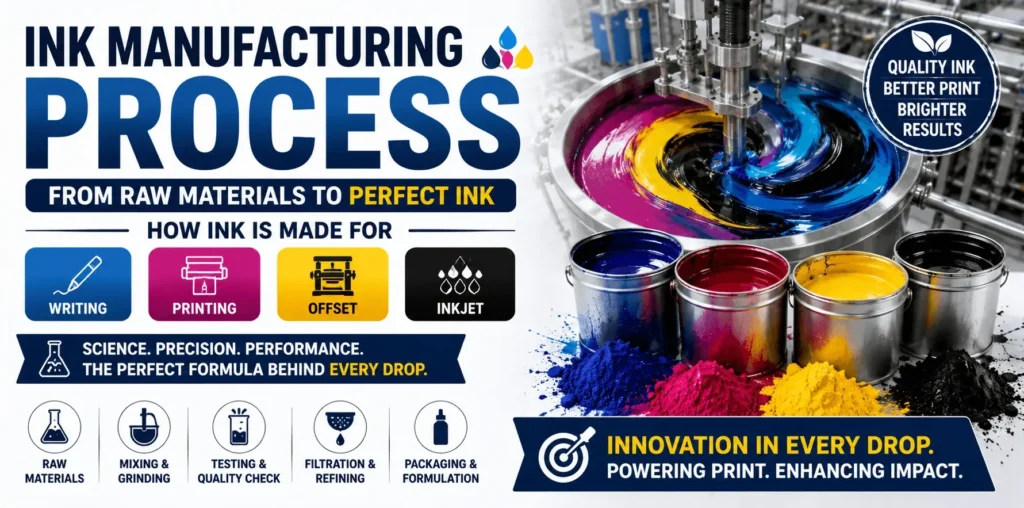

The ink manufacturing process is a sophisticated industrial procedure involving pigments, binders, solvents, additives, and advanced processing technologies to produce inks used in writing, printing, packaging, publishing, and industrial applications. Ink is an essential component of communication and artistic expression. Ink has a significant role in human history from Traditional pen inks to modern offset and inkjet printing systems, inks play a vital role in communication, branding, and commercial printing industries.
Modern printing ink manufacturing combines chemistry, material science, and precision engineering to create products with high color consistency, durability, drying performance, and print quality. Different ink formulations are developed for offset printing, gravure printing, flexographic printing, screen printing, and digital inkjet applications.
Contents
- 1. Offset Ink Manufacturing Process
- 2. Printing Ink Manufacturing Process
- 3. Inkjet Ink Manufacturing Process
- 4. Water-Based Ink Manufacturing Process
- 5. Gravure Ink Manufacturing Process
- 6. The Science Behind How Ink Is Made
- 7. Step-by-Step Ink Manufacturing Process
- 8. Ink Manufacturing Process Flow Chart
- 9. Types of Ink and Their Specific Uses
- 10. Eco-Friendly Trends in Ink Manufacturing
- 11. Raw Material Cost in Ink Manufacturing
- 12. Ink Manufacturing Business Opportunities
- 13. Future Scope of Ink Manufacturing Industry
- 14. Conclusion
- 15. Looking to Start an Ink Manufacturing Business?
Offset Ink Manufacturing Process
Offset printing inks are oil-based formulations designed for commercial high-speed printing applications. The process involves pigment dispersion, varnish preparation, milling, viscosity adjustment, filtration, and quality testing for smooth printing performance.
Printing Ink Manufacturing Process
Printing ink manufacturing involves mixing pigments, solvents, binders, and additives followed by dispersion, milling, filtration, and packaging to create industrial-grade printing inks.
Inkjet Ink Manufacturing Process
Inkjet ink manufacturing requires ultra-fine particle control and filtration to ensure smooth flow through printer nozzles without clogging.
Water-Based Ink Manufacturing Process
Water-based inks use water as the primary solvent and are widely used in eco-friendly packaging and flexographic printing applications.
Gravure Ink Manufacturing Process
Gravure inks are low-viscosity solvent-based inks used in packaging, magazines, decorative laminates, and publication printing industries.
The Science Behind How Ink Is Made
The process of how ink is made combines a rich blend of art, chemistry, and technology. Ink is not just a simple fluid with color; it is a carefully engineered product designed to meet specific demands based on its application—whether for writing, printing, or painting. The quality and composition of ink vary depending on the medium it is used with, such as pens, offset printers, or inkjet printers.
Key Raw Materials Used in Ink Production
The primary materials required to manufacture ink fall into four main categories: colorants, binders, solvents, and additives. Each of these components, moreover, plays a crucial role in determining the ink’s behavior, color consistency, and longevity. In particular, colorants define the hue and vibrancy, while binders ensure the pigment adheres to the surface. Meanwhile, solvents control the ink’s flow and drying time, and finally, additives enhance specific properties such as UV resistance, gloss, or durability.
1. Colorants (Pigments and Dyes)
Colorants are the agents responsible for the ink’s hue. There are two main types: pigments and dyes. Pigments are finely ground particles that remain suspended in the binder, providing opacity and UV resistance. Dyes, on the other hand, dissolve in the liquid medium, offering brighter and more vibrant colors, though they are often less fade-resistant.
Examples of pigments include:
Carbon black (for black ink)
Titanium dioxide (for white ink)
Phthalocyanine (for cyan and green tones)
Common dyes include:
Eosin (red)
Methylene blue
Acid yellow
2. Binders
Binders are substances that hold the pigment particles together; moreover, they ensure proper adhesion to the paper or printing surface. In the ink industry, typical binders include natural gums, resins, or synthetic polymers. The choice of binder is critical; in fact, it can significantly influence properties such as drying time, durability, and glossiness of the ink. Therefore, manufacturers must carefully select binders based on the desired performance characteristics.
Examples:
- Shellac
- Alkyd resins
- Acrylic resins
- Polyvinyl acetate
3. Solvents
Solvents help to dissolve or disperse the ink ingredients and adjust the ink’s viscosity. Depending on the type of ink being produced, the solvent can either be water-based or oil-based. The volatility of the solvent also influences how quickly the ink dries.
Examples:
- Water (used in most modern inkjet and eco-friendly inks)
- Ethanol
- Isopropyl alcohol
- Petroleum distillates
4. Additives
Additives are optional ingredients added to modify specific properties of the ink. These include agents for improving flow, preventing clogs, enhancing UV resistance, or providing waterproof capabilities.
Common additives include:
- Surfactants (for reducing surface tension)
- Dispersants
- Preservatives
- Defoamers
- UV stabilizers
Step-by-Step Ink Manufacturing Process
The manufacturing process of ink is both art and science, involving mixing, dispersion, milling, filtering, and packaging. Below is a breakdown of the primary stages in ink production:
1. Formulation and Mixing
The process starts with selecting the appropriate raw materials and measuring them precisely. The pigments, binders, solvents, and additives are weighed based on the type of ink and its intended use. These materials are then mixed in a large batch mixer. The goal at this stage is to ensure the preliminary blending of components.
2. Dispersion of Pigments
Since pigments are insoluble particles, they must be evenly dispersed throughout the mixture. This is achieved using high-speed dispersers or bead mills. Proper dispersion ensures that the ink maintains a uniform color and texture without clumping or settling.
This is one of the most crucial steps when ink is made because poor dispersion can lead to quality issues like streaking, clogging, or inconsistent color application.
3. Milling and Grinding
After dispersion, the ink mixture is subjected to a milling process using three-roll mills or ball mills. This step further breaks down pigment particles to micron or even nanometer sizes. The smaller the pigment particle, the smoother and more consistent the ink’s application.
The milling process also enhances the ink’s gloss, transparency, and drying characteristics. It’s during this step that the full potential of the ink is unlocked.
4. Filtration
Subsequently, once the ink has been milled to the desired fineness, it is carefully filtered to eliminate any unwanted solid residues or large particles. As a result, the ink remains stable over time and does not clog fine nozzles in printers or pens.
5. Quality Control Testing
Before packaging, the ink undergoes rigorous quality control tests. Parameters such as pH, viscosity, color consistency, drying time, and rub resistance are measured. If any of these values fall outside acceptable ranges, adjustments are made to the formulation.
For example:
- pH is adjusted using acids or bases
- Viscosity is changed by adding solvents or thickeners
- Color matching is done using spectrophotometers
6. Filling and Packaging
The final product is filled into appropriate containers such as cartridges, bottles, or drums, depending on the end-user application. During this phase, the packaging is labeled with necessary information including batch numbers, expiry dates, and usage instructions.
See Also: Artificial Marble Tiles
Ink Manufacturing Process Flow Chart
↓
Binder Preparation
↓
Mixing & Formulation
↓
Pigment Dispersion
↓
Milling & Grinding
↓
Filtration
↓
Quality Testing
↓
Packaging
Types of Ink and Their Specific Uses
Understanding how ink is create also requires insight into its different varieties. Each type is manufactured slightly differently based on its performance requirements.
1. Writing Ink
Used in fountain pens, ballpoints, and markers, writing ink is generally water-based with added preservatives. It must flow smoothly and dry quickly on paper.
2. Printing Ink
There are several subcategories under printing ink:
- Offset printing ink: Oil-based and slow-drying to avoid smudging during high-speed printing.
- Flexographic ink: Water or solvent-based, suitable for packaging materials like plastic and cardboard.
- Gravure ink: Low-viscosity ink used for high-volume printing such as magazines and wallpaper.
3. Inkjet Printer Ink
This type of ink is either dye-based or pigment-based. It requires excellent fluidity to prevent nozzle clogging and fast drying to avoid smudging.
4. Screen Printing Ink
Thicker ink used for textiles, signage, or specialty items. It includes UV-curable or solvent-based formulas for better adhesion and color vibrancy.
Environmental Considerations in Ink Production
As sustainability becomes a global concern, the ink industry is making significant strides toward eco-friendly manufacturing. Traditional inks often used petroleum-based solvents, heavy metals, and VOCs (volatile organic compounds), which are harmful to both health and the environment.
Modern advancements focus on:
- Soy-based inks: A renewable alternative to petroleum-based inks.
- Water-based inks: Less harmful to the environment and easier to clean.
- UV-curable inks: Cured instantly using UV light, minimizing emissions.
The shift toward sustainable ink production is also influencing how ink is made across the world, prompting stricter regulations and greener innovations.
Challenges in Ink Manufacturing
While the process might seem straightforward, manufacturers often face several challenges, such as:
- Maintaining consistency between batches
- Managing costs of high-quality pigments
- Ensuring ink compatibility with evolving printer technologies
- Meeting environmental regulations without compromising performance
Additionally, as consumer demand for vibrant colors, specialty finishes, and fast-drying inks grows, the industry must constantly innovate its formulations and processes.
See Also: Hygiene Products
Machinery Used in Ink Manufacturing Process
Industrial ink manufacturing units use specialized machinery to ensure uniform dispersion, color consistency, and smooth printing performance.
Major Machinery Includes:
- High-speed dispersers
- Ball mills
- Three-roll mills
- Mixing tanks
- Filtration systems
- Storage tanks
- Automatic filling machines
Advanced machinery improves pigment dispersion, ink stability, drying performance, and production efficiency.
Eco-Friendly Trends in Ink Manufacturing
The printing industry is increasingly shifting toward sustainable ink manufacturing technologies to reduce environmental impact and VOC emissions.
Modern eco-friendly inks include:
- Water-based inks
- Soy-based inks
- UV-curable inks
- Low-solvent inks
These formulations offer improved environmental safety, regulatory compliance, and reduced air pollution compared to traditional solvent-based inks.
Raw Material Cost in Ink Manufacturing
The production cost of ink depends largely on the quality of pigments, resins, solvents, and additives used during manufacturing.
Major Cost Factors:
- Pigment quality
- Resin selection
- Solvent type
- Additive usage
- Energy consumption
- Packaging materials
Efficient formulation and proper raw material sourcing can significantly improve profit margins in industrial ink manufacturing operations.
Ink Manufacturing Business Opportunities
The printing ink manufacturing industry offers significant business opportunities due to rising demand from:
- Packaging industries
- Publishing companies
- Newspaper printing
- Textile printing
- Flexible packaging
- Label printing
- Commercial advertising
Industrial ink manufacturing businesses can supply products to printing presses, packaging manufacturers, stationery companies, and digital printing industries.
Future Scope of Ink Manufacturing Industry
The global ink manufacturing industry is evolving rapidly due to increasing demand from packaging, digital printing, textile printing, labeling, and commercial publishing sectors. Modern industries are shifting toward eco-friendly and high-performance inks such as:
- Water-based inks
- UV-curable inks
- Soy-based inks
- Low-VOC printing inks
- Digital printing inks
The growth of eCommerce packaging, flexible packaging, industrial labeling, and digital printing technologies is expected to create strong long-term opportunities for printing ink manufacturers worldwide.
Frequently Asked Questions
Q1. What is the ink manufacturing process?
The ink manufacturing process involves mixing pigments, binders, solvents, and additives followed by milling, filtration, testing, and packaging.
Q2. What raw materials are used in printing ink manufacturing?
Major raw materials include pigments, dyes, acrylic resins, solvents, surfactants, and preservatives.
Q3. What is offset ink manufacturing process?
Offset ink manufacturing involves oil-based pigment formulations designed for commercial printing applications.
Q4. Are water-based inks environmentally friendly?
Yes, water-based inks are considered eco-friendly because they contain lower VOC emissions than solvent-based inks.
Q5. Which industries use industrial printing inks?
Printing inks are widely used in packaging, newspapers, magazines, labels, textiles, advertising, and commercial printing industries.
Conclusion
The ink manufacturing process is an essential industrial operation that supports the printing, packaging, publishing, textile, and commercial communication industries worldwide. From writing inks and offset printing inks to modern inkjet and water-based formulations, ink production combines advanced chemistry, precision engineering, and quality control systems to achieve high-performance printing results.
As demand for packaging, labeling, commercial printing, and eco-friendly printing solutions continues to grow, the printing ink manufacturing industry offers strong opportunities for industrial manufacturers, chemical processing companies, and entrepreneurs. Modern advancements in water-based inks, UV-curable inks, and sustainable formulations are also transforming the future of ink production globally.
By understanding the raw materials, formulations, machinery, and manufacturing process involved in industrial ink production, businesses can improve product quality, operational efficiency, and market competitiveness in the expanding global printing industry.
Looking to Start an Ink Manufacturing Business?
If you are planning to establish an industrial ink manufacturing unit, professional consultancy can help with:
- Detailed Project Reports (DPR)
- Ink formulation guidance
- Machinery selection
- Industrial plant setup
- Manufacturing process consultation
- Printing ink formulation support
- Market feasibility analysis
- Packaging solutions
Contact our expert team today to explore profitable ink manufacturing business opportunities.
Contact Us