
Change in the basis of classifying micro, small and medium enterprises from investment in plant & machinery
The Micro, Small, and Medium Enterprises (MSME) sector is widely recognized as the backbone of the Indian economy. It significantly contributes to employment generation, exports, and the overall GDP. Traditionally, MSME classification was based on investment in plant and machinery or equipment. However, the Government of India brought a paradigm shift by redefining MSME classification based on turnover and investment. This progressive step aims to bring more businesses under the MSME umbrella and provide equal opportunities for growth and government support. MSME Classification: Redefined by Turnover and Investment Criteria Earlier, the MSME classification in India followed a rigid structure based solely on the amount invested in plant and machinery (for manufacturing enterprises) or equipment (for service enterprises). This outdated framework posed significant limitations for growing enterprises, as even a marginal increase in investment could disqualify them from availing MSME benefits. Recognizing this drawback, the government introduced a new, inclusive definition during the COVID-19 pandemic in 2020 as part of the Atmanirbhar Bharat Abhiyan. Under the revised MSME classification, both investment and annual turnover are now considered. Moreover, there is no distinction between manufacturing and service enterprises—both are now treated equally, which streamlines the compliance process and promotes sectoral equality. The New MSME Classification Structure As per the new definition: Micro Enterprise: Investment: Up to ?1 crore Turnover: Up to ?5 crore Small Enterprise: Investment: Up to ?10 crore Turnover: Up to ?50 crore Medium Enterprise: Investment: Up to ?50 crore Turnover: Up to ?250 crore This dual-criteria system ensures a balanced approach to classification, making it more dynamic and adaptable to current market conditions. Reasons Behind the Shift in MSME Classification The shift in MSME classification was driven by multiple factors: Inclusive Growth: Many businesses that had exceeded the investment threshold earlier were deprived of MSME benefits despite having low turnover. The new system includes such enterprises and provides them with due benefits. Global Standards Alignment: Most developed countries use turnover as a standard parameter for business classification. By adopting a similar model, India has aligned its MSME policy with global norms. Encouragement of Expansion: Previously, businesses hesitated to invest further in expansion to avoid crossing the MSME classification threshold. Now, the revised criteria motivate growth while maintaining eligibility for incentives. Transparency and Ease of Verification: Turnover figures can be easily verified using GST data, ensuring greater transparency and reducing misreporting. Benefits of the Revised MSME Classification The restructured MSME classification brings numerous advantages: Wider Coverage of Enterprises: A broader definition means more businesses qualify as MSMEs, thereby availing themselves of numerous government incentives, including easy access to finance, subsidies, and protection from delayed payments. Uniformity Between Manufacturing and Services: The removal of differentiation between manufacturing and service industries has eliminated confusion and provided an equal footing for all types of businesses. Digital Integration: Since turnover is now traceable through GST records, the classification process has become digital, faster, and free from bureaucratic delays. Facilitated Exports and Global Competitiveness: MSMEs that are export-oriented often maintain high turnover with minimal domestic investment. The new definition brings such enterprises into the formal MSME ecosystem, offering them policy support. Stimulated Employment and Rural Growth: By encouraging business growth and simplifying classification, the new definition helps MSMEs thrive in rural and semi-urban areas, leading to localized job creation and inclusive development. Challenges in Implementing the New MSME Classification Despite the benefits, the revised MSME classification has not been without criticism and challenges: Compliance Burden for Small Units: Enterprises that do not fall under the GST regime may find it difficult to prove turnover, making them ineligible for classification despite being micro or small units by size. Ambiguity in Investment Definition: Although turnover is easy to track, investment remains a vague criterion, especially for businesses operating without formal books of accounts or audited financials. Technology Gaps: Rural MSMEs, especially those operating offline, struggle to align their operations with GST and Udyam registration processes, thereby missing out on classification benefits. Udyam Registration and Its Impact To make the MSME classification framework efficient, the Ministry of MSME launched the Udyam Registration portal. It is an online, paperless, and zero-cost platform for MSME registration that uses PAN and Aadhaar data to determine investment and turnover automatically through integration with GST and Income Tax systems. Advantages of Udyam Registration: Real-time Classification: Automatic data retrieval enables dynamic updates of enterprise classification. Ease of Doing Business: A single-window digital platform simplifies compliance, enhances transparency, and speeds up registration processes. Linkage with Other Portals: Udyam is integrated with systems such as TReDS, e-marketplaces, and GeM to improve market access for MSMEs. As of 2025, over 3 crore MSMEs have registered on the Udyam portal, reflecting its popularity and usefulness among small businesses. Impact on Financial Institutions and Policy Makers Banks, NBFCs, and government departments now use the updated MSME classification for extending credit and subsidies. Financial institutions rely on Udyam-verified data to assess creditworthiness, which speeds up loan disbursement under schemes like CGTMSE, PMEGP, and SIDBI support programs. The government also uses MSME classification data to formulate policies related to infrastructure development, skill training, procurement norms, and fiscal stimulus packages. Real-World Implications for Businesses Let’s consider a few examples of how the revised MSME classification has helped: Example 1: A digital marketing agency with minimal physical investment but a turnover of ?4 crore earlier failed to qualify as an MSME. Now, under the revised norms, it qualifies as a micro enterprise and receives benefits like collateral-free loans and interest subsidies. Example 2: A textile unit in Gujarat that recently expanded its operations to reach ?8 crore turnover while keeping its investment under ?10 crore, now falls under the ‘Small Enterprise’ category, continuing to enjoy the benefits while growing its market reach. Road Ahead for MSME Classification The MSME classification system must continue to evolve with the economy. Some suggestions for future improvement include: Inclusion of Employment Numbers: Adding employment count as a third parameter could improve social impact assessment. Dynamic Reclassification: The system should automatically upgrade or downgrade enterprises based on
How to Start Natural Rubber Latex Condom Manufacturing 2026 | Plant Setup to Finished Product Opportunities
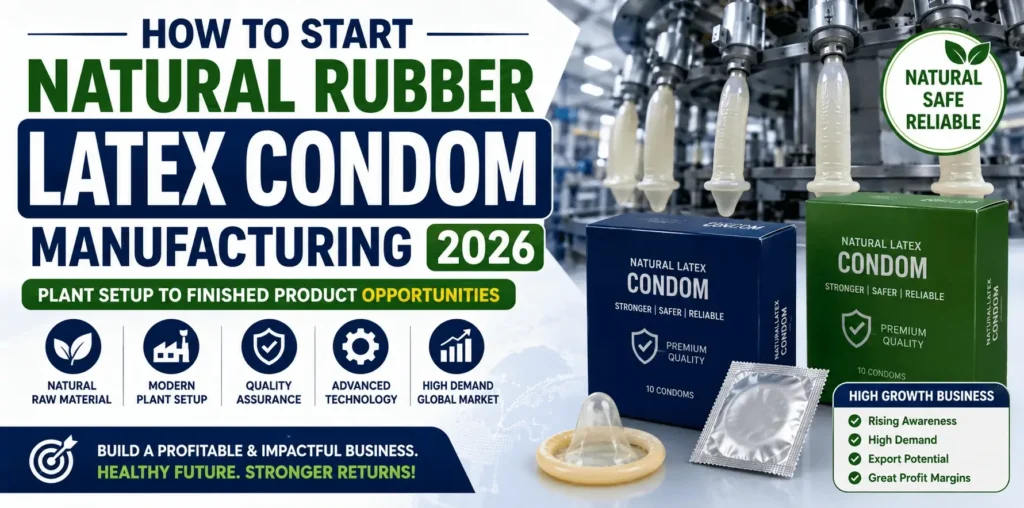
The Latex Condom Manufacturing Business is emerging as a high-potential opportunity in the healthcare and personal wellness industry due to increasing awareness of safe sex practices, rising population health initiatives, and growing global demand for contraceptive products. Natural rubber latex condoms continue to dominate the market because of their affordability, flexibility, durability, and effectiveness. India is becoming an important hub for latex condom manufacturing due to expanding healthcare infrastructure, government awareness programs, export demand, and advancements in automated production technologies. Entrepreneurs entering the condom manufacturing business can benefit from rising domestic consumption, NGO procurement programs, eCommerce growth, and international supply opportunities. This guide explains the complete latex condom manufacturing business setup process including machinery, manufacturing technology, raw materials, quality standards, licensing requirements, investment cost, and profitability analysis. What is Latex Condom Manufacturing? Latex condom manufacturing is an industrial process that produces natural rubber latex condoms through dipping, vulcanization, electronic testing, lubrication, and sterile packaging processes for healthcare and personal protection applications. Why Latex Condom Manufacturing is Growing in India Include: awareness programs government healthcare initiatives export demand eCommerce growth STI prevention awareness NGO procurement population control programs Understanding the Latex Condom Manufacturing Industry Latex condom manufacturing is part of the broader sexual wellness and healthcare segment. The product, made from natural rubber latex, undergoes a highly sensitive production process involving dipping, vulcanization, testing, and packaging. With increasing global concern over sexually transmitted infections (STIs), HIV/AIDS, and population control, the demand for quality condoms is growing, especially in developing nations. India, China, Brazil, and parts of Africa are considered high-potential markets for expansion. Governments and NGOs have made substantial investments in distributing free or subsidized condoms, which adds to the demand. Furthermore, the social taboo surrounding condom usage is diminishing due to awareness campaigns, which enhances the prospects for new players in the latex condom manufacturing industry. Step-by-Step Guide to Starting a Latex Condom Manufacturing Business 1. Market Research and Business Planning Before investing in machinery or infrastructure, conduct a detailed market analysis. Study regional and global demand, consumer behavior, competitor strategies, and potential distribution channels. Identify whether you’ll cater to the premium segment (flavored, textured, ultra-thin) or standard products. Create a business plan covering: Business objectives Target market Investment and financial projections Production scale Pricing and distribution model Compliance and certifications A solid plan will help attract investors and secure loans or grants from health-oriented funding agencies. 2. Legal Compliance and Licensing Given that condoms are classified as medical devices in many countries, manufacturing them requires stringent regulatory adherence. In India, approval from the Drug Controller General of India (DCGI) and registration with CDSCO (Central Drugs Standard Control Organization) is mandatory. Other global certifications include: ISO 4074:2015 (International standard for natural rubber latex condoms) CE Marking (European market) WHO Prequalification (for global NGO supply) GMP guidelines WHO quality standards Medical device regulations Quality testing protocols Apart from that, you’ll also need: Company registration GST or other local tax registration Factory license Pollution control and fire safety certificates Compliance helps ensure product safety, international acceptance, and eligibility for government and NGO procurement programs. 3. Location and Factory Setup Choosing the right location is essential. The ideal site should have good connectivity, access to skilled labor, and reliable water and electricity supply. The factory layout should consist of the following: Raw material storage Production and dipping area Drying and curing rooms Electronic testing section Packing and storage rooms The facility should follow GMP (Good Manufacturing Practices) and hygiene protocols to prevent contamination. 4. Machinery and Equipment Investing in high-quality automated machinery ensures efficiency and product consistency. Major equipment includes: Latex dipping machines Coagulum tanks Vulcanization oven Electronic testing equipment Packaging machines Conveyor belts and air compressors Automated machines improve output, reduce manual errors, and maintain hygiene. Depending on the production capacity, the machinery cost can range from ?1 crore to ?5 crore. 5. Raw Material Procurement The main raw material in latex condom manufacturing is natural rubber latex, sourced from rubber plantations or vendors. Other materials include: Coagulant solution Lubricants (silicone or water-based) Corn starch or talc (for dusting) Foils or wrappers (for packaging) Flavoring agents (for specialty condoms) Ensure that all materials are of medical-grade quality and comply with health regulations. 6. How are Latex Condoms Manufactured? The standard latex condom manufacturing process generally includes: Latex Compounding: Mixing raw latex with chemicals to improve elasticity and durability. Former cleaning and Dipping: Cleaned glass or ceramic molds are dipped in coagulant and then into the latex solution to form the condom layer. Vulcanization: Condoms are cured at high temperatures to strengthen the rubber. Leaching and Washing: The product is thoroughly washed to remove residual chemicals and proteins. Drying and Testing: Condoms are electronically tested for holes, strength, and elasticity. Electronic pinhole testing: Lubrication and packaging: Each piece is lubricated, sealed in foil wrappers, and then packed into boxes. Sterility and quality inspection The entire process must be handled in a contamination-free environment using sterilized equipment. 7. Quality Control and Testing Quality assurance is a vital component of latex condom manufacturing. International standards dictate rigorous testing, including: Electronic pinhole testing Air burst and tensile strength test Water leak test Lubricant quantity test Random samples are taken from each batch to ensure consistency and safety. If a batch fails any of the tests, it must be discarded. 8. Branding and Marketing Strategy Create a compelling brand identity that reflects trust, safety, and innovation. Use discreet yet bold packaging to attract consumers. Focus on: Health campaigns and CSR collaborations Social media marketing targeting youth and urban areas Online marketplaces and pharmacy tie-ups Government supply contracts and tenders Brand ambassadors, health influencers, and digital ads can help break taboos and promote acceptance. 9. Distribution Channels Condoms are widely sold through: Pharmacies and drugstores E-commerce platforms Supermarkets and convenience stores NGOs and health agencies Clinics and hospitals Partner with logistics companies that specialize in sensitive goods. Maintain an efficient supply chain to ensure consistent product availability. 10. Cost and Profitability Analysis Starting a latex condom manufacturing