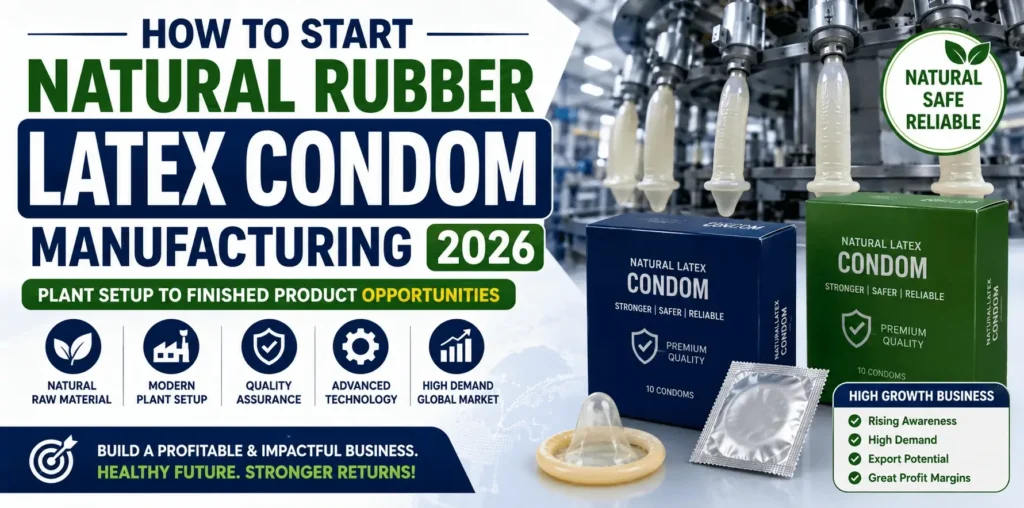

The Latex Condom Manufacturing Business is emerging as a high-potential opportunity in the healthcare and personal wellness industry due to increasing awareness of safe sex practices, rising population health initiatives, and growing global demand for contraceptive products. Natural rubber latex condoms continue to dominate the market because of their affordability, flexibility, durability, and effectiveness.
India is becoming an important hub for latex condom manufacturing due to expanding healthcare infrastructure, government awareness programs, export demand, and advancements in automated production technologies. Entrepreneurs entering the condom manufacturing business can benefit from rising domestic consumption, NGO procurement programs, eCommerce growth, and international supply opportunities.
This guide explains the complete latex condom manufacturing business setup process including machinery, manufacturing technology, raw materials, quality standards, licensing requirements, investment cost, and profitability analysis.
Contents
- 1. What is Latex Condom Manufacturing?
- 2. Why Latex Condom Manufacturing is Growing in India
- 3. Understanding the Latex Condom Manufacturing Industry
- 3.1. Step-by-Step Guide to Starting a Latex Condom Manufacturing Business
- 3.1.1. 1. Market Research and Business Planning
- 3.1.2. 2. Legal Compliance and Licensing
- 3.1.3. 3. Location and Factory Setup
- 3.1.4. 4. Machinery and Equipment
- 3.1.5. 5. Raw Material Procurement
- 3.1.6. 6. How are Latex Condoms Manufactured?
- 3.1.7. 7. Quality Control and Testing
- 3.1.8. 8. Branding and Marketing Strategy
- 3.1.9. 9. Distribution Channels
- 3.1.10. 10. Cost and Profitability Analysis
- 3.1.11. 11. Sustainability and Innovation
- 3.1. Step-by-Step Guide to Starting a Latex Condom Manufacturing Business
- 4. Frequently Asked Questions
- 5. Looking to Start a Latex Condom Manufacturing Business?
What is Latex Condom Manufacturing?
Latex condom manufacturing is an industrial process that produces natural rubber latex condoms through dipping, vulcanization, electronic testing, lubrication, and sterile packaging processes for healthcare and personal protection applications.
Why Latex Condom Manufacturing is Growing in India
Include:
- awareness programs
- government healthcare initiatives
- export demand
- eCommerce growth
- STI prevention awareness
- NGO procurement
- population control programs
Understanding the Latex Condom Manufacturing Industry
Latex condom manufacturing is part of the broader sexual wellness and healthcare segment. The product, made from natural rubber latex, undergoes a highly sensitive production process involving dipping, vulcanization, testing, and packaging. With increasing global concern over sexually transmitted infections (STIs), HIV/AIDS, and population control, the demand for quality condoms is growing, especially in developing nations.
India, China, Brazil, and parts of Africa are considered high-potential markets for expansion. Governments and NGOs have made substantial investments in distributing free or subsidized condoms, which adds to the demand. Furthermore, the social taboo surrounding condom usage is diminishing due to awareness campaigns, which enhances the prospects for new players in the latex condom manufacturing industry.
Step-by-Step Guide to Starting a Latex Condom Manufacturing Business
1. Market Research and Business Planning
Before investing in machinery or infrastructure, conduct a detailed market analysis. Study regional and global demand, consumer behavior, competitor strategies, and potential distribution channels. Identify whether you’ll cater to the premium segment (flavored, textured, ultra-thin) or standard products.
Create a business plan covering:
Business objectives
Target market
Investment and financial projections
Production scale
Pricing and distribution model
Compliance and certifications
A solid plan will help attract investors and secure loans or grants from health-oriented funding agencies.
2. Legal Compliance and Licensing
Given that condoms are classified as medical devices in many countries, manufacturing them requires stringent regulatory adherence. In India, approval from the Drug Controller General of India (DCGI) and registration with CDSCO (Central Drugs Standard Control Organization) is mandatory. Other global certifications include:
- ISO 4074:2015 (International standard for natural rubber latex condoms)
- CE Marking (European market)
- WHO Prequalification (for global NGO supply)
- GMP guidelines
- WHO quality standards
- Medical device regulations
- Quality testing protocols
Apart from that, you’ll also need:
- Company registration
- GST or other local tax registration
- Factory license
- Pollution control and fire safety certificates
Compliance helps ensure product safety, international acceptance, and eligibility for government and NGO procurement programs.
3. Location and Factory Setup
Choosing the right location is essential. The ideal site should have good connectivity, access to skilled labor, and reliable water and electricity supply. The factory layout should consist of the following:
Raw material storage
Production and dipping area
Drying and curing rooms
Electronic testing section
Packing and storage rooms
The facility should follow GMP (Good Manufacturing Practices) and hygiene protocols to prevent contamination.
4. Machinery and Equipment
Investing in high-quality automated machinery ensures efficiency and product consistency. Major equipment includes:
Latex dipping machines
Coagulum tanks
Vulcanization oven
Electronic testing equipment
Packaging machines
Conveyor belts and air compressors
Automated machines improve output, reduce manual errors, and maintain hygiene. Depending on the production capacity, the machinery cost can range from ?1 crore to ?5 crore.
5. Raw Material Procurement
The main raw material in latex condom manufacturing is natural rubber latex, sourced from rubber plantations or vendors. Other materials include:
Coagulant solution
Lubricants (silicone or water-based)
Corn starch or talc (for dusting)
Foils or wrappers (for packaging)
Flavoring agents (for specialty condoms)
Ensure that all materials are of medical-grade quality and comply with health regulations.
6. How are Latex Condoms Manufactured?
The standard latex condom manufacturing process generally includes:
- Latex Compounding: Mixing raw latex with chemicals to improve elasticity and durability.
- Former cleaning and Dipping: Cleaned glass or ceramic molds are dipped in coagulant and then into the latex solution to form the condom layer.
- Vulcanization: Condoms are cured at high temperatures to strengthen the rubber.
- Leaching and Washing: The product is thoroughly washed to remove residual chemicals and proteins.
- Drying and Testing: Condoms are electronically tested for holes, strength, and elasticity.
- Electronic pinhole testing:
- Lubrication and packaging: Each piece is lubricated, sealed in foil wrappers, and then packed into boxes.
- Sterility and quality inspection
The entire process must be handled in a contamination-free environment using sterilized equipment.
7. Quality Control and Testing
Quality assurance is a vital component of latex condom manufacturing. International standards dictate rigorous testing, including:
Electronic pinhole testing
Air burst and tensile strength test
Water leak test
Lubricant quantity test
Random samples are taken from each batch to ensure consistency and safety. If a batch fails any of the tests, it must be discarded.
8. Branding and Marketing Strategy
Create a compelling brand identity that reflects trust, safety, and innovation. Use discreet yet bold packaging to attract consumers. Focus on:
Health campaigns and CSR collaborations
Social media marketing targeting youth and urban areas
Online marketplaces and pharmacy tie-ups
Government supply contracts and tenders
Brand ambassadors, health influencers, and digital ads can help break taboos and promote acceptance.
9. Distribution Channels
Condoms are widely sold through:
Pharmacies and drugstores
E-commerce platforms
Supermarkets and convenience stores
NGOs and health agencies
Clinics and hospitals
Partner with logistics companies that specialize in sensitive goods. Maintain an efficient supply chain to ensure consistent product availability.
10. Cost and Profitability Analysis
Starting a latex condom manufacturing unit requires an initial investment of ?2–6 crore depending on capacity and automation. Key expenses include:
Land and building
Machinery and installation
Raw materials
Labor and utility costs
Licensing and compliance
The manufacturing cost per condom can range from ?0.50 to ?1.20, while the selling price (B2B) is around ?1.50 to ?2.50 depending on the brand and features. A well-managed unit can achieve a profit margin of 20–30% annually.
11. Sustainability and Innovation
There’s a rising demand for eco-friendly and biodegradable condoms. Innovating with plant-based lubricants, organic latex, and recyclable packaging can attract health-conscious consumers. Including female condoms, flavored variants, and ultra-thin designs can diversify your portfolio.
Additionally, implementing solar energy, water recycling, and low-emission equipment will align your business with global ESG (Environmental, Social, Governance) standards and help secure international partnerships.
Frequently Asked Questions
Q1. Is latex condom manufacturing profitable?
Yes, latex condom manufacturing can be profitable due to growing healthcare awareness, recurring consumer demand, government procurement, and export opportunities.
Q2. What is the cost of setting up a condom manufacturing unit?
A latex condom manufacturing unit may require an investment ranging from ₹2 crore to ₹6 crore depending on automation, production capacity, and compliance standards.
Q3. What raw materials are used in latex condom manufacturing?
Natural rubber latex, lubricants, coagulants, flavoring agents, packaging foils, and medical-grade chemicals are commonly used.
Q4. What licenses are required for condom manufacturing in India?
Manufacturers generally require CDSCO approval, GMP compliance, factory licenses, and medical device-related certifications.
Conclusion
The Latex Condom Manufacturing Business offers significant opportunities for entrepreneurs seeking to enter the healthcare and personal wellness industry. Rising awareness of sexual health, increasing government initiatives, expanding export demand, and growth in healthcare infrastructure are driving strong market demand for high-quality latex condoms.
By investing in advanced machinery, maintaining strict quality standards, ensuring regulatory compliance, and building strong distribution networks, entrepreneurs can establish a profitable and sustainable condom manufacturing business in India.
Looking to Start a Latex Condom Manufacturing Business?
If you are planning to establish a condom manufacturing plant, professional consultancy can help with:
- Detailed Project Reports (DPR)
- Manufacturing setup guidance
- Machinery consultation
- GMP & regulatory compliance
- Plant layout planning
- Market research
- Financial feasibility analysis
- Product development strategy
Contact our expert team today to explore profitable latex condom manufacturing business opportunities.
Visit the page Select and Choose the Right Business Startup for You for sorting out the questions arising in your mind before starting any business and know which start-up you can plan.
We, at NPCS, endeavor to make business selection a simple and convenient step for any entrepreneur/startup. Our expert team, by capitalizing on its dexterity and decade’s long experience in the field, has created a list of profitable ventures for entrepreneurs who wish to diversify or venture. The list so mentioned is updated regularly to give you a regular dose of new emerging opportunities.