
Adult Diaper Manufacturing Business in India: BIS IS:17015, SAP Technology, Market Demand and Investment Guide
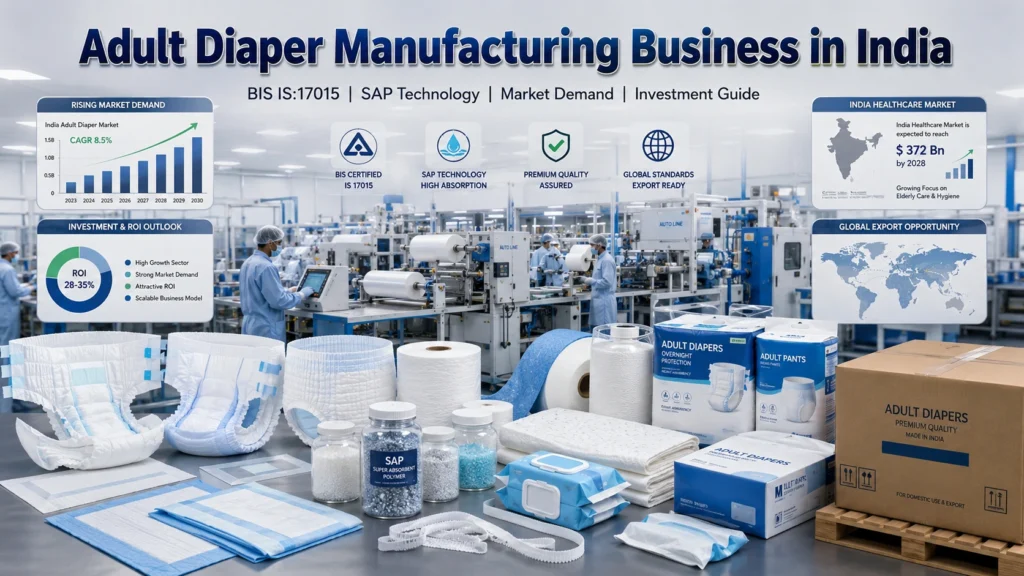
Adult Diaper Manufacturing Business in India The adult diaper segment is one of the fastest growing consumer healthcare product segments in India, owing to the increase in the aging population, awareness about incontinence, adoption of nursing/ post-surgical care in the hospital sector and formalization of home care for the elderly and nursing. The market value is estimated at Rs 1,500-2,000 crore and is growing at a healthier rate of 20-25 percent CAGR as compared to most medical consumable categories, with India importing a large proportion of its need even though it has the infrastructure, technology and expertise to manufacture medical-grade adult diapers, SAPs (superabsorbent polymer) and packaging. According to Research published in NCBI: Urinary Incontinence Prevalence in India, there is a massively under-served domestic market as it is estimated that 20-30 percent of the elderly population in India suffers from urinary incontinence. According to WHO Global Report on Ageing and Health, access to adult incontinence products is among the most important parameters of quality of life of the ageing population of middle-income countries. Market Opportunity: Why This Business Cannot Be Ignored Multinational brands such as Kimberly-Clark’s Depend and Tena by the Essity dominate the market of diapers for adults in India, with a few organised domestic producers. The majority of the Rs 2000 crore+ growth in the market is happening in institutional channels such as hospitals and home care, where quality is the main procurement criterion of choice, per the standards set by the Bureau of Indian Standards (BIS) under the IS:17015 (Adult Diaper Specification) standard. One that is growing rapidly is hospital and home care institutional supply. The growth of national programme initiatives such as elder care and palliative care provided by NHM and the growing market of registered adult care facilities under the Ministry of Social Justice is generating huge institutional buyer markets for the quality domestic producers of certified adult incontinence products, thereby opening up government procurement channels as well as consumer retail outlets. Get Detailed Insights from This Book: Sanitary Napkins, Baby and Adult Diapers Industry Analysis: Growth Drivers and Demand Outlook The adult diaper market in India is currently Rs 1,500-2,000 crore with a growth rate of 20-25 per cent per year. According to the FICCI’s Consumer Healthcare Report, India’s adult incontinence market will swell to Rs 5,000 crore by 2030, as the ageing population of 140 million +60 years will grow at 3 per cent every year, and there is a growing awareness across the country about the management solutions available for incontinence. The PIB: India Census and Elderly Population Statistics indicates that the ageing population is growing at a compound annual rate of 3 percent and by 2050, the number of elderly people in India will be more than 300 million and one of the world’s largest ageing populations. To get private label supply to the pharmacy chains (Apollo Pharmacy, MedPlus, Wellness Forever) is an effective way to enter the market, without burdening consumer brand building costs and with access to proven retail distribution channels on institutional rates. The PMEGP scheme of MSME Ministry offers up to a maximum of 25-35 percent capital subsidy for manufacturing a new manufacturing unit in the consumer healthcare product manufacturing sector, which brings down the net equity required for a new manufacturing unit by an adult diaper manufacturing entrepreneur. India’s consumer healthcare market is expanding at more than 15 percent per year and among the fastest-growing sub-categories are products for elder care and incontinence management, according to the IBEF: India Consumer Healthcare Market. India Adult Diaper Market Overview Parameter Market Data Notes India Adult Diaper Market Value Rs 1,500 – 2,000 crore Industry estimates Market Growth Rate 20-25% CAGR Ageing population and care awareness India Population Aged 60+ 140+ million people Growing at 3% annually BIS Standard IS:17015 (Adult Diaper Specification) Mandatory for institutional supply Core Technical Ingredient SAP (Superabsorbent Polymer) 250-300g/m2 in absorbent core Key Market Segments Hospital, nursing home, home care, retail Multiple buyer channels Market Leaders Kimberly-Clark, Tena, Romsons, Nobel Hygiene Domestic brands growing How to Start: Step-by-Step Guide for Entrepreneurs Step 1: Business Setup and BIS IS:17015 Certification Dedicate entity, get Udyam MSME registration, and factory licence and GST. Request the BIS IS:17015 (Adult Diaper) Certificate which is required for hospital / medical institution supply. The absorbency under pressure, acquisition time, rewet, pH and odour parameters are specified in IS:17015. No CDSCO Device Licence for incontinence management (wound care) diapers. Step 2: Technology: SAP Core and Absorbent Layer Design Adult diapers feature a superabsorbent polymer (SAP) core that absorbs urine 30 times its weight, surrounded by absorbent fluff pulp, and topped with a top sheet (nonwoven) and backed by a breathable PE or PP film. Absorbency capacity is dependent on SAP concentration (250 – 300 g/m2). Forging R&D partnership with domestic supplier of SAP (Nippon Shokubai India, SDP Global / imported specialty polymer distributors). The Wikipedia: Adult diaper encompasses international technology standards for adult incontinence products, such as SAP concentration, acquisition time and rewet performance. Get Detailed Insights from This Book: Our Books Step 3: Production Line: Diaper Converting Machine An integrated diaper converting machine is utilized for the production of adult diapers, which combines the process of creating the fluff pulp-SAP core, attaching top sheet and backsheet, adding leg cuffs, applying elastic waist bands, applying adhesive fastening tapes, cutting and folding into individual pads into one process. The typical production rate of an adult diaper machine is 200-400 per minute. Investment: Rs. 1-3 crore for a simple converting machine, which can be purchased from Chinese or European suppliers. Step 4: Product Range: Tape Style and Pull-Up Style Tape-type adult diapers (adhesive tabs) are used by bedridden patients at a hospital or nursing home. Pull-up adult diapers (underwear style, stretch panels) are used by ambulatory incontinent adults in home care and retail pharmacy. Pull-ups are retail priced at Rs 40-80 per piece, growing faster as retail awareness is increasing, compared to tape-style which is priced at Rs 25-50 per piece. Step 5:
THIN FILM PHOTOVOLTAIC (PV) MARKET: Global Landscape, India Demand-Supply Gap & MSME Startup Strategy
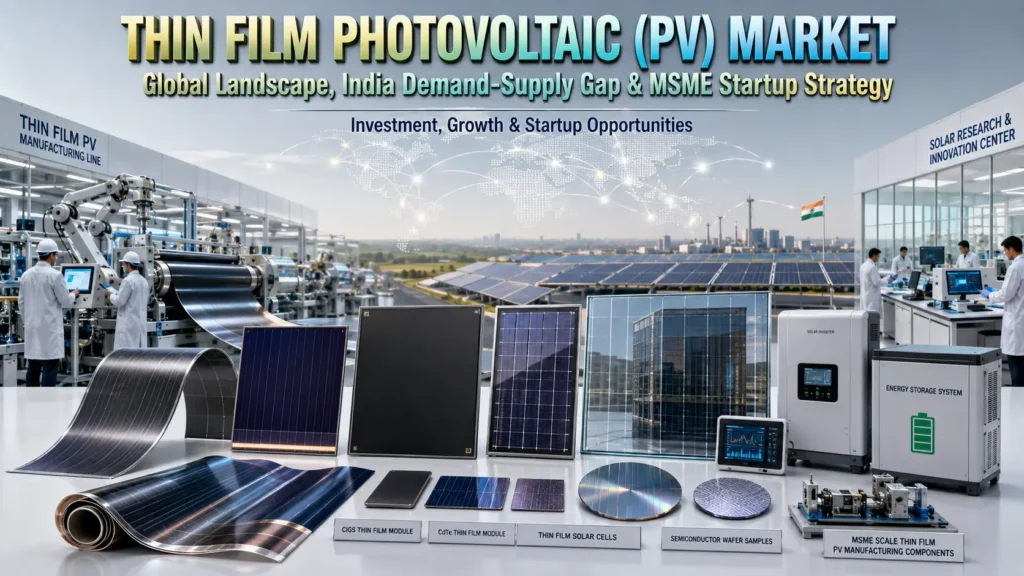
Thin Film Photovoltaic Manufacturing in India MARKET INSIGHT The worldwide thin-film PV (TFPV) market is worth more than USD 20 billion and is growing at more than 17% CAGR, fuelled by the growth of portable applications and building-integrated photovoltaic (BIPV) applications as well as utility-scale solar. The National Solar Mission (NSM) which aims to add one million MW of solar power by 2030, has created a high priority manufacturing opportunity for the thin-film PV industry with a significant import substitution potential. Structural demand-supply gap for thin-film modules is currently being met by imports from China, Japan and USA, which MSME manufacturers can close with the country. The Thin-Film PV Market: An Industrial Overview The solar energy market has experienced a fundamental change in the last 10 years, with thin film photovoltaic (PV) technology becoming a commercially viable and technically valuable alternative to traditional crystalline silicon solar modules in several high value applications. Thin-film PV cells are produced by depositing one or more ultra-thin layers of photovoltaic semiconductor material, usually in micrometres, onto a substrate like glass, metal foil or flexible plastic, and are not made by the energy-intensive ingot slicing and thick wafer processing used in conventional silicon wafer-based PV panels. This basic production disparity allows the production of significantly less material per watt of power output, power output flexibility, and distinctly superior performance characteristics under real world conditions. Get Detailed Insights from This Book: Solar PV Power and Solar Products Handbook The three major commercial types of thin-film technology are Cadmium Telluride (CdTe), Copper Indium Gallium Selenide (CIGS or CIS), and Amorphous Silicon (a-Si). Each of the technologies offers a specific set of efficiency, cost and application characteristics. The International Energy Agency (IEA) estimates that solar PV technology has become the world’s cheapest energy source to date in large parts of the world, and even thin-film PV technologies play a major part in this cost reduction trend, adding that solar PV has opened up new application categories besides the fixed-frame rooftop panel. The Indian solar market is at the cross-roads of energy security, climate change and manufacturing. India is a sizeable, ongoing, policy-driven and sunny market, both for PV equipment and as a manufacturing hub for PV energy supply. Global Manufacturing Landscape: Key Players Shaping the Industry Many vertically integrated technology conglomerates and a handful of thin-film innovators, all vertically integrated, are present in North America, East Asia and Europe that dominate the thin-film PV industry. The following table provides a summary of the key manufacturers active in this area, the country of origin for the manufacturer and the key technology that is used, as well as the main markets targeted. Company Country Technology Key Market Segment First Solar USA CdTe Thin-Film Utility-Scale Solar Jinko Solar China Multi-Tech including TF Utility & Commercial JA Solar Co. Ltd China Multi-Technology Global Utility Panasonic Corporation Japan HIT / Thin-Film Residential & Commercial Mitsubishi Electric Corp. Japan Amorphous Silicon Commercial & Industrial Sharp Corporation Japan CIGS Thin-Film Residential & BIPV Kyocera Corporation Japan Multi-crystalline & TF Commercial Systems Kaneka Corporation Japan Amorphous Si (a-Si) BIPV & Flexible MiaSole USA CIGS on Foil Flexible / Portable Solar Ascent Solar Technologies USA CIGS on Plastic Aerospace & Wearables Hanergy Mobile Energy China CIGS / GaAs Mobile & Portable Energy Yingli Green Energy China Multi-Technology Utility & Rooftop Trina Solar China Multi-Technology Global Utility ReneSola Co. Ltd China Thin-Film & Si Commercial Rooftop Suntech Power Holdings China Multi-Technology Utility Scale SUNQ China Thin-Film Consumer & Portable Trony Solar China Amorphous Silicon Commercial Solar Filsom AG Europe CIGS Thin-Film BIPV & Industrial Shunfeng Intl Clean Energy China Multi-Technology Utility Scale First Solar is the world’s leading technology company in large-scale, CdTe-solar, and has long been the low-cost leader in the U.S., European and portions of Asian utility-scale markets. The Chinese players (Jinko Solar, JA Solar, Trina Solar, Yingli, ReneSola, Suntech, SUNQ, Trony and Shunfeng) are the powerhouse behind the current 90%+ drop in PV module prices over the last 20 years. Meanwhile, the module efficiency and integration of BIPV products are still being dominated by Japanese technology companies, such as Panasonic, Sharp, Mitsubishi Electric, Kyocera, and Kaneka. Ascent Solar Technologies and MiaSole are pushing the envelope on the ultra-lightweight, flexible thin-film into defense, aerospace and wearable consumer applications. European specialist Filsom AG is taking the lead in the BIPV architectural segment, thanks to its precision CIGS deposition technology. Access Complete Business Plan: Start a Manufacturing Unit of Solar Panel. The Renewable-Energy Business is Expected to Keep High Growth. Technology Deep-Dive: CdTe, CIGS, and Amorphous Silicon Every type of thin film technology is in a different niche in the solar industry, with varying levels of capital intensity, manufacturing needs, and points of entry for MSMEs interested in entering this growing sector. Cadmium Telluride (CdTe) The non-silicon solar market is dominated by CdTe thin-film. It offers the lowest manufacturing cost per watt of any commercially available PV technology and has a particular advantage in high heat, high humidity applications which are common in much of the solar belt in India. First Solar’s position is well entrenched, but the patents available in the space are beginning to give other companies a chance to get in on tellurium and cadmium supply chains. The Ministry of New and Renewable Energy (MNRE) has declared CdTe and CIGS modules as priority category in the policy framework Approved List of Models and Manufacturers (ALMM) and the policy objective is to promote the domestic manufacturing of these modules. Copper Indium Gallium Selenide (CIGS) CIGS technology is the most efficient of all the thin-film technologies with laboratory cells now having efficiencies of over 23% and commercial modules are now achieving efficiencies of 14-18% in mass production. Its unique strength is its flexibility of the substrate that can be deposited onto a thin aluminium foil or polymer plastic, which means it can be used in curved glass facades, portable power packs, backpack-mounted chargers and wearable electronics. Mass-market applications are being led by companies such as MiaSole,