
Electrical & Electronics Manufacturing: 4 Business Ideas from Copper Wire to Lithium Batteries
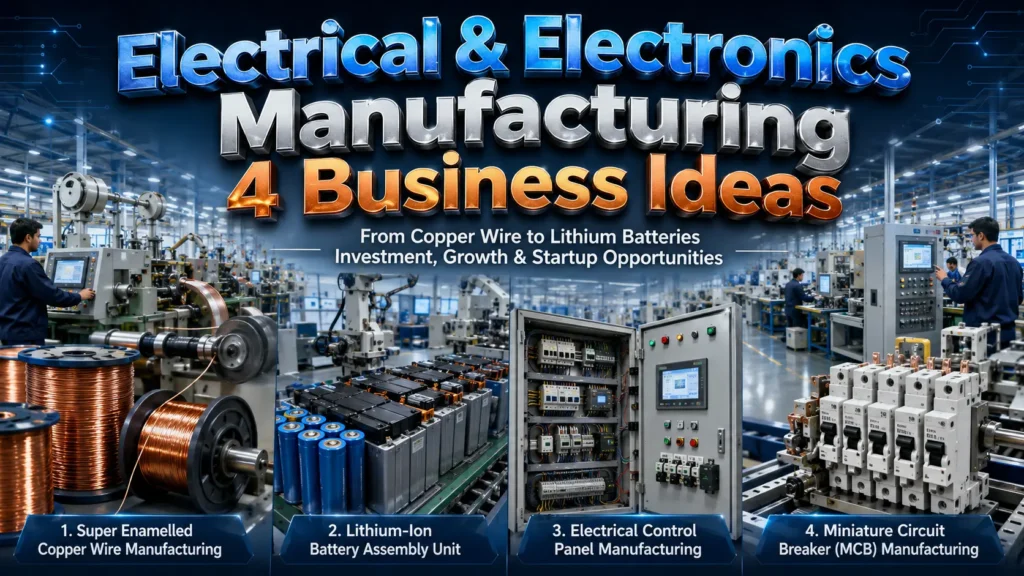
Electrical & Electronics Manufacturing Business For those who are looking around for business ideas with a long-term horizon, it is a good idea to take a second look at India’s electrical and electronics manufacturing base, because it is one of the most significant changes that the industry is currently undergoing. The reasons are not philosophical. Wiring and protection devices are required on every new residential tower; batteries packs are required for every electric two-wheeler, control panels are required for every industrial shed and every motor rewinding shop requires enamelled copper wire. This article outlines four real manufacturing opportunities – Super Enamelled Copper Wire, Lithium-Ion Battery Assembly, Electrical Control Panels, and Miniature Circuit Breakers (MCBs) – in a way that a consultant would approach when considering a project for a first-generation entrepreneur with practical, feasibility-oriented logic. Why This Sector Deserves Attention Right Now It is unusual and noteworthy that three separate demand curves are converging at the same time. Construction and real estate activities are driving up the demand for control panels and MCBs as distribution boards and protective switchgear are essential for any commercial or residential project prior to its use. At the same time, the electric mobility transition is generating a completely new supply chain for components: lithium-ion cells and battery packs—an industry that existed only in small quantities a decade ago. But there is an undercurrent to these, the simple enamelled copper wire, which is used in almost every motor, transformer and generator the country produces and whose consumption goes hand-in-hand with industrial growth and investment in infrastructure, rather than any one trend. The mix is appealing from a profitability perspective on a few reasons: It covers both established, cash-generating businesses (copper wire and MCBs) and growth businesses that offer more opportunity for new entrants (battery assembly and control panels for niche applications). A consultant who reviews this area will consider raw material cost pass-through, as well as the trust of the brand in products where safety is a critical issue, and the ability to service the OEM client on a recurring basis — and all three points would find electrical manufacturing to be reasonably defensible once a unit has proven themselves. There is another export aspect: Indian products such as wiring, panels and battery packs are increasingly selling in the African, Middle East and South Asian markets, where Indian products that are price competitive and reasonably certified are well-positioned against higher-priced options. Related Article: How to Start an Electrical Manufacturing Business in India – Profitable Ideas & Complete Guide Government Policies and Incentives Supporting New Entrants Entrepreneurs may not be aware but policy support for this sector is more widespread than they imagine and can substantially alter the economics of a project if used correctly. The Production Linked Incentive (PLI) for Advanced Chemistry Cell (ACC) battery storage has secured significant investments in large-scale Lithium-Ion Batteries (LIB) manufacturing in India, while the smaller battery pack assembly units indirectly benefit from the cell ecosystem being nurtured by the PLI scheme. The PLI scheme for White Goods and the overall PLI for electronics manufacturing similarly provide benefits for component suppliers that supply to the larger assembly business, such as control panel and switchgear component suppliers. On the borrower’s side, there is a credit guarantee scheme and the assistance of the Ministry of MSME for collateral-free loans provided to a first-time entrepreneur, which makes it a lot easier to avail the working capital without pledging family property and availability of interest subvention schemes that reduce the cost of the term loans for plant and machinery. The FAME and then the EV linked incentive program by the government of the country known as Ministry of Heavy Industries has benefited indirectly the demand for Lithium-ion battery assembly by providing subsidy to end-vehicles, which trickles down to the supplier of components. State-level industrial policies, especially in the states that actively promote the electronics and EV component industries, often add on power tariff concessions, stamp duty exemption, and capital subsidy. Eligibility details are updated periodically; therefore, readers can check scheme details directly on the Ministry of MSME portal for authentic and updated scheme details. Multiple Business Ideas for Startups in This Sector 1. Super Enamelled Copper Wire Manufacturing Super enamelled copper wire is the “plain vanilla” of the electrical motor and transformer industry, and this is why it’s a viable business venture for a serious entrepreneur and not a hobby. The product consists of copper conductor covered with a number of layers of enamel (polyester, polyesterimide or polyamide-imide) which are applied to the conductor by a continuous line of wire-drawing and enamelling, and then baked in ovens to the dielectric strength and thermal class desired by applying the end-user. The range of real-world applications is vast, including domestic and industrial motors, transformers, generators, relays, solenoids and household appliances, and is far from seasonal like some customer types. An important manufacturing tip is that most quality complaints come at the enamelling oven stage of the process and not at the wire drawing stage, so it’s important to budget enough for a sure-fire multiple pass enamelling machine, not the wire drawing. One of the key raw materials, which is subject to price volatility, is Copper wire (rod) used in electrolytic production and Enamel varnish used for coating the wires, which are sold to customers on a formula basis. Motor rewinding industry, OEM transformer manufacturers, fan and pump industry, the motor rewinding industry is a major consumer of copper wire and the fan and pump industry is a major user of copper wire, and the motor rewinding industry is a major demand driver for copper wire, and because copper wire is an actual input and not discretionary, the revenue can be tracked fairly closely with the industrial production data. Processing efficiency and working capital discipline are most important factors affecting profitability in this category, as copper content is significant in determining the overall cost, and a well-run processing unit with a consistent quality certification can benefit from