
Top 20 Manufacturing Business Ideas in Odisha with High Growth Potential

Manufacturing business ideas in Odisha Odisha has quietly emerged as one of the most attractive manufacturing locations in India. This state now provides a unique mix for those who are looking into their business ideas with a capital of ₹15 crore — abundant natural resources, fast-improving industrial infrastructure as well as a very aggressive government policy to encourage investment pulling in. From a first-generation entrepreneur to an MSME promoter seeking diversification, the manufacturing business scenario in Odisha is expanding across various industry sectors that may not have been taken seriously until now. Strategically located near the important mineral belts, Odisha has three major ports (Paradip, Dhamra, Gopalpur) and a coastal geography that allows for export logistics. The Odisha Industrial Development Corporation (IDCO) has been developing more than 50 industrial estates and parks in various important districts of the state which are equipped with plug and play infrastructure for new manufacturing units, according to the corporation. Combine these with the fact that the population is over 45 million, the consumer class is expanding, and the road and rail infrastructure is improving and you have the makings of a manufacturing company that has the potential to grow significantly over the next five to seven years after commission. This article discusses 20 potential manufacturing projects which are ideal for the investment range of ₹ 15 crores. These business ideas have been screened using a criterion of feasibility, namely access to raw materials, the demand for the business, policy support, and the logic of profitability. Why Odisha Is a Smart Location for Manufacturing Business Even the investors still prefer to go for Gujarat or Maharashtra for manufacturing business planning. It’s a natural instinct but one that is also becoming more expensive: land value has skyrocketed, labour costs have skyrocketed, and competitive density has skyrocketed in those states. The state of Odisha, on the other hand, has prospered in a quiet and effective manner. The State of Odisha, on the other hand, has been growing quietly and effectively. The Indian Bureau of Mines (IBM) shows that Odisha has almost 25% share of the country’s total iron ore reserves and has a significant advantage in the distribution of reserves of chromite, bauxite, coal and manganese – which is a mineral asset that is not found in any other states of India in the same quantity. These mineral reserves are not only for big steel and aluminium companies. They develop a whole downstream system – processed minerals to industrial chemicals, precision components, refractory products – which can be profitably entered by smaller manufacturers having ₹10-20 crore revenue. Moreover, the industrial policy of the Odisha government provides you with land at subsidised rate in the industrial parks, capital investment subsidy and power tariff concession which all directly reduces your operating cost. The Ministry of Commerce & Industry, Government of India data reveals an uninterrupted growth rate in the year-on-year trend of investments in industries in Odisha. Enhancement in ease of doing business and improved single window clearance has also driven growth in the state’s MSME sector. Government Policies and Incentives That Make Manufacturing Business Viable The Odisha Industrial Policy offers detailed incentives for both MSMEs and big manufacturing establishments. With just a few schemes available for a project that is worth ₹15 crore. Perhaps the greatest leverage is the state capital investment subsidy on fixed capital investment of 20-40%. This cuts your equity requirement and increases ROI. Further, you benefit from VAT/GST concession, electricity duty exemption for the first 5 years and stamp duty waiver on land purchase in Industrial Estates which further helps bring down your set-up cost. The Ministry of MSME has established Credit Guarantee Fund Trust for Micro and Small Enterprises (CGTMSE) at the national level, which provides for collateral-free loan facility of up to ₹5 crore. The Production Linked Incentive (PLI) scheme under DPIIT includes 14 industries, most of them with good presence in Odisha such as food processing, textile, specialty chemicals etc. The Make in India initiative has also simplified environmental/ factory clearance for manufacturing units located in the notified areas. The time and cost of commissioning is minimized with ready infrastructure from Industrial Development Corp of Odisha at its various clusters such as Kalinganagar, Jharsuguda and Parasdep SEZ. Also, the National Bank for Agriculture and Rural Development (NABARD) provide refinance schemes and direct credit to agro-processing and food manufacturing units in Odisha — which is a significant source of support for food-sector entrepreneurs. 20 Manufacturing Business Ideas in Odisha at ₹15 Crore Investment 1. Sponge Iron Manufacturing There are more sponge iron plants in Odisha than anywhere else in India. This is because Odisha is the largest concentration of sponge iron plant in India. Keonjhar and Sundargarh are the two districts which have rich deposits of iron ore. The Ministry of Steel, Government of India has published data on direct reduced iron (sponge iron) which portrays India is the largest producer of direct reduced iron (sponge iron) in the world, and Odisha contributes a major chunk of the total capacity of the country. The investment required for a small scale (50000 TPA) sponge iron plant is within the range of ₹12–15 crore. Sponge iron is still in demand as it is a raw material for small steel re-rollers and induction furnaces. Margins are closely related to iron ore procurement expenses, giving Odisha an edge. But any entrepreneur will have to properly invest in the pollution control system and waste heat recovery system to comply with the norms while minimizing the cost of fuel. 2. Ferro Alloys (Ferro Manganese / Silico Manganese) Ferro alloys are essential inputs for steelmaking and that Odisha is endowed with deposits of manganese ore which gives it a clear upstream advantage. The cost of establishing a Ferro Alloy Plant of medium size (10,000-15,000 TPA) will require around ₹13-15 crore. A steady demand exists for these products from Japan, South Korea and Europe, which are steelmakers. According to data collected by Ferro Alloys Producers’ Association of India (FAPA),
Manufacturing Business Ideas in Tamil Nadu: Best Opportunities Under ₹1 Crore
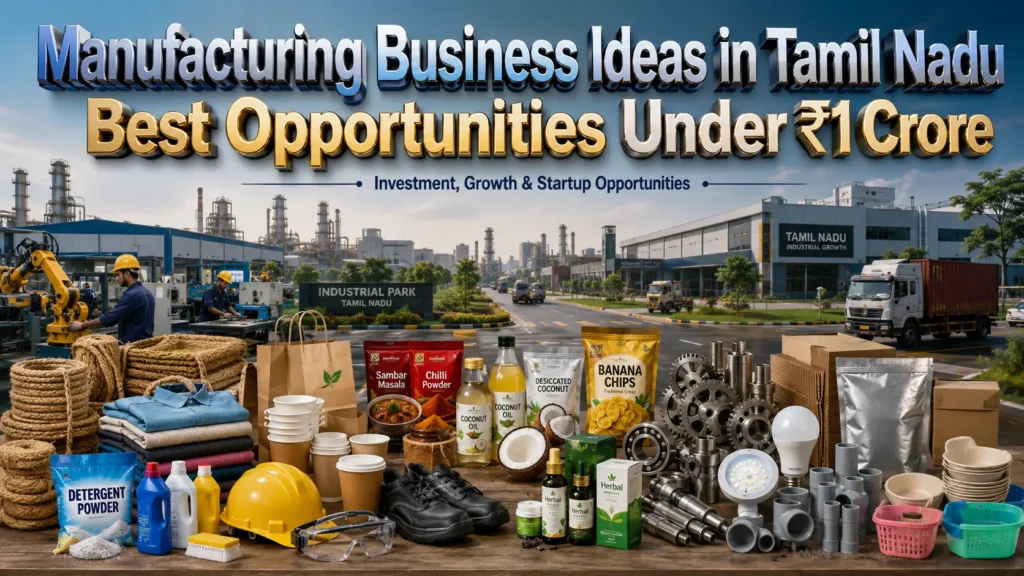
Manufacturing business ideas in Tamil Nadu Tamil Nadu is now one of India’s most powerful manufacturing states and entrepreneurs with ₹1 crore in their pocket have more business ideas that are real than in any other part of the country. The state has a mix of port facilities, skilled workers, and a rich network of suppliers that most first-timers fail to recognise until they begin to survey land. To build a new unit in Chennai, Coimbatore, Tiruppur or Hosur does not require a strong demand base to be created. As Chennai, Coimbatore, Tiruppur and Hosur already have established the demand base for the global supply chain, a new unit can be set up at these locations without facing any difficulty in creating demand. It just needs to connect to the existing. This article dissects where the real scope lies, which government schemes are effective at cutting down your capital expenditure, and which particular manufacturing lines make sense at an investment of ₹1 crore. The objective is not a wish list, but a practical decision making. Get Detailed Project Report (DPR): Tamil Nadu Business Opportunities Guide Why Tamil Nadu Is the Right Base for This Investment The production share of Tamil Nadu in India is one of the highest in the manufacturing sector, which isn’t a coincidence. For decades, the state has been spending money on developing industrial corridors and power plants and on vocational training colleges that churn out skilled manpower for the factories. Thus, a founder who establishes here can save time in training employees and more time in production stabilisation. Access to exports is also important. A significant proportion of India’s exports are carried by Chennai and Tuticorin ports, reducing the cost of logistics for those who produce components, textiles or processed foods for export to international markets. Further, the cluster system in Tamil Nadu reduces working capital cycle as raw material suppliers, job-work vendors and testing labs are within a 50-kilometre radius. Government Policies and Incentives Supporting New Units There are a handful of schemes that directly decrease the effective amount of money that a founder has to invest. For those who have only ₹1 crore in their bank account, the credit guarantee fund trust for micro and small enterprises (CGTMSE) with collateral-free loans up to a defined limit is significant, and the Prime Minister’s Employment Generation Programme (PMEGP) is crucial for financing new manufacturing units by the ministry of MSME. The Production Linked Incentive (PLI) scheme, under the Department for Promotion of Industry and Internal Trade (DPIIT), incentivises certain industries such as textiles and electronics for increasing their production and Tamil Nadu’s own state industrial policy also includes capital subsidy, stamp duty concession and power tariff relief. They should also visit Tamil Nadu Industrial Guidance Bureau to obtain single window clearance which takes away a significant portion of the delay in approvals that regularly drains the first year. The Ministry of MSME website provides the scheme details with eligibility and caps on subsidy for each of these schemes. Multiple Business Ideas Worth Evaluating Textile Weaving and Processing Unit Tamil Nadu also has a significant production of cotton yarn and knitwear – especially in Tiruppur and Coimbatore – and so a weaving or processing unit here exists within a pre-existing ecosystem rather than on the fringes. A mid-scale weaving unit, with dyeing and finishing capacity, and with a businessman with a capital of ₹1 crore, can start it with a selling price of direct transaction with export houses who are already procuring from the local market. Margins are far more related to the type of fabric and generally with processed cotton fabric, the realisation is higher than that of raw yarn trading, which makes it a better option for the new entrants than actually spinning. Read the Complete Book Here: The Complete Technology Book on Textile Spinning, Weaving, Finishing and Printing Auto Components and Precision Machining Hosur and Chennai have a high concentration of auto and auto-ancillary manufacturing facilities, resulting in consistent and recurring demand for precision-machined parts. A job-work unit based on CNC can have two or three machines that can be expanded as quality certificates are received and order volumes increase with the budget of ₹1 crore. Geography is also a competitive advantage for the founders outside Tamil Nadu as OEMs like to use vendors in the vicinity of their assembly lines. Food Processing: Millets and Spice Units There has been a significant increase in the demand for processed millets, as they are being sold to the health-conscious consumers, and agricultural belt of Tamil Nadu is providing raw material at competitive rate. Modest machine investment is required to set up a cleaning, milling and packaging plant for millets or regional spices, which can be utilized by the retail markets as well as the institutional markets. Founders need to invest in good moisture control and packaging equipment, since shelf-life and packaging quality are important factors for repeat orders. Related Article: Semiconductor & Electronics Manufacturing in India: MSME Entry Points, Realistic Costs, and Where the Real Money Is Leather Goods Manufacturing The leather industry is one of the oldest clusters in India and the area of Vellore and its surrounding areas has developed its tanning facilities and artisans. Having a ₹1 crore unit manufacturing finished leather goods, instead of raw leather tanning, greatly reduces the costs of environmental compliance and still provides lucrative margins for export products such as leather bags, leather belts and leather components for shoes. Explore This Book: Leather Processing & Tanning Technology Handbook Electronics Assembly Using SMT Lines Under the PLI push, electronics manufacturing is gaining momentum with Tamil Nadu already having several electronics parks. This budget is suitable for a smaller assembly, using SMT, unit that specializes in sub-components or contract assembly with larger OEMs and can make a profit if that stable anchor client is found prior to investing in the entire line of SMT machinery. Import-Export Opportunity for New Manufacturing Startups The ports of Tamil Nadu receive significant volumes