
Bio-Based Hybrid Leather: Business Ideas, Market Opportunity, and the Green Manufacturing Revolution in India
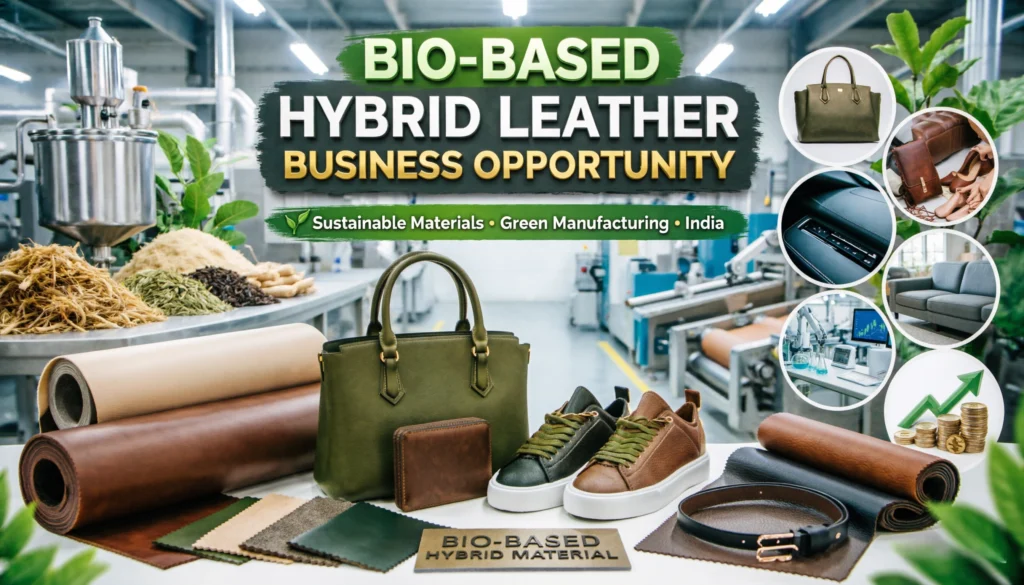
Bio based hybrid leather is one of the most promising material innovations of the last decade for a first-generation entrepreneur or MSME founder looking for business ideas that are equally sustainable and profitable. It is cruelty-free, biodegradable, and has become more cost effective to produce, all while being a demand of global brands who have pledged animal-free supply chains. India has a vast agro-waste base, a strong manufacturing base for textiles and a government that has taken an active stance to encourage green production, making it a perfect position to lead the way in this area globally. That’s an opportune moment. Bio-based hybrid leather isn’t just vegan leather. It is an advanced form of material with plant-derived fibres or bacterial cellulose or mycelium, which are mixed with bio-polymers or natural binders to create composites with mechanical characteristics and durability comparable — and in some cases superior — to animal hide. That’s the “hybrid” part that’s important: They are made using a combination of several biological sources and processing methods, which enable manufacturers to adjust the end product for different uses, such as fashion accessories, automotive interiors, and premium footwear. Check Out This Recommended Book: Leather Processing & Tanning Technology Handbook Why This Sector Is Growing Faster Than Expected The global bio-based leather market has come a long way from the experimental stage. According to several market intelligence reports, the market is growing at a CAGR of more than 13% owing to the paradigm shift in global brands’ way of thinking about material procurement. The EU Green Deal calls for the elimination of chromium tanned hides and the limiting of synthetic leathers made from high carbon.The EU Green Deal requires the removal of chromium tanned hides and the limitation of synthetic leathers made from high carbon. German, French, and Italian major fashion brands and carmakers are keen on sourcing mycelium and pineapple-fibre products. The total market of synthetic leather, which includes bio-based, PU and PVC varieties, would have reached India’s own size of approximately USD 3.3 billion in the coming decade. The Bio-based products is the highest growth segment. The brands already have some in the domestic market such as Allen Solly who has introduced PETA-approved vegan handbag collections made from bio-based apple and cactus leather, which are a strong indicator that Indian consumers are ready for this category on a large scale. Export-ready MSME leather units with bio-based leather EBITDA margins range from 18-25% after volumes are settled. That’s an interesting number for any entrepreneur who contrasts that with margins that are commonly in single digits with traditional textile production. Government Policies and Schemes Supporting This Business The overall policy framework for manufacturing bio-based hybrid leathers in India is very enabling, involving several ministries and schemes. Indian Footwear and Leather Development Programme (IFLDP) The IFLDP is a initiative of the Ministry of Commerce under DPIIT directly working on supporting the technology up-gradation in the leather ecosystem. Financial assistance in MSME units is provided at 30% of the cost of plant and machinery and for the units in Northeastern States it is available up to 40% of the cost of the plant and machinery. The Integrated Development of Leather Sector (IDLS) sub-scheme has an outlay of ₹500 crore. Start-ups using bio-polymer coating or fibre extraction equipment and investing in bio-based hybrid leather can directly benefit. All details are available on the National Single Window System portal: www.nsws.gov.in. BioE3 Policy and Make in India High-performance bio-based manufacturing is also explicitly supported under the BioE3 Policy, Department of Biotechnology. Bio-based hybrid leather (made by processing plant fibres or by growing mycelium or bacterial cellulose) is clearly within the scope of BioE3. Advanced materials are also recognized as priority sectors of manufacturing under the Make in India programme initiated by DPIIT. To avail the DPIIT recognition, founders should register on Startup India and avail income tax exemption for 3 years successive and fast track clearance from various regulatory authorities. MSME Credit and Subsidy Support The Ministry of MSME offers loans under the Prime Minister’s Employment Generation Programme (PMEGP) for the first-generation manufacturing entrepreneurs with subsidy. New founders’ main hurdle is eliminated when they can borrow through collateral-free lending by CGTMSE. The Council for Leather Exports is also a valuable source of export facilitation support and market intelligence on international buyer requirements for entrepreneurs. View Full Project Details: Leather, Leather Goods & Tanning Industry Handbook Manufacturing Business Ideas in Bio-Based Hybrid Leather 1. Agro-Waste Fibre Extraction and Bio-Leather Sheet Manufacturing The most basic manufacturing opportunity in this business is to obtain raw bio-leather sheets from agro-waste. Pioneer startups have transformed large amounts of banana stem waste, pineapple leaf fibre, coconut husk, and sugarcane bagasse into leather composites, all with tremendous potential to transform.The startups have turned a huge volume of banana stem waste, pineapple leaf fibre, coconut husk, and sugarcane bagasse into leather composites with great potential. The cost of agrowaste fibre extraction equipment, slurry preparation system and coating machine would be around ₹15–30 lakh for a founder starting an agro-waste fibre extraction unit. The extracted fibre slurry is used in mixing natural binders, bio-polymers and finishing agents to make fibres sheets which are being supplied to bag, footwear and automotive upholstery manufacturers. The costs of agro-waste are much less than that of petrochemical inputs and most Indian states have agricultural surplus at a nominal rate. This model is being supported by the cluster development programmes of the Ministry of MSME, which provide technical and financial support for agro industries. 2. Mycelium Leather (Mushroom Leather) Production Unit Mycelium-based leather — grown from the root structure of fungi — is one of the most exciting innovations in this space globally. In India, this remains a largely untapped production segment even though agricultural waste substrates are widely available. A mycelium leather production unit operates on a fermentation-and-harvest cycle: agricultural waste is inoculated with fungal spores, grown into a dense mat, harvested, heat-treated, and processed into leather-like sheets. Capital requirements are moderate — a small-batch unit can