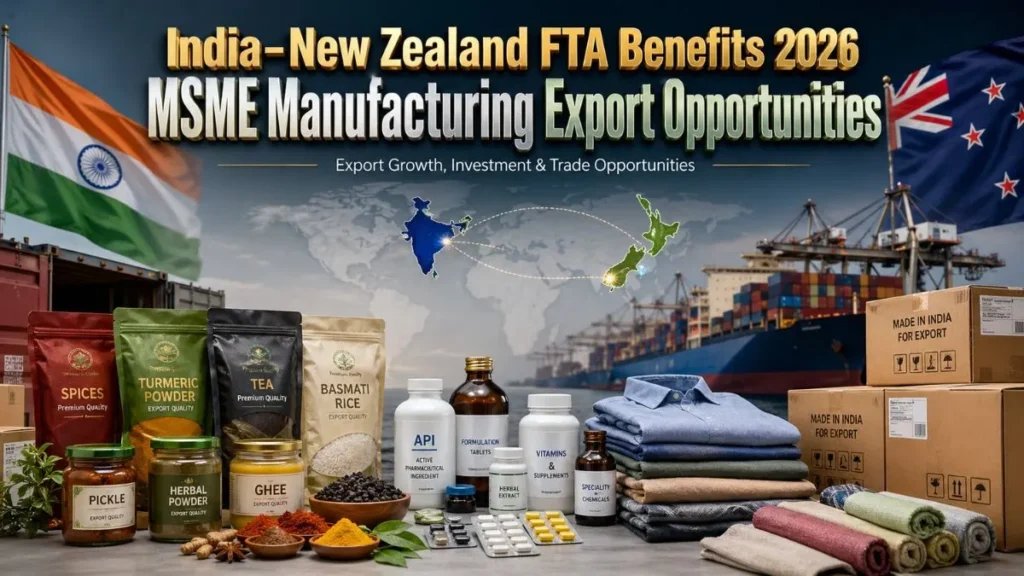

Introduction: India New Zealand FTA MSME export opportunities
The Free Trade Agreement (FTA) signed between India and New Zealand is a major trade opportunity for Indian MSME manufacturers. This FTA differs from many other traditional trade agreements, which confer a limited level of benefit, in that it provides almost fully duty-free access to Indian products in New Zealand.
This agreement offers MSME manufacturers in leather, processed food, engineering products and herbal products a new export opportunity. But the key to success is readiness for quality control, certification, and exporting.
This is more than a policy shift; it is an opportunity for Indian small manufacturers to be more competitive.
Related Article: India–New Zealand FTA 2026: Key Export Sectors and MSME Opportunities
What the India–New Zealand FTA Actually Changes
On the surface, the deal eliminates duties on most Indian exports to New Zealand. Indian exporters used to pay duties ranging from 5% to 10% which put them at a disadvantage compared to other exporters.
This is no longer the case.
Key structural changes include:
- New Zealand has removed tariffs from almost 100% of the tariff lines
- India has liberalised a substantial part of its market but has safeguarded sensitive areas
- Trade between the countries is set to increase from the current USD 1.3 billion
These may seem macro in nature but the impact is at the MSME level where prices, margins and competitiveness go up immediately.
Why MSMEs Should Take This Seriously
The pact is not just for exports for MSME manufacturers, but it is about re-entering the market. Earlier slightly premium products are now competitively priced.
But this doesn’t guarantee success. New Zealand is a highly regulated market and buyers are concerned with:
- Product consistency
- International certifications
- Factory audits
- Packaging and labelling
In other words, no tariffs, higher quality.
For MSMEs, early recognition of this is key.
Leather and Footwear Industry: A Strong Export Opportunity
The leather industry in India, particularly in Agra, Kanpur and Tamil Nadu, can take advantage of this. Previously, a 5% duty made exports less competitive in the NZ retail market. The FTA eliminates this handicap.
The export of leather wallets, belts, handbags and shoes become more viable.
Key advantages for MSMEs:
- Good availability of raw materials in clusters
- Export experience in many units
- Growing demand in high end retail
But New Zealand buyers demand high standards and consistency. Even minor defects can lead to rejection of consignments.
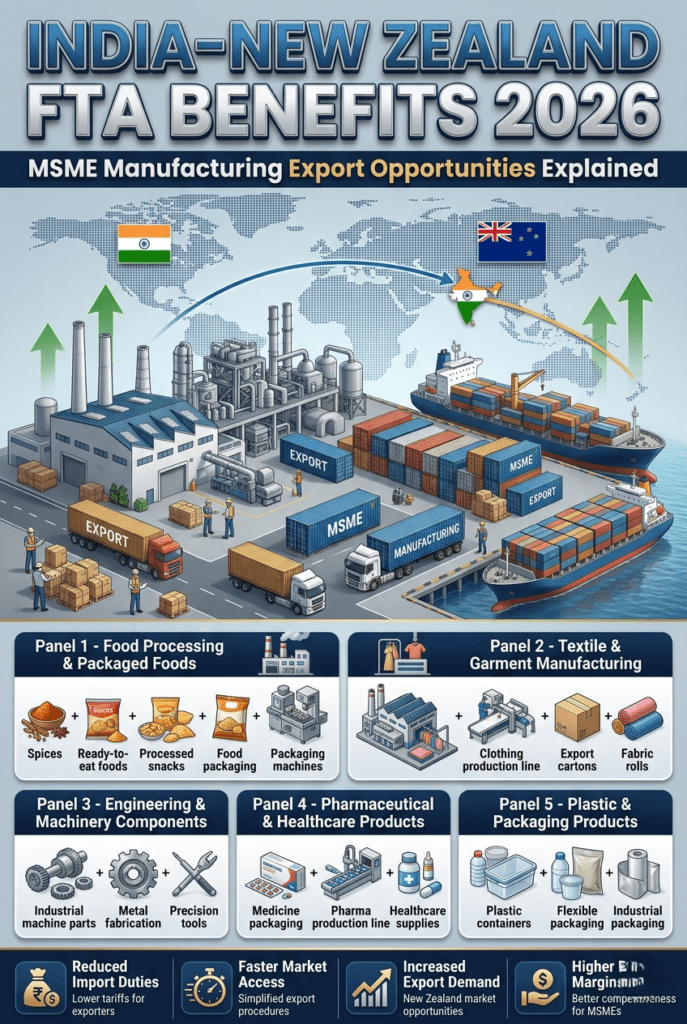
Processed Food and Spices: A Demand-Driven Sector
Spices and processed foods are already a major export product for India. The FTA will enhance this by eliminating import tariffs.
This is an attractive market as the Indian diaspora in New Zealand provides a ready market.
High demand products consist of:
- Masalas and spices
- Ready-to-eat meals
- Prepared ethnic foods
- Organic and natural food items
However, exporters have to conform to Food Safety norms.
Minimum requisites for export:
- FSSAI certification
- Hygienic processing standards
- Export-grade packaging
- Phytosanitary compliance
Without this even the best food products don’t reach to market.
Get Detailed Insights from This Book: Handbook on Spices
Engineering Goods: Competing on Quality, Not Price Alone
Indian engineering and auto components MSMEs already enjoy a good international reputation. The FTA opens the door for them to access New Zealand’s industrial sector duty free.
These include parts for agricultural equipment, industrial equipment and mechanical components.
Why this sector is promising:
- Many engineering parts are imported into New Zealand
- There is a growing need for suppliers
- Businesses are looking to spread the risk of sourcing from one country
But the competition is on quality, not price.
MSMEs must invest in:
- ISO certification
- CNC machining capabilities
- Quality testing systems
Barring these, it is hard to penetrate this market.
AYUSH and Herbal Products: A High-Margin Export Segment
Perhaps the most intriguing aspect of the FTA is the acknowledgement of traditional and AYUSH systems of medicine. This opens up a niche for export for health products.
Increased market demand for natural products across the globe and in New Zealand as well.
Opportunities in this segment:
- Herbal supplements
- Ayurvedic wellness products
- Natural health formulations
Key compliance requirements:
- AYUSH GMP certification
- Scientific documentation of formulations
- Correct claims and labelling
High profit margins but also high regulatory risks.
Get Detailed Project Report (DPR): Comprehensive Guide to Herbal and Ayurvedic Products
Investment Planning for MSMEs
The most common failure of MSMEs in export is unplanned investment. The FTA provides opportunity, but investment planning is key to success.
Prior to entering the market, MSMEs should define:
- Demand for their product type
- Costs of certification and regulations
- Production scalability
- Export logistics expenses
- Expected profit margins
Without knowing this, even a great opportunity can be distressing.
Why Feasibility Study Is Critical Before Entering Export Markets
Export markets are not like local markets. Competitive pricing does not automatically lead to sales – compliance, consistency and documentation are as important.
This is where business consultancy services can assist.
Companies such as Niir Project Consultancy Services (NPCS) help MSMEs to plan a project by creating reports and feasibility studies.
They offer services such as:
- Market survey and analysis
- Plant setup planning
- Machinery selection guidance
- Estimation of financials and profit
- Export readiness assessment
The feasibility study will help a first-time exporter to make effective decisions and minimize risk.
Identify high-growth industries before others do
Conclusion: Opportunity Is Real, But Execution Matters More
Real opportunities exist for Indian MSMEs under India-New Zealand FTA for exporting the products from Leather, food processing, engineering and AYUSH sector to New Zealand, because the duty elimination increases the export competitiveness and access to new markets.
But this is not a sure-fire win.
New Zealand is a quality- and compliance-driven market where customers expect quality, documentation and reliability. MSMEs that approach export as a business system rather than a sales channel will be successful.
Put simply, the FTA provides access, but it is up to you to see how far you can reach within it.
Frequently Asked Questions (FAQ)
- What’s the key advantage of the India-New Zealand FTA for MSMEs?
100% duty-free access which improves price competitiveness in the New Zealand market.
- What are the most promising sectors for MSMEs to export?
Leather, processed food, engineering products and AYUSH products have the greatest potential.
- Do I need to be certified to export to New Zealand?
Yes, depending on the products concerned, certifications like FSSAI, ISO 9001, AYUSH GMP is needed.
- What is the investment needed to begin exporting?
It varies for different industry types, but ranges from 40 lakh to 1.5 crore and higher depending on the scale.
- What support does NPCS offer to MSMEs?
NPCS offers feasibility studies, project reports and export advice to establish profitable manufacturing and export units.