
Ink Manufacturing Process for Printing & Industrial Applications | How Ink is made for Writing, Printing, Offset & Inkjet.
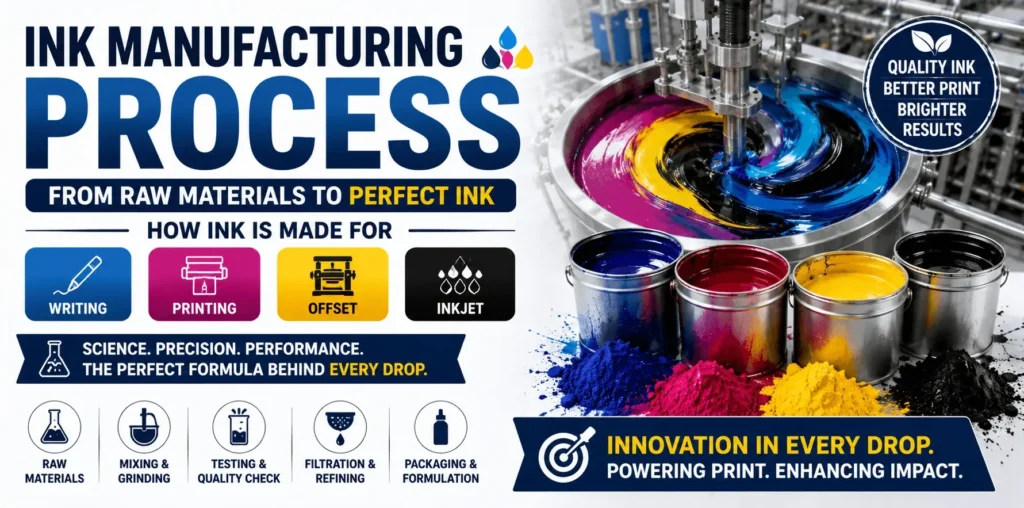
The ink manufacturing process is a sophisticated industrial procedure involving pigments, binders, solvents, additives, and advanced processing technologies to produce inks used in writing, printing, packaging, publishing, and industrial applications. Ink is an essential component of communication and artistic expression. Ink has a significant role in human history from Traditional pen inks to modern offset and inkjet printing systems, inks play a vital role in communication, branding, and commercial printing industries. Modern printing ink manufacturing combines chemistry, material science, and precision engineering to create products with high color consistency, durability, drying performance, and print quality. Different ink formulations are developed for offset printing, gravure printing, flexographic printing, screen printing, and digital inkjet applications. Offset Ink Manufacturing Process Offset printing inks are oil-based formulations designed for commercial high-speed printing applications. The process involves pigment dispersion, varnish preparation, milling, viscosity adjustment, filtration, and quality testing for smooth printing performance. Printing Ink Manufacturing Process Printing ink manufacturing involves mixing pigments, solvents, binders, and additives followed by dispersion, milling, filtration, and packaging to create industrial-grade printing inks. Inkjet Ink Manufacturing Process Inkjet ink manufacturing requires ultra-fine particle control and filtration to ensure smooth flow through printer nozzles without clogging. Water-Based Ink Manufacturing Process Water-based inks use water as the primary solvent and are widely used in eco-friendly packaging and flexographic printing applications. Gravure Ink Manufacturing Process Gravure inks are low-viscosity solvent-based inks used in packaging, magazines, decorative laminates, and publication printing industries. The Science Behind How Ink Is Made The process of how ink is made combines a rich blend of art, chemistry, and technology. Ink is not just a simple fluid with color; it is a carefully engineered product designed to meet specific demands based on its application—whether for writing, printing, or painting. The quality and composition of ink vary depending on the medium it is used with, such as pens, offset printers, or inkjet printers. Key Raw Materials Used in Ink Production The primary materials required to manufacture ink fall into four main categories: colorants, binders, solvents, and additives. Each of these components, moreover, plays a crucial role in determining the ink’s behavior, color consistency, and longevity. In particular, colorants define the hue and vibrancy, while binders ensure the pigment adheres to the surface. Meanwhile, solvents control the ink’s flow and drying time, and finally, additives enhance specific properties such as UV resistance, gloss, or durability. 1. Colorants (Pigments and Dyes) Colorants are the agents responsible for the ink’s hue. There are two main types: pigments and dyes. Pigments are finely ground particles that remain suspended in the binder, providing opacity and UV resistance. Dyes, on the other hand, dissolve in the liquid medium, offering brighter and more vibrant colors, though they are often less fade-resistant. Examples of pigments include: Carbon black (for black ink) Titanium dioxide (for white ink) Phthalocyanine (for cyan and green tones) Common dyes include: Eosin (red) Methylene blue Acid yellow 2. Binders Binders are substances that hold the pigment particles together; moreover, they ensure proper adhesion to the paper or printing surface. In the ink industry, typical binders include natural gums, resins, or synthetic polymers. The choice of binder is critical; in fact, it can significantly influence properties such as drying time, durability, and glossiness of the ink. Therefore, manufacturers must carefully select binders based on the desired performance characteristics. Examples: Shellac Alkyd resins Acrylic resins Polyvinyl acetate 3. Solvents Solvents help to dissolve or disperse the ink ingredients and adjust the ink’s viscosity. Depending on the type of ink being produced, the solvent can either be water-based or oil-based. The volatility of the solvent also influences how quickly the ink dries. Examples: Water (used in most modern inkjet and eco-friendly inks) Ethanol Isopropyl alcohol Petroleum distillates 4. Additives Additives are optional ingredients added to modify specific properties of the ink. These include agents for improving flow, preventing clogs, enhancing UV resistance, or providing waterproof capabilities. Common additives include: Surfactants (for reducing surface tension) Dispersants Preservatives Defoamers UV stabilizers Step-by-Step Ink Manufacturing Process The manufacturing process of ink is both art and science, involving mixing, dispersion, milling, filtering, and packaging. Below is a breakdown of the primary stages in ink production: 1. Formulation and Mixing The process starts with selecting the appropriate raw materials and measuring them precisely. The pigments, binders, solvents, and additives are weighed based on the type of ink and its intended use. These materials are then mixed in a large batch mixer. The goal at this stage is to ensure the preliminary blending of components. 2. Dispersion of Pigments Since pigments are insoluble particles, they must be evenly dispersed throughout the mixture. This is achieved using high-speed dispersers or bead mills. Proper dispersion ensures that the ink maintains a uniform color and texture without clumping or settling. This is one of the most crucial steps when ink is made because poor dispersion can lead to quality issues like streaking, clogging, or inconsistent color application. 3. Milling and Grinding After dispersion, the ink mixture is subjected to a milling process using three-roll mills or ball mills. This step further breaks down pigment particles to micron or even nanometer sizes. The smaller the pigment particle, the smoother and more consistent the ink’s application. The milling process also enhances the ink’s gloss, transparency, and drying characteristics. It’s during this step that the full potential of the ink is unlocked. 4. Filtration Subsequently, once the ink has been milled to the desired fineness, it is carefully filtered to eliminate any unwanted solid residues or large particles. As a result, the ink remains stable over time and does not clog fine nozzles in printers or pens. 5. Quality Control Testing Before packaging, the ink undergoes rigorous quality control tests. Parameters such as pH, viscosity, color consistency, drying time, and rub resistance are measured. If any of these values fall outside acceptable ranges, adjustments are made to the formulation. For example: pH is adjusted using acids or bases Viscosity is changed by adding solvents or thickeners Color matching
Project Profiles to Start a New Enterprise and Select Your Own Industry
Establishing an industry is a dream for many aspiring entrepreneurs and investors. Whether it’s a small-scale manufacturing unit or a large-scale industrial complex, every successful venture begins with a solid foundation—and at the heart of that foundation lies a well-crafted project profile. These documents not only provide clarity but also guide decision-making and resource allocation. In essence, project profiles are indispensable blueprints that can transform a vision into a tangible business reality. Understanding the Importance of Project Profiles Before diving deep into the industrial journey, it’s essential to understand what project profiles actually are. A project profile is a concise document that outlines the essential aspects of a business idea or industrial project. It provides insights into the proposed activity, including objectives, investment requirements, technical details, operational plans, market potential, risk factors, and projected returns. These profiles serve multiple purposes. For startups and SMEs, they help evaluate feasibility and financial viability. For investors and lending institutions, project profiles offer the data needed for funding decisions. Moreover, government bodies and policy-makers use them to assess proposals for subsidies, permits, and development support. Thus, preparing comprehensive and realistic project profiles is the first strategic step toward building any dream industry. See Also: Wooden Furniture Manufacturing Key Elements of an Effective Project Profile An impactful project profile is more than just a description. It must be detailed, data-driven, and tailored to the specific sector. Here’s a breakdown of the most vital components: 1. Executive Summary This section provides a snapshot of the entire project. It briefly touches on the business idea, objective, target market, and expected benefits. The executive summary is crucial because it sets the tone and determines whether stakeholders will read further. 2. Introduction and Objectives Clearly explain what the project is about and its primary objectives. Why is this industry needed? What problem does it solve? How will it contribute to the local economy or employment? 3. Market Analysis Conduct a thorough market survey and present findings. Include details like demand and supply trends, competitor analysis, target audience, pricing strategies, and distribution channels. A strong market section strengthens the profile’s credibility. 4. Technical Feasibility Detail the technical aspects of the project—plant location, infrastructure requirements, production capacity, machinery, raw material sources, and technical know-how. This section helps establish how the business will function on the ground. 5. Financial Projections Financial viability is at the core of any business. This section includes capital investment, operational costs, break-even analysis, profit margins, return on investment (ROI), and cash flow forecasts. Proper use of charts, tables, and ratios improves clarity. 6. Organizational Structure Describe the proposed structure of the business, including key personnel, management hierarchy, and staffing requirements. An efficient organizational plan ensures smooth operations. 7. Risk Assessment Every industrial venture comes with risks—market volatility, raw material price fluctuations, regulatory challenges, or technological changes. This section outlines potential risks and the mitigation strategies in place. 8. Conclusion and Recommendations Summarize the feasibility and sustainability of the project and recommend the next steps—whether it’s pursuing funding, applying for permits, or starting pilot operations. Benefits of Using Project Profiles Using project profiles during the business planning phase offers numerous advantages. Here are some key benefits: Clarity of Vision: A well-structured profile forces entrepreneurs to articulate their idea with clarity, helping eliminate ambiguity. Informed Decision-Making: With detailed financial and technical data, project profiles facilitate informed choices. Attracting Investment: Lenders, venture capitalists, and government agencies often require a project profile before approving financial assistance or grants. Planning & Execution Tool: It serves as a roadmap for implementation, helping in task scheduling, procurement, hiring, and marketing. Compliance & Approvals: Many licensing authorities and regulatory bodies require a project profile for environmental clearance, land acquisition, or subsidies. How to Create Customized Project Profiles Each industry has its own set of standards, equipment needs, and operating procedures. Hence, a one-size-fits-all approach doesn’t work. Here’s how you can tailor project profiles to suit different industries: For Manufacturing Units Focus on the production process, sourcing of raw materials, quality control mechanisms, and plant layout. Highlight energy usage and environmental impact if necessary. For Agro-Based Industries Include data on seasonal supply of inputs, processing methods, cold storage needs, and linkages with local farmers. Explain how the project aligns with rural development. For Service Industries Provide a clear value proposition, customer service plans, service delivery methods, technology usage, and client acquisition strategies. For Export-Oriented Units Emphasize global market trends, compliance with international quality standards, export incentives, logistics planning, and currency risk management. Tools & Resources for Developing Project Profiles Thanks to digital advancements, creating project profiles is now easier than ever. Several government and private platforms provide free or paid templates. These include: MSME Development Institutes: Offer ready-made project profiles for small industries. Industrial Promotion Agencies: State-level bodies that provide sector-specific guidance. Online Marketplaces: Freelancers and agencies specialize in custom profile creation. Financial Institutions: Banks like SIDBI and NABARD often have standard profile formats. Software Tools: Business plan software like LivePlan, BPlan, and Bizplan helps automate the process. If you’re unsure about technicalities, hiring a professional consultant can ensure your project profile meets industry and funding standards. See Also: Zinc Sulphate Fertilizer Real-World Examples of Project Profiles Let’s consider a few real-world examples to understand the scope: Example 1: Organic Fertilizer Plant Objective: Promote eco-friendly farming.Investment: ?25 lakhsProfitability: Break-even in 18 months with 20% ROIHighlight: Sustainable waste management and government subsidy support. Example 2: Packaged Drinking Water Unit Objective: Meet growing urban demandInvestment: ?45 lakhsProfitability: 30% margin with high repeat salesHighlight: Demand from retail chains and institutions Example 3: LED Bulb Assembly Plant Objective: Promote energy efficiencyInvestment: ?10 lakhsProfitability: Low input cost, high volume salesHighlight: Government’s “Make in India” push and local vendor support Each of these profiles addresses specific market needs and follows a defined structure, making it easier to implement the idea effectively. Tips for Making a Winning Project Profile To make your project profiles stand out, follow these expert tips: Use Visuals: Charts, graphs, and infographics enhance understanding. Stay Realistic: Avoid inflated
New Enterprise Setup – Project Reports/Project Profiles- Emerging Business Opportunities
Starting a small business can be a thrilling yet overwhelming journey. Entrepreneurs often struggle with planning, budgeting, market analysis, and execution. One of the most effective tools that can bridge this gap is a well-structured project profile. Project profiles for small businesses act as blueprints that provide clear, actionable, and ready-to-implement insights into launching and managing a successful venture. These profiles are particularly valuable in India, where micro, small, and medium enterprises (MSMEs) play a crucial role in employment generation and economic growth. Why Project Profiles for Small Businesses Are Essential The initial stages of setting up a business involve numerous challenges—identifying a profitable idea, assessing demand, estimating investment, and planning operations. Project profiles for small businesses help by offering detailed, pre-researched templates that address all critical aspects of a business. These documents often include: Executive Summary Market Potential Analysis Product or Service Description Manufacturing or Service Process Machinery and Raw Material List Manpower Requirements Capital Investment Profitability Projections They essentially fast-track decision-making and minimize risk by ensuring entrepreneurs are well-prepared before diving into business operations. See Also: Baby Diaper Manufacturing Categories of Ready-to-Use Project Profiles The versatility of project profiles for small businesses lies in their adaptability to various industries. Here are some commonly sought-after categories: 1. Food Processing Projects Food processing continues to be one of the most lucrative segments in India and abroad. Some high-demand profiles include: Spice Powder Manufacturing Pickle Making Unit Packaged Drinking Water Plant Tomato Sauce and Ketchup Production These profiles include information on FSSAI licensing, quality control, packaging materials, and profitability estimates. 2. Agro-Based Businesses India being an agrarian economy, agro-based industries offer vast opportunities. Entrepreneurs can explore: Vermicompost Manufacturing Cold Storage for Fruits & Vegetables Dairy Farming and Milk Processing Oil Extraction Units (Mustard, Coconut, etc.) These project profiles emphasize seasonal demand, procurement logistics, and price fluctuations in raw material markets. 3. Chemical and Cosmetic Industry With increasing demand for personal care and hygiene products, this segment offers several small-scale opportunities: Hand Sanitizer Manufacturing Liquid Detergent Plant Essential Oils Production Herbal Soap Making Project profiles typically contain formulations, ingredient sourcing, compliance with chemical safety norms, and market competition. 4. Textiles and Handloom India’s rich textile heritage creates space for both traditional and modern small businesses. Profiles may include: Handloom Garment Unit Embroidery and Zari Work Studio Small-Scale Knitting or Weaving Unit Eco-Friendly Jute Bag Production These profiles guide on labor requirements, design aspects, machinery, and marketing techniques. 5. Paper and Packaging Demand for biodegradable packaging and paper-based products is growing due to environmental awareness: Paper Cup/Plate Manufacturing Corrugated Box Production Notebook and Stationery Making Carton Packaging for FMCG Environmental compliance and sustainable sourcing are major highlights in such project profiles. See Also: Manufacturing Business Idea Benefits of Using Ready-to-Use Project Profiles Whether you are applying for a bank loan, pitching to investors, or simply assessing feasibility, project profiles for small businesses offer multiple advantages: Clarity of Vision:A comprehensive project profile eliminates ambiguity by detailing every aspect of the business. Cost & Time Efficiency:Entrepreneurs save both time and money by using pre-formulated profiles instead of hiring costly consultants. Risk Mitigation:By studying market trends, competition, and profitability, these profiles reduce the chances of failure. Funding Support:Most financial institutions and government schemes for MSMEs require a project report. Ready-to-use profiles fulfill this criterion with ease. Customizability:While these profiles provide a ready framework, they are flexible enough to be adapted to local market conditions. Government & Institutional Support for Project Profiles Many government bodies and institutions recognize the importance of project planning for MSMEs. Several of them provide access to project profiles for small businesses at no cost: KVIC (Khadi and Village Industries Commission) MSME Development Institutes National Small Industries Corporation (NSIC) SIDBI (Small Industries Development Bank of India) These profiles are often developed in collaboration with industry experts, ensuring credibility and practical relevance. How to Make the Most of a Project Profile To fully leverage project profiles for small businesses, entrepreneurs should: Adapt to Local Market: Tweak the numbers and processes to match regional demand and competition. Update Regularly: Keep economic and pricing data current. A two-year-old profile might have outdated assumptions. Consult Experts: Use profiles as a starting point, then seek expert consultation for legal, financial, or technical clarifications. Cross-Validate: Compare multiple profiles from different sources to find the most reliable and relevant data. Present Effectively: Use the profile to build a compelling business proposal for investors or banks. Common Mistakes to Avoid While project profiles for small businesses are immensely useful, they should be used wisely. Avoid: Blind Implementation: Never adopt a profile without validating it for your business context. Ignoring Market Research: Use profiles alongside primary research to ensure accuracy. Skipping Financial Assumptions: Ensure all cost estimations align with current market prices and include contingencies. Overreliance: These profiles are guides, not guarantees. Success still depends on execution, marketing, and customer engagement. The Road Ahead In a rapidly evolving entrepreneurial ecosystem, knowledge is power. Ready-to-use project profiles for small businesses act as essential tools for informed decision-making. With India’s push towards self-reliance (Aatmanirbhar Bharat) and Make in India initiatives, access to such resources has become easier and more important than ever. Whether you’re planning to start a small-scale bakery, set up a paper bag manufacturing unit, or dive into organic farming, the right project profile can be your roadmap to sustainable success. Combined with modern digital tools, market understanding, and persistent effort, these profiles can be the difference between a failed attempt and a flourishing enterprise. See Also: Tamarind Pulp & Paste Manufacturing Conclusion In essence, project profiles for small businesses are not just documents—they are strategic assets. They help visualize the entire journey from concept to customer, mitigate risks, and pave the way for profitable execution. With growing access to quality, customizable profiles through government portals, NGOs, and private agencies, every aspiring entrepreneur now has the resources to take the first step confidently. Don’t start from scratch—start smart. Use a project profile, and turn your business dream into a tangible reality.
Selected Business and Investment Opportunities for Micro, Small & Medium Enterprises (MSMEs)
India’s micro, small, and medium enterprises (MSMEs) sector has always been the backbone of the country’s economic development. As the landscape evolves with new technologies, market demands, and policy reforms, MSMEs are at the cusp of unprecedented growth. In 2025, the business & investment environment presents numerous opportunities for entrepreneurs and small businesses to scale and succeed. With government incentives, access to digital infrastructure, and a growing consumer base, there’s no better time for MSMEs to seize their share of the future. Emerging Business & Investment Trends for MSMEs in 2025 In 2025, MSMEs are uniquely positioned to lead innovation, particularly in sectors like green energy, digital services, sustainable manufacturing, and health tech. Here are the top business & investment opportunities MSMEs should consider: 1. Renewable Energy and Green Businesses Climate change and global sustainability goals are driving demand for green energy solutions. MSMEs can tap into solar panel installation, energy-efficient products, eco-friendly packaging, and waste-to-energy startups. With government schemes like the PM-KUSUM and subsidies for solar equipment manufacturers, green enterprises offer excellent business & investment returns and long-term relevance. See Also: Business in Mizoram 2. Agri-Tech Startups Agriculture in India is undergoing a tech revolution. From drone-based crop monitoring to AI-powered irrigation systems and organic farming, MSMEs that offer technology solutions to small farmers can generate significant revenue while solving core agricultural issues. The demand for organic produce, vertical farming, and agritech logistics is growing, making this sector a hotbed for business & investment. 3. Digital Marketing and Content Creation Services As more businesses go online, digital marketing has become an essential service. MSMEs can start agencies that specialize in SEO, social media management, and influencer marketing. With low capital investment and high scalability, this is a thriving business & investment idea, especially for young entrepreneurs and freelancers looking to build a digital-first agency. 4. E-commerce Niche Products Niche product-based online stores—especially those focused on sustainable fashion, regional foods, customized gifting, and home décor—are seeing strong traction. MSMEs can leverage platforms like Shopify, Amazon, and Flipkart to scale their product businesses. Logistics and payment gateways are more accessible than ever, making it a compelling business & investment domain. 5. Health and Wellness Industry Post-pandemic, health and wellness have taken center stage. MSMEs can launch startups in fitness, dietary supplements, organic personal care, or telemedicine. Ayurvedic wellness products, mental health apps, and eldercare services are gaining popularity and investment interest. With increasing consumer awareness, this sector offers substantial business & investment potential. 6. EV (Electric Vehicle) Infrastructure India’s EV market is growing fast, with increasing demand for EVs and supporting infrastructure. MSMEs can explore opportunities in charging stations, battery recycling, and EV parts manufacturing. Policies like FAME II are designed to encourage such ventures. It’s an ideal time for business & investment in green mobility solutions. 7. SaaS and Tech Product Development Software-as-a-Service (SaaS) is one of the most profitable models globally. MSMEs can build or resell SaaS solutions tailored to Indian SMEs—such as invoicing software, CRM tools, and HR solutions. Cloud computing has minimized development costs, making tech products a lucrative business & investment segment. 8. Ed-Tech for Skill Development Online education isn’t just about schools anymore. MSMEs can target vocational skills, coding bootcamps, upskilling platforms, and corporate training programs. The National Education Policy (NEP) 2020 promotes digital education, making this a ripe opportunity for business & investment in 2025. 9. Tourism and Local Experience Platforms India’s tourism sector is rebounding with a focus on local and cultural experiences. MSMEs can set up eco-tourism ventures, homestays, adventure travel businesses, and cultural experience platforms. Partnering with platforms like Airbnb or setting up independent apps is a scalable business & investment route. 10. Customized Manufacturing and 3D Printing With rising demand for custom and on-demand manufacturing, MSMEs can invest in small-scale 3D printing setups or CNC-based manufacturing. Applications include prosthetics, architectural models, and product prototyping. This space combines high innovation with a growing customer base, ideal for business & investment. See Also: Profitable Projects on Food or Beverage Processing 11. Recycling and Waste Management With urban waste generation on the rise, businesses that focus on recycling plastic, metal, paper, and e-waste are increasingly relevant. MSMEs can also explore composting units, recycled construction materials, and waste collection services. Government partnerships and CSR funding make this a solid business & investment opportunity with social impact. 12. Fintech for Rural and Urban India There is a large underserved population in rural and semi-urban India with limited access to financial services. MSMEs can create digital wallets, micro-financing apps, and affordable insurance models. Collaborating with banks or acting as NBFCs (Non-Banking Financial Companies) can be a strategic business & investment model with long-term returns. 13. Franchise Businesses Buying into an existing brand’s franchise—whether in food, retail, education, or laundry services—is a smart way to reduce risk and tap into a ready-made market. MSMEs with limited experience but enough capital can choose franchise models offering fixed ROI. This remains a proven business & investment path. 14. Smart Home and IoT-Based Services IoT (Internet of Things) solutions for security, automation, and energy management are on the rise. MSMEs can develop or install smart home devices like automated lighting, surveillance systems, or connected appliances. It’s a futuristic business & investment idea backed by growing demand from urban households. 15. Handmade and Regional Products There is increasing global demand for Indian handicrafts, regional textiles, and artisanal products. MSMEs can tap into this with product sourcing from local artisans and selling through global marketplaces like Etsy, Amazon Global, and more. Government export incentives make it easier for such business & investment projects to succeed globally. Government Support and Financing for MSMEs The Indian government has been actively supporting MSMEs through various schemes: Credit Guarantee Fund Trust for Micro and Small Enterprises (CGTMSE): Helps businesses get collateral-free loans. MSME Champions Portal: Offers grievance redressal, guidance, and support. Udyam Registration: Simplifies business recognition and eligibility for schemes. Production Linked Incentive (PLI) Scheme: Encourages manufacturing in key sectors. Additionally, platforms like SIDBI, MUDRA,
Project Opportunities for New Businesses, Start-Ups, and Entrepreneurs.
Starting a new business is both thrilling and challenging. In today’s dynamic economy, aspiring entrepreneurs are constantly seeking startup project opportunities that are innovative, cost-effective, and sustainable. The good news is that the landscape is ripe with possibilities for individuals ready to put in the work and take calculated risks. Whether you’re a first-time business owner or someone looking to pivot from a traditional job, the current market offers a wide array of startup ideas that cater to different skills, budgets, and target audiences. Exploring High-Potential Startup Project Opportunities One of the most significant advantages of launching a startup today is the accessibility of resources and knowledge. The internet, digital tools, and online marketplaces have democratized business operations, making it easier than ever for new business owners to enter various industries. But selecting the right project is crucial. Below are key sectors and ideas to consider when evaluating startup project opportunities. 1. E-commerce and Dropshipping The rise of digital commerce has opened massive avenues for entrepreneurs. E-commerce and dropshipping, in particular, allow you to start a business without heavy investment in inventory. Platforms like Shopify and WooCommerce have simplified the process. Niche markets—such as eco-friendly products, pet accessories, and home decor—are trending and profitable. With proper market research and digital marketing strategies, this can become a scalable business. Benefits: Low initial investment Global market access Scalability through automation 2. Sustainable Product Manufacturing Sustainability is not just a buzzword—it’s a business model. Consumers are more conscious about their purchases, creating demand for eco-friendly goods. Consider launching startup project opportunities around reusable packaging, biodegradable tableware, or upcycled fashion. Governments also offer incentives for green startups, making this a financially and socially rewarding choice. Examples: Organic personal care products Plant-based packaging Solar-powered gadgets 3. Health and Wellness Ventures Post-pandemic, the wellness industry is booming. From mental health apps to fitness accessories and organic supplements, this field is thriving. Entrepreneurs with a background in healthcare, nutrition, or psychology can leverage their expertise to create unique offerings. Top Ideas: Yoga and meditation platforms Mobile physiotherapy services Nutritional meal prep businesses This industry is particularly suited to startup project opportunities that aim to improve quality of life and generate long-term customer loyalty. See Also: Business in Bangladesh 4. EdTech and Online Learning Digital education is no longer just a supplement—it’s mainstream. With people of all ages eager to learn new skills or prepare for competitive exams, EdTech platforms have found a firm footing. You can create micro-courses, tutoring services, or skill development apps. If you have a background in education or a specific subject, this sector holds massive promise. Why Consider This? High demand for digital content Low operational costs Recurring revenue through subscriptions This is one of the best startup project opportunities for knowledge-based entrepreneurs. 5. Food & Beverage Startups The food business is an evergreen industry, and with evolving customer preferences, there’s always room for innovation. Cloud kitchens, specialty cafes, vegan desserts, and health-centric snacks are just a few lucrative ideas. Small-scale food processing units or homemade food delivery can be started with moderate capital and scaled with demand. Trends to Watch: Functional beverages Ethnic and regional cuisine Ready-to-eat healthy meals Food startups are ideal startup project opportunities for individuals with culinary skills or passion for gastronomy. 6. Digital Services and Freelancing Platforms As businesses go digital, they increasingly outsource services like web design, SEO, content writing, and virtual assistance. Creating a freelancing platform or agency for such services can be highly profitable. This type of startup requires strong networking and branding strategies but can be built with minimal fixed costs. Niche Services: Resume writing and career coaching Online bookkeeping for small businesses Podcast editing and content repurposing This model is perfect for professionals looking to transition into self-employment via startup project opportunities that are service-based and expertise-driven. 7. Tech Startups and App Development If you have a tech background, app development or software-as-a-service (SaaS) startups can be highly lucrative. From local delivery apps to custom CRM solutions for small businesses, the market is hungry for innovation. Collaborate with developers or investors if you have the idea but lack technical skills. Lucrative Niches: Hyperlocal delivery apps AI tools for small businesses AR/VR applications for retail This is among the most scalable startup project opportunities for tech-savvy entrepreneurs. 8. Home Improvement and Real Estate Support Services The rise of remote work has led people to invest more in their homes, driving demand for services like interior design, home automation, and smart furniture. Similarly, supporting services in the real estate sector—such as property management, staging services, and drone photography—are growing. Potential Ventures: DIY home renovation kits Smart lighting and security solutions Virtual real estate tours These ideas represent emerging startup project opportunities with long-term potential in both urban and semi-urban areas. 9. Local Tourism & Experience-Based Businesses With domestic travel surging, local tourism startups focusing on curated experiences—like trekking, culture walks, or culinary tours—are thriving. If you live in a region with historical or natural attractions, this is a great low-investment idea. Unique Concepts: Heritage homestays Rural tourism experiences Adventure travel packages This sector is perfect for passionate storytellers and travel enthusiasts exploring startup project opportunities with cultural or community value. 10. Pet-Centric Products and Services Pet ownership is increasing globally, and pet parents are spending more on food, healthcare, grooming, and accessories. You can start a pet grooming van, pet bakery, or even a platform that connects pet sitters with owners. Popular Products & Services: Organic pet treats Pet-friendly travel packages On-demand veterinary consultations This is one of the most emotionally rewarding startup project opportunities and offers excellent customer retention. See Also: Polymer Pencil Manufacturing Final Thoughts The journey of entrepreneurship begins with an idea—but success follows only when the idea is supported with research, planning, and execution. The best startup project opportunities align with your interests, market needs, and financial capabilities. Start small, validate your business model, and adapt based on customer feedback. As a new business owner, stay informed, build a strong
November 2017 Entrepreneur India Monthly Magazine
The entrepreneurial spirit in India has seen a remarkable transformation in the last decade, and November 2017 Entrepreneur India stands as a landmark in documenting this evolution. With innovation at its core, the entrepreneurial ecosystem has shifted from traditional family-run businesses to dynamic startups fueled by technology, global ambition, and policy support. The November 2017 edition of Entrepreneur India magazine highlighted this significant progress, offering an insightful glimpse into how India’s business landscape was maturing, attracting global investments, and innovating across sectors. Growth and Innovation Driving India’s Entrepreneurial Journey The November 2017 Entrepreneur India edition was more than just a magazine issue—it was a mirror reflecting the changing face of Indian business. This special edition focused on how startups were not only growing rapidly but also contributing to employment, digital advancement, and societal impact. See Also: Profitable Projects on Food or Beverage Processing The Rise of Startup India One of the defining themes of the November 2017 Entrepreneur India issue was the booming startup culture powered by government initiatives like Startup India. Launched in 2016, the program had started to bear fruit by 2017. The magazine profiled several young companies that had scaled nationally and internationally. Sectors like FinTech, HealthTech, EdTech, and AgriTech were making headlines, backed by venture capitalists who were increasingly bullish on Indian innovation. Entrepreneur India showcased interviews with founders who had defied the odds to build scalable, tech-first businesses. From food delivery giants to payment gateways and health platforms, the publication examined how entrepreneurs were leveraging mobile penetration and data analytics to solve real-world problems. Case Studies of Innovation The November 2017 Entrepreneur India edition included detailed case studies of startups like BYJU’S, Paytm, and Practo. These companies represented a new wave of Indian entrepreneurship, combining global vision with local execution. BYJU’S, for instance, had just begun its aggressive global expansion and had already disrupted how millions of students in India prepared for exams. Paytm, post-demonetization, had become a household name. Its success story was highlighted as an example of how policy changes can trigger innovation when the right infrastructure exists. Another significant highlight was the integration of artificial intelligence, machine learning, and data science into core business operations. The magazine analyzed how even mid-sized firms were beginning to adopt these technologies to improve efficiency and customer engagement. Women Entrepreneurs Shaping the Future The November 2017 Entrepreneur India edition paid tribute to women entrepreneurs who were breaking stereotypes. From urban fintech startups to rural skill training initiatives, women were making an impact like never before. The magazine highlighted figures such as Falguni Nayar of Nykaa and Richa Kar of Zivame, both of whom had established themselves in industries traditionally dominated by men. Their journeys inspired a new generation of female founders. Entrepreneur India emphasized how incubators and angel networks were increasingly supporting women-led ventures, giving rise to a more inclusive ecosystem. Policy Push and Institutional Support Another key discussion in November 2017 Entrepreneur India was the role of government policies in promoting entrepreneurship. The GST rollout, despite initial hiccups, was viewed as a long-term growth enabler for startups and SMEs. Additionally, the introduction of the Atal Innovation Mission (AIM), funding from SIDBI, and the growing presence of startup accelerators like Nasscom 10,000 Startups were considered major boosts. The magazine credited these policy measures with improving ease of doing business, encouraging youth to pursue entrepreneurship rather than traditional jobs. See Also: Production of Ferrous and Non-Ferrous Metals Regional Hubs Emerging While Delhi-NCR, Mumbai, and Bangalore were already seen as India’s Silicon Valley equivalents, the November 2017 Entrepreneur India edition noted the rise of tier-II and tier-III cities as new business hubs. Cities like Jaipur, Kochi, Indore, and Bhubaneswar were gaining recognition for their local innovation centers and incubator programs. This trend was driven partly by lower operational costs and partly by increased digital access. Local governments were incentivizing business setup through tax rebates and infrastructural development. The magazine predicted that over the next decade, these regions would produce a significant share of the country’s entrepreneurs. Investor Confidence and Funding Boom In November 2017 Entrepreneur India, the discussion around investor confidence revealed an evolving mindset. Gone were the days when investors shied away from Indian startups due to fear of failure or poor governance structures. Instead, a new breed of angel investors, family offices, and foreign VC firms had entered the arena. The magazine presented funding trends, which showed that sectors like logistics, education, renewable energy, and consumer tech had attracted multi-million-dollar investments in just the past quarter. Platforms like AngelList and LetsVenture were also streamlining seed fundraising, making capital more accessible to early-stage entrepreneurs. Challenges That Remained Despite the optimistic narrative, November 2017 Entrepreneur India did not ignore the persistent challenges. Regulatory red tape, lack of skilled manpower, and the pressure of sustainability continued to haunt many founders. The magazine also discussed the need for financial literacy among entrepreneurs and the importance of building businesses that focused on profitability, not just valuation. It urged readers to build sustainable models with long-term vision rather than chasing short-term media limelight. Role of Technology in Disruption Another pillar of the issue was how digital transformation was becoming a foundation for all kinds of innovation. Cloud computing, blockchain, and the rise of SaaS platforms were giving startups a level playing field against global giants. The magazine covered stories of small companies that had built robust enterprise solutions with global clientele using open-source tools and agile frameworks. From e-commerce to education, the digital wave had disrupted every sector. The November 2017 Entrepreneur India edition included expert columns predicting that India’s data-driven growth would multiply manifold, especially as Jio-led internet penetration deepened. See Also: Calcium Silicate Board Youth as Catalysts for Change Young entrepreneurs—especially under 30—were a dominant focus of the November 2017 Entrepreneur India edition. Profiles of college dropouts, tech prodigies, and social entrepreneurs showcased how the next generation was driven by purpose, not just profit. India’s demographic dividend was becoming a real asset, with innovation clubs, coding bootcamps, and startup
List of Manufacturing Business Ideas for Small Scale Industry (MSME).
Micro, Small, and Medium Enterprises (MSMEs) are the backbone of India’s economy, contributing significantly to employment, GDP, and exports. As the country moves toward an era of self-reliance under the “Aatmanirbhar Bharat” mission, 2025 presents a golden opportunity for aspiring entrepreneurs to step into the MSME manufacturing sector. With increasing government support, easier access to finance, and the digitization of processes, starting an MSME manufacturing business in 2025 is more viable than ever before. Why 2025 is the Right Time to Start an MSME Manufacturing Business The Indian economy is witnessing a shift toward localized production and reduced import dependency. This shift is creating a fertile ground for MSME manufacturing ventures across various industries. Government initiatives like “Make in India”, Production Linked Incentive (PLI) schemes, and sector-specific subsidies are accelerating the growth of manufacturing businesses. Moreover, global companies are exploring India as an alternative manufacturing base, leading to increased opportunities for ancillary industries and local vendors. Let’s explore the top MSME manufacturing business ideas that have the potential to flourish in 2025: See Also: Manufacturing & Processing Ideas in Odisha 1. Electric Vehicle (EV) Components Manufacturing With the electric vehicle revolution in full swing, there is a rising demand for components such as battery packs, charging stations, controllers, wiring systems, and sensors. MSMEs can focus on manufacturing EV sub-components and charging infrastructure accessories. This is a high-growth sector where first movers can establish a strong market presence. Why it’s viable: Strong government push for EV adoption FDI inflows in the automotive sector Opportunities in both B2B and B2C segments How to start: Collaborate with EV OEMs for component supply Apply for subsidies under the FAME II scheme Use AI and automation for precision manufacturing 2. Eco-Friendly Packaging Materials As single-use plastic gets phased out, eco-conscious packaging is gaining popularity. MSME manufacturing businesses can tap into producing biodegradable containers, compostable bags, paper straws, and recycled cardboard boxes. Demand is high from the food & beverage, e-commerce, and FMCG sectors. Why it’s viable: Rising global awareness around sustainability Mandatory government regulations on plastic use Export potential in eco-conscious countries How to start: Invest in paper pulping or corn-starch processing machines Source raw material from agricultural waste Get certified by environmental and quality agencies 3. Ayurvedic and Herbal Products Manufacturing India has a rich history in Ayurveda, and the market for herbal products continues to boom. MSMEs can manufacture herbal cosmetics, supplements, teas, oils, and immunity boosters. With wellness trends on the rise, this sector offers scalable opportunities both domestically and globally. Why it’s viable: Growing preference for chemical-free products Huge export market, especially in the USA and Europe Can start with low investment and scale gradually How to start: Register under AYUSH for legal compliance Partner with local farmers for sourcing raw herbs Leverage e-commerce platforms for retail distribution 4. 3D Printing and Rapid Prototyping Units This futuristic manufacturing idea is gaining traction due to its precision and cost-efficiency. MSMEs can offer services like prototyping for automobile parts, machinery spares, medical devices, and even architectural models. Why it’s viable: Cost-effective for small batch productions Low material wastage and fast turnaround time Strong applications in R&D and innovation sectors How to start: Choose between FDM, SLA, or SLS printing technologies Hire skilled technicians and designers Target B2B clients for industrial prototyping contracts 5. Solar Panel and Renewable Energy Equipment Manufacturing India’s focus on renewable energy opens doors for MSMEs in solar panel assembly, battery storage systems, solar water heaters, and inverters. With high government incentives and a growing customer base, this business holds long-term promise. Why it’s viable: Part of India’s National Solar Mission Applicable for both rural and urban installations Subsidies and tax benefits available How to start: Tie up with government-certified installers Train technicians under skill development programs Focus on local and export markets for scalability 6. Food Processing Units Food processing remains one of the most profitable MSME manufacturing sectors. Entrepreneurs can establish units for processing fruits, vegetables, spices, packaged snacks, dairy products, and ready-to-eat meals. The increasing demand for hygienic and long-shelf-life food makes this an evergreen industry. Why it’s viable: Huge demand in urban and rural areas Value addition increases product margins Backed by schemes like PMFME (Pradhan Mantri Formalisation of Micro food processing Enterprises) How to start: Choose a niche such as spices, pickles, or frozen foods Invest in packaging, cold storage, and logistics Follow FSSAI standards and certifications 7. Handmade and Artisanal Product Manufacturing Consumers are shifting back to handmade, authentic, and regionally rooted products like terracotta pottery, handmade textiles, wooden decor, artisanal soaps, and jewelry. MSME manufacturing businesses that revive traditional crafts with modern marketing can flourish in this segment. Why it’s viable: Promotes local artisans and communities High-value products with strong branding appeal Strong demand in niche and export markets How to start: Work with artisan clusters or cooperatives Use digital platforms like Etsy, Amazon, and Instagram Apply for GI (Geographical Indication) tag support Benefits of Starting an MSME Manufacturing Business in 2025 Financial Support:Easy access to loans under CGTMSE, MUDRA, and SIDBI schemes reduces entry barriers for new entrepreneurs. Digital Infrastructure:With tools like UDYAM registration, GST e-filing, and government e-marketplace (GeM), running an MSME is smoother than ever before. Employment Generation:MSME manufacturing units create local employment, boosting regional economies and ensuring community development. Market Linkages:Export facilitation councils and e-commerce partnerships open new avenues for market reach, both locally and globally. Skilled Workforce Availability:Various government programs like Skill India provide trained manpower for MSME manufacturing businesses. Tips for Success in MSME Manufacturing Start Lean: Begin with minimal investment and expand with proof of demand. Focus on Quality: Certifications like ISO, BIS, and CE improve trust and sales. Leverage Technology: Use digital tools for inventory, customer management, and process automation. Sustainability Matters: Eco-friendly and ethical practices enhance brand image and customer loyalty. Build Partnerships: Collaborate with vendors, logistics providers, and distributors for seamless operations. See Also: Manufacturing & Processing Business Ideas in Jammu & Kashmir Final Thoughts The future of MSME manufacturing in India
Great Small Business Ideas for the Future 2020 and Beyond.
India is a land of vast opportunities, and with the changing economic landscape, 2025 is shaping up to be a year full of entrepreneurial promise. As urbanization increases, digital transformation deepens, and consumer behavior evolves, small businesses are poised to thrive. Whether you’re a budding entrepreneur, a professional looking for independence, or someone aiming to secure an alternative income stream, now is the perfect time to explore the most promising small business ideas in India. Top Small Business Ideas in India You Should Consider In this article, we explore a curated list of high-potential small business ideas tailored to suit India’s dynamic market conditions in 2025 and beyond. These ideas are budget-friendly, scalable, and designed to succeed even with minimal initial investment. See Also: Polymer Pencil Manufacturing 1. Digital Marketing Agency The demand for digital services is booming across industries. Every business—big or small—is trying to make a mark online. A digital marketing agency that offers services like SEO, content marketing, paid ads, and social media management can be launched with minimal infrastructure. With more MSMEs coming online, there’s a steady stream of clients looking for visibility. Why It Works in India: Low startup costs High demand from growing online businesses Remote-friendly model 2. Home-Based Cloud Kitchen Food delivery apps have made it easier than ever for home chefs and small food entrepreneurs to thrive. A cloud kitchen is a delivery-only restaurant that saves costs by eliminating the dine-in space. All you need is a small commercial kitchen setup and good culinary skills. This is one of the most profitable small business ideas in India especially in metro cities and towns. Key Advantages: No rent for restaurant space Easy to promote through food delivery apps Highly scalable with menu innovation 3. Organic Farming and Agri-Business With the rising demand for chemical-free food, organic farming has become one of the best small business ideas in India. Whether it’s growing vegetables, herbs, or medicinal plants, organic produce fetches higher prices. If you don’t have land, you can even start as a distributor or seller through an e-commerce platform. Future Trends to Watch: Government subsidies and support Growing health awareness Export potential of organic produce 4. EV Charging Station Setup As India transitions to electric vehicles (EVs), there’s a growing need for EV infrastructure. Setting up a small-scale EV charging station can be a future-ready investment. The government’s push for EV adoption and various subsidies make this one of the most sustainable small business ideas in India for long-term growth. Key Considerations: Collaborate with EV companies Focus on high-traffic areas Use solar-powered solutions for added value 5. Customized Gifting & Handmade Crafts The gifting industry in India is rapidly evolving. Consumers today prefer unique, personalized gifts. Starting a business that creates custom items—handmade candles, photo frames, resin art, or personalized corporate gifts—requires a small investment and a lot of creativity. Social media platforms like Instagram and Pinterest make it easier to showcase and sell. Why It’s Trending: Low entry barriers High-profit margins on artisanal products Export opportunities via platforms like Etsy 6. Skill-Based Online Coaching With India’s expanding digital infrastructure, online learning has become a norm. If you have expertise in a field—like coding, digital marketing, design, language, or fitness—you can start an online coaching business. This is not only one of the smartest small business ideas in India but also one with the potential for global outreach. Revenue Models Include: Paid webinars or workshops Subscription-based courses YouTube monetization and affiliate marketing 7. Mobile Repair & Refurbishing The number of smartphone users in India is projected to reach over 1 billion. With such high usage, the demand for mobile repair, screen replacement, and refurbishing services is evergreen. Starting a small mobile repair shop or offering home service can turn into a steady income source. Growth Drivers: Affordable training available Partnerships with mobile retailers Expansion into refurbishing and resale 8. Pet Care and Grooming Services With increasing urbanization and nuclear families, pet ownership has become common across Indian cities. Pet grooming, boarding, and training services are growing rapidly. This niche yet profitable space is an underrated gem among small business ideas in India. Things You’ll Need: Training or certification in pet grooming Basic grooming tools Collaborations with pet stores or vets 9. Eco-Friendly Packaging Business As awareness around sustainability grows, eco-friendly products are becoming more popular. Businesses are moving away from plastic and are looking for alternatives like paper, jute, cloth, or biodegradable packaging. Starting a business that produces or supplies eco-packaging materials can be a green and profitable venture. Market Drivers: Ban on single-use plastic Corporate social responsibility Rise in eco-conscious brands 10. Freelance Services Marketplace Launch a platform or agency that connects Indian freelancers—writers, designers, coders, video editors—with global clients. You could start with your own network or niche and grow into a full-scale platform. It’s one of the top digital-first small business ideas in India for tech-savvy entrepreneurs. High-Potential Niches: Edtech content creation YouTube video editing E-commerce product photography See Also: Calcium Silicate Board 11. Urban Gardening Products With limited space and growing environmental concerns, urban residents are increasingly turning to terrace and balcony gardening. Selling planters, seeds, organic compost, and vertical garden kits can be an excellent retail or e-commerce venture. Why It’s Growing: Pandemic-driven interest in home gardening High-profit margins on garden accessories Potential to expand into landscaping services 12. Local Tourism & Experience Curation As domestic travel booms, travelers are looking for more authentic and offbeat experiences. Starting a small agency that curates cultural tours, food trails, or adventure trips in your local region is one of the most creative small business ideas in India. Add photography or videography to make it Instagram-worthy. Great For: Tier-2 and Tier-3 cities Heritage towns and eco-tourism hubs Collaborating with homestays and artisans See Also: Profitable Manufacturing & Processing Business Ideas in Haryana Final Thoughts: Make 2025 Your Entrepreneurial Breakthrough The beauty of these small business ideas in India lies in their adaptability, low initial cost, and potential for growth. In
Commercial Production of Chemicals
The commercial production of chemicals plays a vital role in supporting industrial growth across sectors such as pharmaceuticals, agriculture, textiles, automotive, construction, and consumer goods. This multi-billion-dollar global industry involves synthesizing, formulating, and processing chemicals at scale to meet the diverse needs of end-users. Whether it’s basic bulk chemicals like sulfuric acid, specialty chemicals like dyes and coatings, or advanced materials such as polymers, the chemical manufacturing sector provides the foundation for countless modern conveniences. Moreover, India’s position as a rising hub for chemical manufacturing offers entrepreneurs immense potential to invest, innovate, and expand. Commercial Production of Chemicals The commercial production of chemicals involves transforming raw materials—natural or synthetic—into usable compounds through physical and chemical processes. These operations are typically conducted in large-scale chemical plants or processing units using specialized machinery and strict quality control systems. The goal is to produce consistent, safe, and economically viable chemical products that meet industry or regulatory specifications. As industries continue to diversify, so does the demand for customized chemical formulations. This has given rise to a wide range of sub-segments such as agrochemicals, petrochemicals, specialty chemicals, bio-based chemicals, and performance materials. Market Overview and Industry Scope India is the 6th largest producer of chemicals globally and the 3rd largest in Asia. The Indian chemical industry was valued at over USD 180 billion in 2022 and is projected to reach USD 300 billion by 2025, growing at a CAGR of 9–10%. Factors driving this growth include: Increased domestic consumption in agriculture, construction, and FMCG sectors Government support under the “Make in India” and PLI schemes Rising global demand for alternatives to Chinese chemical exports Innovation in green and sustainable chemistry As a result, the commercial production of chemicals presents lucrative opportunities for businesses willing to meet both domestic and export market demands. Types of Chemicals You Can Manufacture The chemical industry is divided into several broad categories. Depending on your expertise, market research, and investment capacity, you can specialize in: 1. Basic (Commodity) Chemicals Produced in high volumes and used as raw materials for other industries. Examples include: Sulfuric acid Caustic soda Nitric acid Ammonia Methanol 2. Specialty Chemicals High-value, low-volume chemicals tailored for specific functions. These include: Paints and coatings Adhesives and sealants Surfactants Water treatment chemicals Construction chemicals 3. Agrochemicals Used in farming and agriculture: Pesticides Herbicides Fungicides Fertilizer additives 4. Pharmaceutical Intermediates and APIs Raw materials used to produce medicines, antibiotics, and biologics. 5. Polymers and Plastics Used in packaging, automotive parts, electrical appliances, etc. The choice of chemical segment will influence your process setup, machinery, licenses, and profitability. See More – barley malt manufacturing Manufacturing Process Overview While each chemical has a unique production route, the general steps in the commercial production of chemicals include: 1. Raw Material Preparation Natural resources like crude oil, minerals, gases, or biomass are sourced and prepared for processing. 2. Chemical Reaction Reactants are combined under controlled conditions (temperature, pressure, catalysts) to produce the desired compound. 3. Separation and Purification By-products, impurities, and unreacted materials are removed using distillation, filtration, crystallization, or extraction. 4. Drying and Finishing The purified chemical is dried, cooled, and subjected to finishing operations such as granulation or emulsification. 5. Packaging and Storage Final products are packaged in drums, bags, or containers and stored under safe, regulated conditions before distribution. Automation and real-time monitoring are increasingly used in modern chemical plants to ensure safety, consistency, and environmental compliance. Equipment and Plant Setup The scale and type of equipment depend on your chosen chemical product. However, standard equipment used in chemical production includes: Reactors (batch or continuous) Distillation columns Heat exchangers Agitators and mixers Storage tanks (for raw materials and final products) Filtration and drying systems Safety equipment (scrubbers, fume extractors, PPE) Instrumentation and control panels A medium-scale unit may also need a laboratory for quality testing and R&D. Investment and Setup Cost The capital required for setting up a commercial chemical production business depends on factors like plant capacity, infrastructure, automation level, and product type. Expense Head Estimated Range (INR) Land and Infrastructure ?1 – ?3 crore Machinery and Equipment ?2 – ?5 crore Utilities and ETP Setup ?50 lakh – ?1.5 crore Raw Materials (initial stock) ?50 lakh – ?1 crore Licenses and Certifications ?10 lakh – ?25 lakh Labor, Admin, Setup ?20 lakh – ?50 lakh Total Investment Estimate ?4.5 – ?11 crore Specialty chemicals typically offer better margins and lower volume requirements, making them attractive for mid-sized enterprises. Licensing and Regulatory Requirements The commercial production of chemicals is highly regulated due to safety, health, and environmental concerns. Key approvals include: Factory License MSME/Udyam Registration Consent from State Pollution Control Board (CTE & CTO) Hazardous Waste Management Authorization Explosive/flammable storage license (if applicable) FSSAI License (for food-grade chemicals) Drug License (for pharma intermediates) REACH/ISO Certifications (for export markets) Additionally, your plant must comply with environmental norms, effluent treatment guidelines, and safety codes under the Factory Act. Marketing and Sales Strategy Marketing your chemical products involves both direct and indirect channels: B2B partnerships with manufacturers, contractors, and distributors Participation in industry expos, trade fairs, and chemical forums Developing an in-house technical sales team Online marketing via a professional website and platforms like IndiaMART Export tie-ups through trade consultants or export promotion councils Product quality, packaging, pricing, and timely delivery are crucial in building long-term business relationships in this sector. Read Also – How to Start a Personal Care Products Manufacturing Business Profit Margins and Return on Investment The commercial production of chemicals can yield strong profits with proper efficiency, demand alignment, and cost control. Commodity Chemicals: 8–15% net margins Specialty Chemicals: 20–35% net margins Agro/Pharma Intermediates: Up to 40% margins for niche products Most units recover their initial investment within 3–5 years depending on the product life cycle and market reach. Trends and Opportunities in Chemical Manufacturing Green Chemistry: Demand for sustainable and biodegradable chemicals is growing. Contract Manufacturing (CMO): Many global firms seek Indian partners for manufacturing at scale. Import Substitution: The Indian government encourages the domestic production
Top Small and Medium Scale Business Ideas List for Beginners.
Starting your own business can be a game-changer, especially when you choose the right industry and scale. For first-time entrepreneurs and aspiring business owners, small and medium enterprises (SMEs) offer a perfect entry point into the business world. These ventures generally require lower capital, are easier to manage, and can grow sustainably with time. Whether you are in a metro city or a smaller town, there is a huge scope in India for small & medium scale business ideas that align with local demand and personal skills. Why Small & Medium Scale Business Ideas are the Perfect Launchpad for Beginners The primary advantage of small and medium enterprises lies in their flexibility. With limited investment and manageable risk, these businesses are ideal for beginners. From manufacturing to service-based ventures, the variety of opportunities available ensures there is something for every aspiring entrepreneur. Let’s explore some of the most promising small & medium scale business ideas to kick-start your entrepreneurial journey. See Also: Business in Uttarakhand 1. Food Processing Units The demand for processed and packaged food is at an all-time high due to urban lifestyles and busy work schedules. Starting a small-scale food processing unit, such as pickles, jams, sauces, or ready-to-eat snacks, is one of the most practical small & medium scale business ideas. You can begin from home or a small industrial unit, ensuring hygiene and quality to build customer trust. 2. Homemade & Organic Skincare Products With rising awareness of harmful chemicals in mass-market cosmetics, the demand for organic and handmade skincare products has surged. You can manufacture items like face masks, soaps, lotions, and scrubs using natural ingredients. These products appeal to urban and health-conscious consumers, making them a viable option under small & medium scale business ideas. 3. Customized T-Shirt Printing If you’re creative and tech-savvy, customized apparel printing is an exciting venture. T-shirts with quirky quotes, brand logos, or personalized messages are in high demand. A small investment in a heat press machine and a few design tools can help you start this business from your garage or even your living room. 4. Bakery or Cake Shop A bakery or home-based cake business is one of the most evergreen small & medium scale business ideas. All it takes is a basic kitchen setup, baking skills, and proper marketing through social media platforms like Instagram and WhatsApp. From birthday cakes to healthy baked goods, this business offers immense scope for creativity and profit. 5. Mobile Car Wash Service Urban vehicle owners often look for doorstep car cleaning solutions. A mobile car wash business can be started with minimal equipment such as a pressure washer, cleaning agents, and microfiber towels. It is a low-investment, high-demand venture perfect for residential neighborhoods and office complexes. 6. Recycled Paper Products As environmental concerns rise, recycled paper and eco-friendly stationery have carved a niche market. You can set up a small manufacturing unit that produces notebooks, paper bags, or seed paper products. This green business not only generates income but also promotes sustainability—making it one of the most meaningful small & medium scale business ideas today. 7. Handmade Jewelry Business The demand for artisan and handmade jewelry is booming, especially among millennials and Gen Z. Using beads, shells, stones, and metals, you can craft bracelets, necklaces, and rings. Selling through Instagram, Etsy, and local exhibitions can create a strong customer base for this creative business. 8. Spice Powder Manufacturing India’s love for spices is unmatched, making spice powder manufacturing a profitable small & medium scale business idea. You can start by sourcing raw spices from wholesale markets and processing them using small grinders. Hygienic packaging and regional branding can boost your sales significantly. 9. Digital Marketing Agency With businesses moving online, digital marketing services are in great demand. If you have skills in SEO, social media management, content writing, or ad campaigns, you can offer these services from the comfort of your home. It requires almost zero physical infrastructure but offers high returns. See Also: Paper Glasses 10. Pet Grooming Services As pet ownership increases in urban areas, so does the demand for grooming services. If you’re an animal lover, setting up a small grooming salon or even a mobile grooming van can be an ideal business. It’s one of the most niche but fast-growing small & medium scale business ideas for pet enthusiasts. 11. Agarbatti & Candle Manufacturing The raw materials and machinery required for producing incense sticks or decorative candles are easily available and inexpensive. These items have consistent demand across religious, spiritual, and decor markets, especially during festivals. You can start on a small scale and expand through retail or online channels. 12. Tuition & Coaching Centers Education remains a recession-proof industry in India. Whether academic tutoring or training for competitive exams, small coaching centers can be started from home. With hybrid models of online and offline classes, the scalability is impressive, making this a reliable choice among small & medium scale business ideas. 13. Mobile Repair & Accessories Shop With smartphones becoming essential for daily life, repair services and accessories like chargers, cases, and screen guards are always in demand. A small shop in a high-footfall area can be very profitable, especially with skilled labor and minimal initial investment. 14. Handicraft Export Business India’s rich culture of handicrafts can be monetized through export opportunities. Whether it’s handloom fabrics, wooden toys, or brass décor, global buyers seek unique Indian products. With a reliable supplier network and online B2B platforms, this can grow into a significant medium-scale venture. 15. Printing & Photocopy Business Located near schools, colleges, or courts, a printing and photocopy business is always in demand. You can also offer value-added services like lamination, binding, graphic designing, and business card printing. With consistent footfall, this idea ensures daily income flow. Key Points to Consider Before Starting a Small or Medium Business Market Research: Understand demand, target audience, and competitors in your chosen domain. Legal Requirements: Register your business, acquire necessary licenses, and understand tax obligations.