
In the era of globalization and digital transformation, entrepreneurs are increasingly turning to the export business to unlock higher profit margins, broader market reach, and long-term growth. With the right strategy, knowledge of international trade regulations, and a product in demand, you can start your own export business and tap into the booming global economy. Whether you’re exporting agricultural produce, handicrafts, textiles, or manufactured goods, this guide provides a comprehensive roadmap for launching and scaling a successful export venture.
Related Projects: Trade, Commodities
Contents
- 1. Why Start an Export Business?
- 1.1. Step-by-Step Guide to Start Your Own Export Business
- 1.2. 1. Choose the Right Product for Export
- 1.3. 2. Register Your Export Business
- 1.4. 3. Conduct Market Research and Select Target Countries
- 1.5. 4. Find International Buyers
- 1.6. 5. Set Up Packaging, Logistics, and Compliance
- 1.7. 6. Receive Payment and Manage Foreign Exchange
- 1.8. 7. Scale and Expand Your Export Operations
- 1.9. Pro Tips for New Exporters
- 1.10. Conclusion
Why Start an Export Business?
The export business offers a wealth of advantages that make it one of the most attractive opportunities for new-age entrepreneurs:
Higher profit margins due to international pricing
Increased market size beyond domestic boundaries
Government support through subsidies, schemes, and export promotion councils
Brand value enhancement with global exposure
Diversification of business risk across multiple countries
Starting an export business is no longer limited to big corporations. Today, MSMEs, individual entrepreneurs, and even home-based manufacturers are tapping into international markets with the help of online platforms and eCommerce.
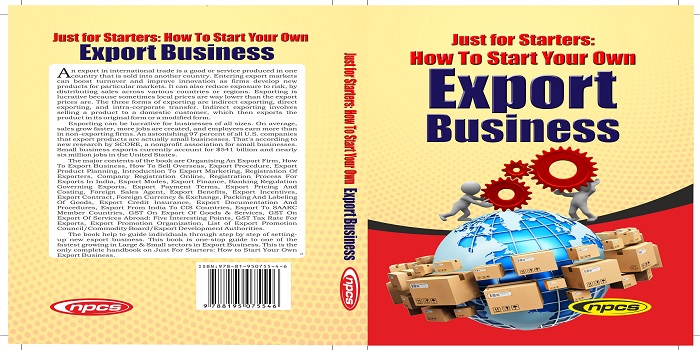
Get Detailed Insights from This Book: Just For Starters: How To Start Your Own Export Business
Step-by-Step Guide to Start Your Own Export Business
1. Choose the Right Product for Export
The foundation of a successful export business lies in choosing a product that is in global demand, easy to source, and profitable. Popular export categories include:
Agricultural products (spices, tea, rice, pulses)
Textiles and garments
Leather goods
Handicrafts and home décor
Processed food items
Herbal and ayurvedic products
Engineering goods and auto components
Tip: Focus on unique, high-quality, or niche products that are hard to replicate locally in other countries.
Related Books: Project Profiles
2. Register Your Export Business
Legal registration is essential to operate an export business officially. Here’s what you need to do:
Register your business entity (Proprietorship, LLP, Pvt. Ltd., etc.)
Obtain PAN & GST registration
Open a current account with a bank authorized for forex transactions
Get an Import Export Code (IEC) from the Directorate General of Foreign Trade (DGFT)
Register with Export Promotion Councils for your industry (e.g., APEDA, FIEO, etc.)
3. Conduct Market Research and Select Target Countries
Before you begin exporting, you must analyze where your product has high demand and fewer trade barriers. Use these steps:
Study global demand and pricing trends
Evaluate trade policies, import duties, and competitor pricing
Select 2–3 target countries to focus your initial marketing efforts
Use government portals like Export India, DGFT, and EXIM Bank to access country-specific reports
4. Find International Buyers
Securing international buyers is a critical part of launching your export business. Here’s how:
List your products on B2B portals like Alibaba, IndiaMART, TradeIndia, GlobalSources
Participate in international trade fairs and buyer-seller meets
Join export promotion councils that connect exporters with verified foreign buyers
Use LinkedIn and cold-email marketing to reach importers, wholesalers, and retailers
Build a professional export website with product catalogs and inquiry forms
5. Set Up Packaging, Logistics, and Compliance
The export process doesn’t end with getting a buyer; fulfilling an order involves multiple logistics and documentation tasks:
Choose export-quality packaging based on international standards
Coordinate with freight forwarders or shipping agents for sea or air transport
Understand Incoterms (FOB, CIF, etc.) to define buyer-seller responsibilities
Prepare all documents:
Commercial invoice
Packing list
Bill of lading/airway bill
Certificate of origin
FSSAI/agriculture/laboratory certificates (if required)
Comply with destination country regulations (labeling, customs duty, banned substances)
6. Receive Payment and Manage Foreign Exchange
Managing international payments securely is vital for profitability. Use these best practices:
Agree on LC (Letter of Credit), TT (Telegraphic Transfer), or Advance Payment
Partner with a bank that offers foreign exchange services and export incentives
Understand currency conversion, hedging, and export benefits under the Foreign Trade Policy
Claim export incentives like MEIS/RODTEP, tax refunds under GST, and interest subsidy schemes
7. Scale and Expand Your Export Operations
Once you’ve successfully completed a few export cycles, you can start scaling up:
Add more products to your catalog
Expand into new markets and regions
Build partnerships with overseas distributors
Consider setting up a warehousing and distribution model abroad
Invest in digital marketing and SEO for your export website to attract inbound leads
Pro Tips for New Exporters
Always verify buyer credentials before shipping
Maintain proper documentation to avoid customs delays
Keep track of international trade regulations and certifications
Start small, test markets, and grow gradually
Use insurance policies to protect goods in transit
Build a reliable supply chain with trusted vendors and manufacturers
Conclusion
Starting your own export business is one of the most rewarding decisions an entrepreneur can make today. With growing international demand for Indian goods and favorable government policies, now is the right time to explore the export market. All it takes is research, commitment, and smart execution to build a globally recognized export brand.
See More Links:
- Start a Business in Asia
- Start a Business in Potential Countries for Doing Business
- Best Industry for Doing Business
- Business Ideas with Low, Medium & High Investment
- Looking for Most Demandable Business Ideas for Startups
- Startup Consulting Services
- Start a Business in Africa
- Start a Business in India
- Start a Business in Middle East
- Related Videos
- Related Books
- Related Projects
- Related Market Research Reports
NIIR PROJECT CONSULTANCY SERVICES, DELHI
An ISO 9001:2015 Company
ENTREPRENEUR INDIA
106-E, Kamla Nagar, Opp. Mall ST,
New Delhi-110007, India.
Email: npcs.ei@gmail.com
Tel: +91-11-23843955, 23845654, 23845886
Mobile: +91-9097075054, 8800733955
Website: https://www.entrepreneurindia.co
https://www.niir.org