
India New Zealand FTA Benefits 2026: MSME Manufacturing Export Opportunities Explained

Introduction: India New Zealand FTA MSME export opportunities The Free Trade Agreement (FTA) signed between India and New Zealand is a major trade opportunity for Indian MSME manufacturers. This FTA differs from many other traditional trade agreements, which confer a limited level of benefit, in that it provides almost fully duty-free access to Indian products in New Zealand. This agreement offers MSME manufacturers in leather, processed food, engineering products and herbal products a new export opportunity. But the key to success is readiness for quality control, certification, and exporting. This is more than a policy shift; it is an opportunity for Indian small manufacturers to be more competitive. Related Article: India–New Zealand FTA 2026: Key Export Sectors and MSME Opportunities What the India–New Zealand FTA Actually Changes On the surface, the deal eliminates duties on most Indian exports to New Zealand. Indian exporters used to pay duties ranging from 5% to 10% which put them at a disadvantage compared to other exporters. This is no longer the case. Key structural changes include: New Zealand has removed tariffs from almost 100% of the tariff lines India has liberalised a substantial part of its market but has safeguarded sensitive areas Trade between the countries is set to increase from the current USD 1.3 billion These may seem macro in nature but the impact is at the MSME level where prices, margins and competitiveness go up immediately. Why MSMEs Should Take This Seriously The pact is not just for exports for MSME manufacturers, but it is about re-entering the market. Earlier slightly premium products are now competitively priced. But this doesn’t guarantee success. New Zealand is a highly regulated market and buyers are concerned with: Product consistency International certifications Factory audits Packaging and labelling In other words, no tariffs, higher quality. For MSMEs, early recognition of this is key. Leather and Footwear Industry: A Strong Export Opportunity The leather industry in India, particularly in Agra, Kanpur and Tamil Nadu, can take advantage of this. Previously, a 5% duty made exports less competitive in the NZ retail market. The FTA eliminates this handicap. The export of leather wallets, belts, handbags and shoes become more viable. Key advantages for MSMEs: Good availability of raw materials in clusters Export experience in many units Growing demand in high end retail But New Zealand buyers demand high standards and consistency. Even minor defects can lead to rejection of consignments. Processed Food and Spices: A Demand-Driven Sector Spices and processed foods are already a major export product for India. The FTA will enhance this by eliminating import tariffs. This is an attractive market as the Indian diaspora in New Zealand provides a ready market. High demand products consist of: Masalas and spices Ready-to-eat meals Prepared ethnic foods Organic and natural food items However, exporters have to conform to Food Safety norms. Minimum requisites for export: FSSAI certification Hygienic processing standards Export-grade packaging Phytosanitary compliance Without this even the best food products don’t reach to market. Get Detailed Insights from This Book: Handbook on Spices Engineering Goods: Competing on Quality, Not Price Alone Indian engineering and auto components MSMEs already enjoy a good international reputation. The FTA opens the door for them to access New Zealand’s industrial sector duty free. These include parts for agricultural equipment, industrial equipment and mechanical components. Why this sector is promising: Many engineering parts are imported into New Zealand There is a growing need for suppliers Businesses are looking to spread the risk of sourcing from one country But the competition is on quality, not price. MSMEs must invest in: ISO certification CNC machining capabilities Quality testing systems Barring these, it is hard to penetrate this market. AYUSH and Herbal Products: A High-Margin Export Segment Perhaps the most intriguing aspect of the FTA is the acknowledgement of traditional and AYUSH systems of medicine. This opens up a niche for export for health products. Increased market demand for natural products across the globe and in New Zealand as well. Opportunities in this segment: Herbal supplements Ayurvedic wellness products Natural health formulations Key compliance requirements: AYUSH GMP certification Scientific documentation of formulations Correct claims and labelling High profit margins but also high regulatory risks. Get Detailed Project Report (DPR): Comprehensive Guide to Herbal and Ayurvedic Products Investment Planning for MSMEs The most common failure of MSMEs in export is unplanned investment. The FTA provides opportunity, but investment planning is key to success. Prior to entering the market, MSMEs should define: Demand for their product type Costs of certification and regulations Production scalability Export logistics expenses Expected profit margins Without knowing this, even a great opportunity can be distressing. Why Feasibility Study Is Critical Before Entering Export Markets Export markets are not like local markets. Competitive pricing does not automatically lead to sales – compliance, consistency and documentation are as important. This is where business consultancy services can assist. Companies such as Niir Project Consultancy Services (NPCS) help MSMEs to plan a project by creating reports and feasibility studies. They offer services such as: Market survey and analysis Plant setup planning Machinery selection guidance Estimation of financials and profit Export readiness assessment The feasibility study will help a first-time exporter to make effective decisions and minimize risk. Identify high-growth industries before others do Conclusion: Opportunity Is Real, But Execution Matters More Real opportunities exist for Indian MSMEs under India-New Zealand FTA for exporting the products from Leather, food processing, engineering and AYUSH sector to New Zealand, because the duty elimination increases the export competitiveness and access to new markets. But this is not a sure-fire win. New Zealand is a quality- and compliance-driven market where customers expect quality, documentation and reliability. MSMEs that approach export as a business system rather than a sales channel will be successful. Put simply, the FTA provides access, but it is up to you to see how far you can reach within it. Frequently Asked Questions (FAQ) What’s the key advantage of the India-New Zealand FTA for MSMEs? 100% duty-free access which
6 Profitable Food Processing Business Ideas in India with Low Investment (Complete Startup Guide)
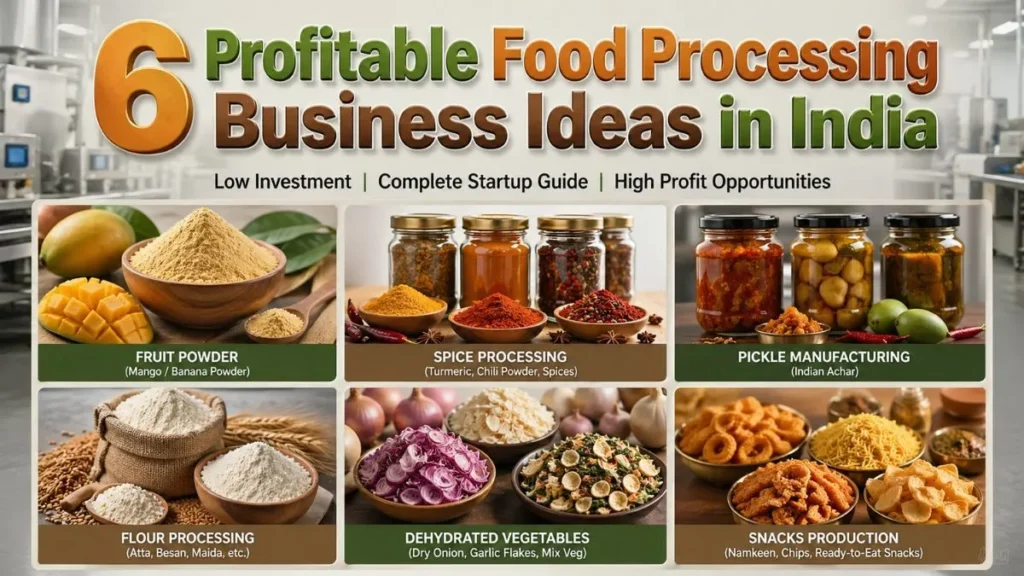
food processing business ideas in India India is a leading agricultural economy. It is home to vast production of fruits, vegetables, grains and dairy products. But much of it goes unprocessed or is wasted because of the lack of processing infrastructure. Indian entrepreneurs find their business opportunities at this location. People now prefer processed food products according to the recent market trend. Consumers want products that are convenient, have a longer shelf life and are pre-cooked. Urban areas experience increasing demand for processed food products because of growing urbanization and rising health-consciousness and food delivery application usage. As a result, the food processing industry is one of the fastest-growing industries in India. This is a secure, profitable and sustainable industry for both seasoned and aspirational entrepreneurs. Why Food Processing Is a Smart Business The food processing industry is seen as a safe investment because food is an essential commodity. Food processing exists as a continuous operation because demand for its products remains constant throughout the entire year. This makes it an ideal industry for investment. A key driver for growth is government policies. India’s government has launched a number of schemes to support small and medium enterprises. These schemes provide financial assistance through subsidies and loan services which help businesses reduce their initial financial burdens. The most beneficial schemes are: PMEGP Scheme (subsidy up to 35%) MUDRA Loan Scheme (up to ₹10 lakh loan) CGTMSE Credit Guarantee Scheme PMKSY Food Processing Scheme Startup India Program These schemes have allowed many small businesses to be established and flourish in India. Best Food Processing Business Ideas with High Profit Potential The first step while starting a manufacturing business is to select the right business idea. Here are some of the best profitable food processing business ideas for India. 1. Moringa Powder and Capsule Manufacturing Moringa qualifies as a superfood because it contains high amounts of nutrients and antioxidants. The health supplement market has expanded throughout recent years which creates a profitable business opportunity. The business requires no complicated processes to start because all necessary materials are easy to obtain. The final product also has a long shelf life, which results in decreased product loss. Investment: ₹5-10 lakh Profit Margin: 25% to 35% Access Complete Business Plan: Moringa Oleifera Powder. Formulation and Processing of Moringa Oleifera 2. Potato Chips and Namkeen Manufacturing Namkeen manufacturing is one of the most popular food businesses in India. Potato chips, banana chips and namkeens are consumed by people from all age groups every day. Local manufacturers can be successful against big players with better taste, quality and cost. This is a low-investment, high-demand and high-turnover business. Investment Required: ₹40 – 60 lakh Profit Margin: 18% to 25% 3. Honey Processing and Packaging Honey is used in homes, restaurants and health care products. There is growing interest in natural and organic products, which has led to a rise in demand for pure honey. An entrepreneur can get raw honey from beekeepers and pasteurise and bottle it for sale. The business can be scaled up from a small operation. Investment: ₹7-12 lakh Profit Margin: 20% to 30% 4. Dairy Processing Business Indians consider paneer (cottage cheese), ghee (clarified butter), butter, and flavoured milk to be essential dairy products. Urban residents show increasing interest in packaged dairy products because of the growing trend of urbanization. The industry must implement hygienic practices and quality control measures but it operates as a profitable business which maintains strong customer loyalty. Investment Required: ₹25 lakh to ₹1 crore Profit Margin: 18% to 24% Related Article: How to Start a Dairy Processing Plant in India | Investment, Costs & Profit Guide 5. Spice Processing and Packaging India ranks as the top spice producer while the demand for packaged spices keeps increasing both domestically and in international markets. The process includes purchasing raw spices and grinding them into finished products which will bear the company’s brand name. This business operates as a perfect fit for small and medium-sized enterprises because the company needs only basic materials and the production process is straightforward. Investment: ₹10 lakh to ₹20 lakh Profit Margin: 20% to 30% 6. Frozen Food Processing Business Frozen food is increasingly becoming more popular in cities due to its convenience and time-saving nature. Frozen vegetables, instant foods and frozen meat are currently in great demand. While the initial investment required for this business is higher than small-scale enterprises, it has great export potential and growth opportunities. Investment Required: ₹50 lakh to ₹2 crore Profit Margin: 20% to 28% Read the Complete Book Here: Handbook on Fruits, Vegetables & Food Processing with Canning & Preservation (3rd Edition) Steps to Start a Food Processing Business The establishment of a food processing enterprise requires proper execution of specific critical actions. The implementation of a structured methodology will enable organizations to decrease their operational hazards while achieving their desired business results. The process of starting a business usually requires execution of four essential components which include business planning, company registration, obtaining financial resources and establishing operational systems. Key steps to start: Choose a profitable product in demand Create a business plan Register and get licenses Secure finance from banks and various schemes Buy equipment and begin manufacturing Small-scale food processing operations achieve their first operational stage within two to four months after executing these particular tasks. Licenses Required for Food Processing Business in India The business owner must obtain necessary permits and official documents before starting the business operations. The licenses guarantee food safety, legality and consumer confidence. The most important licenses include: FSSAI License (required for all food businesses) GST Registration Udyam Registration (MSME registration) Trade License from local authority Some businesses require additional permits which include factory license and pollution control license and other licenses for their operations. Investment and Profit Potential in Food Processing The investment requirements of a business depend on its operational activities and the size of its operations. Businesses require minimum financial resources for establishment, while industrial facilities demand substantial capital investment
Top Renewable Energy Business Ideas in Jharkhand with Government Subsidy and Low Investment
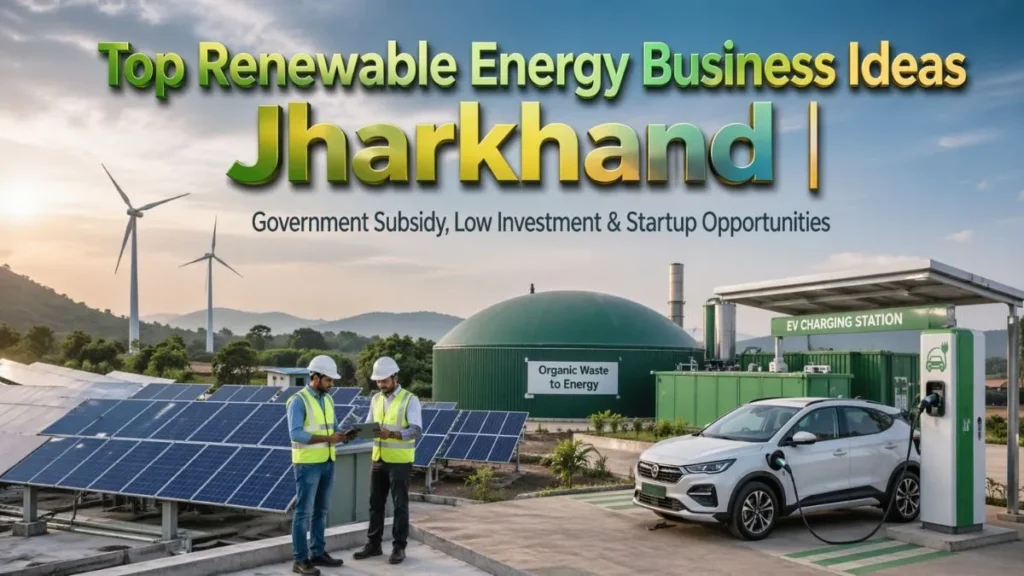
Renewable energy business Jharkhand The renewable energy sector in India is booming and alternative industrial areas are growing outside the traditional manufacturing centers. Jharkhand is one of such regions and it is silently establishing itself as one of the most promising locations to conduct a renewable energy business. The opportunity itself is not commonly spoken about at the moment, but the indications are evident- the policies of the government are favourable, the costs of production are lower, and the demand on clean energy products increases consistently. This combination is a strong advantage to first-generation entrepreneurs. The creation of a manufacturing facility of renewable energy in Jharkhand will be useful today to enable businesses to expand before competitors in the next few years. The state is slowly disengaging its economy which was majorly mining-based to manufacturing and energy production and renewable energy is emerging as a core aspect of the transformations. Why Jharkhand Is Becoming a Renewable Energy Business Destination Jharkhand is a rare combination of natural resources, industrial infrastructure, and policy support that predisposes it to the investment in renewable energy. The year long sunshine available to the state renders the production of solar energy very possible. Moreover, every year, vast amounts of agricultural and forest residue are produced, which can be used in the production of biomass fuel. The other factor is that the state is strategically located in eastern India. The companies based in Jharkhand will find it easy to deliver their products to the nearby states and save on the cost of transporting goods and enhance efficiency in delivery. The major strengths of commencing a renewable energy venture in Jharkhand are: Less cost of land and infrastructure than in metro cities. Access to skilled and semi-skilled labour. Increasing renewable energy products demand. Intense government incentives of MSME manufacturing. Availability of regional eastern and central Indian markets. These benefits provide a stable environment to new manufacturing businesses to thrive. Get Detailed Project Report (DPR): Renewable Energy Sector and Non-Conventional Energy Projects Cost Advantage: A Major Benefit for Startup Entrepreneurs The cheap cost of setting up and running a manufacturing unit is one of the greatest reasons why entrepreneurs are opting to locate to Jharkhand. The cost of industrial land is cheaper as compared to bigger cities and the cost of labour is also competitive without affecting the level of skills. The reduced operating costs will enable the startups to work longer in the initial years of business. To illustrate, a small manufacturing unit in Jharkhand may incur less startup investment, by 30 to 40 percent, than in the metro cities. This cost saving directly enhances profitability and minimizes financial risk. Common cost reductions are: Government industrial areas with affordable industrial land. Reduced monthly salaries of skilled employees. Less warehouse and factory rental costs. Industrial competitive electricity charges. To the small-time entrepreneur who may be starting with a small capital base these savings may spell the difference between success and failure. Growing Demand for Renewable Energy Products in India India is fast developing clean energy to minimize pollution and sustain energy demands in future. This shift is driving a high demand in the renewable energy equipment and service. Industries are switching to cleaner fuels; households are installing rooftop solar and electric cars are becoming more prevalent in cities. Therefore, manufacturing, installation, and maintenance services are offering new opportunities to small and medium enterprises. The renewable energy supply chain relies on small suppliers instead of big companies in many aspects, and it is therefore the best place to get the first-generation entrepreneurs. Key demand forces in the renewable energy market are: Growth of solar panels on rooftops. More use of electric vehicles. Rural electrification by government. Increased demand of industrial fuel that is green. Increased clean energy infrastructure. This is a continuous demand that guarantees the stability of the business. Profitable Renewable Energy Business Ideas in Jharkhand With moderate investment and good growth prospects, several renewable energy businesses can be started in Jharkhand. These are local and regional based businesses and enjoy government support programs. Solar Rooftop Installation and Component Manufacturing Increasing electricity costs and government subsidies are making solar rooftop systems increasingly popular. Installation can be the starting point of the entrepreneurs and then grow into production of components of mounting structures and electrical panels. The recurring income of this business provided by maintenance and service contracts. Investment is estimated to be between 25 lakh and 1.5 crore, depending on the scale and equipment. Download the Full Guide: Solar PV Power and Solar Products Handbook Biomass Briquette and Pellet Making. One of the most viable renewable energy companies in the state of Jharkhand is the production of biomass fuels since the raw materials are highly accessible. Forest residue and agricultural waste can be transformed into fuel utilized by factories and commercial kitchens. Typical raw materials are: Rice husk Sawdust Mustard stalk Agricultural residue Based on the efficiency of production and sales, a biomass plant is usually able to recover its investment in a span of two years. EV Charging Equipment Manufacturing and Installation Adoption of electric vehicles is growing in India, which presents a need in charging infrastructure. One way in which businesses can be involved in this sector is by assembling charging units, producing enclosures or even offering installation services. The initial investment is a bit more; however, in the long term, the growth prospects are high. Solar Lighting and Rural Electrification Products The solar lighting products are common in the villages and remote places where the supply of electricity is not reliable. Rural development projects are regularly funded by government programs purchasing solar street lights and home lighting systems. These products can be supplied in the form of institutional sales, which can give regular revenue. Start-up investment is between 20 lakh and 2 crores depending on the production capacity. Find high-return business ideas based on your budget & ROI Government Schemes Supporting Renewable Energy Entrepreneurs The financial viability of renewable energy business heavily relies on government
MSME Schemes in India: Complete Guide to Subsidies, Loans & Government Benefits
Introduction: MSME schemes in India One of the well-built sectors of the Indian economy is the Micro, Small and Medium Enterprises (MSME) sector. It supports almost one-third of GDP and employs millions of individuals both in the rural and urban India. Nevertheless, many entrepreneurs have one big problem namely, insufficient funds and knowledge of government programs. Interestingly, India is already well-established with a complete subsidy and credit system, but it is not used to its full potential because of the complicated procedures and absence of proper guidance. Nowadays, subsidies, loans are provided without collaterals, and state incentives allow MSME entrepreneurs to start up and grow their business at a considerably low cost. The difficult thing is to understand what scheme suits your business, and utilize it properly. Related Article: JanSamarth Loan Apply Online 2026: Complete Government Business Loan Guide for MSME MSME Classification in India It is necessary to know about MSME classification before delving into schemes. The classification of businesses is according to investment in plant and machinery as well as turnover annually. Micro enterprises: Investment up to 1 crore and turnover up to 5 crores. Small businesses: Investment less than 10 crore and turnover less than 50 crore. Medium enterprises: Investment increase of up to 50 crore and turnover increase up to 250 crore. This categorization is significant since subsidies and loans are determined by it. The majority of schemes demand Udyam Registration, the official MSME registration in India. Major MSME Schemes in India India has a number of governmental programs which assist the business owners in various phases of the business development. Read the Complete Book Here: Our Books PMEGP – Prime Minister Employment Generation Programme PMEGP is the most popular scheme among new entrepreneurs. It assists people to initiate micro enterprises by availing them with financial aid as a subsidy of margin money. In this scheme, a subsidy of 15 to 35% of the project cost would be given to eligible applicants based on location and category. It is particularly applicable to first time business people who wish to establish manufacturing or service-based businesses. MUDRA Loan Scheme MUDRA scheme is a collateral free loan scheme to the micro and small businesses. It is among the simplest financing means in India. The scheme is categorized into three: Shishu: Less than ₹50,000 to very small startups. Kishore: 50,000-5 lakh to expand businesses. Tarun: 5 to 10 lakh to existing micro units. Such loans are extended by banks, NBFCs and microfinance institutions. CGTMSE Scheme Credit Guarantee Scheme of Micro and Small Enterprises (CGTMSE) enable the enterprises to borrow money without collateral. Key benefits include: Loan up to 2 crores. Government-backed credit guarantee Less difficult bank approvals. Less risk to the lenders. The scheme is very vital to businesses which lack assets to pledge. Get Detailed Project Report (DPR): Project Reports & Profiles CLCSS – Technology Upgradation Subsidy This plan encourages companies that desire to modernize the equipment and embrace new technology. It assists in enhancing productivity and competitiveness within manufacturing industries. Gives as much as 15% capital subsidy. Maximum benefit of up to 15 lakhs. Usable on approved equipment. ZED Certification Scheme Zero Effect Zero Defect (ZED) scheme encourages quality production and sustainability. Benefits include: Reimbursement of certification cost. Export preparedness support. Promotion of environmentally friendly manufacturing. Such a plan is particularly applicable to manufacturers who have a global target. State Government MSME Schemes In addition to central government schemes, state governments provide some other incentives to MSMEs as well. There are some large-scale ones, such as: Gujarat: Subsidy of interest and lower cost of industrial land. Maharashtra: Capital subsidy on micro enterprises. Tamil Nadu: Power tariff and wage support benefits. Karnataka: MSME interest subvention. Capital subsidy on manufacturing units in Rajasthan: Uttar Pradesh: ODOP scheme in Favor of local products. Such plans are usually combined with central subsidies, with the net effect of boosting the overall benefits of entrepreneurs. How to Apply for MSME Schemes The application is easy and should be well planned and documented. The first one is that all businesses need to undergo Udyam Registration, which is free of charge and online. Most MSME schemes are obliged to register. Once registered, the next thing to do is to decide the appropriate scheme according to your business stage. As an illustration, new entrepreneurs tend to use under PMEGP and existing businesses use MUDRA or CGTMSE. Preparation of a Detailed Project Report (DPR) is one of the most crucial steps. This document includes: Business model and product information. Set up and machinery cost. Financial projections Market demand analysis Break-even estimation and profit. It is hard to get loan or subsidy approval without a powerful DPR. Lastly, applications are done via banks, DIC offices or government portals depending on the scheme. Upon verification and inspection, subsidies or funds are granted. Stop guessing—choose the right business with confidence Challenges Faced by MSME Entrepreneurs Although the government is very supportive, most of the entrepreneurs continue to encounter problems like: Inadequate knowledge regarding schemes. Poor or unsuccessful project reports. Bank delays. Lack of comprehension of eligibility requirements. Poor documentation management Such difficulties tend to lead to rejection or postponement of applications. Role of NPCS (Niir Project Consultancy Services) Professional guidance is of great importance in such a complex eco system. NPCS (Niir Project Consultancy Services) is a reputable consultancy that assists businesspeople with the planning and paperwork. NPCS offers services including: Detailed Project Reports (DPRs) Market research and feasibility studies. Cost analysis and machinery. MSME scheme guidance Investment planning support The reports will be tailored to meet bank and government standards, which further enhances the success of loan and subsidy approval. In the case of first-time entrepreneurs, NPCS serves as an intermediary between the schemes of the government and their practical application to minimize risks of rejection and save time. Conclusion The government support provided by MSME schemes in India creates a strong business development opportunity for entrepreneurs who want to establish and expand their companies. The system provides financial
Pharmaceutical MSME Business in Tamil Nadu: Investment, Govt Subsidy & Export Guide
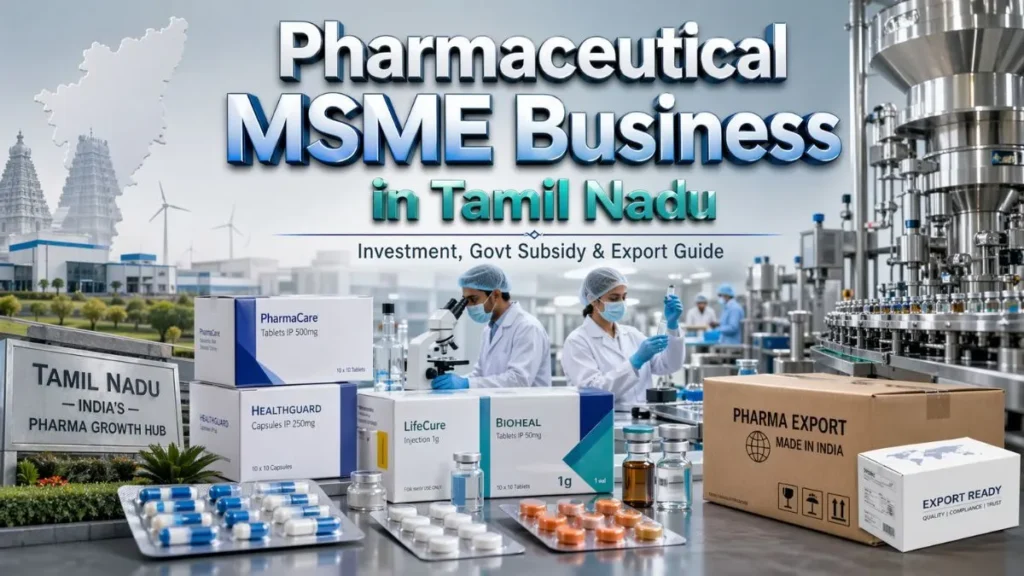
Introduction: Pharmaceutical MSME Business in Tamil Nadu The pharmaceutical industry in India is largely identified with Gujarat and Hyderabad but in the past ten years Tamil Nadu has silently become one of the most organized and stable pharmaceutical manufacturing center in India. The growth of Tamil Nadu has been consistently smooth, policy supported, and well incorporated into its larger industrial ecosystem, unlike rapid industrial booms that were led by single clusters. Over 1,500 pharmaceutical production facilities (APIs, formulations, nutraceuticals, herbal products, and veterinary pharmaceuticals) are licensed in the state today. To the MSME entrepreneurs, this is not only a business opportunity in the industry but a long-run base of export-oriented manufacturing that is well supported by the government and has a well-developed infrastructure. Related Article: India Pharmaceutical Excipients Market: Demand–Supply Gap and Manufacturing Opportunities (2026–2031) Why Tamil Nadu is Becoming a Pharma Manufacturing Powerhouse The emergence of Tamil Nadu as a pharmaceutical powerhouse is no coincidence. It is a product of sixty years of education, development, and industrial strategy. Availability of skilled human capital is one of the greatest strengths. This means that the state graduates a huge amount of pharmacy graduates, chemical engineers and biotechnology professionals on an annual basis, which means that the state is guaranteed of steady supply of skilled manpower. The other important consideration is the logistics and connectivity. Through Chennai port and Tuticorin port, the pharmaceutical companies have direct access to global shipping routes, and hence, it is easy to make exports more cost effective and quicker. This is essential in the regulated industry where timing of supply chain can affect product quality and approvals. The state government has also come up with specific pharma manufacturing industrial ecosystems such as: Chennai API and formulation cluster (Pharma City) SIPCOT industrial estates in various districts. Emerging pharma zones in Hosur, Coimbatore, Salem, and Vellore, MSME. The clusters provide better operational efficiency because they assist in infrastructure establishment and maintenance tasks, which benefit MSME investors through their ability to share resources. Get Detailed Insights from This Book: Just For Starters: How To Start Your Own Export Business High-Potential Pharmaceutical MSME Segments Tamil Nadu presents chances in various levels of pharmaceutical production. The different sectors need different funding and skill requirements according to their operational needs. Entrepreneurs in the MSME sector generally join depending on the size of capital and technical competence. 1. API Manufacturing (High Growth, High Stability). Active Pharmaceutical Ingredients (APIs) form the essential core component of the worldwide pharmaceutical supply chain system. India is already becoming less reliant on imports, particularly that of China, which is a huge market. The main APIs that are in demand are: Metformin (anti-diabetic) Atorvastatin (cholesterol management) Amlodipine (cardiovascular treatment) This segment has long-term contracts, predictable demand, and high export opportunities but demands greater technical compliance. Get Detailed Insights from This Book: Business Ideas for Startup in Drugs & Pharmaceutical Industry with Project Profiles (3rd Edition) 2. Nutraceutical and Herbal Extract Industry (Swiftest growing segment). Currently, the world is experiencing a high speed of the demand of preventive healthcare products. One of the fastest-growing pharma-adjacent industries are nutraceuticals and herbal extracts. Products are herbal extracts, vitamin formulations, amino acids and plant-based health supplements. Tamil Nadu has a natural advantage due to availability of medicinal plants and agricultural raw materials like turmeric and spices. Reduced regulatory burden in comparison to drugs. Strong demand of exports in USA and Europe. High profitability of branded formulations. 3. Veterinary Pharmaceutical Manufacturing It is among the least developed, but the most promising MSME segments. The development of poultry, dairy, and aquaculture business in India has augmented the necessity of the animal health products. Typical products include: Veterinary antibiotics Anti-parasitic drugs Feed supplements Reduced regulatory burden compared with human pharma. Good rural and export demand. Speedier product commercialization period. 4. Ophthalmic Formulations Eye drops, sterile solutions, and ointments are examples of a high-margin niche. When a facility is compliant and certified, then competition becomes low since it has entry barriers. This division needs cleanroom production and high level of sterility but has stable long term demand within the home and export markets. Government Incentives Supporting Pharma MSMEs in Tamil Nadu Government policy has a very important part to play in rendering pharmaceutical manufacturing viable. In Tamil Nadu, both the state and central governments promote the development of MSME. Central Government Support The Scheme of greatest significance is the Production Linked Incentive (PLI) Scheme on Bulk Drugs which promotes local production of API by providing financial incentives based on production output. Additional key support systems are: CGTMSE (collateral-free MSME loans) SIDBI financing support Startup India Recognition Benefits. Tamil Nadu State-Level Support The state offers a number of industrial incentives such as capital subsidies and infrastructure benefits. MSMEs established in endorsed industrial zones can also be provided with: Stamp duty exemptions Power tariff concessions Land allocation via TIDCO under subsidies. Fast-track clearances in industrial parks. Such incentives are very effective in lowering the initial project costs and enhancing financial viability. Get Detailed Project Report (DPR): Pharmaceutical Drugs and Bulk Drug Intermediates Export Opportunities for Tamil Nadu Pharma Industry India is internationally known as the Pharmacy of the world and Tamil Nadu has a significant role in this ecosystem. A high level of compliance and quality production is increasing the pharmaceutical exports of the state. Some of the major export destinations are: United States and Canada. European Union countries African nations ASEAN region Latin America The regulatory needs of each market are varied, yet when MSMEs meet GMP, they can enjoy the benefits of high-value global supply chains. The fast-growing demand of low-priced generic medicines and nutraceuticals makes Africa and ASEAN the most appealing venues of MSMEs. Investment Overview for MSME Entrepreneurs The amount of investment required differs greatly with the type of product. The capital required of a small nutraceutical unit can be comparatively moderate, whereas the production of API must be accompanied with a greater investment because of the infrastructure and the regulations. Typical investment ranges: Nutraceutical
Renewable Energy Business in Chhattisgarh: High Profit Ideas, Cost & Government Subsidy Guide
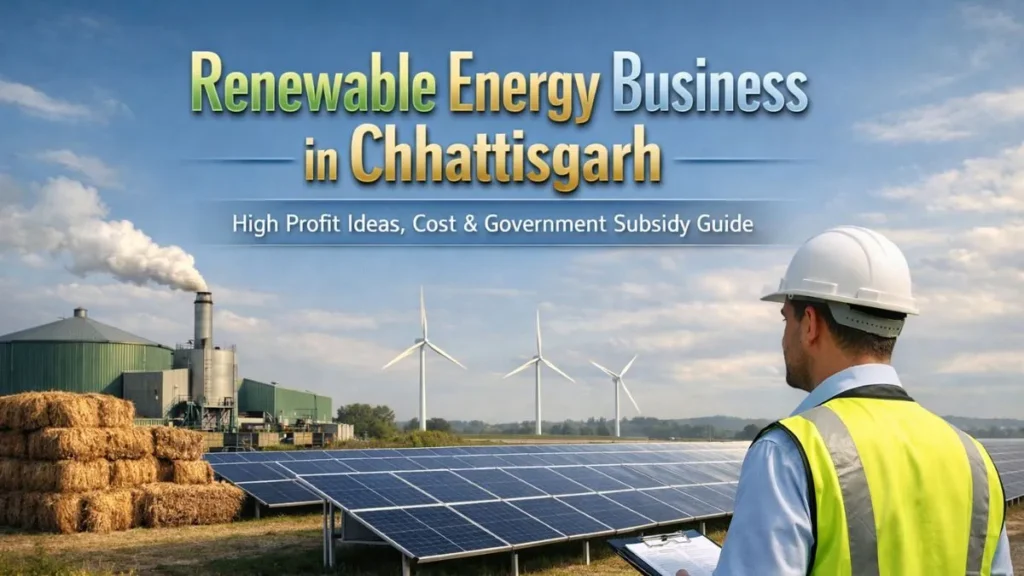
Introduction: Renewable Energy Business in Chhattisgarh. Making it silently one of the fastest-evolving states in India regarding business opportunities in the field of renewable energy, Chhattisgarh is. Although there are already established solar hubs such as Gujarat and Rajasthan that are already dominating the market, Chhattisgarh is currently getting attention with the low cost of set up, high industrial demand and natural resources. The energy consumption of the state is growing at a very good pace due to steel, cement, aluminium, and mining industries. Meanwhile, the government is also actively encouraging the use of clean energy by subsidizing and industrial policies. This is creating a wide entrance point to business people who would like to establish long term renewable business. Get Detailed Insights from This Book: India Solar Glass Market Key Renewable Energy Business Opportunities in Chhattisgarh The state will provide a variety of business opportunities based on investment ability and experience. The solar energy is the most favoured segment particularly with the increased number of rooftop installations and industrial. Solar module assembly, EPC contracting, and mounting structure manufacturing can be studied by the entrepreneurs. Another opportunity that is strong due to the presence of agricultural and forest waste is biomass energy. The industry is not developed yet and this puts early movers in a good position. Government push to electric mobility is also increasing EV-related businesses rapidly. Some of the major business opportunities include: Solar module and EPC assemblies. The production of biomass briquettes and pellets. Installation of EV charging stations and equipment production. Lithium battery pack. Carbon credits and biochar manufacturing to use in agriculture. All these sections vary in their level of investment and their potential of being scaled, and thus the industry is an apt place to be among small and large business owners. Investment Required to Start Renewable Energy Business The amount of investment in the industry is highly varied according to the business model. Small-scale biomass facilities need comparatively low capital, whereas solar and EV production need more investment yet has superior returns in the long-term. To make a better picture: Biomass briquette plant: ₹30 lakh – ₹80 lakh Solar EPC business: ₹50 lakh – ₹2 crore EV charger production unit: 2 crore -5 crore. Solar module assembly facility: ₹3 crore- 8 crore. Lithium battery pack unit: ₹5 crore-15 crore. The figures can be different according to the location, technology, and capacity of production. Get Detailed Project Report (DPR): Renewable Energy: Green Power and Non-Conventional Energy Sources Government Subsidies and Support Schemes The good government support at the central and state levels is one of the greatest opportunities of launching a renewable energy business in Chhattisgarh. Major Central Government Schemes PLI Scheme on solar production and batteries. EV adoption scheme (FAME-II). Surya Ghar Muft Bijli Yojana of rooftop solar. MUDRA loans and PMEGP loans to MSMEs. State-Level Support in Chhattisgarh Subsidies on capital investments in industries. Electricity duty exemption Allocation of industrial lands at reduced prices. Renewable energy policy incentives. These plans greatly alleviate the initial investment pressure and enhance profitability. Why Chhattisgarh is a Strong Location for Renewable Energy Business Chhattisgarh has a peculiar blend of industrial capacity and existence of resources. The state already boasts of good manufacturing base in cities such as Bhilai, Raipur and Korba which facilitates development of supply chain. The other significant benefit is cheap industrial land in comparison to metro states. This in itself saves on the cost of setting up a project to a large extent. Key advantages include: Good industrial demand of electricity. Plentiful biomass and agricultural waste. Central location and access to various states. Less expensive land, labour cost than metro cities. Expanding EV and solar market. These are the reasons why it is a viable and lucrative site to renewable energy startups. Find high-return business ideas based on your budget & ROI Step-by-Step Process to Start a Renewable Energy Business To invest in renewable energy, one needs to plan the business and not only invest. The initial one is the right segmentation according to the budget, demand in the market, and expertise. Once the business model is chosen, entrepreneurs need to come up with a comprehensive business project report to determine feasibility and financial viability. This is a very crucial step in obtaining bank loans and subsidies. After arranging funds, the next processes are the land purchase, installation of machinery, and recruitment of workforce. Once established, the emphasis is placed on establishing customer relationship with industries, EPC contractors or government projects. Role of NPCS (Niir Project Consultancy Services) Success in the renewable energy industry is pegged on proper planning. Here NPCS (Niir Project Consultancy Services) has a significant role to play. NPCS also offers professional consultancy services such as Detailed Project Reports (DPRs) and feasibility studies, market research, and financial planning to multiple industries within the solar energy, biomass, EV charging, and battery manufacturing sector. Their services assist entrepreneurs in comprehending: Real cost of project and investment needed. Market demand and competition analysis. Choice of machinery and raw materials. Return on investment and profitability. As a type of first-time entrepreneur NPCS serves as a support system that helps to minimize the risk and increase the accuracy of the decision making. Professionally prepared DPR also enhances the likelihood of banks and other financial institutions to give loans. Related Article: 10 Profitable Renewable Energy Manufacturing Business Ideas in India Future of Renewable Energy in Chhattisgarh The future of renewable energy in Chhattisgarh is very promising. Demand will be stimulated by the growing interest in electric mobility, environmentally friendly energy generation and industrial sustainability. The state will be a large renewable energy centre in central India by the year 2030. Those venturing in today will have early-mover advantage, reduced competition and robust government support. Conclusion One of the most promising opportunities to start a business in India is the renewable energy business in Chhattisgarh in 2026. Industrial development coupled with government subsidies, cheap operation and increasing energy demand provides a good base towards long term
How to Start a Profitable Food Processing Business in India (₹10 Lakh to ₹1 Crore Ideas + Government Schemes)
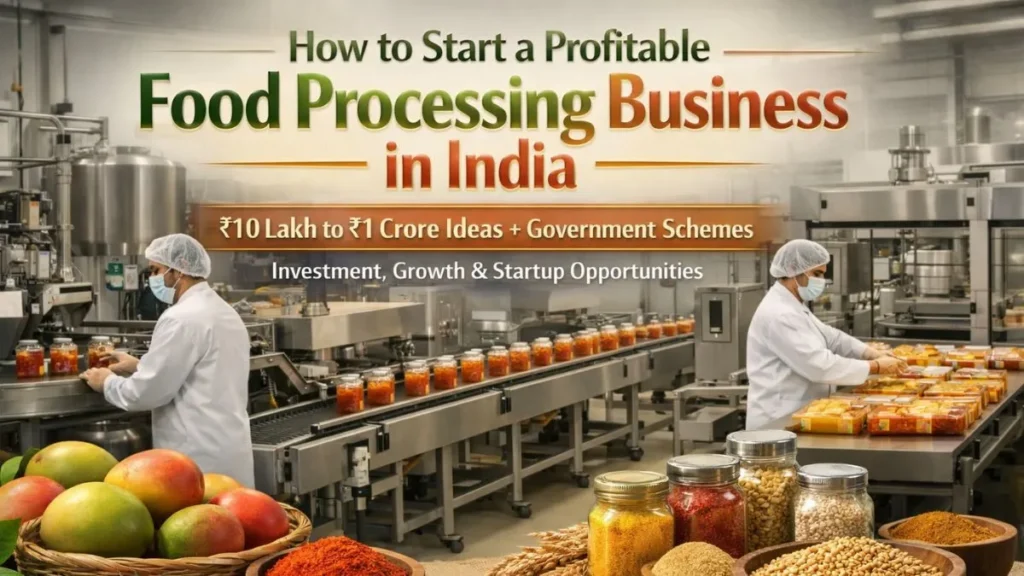
Food processing business India has one of the best business opportunities in food processing industry, which is rapidly expanding. India is a big agricultural manufacturer, and majority of the raw food is not processed. This puts a massive disconnect between raw materials and finished products. Due to shifting lifestyles, individuals have adopted the preference of packaged, hygienic and ready-to-eat food products. This is in demand both in city and country markets. Simultaneously, the government has facilitated the establishment of food-based manufacturing facilities and has enhanced infrastructure. Simply, in this industry, you can purchase raw agriculture products at a low price, process them and sell them at significantly high prices. Explore This Book: Manufacture of Food & Beverages with Project Profiles (3rd Edn.) Why Food Processing Business is Profitable The ability to add value to raw materials is the key reason why food processing is a profitable venture. An unprocessed agricultural product gains several times its worth once it is processed, packaged and branded. As an illustration, raw fruits can earn minimal profits, but once these are processed into juice, jam, or dry snacks, the profitability will greatly rise. Likewise, branded products can be made out of spices, milk, grains and vegetables. Key reasons this business works well in India: Constant need of food products. Availability of cheap raw materials Strong export market Government subsidies and loans. High value addition potential. The second significant benefit is that food is a daily need and hence demand will be constant all year round. Best Food Processing Business Ideas in India. This industry has numerous business opportunities that are based on the level of investment and location. Fruit juice production, spice processing, frozen foods production, dairy products, bakery products, and health supplements are some of the most lucrative ideas. The demand of fruit-based products such as juices, jam, and pulp has been on the increase because of the increasing health concern. Another powerful category is spice processing since India already leads the world in terms of spices. Busy lifestyles are also increasing the rate at which frozen food is being consumed. Frozen foods such as vegetables, seafood, and ready-to-cook meals are gaining popularity in the urban homes. High-demand food business ideas include: Fruit juice and beverage unit Spice grinding and packing unit. Frozen food processing Dairy products such as paneer and cheese. Bakery and snack production. Cold-pressed oil manufacturing Herbal health products and Moringa. The investment level and profit margin in each of these segments vary, but each has a high potential of growth in the long-term. Get Detailed Project Report (DPR): Fruits and Vegetables Value Addition and Food Processing Guide How to Start a Food Processing Business It cannot be done without proper planning but only by investing in this business. Market research is the initial step. You must know what products are sought after in your locality, what raw materials are readily accessible and what competition is already present. Business registration is the next step after the product has been chosen. These will be MSME (Udyam) registration, GST registration, and FSSAI license which is a requirement of any business related to food in India. Selection of the appropriate location becomes significant after registration. The industrial locations are generally more advantageous as they already possess some basic facilities such as electricity, water supply, and access to transport. Another step is the choice of machinery. There are numerous reputable manufacturers of India who offer affordable machines to small and medium food processing plants. Lastly, there should be planning in the sourcing of the raw material by establishing direct linkages with the farmers or wholesale markets. Investment and Profit Margin The capital investment will be based on the size of the business. The initial investment required is approximately ₹10-20 lakh to start a small unit, and ₹50 lakh-1 crore or more to start a medium unit. Typical investment structure: Machinery: 40–50% Setup and infrastructure: 20–30% Working capital: 20% Licensing and approvals: 5–10% The profit margins differ according to the type of product. Packaged food products are lower margin as basic and more margins as branded and value-added food products yield much higher margins. The profit margins in food processing are between 12-40 percent on average. Government Schemes for Food Processing Business This sector has a great support by the Indian government in terms of schemes. These plans contribute to a lowering of the start-up prices and simplify financing of new businesses. Noteable schemes are PMEGP and PMFME that subsidize new businesses and micro food processing units respectively. Small businesses with no collateral can get MUDRA loans. CGTMSE also offers larger funding requirements but unsecured. Key advantages of state plans: Subsidies up to 35% Collateral-free loans Low-interest funding options Export promotion support Startup tax benefits Such plans ease financial stress among new entrepreneurs to a large extent. Find high-return business ideas based on your budget & ROI Role of NPCS (NIIR Project Consultancy Services) NPCS (NIIR Project Consultancy Services) is significant in assisting the business starters to begin food processing business in India. It offers in-depth reporting of projects that are needed in bank loans and government schemes. These reports encompass total business planning which includes machinery needs, production process, cost estimation, profit calculation and plant layout design. NPCS will assist entrepreneurs by preventing mistakes by having a clear picture of the business prior to investing in it. What NPCS provides: Detailed project reports (DPR). Plant and machinery set up advice. Financial feasibility reports Bank loan documentation support. Research and analysis of industries. In the case of first-time entrepreneurs, NPCS can be particularly helpful since it lowers the risk and enhances choices. Challenges in Food Processing Business Despite the profitability of this business, there are challenges associated with it. The greatest problem is the fluctuation of the price of raw materials because of seasonal availability. The other difficulty is the ability to adhere to similar quality standards, which is required to be FSSAI compliant. Managing working capital is also significant since the payment delays by
Moringa Seed Oil Extraction Business in India: Cost, Machinery, Profit & Complete Project Report

Introduction: Moringa Oil Business India The seed oil extraction of moringa business is emerging as one of the rapidly expanding business opportunities in the Indian agro processing industry. As the world continues to demand natural, chemical-free and plant-based oils, moringa oil has been highly utilized in the cosmetics, pharmaceutical and wellness market. India is already a significant producer of the moringa seeds in the world, but the majority of it is exported as raw material. There is minimal value addition in the country. This gives a significant chance to entrepreneurs to install cold-press oil extraction plants and achieve high-margin markets in exports. This business is appealing because of its moderate investment, good supply of raw materials and high prices in the global markets. What is Moringa Seed Oil and Why It Is Valuable Moringa seed oil is derived out of the seeds of the moringa Oleifera tree, commonly referred to as the miracle tree. It is non-greasy, lightweight and abundant in antioxidants, vitamin E and oleic acid. These properties have made it very popular in: Anti-aging and skin care products. Scalp oils and oils on the hair. Aromatherapy and massage oils. Pharmaceutical and herbal preparations. The world is witnessing a rise in demand due to the fact that consumers are moving towards natural and clean-label cosmetic products. Get Detailed Insights from This Book: Herbal Cosmetics & Ayurvedic Medicines (EOU) (3rd Revised Edition) Why This Business Is Growing Rapidly The increase in popularity of the moringa oil manufacturing has strong economic and market reasons. India has a comparative advantage since almost 80 percent of the world moringa production is in Indian states like Andhra Pradesh, Tamil Nadu, Karnataka and Telangana. Nevertheless, the bulk of value addition occurs after the farming phase. This provides a definite chance to MSME entrepreneurs to venture into processing and make better margins. Some of its driving factors are: Increasing demand of organic cosmetic oils in the world. Minimal competition in structured processing units. Good exportations to high value markets. Low-cost raw materials in India. Manufacturing Process of Moringa Oil The process of production is easy, clean and it can be used in small and medium sized industries. The seeds of moringa are first collected and washed then de-hulled to eliminate outer shells. The inside kernels are then subjected to cold-press oil expeller, oil is extracted mechanically without the use of chemicals. The oil is extracted and then filtered to eliminate impurities and checked on quality parameters such as acidity and moisture content. Lastly, it is filled in glass bottles, or food grade containers, and stored and sold. The choice of this cold-press process is due to the fact that it maintains the nutrients and enables the oil to be sold at high prices in cosmetic and export markets. Machinery Required for Setup An average unit of MSMEs demands simple yet effective machinery. They are seed cleaning machines, de-hulling equipment, cold press expellers, filtration systems and packaging machines. In the case of a small plant, a minimum of 200-500 kg/day is a good capacity to begin operations. Key machinery includes: Cold press oil expeller (2-3 units) Seed cleaning & grading system Filter press unit Filling and labelling machine. Basic quality testing devices. Indian manufacturing hubs have easy access to the machines and their establishment and maintenance are convenient. Get Detailed Project Report (DPR): Moringa Tablets Production Business Guide Investment and Project Cost The overall investment is determined by the size and degree of automation. On average, the project cost ranges between ₹39 lakh to ₹84 lakh. This involves land or sheds development, machinery installation, working capital, packaging set up and testing equipment. Government programmes such as PMEGP and MUDRA can alleviate financial strain greatly by providing subsidies and loans without collaterals. Profit Margin and Revenue Potential Moringa oil enterprise has a good prospect of making profits because of the high export price. The domestic market price is typically between ₹900 and ₹1500 per litre and export-grade oil can go up to ₹2500 to 5000 per litre with certification and quality. An efficiently operated 500 kg/day unit has the potential to earn 10 to 15 lakh every year. Efficiency is required in profit, but usually: Gross margins of 35-55. Other revenues include those of seed cake by-products. The by-product is also employed in the animal feed and in the organic fertilizer industries, which provides an additional revenue to the business. Export Market Opportunity In the global markets where natural cosmetic ingredients are in high demand, moringa oil enjoys high demand. Key exporters are USA, Germany, France, Japan, South Korea and UAE. Moringa oil is applied in luxury skin care products, anti-aging creams and hair care products in these countries. A big advantage of India is that: The raw material is in high supply. Cost of production is cheaper compared with the world competitors. Quality: It is possible to enhance quality through appropriate certification. Entrepreneurs can easily access premium export markets with such certifications as ISO, USDA Organic or ECOCERT. Turn your budget into a successful business plan Government Schemes for MSME Entrepreneurs The Indian government is very supportive to agro-processing enterprises in terms of finance. Key schemes include: PMEGP subsidy on new manufacturing units. MUDRA loans to small entrepreneurs. CGTMSE collateral-free credit up to ₹2 crore PMKSY assistance in food processing facilities. The plans reduce startup risks while supporting first-time entrepreneurs to enter their field of work. Role of NPCS (NIIR Project Consultancy Services) The process of starting a manufacturing business requires scheduled planning, financial research, and structured financial organization. NPCS (NIIR Project Consultancy Services) plays an important role in this process. The company provides complete project documentation which includes detailed project reports and feasibility studies along with equipment consultancy and expense evaluation and industry analysis services. Their reports are used extensively to report: Bank loan approvals Government subsidy applications Investment planning Technical setup guidance In case of moringa oil projects, NPCS assists entrepreneurs to comprehend precise profitability, machinery choice, and the viability of the business prior
Gautam Adani Success Story: From Diamond Sorter to Business Empire | Business Lessons and Profitable Industry Ideas

Gautam Adani success story Gautam Adani’s is one of the most powerful inspirational stories of entrepreneurship in the modern India. He was born in a simple family in Ahmedabad and did not receive a big industrial empire. Rather, he created success, based on a measured risk-taking, long-term vision and ability to recognize the opportunities in expanding industries. The Adani Group is one of the most powerful business groups in the country today as it operates in ports, logistics, power generation, airports, cement, and renewable energy. His story is not only inspirational, but also practical to those who aspire to be entrepreneurs. It demonstrates that the smallest of things can result in huge developments in case of planning, persistence, and strategic decision-making. It also emphasizes the need to do a professional feasibility analysis prior to investing in any industry and this is where professional services providers such as Niir Project Consultancy Services (NPCS) come in. Get Detailed Insights from This Book: Our Books Early Life and the Beginning of His Business Journey Gautam Adani was born in 1962 in a middle-class Jain family. His father was a small textile businessman and the family was leading a simple life. Adani however had other ambitions besides trading. He joined a commerce course at Gujarat University, but dropped out of school before graduating since he thought that the true business knowledge is gained through experience. He immigrated to Mumbai at a tender age to see what was available. His initial employment as a diamond sorter, made him learn the working mechanisms of the markets and the quality of a product. Several years later, he found himself venturing into business of his own, having gained confidence and experience in the running of a business. The skills that were acquired in this initial stage of his professional life were to be vital to his success in the future such as negotiation, market knowledge and risk management. The Turning Point: Entry into Commodity Trading The actual breakthrough to the career of Adani came when he came back to Ahmedabad to run a PVC manufacturing plant owned by his brother. India was rapidly growing its plastic business, and raw material demand was growing at that time. Adani saw this opportunity and he started importing PVC which enabled him to venture into the international trade market. In 1988, he founded Adani Exports Limited, which became: Adani Enterprises Limited This company was the base of the Adani business empire and the start of big business. Mundra Port: The Strategic Choice that created the Empire The development of: was one of the biggest milestones of Adani. Mundra Port In the 1990s, there was significant challenge of port infrastructure in India such as congestion and slow cargo handling. Adani saw this loophole and invested in the construction of a state-of-the-art private port which could accommodate high volumes effectively. Gradually, Mundra Port grew to be the biggest trade port in India and a main contributor of the development of the Adani Group. The choice proves the strength of seeing the long-term prospects rather than temporary returns. Access Complete Business Plan: Project Reports & Profiles Expansion into Major Industries Following the success of Mundra Port, the Adani Group diversified to various industries which contribute to the economic development. These industries developed a robust business ecosystem, which is still expanding today. Some of the major industries include: Generation of power by Adani Power. Adani Green Energy through renewable energy. Airport through Adani Airport Holdings. Cement production with the help of Ambuja Cements and ACC Limited. This diversification plan enabled the company to develop long-term stability and sustained growth. Key Business Lessons Entrepreneurs Can Learn from Gautam Adani The experience of Adani can teach some valuable lessons to those entrepreneurs who would like to establish sustainable business. These are applicable in startups, MSMEs, and industrial investors. The greatest lessons are: Concentrate on the industries that are increasing in demand. Gets to thinking long term, not quick profits. Build systems and infrastructure, not only products. Making calculated risks on the basis of market research. Keep on expanding into related areas. The principles can be applied to any business owner who intends to establish a manufacturing or infrastructure-based company in India. Emerging Business Opportunities Inspired by the Adani Model India is now rapidly growing in terms of infrastructure and production. The investment in transportation, energy, and industrial development by the government, has provided a great demand of new businesses. When entrepreneurs venture in these areas and do it well by planning, then they are able to enjoy growth that is stable and profitable. Among the best opportunities there are: Solar component manufacturing Cold storage and warehousing. Pre-engineered building structures Specialty chemical production Waste-to-energy and compressed biogas projects. The industry policies, rising domestic demand, and export potential favor these industries, and therefore, these industries are appealing to new entrepreneurs. Identify high-growth industries before others do Why Professional Project Planning Is Essential Before Starting a Business One of the most frequent causes of failure is to start a business that is not planned properly. A good idea may not work out even when there is underestimation of costs or wrong assessment of demand. Professional project planning helps entrepreneurs to avoid risks while making educated choices. The Detailed Project Report (DPR) serves as the main document which every industrial project needs to complete its requirements. The document provides a complete understanding of the business operations which helps investors and banks assess the business’s financial viability. A standard DPR has: Market demand analysis Costs of investment and operating costs. Machinery and raw material needs. Production capacity planning Profit and loss projections. This is a systematic way of improving the likelihood of business success, and minimizing financial risk. Related Article: Top 15 Manufacturing Businesses in India with High Demand and Profit (China+1 Opportunity) About NPCS and How It Helps Entrepreneurs Niir Project Consultancy Services is one of the most popular consultancy firms in India, which deals with the industrial project planning and
India’s $5 Trillion Economy: Top Industries Driving Growth for Entrepreneurs and Investors

India 5 trillion economy business opportunities The ambition of India to be a 5 trillion economy is gradually shifting the policy vision to reality. The business environment is changing with new industrial parks, manufacturing facilities, logistics centers, and renewable energy projects across the country. Entrepreneurs no longer have to be restricted to the conventional industries; they can choose among a great variety of industries with high demand, technological development, and government grants. This is among the most promising times in the economic history of India among the startup founders and industrial investors. It is possible not only to start a business, but to start in the right industry at the right time. Knowledge of the areas that are growing at a fast rate can assist business owners to minimize risk and create sustainable and profitable businesses. The Economic Drivers of the Indian Growth. A combination of demographic strength, infrastructure development, and policy support are driving the growth of India. The high number of working population, the growing urbanization and consumer expenditure are generating long term demand of goods and services in industries. The MSME sector is one of the greatest contributors to this growth. Small and medium enterprises are very significant in production, generation of employment and export. More MSMEs are going to national and global supply chains and are also expanding outside their local markets with increased access to financing and technology. A number of structural forces are driving industrial growth: Rising domestic consumption Manufacturing incentives by the government. Increasing export demand Infrastructure development projects Expansion in online and logistical networks. All this will provide an incentive to investors willing to invest in new business venture. Get Detailed Insights from This Book: Our Books Manufacturing: The Core Engine of India’s Industrial Economy The manufacturing sector has become the lifeline of economic change in India. Government programs promoting the local production and decreasing the reliance on imports have made the manufacturing industry very strong. Consequently, both traditional and high-tech industries are opening up new business opportunities. The predictability of demand and long term growth prospects are usually advantageous to entrepreneurs joining the manufacturing industry. The industry also has scaling opportunities when there is growth in the demand in the market. High-Potential Manufacturing Segments The market is growing at an exceptionally high rate in some manufacturing sectors as a result of the policy support and demand: Specialty chemicals and industrial intermediates. Food processing and packaged foods. Designing and making products. Packaging materials Polymer and plastic products. one of the most lucrative areas is the specialty chemicals. The demand on Indian chemical manufacturers has gone up due to global supply chain changes, offering export opportunities and good profit margins. Another fast growing industry is food processing. The need to buy packaged and ready-to-eat food products is also increasing as the lifestyles of the consumers shift. Value-added businesses that deal with agricultural products are usually highly profitable than the sale of raw commodities. Infrastructure and Construction: A Sector Built on Continuous Demand India is spending a lot of money in developing infrastructure such as highways, airports, railways, industrial corridors, and housing. This massive construction project is creating a continuous demand in the building materials and engineering products. The construction materials sector has a stable business environment due to the fact that the demand is tied to longer term development projects, not to the short term market cycles. There is a steady growth in revenue of entrepreneurs who join this sector. Businesses in Construction Materials that are profitable. The industries in this sector with high potential are: AAC blocks and fly ash bricks. Ready-mix concrete production Steel fabrication and structure. Pre-engineered building structures Manufacturing of tiles and sanitary ware. These are usually medium-investment businesses that have good local demand. Renewable Energy: The quickest growing industrial prospect. The shift to clean and sustainable energy is giving new prospects to entrepreneurs in India. The government policies on renewable energy development have promoted the investments in solar power, biofuel production and waste-to-energy. The business of renewable energy is appealing as it is profitable and also green. With the ever increasing energy demands, firms offering renewable solutions are projected to increase at an alarming rate. Emerging Renewable Energy Business Opportunities Investors are paying a lot of attention to the following areas: Compressed biogas (CBG) plants. Solar panels production and installations. Electric vehicle charging infrastructure. Biomass fuel production Energy storage solutions These are relatively safe investments and the businesses usually have government subsidies and long term contracts. Access Complete Business Plan: Solar Panel Pharmaceuticals and Healthcare: A High-Growth, High-Margin Industry India has emerged as a world pharmaceutical manufacturing powerhouse. The nation sells medicines to a wide range of overseas markets and is still developing its medical services. Increasing population and health awareness are putting more demand on medical products and services. The pharmaceutical industry provides good growth opportunities to entrepreneurs who ensure high quality and adhere to the regulations. The profit margins of businesses in this industry may be very high as opposed to most other manufacturing industries. The nutraceutical market is growing at a high rate besides the conventional medicines. The consumers are becoming more and more interested in preventative health care products, which also generates the need in supplements, herbal extracts, and wellness products. Government Support: A Major Advantage for New Businesses The industrial growth in India has been greatly driven by government policies. There are several programs that offer financial aid, infrastructure, and tax breaks to entrepreneurs. These programs greatly minimize the expense and risk of establishing a new business. Companies that are in line with the priorities of the government tend to have accelerated approvals and access to funds with ease. Key Benefits of Government Schemes Government support programs can provide: Capital subsidies of machinery and infrastructure. Tax incentives to new companies. MSME loans at a low-interest rate. Export promotion assistance Skill and technical development assistance. By using these advantages, profitability and quickening business expansion can be enhanced. Identify high-growth industries before others do