
Profitable Semiconductor Business Opportunities in India Under ISM 2.0 (Startup & MSME Guide)
Semiconductor business opportunities in India are expanding rapidly as the industry moves beyond capital-intensive fabrication plants that once required billions of dollars in investment. However, the Union Budget of India 2026–27, along with the expansion of the India Semiconductor Mission (ISM) 2.0, is changing this narrative. The government’s focus has shifted toward building a complete semiconductor ecosystem, opening the door for startups and MSMEs to participate in one of the world’s most strategic industries. Rather than competing head-on with global chipmakers, Indian entrepreneurs can enter the semiconductor manufacturing supply chain. Incentives such as capital goods duty exemptions, bonded warehousing provisions, deferred duty payments and export facilitation have lowered entry barriers. As a result, startups now have practical possibilities in manufacturing support systems, materials, services and specialised logistics. India’s effort to minimize dependence on imports and increase electronics manufacturing is driving persistent demand for domestic suppliers. Businesses that are about quality, technical capability and disciplined growth can build strong, defensible businesses in this new ecosystem.(Semiconductor business opportunities in India) Read More: Our Books Why ISM 2.0 Is a Real Opportunity for Startups Semiconductors are now one of the strategic manufacturing sectors in India, which translates into long-term policy support and structural support. The latest budget initiatives are aimed at enhancing the financial feasibility and efficiency of operation in industrial ventures. Demand visibility is on the upswing as domestic fabs and electronics manufacturers are interested in local suppliers to minimize the risk and supply chain delays.(Semiconductor business opportunities in India) Startups have several policy benefits that make manufacturing more viable: Duty exemptions on capital goods reduce initial costs of investment Bonded warehousing – inventory storage free of duty payments Deferred duty systems help in reducing the working capital pressure Export facilitation measures ease the international shipping Together these reforms provide a more favourable environment for entrepreneurs who are willing to invest in specialised manufacturing or services. Ancillary Manufacturing: The Hidden Workhorse of Semiconductor Production Ancillary manufacturing is one the easiest ways to enter the semiconductor ecosystem. Fabrication and backend facilities rely on the use of thousands of precision components and consumables which must comply with strict technical and cleanliness standards. These products may not be glamorous, but they are important for daily operations.(Semiconductor business opportunities in India) Because of this tendency among fabs not to switch approved vendors, the ancillary suppliers often have the benefit of long term repeat orders. Profitability, not due to high-volume production, but to consistent quality and process discipline. Typical ancillary manufacturing areas are: Precision machined components for vacuum and process systems Wafer carriers, trays, and handling accessories ESD-safe packaging and cleanroom-compatible products Automation fixtures, enclosures, and thermal management solutions Startups that concentrate on one market segment achieve better results than businesses that try to develop multiple products simultaneously. Read More: Business Plans / Project Profiles Tooling and Equipment: Innovation in Engineering Brings Growth The semiconductor manufacturing process requires various equipment components combined with automated systems. The advanced chipmaking machines used by international companies run the market yet they require specialized tools and support equipment. Indian startups with good engineering skills have the ability to solve specific operational challenges that semiconductor facilities face. The focus of the Union Budget on domestic capital goods manufacturing makes for a robust business case for domestic tooling companies. Import delays and high prices make manufacturers seek out domestic suppliers who can deliver faster and provide technical support.(Semiconductor business opportunities in India) In this segment, success is often achieved through a build-create-qualify-repeat scale. A startup may well start with a single product or engineering solution. Once qualified by a customer, the equipment becomes part of the manufacturing process, which creates stable and long-term revenue opportunities. Examples of possible areas for tooling focus would include automation systems, precision alignment tools, environmental monitoring devices and specialised sub-fab equipment. The main thing is to solve one problem extremely well before going into additional products. Read More: Project Reports & Profiles Chemicals and Materials: Strategic and Technically Demanding The chemicals and materials segment is one of the most sensitive areas of semiconductor manufacturing. Production processes rely on ultra-pure substances and materials with high technology where even the smallest contamination can cause a production failure. As India looks to decrease dependency on imported materials, the local manufacturing of the same is gaining importance.(Semiconductor business opportunities in India) Startups moving into this sector will need to focus on: High level quality control systems Advanced laboratory testing and process validation Strict regulatory compliance & certifications Constant research and product development Although the barrier to entry is high, the rewards are high. Once a material supplier is approved, customer relationships are often long term since fabs are reluctant to switch validated suppliers. Companies that manage to gain credibility in specialty chemicals or advanced products can typically enjoy good margins and stable growth.(Semiconductor business opportunities in India) Testing, Packaging and Semiconductor Logistics: Growth Path Available The backend semiconductor ecosystem provides one of the most realistic places for new businesses to start. Testing and packaging services earn revenue from long-term service contracts instead of huge investments in manufacturing. Because electronics manufacturing in India is growing at a fast rate, the need for reliable backend support is rising further. Testing businesses can specialise in functional testing, reliability testing or failure analysis. Packaging services are adding value by the use of high-tech assembly and chip finishing processes. These segments have higher skill demands and lower capital investment requirements than fabrication facilities.(Semiconductor business opportunities in India) Logistics is another very important part of the semiconductor supply chain. Components need specialised handling to prevent them from being damaged by electrostatics and contamination. Budget reforms like bonded warehousing safe harbour and electronic export sealing are making things much more feasible for logistics startups with semiconductor clients at the centre of their business.(Semiconductor business opportunities in India) Read More: Handbook on Electroplating with Manufacture of Electrochemicals (2nd Edition) Import Substitution and Export Expansion India’s reliance on import of semiconductor inputs opens up immediate opportunities for Indian manufacturers. Startups
India-EU Free Trade Agreement Opportunities for MSME Entrepreneurs
The India-EU Free Trade Agreement Opportunities for MSME Entrepreneurs represent one of the most significant structural shifts for Indian manufacturing and export-oriented entrepreneurship in recent decades. This agreement is not a diplomatic headline meant for policy circles alone. It directly reshapes cost structures, market access, and feasibility outcomes for industrial projects across multiple sectors. For business investors, MSME promoters, and first-generation manufacturers, the agreement introduces a rare advantage: predictability. Clearly defined tariff elimination schedules, product-specific rules of origin, and improved access to European buyers allow entrepreneurs to evaluate projects using hard commercial logic rather than assumptions. With a combined market exceeding INR 2091.6 lakh crore, the opportunity is substantial—but only if approached with discipline. Why the India-EU Trade Agreement Changes Business Viability The most important shift created by the India-EU Free Trade Agreement opportunities is the removal of historical cost disadvantages. Indian manufacturers have long faced tariff barriers ranging from 4% to 26% when competing in the European Union against suppliers from countries with preferential trade access. Under the agreement: This fundamentally alters feasibility calculations. A product that was previously uncompetitive due to a 12–17% tariff burden can now be viable without changing its manufacturing process or pricing strategy. View our:- Books Market Access as a Project Selection Filter Market access is not an abstract trade concept. For entrepreneurs, it is a project selection filter. Under the agreement, sectors receiving day-one tariff elimination become immediately viable for export-oriented manufacturing: These sectors already have established domestic supply chains, measurable EU demand, and fragmented supplier bases. The cost barrier has been legislatively removed. What remains is execution capability. Labour-Intensive Manufacturing and the MSME Advantage Labour-intensive sectors sit at the core of the India-EU Free Trade Agreement opportunities, aligning naturally with India’s workforce profile and MSME ecosystem. Textiles, apparel, marine products, toys, and sports goods together account for exports exceeding INR 2.87 lakh crore that previously faced EU duties between 4% and 26%. These duties are now eliminated or significantly reduced. Common characteristics that favour MSMEs include: Indian exporters have already demonstrated global competitiveness in these sectors. The agreement simply removes the structural penalty. Read More Article:- Investment Opportunities Textiles and Apparel: Zero Duty, High Discipline The EU textile import market is valued at approximately INR 22.9 lakh crore. With zero duty access across all tariff lines, Indian manufacturers now compete on equal footing with suppliers from other FTA countries. However, access alone does not guarantee orders. European buyers demand: Projects focused on organic cotton garments, recycled polyester apparel, and certified home textiles are structurally better positioned to capture this demand. View:- Project Report Leather and Footwear Manufacturing Opportunities Before the agreement, Indian leather exporters faced tariffs of up to 17%. These tariffs are now fully eliminated. The European Union imports leather and footwear worth INR 8.71 lakh crore annually, while India’s share remains modest. Even a marginal increase in market penetration translates into substantial incremental revenue. New entrants gain an advantage if they focus on: At scale, production above 10,000 pairs per month with factory-level gross margins of 35–40% is achievable under disciplined operations. Marine Products and Value-Added Seafood Processing Marine exports receive 100% trade value coverage under the agreement, eliminating tariffs of up to 26%. The EU marine import market is valued at INR 4.67 lakh crore. Commercially viable project models include: Success depends on raw material sourcing discipline, cold chain infrastructure, and certifications such as BRC and IFS. While capital requirements are higher (INR 3–5 crore), net margins of 8–12% are realistic for compliant and well-managed operations. Engineering Goods and Value Chain Integration Engineering goods exports to the EU previously faced tariffs of up to 22%. Reduced duties now enable MSME-led engineering units to integrate into European supply chains. High-potential segments include: The agreement also reduces costs on imported European machinery, improving tooling access and technology absorption for Indian manufacturers. Chemicals, Plastics, and Rubber Manufacturing The agreement eliminates duties on 97.5% of India’s chemical export basket by value, addressing tariffs of up to 12.8%. The EU chemical import market alone is valued at INR 43.57 lakh crore, with plastics and rubber adding another INR 27.67 lakh crore. These sectors favour technically competent promoters with: Entry barriers are higher, but defensibility and long-term buyer relationships are stronger. Critical Success Factors Entrepreneurs Cannot Ignore The India-EU Free Trade Agreement opportunities remove tariff barriers, not operational requirements. European buyers are unforgiving when it comes to: Common failure points include underestimated working capital needs, insufficient certification planning, and over-dependence on a single buyer. Export payment cycles of 60–90 days must be planned into project financials from day one. Watch:- Youtube Channel conclusion If you are evaluating a manufacturing or export-oriented project under the India-EU framework, a professionally prepared feasibility study, plant setup advisory, and compliance roadmap can determine viability before capital is committed. How NPCS Can Help You NPCS provides end-to-end project consultancy for MMA and other chemical manufacturing projects, including: Contact Us Niir Project Consultancy Services 106-E, Kamla Nagar, Opp. Mall ST, New Delhi-110007, India. Email: info@entrepreneurindia.co Mobile: +91-9097075054 Website:https://www.entrepreneurindia.co
Paper Bottle Manufacturing Business – An Infrastructure-Led Opportunity in Beverage
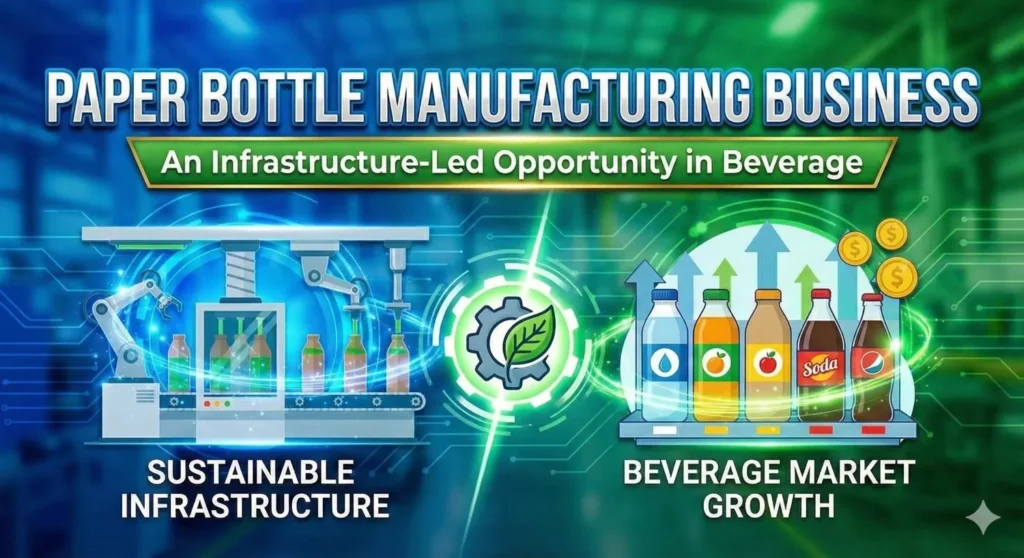
Packaging Infrastructure: A Better Investment than Consumer Products Paper Bottle Manufacturing Business – An Infrastructure-Led Opportunity in Beverage The majority of startups fail because they are too close to the volatility of consumers. Demand fluctuates, brand costs increase, and pricing power is rapidly eroded. Packaging is a completely different industry. The paper bottle business represents the next step in this logic. The paper bottle is not seen as an eco-friendly product, but rather as the core infrastructure of the future beverage industry. Packaging is upstream and locked in production lines, logistic systems, and long-term supply contracts. Paper bottle production is a rare opportunity for first-generation entrepreneurs, MSME investors, and MSME buyers. Paper bottles are no longer viewed as an innovation in product design, but rather as a necessity. Packaging infrastructure for beverages: New Startups with Infrastructure as the Main Driver. From product thinking to packaging infrastructure thinking Most manufacturing entrepreneurs think in terms of units sold. Infrastructure-led businesses consider: Paper bottles clearly belong to the second category. Switching suppliers is expensive and disruptive for a beverage company that has redesigned its filling lines, branding, compliance systems, and logistics around paper bottles. It creates structural lock-in, which is rare for startups. Paper bottle plants are characterized by: The mindset of the company determines if it will grow or not. Related Article:- Paper Industry Why startups and MSMEs have an advantage in paper bottle production The structure of large packaging companies is slow. Glass and plastic packaging ecosystems are capital-intensive, legacy-driven, and resistant to change. These constraints do not apply to startups. New entrants in the paper bottle business can benefit from: This allows MSME entrepreneurs to compete with established players by focusing on their execution. Paper Bottles: The Engineering Logic Behind Them The paper bottles are effective because they divide functions in a clever way. Outer Paperboard Shell Inner Liner The modular design is important commercially. Paper bottle production, unlike glass or polymer bottle plants, is: This reduces the risk of failure for new manufacturing enterprises. Manufacturing as a service: A smarter revenue model Manufacturing As A Service is one of the packaging models that are underused. Paper bottle manufacturers should not compete on the basis of price per unit but instead, they can be positioned as: Customers do not purchase bottles in this model. Instead, they buy access to capacity. Transactional sales revenue shifts to: This model improves the ability to service debt and stabilises cash flows, which is critical for MSME scale manufacturing. A detailed feasibility and capacity study is a must if you are evaluating paper bottle manufacturing businesses. A professional techno-economic study prevents overcapitalisation and mismatches in demand. View our:- Books First-time manufacturers are favored by capacity economics Paper bottle plants can be compact, modular, and scalable. Parameter Startup Advantage Requirements for Land Small industrial sheds Workforce Manpower shortages Expansion Shift or Lane-Based Downtime Risk Low-modular equipment Break-even Achievable at partial utilisation It allows the founder to validate their operations and expand without affecting cash flow. Multinational beverage brands are not the only drivers of demand It is a common misconception that only the global beverage giants are important. The early demand for paper bottles is driven by: They see sustainable packaging as a differentiation of the brand and not as regulatory compliance. These players are more flexible and quicker in their decision-making. They also welcome long-term partnerships. This demand profile is perfectly aligned with the manufacturing scale of MSMEs. View:- Project Report Export of Empty Bottles and Not Filled Beverages Exporting empty paper bottles is a logistically efficient way to export beverages. The following are some of the advantages: Paper bottle producers can serve as regional hubs for exporting goods to overseas bottlers. This is in line with the Ministry of Commerce and Industry’s export-led manufacturing goals, particularly where sustainability increases global competitiveness. New Startups with Infrastructure as the Main Driver. Learn from Industry Leaders: Control Dependency India’s most successful industrialists didn’t start with consumer brands. You built: The basic principle is straightforward: You can control what others depend on. The same logic applies to the manufacture of paper bottles. Beverage brands can change. Packaging infrastructure does not. Infrastructure-led manufacturing outperforms consumer startups consistently over the long-term. Startup Models that Scale Some of the most viable paper bottle business models are: Regional Packaging Utility Serve all beverage producers in a specified radius. Export-Focused Manufacturing Platform Unfilled bottles can be supplied to international bottlers. Integrated Sustainable Packaging Unit Combining paper bottles with secondary packaging and cartons. Private Label Contract Manufacturing Produce exclusive designs for retail chains. The model’s growth is based on the demand of the customer, and not in advance. Why Feasibility planning is non-negotiable The industry rewards those who are disciplined, not the optimistic. The following are key success factors: Niir Project Consultancy Services’ feasibility studies are based on actual operational economics and not just brochure projections. This improves bankability and prevents capital misallocation. New Startups with Infrastructure as the Main Driver. Last Thought: Build what the industry cannot operate without The paper bottles are changing the way beverages are packaged and distributed. The paper bottles manufacturing business does not appeal to founders who are looking for quick exits or hype cycles. This is for entrepreneurs who want to create manufacturing assets on which the beverage industry can become structurally dependent. Watch:- Youtube Channel How NPCS Can Help NPCS (Niir Project Consultancy Services) provides end-to-end support for entrepreneurs, including: With expert support, your chances of success in this high-growth sector increase significantly. Contact Us Niir Project Consultancy Services 106-E, Kamla Nagar, Opp. Mall ST, New Delhi-110007, India. Email: info@entrepreneurindia.co Mobile: +91-9097075054 Website:https://www.entrepreneurindia.co FAQs Can this be used by first-time entrepreneurs?With professional planning and technical onboarding, yes. Is the business dependent on sustainability subsidies?Sustainability accelerates adoption, but economics drive it. Is it better to have fewer clients than more?No. Anchor clients with a long-term relationship are preferred. Does the technology pose a risk?no. Once it is in operation, the machine will remain mechanically stable. What is the required mindset? Be an infrastructure builder and not a product vendor.
Electrical Components Manufacturing Opportunities in India 2026
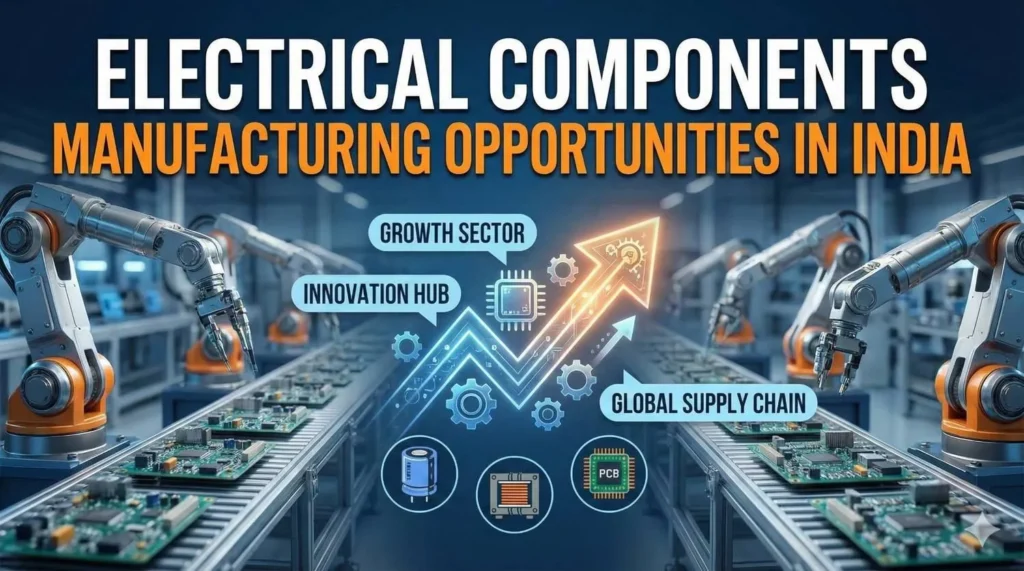
Electrical Components Manufacturing Opportunities in India 2026. India is not “upgrading”, it is rebuilding its power sector at scale. Transmission expansion, renewable infrastructure, smart grids, and metro rail electrification are all converging to create one reality: a sustained demand for electrical component manufacturing. This is not a speculative market. It is infrastructure-backed demand driven by grid expansion, replacement of aging assets, and new energy systems. This sector is a great opportunity for MSMEs and the first generation of manufacturers. It offers predictable volume, repeat procurement, and export viability if you enter with the right product logic. This article explains the real manufacturing opportunities and which product categories are most profitable. It also explains how investors can evaluate their entry, without hype or fluff. Why Manufacturing Electrical Components is a Good Business Decision Now 1. The Growth of Electricity Demand Electricity consumption is on the rise due to urbanization, the adoption of EVs, industrial expansion, and digital infrastructure. Electrical equipment demand increases before electricity consumption peaks, making manufacturers early beneficiaries. 2. Grid modernization is equipment-intensive Continuous procurement is required for: It is not a one-time capital expenditure, but a demand for replacements. 3. Renewable Energy Increases Component Consumption Solar and wind power plants consume more electrical equipment per MW compared to conventional plants, resulting in a higher demand for transformers and cables. 4. Import dependency creates entry gaps India continues to import advanced motors, switchgear components and power electronics. This is a clear indication of production gaps rather than market saturation. Related Article:- Electronic Project Electrical Components Manufacturing Segments with High Demand Segmentation of the Electrical Components Market: INFOGRAPHIC 1. Distribution Transformer Manufacturing (16kVA-2500kVA) India’s electrification campaign is centered around distribution transformers. They are required by every housing cluster, industrial park, renewable plant and substation. Product Scope Business Logic [IMAGE] Distribution Transformer Applications 2. Switchgear Manufacturing (LT & HT). Switchgear demand directly correlates with infrastructure growth. Isolation, protection, and control are essential for every power system, whether industrial or commercial. Manufacturing Scope Why This Segment is Stable View our:- Books 3. Electric Motor Manufacturing and Industrial Drives Motors transform electricity into motion – and India runs on movement. They are essential for pumps, compressors, and HVAC systems, as well as conveyors, automation systems, and EV auxiliaries. Product Categories Export AdvantageThe balance between cost and performance is the reason why Indian cars are popular in Asia, Africa and South America. 4. Power Cable Manufacturing Cables are essential to the operation of any electrical system. Cables are products that are frequently ordered and in high demand. Product Lines Commercial Reality 5. Electrical Control Panels & Automation Systems Control panels are customizable products that are ideal for MSMEs who compete on engineering, service and scale alone. Manufacturing Options Why MSMEs Win HereCustomization is a barrier to entry for mass producers. 6. Solar Electrical Components Manufacturing Demand for electrical components in balance of system systems increases automatically with the growth of renewable capacity. High Demand Products This segment is a beneficiary of ‘s policy continuity and export-relevant. 7. Smart Grid and Metering components India’s move to smarter electricity networks is technology-driven and component-heavy. Startup-Friendly Products This is a technology-manufacturing hybrid–not suitable for everyone, but powerful for capable teams. View:- Project Report 8. Power Distribution Hardware & Accessories Products with low complexity and low demand. Products Why This Work Import Substitution Logic and Export Logic [INFOGRAPHIC: Import and Export Opportunity Map] Imported Export-Ready Products Export acceptance or import gaps can help manufacturers win more quickly. India’s Power Sector Industrial Leaders: Lessons to be Learned India’s power equipment ecosystem was created by long-term planners who understand infrastructure cycles, not short-term profits. Their success confirms a truth: Electrical Manufacturing rewards patience, scale discipline and technical consistency. Watch:- Youtube Channel Conclusion: Electrical Manufacturing is a Wealth Builder for the Long-Term India is building one of the largest and most complicated power systems in the world. This will ensure a sustained demand for: This sector has a lot to offer manufacturers: Electrical component manufacturing is not trendy; it is structural. It works because it is effective. Are you serious about starting a business in the manufacturing of electrical components?The wrong assumption regarding capacity, product mix, or compliance can lead to a loss. Before investing capital, commission a DPR or a study of techno-economic feasibility. Start Your Own Business How NPCS Can Help NPCS (Niir Project Consultancy Services) provides end-to-end support for entrepreneurs, including: With expert support, your chances of success in this high-growth sector increase significantly. Contact Us Niir Project Consultancy Services 106-E, Kamla Nagar, Opp. Mall ST, New Delhi-110007, India. Email: info@entrepreneurindia.co Mobile: +91-9097075054 Website:https://www.entrepreneurindia.co FAQs 1. Which electrical products are easiest for new manufacturers? Cables, control panels, and LT switchgear components offer lower entry barriers. 2. Is export viable for MSMEs? Yes. Transformers, cables, motors, and hardware have strong overseas demand. 3. Typical investment range? ?40–80 lakh for basic units; transformer plants require higher capital. 4. Does policy support exist? Yes. Open FDI, manufacturing incentives, and infrastructure spending support the sector. 5. Can NPCS prepare a DPR for my project? Yes. NPCS delivers complete feasibility and financial reports for electrical manufacturing units.
Fish Processing and Cold Storage Business Opportunity in India

Aquaculture is no longer a farm activity–it’s an industrial opportunity Fish Processing and Cold Storage Business Opportunity in India has evolved far beyond ponds, nets, and fish. The industry is now structured, export-linked, and processing-driven, with strong integration in both directions. Scientific aquaculture, hatcheries and feed plants, cold chain, processing units, and export infrastructure are increasingly supporting what was once heavily dependent on capture fisheries. This transformation is clearly evident in the industry publication that has been uploaded. The two activities are now viewed as engines of growth for rural manufacturing and employment, as well as foreign exchange earnings. Aquaculture-linked manufacturing is one of the sectors that is most attractive to new entrepreneurs and MSMEs due to a growing global demand for fish proteins, improved production systems at home, and strong government support. Startups that are willing to look beyond primary agriculture will find the best opportunities in processing and cold chain, feed manufacturing, and value-added exports. These segments offer better margins, greater scalability, and more demand visibility. Why aquaculture is a rising industry for manufacturing entrepreneurs Aquaculture is one of India’s fastest-growing agri-based sectors. The publication reveals that India has shifted from a volume-focused fisheries industry to a value-focused aquaculture where processing and logistics are the determining factors of profitability. The Missing Link: Why Processing and Cold Chain Matter Despite a strong increase in production, a large portion of the value of fish is lost because: This is the perfect place to start a new manufacturing business. Related Article:- Fisheries and Aquaculture Key Manufacturing Opportunities in the Aquaculture Value Chain Here are high-potential, feasibility-driven business opportunities that emerge from aquaculture growth. 1. Fish Processing Plants (Fresh, Frozen & Value-Added Products) Industry Overview The value of aquaculture is based on the processing of fish. Processing converts raw fish into export-ready, shelf-stable, and branded products. Products Manufactured Why Demand is Strong Global buyers prefer: The publication highlights that seafood with added value earns significantly more than raw exports. Startup Opportunity Entrepreneurs can set up: The processing plants have strong links with the farmers, as well as forward and backward links with distributors, retailers, and exporters. View Books on:- Handbook on Fisheries and Aquaculture Technology 2. Ice Plants and Cold Storage Infrastructure Why Ice is Critical to Fisheries Fish is one of the most perishable foods. From harvest to processing, ice and temperature control is essential. Manufacturing & Service Area Market Reality The publication highlights that gaps in the cold chain remain a major bottleneck for fisheries’ growth. The demand for ice storage and reliable ice services is therefore constant. Why is it a good choice for new entrepreneurs When entrepreneurs enter the fisheries industry, they often begin by establishing ice plants. 3. Aquaculture Feed Manufacturing Units Importance of Feed in Aquaculture Feed is the highest cost of production in shrimp and fish farming. The quality of feed has a direct impact on growth rate, farm profitability, and survival. Products Manufactured Industry Trend This publication highlights the growing use of scientifically formulated feed and the decreasing dependence on traditional feeding methods. Startup advantage The feed manufacturing industry offers predictable cash flow and scalable volume to MSME investors. 4. Hatchery and Seed Production (Integrated Opportunity) Why seed quality matters For farm productivity, high-quality seeds are essential. Poor quality seed leads to diseases, mortality and losses. Manufacturing-Linked Opportunities Hatcheries are industrial units of bio-production that involve controlled breeding, water systems and technical protocols. Entrepreneurial Scope The best results are achieved when this segment is integrated with downstream processing, feed supply, or both. View Project Report:- Fish and Marine Products 5. Value-Added Seafood Products and Secondary Processing Emerging demand Consumers in urban areas and on international markets are increasingly demanding: Manufacturing Opportunity The secondary processing unit focuses on: This segment offers higher profit margins than bulk imports and allows startups to create differentiated brands. Import–Export Perspective: Why Global Markets Matter India is one of the leading exporters of seafood in the world. The majority of India’s exports are low value frozen products. The publication shows a clear shift towards: Start-up Opportunity from Export Data Export competitiveness is gained by entrepreneurs who design their plants from the start to international standards. Why New Entrepreneurs Should Enter Aquaculture Manufacturing This industry offers many rare benefits: Aquaculture manufacturing, unlike speculative industries, is demand-anchored and repeat-driven. MSME Success Models Entrepreneurs Can Learn From India’s aquaculture industry has been shaped by MSME entrepreneurs, who have focused on implementation rather than hype. Typical success patterns include The right foundation has allowed several MSME promoters to grow from regional operations into exporters that are globally compliant. Government Ecosystem Supporting Fisheries & Aquaculture The following institutions provide support to entrepreneurs in this sector: These organizations support exports, infrastructure, skill development, and market access. Practical Opportunity Snapshot Table Segment Key output Primary market Startup suitability Fish Processing Frozen seafood & Value-added seafood Export and domestic High-quality Ice Plants Ice block/flake Farmers and processors Very High Cold Storage Frozen & chilled storage Supply chain High-quality Feed Manufacturing Fish & shrimp feed Farmers Very High Value Addition Products that are ready to cook Retail & Export Medium-High Why the Timing Is Right The aquaculture industry is moving from production-led to infrastructure and processing-led growth. Entrepreneurs who enter the market now can position themselves not only as suppliers but also as key enablers in the value chain. Closed Perspective Aquaculture has evolved beyond the simple farming of fish. It’s about creating industrial systems that revolve around food, logistics, and quality, as well as global markets. Entrepreneurs who understand this shift, invest in cold chain and value-added processing, can build businesses that are export-oriented and resilient. For manufacturing-focused startups seeking scale, stability, and global relevance, aquaculture offers not just an opportunity–but a long-term industrial pathway. Watch:- Youtube Channel Conclusion Value-added seafood and secondary processing shift aquaculture from volume to value. By focusing on ready-to-cook and ready-to-eat products, better packaging, and branding, manufacturers can achieve higher margins, stronger market control, and more stable demand than bulk frozen exports. This segment rewards disciplined processing, compliance, and gradual brand building—making it a practical path for MSMEs to move up the value chain. How NPCS Can Help NPCS (Niir Project Consultancy Services) provides end-to-end support for entrepreneurs, including: With expert
10 New Manufacturing Business Opportunities in India for Startups and MSMEs

New Manufacturing Business Opportunities in India India has entered a critical phase of its industrial evolution. Manufacturing is no longer an unstructured growth opportunity, but a well-structured one, thanks to policy reforms and global supply-chain realignments. Government initiatives like Make in India, Atmanirbhar Bharat and China+1 strategy push capital, technology and demand towards domestic manufacturing. This shift was reinforced by the Union Budget 2024-25, which included infrastructure expansion, MSME support, simplified compliance and a long-term R&D financing program of Rs 1 lakh crore. This environment is a rare opportunity for entrepreneurs and MSMEs: strong domestic demand and rising exports, as well as policy-backed reduction of risk. Here are the most promising manufacturing business opportunities that startups in India can enter and scale. 1. Defence Component Manufacturing India spends more on defence than any other country in the world, but import dependency is still high. The government has made defence manufacturing available to MSMEs and private companies in order to close the gap. The government’s long-term contracts, R&D grant, and offset policy have led to a sustained demand for precision parts, electronics, drone parts, and subsystems. Startups can enter through niche manufacturing–machined components, avionics parts, protective equipment, or electronic modules–by supplying to larger OEMs. Defence manufacturing rewards compliance and quality, not price wars. This makes it a great place for entrepreneurs who are disciplined. 2. Electric Vehicle (EV), Components, and Battery Packs The adoption of electric vehicles is increasing across all fleets, including two-wheelers and three-wheelers. India imports the majority of EV components and especially lithium-ion battery packs. This gap presents opportunities for battery pack assembly and thermal systems as well as motor controllers, charging devices, thermal systems, EV electronics, and charging equipment. Even small manufacturers can get into the industry by localising a component that is import-dependent. Early movers in EV manufacturing are more likely to build strong supply relationships than consumer brands. Related Article:- Indian Startups 3. Green Hydrogen and Renewable Energy Equipment India’s renewable-energy targets are driving massive demand in solar modules, wind turbine components, and grid-scale storage systems. Import duties, production incentives, and other measures now encourage domestic manufacturing of solar components and mounting structures. Early manufacturers have the opportunity to build electrolyzers and storage tanks as well as fuel-cell components. This sector is a good investment, has export potential and aligns with the long-term energy policies. 4. Aerospace and Drone Manufacturing Drone production has evolved from a limited activity to one that is a strategic priority. Import bans have led to a strong demand for drones and parts made in the country. MSMEs are able to manufacture assemblies, airframes or motors with relatively modest capital. Aerospace manufacturing has a high value and low volume, so it is suitable for startups that have engineering skills and a quality-driven approach. View:- Project Report 5. Electronics and Semiconductor Hardware India is quickly becoming a global hub for electronics manufacturing, but component imports are still high. There are opportunities in PCB assembly and chargers. Enclosures, power electronic, telecom equipment, industrial electronics, and enclosures. Government incentives are now supporting electronics clusters, component assembly, and semiconductor manufacturing. Startups who focus on B2B rather than consumer branding can scale faster and with stable margins. 6. Pharmaceutical APIs and medical devices India’s strength in pharmaceuticals is offset by its high import dependency on APIs and equipment for medical use. The government-backed bulk drug park and medical device clusters have now reduced entry barriers. Export potential and long-term demand are available for manufacturing APIs, intermediates or diagnostic kits. The compliance is strict but the margins increase with certification and scale. View our:- Books 7. Specialty Chemicals and Advanced Materials Specialty chemicals are a high-value manufacturing opportunity. Rapid growth is supported by import substitution, global diversification, and strong export demands. Startups can concentrate on niche chemicals, additives or coatings. They can also focus on electronic-grade materials or advanced composites. This sector rewards technical expertise and consistency in process over marketing spending. 8. Recycling and Waste-Based Production India’s drive towards a circular economic system is creating a demand for manufacturing based on recycling. E-waste recycling, battery recycling and plastic reprocessing are now regulated. Recycling units are able to benefit from a stable raw material supply and green financing. They also enjoy a long-term industrial demand. When executed in large scale, this sector can combine sustainability and profitability. 9. Food Processing and Agro-based Manufacturing India only processes a small fraction of its agricultural production, leaving a huge amount of value untapped. There are many manufacturing opportunities in packaged food, dairy processing and grains. Food processing is a scalable, stable manufacturing business, provided that hygiene, quality and distribution are professionally handled. 10. Industrial Automation, Robotics & Smart Factory Equipment Manufacturing Industrial Automation and Robotics Manufacturing is a high-potential opportunity as Indian factories are rapidly automating to cut costs and meet quality standards. Demand is rising for PLC panels, conveyors, sensors, robotic arms, and retrofit automation kits. Heavy import dependence and the growth of EV, pharma, electronics, and food plants make this a stable, long-term B2B manufacturing business with recurring service revenue. Watch:- Youtube Channel The conclusion of the article is: India’s manufacturing industry is undergoing structural change. Defence, EVs and renewables, electronics, pharmaceuticals, chemicals, food processing, and recycling are no longer just speculative concepts. They are now policy-backed growth drivers. Entrepreneurs can gain a competitive advantage by focusing on a single manufacturing niche and building technical capabilities, aligning themselves with government incentives, rather than following trends. Today, manufacturing rewards those who are disciplined, compliant, and execute their plans, not those who take shortcuts. The window of opportunity is now open. The next generation of Indian manufacturing will be defined by those who act early, plan well, and invest with confidence. Find the Best Idea for Yourself With our Startup Selector To How NPCS Can Help NPCS (Niir Project Consultancy Services) provides end-to-end support for entrepreneurs, including: With expert support, your chances of success in this high-growth sector increase significantly. Contact Us Niir Project Consultancy Services 106-E, Kamla Nagar, Opp. Mall ST, New Delhi-110007, India. Email: info@entrepreneurindia.co Mobile: +91-9097075054 Website:https://www.entrepreneurindia.co FAQs – Industrial Automation & Robotics Manufacturing in India Q1. Is industrial automation manufacturing profitable in India?Yes. Demand is driven by EV, pharma, electronics, food, and logistics sectors, with high margins in system integration, customization, and
10 High-Demand Downstream Steel Product Manufacturing Ideas in India
Downstream Steel Product Manufacturing Ideas in India is real challenging. India’s infrastructure cycle does not involve speculation, but rather execution. Mega-programs like PM GatiShakti and renewable energy expansion projects, metro rail, logistics corridors, industrial parks, and other mega-projects are driving finished Steel consumption to sustained double-digit growth. The upstream steel industry is capital-intensive and crowded. Downstream Steel Manufacturing offers MSMEs advantages such as faster entry into the market, regional dominance and import substitution. This article breaks down ten downstream steel product manufacturing concepts which are in high demand and that will continue to grow aggressively until 2026. 1. Manufacturing of Pre-Engineered Building Structures (PEB). PEB is now the standard for all warehouses, factories, and data centers. Why is demand structural Manufacturing scope Business Logic Outlook for 2026: Demand for e-commerce and warehouse storage will grow By 25-30% 2. Solar Module Mounting Structures Manufacturing This segment is the most cleanly produced steel segment available today. Hard facts Products 2026 demand Related Article:- 10 Promising and Innovative Startups for Entrepreneurs 3. Steel Pipes, Tubes & Hollow Sections – ERW / GI /MS India still imports precision and structural pipes. This is both a warning and an opportunity. Applications Manufacturable Products Actionable setup 4. TMT Bars & Construction Steel Products Construction consumes 43 % of India’s. This segment is only worth ignoring if you dislike volume businesses. Products Why HTML0 works Project idea 5. Steel Fabrication for Metro, Railways & Airports India has implemented, not planned, the expansion of airports, railways, and metro Phase-II. Fabricated Products Why MSMEs Win Growth Outlook: 20% growth rate through 2026 View:- Project Report 6. Steel Wire Products Manufacturing Low capital expenditure. High margins. Consistent demand. No drama. Products Demand sectors Clear entry point for MSME. 7. Steel Service Centers Smart entrepreneurs are focusing on this value-adding method that does not involve melting steel. Services End users 2026-ready idea 8. Stainless Steel Products for Urban Infrastructure In India, urban areas are switching from mild steel to stainless for hygiene and durability. Products Why HTML0 works 9. Steel Bolts, Fasteners & High Strength Connectors Fasteners are used in every infrastructure project. Products Strategic edge View our:- Books 10. Steel Storage Systems & Warehouse Infrastructure The demand for warehousing is growing across FMCG and ecommerce. Products Market reality Learn from India’s Steel Leaders Common thread? Execution is more important than optimism. Projects for Downstream Steel Manufacturing in 2026 Conclusion: The brutal truth about downstream steel This is not an industry where you can “get rich fast”. This is a stay disciplined to get rich sector. You can: Over the next 5 to 7 years, downstream steel manufacturing will pay you more than other industrial segments. This is the place to look for serious manufacturers if you are looking for stability, scalability and growth that aligns with policy. Watch:- Youtube Channel How NPCS Can Help NPCS (Niir Project Consultancy Services) provides end-to-end support for entrepreneurs, including: With expert support, your chances of success in this high-growth sector increase significantly. Contact Us Niir Project Consultancy Services 106-E, Kamla Nagar, Opp. Mall ST, New Delhi-110007, India. Email: info@entrepreneurindia.co Mobile: +91-9097075054 Website:https://www.entrepreneurindia.co FAQs What are downstream steel products?Value-added steel products like PEB structures, pipes, solar MMS, fasteners, fabrication, wire products, and storage systems made from finished steel. Is downstream steel manufacturing profitable in India?Yes—if you choose infrastructure-linked products and operate at the right scale. Profit comes from volume, location, and EPC linkage, not speculation. Which downstream steel products are in highest demand (2025–26)?PEB structures, solar MMS, steel pipes & tubes, TMT bars, and warehouse racking systems. Is this suitable for MSMEs?Yes. Most downstream steel segments are MSME-friendly with modular expansion and strong domestic demand. What are the main risks?Wrong product choice, overcapacity, poor location, and weak demand assessment.
Why Rare-Earth Magnet Manufacturing Can Make India a Global Player
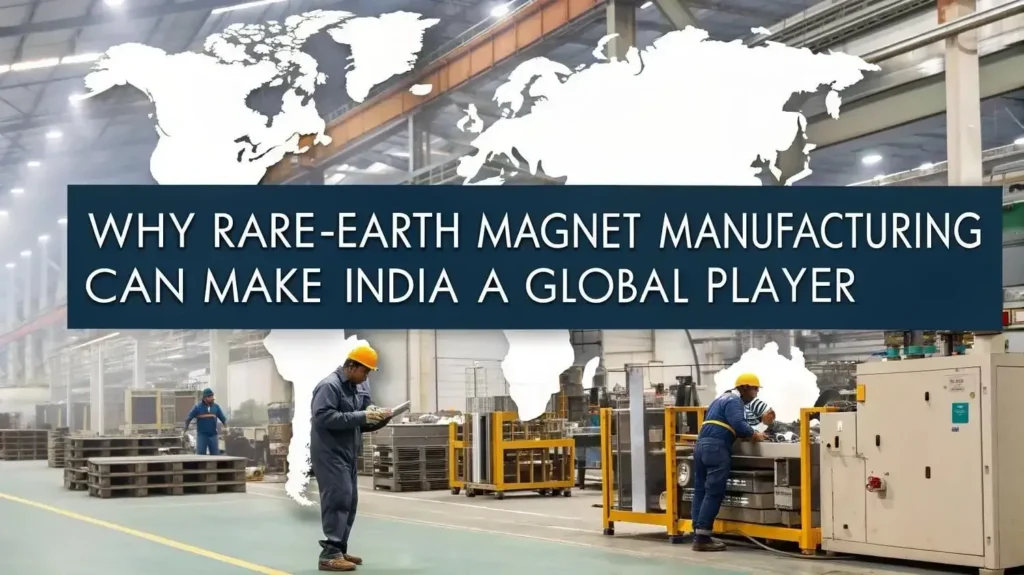
To this day, few might know that rare-earth permanent magnets (REPMs) are now powering the most important industries of the century, from drones and missiles to consumer electronics and robotics, as well as EV engines and wind turbines. The global shift to clean and electric energy has made the need for rare-earth magnets reach unprecedented demand. India starting to manufacture rare-earth magnets and other strategically important magnets—especially with the launch of a ?7,280-crore magnet manufacturing facility—goes far beyond industrial growth. It represents a major geopolitical and supply-chain opportunity, particularly well-suited for bootstrap entrepreneurs. Today, rare earth magnet manufacturing in India is among the fastest-growing yet still underdeveloped sectors, creating a powerful chance for new businesses to enter a high-demand global market. Why Rare-Earth Magnet Manufacturing Matters for India National Security and Supply-Chain Independence At present, India relies solely on one country for REPMs, leading to: 1. Supply chain disruptions 2. Increased costs 3. Geopolitical issues India needs to establish a home-grown ecosystem that guarantees the following: 1. Electric vehicles 2. Renewables 3. Aerospace and defense 4. Electronics and automation This needs to be done, and cannot be postponed. Turning Raw Resources into High-Value Output India has rare-earth resources, but as a result of: 1. Exporting inexpensive oxides 2. Overpaying for magnets India can finally shift policies and move up the value chain. This is where the money is at. Global Export Positioning India’s current position allows it to meet these industries’ needs better than its competitors. Many countries are prioritizing trade relationships with other countries rather than India’s cast competitors with China. Many countries worldwide are diversifying away from traditional rare-earth suppliers. India can fill this gap. India has the ability to meet the needs of: If India plays it right, rare-earth magnets can become its next IT or Pharma-level export success. Inside the 7,280-Crore Government Scheme What the Scheme Enables 1. 6,000 MTPA domestic REPM capacity 2. The first competitors in the market will get the biggest advantages 3. Opening new facilities will also attract capital grants 4. There will be initial grants + performance-based benefits for 5 players 5. All levels of production at the same facility (oxide ? alloy ? magnet) 6. Benefits align with the goals of Make in India & Atmanirbhar Bharat It is much more than just a simple subsidy; it is about ecosystem facilitation. And for the first competitors, it is a permanent advantage. Reasons to Focus on Entrepreneurship Absence of Rivals, Great Need No large-scale magnet manufacturers exist in India. If you step in now, you are not up against competitors; you are seizing an opportunity. Tailwinds in Mobility and Clean Energy Demand drivers continue to grow with: 1.2 and 4-wheeled EVs 2. Generators for wind turbines 3. Robotics and solar tracking 4. Electronic devices 5. Modernization of defense systems The need for these products is not cyclical in nature, hence indispensable. Government-Backed Stability The sector receives assistance through: 1. Import substitution policies 2. Long-term procurement plans 3. Incentives, subsidies, and R&D support This significantly reduces the level of risk for businesses. Multiple Entry Models There is no necessity to begin with a billion-rupee plant. Entry models include: 1.Full REPM manufacturing 2. Alloy/oxide supply .3 Custom magnet production 4. Machining and finishing 5. REPM recycling 6. Magnet-based component manufacturing (EV motors, drone motors) There is a variety of different CapEx and risk levels for each of these. Export-Led Growth With production that meets ESG guidelines and a standardized quality, India is able to connect with: 1. U.S. Inflation Reduction Act supply chains 2. European renewable ecosystems 3. Asian EV manufacturing hubs Strategic Business Models (with CapEx Logic) Model CapEx Level Strategic Fit Target Market Full REPM Manufacturing High Vertical control + import substitution India + global Alloy/Oxide Supplier Medium Critical raw input supply Magnet manufacturers Custom Magnet Manufacturing Medium High-value B2B niche EVs, electronics Magnet Recycling Medium ESG-driven circular economy Magnet plants EV/Defense Component Manufacturing Medium Downstream integration OEMs & Tier-1s Execution Roadmap — 10 Steps to Build a Rare-Earth Magnet Business Step-by-Step Breakdown If you skip even one of these steps, your project will stall.Execute this roadmap with precision. India’s Geopolitical Opportunity Rare-earth magnets are valuable outside industrial use. They are a strategic resource.Countries want supply chains that are: India satisfies all of these. And this positions India like how it went on to dominate IT services and generic pharma as a potential global hub for magnets. FAQs 1. What are rare-earth magnets and why are they important? Rare-earth magnets are powerful permanent magnets used in EVs, electronics, wind turbines, medical devices, and defense systems. Their high strength makes them essential for modern industries. 2. Is India capable of manufacturing rare-earth magnets? Yes. India has significant rare-earth reserves and is now boosting its magnet manufacturing capacity through government schemes, investments, and strategic industry partnerships. 3. What government support is available for rare-earth magnet production? India has launched a ?7,280-crore scheme to promote local magnet manufacturing, encourage private sector participation, and reduce dependence on imports. 4. Why is rare-earth magnet manufacturing considered strategic for India? Because magnets are crucial for energy, technology, and defense industries. Local production strengthens national security, cuts imports, and supports Make-in-India goals. 5. What are the business opportunities in India’s rare-earth magnet sector? Opportunities lie in mining, processing, magnet production, EV supply chains, wind energy components, and advanced electronics manufacturing. How NPCS Can Help You to start Rare-Earth Magnet Manufacturing business in india NPCS (Niir Project Consultancy Services) provides end-to-end support for entrepreneurs, including: With expert support, your chances of success in this high-growth sector increase significantly. Contact Us Niir Project Consultancy Services 106-E, Kamla Nagar, Opp. Mall ST, New Delhi-110007, India. Email: info@entrepreneurindia.co Mobile: +91-9097075054 Website: https://www.entrepreneurindia.co
How to Start Paper Water Bottles Manufacturing Business: The Ultimate 2026 Guide

Do you want to start Manufacturing Paper Water Bottles Business in 2026? If yes, you have reached at a right place. The Paper Water Bottles are an innovative and eco-friendly alternative to traditional plastic bottles. As the world becomes more aware of the dangers of plastic pollution, paper-based packaging is emerging as a promising solution. These bottles are typically made from strong paperboard combined with a thin biodegradable or recyclable lining, making them both functional and environmentally responsible. With the rising demand for sustainable packaging, entrepreneurs looking to start Paper Water Bottle Manufacturing Business can tap into a fast-growing and future-ready market. With global and Indian governments pushing for plastic reduction and consumers actively preferring sustainable products, the paper bottle industry is gaining momentum. For entrepreneurs, this is an opportunity to enter a rapidly growing market while contributing to environmental responsibility. This article explores the market outlook, manufacturing process, investment requirements, government support, and key business strategies. Global Market Outlook of Manufacturing Paper Water Bottles The global market for paper bottles is growing at a rapid pace. Early industry estimates valued the paper water bottle market demand at $150–$174 million in the early 2020s. By the early 2030s, projections suggest the market could cross $1–1.5 billion, representing a 20–30% CAGR. Even broader paper-based packaging markets are expanding from $8.5 billion in 2024 to about $22.3 billion in 2033, at ~11% CAGR. Paper Water Bottles, Bioplastics & Biodegradable Products Manufacturing Handbook Key Global Growth Drivers Driver Explanation Plastic bans & environmental regulations Countries like EU members and US states are limiting plastic bottle use, encouraging sustainable packaging. Corporate sustainability goals Major beverage companies (PepsiCo, Coca-Cola, Carlsberg, Diageo) are investing in paper bottle innovation. Consumer demand Millennials and Gen-Z prefer products aligned with environmental values. Advances in materials Better coatings like PLA (biodegradable polymer) are improving leak resistance. Investment in innovation Startups and packaging manufacturers are building capacity for large-scale production. In short, the global market shows consistent double-digit growth, making paper water bottles a future-ready business segment. Related Article:- Paper Industry Indian Market Scenario India is one of the world’s fastest-growing packaging markets. Packaging is the 5th largest sector of the Indian economy and is expanding at 22–25% per year. The overall paper and packaging market in India was about ?7.36 lakh crore (US$84B) in 2024 and is expected to reach ?12.53 lakh crore (US$143B) by 2029. A segment-specific projection places the paper packaging market at $19.07 billion in 2025, growing to $46.43 billion by 2030 (CAGR ~19.5%). Factors Driving Growth in India These conditions make India an ideal environment for manufacturing paper water bottles, both for domestic and export markets. View our:- Books Export Opportunities India exported US$3.02 billion worth of paper and paper products in FY 2022–23, according to CAPEXIL. Major export destinations include: Global buyers are actively looking for sustainable packaging suppliers, and India’s manufacturing capacity is quickly scaling due to: This means Indian paper bottle manufacturers can position themselves as global suppliers, not just domestic sellers. Manufacturing Process Overview A typical paper water bottle has: Core Raw Materials Material Purpose High-quality paperboard or molded fiber Bottle structure Biodegradable/food-grade polymer (e.g., PLA) Liquid barrier Adhesives, prints, labels Branding & sealing Required Machinery For branding, an offset or digital printing line may be included. View our:- Project Reports Plant Size & Layout Capital Investment Depending on capacity: Regulatory Approvals You will need: For export: Market Demand and Use Cases Paper bottles are not limited to packaged drinking water. Their application range is wide: Category Use Examples Beverages Water, flavored drinks, juices Alcoholic beverages Limited edition eco-friendly packaging Personal care Shampoo, body wash, lotion Household liquids Cleaners, detergents Gifting & events Corporate & hospitality eco Campaigns Urban consumers, tourism events, premium beverage brands, and eco-conscious retail chains are early adopters. Government Support The government is indirectly supporting the industry through: Entrepreneurs may also seek MSME loans and subsidy-linked financing under: Opportunities for Entrepreneurs Opportunity Why It Matters Early mover advantage Very few domestic manufacturers currently High export demand Strong interest in the EU, the Middle East, and North America Brand partnerships FMCG and beverage brands want sustainability solutions Premium pricing Eco-friendly appeal allows better margins Diversification Strong interest in EU, the Middle East, and North America Challenges to Consider However, these challenges are temporary; scale and material innovation are lowering costs every year. FAQs What is the cost of paper bottle manufacturing setup? The cost of setting up a paper bottle manufacturing unit generally ranges from ?25 lakh to ?1.5 crore, depending on production capacity, machinery type, automation level, land, and raw material requirements. How to start a paper water bottle business? To start a paper water bottle business, conduct market research and create a business plan, arrange capital, choose appropriate machinery, set up the production unit, source quality paperboard and linings, obtain necessary licenses, implement quality testing, and build distribution and marketing channels. How much money is needed to start a water bottle business? Starting a basic water bottle business may require an investment of ?10 lakh to ?50 lakh for small units. For eco-friendly paper bottle manufacturing with specialized machinery, expect a higher investment of ?25 lakh to ?1.5 crore. Is the water bottle business profitable? Yes — the water bottle industry, especially eco-friendly paper bottles, can be profitable due to growing demand and environmental awareness. Typical profit margins range from 20% to 40%, depending on scale, pricing, and distribution efficiency. Find high-return business ideas based on your budget & ROI Conclusion Manufacturing Paper water bottles is a future-oriented, scalable, and export-friendly business opportunity. Global sustainability trends, India’s booming packaging industry, and government support create a strong foundation for success. Entrepreneurs who invest early in technology, quality, and market positioning can establish leadership in this emerging sector. If planned carefully—with the right raw materials, plant setup, quality standards, and brand partnerships—a paper bottle manufacturing venture can be both profitable and environmentally meaningful. How NPCS Can Help You NPCS (Niir Project Consultancy Services) provides end-to-end support for entrepreneurs, including:
Most Top 10 Profitable Business Ideas for the Next 10 Years

Top 10 profitable business ideas Here are the in deapth guide to start Top 10 profitable business ideas Manufacturing is a major driver of economic development and entrepreneurship. Saline solutions, production of cigarettes, manufacturing and surgical gloves (latex or nitriles) are among the most promising ventures of today. These industries range from essential healthcare products to huge consumer markets, each offering unique advantages, challenges and growth trajectory. This article gives a brief overview of each business opportunity. It examines the market outlook, manufacturing process, and startup considerations. Industry Global Market Size (2025) Projected Market Size CAGR Key Growth Regions IV Saline Solutions $4 Billion (2024) $6.3 Billion (2032) ~7% Asia-Pacific and North America Cigarettes (Tobacco) $1.16 Trillion (2025) $1.38 Trillion (2033) ~2% Asia and Africa Disposable Gloves $11.2 Billion (2025) $23.2 Billion (2034) ~8% North America and Asia-Pacific 1. Saline Manufacturing: A Vital Healthcare Product Saline solution (0.9% sodium chloride) is one of the most widely used fluids in medicine–administered intravenously for hydration, as a drug vehicle, and for wound care. Saline is used in hospitals, clinics, and emergency rooms every day, which ensures a consistent global demand. Market Outlook: The IV saline industry, which was worth $4 billion in 2024, is expected to reach $6 billion by 2032, at a CAGR of approximately 7%. The growth is driven by increased healthcare usage, better hospital infrastructures in developing countries, and an increase in preparedness for emergencies.Asia-Pacific has the fastest-growing market due to its expanding hospital networks, healthcare reforms, and local production. View our:- Books Manufacturing Process: Setup & ComplianceManufacturing needs GMP-certified cleanroom facilities as well as water treatment units and sterilizers. Since saline falls under the category of pharmaceutical products, regulatory approvals are required (e.g., CDSCO in India and FDA in the US). Business InsightAlthough margins are modest, volume-based production assures profitability. Localized supply can reduce transport costs and dependence on imports. Similar infrastructure can be used to diversify into other IV fluids such as dextrose and Ringer’s Lactate. View our:- Project Reports 2. Cigarette manufacturing: a massive but regulated market In spite of health awareness, the cigarette industry remains one of the largest consumer industries in the world, with more than one billion smokers worldwide. Market Overview: The global tobacco and cigarette market is estimated to be worth over $1.16 trillion in 2025 and is projected will reach $1.38 trillion in 2033. This growth rate of 2% could continue into the future.Although the demand volume in developed countries is stable or falling, revenue continues to rise due to premiumization strategies. Manufacturing Process: Raw Material:s Cigarette paper, filters, and adhesives. It is important to maintain a reliable tobacco source. Regulatory landscape:Due to taxation and health concerns, the industry is heavily regulated. The manufacturers are required to have licenses and registrations for excise taxes, as well as comply with packaging laws, including health warnings. Advertising is sometimes restricted. Retail prices are heavily influenced by taxes, which make up a large portion. Opportunities & Challenges: 3. Manufacturing Surgical Gloves: Meeting Global Health and Safety Demand disposable glove industry, including latex and Nitrile gloves, has exploded post-pandemic because of increased hygiene awareness. These gloves are essential in the healthcare industry, laboratories, food handling and industrial safety. Market Outlook: The global glove market, valued at approximately $11 billion dollars in 2025, is expected to exceed $23 billion dollars by 2034. This represents an 8% CAGR. North America is the leader in glove consumption. Asia-Pacific, a hub of glove manufacturing (Malaysia Thailand Indonesia), is rapidly increasing both production and demand. Latex vs. Nitrile: Related Article:- Surgical Drapes, Surgical Gowns, Surgical Table Cover Manufacturing Steps: View our:- Books Facility requirements:A glove plant requires long automated dipping and curing lines, chemical preparation units, water treatment systems, as well as curing ovens. Smaller semi-automatic machines can be used to help start-ups begin modestly and then scale up. Opportunities: Challenges: The glove industry is a highly consumptive industry with high growth. View our:- Project Reports Planning and Feasibility Support Niir Project Consultancy Services specializes on preparing market survey-cum-Detailed Project Reports, which cover technical details, financial forecasts, and regulatory needs. NPCS reports help entrepreneurs make informed decisions, reduce startup risks and get expert advice. Conclusion Each of these manufacturing opportunities–saline solutions, cigarettes, and surgical gloves–offers unique advantages: Success is determined by compliance, quality, and scale. Entrepreneurs who perform detailed feasibility analyses and align themselves with changing market demands can create profitable, sustainable ventures that contribute to economic and industrial growth. FAQs: Top 10 Profitable Business Ideas Which business is most profitable? The most profitable businesses today include digital marketing services, e-commerce, cloud kitchen, real estate consultancy, and manufacturing units. These sectors offer high demand, scalability, and strong margins. What is a 7 step business plan? A 7-step business plan includes: 1) Business idea, 2) Market research, 3) Business model, 4) Marketing strategy, 5) Operations plan, 6) Financial plan, and 7) Growth strategy. This structure helps in starting and scaling any business successfully. Which business gives 1 lakh profit? Businesses like digital marketing agencies, cloud kitchens, tiffin services, boutique manufacturing, printing services, coaching centers, and trading businesses can easily generate ?1 lakh monthly profit with proper execution. Which business is best in 50,000 rupees? With a ?50,000 budget, you can start businesses like homemade food services, online reselling, digital services, graphic design, candle making, handmade product business, and small-scale trading. These require low investment and offer good returns. How to earn 50 lakhs quickly? To earn ?50 lakhs faster, people choose high-growth opportunities such as real estate, export business, stock market trading, high-ticket digital services, franchise ownership, and scalable e-commerce models. Income depends on skill, demand, and investment. Which business gives 2 lakh per month? Businesses like real estate brokerage, wholesale trading, franchise business, digital marketing agency, manufacturing units, and successful cloud kitchens can generate ?2 lakh or more per month with consistent operations. What is the safest business to start? Service-based businesses like digital marketing, consultancy, tuition/coaching, freelancing, home food services, and reselling are considered the safest because they require low investment and have steady demand. How NPCS Can Help You NPCS (Niir Project Consultancy Services) provides end-to-end support for entrepreneurs, including: With expert support, your chances of success in this high-growth sector increase significantly. Contact Us Niir Project Consultancy