
Production of Hexa (Methoxymethyl) Melamine.
Hexa Methoxymethyl Melamine, also known as HMMM, is an essential chemical compound used primarily in the production of high-performance coatings, adhesives, and resins. It plays a crucial role in the automotive, textile, and paint industries due to its excellent cross-linking abilities and resistance to moisture and heat. As industrial demand for Hexa Methoxymethyl Melamine continues to grow, entrepreneurs and chemical manufacturers are finding great opportunities in establishing production units for this versatile compound. Understanding Hexa Methoxymethyl Melamine and Its Market Potential Hexa Methoxymethyl Melamine is a methylated melamine-formaldehyde resin that serves as a crosslinker in thermosetting systems. It is widely used to improve durability and chemical resistance in surface coatings, especially automotive paints. The global demand for eco-friendly and long-lasting coating materials has significantly increased the consumption of HMMM. Starting Hexa Methoxymethyl Melamine production requires technical know-how, compliance with chemical safety regulations, and capital investment. However, with proper planning and execution, this can become a profitable chemical manufacturing business. Step 1: Conduct Market Research Before setting up a manufacturing unit, it’s important to understand the current and future demand for Hexa Methoxymethyl Melamine in domestic and international markets. Research on its application sectors like automotive, electronics, construction, and textiles will give you insights into potential buyers. Identify competitors, pricing trends, and import-export data. A strong understanding of market dynamics can help you position your brand effectively. Step 2: Create a Detailed Business Plan A comprehensive business plan is essential for success. Include details such as: Raw material sourcing (melamine, formaldehyde, methanol, catalysts) Equipment and machinery required Financial projections Licensing and regulatory compliance Marketing and sales strategies Your business plan should also outline the production process, plant capacity, and workforce requirements. This will serve as a roadmap for smooth operations. Step 3: Choose a Suitable Location Location is a key factor in chemical manufacturing. Choose an industrial area that is well-connected by road and rail and allows the handling of hazardous chemicals. The site should have access to utilities like electricity, water, and proper waste disposal systems. Availability of skilled labor and proximity to raw material suppliers and buyers is also crucial. Step 4: Obtain Necessary Licenses and Approvals Since Hexa Methoxymethyl Melamine falls under chemical manufacturing, you’ll need to obtain approvals and licenses from various regulatory bodies, including: Pollution Control Board (PCB) Factory license from local authorities Fire safety clearance Hazardous chemicals handling approval MSME/SSI registration (optional but beneficial) Ensure compliance with the Environment Protection Act, Chemical Safety Rules, and ISO standards if applicable. Step 5: Procure Machinery and Raw Materials To begin production, you’ll need specialized equipment for methylation and condensation reactions. Key machinery includes: Reactors (glass-lined or stainless steel) Condensers Storage tanks Pumps and valves Heat exchangers Safety systems (gas detectors, alarms, PPE kits) Essential raw materials for producing Hexa Methoxymethyl Melamine are: Melamine Formaldehyde Methanol Acid or base catalysts Always source high-quality materials from trusted suppliers to maintain product consistency. Step 6: Set Up the Production Process Hexa Methoxymethyl Melamine is synthesized through a controlled reaction between melamine and formaldehyde, followed by etherification using methanol. The key stages include: Methylolation: Melamine reacts with formaldehyde in a water medium under specific pH and temperature to form hydroxymethyl melamine. Etherification: The hydroxymethyl groups are further reacted with methanol in the presence of a catalyst to form Hexa Methoxymethyl Melamine. Distillation and Recovery: Excess methanol and byproducts are removed using distillation to purify the product. Cooling and Packaging: The final compound is cooled and packed in airtight containers to prevent moisture absorption. The production environment must be temperature- and pressure-controlled to ensure the safety and efficiency of the process. Step 7: Quality Control and Testing Maintaining the quality of Hexa Methoxymethyl Melamine is vital for customer satisfaction and regulatory compliance. Regular lab testing should be conducted to monitor parameters such as: Purity level (usually above 98%) Viscosity Formaldehyde content Residual methanol pH value Solubility Use standard testing methods like GC (Gas Chromatography), HPLC (High-Performance Liquid Chromatography), and FTIR (Fourier-transform infrared spectroscopy). Step 8: Packaging and Storage HMMM is sensitive to moisture and should be stored in airtight, UV-resistant containers. Use high-density polyethylene (HDPE) or lined drums for packing. Ensure labeling includes safety instructions, batch number, manufacturing date, and MSDS (Material Safety Data Sheet) information. Store the product in a cool, dry, and well-ventilated warehouse, away from direct sunlight and flammable substances. Step 9: Branding and Marketing To successfully market your Hexa Methoxymethyl Melamine, develop a strong brand identity. Use B2B marketing strategies such as: Creating a professional website Attending chemical expos and trade fairs Partnering with industrial distributors Email marketing and LinkedIn outreach Highlight the technical specifications, safety compliance, and application benefits of your product. If targeting exports, acquire REACH certification (Europe) or comply with other international quality norms. Step 10: Financial Planning and ROI Hexa Methoxymethyl Melamine production requires significant initial investment, but yields high returns due to the product’s growing demand. Some typical costs include: Plant setup and machinery: ?1 to ?3 crore Raw material inventory: ?25 to ?50 lakh (initial) Licenses and certifications: ?2 to ?5 lakh Labor and utilities: ?1 to ?2 lakh/month Marketing and logistics: ?5 to ?10 lakh annually With the right pricing and volume, a well-managed HMMM unit can achieve ROI within 2 to 3 years. Environmental and Safety Considerations Handling chemicals like methanol and formaldehyde poses environmental and health risks. Implement the following: Use fume hoods and gas scrubbers to capture emissions Provide safety training to workers Set up emergency response systems Follow waste disposal norms strictly Adopting green chemistry principles where possible can also make your brand more sustainable. Final Thoughts Starting a Hexa Methoxymethyl Melamine production unit offers a lucrative opportunity in the chemical industry. With increasing applications in coatings, resins, and adhesives, demand is poised to rise steadily. By combining strong technical execution with smart business planning, you can establish a profitable and sustainable operation. From acquiring raw materials and equipment to managing production and compliance, every step must be handled with precision. Investing in quality control, skilled
Green Business Ideas for Startup, Entrepreneurs
In recent years, the growing concerns about climate change, environmental pollution, and resource depletion have prompted individuals and governments to focus on sustainable practices. As a result, green entrepreneurship is no longer just a trend—it’s a necessity. The year 2025 offers an ideal opportunity for aspiring entrepreneurs to tap into this booming sector. Whether you’re motivated by environmental concerns or market potential, launching a sustainable venture can make a significant impact. Here are some of the most promising green business ideas to help you start your eco-conscious journey in 2025. Why Green Business Ideas Matter More Than Ever The urgency of combating global warming has shifted public and private focus toward cleaner, eco-friendly operations. Consumer preferences have evolved, with an increasing number of people choosing brands that reflect their environmental values. Governments are also incentivizing green initiatives through subsidies, tax benefits, and regulatory support. Against this backdrop, launching a business that promotes sustainability not only aligns with ethical imperatives but also positions you for long-term profitability. From organic farming to waste recycling, there are endless green business ideas that can suit various skill sets and budgets. 1. Solar Energy Installation Services Solar energy continues to be one of the fastest-growing segments in the green economy. As the cost of solar panels decreases and their efficiency improves, both residential and commercial customers are eager to switch to solar power. If you have a technical background or can partner with experts, starting a solar panel installation service can be a lucrative and sustainable business opportunity. 2. Sustainable Fashion Brand The fashion industry is one of the top polluters in the world. In 2025, consumers are expected to continue shifting toward sustainable clothing made from organic, recycled, or upcycled materials. Launching a fashion brand that promotes eco-conscious manufacturing, zero-waste patterns, and ethical labor practices can attract a loyal customer base. This is one of the more creative green business ideas that allows you to make a statement while turning a profit. 3. Organic Farming and Urban Gardening As more people seek healthier lifestyles, the demand for organic produce is skyrocketing. Starting an organic farm or even a small-scale urban gardening service can fulfill this growing need. You can supply to local restaurants, farmers’ markets, and even offer home delivery subscriptions. This business idea not only contributes to food sustainability but also helps reduce carbon footprints associated with food transportation. 4. Eco-Friendly Packaging Solutions With mounting bans on single-use plastics, businesses across sectors are looking for sustainable packaging alternatives. Offering biodegradable, compostable, or recyclable packaging materials can make your startup a valuable resource for eco-conscious companies. This sector is projected to grow significantly by 2025, making it a timely green business idea. 5. Green Cleaning Services Traditional cleaning products contain harmful chemicals that pollute both indoor and outdoor environments. Green cleaning services use natural, non-toxic products that are safe for humans and the planet. You can target households, offices, schools, and healthcare facilities. This business model is scalable and has recurring revenue potential, all while aligning with environmental values. 6. Electric Vehicle (EV) Charging Station As electric vehicles become mainstream, the demand for convenient and fast charging stations will rise exponentially. Investing in an EV charging station—particularly in areas with growing EV adoption—can position you as a pioneer in this essential infrastructure development. It’s one of the forward-thinking green business ideas with long-term growth potential. 7. Recycled Furniture and Home Decor Turning discarded materials into beautiful, functional furniture and home decor is both an art and a business. Recycled furniture appeals to environmentally-conscious consumers who appreciate sustainability and craftsmanship. Using reclaimed wood, metal, and even plastic can reduce landfill waste and add unique character to your creations. 8. Green Consulting If you have expertise in environmental science, sustainability practices, or green certifications, offering consulting services to businesses can be a profitable venture. Many companies want to reduce their environmental impact but don’t know where to start. Your services can include carbon footprint analysis, sustainability reporting, eco-certification assistance, and green supply chain strategies. 9. Zero-Waste Retail Store Opening a zero-waste store that sells unpackaged goods, reusable containers, and sustainable household items can tap into the growing zero-waste movement. You can also include educational workshops and community events to build brand loyalty and raise environmental awareness. This hands-on approach to sustainability makes it one of the more impactful green business ideas. 10. Biodegradable Products Manufacturing From toothbrushes to tableware, manufacturing biodegradable alternatives to everyday plastic items is a profitable business opportunity. These products decompose naturally without harming the environment, and consumers are increasingly making the switch. This idea requires some initial investment in research, materials, and equipment but promises sustainable returns. 11. Vertical Farming Systems Vertical farming allows crops to be grown in stacked layers using controlled-environment agriculture technology. It saves space and uses less water, making it ideal for urban settings. Starting a vertical farming business or supplying these systems to schools, restaurants, or urban communities can put you at the forefront of urban agriculture innovation. 12. Upcycled Products and Art Turning waste into art is not only eco-friendly but also artistically fulfilling. From handbags made from seat belts to sculptures made from scrap metal, upcycled products have strong appeal among niche markets. Platforms like Etsy and social media help in promoting these creative green business ideas to a global audience. 13. Water Conservation Technologies With water scarcity becoming a global concern, developing or distributing water-saving technologies like low-flow fixtures, smart irrigation systems, or greywater recycling units can make a meaningful difference. This tech-driven solution appeals to both residential and commercial clients and fits well within the realm of eco-innovation. 14. Sustainable Event Planning Events often generate massive amounts of waste. As a sustainable event planner, you can organize weddings, corporate functions, or festivals with minimal environmental impact. This includes using compostable utensils, sourcing local food, minimizing energy usage, and encouraging guests to carpool or use public transport. 15. Eco-Tourism Business The tourism industry is undergoing a shift toward sustainability. Launching an eco-tourism business—offering
December 2019 Entrepreneur India Monthly Magazine
December 2019 monthly magazine – Startup & Business Focus was a pivotal edition that captured the pulse of India’s vibrant and fast-growing startup ecosystem. This edition didn’t just celebrate success—it analyzed trends, highlighted ground-level innovation, and delivered key insights that inspired entrepreneurs, policy-makers, and investors across the nation. The issue came at a time when Indian startups were making their global mark, and the business climate was undergoing significant transformation due to policy changes, digital acceleration, and investor optimism. Key Themes Covered in the Magazine The Entrepreneur India Dec 2019 – Startup & Business Focus issue offered a thorough examination of India’s entrepreneurial ecosystem, ranging from government-backed programs to private capital influx. It served as a guidebook for aspiring entrepreneurs while also being a source of strategic insights for existing startups looking to scale. The Rise of Non-Metro Startups One of the strongest messages from the edition was the emergence of Tier 2 and Tier 3 cities as startup hubs. The magazine spotlighted smaller towns like Jaipur, Indore, Bhubaneswar, and Coimbatore, where entrepreneurs were innovating in agritech, edtech, and healthtech sectors. Entrepreneur India Dec 2019 – Startup & Business Focus revealed how these cities, equipped with talent and now better internet penetration, were becoming startup breeding grounds. Infrastructure and Incubators State governments and private players were setting up incubators and accelerators outside the metros, offering young entrepreneurs access to mentorship, seed capital, and industry connections. This decentralization of entrepreneurial opportunity was among the strongest highlights of the edition. Stories of Grit and Innovation The magazine profiled successful startups that began with limited resources and leveraged digital platforms to create impact. Whether it was a company offering AI-driven healthcare diagnostics or a startup selling organic produce online, the common thread was innovation rooted in solving real problems. Failures That Led to Success Interestingly, Entrepreneur India Dec 2019 – Startup & Business Focus did not glamorize success alone. It included in-depth case studies of failed startups, explaining what went wrong—mismanagement, market misjudgment, or investor conflicts. These case studies were shared not to discourage but to educate. Policy Impact and Government Initiatives Government support was another major theme. The issue delved into how Startup India, Digital India, and Make in India were offering new momentum to entrepreneurs. Regulatory simplification, startup tax exemptions, and easier business registration were all contributing to an improved ease of doing business. GST and Compliance Simplification The magazine clarified how the Goods and Services Tax (GST) and new labor reforms were affecting small businesses and startups. It gave actionable tips on how to stay compliant and benefit from available deductions or exemptions. Funding Landscape and Investor Trends Entrepreneur India Dec 2019 – Startup & Business Focus also offered deep insight into investor sentiment. From early-stage angel networks to Series A and beyond, the edition covered who was investing, in what, and why. From Valuation to Value Creation A standout analysis in the magazine showed that investors were beginning to prioritize long-term value over inflated valuations. Sustainable business models, a clear revenue path, and tech integration were seen as more attractive than vanity metrics. Women Entrepreneurs in Focus This edition strongly highlighted the rise of women-led startups. From fintech to fashion tech, the issue covered how women entrepreneurs were breaking barriers and accessing funding more than ever before. Support Ecosystems for Women Founders Accelerator programs, government incentives, and mentorship platforms specifically targeting women were beginning to show results. Entrepreneur India Dec 2019 – Startup & Business Focus illustrated this shift with interviews and performance statistics. The Tech Revolution Driving Change Emerging technologies like Artificial Intelligence, Machine Learning, Blockchain, and IoT were not just buzzwords—they were solving core industry problems. The edition explored how startups were embedding these technologies into their business DNA. Sector-Wise Breakdown From automated logistics platforms in the supply chain to blockchain in agricultural transactions, the magazine categorized the impact of each technology sector-wise. This made it a powerful reference for tech entrepreneurs seeking vertical-specific applications. Global Expansion and Indian Startups Abroad Entrepreneur India Dec 2019 – Startup & Business Focus looked beyond national boundaries. Indian startups expanding into Southeast Asia, Europe, and the U.S. were highlighted. These businesses were no longer confined to Indian problems—they were solving global issues. Cross-Border Investments The magazine detailed how cross-border venture capital funding was boosting Indian startups. It provided advice on how to pitch to foreign investors and comply with international business regulations. Social and Environmental Impact Businesses The edition applauded startups focused on social entrepreneurship. Clean water, sustainable packaging, rural fintech, and edtech initiatives found special mention. Metrics Beyond Profit Entrepreneur India Dec 2019 – Startup & Business Focus discussed how new-age founders were using alternative success metrics—impact, user reach, behavioral change—instead of just top-line growth. Millennial and Gen Z Entrepreneurs The youth-led wave was visible throughout the edition. College dropouts, first-generation founders, and students were building apps and platforms that saw viral growth overnight. A New Mindset Speed, flexibility, and technology adoption were the hallmarks of these young entrepreneurs. Their stories reflected a shift in entrepreneurial culture—more risk-taking, more experimentation, and stronger digital intuitiveness. Practical Guidance and DIY Playbooks A major asset of this edition was the set of practical toolkits. From legal compliance checklists to fundraising templates and pitch deck frameworks, the issue empowered entrepreneurs with ready-to-use content. Expert Panels and Q&A Interviews with VCs, angel investors, and startup mentors were presented in a Q&A format. Their tips on pitching, hiring, branding, and scaling were concise and actionable. Events and Networking Opportunities The magazine listed upcoming events, competitions, and expos in India’s business calendar for Q1 2020. It encouraged founders to attend, network, and participate in ecosystem-building activities. Building Entrepreneurial Communities Entrepreneur India Dec 2019 – Startup & Business Focus stressed the importance of collaborative ecosystems. It encouraged joining co-working spaces, mentorship programs, and industry groups to build resilience and gain exposure. Legal Insights and Business Structures The magazine helped demystify legal jargon around business formation, intellectual property, and shareholder agreements. Startups were guided on choosing the
Best Eco Friendly Products, Projects & Ideas for Startups
The Best Eco Friendly Products, Projects & Ideas for Startups are reshaping the way businesses think about profitability and sustainability. In a world where climate change, plastic pollution, and carbon emissions are urgent global concerns, eco-conscious startups are not just trends—they’re becoming essential. From biodegradable packaging and zero-waste solutions to solar-powered gadgets and sustainable fashion, green business ideas are gaining massive attention. Entrepreneurs who align with environmental goals are not only helping the planet but also tapping into a fast-growing consumer base that prefers conscious brands. Now is the perfect time to explore the best eco friendly products, projects & ideas for startups that combine innovation with impact. Why Eco Friendly Startups Are the Future Eco-conscious consumers are driving a market shift. People are choosing brands that align with their values—be it cruelty-free, plastic-free, locally sourced, or carbon-neutral. Governments are incentivizing green businesses, while investors are backing sustainable ventures more than ever. That’s why the Best Eco Friendly Products, Projects & Ideas for Startups are not only good for the planet—they’re also incredibly profitable. Whether you’re a first-time founder or looking to pivot your current business, the green economy offers countless low-investment, high-impact opportunities. Products like bamboo toothbrushes, reusable bags, organic detergents, or upcycled fashion are becoming mainstream. On a bigger scale, ideas like bioplastics manufacturing, composting plants, or EV charging networks are changing entire industries. In this context, creating a startup around eco friendly solutions is not just visionary—it’s practical and profitable. Sustainable Packaging and Alternatives to Plastic Among the Best Eco Friendly Products, Projects & Ideas for Startups, plastic alternatives are in high demand. Consumers and brands are moving away from single-use plastic toward biodegradable and compostable packaging materials. Startups can produce eco-friendly containers from sugarcane bagasse, cornstarch bioplastics, bamboo fiber, or recycled kraft paper. Packaging businesses that offer customized, sustainable solutions for D2C brands, food chains, or e-commerce companies have a strong recurring revenue model. Beyond packaging, items like edible spoons, reusable silicone wraps, and beeswax paper rolls are popular among urban eco shoppers. Launching a small unit that manufactures or distributes such items is a smart entry point for entrepreneurs interested in the green product market. Organic Personal Care and Cleaning Products One of the fastest-growing segments in the Best Eco Friendly Products, Projects & Ideas for Startups is natural personal care and home cleaning. Eco-minded consumers are avoiding products with parabens, sulfates, artificial fragrances, and harsh chemicals. Instead, they prefer herbal, toxin-free shampoos, soaps, creams, and detergents. Startups can create organic bath bars using plant-based oils, essential oils, and biodegradable packaging. Similarly, herbal floor cleaners and enzyme-based detergents can replace conventional cleaners. These can be marketed to households, schools, hotels, and health-conscious individuals who prioritize chemical-free living. Subscription-based eco-friendly kits and refill stations also create great retention-based business models. Sustainable Fashion and Upcycled Apparel Textile waste is one of the biggest environmental problems today, which is why fashion ventures are an essential part of the Best Eco Friendly Products, Projects & Ideas for Startups. From producing garments using organic cotton, hemp, or bamboo to upcycling old clothing into new styles, there are endless possibilities. Startups can collect fabric waste from local tailors or manufacturers and turn them into accessories, bags, or custom outfits. Zero-waste pattern cutting, ethical manufacturing practices, and transparent supply chains are now a USP that customers seek. Launching a fashion brand with sustainability at its core can earn not just customer love but also media attention and loyal niche communities. Eco Friendly Tech & Energy Projects Tech-driven green businesses are on the rise. Some of the Best Eco Friendly Products, Projects & Ideas for Startups include solar-powered lighting, smart energy monitors, and portable wind turbines for rural areas. Startups can also work on EV battery maintenance, solar product retailing, or B2B solar panel installations. Even apps that help people track their carbon footprint, find second-hand goods, or connect with sustainability events are thriving. Green tech isn’t just about physical products—it’s also about empowering consumers to make better choices. With the right business model, even a data-driven sustainability tool can become a game-changer. Waste Management and Composting Solutions Turning waste into wealth is a major pillar of the Best Eco Friendly Products, Projects & Ideas for Startups. From home compost bins to industrial organic waste converters, there are scalable solutions to tackle food and garden waste. Entrepreneurs can offer composting kits for urban homes or set up B2B models for restaurants and hotels. In rural areas, startups can create vermicomposting units to convert farm waste into organic fertilizer. There is also increasing demand for managing e-waste and textile waste through organized collection, sorting, and recycling systems. These businesses create environmental value while solving real-world urban and rural challenges. Eco Friendly Stationery and Lifestyle Products Eco friendly lifestyle brands are booming. Stationery products made from recycled paper, plantable seed pens, bamboo desk organizers, and cork-based diaries are all part of the Best Eco Friendly Products, Projects & Ideas for Startups. These items are especially popular among students, professionals, and corporate gift buyers. Startups can design sustainable desk essentials or gift hampers that promote green living. With the rise of remote work and home offices, stylish eco-products are becoming a part of everyday workspaces. Many educational institutions and NGOs are also bulk buyers of eco-stationery, opening doors for B2B as well as D2C growth. Green Subscription Boxes and Online Marketplaces One of the most creative ideas among the Best Eco Friendly Products, Projects & Ideas for Startups is launching a green subscription box. Curated monthly or quarterly boxes with eco products—like reusable bags, compostable utensils, organic skincare, and zero-waste kits—can be offered to conscious consumers. Alternatively, startups can create an online marketplace that only sells certified eco-friendly products. By curating ethical brands and educating users through blogs and product guides, such platforms can build a loyal following. From handmade to upcycled goods, the demand for curated green products is rapidly rising, especially in metro cities. Conclusion Exploring the Best Eco Friendly Products, Projects &
Upcoming Business Ideas with Investment of 30 Million
With a substantial capital like a $30 Million Investment, an entrepreneur has the flexibility to explore highly lucrative, scalable, and sustainable ventures across multiple industries. This amount allows for diversification, tapping into futuristic technologies, and entering markets with high barriers to entry. Whether you are an individual investor, a corporate body, or a fund manager looking to deploy this capital wisely, the following article explores robust business ideas that promise impressive returns over the long term. Top High-Growth Sectors to Consider for a $30 Million Investment 1. Renewable Energy Projects The global push toward sustainability is creating a massive opportunity in renewable energy. With a $30 Million Investment, you can launch a solar or wind energy plant, particularly in high-insolation or wind-rich regions. Solar farms in India, Africa, or the Middle East can offer a high ROI due to lower land and operational costs. Governments worldwide provide incentives and subsidies, further boosting profitability. Investing in battery storage and green hydrogen startups can also diversify your renewable portfolio. 2. Biotechnology and Healthcare Innovation Post-pandemic, biotechnology is one of the fastest-growing sectors. A $30 Million Investment can seed a biotech research firm focusing on advanced therapies like gene editing, personalized medicine, or cancer treatment. Another viable option is setting up high-end diagnostic labs or specialty hospitals in under-served Tier II and Tier III cities, where healthcare infrastructure is still developing. You can also consider investing in telemedicine platforms to meet the demand for virtual care globally. 3. Real Estate Development in Emerging Markets Real estate remains a classic avenue for wealth creation. Your $30 Million Investment can go into mixed-use developments (residential + commercial), smart cities, or retirement communities in fast-developing regions like Southeast Asia, Eastern Europe, or certain African countries. Build-to-rent models are particularly attractive now, driven by younger populations preferring rental over ownership. A well-positioned real estate project can yield long-term rental income along with capital appreciation. 4. Fintech Platform or Digital Bank Digital financial services are booming, especially in regions with low banking penetration. With a $30 Million Investment, you could create a neobank, peer-to-peer lending service, or a decentralized finance (DeFi) platform. The capital will help you acquire regulatory licenses, build secure infrastructure, and market the product across a wide audience. Emerging markets like India, Nigeria, and Brazil offer significant potential for digital banking adoption and expansion. 5. Advanced Manufacturing and Robotics The future of manufacturing lies in automation, smart factories, and AI-driven logistics. Your $30 Million Investment can fund an advanced manufacturing unit producing robotics for agriculture, warehousing, or healthcare. Another option is setting up a semiconductor component plant, especially considering current global shortages. You could also explore precision manufacturing for aerospace or medical device industries, which yield higher margins due to their technical complexity and regulatory standards. 6. E-commerce Aggregator or Brand Incubator Rather than launching a single online store, an increasingly popular trend is acquiring and scaling multiple e-commerce brands under one roof. With a $30 Million Investment, you can build an e-commerce aggregator that acquires DTC (direct-to-consumer) brands in niche markets such as pet supplies, fitness gear, or skincare. Additionally, you could incubate original product lines using proprietary tech and influencer partnerships. The capital helps in acquiring customers and optimizing supply chains. 7. Film Production Studio or Streaming Content Platform The entertainment industry continues to evolve with growing OTT (over-the-top) consumption. A $30 Million Investment can go into launching a mid-sized production studio that creates web series, films, and documentaries for global audiences. Alternatively, you can build a niche streaming platform focusing on regional content, documentaries, or animated storytelling. With the right content strategy and marketing push, such platforms can attract both subscribers and licensing deals. 8. Agri-Tech Solutions and Vertical Farming With global food security challenges and urbanization trends, agri-tech is gaining attention. A $30 Million Investment can set up high-tech vertical farms in urban centers, which use hydroponics and climate control to produce fresh food with minimal water usage. You can also invest in farm management software, AI-powered crop prediction models, or precision drone spraying technologies. These solutions have strong government support and can scale across continents. 9. Franchise Network Development Franchising remains one of the most predictable business models. With your capital, you can acquire a master franchise license for a popular global brand in food, fitness, or education and expand it across an entire region or country. A $30 Million Investment can build multiple outlets, run aggressive marketing, and employ regional teams for faster rollout. Alternatively, if you own a successful business model, you can use the funds to turn it into a franchise and sell licenses globally. 10. AI & SaaS Product Incubation Software-as-a-Service (SaaS) continues to be a top choice for investors. Use your $30 Million Investment to launch or fund a suite of SaaS tools—CRM for small businesses, HR platforms, or niche industry solutions for legal or construction sectors. Pair this with artificial intelligence to offer smart analytics or predictive solutions. The subscription model ensures recurring revenue, and software companies tend to scale rapidly with lower overhead than traditional businesses. 11. Space Tech or Satellite Communication Private space exploration and satellite communication are becoming more accessible. A $30 Million Investment won’t launch rockets like SpaceX, but it can develop small satellite manufacturing, ground station services, or AI-powered imaging analysis for agriculture, defense, and urban planning. These niche segments are attracting interest from larger players looking for partnerships or acquisitions, giving early investors an attractive exit route. 12. Education Technology (EdTech) Platform EdTech has seen explosive growth and shows no signs of slowing down. Whether you’re building a K-12 virtual academy, a coding bootcamp, or an AI-driven tutoring app, a $30 Million Investment offers the runway for technology development, curriculum design, and aggressive student acquisition. Markets in Asia and Africa are highly responsive to affordable, high-quality digital education solutions. 13. Luxury Hospitality or Eco-Resort Chain The hospitality industry is rebounding post-COVID, especially in the luxury and eco-tourism segments. Your $30 Million Investment can establish a boutique chain
Best Manufacturing Business To Start With 30 Million
India’s rapidly evolving economy, coupled with government incentives like the “Make in India” initiative, has paved the way for new-age entrepreneurs to venture into the manufacturing sector. With a capital of ?30 million (?3 crore), aspiring business owners can kickstart a range of profitable and trending manufacturing businesses. This budget is substantial enough to cover factory setup, raw materials, machinery, and even initial marketing, making it ideal for small to medium-scale manufacturing ventures. Best Trending Manufacturing Businesses to Launch in 2025 In this article, we explore some of the most trending manufacturing businesses that can be successfully started with an investment of ?30 million. Each business idea has been selected based on market demand, future scalability, and potential return on investment. 1. Electric Vehicle (EV) Battery Manufacturing With India’s EV market growing rapidly, battery manufacturing is an increasingly promising domain. Lithium-ion batteries are the most in-demand components in electric vehicles, including two-wheelers and e-rickshaws. Why it’s trending: Government subsidies and FAME II policy. High demand from automobile and consumer electronics sectors. Scope for exports. ?30 million breakdown: Machinery and equipment: ?12–15 million Factory lease and setup: ?5 million Raw materials: ?6–7 million Labor and utilities: ?2 million Marketing and compliance: ?1–2 million 2. Solar Panel Assembly Unit As India pushes for renewable energy, the demand for solar panels is skyrocketing. Starting a solar panel assembly unit can be a lucrative venture. Reasons to invest: The solar energy sector is expected to grow by 25% annually. Government provides multiple tax rebates and capital subsidies. Growing demand in rural and urban residential sectors. This business can fit within the ?30 million investment range with funds allocated for technology, manpower, and solar-grade raw materials. 3. Organic Fertilizer Production Organic farming is no longer a niche trend—it’s becoming a norm. Starting an organic fertilizer production unit is one of the trending manufacturing businesses that ensures sustainability along with profitability. Opportunities: Increased awareness of soil health and eco-farming. Growing export opportunities. Low technological barrier to entry. With ?30 million, you can establish a medium-scale facility, procure composting equipment, and ensure full compliance with FSSAI and other agricultural regulations. 4. Biodegradable Packaging Material The ban on single-use plastic and the rise in eco-conscious consumers have opened the door to biodegradable packaging solutions. Entrepreneurs can manufacture items like compostable containers, paper-based packaging, or cornstarch bags. Market trend drivers: FMCG, e-commerce, and food delivery sectors seeking sustainable alternatives. Government regulations enforcing green packaging. Opportunity to create B2B and B2C brands. Within ?30 million, you can set up a facility, purchase biodegradable extrusion and molding machines, and invest in R&D for better product quality. 5. Smart Home Appliances Manufacturing As the smart home trend expands, there’s a rising demand for products like automated lighting, smart plugs, air purifiers, and security cameras. Developing or assembling smart home devices is among the top trending manufacturing businesses due to tech adoption across urban India. Growth factors: Rising urbanization and middle-class income. Integration of IoT and AI. High retail margins and global export potential. A ?30 million investment is enough for importing chipsets, assembling units, hiring electronic engineers, and creating a distribution network. 6. Textile and Garment Manufacturing (Eco-Fashion Focus) India’s garment industry is massive, and there’s a growing demand for sustainable and organic fashion products. You can start a textile manufacturing unit focusing on eco-friendly fabrics like bamboo, hemp, or organic cotton. Why it’s trending: Global shift toward ethical fashion. Massive domestic demand, especially through online marketplaces. Potential to create your own label or serve export markets. Investment will cover machinery, dyeing units, stitching facilities, worker salaries, branding, and distribution. 7. Processed Food Manufacturing Processed and packaged foods—such as frozen snacks, ready-to-cook meals, health bars, or ethnic foods—are highly sought-after. The Indian processed food market is projected to reach $500 billion by 2030. Advantages: Expanding supermarket and e-grocery landscape. Ability to customize product range for regional tastes. FSSAI and ISO certifications can help gain retail credibility. ?30 million is enough to build a medium-scale facility with modern food processing equipment, storage, distribution, and packaging lines. 8. Ayurvedic and Herbal Products Manufacturing Ayurveda is not only a tradition but now a trend. Manufacturing herbal products like face packs, oils, supplements, and wellness teas has emerged as a top business opportunity. Why it’s one of the trending manufacturing businesses: Ayurveda’s rising global recognition. Increasing demand from wellness-conscious consumers. Strong export market and eCommerce adaptability. With ?30 million, you can invest in raw materials, proprietary formulations, GMP-certified production facilities, and digital branding. 9. Water Purification Systems Clean water is a priority across India, especially in rural and semi-urban areas. Manufacturing RO systems, UV purifiers, or water softeners can lead to long-term profits. Key drivers: Water contamination awareness. Household and commercial demand for purification solutions. Opportunity to serve municipal or government contracts. The budget allows for setting up a plant, testing labs, certification, and service teams. 10. 3D Printing for Industrial Prototypes 3D printing is revolutionizing manufacturing across automotive, aerospace, healthcare, and architecture. With rising industrial adoption, a B2B-focused 3D printing service and parts manufacturing unit can be a profitable venture. Benefits: High margins and relatively low competition. Rapid prototyping needs from multiple industries. Ideal for customization-based business models. Initial investment will be spent on industrial-grade 3D printers, CAD design tools, raw materials (resins, metals), and operator training. Final Thoughts on Trending Manufacturing Businesses With ?30 million in hand, you are well-positioned to launch any of the trending manufacturing businesses mentioned above. The key to success lies not just in choosing the right product, but also in combining innovation, operational efficiency, and marketing savvy. Whether you are targeting domestic markets or aspiring to go global, India’s manufacturing landscape is rich with potential. When entering the manufacturing domain, remember to: Do detailed feasibility and market analysis. Ensure compliance with statutory and safety norms. Use digital marketing to promote your products. Innovate continuously to stay ahead of competitors. Choosing from these trending manufacturing businesses gives you a strategic edge in tapping into high-growth sectors while building long-term
Profitable Business Ideas in Manufacturing of Chlorinated Paraffin Wax (CPW) Industry.
The CPW manufacturing industry, or Cereal Processing and Packaging, represents one of the most lucrative segments in the fast-moving consumer goods (FMCG) sector. The increasing global demand for ready-to-eat foods, especially breakfast cereals, is fueling consistent growth and opportunity. With consumers prioritizing health, convenience, and innovation, launching a CPW manufacturing business today can translate into high margins and scalable expansion. Comprehensive Guide to Launching a Successful CPW Manufacturing Business Understanding CPW ManufacturingAt its core, CPW manufacturing involves producing and packaging cereal-based food products that range from cornflakes and muesli to granola and fortified puffs. These products are either processed by extrusion, puffing, flaking, or roasting and then mixed, flavored, and packaged in various forms. The entire process requires precision, hygiene, nutritional formulation, and aesthetic packaging to succeed in an increasingly competitive market. Market Potential and Industry Scope The global breakfast cereal market is projected to surpass $75 billion by 2030, and CPW manufacturing plays a critical role in this growth. Consumer lifestyles are shifting towards quick, healthy options, creating a consistent demand for breakfast cereals and snacks. In regions like North America, Europe, and emerging economies in Asia, the popularity of cereals among all age groups ensures recurring revenue streams. In India and Southeast Asia, the CPW segment is still under-penetrated, offering an early-mover advantage. Rising health awareness and the convenience of ready-to-eat meals are pushing more brands into this segment, yet there’s ample space for innovation in taste, formulation, and packaging. Capital Investment and Machinery Setup Starting a CPW manufacturing unit requires a moderate to high capital investment, depending on the scale of operation. Here’s a basic breakdown: Small-Scale Unit: INR 25–50 lakhs Medium-Scale Unit: INR 1–2 crores Large-Scale Unit: INR 5+ crores Essential Machinery Includes: Grain cleaning and grading machine Roasting or puffing machine Extruder and flaking machine Mixing and flavoring units Dryers and cooling conveyors Automatic packaging machines Weighing and sealing equipment These machines should conform to FSSAI, ISO, and GMP standards to ensure quality and safety. Raw Material Sourcing The backbone of any CPW manufacturing business is a reliable and consistent supply of high-quality raw materials. Key raw materials include: Corn, wheat, rice, oats, and barley Sweeteners (sugar, honey, malt) Dried fruits and nuts Natural and artificial flavors Fortifying agents (vitamins, minerals) Packaging materials (laminated pouches, cartons) Local sourcing for grains can significantly reduce input costs, especially in agricultural countries like India, the USA, or Brazil. Formulation and Product Development To stand out in a competitive CPW market, we must create unique formulations catering to diverse consumer segments: Kids: Sweetened cereals with fun shapes and added calcium Adults: High-fiber, low-sugar options Fitness Enthusiasts: Protein-rich granola and muesli older people: Easy-to-digest, fortified cereals Hiring experienced food technologists and investing in R&D can lead to the development of proprietary recipes, which increases brand value and consumer loyalty. Packaging and Branding Strategy Packaging is not just functional—it’s one of the strongest marketing tools in CPW manufacturing. Eye-catching, durable, and informative packaging increases shelf appeal and builds trust. Invest in: Resealable pouches or containers Nutritional labeling and certifications Attractive brand design Multi-language printing (for international markets) We must emphasize eco-friendly packaging, which resonates strongly with modern consumers. Licensing and Regulatory Compliance To legally operate a CPW manufacturing business, we must secure various approvals: FSSAI License – Mandatory for food processing units GST Registration Factory License from local authority Fire and Pollution NOC ISO 22000 – Food safety management certification Halal/Kosher certification (if exporting) Compliance not only ensures safety and legality but also boosts customer trust and export eligibility. Hiring Skilled Workforce For smooth operations, we require the following personnel: Food technologists and quality controllers Machine operators and maintenance staff Packaging and warehouse handlers Sales and marketing professionals Logistic and distribution managers Training in hygiene standards, equipment handling, and safety procedures is essential to maintain consistent product quality. Sales Channels and Distribution Network A strong distribution strategy is key to scaling a CPW manufacturing business. Potential sales channels include: Supermarkets and hypermarkets Online grocery platforms (Amazon, BigBasket, Walmart) Health food stores and gyms Schools, offices, and hospital cafeterias Export markets via distributors and e-commerce Creating tie-ups with retailers and launching D2C (direct-to-consumer) websites can help build brand presence rapidly. Marketing Strategies to Dominate the CPW Industry We must establish a robust marketing approach to carve out market share: Digital Marketing: SEO-optimized websites, social media campaigns, influencer partnerships B2B Promotions: Attending food expos, retail tie-ups, and hotel collaborations Sampling Programs: Giveaways in schools, gyms, and grocery stores Health Certifications: Highlighting ‘Low Sugar’, ‘High Fiber’, ‘Non-GMO’, ‘Vegan’, etc. Building a story around our brand (e.g., locally sourced, women-run, sustainable) can resonate powerfully with target audiences. CPW Manufacturing – A High-Profit, Long-Term Business Model When executed correctly, CPW manufacturing offers profit margins between 20% and 35%, depending on product type and scale. The recurring nature of consumer purchases makes this industry attractive for long-term investors. To maximize profitability: Optimize procurement costs Maintain low wastage through efficient process design Invest in automation for labor savings Expand to export markets where margins are higher With scalability, product diversification, and international demand, a CPW manufacturing venture can evolve from a small regional unit into a national or even global brand. Challenges and How to Overcome Them Like any business, CPW manufacturing presents challenges such as: High initial investment Supply chain disruptions Shelf life issues Changing consumer preferences These can be managed by: Conducting market research and consumer trend analysis Ensuring strong supplier relationships Innovating continuously through R&D Investing in cold-chain logistics (if needed) Future Trends and Innovations in CPW Manufacturing To stay ahead in the market, we should focus on: Functional cereals (with probiotics, immunity boosters) Organic and clean-label products Personalized nutrition cereals Plant-based milk-compatible products Smart packaging with QR codes and freshness indicators Embracing these trends not only helps in customer retention but also opens up new market opportunities. Visit the page Select and Choose the Right Business Startup for You for sorting out the questions arising in your mind before starting any business and
Bio-Based and Biodegradable Plastics Production.
In an era of growing environmental awareness and government regulations aimed at reducing plastic pollution, biodegradable plastics have emerged as a promising business opportunity. These eco-friendly alternatives to traditional plastics decompose naturally in the environment, making them highly desirable for consumers and industries alike. As more companies and countries adopt green practices, the demand for biodegradable plastics is rising steadily, opening the door for entrepreneurs, investors, and manufacturers to capitalize on this trend. But how exactly can you make money from biodegradable plastics? Exploring Profitable Avenues in the Biodegradable Plastics Industry The biodegradable plastics market offers several streams of revenue, ranging from manufacturing and retail to technology development and waste management. Here’s a comprehensive look at the most profitable opportunities. 1. Manufacturing Biodegradable Plastics One of the most direct and potentially lucrative ways to make money from biodegradable plastics is through manufacturing. Businesses can set up production units to create different types of biodegradable plastic products, such as bags, containers, cutlery, films, and packaging materials. This requires investment in machinery, raw materials (such as polylactic acid or PLA, starch blends, or PHA), and skilled labor. Since regulations banning single-use plastics are increasing globally, many businesses are actively seeking alternatives. This offers a consistent demand stream for biodegradable plastic manufacturers. Partnering with retail chains, restaurants, or e-commerce platforms to supply them with sustainable packaging materials can ensure long-term contracts and steady revenue. 2. Selling Raw Materials for Biodegradable Plastics Not everyone can afford to build a full-fledged production unit, but becoming a supplier of raw materials for biodegradable plastics can also be a smart business move. Raw materials like corn starch, cassava, sugarcane, and even algae are used to make biodegradable plastics. By sourcing these materials directly from farmers or agricultural cooperatives and selling them to plastic manufacturers, you can earn good margins. Additionally, there’s also scope in importing or exporting these raw materials based on global demand. Countries lacking agricultural resources may depend on foreign suppliers, opening up international trade avenues. 3. Custom Product Development and Branding The branding potential of biodegradable plastics is another way to drive profits. Eco-conscious brands are often willing to pay a premium for custom, biodegradable packaging that aligns with their sustainability goals. You can collaborate with such brands to design unique, biodegradable products, such as branded food containers, mailer bags, or shopping bags. This niche of customized, environmentally friendly packaging is especially lucrative in the organic food, beauty, and fashion industries. By offering tailored solutions, you can differentiate your business and command higher prices. 4. Creating an E-commerce Business Selling Biodegradable Products E-commerce platforms are ideal for launching a business that sells biodegradable plastic alternatives directly to consumers. You can create a brand that offers household products made from biodegradable plastics, such as trash bags, cutlery, food wraps, storage containers, or gardening tools. By focusing on sustainability, packaging, and storytelling, your brand can attract environmentally conscious consumers. With digital marketing strategies and platforms like Amazon, Etsy, or Shopify, you can reach global audiences without the need for a physical store. Furthermore, subscriptions and bundles can provide consistent monthly revenue. For instance, you could offer a monthly “green home kit” with various biodegradable plastic items for eco-conscious families. 5. Licensing Biodegradable Plastics Technology If you have access to innovative technology or R&D in the biodegradable plastics space, licensing your technology to manufacturers can be a highly profitable, low-overhead model. Universities, research labs, and biotech startups often develop new formulations or more efficient manufacturing techniques for biodegradable plastics. These can be licensed to large-scale producers in exchange for royalties or upfront fees. This business model allows you to monetize intellectual property without having to handle production, marketing, or logistics. It’s ideal for those who have technical know-how but want to avoid operational complexities. 6. Franchising Biodegradable Product Stores Retail franchising can help you expand quickly while leveraging brand equity. If you’ve successfully established a brand around biodegradable plastic products, you can franchise your model to others. Franchisees will invest in setting up the store or e-commerce channel and pay you a royalty or fixed fee. This approach is scalable and allows you to penetrate multiple markets with relatively low capital investment. It also helps in promoting a consistent brand message focused on sustainability. 7. Exporting Biodegradable Plastics to International Markets The global market for biodegradable plastics is expanding rapidly. Countries like Germany, Japan, Canada, and Australia are leading adopters due to strict environmental regulations. If you’re based in a country with low production costs, exporting biodegradable plastic products can be highly profitable. To succeed in international markets, you must adhere to global standards like ASTM D6400 or EN13432. Establishing partnerships with global distributors or working with export promotion councils can help streamline the export process. Trade fairs and B2B platforms like Alibaba or TradeIndia are also effective in reaching overseas buyers. 8. Setting Up a Biodegradable Plastics Recycling Unit Though biodegradable plastics are designed to decompose, they often need specific conditions to do so effectively. Setting up a waste collection and recycling unit that focuses on biodegradable plastics can open a new revenue stream. You can offer this service to municipalities, housing societies, or corporate campuses. Collected materials can be processed and sold back to manufacturers as raw materials or compost. This circular business model aligns well with government incentives for waste management and sustainability. 9. Offering Consultancy and Compliance Services With so many regulations, certifications, and technical processes involved, many companies entering the biodegradable plastics sector require guidance. If you have expertise in environmental law, biodegradable material science, or sustainable supply chains, offering consultancy services can be a profitable avenue. You can help businesses ensure that their products are compliant with local and international environmental standards. Certification guidance, market entry strategy, and sustainability audits are just a few of the services you can offer. 10. Educating Through Online Courses and Workshops Another passive income stream involves creating educational content around biodegradable plastics. If you have industry experience, you can design courses, write eBooks, or
Bioplastic Products Manufacturing Industry, Profitable Business Ideas on Biodegradable Products
The global demand for sustainable alternatives to traditional plastics has surged, ushering in a new era of innovation and opportunity. Among the most promising sectors is bioplastic manufacturing, a field at the intersection of biotechnology, environmental sustainability, and industrial scalability. As we move into 2025, the market for bioplastics is not just growing — it’s exploding with potential for entrepreneurs, investors, and manufacturers alike. Why Bioplastic Manufacturing Will Dominate in 2025 The rise of bioplastic manufacturing stems from an urgent global shift away from petroleum-based plastics. Governments across continents are introducing strict regulations to curb plastic pollution, and consumers are gravitating toward eco-friendly alternatives. Bioplastics, which are made from renewable biomass sources like corn starch, sugarcane, and algae, offer a promising solution to the world’s plastic waste problem. According to market projections, the bioplastics industry is expected to exceed USD 30 billion by 2025, propelled by innovation, governmental incentives, and the rising environmental consciousness among end-users. This growth provides a lucrative opportunity for entrepreneurs to build sustainable, future-ready businesses in the bioplastic space. Types of Bioplastics You Can Manufacture Understanding the various types of bioplastics is essential before venturing into production. These include: PLA (Polylactic Acid): Derived from fermented plant starch (usually corn), PLA is widely used in packaging, 3D printing, and disposable tableware. PHA (Polyhydroxyalkanoates): Produced by bacterial fermentation, PHA is biodegradable and used in medical devices, packaging, and agricultural films. Starch Blends: A mixture of starch and other biodegradable materials, used in bags and packaging. Bio-PET: A bio-based version of PET (polyethylene terephthalate) with up to 30% renewable material content, used in bottles and containers. Each variant has specific applications, processing techniques, and end-user markets, allowing manufacturers to target diverse sectors such as food & beverage, healthcare, retail, and agriculture. Profitable Business Ideas in Bioplastic Manufacturing 1. Biodegradable Packaging Units With e-commerce and FMCG industries striving to become green, launching a biodegradable packaging manufacturing unit can be immensely profitable. Products like compostable courier bags, food containers, and shrink films are in high demand. Focus on lightweight, strong, and cost-efficient designs to attract bulk buyers. 2. Bioplastic Cutlery and Tableware Disposable plastic cutlery has been banned in many countries, making way for bioplastic alternatives. Manufacturing compostable plates, forks, spoons, and cups from PLA and CPLA materials is a scalable business, especially for catering services, event organizers, and food chains. 3. Agricultural Bioplastic Films Biodegradable mulch films made from bioplastics improve soil health, reduce labor, and eliminate the need for post-harvest plastic collection. Target the agricultural sector with offerings like compostable seedling trays, greenhouse covers, and irrigation tubing. 4. Bioplastic Components for Medical Use The medical sector increasingly uses bioplastics in sutures, drug delivery systems, and implants. Though this niche requires more certifications and precision, it offers high-margin opportunities and long-term contracts with hospitals and health institutions. 5. Custom Bioplastic Injection Molding Startups and R&D firms need custom-designed bioplastic prototypes. Launching a service-based business offering prototyping and low-volume manufacturing using bioresins can fill a niche need while enabling innovation partnerships. Paper Water Bottles, Bioplastics & Biodegradable Products Manufacturing Handbook Setting Up a Bioplastic Manufacturing Plant 1. Site and Infrastructure Choose an industrial zone with easy access to raw materials (like corn or sugarcane), utilities, and transportation. Ensure compliance with local environmental laws and acquire necessary licenses such as a Pollution Control Board certificate. 2. Machinery and Equipment The equipment you need depends on the type of bioplastic you’re producing. Basic machines include: Extrusion units Injection molding machines Granulators and pelletizers Mixers and dryers Thermoforming equipment Investing in semi-automatic or fully automatic setups ensures consistent product quality and higher throughput. 3. Raw Materials Sourcing Bioplastics rely heavily on agricultural feedstocks. Form strong partnerships with local farmers and agro-processing units for a stable, cost-effective supply. Consider importing specialized biopolymers if needed for high-end applications. 4. Workforce and Technical Expertise Hire skilled operators, mechanical engineers, and quality control personnel. For advanced products, retain R&D experts and biotechnologists to develop custom grades of biodegradable polymers tailored to client needs. 5. Certifications and Standards Acquire international certifications such as: ASTM D6400 / EN 13432 for compostability ISO 17088 for biodegradability FDA approval if manufacturing food-contact items These credentials enhance marketability and foster trust among clients and partners. Cost and Investment Breakdown Starting a small-scale bioplastic manufacturing unit typically requires an initial investment of ?50 lakhs to ?2 crores, depending on production scale and automation levels. Here’s a typical breakdown: Machinery and Equipment: ?25–80 lakhs Raw Materials: ?10–30 lakhs (initial inventory) Licensing and Certifications: ?2–5 lakhs Manpower and Operations: ?5–15 lakhs per year Marketing and Branding: ?2–10 lakhs Seek funding via green loans, venture capital, or government startup schemes like India’s Startup India or MSME Sustainable ZED Certification program. Marketing Strategy for Your Bioplastic Business To penetrate and dominate the market, implement a multi-channel marketing strategy: SEO-Optimized Website: Create keyword-rich blogs, product pages, and educational content on bioplastic manufacturing. B2B Portals: List your products on IndiaMART, TradeIndia, and Alibaba to reach global buyers. Certifications Showcase: Display compliance certificates prominently to build credibility. Social Proof: Use LinkedIn and Instagram to share client testimonials, process videos, and sustainability milestones. Trade Shows and Events: Participate in green-tech expos, environmental summits, and industry fairs. Future Outlook and Trends By 2025, bioplastics will no longer be an alternative — they’ll be the norm. Innovations like seaweed-based polymers, bacterial cellulose, and fungi-derived plastics are expected to reshape the landscape. Those who invest in research and adaptability today will lead the eco-industrial revolution tomorrow. Moreover, government bans on single-use plastics and mandates on Extended Producer Responsibility (EPR) will funnel demand toward bioplastic manufacturing units, creating a vibrant supply chain ecosystem from farm to factory to shelf. Bioplastic manufacturing in 2025 presents one of the most exciting, impactful, and financially rewarding ventures of our time. By aligning environmental priorities with industrial innovation, we can build a cleaner, greener world — while securing robust, future-ready businesses. Contact Us
How to Start a Profitable A4 Size Paper Manufacturing Business
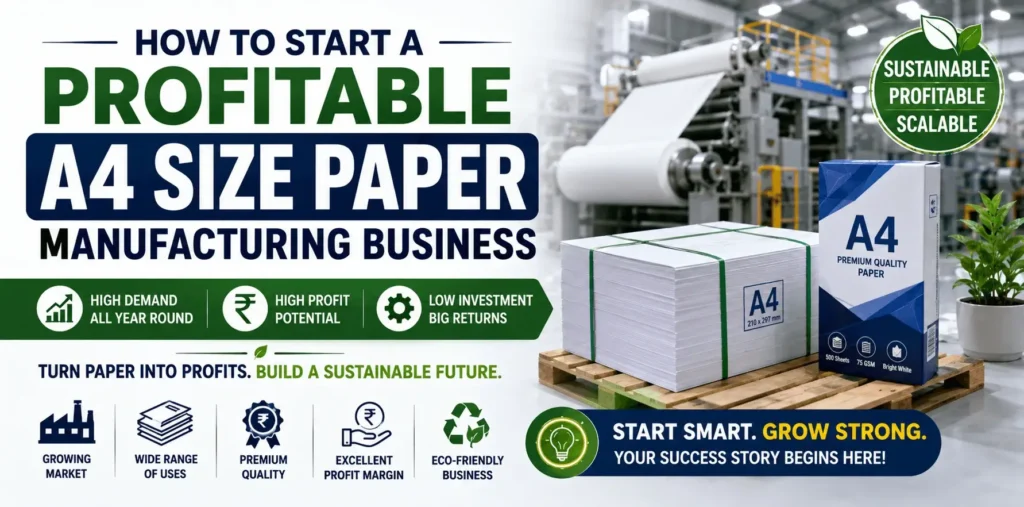
The A4 Size Paper Business is one of the most profitable and fast-moving opportunities in the paper and stationery industry due to continuous demand from schools, offices, government departments, photocopy centers, printing businesses, and corporate organizations. Despite increasing digitalization, the consumption of copier and photocopy paper continues to grow steadily across educational, commercial, and administrative sectors. With relatively low investment, simple machinery setup, and strong year-round market demand, many entrepreneurs are now exploring A4 size paper manufacturing business opportunities in India. Businesses involved in copier paper cutting, packaging, branding, and distribution can generate consistent recurring income through wholesale and institutional supply networks. What is an A4 Size Paper Business? An A4 size paper business involves cutting, packaging, branding, and distributing copier paper sheets commonly used for office printing, photocopying, educational work, and commercial documentation. This guide explains the complete A4 size paper business setup process including machinery, raw materials, manufacturing process, packaging methods, market opportunities, and profitability analysis. Why Starting an A4 Size Paper Manufacturing Unit is a Smart Investment The A4 size paper business has shown remarkable resilience over the years. Even as businesses shift toward digital, paper usage persists across multiple domains such as academic institutions, government sectors, corporate houses, and publishing industries. This specific paper size is considered the global standard for office documents, assignments, reports, photocopies, and formal communications. Why A4 Size Paper Business is Profitable Include: recurring office demand educational demand government supply demand low entry barrier scalable distribution B2B wholesale opportunities institutional contracts Understanding the A4 Size Paper Market Potential The A4 paper market is part of the global printing and writing paper industry, which has seen consistent demand due to its utility in formal documentation. In India alone, paper consumption is expected to reach over 30 million tonnes annually by 2030, and a substantial portion of this includes A4 sheets. This growth presents a golden opportunity for small and medium enterprises (SMEs) to establish localized units for manufacturing and supplying A4 size paper. The relatively low entry barrier in terms of capital investment and land requirement makes this a feasible venture for new entrepreneurs. Moreover, increasing awareness regarding eco-friendly practices has led to a rise in the demand for recycled A4 size paper, creating new niches within the sector. Machinery and Raw Materials Needed for A4 Paper Manufacturing Setting up an A4 size paper manufacturing unit requires some basic yet critical machinery and raw materials. The core components include: Slitting Machine: To cut large paper rolls into A4 dimensions. Ream Cutter Machine: For cutting and trimming the paper sheets accurately. Packaging Machine: To wrap and bundle paper sheets efficiently. Moisture Meter & Calibration Tools: To ensure quality and precision. The main raw materials required are: Jumbo paper rolls (Reel Form) Adhesive and ink (for branding and packaging) Packaging materials (boxes, shrink wraps) Sourcing raw materials from paper mills or wholesalers can reduce costs substantially, especially when purchased in bulk. Manufacturing Process of A4 Size Paper The production process involves several streamlined steps: Loading the jumbo rolls into the slitting machine. Cutting and trimming the paper to A4 dimensions. Counting and bundling the paper into standard reams (usually 500 sheets). Branding and packaging each ream with required labels. Packing the reams into cartons for distribution. Quality checks are performed during each stage to ensure consistency in thickness, brightness, and GSM (grams per square meter), which is a key indicator of paper quality. Legal Requirements and Licensing To establish a compliant unit, the following registrations and certifications are typically required: Udyog Aadhaar/MSME Registration GST Registration Factory License Pollution Control Board Clearance (if applicable) Trademark Registration (for branding) Adhering to these legal protocols ensures smooth operations and boosts the credibility of your business. Investment and Profit Margin in A4 Paper Business Starting a small-scale A4 paper cutting and packaging unit may require an initial investment of INR 10–25 lakhs, depending on the scale and automation of operations. A medium-sized unit can produce approximately 2,00,000 to 3,00,000 sheets per month. Profit margins range between 10% to 25%, depending on sourcing efficiency, operational costs, and distribution reach. With consistent orders and local dealership tie-ups, entrepreneurs can expect a return on investment (ROI) within 12–18 months. Target Customers and Market Strategies Target markets for A4 size paper include: Educational institutions Government offices Corporate houses Stationery wholesalers and retailers Photocopy and printing shops Effective strategies to penetrate the market: Offering bulk discounts to wholesalers and dealers. Establishing partnerships with schools and colleges. Participating in trade fairs to build visibility. Online B2B selling via platforms like IndiaMART, TradeIndia, and Amazon Business. Brand differentiation through eco-friendly or premium-quality paper offerings. Branding and Packaging Tips The look and feel of your paper packaging significantly affect the buying decision, especially in a saturated market. A well-branded ream of A4 size paper instills trust and signals quality. Key tips: Use eco-friendly packaging to attract sustainability-conscious customers. Include certifications or quality standards (like ISO, FSC) on the packaging. Highlight key features such as GSM rating, brightness, and suitability for inkjet/laser printing. Offer customized packaging for bulk corporate clients. Automation and Scaling Up Once the business reaches stability, investing in automated machines for stacking, cutting, and wrapping can enhance productivity. Automation reduces manpower dependency, improves accuracy, and enables higher output with lower operational costs. Scaling up can include: Expanding into A3 and legal size papers Manufacturing colored or recycled A4 sheets Launching a private-label brand and selling through e-commerce Exporting to nearby countries with paper demand Challenges and How to Overcome Them While the A4 size paper business offers lucrative returns, it is not without its set of challenges: Raw material price fluctuation High competition from established brands Logistics and distribution issues Solutions include: Entering into long-term supplier contracts to stabilize costs. Building a niche (such as recycled, sustainable paper). Developing a local distribution network to reduce transport costs. Sustainability and Future Trends The growing awareness of environmental impact is pushing manufacturers toward sustainable paper production. This includes: Using recycled pulp instead of virgin wood fiber.