
Want to Start Business in Raipur, Chhattisgarh in 2026?
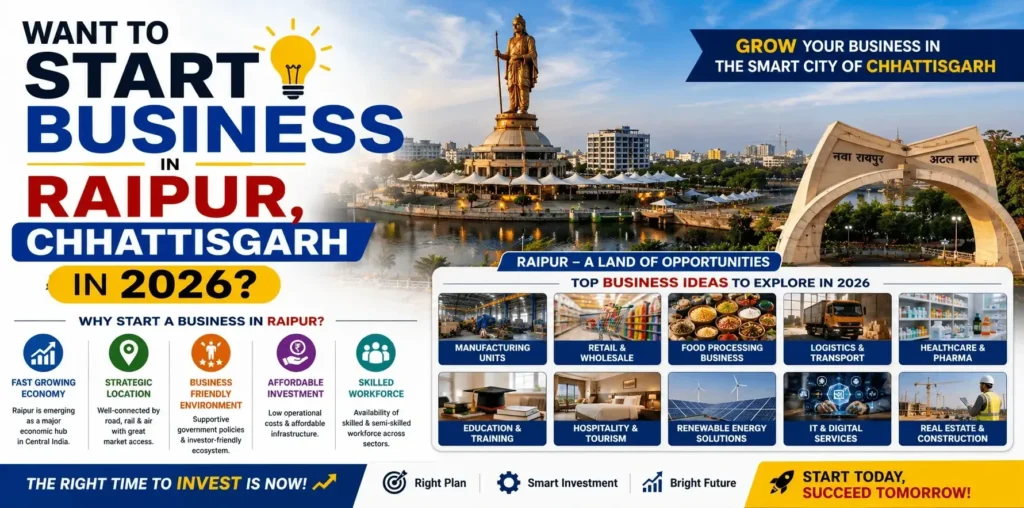
Raipur, the capital of Chhattisgarh, has rapidly evolved into one of the most promising cities in Central India for budding entrepreneurs and business owners. Starting Business in Raipur, Chhattisgarh is a big opportunity, it is strategically located and well-connected by road, rail, and air. Raipur is not only the political and administrative hub of the state but also a major commercial and industrial center. Its pro-business policies, expanding infrastructure, availability of raw materials, and a large workforce make it an ideal destination for investments in various sectors. Whether you’re a local resident or an outstation investor, exploring the right industry is crucial for establishing a successful business in Raipur. Emerging and Profitable Industries to Start Business in Raipur 1. Steel and Iron Industry Raipur has earned the title of “Steel City of Central India” due to its thriving steel and iron industry. The city hosts numerous rolling mills, sponge iron plants, and steel manufacturing units. With raw materials such as coal and iron ore easily accessible from nearby regions like Bastar and Korba, starting a small-scale manufacturing or trading unit can be extremely lucrative. Additionally, due to Raipur’s proximity to mining belts and industrial zones, there is a steady demand for equipment, transport, and auxiliary services, making it a great opportunity for setting up ancillary businesses. 2. Agriculture and Food Processing Agriculture remains a primary occupation in Chhattisgarh, and Raipur serves as a major trading and processing center for grains, pulses, oilseeds, and fruits. The state government offers subsidies and incentives to entrepreneurs looking to enter agro-processing, packaging, cold storage, and warehousing. Starting a business in Raipur that focuses on millet-based foods, organic farming, or food export can be highly profitable. The rise in demand for health-conscious and organic products opens even more doors in this sector. 3. Education and Coaching Centers With increasing literacy levels and a growing middle class, Raipur has become a hotspot for educational institutions, coaching classes, and skill development centers. Students from rural and semi-urban areas flock to Raipur for better educational opportunities. Starting a coaching center for competitive exams, spoken English classes, or skill-based vocational training programs can yield excellent returns. A tech-based educational startup or e-learning platform can also flourish in this digitally adaptive environment. 4. Real Estate and Construction The expansion of Raipur into a smart city and the presence of large-scale projects like Naya Raipur (now Atal Nagar) have increased the demand for housing, office spaces, and commercial complexes. Construction material suppliers, architecture firms, and real estate consultants are in high demand. Starting a business in Raipur in real estate brokerage, construction, or modular interiors can be a smart move, especially with continuous urbanization and migration from rural areas. 5. Tourism and Hospitality Chhattisgarh is home to breathtaking waterfalls, ancient temples, wildlife sanctuaries, and tribal heritage sites. Raipur serves as the gateway to many of these attractions. With an increase in both domestic and international tourists, the hospitality industry is booming. Starting a budget hotel, travel agency, café, or cultural tour operation offers vast potential. Eco-tourism and tribal tourism are niche yet promising business verticals, especially if paired with digital marketing and authentic local experiences. 6. Healthcare and Wellness With improvements in medical infrastructure, Raipur has become a regional hub for quality healthcare. Hospitals, diagnostic centers, nursing homes, and wellness clinics are on the rise. Entrepreneurs can consider investing in pharmacies, telemedicine services, physiotherapy centers, or health-focused apps. In a city where people from nearby rural districts come for treatment, setting up a healthcare-related business in Raipur is both a noble and profitable venture. 7. Textile and Garment Manufacturing Raipur has a long-standing association with handloom and textile products. Sarees from Chhattisgarh, especially from areas like Tussar and Kosa silk, are famous nationwide. With the right blend of tradition and technology, starting a garment unit, tailoring shop, or fabric printing setup can be beneficial. There is also scope in establishing export-focused units that cater to international fashion markets. 8. Logistics and Transport Services Raipur’s location makes it a logistical hub, connecting many parts of central and eastern India. With major highways, a strong railway network, and an airport, goods movement is seamless. Starting a business in Raipur in goods transportation, cold chain logistics, last-mile delivery, or even freight brokerage can serve a wide client base. E-commerce logistics is another rapidly growing opportunity as more people shop online. 9. Renewable Energy and Waste Management Chhattisgarh’s focus on sustainability and clean energy has opened up several green business opportunities. Solar panel installations, biomass energy production, and e-waste recycling plants are supported by government schemes. Setting up a solar energy consultancy, waste segregation facility, or bio-composting unit in Raipur can contribute to environmental health while generating revenue. 10. IT and Digital Services While not traditionally an IT hub, Raipur is witnessing growth in startups offering software, web development, digital marketing, and app-based solutions. With high internet penetration and a young workforce, the digital services industry has ample space to grow. An IT-based business in Raipur can cater to local clients or serve global clients remotely. Freelancing hubs, coworking spaces, and cloud services are other potential segments to explore. 11. Retail and Franchising The retail market in Raipur is flourishing, thanks to malls, shopping complexes, and a young, urban customer base. From apparel and electronics to cosmetics and groceries, demand is steady. Franchising national or international brands in food, fashion, or education can be a low-risk, high-return business model. Entrepreneurs can also explore local brands with strong market appeal. 12. Printing and Packaging As manufacturing and agriculture sectors grow, so does the need for effective packaging and branding. Raipur has opportunities in paper packaging, plastic alternatives, labeling, and industrial printing services. Starting a business in Raipur in eco-friendly or customized packaging can serve clients across industries from food processing to retail and pharma. Key Tips for Starting a Business in Raipur Understand Local Demand – Do thorough market research to assess what products or services are lacking in the region. Leverage Government Schemes –
Fast-Growing Industry for Starting an Eco-Friendly Business.
Jute, often referred to as the “Golden Fiber,” is making a powerful comeback as the world shifts toward sustainable and eco-friendly alternatives. India and Bangladesh are the top producers of jute, and with the rising global demand for biodegradable products, this natural fiber offers immense business potential. Entrepreneurs exploring jute product ideas are tapping into a lucrative and environmentally conscious market. From traditional items like ropes and gunny bags to modern products such as fashion accessories, home décor, and even furniture, jute’s versatility opens the door to multiple profitable ventures. Exploring Profitable Jute Product Ideas: A Green Path to Entrepreneurship One of the major reasons why jute product ideas are gaining popularity is the fiber’s ability to blend sustainability with affordability. As governments and consumers push back against plastic pollution, biodegradable alternatives like jute are being widely adopted across industries. Moreover, manufacturing jute products typically involves low investment and minimal environmental impact, making it an ideal startup option, especially in rural and semi-urban areas. Let’s explore the most profitable jute-based product ideas that entrepreneurs can capitalize on. 1. Jute Bags – The Most In-Demand Product Among the various jute product ideas, jute bags top the list due to their widespread utility and increasing demand. These bags come in multiple forms: shopping bags, tote bags, gift bags, bottle bags, lunch bags, and promotional bags for events or branding purposes. They’re strong, reusable, and aesthetically appealing. Brands are switching to jute bags to maintain an eco-conscious image, especially in retail, fashion, and FMCG industries. Starting a jute bag manufacturing unit requires basic stitching machines and skilled labor. Entrepreneurs can easily collaborate with local artisans or train workers under government schemes like Skill India. You can even explore customized printing on jute bags for corporate clients or special occasions like weddings. 2. Jute Rope and Twine – Durable & Multipurpose Jute rope and twine have immense commercial and industrial applications. They’re used in packaging, agriculture, gardening, construction, and even arts and crafts. With growing preference for natural fibers over synthetic ones, demand for jute twine is rising sharply. Manufacturing jute rope involves a simple twisting process using rope-making machines. A small-scale unit can be set up with limited capital and space. You can start by supplying jute twine and rope to packaging industries, florists, decorators, and local markets. Bulk orders from farmers and government procurement agencies further expand market scope. 3. Jute-Based Home Décor Products Home décor is an emerging category where jute product ideas can truly shine. Consumers today are keen on sustainable living, and jute décor items blend traditional charm with eco-conscious living. Popular products include: Jute rugs and carpets Wall hangings Jute planters and baskets Lampshades Table mats and coasters Design-driven jute products can fetch high prices in urban markets and online platforms like Etsy, Amazon, and Flipkart. Collaborating with interior designers and boutique home stores can also help you establish a niche. 4. Fashion Accessories Made from Jute Jute is no longer confined to coarse textures; it’s now being refined and blended with cotton or other fibers to create fashion-friendly materials. A range of accessories are being made with jute: Jute clutches and handbags Laptop sleeves Belts and jewelry Footwear (espadrilles, sandals) Sunglass cases These innovative jute product ideas cater to urban consumers, especially millennials and Gen Z who prioritize sustainability. Fashion startups can partner with designers or launch e-commerce stores showcasing these accessories. 5. Jute Furniture and Panels A lesser-known yet highly profitable avenue in jute products is furniture and wall panels. Jute-based boards and panels are being used as alternatives to wood and plastic in modular furniture and home construction. They are durable, termite-resistant, and biodegradable. Manufacturing such high-end jute products requires specialized machinery and expertise, but the market is strong in premium housing, eco-resorts, and sustainable architecture. For entrepreneurs with design and construction background, this segment presents a high-margin opportunity. 6. Jute Packaging for Agriculture & Retail With the phasing out of plastic in packaging, jute has emerged as a preferred alternative. Agricultural packaging like jute sacks and gunny bags remains a huge market in India for grains, spices, and pulses. However, innovative jute product ideas have now extended to: Gift wrapping Seed bags Garment covers Box packaging fillers Jewelry and cosmetic pouches Retail brands, particularly organic and handmade product sellers, are looking for sustainable packaging to match their brand values. Tapping into this market can secure long-term B2B clients. 7. Jute Crafts and Stationery Items The handicraft industry is another profitable segment to explore jute product ideas. Craft items made from jute are popular both in domestic and export markets. These include: Handmade photo frames Diaries and notebooks with jute covers Decorative items like garlands, dolls, and table pieces Jute envelopes and file folders These products have consistent demand in the gifting and corporate segment, especially during festive seasons and events. Training artisans or sourcing from NGOs and SHGs (Self Help Groups) can build a sustainable supply chain. 8. Jute Gift Items & Festival Collections Eco-conscious gifting is trending, especially among corporates, educational institutions, and event planners. Jute gift sets can include curated items like: Jute bags filled with snacks or wellness products Custom-printed jute folders and pouches Jute-themed festive hampers Jute plant holders for Diwali or New Year gifts These ideas offer a lot of scope for customization and branding, which means you can charge a premium and build recurring business. Setting Up a Jute Business: Basic Steps Whether you plan to focus on one product or a combination of these jute product ideas, the following steps are essential to begin: Market Research: Understand demand, competitors, and pricing. Product Selection: Choose the right mix based on your capital, skills, and location. Machinery & Setup: Source machines (manual, semi-auto, or fully automatic). Raw Material Procurement: Source jute fiber from mills or government auctions. Manpower: Hire skilled or trainable labor. Branding & Sales: Launch your brand with a story around sustainability. Sell Online & Offline: Use e-commerce platforms, exhibitions, and B2B tie-ups. Government Support &
Sugar Manufacturing Industry Mini Sugar Plant & Sugarcane Mill.
India, one of the largest sugar producers in the world, has an agro-based economy where sugarcane cultivation plays a vital role. The sugar industry not only supports millions of farmers but also drives the rural economy through value-added products and by-products like molasses, bagasse, and ethanol. In recent years, mini sugar plants have emerged as a feasible and profitable investment option for entrepreneurs due to their lower capital requirement, faster setup, and operational flexibility. This article, inspired by the guidance and expertise of Niir Project Consultancy Services (NPCS), provides a comprehensive overview of how to start and manage a sugar mill, including the technical and financial aspects involved. Understanding the Sugar Mil and Mini Plant Business A sugar mil, traditionally known for large-scale sugar production, processes sugarcane into refined sugar by extracting and purifying sucrose. On the other hand, a mini sugar plant is a smaller version that performs the same core functions but on a limited scale—typically processing 250 to 1,000 tons of cane per day (TCD). These smaller units are ideal for regions with abundant sugarcane cultivation but limited infrastructure for large-scale production. Starting a mini sugar mil involves selecting the right location, procuring machinery, planning logistics, and understanding the market. Unlike conventional large mills that need massive investments and land, mini plants can be operational within a shorter timeframe and in more localized rural settings. Niir Project Consultancy Services provides detailed feasibility reports and project planning support for aspiring investors and entrepreneurs in this field. Market Demand and Opportunities The Indian sugar industry is poised for sustained growth, driven by increasing consumption, rising ethanol blending targets, and export potential. Mini sugar plants are especially relevant for small sugarcane-growing regions, where establishing a large factory may not be economically viable. The Government of India’s policies, such as the Ethanol Blended Petrol (EBP) program and incentives for co-generation of power through bagasse, further add to the appeal of setting up a sugar mil. Entrepreneurs can also explore value chains such as jaggery production, ethanol distillation, and electricity generation, making the business model more diversified and profitable. Project Cost and Financial Planning Starting a mini sugar mil involves several key capital expenses. These include the cost of land (if not already owned), plant and machinery, civil works, electrification, and working capital. For a 500 TCD mini plant, the estimated cost ranges between ?25 crores to ?40 crores, depending on the technology and level of automation. Financing options include term loans from banks, subsidies under government schemes (especially for ethanol production and co-generation units), and partnerships. Niir Project Consultancy Services assists entrepreneurs by providing detailed project reports that cover financial projections, break-even analysis, and return on investment timelines. Machinery and Technical Requirements The core machinery required for a sugar mil includes the cane handling system, cane crusher, juice heaters, clarifiers, evaporators, crystallizers, centrifugal machines, and boilers. In a mini plant setup, these systems are optimized for energy efficiency and minimal waste generation. Additionally, by-products like bagasse can be used as fuel in boilers, thereby reducing external energy requirements. Molasses, another by-product, can be diverted to ethanol production, further increasing the revenue streams. With proper planning and expert guidance from NPCS, entrepreneurs can choose between semi-automatic and fully automatic plants depending on budget and operational skills. Raw Material and Supply Chain Sugarcane is a perishable crop with a short window between harvest and crushing. Therefore, proximity to farming areas is essential when selecting the site for the sugar mil. Agreements with local farmers, establishing cane procurement centers, and providing logistical support for transportation are key to maintaining continuous plant operation. Niir Project Consultancy Services often emphasizes the importance of integrated supply chain planning, which includes seasonal harvesting schedules, cane quality management, and timely payment systems to farmers. Ensuring strong farmer relationships not only guarantees raw material availability but also enhances the plant’s reputation and sustainability. Environmental Considerations and Sustainability Running a sugar mil involves water consumption, effluent generation, and energy usage. Therefore, modern mini plants are increasingly designe with sustainability in mind. Effluent Treatment Plants (ETPs), recycling systems, rainwater harvesting units, and solar panels are now being integrate into new setups to meet environmental regulations and reduce carbon footprint. Bagasse, being a clean biomass fuel, allows for steam and power generation, creating a closed-loop energy cycle within the plant. Moreover, vinasse from molasses-based ethanol production can be used to produce bio-compost or biogas, further contributing to the eco-efficiency of the plant. Challenges in the Sugar Mil Industry Despite the attractive returns, the sugar industry has its share of challenges. These include volatile sugarcane prices, seasonal availability, weather dependency, and government pricing controls. Mini plants must also deal with operational hurdles such as skilled labor shortages and maintenance of specialized equipment. To address these challenges, Niir Project Consultancy Services recommends a risk-mitigation approach involving multi-product processing, forward contracts with buyers, and ongoing process optimization through technology upgrades. Additionally, training the local workforce ensures efficient plant operation and reduces dependency on external manpower. Government Policies and Regulatory Framework The Central and State Governments play a significant role in regulating and promoting the sugar industry. Policies concerning Fair and Remunerative Price (FRP) for sugarcane, ethanol procurement prices, and subsidies for setting up co-generation units directly impact the financial dynamics of a sugar mil. Licenses required for operation include environmental clearance, factory registration, pollution control board approvals, and labor permits. Niir Project Consultancy Services assists clients in navigating the bureaucratic process and helps ensure compliance with all applicable laws and standards. Value Addition and Revenue Diversification The key to long-term profitability in a sugar mil lies in value addition. Products like jaggery, ethanol, liquid sugar, and specialty syrups can be developed to target niche markets. Ethanol, in particular, has gained prominence with the government’s push for 20% blending by 2025, offering a lucrative opportunity for sugar millers. Bagasse-based power generation can also be export to the grid, creating an additional income stream. Mini plants, due to their agile structure, can adapt more quickly to market
What Industry Should I Start in Food Processing?
India’s food processing industry is one of the largest in the world, contributing significantly to the economy through value addition, employment generation, and global trade. With rising consumer demand, evolving lifestyles, and the increasing popularity of packaged and ready-to-eat food, the food processing businesses has become one of the most lucrative sectors for entrepreneurs. If you are looking to venture into this dynamic domain, there are numerous innovative and profitable business ideas you can explore. Profitable Food Processing Business Ideas to Start Today 1. Ready-to-Eat (RTE) Meals Manufacturing Urbanization, busy lifestyles, and increasing disposable incomes have led to a surge in demand for ready-to-eat meals. These include heat-and-eat curries, rice dishes, pastas, and even desserts. This food processing business requires investment in automated packaging and food preservation technologies such as retort packaging or freezing. RTE products offer long shelf life and cater to a vast market ranging from students and working professionals to travelers and international buyers. 2. Fruit and Vegetable Processing Fruits and vegetables have a short shelf life, and processing them into purees, juices, frozen packs, and dehydrated products can significantly increase their value. This includes mango pulp, mixed fruit jam, tomato ketchup, and frozen green peas or spinach. Small and medium-scale units can easily tap into the regional and export markets with proper cold chain infrastructure and FSSAI certification. 3. Dairy Processing Unit India is the world’s largest producer of milk, making dairy an evergreen food processing business. You can process raw milk into cheese, paneer, curd, flavored yogurt, butter, ghee, and ice creams. Value-added dairy products, especially organic and probiotic varieties, are seeing consistent demand. The key to success in this area is hygiene, efficient supply chain management, and branding. 4. Bakery and Confectionery Products Starting a bakery or confectionery manufacturing unit is a popular and scalable option. Products such as bread, cakes, cookies, biscuits, muffins, and energy bars are staples in every household. With the growth of e-commerce and home delivery platforms, bakeries can now reach customers nationwide. Moreover, the demand for gluten-free, vegan, or low-sugar alternatives has opened up niche markets within the food processing business sector. 5. Flour Milling and Grain Processing Grain-based products like wheat flour, rice flour, multigrain atta, and semolina are daily essentials. Setting up a modern milling unit with packaging facilities can be highly profitable, especially if you focus on hygiene and branding. There is also demand for organic and stone-ground flour, which can help you target the premium customer base. 6. Meat and Seafood Processing Meat and seafood are perishable items, and processing them into sausages, nuggets, marinated cuts, frozen fillets, and dried seafood products adds immense value. With rising health awareness, there’s growing interest in lean cuts and hygienically processed meat. Licensing from regulatory bodies such as FSSAI and APEDA is mandatory for such businesses. 7. Snack Food Manufacturing India has a thriving snack industry, from traditional namkeens to modern chips, extruded snacks, and health-conscious options like baked or protein-rich items. This food processing business idea allows entrepreneurs to blend taste and innovation. You can create region-specific products (like banana chips in the south or bhujia in the north) or focus on low-calorie snacks for urban consumers. 8. Cold-Pressed Oil Extraction Cold-pressed oils like groundnut oil, mustard oil, sesame oil, and coconut oil are gaining popularity due to their health benefits. Unlike refined oils, these are chemical-free and retain essential nutrients. A small-scale cold-pressed oil mill can be established with modest investment and serve both local markets and online customers. 9. Pickle and Chutney Manufacturing India’s love for pickles and chutneys is timeless. With unique flavors across different regions, this segment of the food processing business has strong potential. Modern packaging, standardized recipes, and proper labeling can turn a traditional recipe into a mass-market product. Export demand is also significant, especially for mango pickle, lime pickle, and coconut chutney. 10. Spices Processing and Packaging India is the world’s largest producer and exporter of spices. Processing spices into powdered, blended, or paste form—such as turmeric, garam masala, and curry paste—can be highly profitable. Ensure hygienic processing and attractive packaging to stand out. Spices are in demand both in domestic kitchens and restaurants, as well as in international markets. 11. Organic and Health Food Products There is a growing consumer base seeking organic, plant-based, and nutritional food products. Items like millet-based snacks, organic pulses, sugar substitutes, herbal teas, and protein-rich ready mixes are gaining popularity. Health-conscious millennials and fitness enthusiasts are driving this trend. If you can establish your brand as clean-label and eco-conscious, this food processing business idea could deliver high margins. 12. Frozen Foods and IQF Products Freezing technology such as Individual Quick Freezing (IQF) preserves the texture and nutrients of foods. You can manufacture frozen vegetables, fruits, seafood, parathas, momos, or snacks. This segment is growing fast due to convenience, especially in metros. Cold storage, logistics, and consistency in product quality are critical success factors. 13. Instant Mixes and Premixes Ready-to-cook premixes for dosa, idli, cake, poha, and soup are in high demand. They save time and effort while delivering home-cooked taste. You can also innovate with international cuisines like pasta sauces, soup bases, or baking mixes. This food processing business idea suits urban nuclear families, working women, and students living away from home. 14. Bottled Beverages and Functional Drinks From fruit juices, flavored milk, and herbal teas to protein shakes and energy drinks, bottled beverages are one of the fastest-growing segments. Innovation in flavors, health benefits, and low-sugar alternatives are in demand. You can also tap into the Ayurvedic and immunity-boosting drinks segment post-COVID. 15. Baby Food and Nutrition Products The infant and toddler food market requires strict quality control and regulatory compliance but offers high margins and customer loyalty. You can manufacture organic baby cereals, fruit purees, or toddler snacks. Trust and branding are crucial, and FSSAI compliance is mandatory. 16. Nut and Dry Fruit Processing Processing nuts and dry fruits into roasted, salted, chocolate-coated, or powdered forms is another attractive food processing
Fastest Growing & Best Industries for Starting a Business.
In today’s rapidly evolving economic environment, identifying and investing in the fastest growing industries can provide a strong foundation for entrepreneurs aiming to build profitable and sustainable businesses. Whether driven by emerging technologies, global health challenges, environmental awareness, or digital transformation, several sectors are witnessing explosive growth. Entrepreneurs who stay ahead of the curve and align their ventures with these booming industries can expect robust returns and long-term stability. Why Entrepreneurs Should Focus on the Fastest Growing Industries The most successful startups often emerge in markets that are not just large, but growing quickly. Investing in the fastest growing industries allows business owners to ride the wave of increased demand, benefit from market gaps, and position themselves as early leaders. High-growth sectors often attract increased consumer interest, government support, and investor funding—factors that can accelerate business development significantly. Let’s explore the top industries leading the charge in 2025 and beyond. 1. Renewable Energy and Clean Technology With climate change taking center stage globally, the renewable energy sector has evolved from a niche market to a thriving industry. Solar panel installations, wind farms, green hydrogen production, and battery storage systems are reshaping how energy is produced and consumed. Governments and corporations are investing heavily in carbon neutrality and green infrastructure, making clean tech one of the fastest growing industries today. Entrepreneurs can enter this market through solar installation services, energy auditing, electric vehicle (EV) infrastructure development, or manufacturing eco-friendly products. As regulations tighten and fossil fuel costs fluctuate, the demand for alternative energy solutions continues to soar. 2. Health and Wellness Technology Healthtech and wellness innovations have seen exponential growth since the COVID-19 pandemic. From telemedicine and wearable health monitors to mental wellness apps and personalized nutrition, this sector is experiencing robust demand. Aging populations, increasing chronic illnesses, and rising healthcare costs are fueling the need for smart, efficient, and accessible health solutions. Digital health startups offering remote diagnostics, AI-based treatment recommendations, or virtual therapy platforms are thriving. Additionally, wellness-focused ventures such as organic skincare, supplements, and fitness apps fall within the scope of this rapidly expanding market. 3. E-commerce and Digital Retail The digital retail revolution continues to be one of the fastest growing industries in the world. Online shopping has become the default mode for millions of consumers, accelerated by better logistics, secure payment gateways, and mobile commerce. From fashion and electronics to groceries and digital goods, e-commerce offers endless opportunities. Aspiring business owners can launch niche-specific online stores, dropshipping operations, or private label brands. Emerging trends such as livestream shopping, social commerce, and AI-powered product recommendations make this sector dynamic and highly lucrative. 4. Artificial Intelligence and Machine Learning AI and machine learning are no longer just buzzwords; they are the driving forces behind automation, analytics, and innovation across all industries. Whether it’s in finance, healthcare, education, or customer service, AI is revolutionizing how decisions are made and services are delivered. Businesses in this domain range from developing AI-powered SaaS products to providing custom AI solutions for enterprises. As companies seek to optimize operations, reduce costs, and predict consumer behavior, the AI industry remains one of the fastest growing industries with high scalability. 5. Cybersecurity As digital transformation accelerates, so do threats to data security. With increasing incidents of data breaches, ransomware attacks, and digital fraud, cybersecurity has become a top priority for organizations and individuals alike. From cloud security to mobile app protection, the market for cyber defense is growing rapidly. Entrepreneurs can capitalize on this by offering penetration testing services, developing encryption tools, or creating security awareness training programs. The demand for skilled cybersecurity solutions is at an all-time high, making it a prime sector to enter. 6. Fintech and Digital Payments The financial technology sector is reshaping traditional banking and financial services. Mobile wallets, online lending platforms, robo-advisors, and blockchain-based services are gaining widespread acceptance. Consumers are embracing digital finance for its convenience, speed, and transparency. Entrepreneurs in this space can develop peer-to-peer lending apps, neobanks, or blockchain-powered transaction systems. As financial inclusion and digital literacy grow worldwide, fintech remains one of the most vibrant and fastest growing industries. 7. Sustainable Products and Green Consumer Goods Modern consumers are increasingly eco-conscious, preferring products that are sustainable, ethically made, and low on carbon impact. From biodegradable packaging and plant-based foods to zero-waste personal care products, the demand for green alternatives is skyrocketing. Starting a business in this niche can involve manufacturing or distributing sustainable products, curating eco-friendly lifestyle boxes, or offering recycling and upcycling services. With the environmental movement gaining strength, green business ideas are both ethical and economically viable. 8. Educational Technology (EdTech) Education has undergone a paradigm shift with the advent of EdTech. Online learning platforms, gamified education, skill-based courses, and AI tutors are transforming how knowledge is delivered. This trend was supercharged by the pandemic and continues to evolve with hybrid and remote learning models. Opportunities in this space include creating e-learning platforms, developing curriculum content, launching tutoring apps, or offering corporate training services. Given the global emphasis on reskilling and upskilling, EdTech stands out as one of the fastest growing industries. 9. Virtual and Augmented Reality VR and AR technologies are not limited to gaming anymore. They are being integrated into real estate, retail, education, tourism, and even healthcare. Virtual showrooms, immersive learning experiences, and AR-based instructions are reshaping consumer interactions. Entrepreneurs can explore opportunities in VR content creation, AR mobile app development, or hardware distribution. As devices become more affordable and accessible, VR/AR applications are expected to grow exponentially. 10. Personalized Nutrition and Food Tech The food and beverage industry is being revolutionize by data and biotechnology. Consumers are seeking healthier, tailored food solutions, and businesses are responding with lab-grown meats, plant-based alternatives, and AI-driven meal planning. This intersection of health, sustainability, and technology makes personalized nutrition one of the fastest growing industries. Entrepreneurs can innovate with smart kitchen appliances, diet-coaching apps, or health-focused meal delivery services. Final Thoughts Understanding and investing in the fastest growing industries is a strategic
List of Profitable Projects on Printing Inks Manufacturing Industry.
India’s growing demand for packaging, advertising, newspapers, and textile printing has significantly increased the consumption of printing ink. From offset printing and gravure to digital formats, printing ink plays a crucial role in various industries. Entrepreneurs with a strategic business approach and understanding of manufacturing processes can tap into this growing market by starting a printing ink manufacturing unit. With the right planning, technology, and marketing efforts, this venture can become a highly profitable one. Steps to Start a Profitable Printing Ink Manufacturing Unit in India 1. Market Potential and Demand The Indian printing ink market is poised for rapid growth, driven by the packaging sector, increased consumerism, digital printing, and the booming e-commerce industry. The rise of flexible packaging for food, cosmetics, and pharmaceuticals directly impacts the demand for high-quality ink. Additionally, the growth of regional newspapers and educational publishing adds to the opportunity for localized ink manufacturing. 2. Types of Printing Ink Before starting your printing ink manufacturing unit, it’s important to decide which types of ink you’ll produce. The major types include: Offset Ink: Used in newspapers, magazines, and books. Gravure Ink: Used in high-volume printing such as packaging and gift wraps. Flexographic Ink: Suitable for non-porous substrates such as plastic and metallic films. Digital Ink: Inkjet and toner inks used for digital printing. Screen Printing Ink: Used for textiles and industrial printing. You can choose to specialize in one or manufacture a combination based on market demand and investment capacity. 3. Investment and Financial Planning The initial investment for a small to medium-scale printing ink manufacturing unit can range between ?25 lakhs to ?1 crore, depending on capacity, automation level, and the types of ink. Key costs include: Land and building (owned or leased) Machinery and equipment Raw materials and chemicals Working capital for salaries, marketing, electricity, and logistics Licenses, certifications, and insurance 4. Location and Infrastructure Choose an industrial location that complies with environmental regulations and has good access to transportation, utilities, and labor. The facility should include separate sections for raw material storage, formulation, processing, quality control, and packaging. Adequate ventilation and safety measures are crucial due to the use of flammable solvents and chemicals. 5. Machinery and Equipment The manufacturing process of printing ink involves mixing, grinding, and filtering raw materials. Equipment needed includes: Mixing tanks and high-speed stirrers Ball mills or triple roll mills Filtration units Heating systems and agitators Filling and packaging machines Quality testing equipment Automating part of the process improves consistency, efficiency, and safety. 6. Raw Materials Used in Printing Ink Manufacturing Essential raw materials for printing ink manufacturing include: Pigments (organic and inorganic) Resins (alkyds, acrylics, polyamides) Solvents (mineral oil, toluene, ethanol) Additives (wetting agents, driers, stabilizers) Waxes for improved durability Your choice of raw materials will depend on the type of ink produced. Sourcing high-quality raw materials ensures product reliability and customer satisfaction. 7. Manufacturing Process Overview While the exact process can vary based on the type of ink, the general steps include: Formulation: Preparing a base recipe of pigment, resin, and solvents. Mixing: Uniform dispersion of pigment into the binder using stirrers. Grinding: Using mills to reduce pigment particle size and ensure a smooth texture. Filtering: Removing impurities to enhance the ink’s finish. Packaging: Filling the ink into cans or cartridges for sale. Quality Control: Testing viscosity, color strength, drying time, and other properties. 8. Legal Requirements and Compliance Setting up a printing ink manufacturing unit requires adherence to legal and environmental standards. You need to obtain: Company registration (MSME/Udyam) Factory license under the Factories Act NOC from the State Pollution Control Board GST registration Fire safety certification ISO 9001 and ISO 14001 certification for better credibility (optional) Compliance with hazardous chemicals regulations is mandatory due to the flammable and toxic nature of some solvents used. 9. Marketing and Distribution Strategy A strong marketing and distribution network is essential to reach printing presses, packaging companies, publishers, and advertising agencies. Your marketing plan can include: Direct B2B sales and industrial partnerships Participation in trade expos and printing exhibitions Digital marketing and SEO for your brand website Appointing regional distributors or sales agents Offering product samples and customization options Packaging your ink in user-friendly formats and ensuring after-sales support builds customer loyalty. 10. Quality Control and Innovation To stay competitive, maintain strict quality standards and invest in R&D. Innovating new eco-friendly or fast-drying inks can provide a niche advantage. Customers are increasingly looking for inks that are non-toxic, water-based, and compliant with safety norms, especially in food and pharma packaging. 11. Sustainability Considerations With increasing environmental regulations, consider integrating sustainable practices such as: Using water-based or vegetable oil-based inks Installing effluent treatment plants (ETPs) Recycling solvent waste Minimizing emissions and energy consumption Not only do these steps reduce environmental impact, but they also improve your brand image and long-term viability. 12. Profit Margin and ROI The profit margins in printing ink manufacturing depend on the type and quality of ink, production volume, and operational efficiency. Typically, margins range from 20% to 35% for industrial-grade inks. A well-managed unit can achieve a break-even point within 2–3 years, especially if marketing and supply chains are optimized. 13. Challenges in the Ink Manufacturing Industry While the sector has significant potential, entrepreneurs should be prepared to handle: Fluctuating raw material prices Stringent environmental regulations Technological obsolescence Increasing demand for customized ink formulations Competition from established brands Constant innovation, quality focus, and smart sourcing can help mitigate these challenges. 14. Future Trends and Opportunities The future of printing ink manufacturing in India is expected to be shaped by: The rise of UV-curable and water-based inks Growth in 3D printing and specialty ink segments Exports of ink to Southeast Asia and Africa Automation and digital transformation in manufacturing Sustainable and biodegradable ink demand Entrepreneurs who adapt to these trends early can secure a competitive edge in both domestic and international markets. Conclusion Setting up a printing ink manufacturing unit in India is a promising and scalable venture, provided you approach it with the
Welding Electrode Manufacturing Plant.
Starting a welding electrode manufacturing plant can be a highly profitable venture, given the rapid industrialization and the ever-growing demand for welding applications in construction, automotive, infrastructure, and other sectors. Welding electrodes, which are consumable materials used in various welding processes, are essential in joining metal parts. With the increasing need for infrastructure development in countries like India, the demand for welding electrodes has significantly risen. Hence, entrepreneurs looking for a sustainable and scalable industrial business idea should consider entering this field. This article will guide you through every critical aspect of setting up a successful welding electrode manufacturing plant. Understanding the Welding Electrode Manufacturing Industry The welding electrode manufacturing industry is an integral part of the broader welding consumables market. Welding electrodes come in different types, including bare electrodes, coated electrodes, and specialty electrodes designed for specific metal types and welding positions. Coated electrodes are the most commonly used due to their ability to provide protection against contamination and to improve weld quality. India’s market for welding consumables is expanding at a steady pace, driven by growth in sectors like oil & gas, shipbuilding, power, and railways. The government’s initiatives like “Make in India” and major investments in the manufacturing sector are further pushing this demand upward. Hence, setting up a welding electrode manufacturing plant not only caters to domestic consumption but also presents export opportunities, especially in countries with similar development needs. Steps to Set Up a Welding Electrode Manufacturing Plant To successfully launch a welding electrode manufacturing unit, you need a detailed understanding of the production process, legal requirements, market demand, and financial investment. Here’s a step-by-step breakdown: 1. Market Research and Feasibility Analysis Before making any investments, conduct thorough market research. Identify your target market: is it domestic, export-based, or both? Understand the demand for different types of electrodes – mild steel electrodes, stainless steel electrodes, hard-facing electrodes, etc. You should also analyze your competitors, their product range, pricing strategies, and market reach. Feasibility studies will help determine the ideal plant size, production capacity, and estimated return on investment (ROI). Consult with industry experts, analyze trends, and use data to forecast profitability. 2. Location and Infrastructure The location of your welding electrode manufacturing plant is crucial. Ideally, the unit should be close to industrial hubs or transportation facilities (highways, railways, ports) for easy procurement of raw materials and distribution of finished goods. Availability of electricity, water, skilled labor, and space for expansion are also critical factors. A typical small-to-medium manufacturing plant may require 5,000 to 15,000 sq. ft. of built-up area, which includes spaces for raw material storage, production, drying, packing, and office administration. 3. Legal and Regulatory Requirements Register your business as an MSME (Micro, Small & Medium Enterprises) under the Ministry of MSME. Obtain GST registration, factory license, NOC from the pollution control board, and fire safety clearance. Also, apply for the Bureau of Indian Standards (BIS) certification since many welding electrodes must meet IS specifications (like IS 814 for covered electrodes). Additionally, comply with labor laws and environmental regulations. For export, you’ll need Import-Export Code (IEC) registration and possibly international certifications like ISO 9001. 4. Raw Materials and Supply Chain The primary raw materials required for welding electrode manufacturing are: Mild steel wire rods (core wire) Rutile Ferro alloys (manganese, silicon, titanium, etc.) Binding agents (sodium silicate) Potassium and sodium salts Iron powder Cellulose (for some types) Source these materials from trusted vendors to ensure consistent product quality. You can either import high-purity materials or buy from domestic suppliers, depending on your quality standards and pricing strategy. 5. Machinery and Equipment The following machinery is typically required to set up a welding electrode manufacturing plant: Wire straightening and cutting machine Dry mixer and wet mixer Extruder machine Wire feeder unit Electrode coating press Conveyor belt system Baking oven (400-500°C) Inspection and testing equipment Packing machine The machinery setup cost varies depending on production capacity. For example, a plant producing 1 ton/day might cost between ?25 lakhs to ?50 lakhs (USD 30,000–60,000), while larger setups require higher investments. 6. Manufacturing Process The welding electrode manufacturing process consists of several stages: Wire Preparation: Wire rods are straightened and cut to the desired length. Flux Preparation: The coating mixture is prepared by mixing minerals, binders, and alloying elements. Coating: The cut wires are fed into a coating machine where flux material is extruded onto the core wire. Drying and Baking: Coated electrodes are dried and then baked in a high-temperature oven to remove moisture and strengthen the coating. Finishing: After baking, electrodes are inspected, tested for quality, and packed in moisture-resistant boxes. 7. Manpower and Staffing A medium-scale unit typically requires a team of 15–30 people including: Skilled machine operators Quality control personnel Electrical/mechanical maintenance staff Administrative and sales personnel Ensure that staff is trained on safety protocols and equipment handling since the manufacturing process involves exposure to high heat, dust, and chemicals. 8. Quality Control and Testing To ensure the performance and safety of welding electrodes, rigorous testing is mandatory. Key quality control tests include: Tensile strength Impact resistance Chemical composition of the weld Slag detachability Arc stability Use testing equipment like tensile testers, X-ray machines (for weld analysis), and hardness testers to validate the electrodes’ properties. Ensure that all batches comply with Indian or international welding standards. 9. Marketing and Sales Strategy Develop a multi-channel marketing strategy to sell your welding electrode manufacturing products. Options include: Direct sales to industries and welding contractors Channel partners and dealers Online industrial marketplaces (like IndiaMART, TradeIndia) Export to countries in Africa, South Asia, or the Middle East Offer sample batches to large buyers for trial, and emphasize on the quality, strength, and reliability of your electrodes. Trade exhibitions and industry expos are also great platforms to showcase your products. 10. Financial Considerations and Profitability Initial investment can vary between ?40 lakhs to ?1.5 crores depending on your production capacity, land cost, and automation level. Here’s a rough cost breakdown: Land and Building: ?10–30 lakhs Machinery and
List of Industrial, Medical and Specialty Gases Manufacturing Project Ideas.
The industrial and medical gases industry is a rapidly evolving sector that plays a vital role in healthcare, manufacturing, food processing, and electronics. In particular, medical gases manufacturing has emerged as a high-potential field due to the growing demand for quality healthcare and the increasing number of hospitals and homecare facilities worldwide. From oxygen and nitrous oxide to medical air and carbon dioxide, these gases are essential for patient treatment and surgical procedures. With 2025 on the horizon, new technological innovations and policy incentives are reshaping the industry, making this the perfect time for entrepreneurs and investors to explore opportunities in medical gases production. Emerging Opportunities in Medical Gases Manufacturing Medical gases refer to a variety of gases used in healthcare settings for treatment, diagnostics, and patient care. These include oxygen, nitrous oxide, carbon dioxide, helium, medical air, and nitrogen. The medical gases manufacturing industry must comply with stringent safety and purity standards, as even minor contamination can pose serious health risks. In recent years, the demand for these gases has skyrocketed due to the rise in chronic diseases, increased hospital admissions, and the COVID-19 pandemic that highlighted the need for medical-grade oxygen. As we move into 2025, the focus is shifting towards automation, quality assurance, and eco-friendly production processes. This transition opens the door for modern entrepreneurs to set up manufacturing units that are compliant, efficient, and profitable. Key Gases in Medical Gases Manufacturing Oxygen (O?):The most vital gas in any healthcare facility, oxygen is used in respiratory treatments, anesthesia, intensive care, and neonatal care. In medical gases manufacturing, oxygen must be produced at very high purity levels—typically 99% or more—and supplied in cylinders or bulk tanks. Nitrous Oxide (N?O):Commonly known as laughing gas, nitrous oxide is used for its anesthetic and analgesic properties, particularly in dental surgeries and childbirth. Its manufacturing process includes purification and liquefaction under controlled environments. Carbon Dioxide (CO?):While CO? is widely known as a greenhouse gas, in medical applications, it is used for insufflation during laparoscopic surgeries and as a component in medical mixtures. High-purity carbon dioxide is essential for patient safety. Medical Air:Comprising oxygen and nitrogen in specific ratios, medical air is used in respiratory therapy and anesthesia. It is often produced on-site in hospitals but can also be manufactured and supplied externally. Nitrogen (N?):Nitrogen is used to power medical devices, preserve biological samples, and prevent oxidation. Its inert nature makes it ideal for a range of applications in healthcare settings. Helium (He):Though less commonly used, helium is critical for magnetic resonance imaging (MRI) machines and as a component in gas mixtures for respiratory treatments. Setting Up a Medical Gases Manufacturing Unit To start a medical gases manufacturing business in 2025, several key steps must be followed: 1. Market Research and Business Planning Start by analyzing the market demand in your target region. Identify the most in-demand gases, potential customers (hospitals, clinics, emergency services), and current competitors. Create a detailed business plan outlining your production goals, investment needs, revenue projections, and marketing strategy. 2. Regulatory Compliance Manufacturing medical gases requires licenses and certifications from government health departments and drug control authorities. In India, for example, compliance with the Drugs and Cosmetics Act is mandatory. ISO certification, Good Manufacturing Practices (GMP), and FDA approvals (for export) are also recommended. 3. Site Selection and Infrastructure Choose a location that complies with zoning regulations and is near hospitals or transportation hubs. The facility should have proper ventilation, fire safety systems, and contamination control zones. Separate areas for gas generation, purification, filling, and storage are essential. 4. Machinery and Equipment Modern medical gases manufacturing plants use advanced technology for cryogenic distillation, pressure swing adsorption (PSA), and membrane separation. Equipment required includes: Air compressors Purifiers and filters Cryogenic storage tanks Gas analyzers Cylinder filling stations Leak detection systems Automation systems help maintain consistency and safety, reducing human error. 5. Quality Assurance and Testing Every batch of medical gas must be test for purity, pressure, and absence of contaminants. Testing should follow pharmacopeia guidelines (like IP, USP, BP) using gas chromatographs and other precision instruments. Ensure thorough documentation and traceability of each batch produced. 6. Packaging and Distribution Medical gases are typically store in high-pressure cylinders or liquid form in insulate tanks. Proper labeling, color coding, and barcoding are essential for safety and compliance. Develop partnerships with logistics providers who can ensure safe, timely delivery to hospitals and clinics. 7. Workforce and Training Hire qualified engineers, chemists, and operators. Regular training on safety protocols, equipment handling, and emergency procedures is critical. A safety officer should oversee operations to ensure adherence to occupational health standards. Investment and Profitability The initial investment in a small-scale medical gases manufacturing unit ranges from ?2 crore to ?10 crore, depending on scale, automation, and location. Key cost components include land, machinery, labor, licenses, and working capital. However, the return on investment (ROI) is high, with profit margins ranging from 20% to 35%, especially when contracts are secure with government hospitals, nursing homes, and private healthcare chains. Technological Innovations in 2025 In 2025, several advancements are expected to revolutionize medical gases manufacturing: Green Hydrogen Integration: Hydrogen, a byproduct in some processes, can be convert into medical-grade gases with minimal carbon footprint. AI & IoT for Quality Control: Predictive maintenance, real-time monitoring, and automated alarms can significantly enhance product safety and reduce downtime. Modular Plants: Compact and mobile gas generation units are gaining traction, especially for remote or rural hospitals. Remote Monitoring: Cloud-based platforms allow plant managers to track pressure, purity, and cylinder inventory from anywhere. Challenges and Risk Management While the industry is lucrative, it comes with challenges: Regulatory Scrutiny: Non-compliance can result in plant shutdowns or legal penalties. Safety Hazards: Gases under pressure are inherently risky. Leakages or explosions must be prevent with rigorous safety protocols. Supply Chain Disruptions: Raw materials or cylinder shortages can delay production. Diversifying suppliers is essential. Competition: The rise in demand has led to a surge in new entrants. A strong value proposition is key to standing out.
How to Start Artificial Marble Tiles Manufacturing Industry.
The artificial marble tiles manufacturing business is rapidly becoming one of the most promising segments in the construction and home improvement industry. With natural marble becoming more expensive and less sustainable, artificial marble tiles offer a budget-friendly and eco-conscious alternative. This synthetic version of marble mimics the elegance of natural stone while being customizable and easier to maintain. The growing demand for cost-effective, stylish flooring and wall finishes in both residential and commercial spaces has created a vast market for artificial marble tiles. Understanding the Artificial Marble Tiles Manufacturing Business Artificial marble tiles, also known as engineered or cultured marble, are manufactured using a blend of natural marble chips, resins, pigments, and additives. This combination is molded and polished to resemble natural marble in appearance and texture. The manufacturing process not only ensures a flawless finish but also provides enhanced durability and moisture resistance. 1. Market Potential India’s construction industry is booming due to urbanization, smart city projects, and rising consumer spending on home decor. The demand for artificial marble tiles is growing in tandem with these developments. Their use is prevalent in flooring, kitchen countertops, bathroom walls, commercial lobbies, and more. Moreover, artificial marble tiles are gaining popularity in tier 2 and tier 3 cities where affordability is a key factor. According to industry estimates, the artificial marble tiles segment is expected to grow at a CAGR of over 9% globally. In India, the market is projected to see even faster growth due to increased infrastructure spending and consumer preference for low-maintenance building materials. 2. Raw Materials Required The primary raw materials used in artificial marble tiles manufacturing include: Crushed marble or dolomite – for the base material Unsaturated polyester resin – for binding Catalyst and accelerator – to initiate and speed up the curing process Pigments and colorants – for visual appeal Fillers – such as calcium carbonate to improve texture and reduce cost Mold release agents – to prevent sticking during production Sourcing quality raw materials is crucial for producing high-grade artificial marble tiles. Local vendors, as well as international suppliers, offer bulk deals that can be leveraged by manufacturers. 3. Manufacturing Process The process of manufacturing artificial marble tiles involves several well-defined stages: Weighing and Mixing: The raw materials are weighed according to the recipe and thoroughly mixed in a mixing machine. Molding: The mixed compound is poured into tile molds. This step determines the final size and shape of the tiles. Curing: The mold is subjected to heating or placed in a curing chamber to harden the mixture. This typically takes 8 to 24 hours depending on the resin used. Demolding: Once cured, the tile is removed from the mold. Polishing and Finishing: The surface is polished using abrasives to provide a glossy marble-like finish. Edges are trimmed for uniformity. Quality Check: Each tile undergoes quality inspection for cracks, color consistency, and surface finish. Packaging: Finished tiles are packed in cartons or wooden crates for delivery. This process can be largely automated with semi-automatic or fully automatic machines, depending on the scale of production. 4. Machinery and Equipment To start an artificial marble tiles manufacturing business, the following equipment is commonly required: High-speed mixers Tile molds and molds racks Vibrating tables Hydraulic press or vacuum de-airing system Polishing machines Cutting and trimming tools Curing chamber or heating oven Dust collectors and ventilation systems The total machinery cost for a small-to-medium-scale plant can range between ?25 lakhs to ?1 crore, depending on production capacity and technology level. 5. Space and Infrastructure A medium-scale unit typically requires around 5,000 to 10,000 square feet of space for operations, raw material storage, curing, finishing, and office setup. A location close to raw material sources, highways, or industrial zones can significantly reduce logistics costs. Access to electricity, water supply, drainage, and safety equipment is essential for smooth functioning. 6. Investment and Financials The total investment required for setting up an artificial marble tiles manufacturing plant includes: Machinery and Equipment: ?25–?50 lakhs Factory Space (Owned/Rented): ?10–?20 lakhs Raw Material Inventory: ?5–?10 lakhs Labor and Wages: ?1–?3 lakhs/month Utilities and Overheads: ?50,000–?1 lakh/month Marketing and Branding: ?1–?3 lakhs With proper financial planning and execution, a manufacturer can expect to break even within 18–24 months of operations. 7. Licensing and Legal Requirements Before beginning production, ensure the following: Register your business (Private Ltd., LLP, or Proprietorship) Obtain a Factory License and SSI/MSME registration Apply for a GST registration Secure Pollution Control Board clearance Get BIS Certification (optional but useful for credibility) You may also need a fire safety clearance and labor law compliances, depending on your state’s regulations. 8. Marketing Strategies To succeed in the artificial marble tiles manufacturing business, marketing plays a vital role. Some key strategies include: Creating sample tiles and sending them to interior designers and architects Partnering with tile retailers and hardware stores Establishing a digital presence through a website and social media Participating in trade shows, exhibitions, and B2B platforms Providing after-sales support and customization options Offering dealer margins and volume discounts can help in penetrating new markets. 9. Sustainability and Waste Management Artificial marble tiles are already seen as more eco-friendly than natural marble since they use industrial by-products and require less quarrying. However, the manufacturing process still produces waste and emissions. To ensure sustainable operations: Recycle rejected tiles and defective products Use dust collectors and proper waste disposal systems Opt for energy-efficient machines Comply with local environmental regulations 10. Challenges and Risk Management Like any manufacturing business, the artificial marble tiles industry comes with its set of challenges: Fluctuations in raw material prices Competition from established tile brands and imports Product breakage during transport Skilled labor shortages Changing customer preferences Risk mitigation can be done by diversifying product designs, investing in quality control, and staying updated with market trends. Conclusion The artificial marble tiles manufacturing business offers substantial opportunities for entrepreneurs looking to enter the construction materials sector. With rising demand, improved manufacturing technologies, and growing aesthetic preferences for artificial marble tiles, this business can
How to Start a Hotel Business or Hotel Startup in India.
India’s diverse landscapes, rich culture, and historical significance make it a global tourism hotspot. With millions of domestic and international travelers flocking to its cities, beaches, and hill stations every year, the hospitality industry, particularly the hotel business in India, has seen remarkable growth. This upward trajectory offers numerous opportunities for aspiring entrepreneurs and investors to launch tourism-based ventures that cater to the evolving needs of travelers. Why the Hotel Business in India is a Profitable Venture The hotel business in India is not only driven by the tourism sector but also supported by the booming economy, rising disposable incomes, increasing urbanization, and improved infrastructure. Government initiatives such as ‘Incredible India’, ‘Dekho Apna Desh’, and investment-friendly policies have boosted tourism-related ventures. Moreover, the rise of digital platforms and travel aggregators has made it easier for customers to access hotel services, thus increasing the demand for quality accommodations. Types of Hotel Business Models in India Aspiring hotel entrepreneurs can choose from a variety of business models, depending on budget, location, and target audience: Budget Hotels: These are highly sought after by middle-class domestic travelers. Budget hotels offer essential services at affordable rates, making them ideal for tier-2 and tier-3 cities where travelers look for economical options. Luxury Hotels: Found in metropolitan cities and popular tourist destinations, luxury hotels provide high-end services, premium dining, wellness spas, and more. They cater to elite domestic and international travelers. Boutique Hotels: These hotels emphasize unique themes, personalized service, and localized experiences. They are gaining popularity among millennials and Gen Z travelers seeking something beyond traditional stays. Resorts: Located near beaches, mountains, and heritage sites, resorts offer an all-in-one travel experience. They are perfect for family vacations, destination weddings, and corporate retreats. Homestays & BnBs: Encouraged by platforms like Airbnb and government-backed schemes, homestays offer authentic local experiences. They require less capital and are great for first-time entrepreneurs. Key Considerations for Starting a Hotel Business in India Location Analysis: Choosing the right location is critical. Proximity to tourist attractions, transportation hubs, and commercial centers boosts occupancy rates. Business Plan & Market Research: A clear business plan detailing target market, competition, pricing strategy, and unique selling points is vital. Understanding market trends and consumer behavior ensures long-term success. Legal Compliance: Obtaining licenses such as FSSAI (for food), GST registration, Fire Safety Certificate, Pollution Clearance, and local municipal licenses is mandatory. Investment & Funding: Depending on the scale, initial capital can range from a few lakhs (for homestays) to several crores (for luxury hotels). Funding can be sourced via banks, NBFCs, or startup investors. Design & Infrastructure: The aesthetics, amenities, and layout of a hotel directly affect customer experience. Engaging a professional architect and interior designer can enhance appeal and functionality. Staffing & Training: Hiring trained professionals in housekeeping, front office, kitchen, and guest services is essential. Regular training enhances customer satisfaction and service quality. Emerging Trends in the Indian Hotel Industry The hotel business in India is undergoing a transformation, with new trends shaping customer expectations and business operations: Sustainable Hospitality: Eco-friendly practices such as solar energy, rainwater harvesting, and plastic-free operations are becoming the norm. Tech Integration: Use of AI-based booking systems, smart rooms, contactless check-ins, and digital concierge services are redefining guest experience. Wellness Tourism: Hotels are incorporating yoga retreats, Ayurvedic treatments, and meditation programs to attract health-conscious travelers. Experiential Stays: Personalized travel experiences, cultural immersion, and activity-based stays (like trekking, cooking classes, etc.) are gaining traction. Government Support for Hotel Startups The Indian government has recognized tourism as a key driver of economic growth and has launched several schemes to support hotel startups: Startup India: Provides tax benefits, funding support, and mentorship to eligible hospitality ventures. Ministry of Tourism Schemes: Offers subsidies and soft loans under the Market Development Assistance Scheme and Swadesh Darshan Scheme. State-Level Incentives: Many states offer land at concessional rates, reduced electricity tariffs, and single-window clearances to hotel projects. Marketing Strategies for Hotel Startups Even the best-designed hotel needs robust marketing to thrive in a competitive market. Here are essential marketing tips: Digital Presence: A professional website with online booking capabilities, virtual tours, and customer reviews builds trust and credibility. Listing on OTAs: Partnering with Online Travel Agencies (OTAs) like MakeMyTrip, Goibibo, Booking.com, and Agoda increases visibility and drives bookings. Social Media & Influencer Marketing: Platforms like Instagram, Facebook, and YouTube are ideal for sharing visual content and collaborating with travel influencers. SEO & Local Listings: Optimizing Google My Business and using local keywords like “budget hotel in Shimla” improves discoverability. Loyalty Programs: Offering return discounts, free upgrades, or complimentary meals helps build customer loyalty. Challenges Faced by Hotel Entrepreneurs Despite its potential, the hotel business in India comes with its set of challenges: High Operational Costs: Salaries, maintenance, utilities, and technology expenses can eat into profits. Seasonal Demand: Many tourist destinations experience fluctuations in occupancy depending on seasonality. Competition: Both organized and unorganized players offer stiff competition, especially in urban areas. Customer Expectations: Modern travelers expect personalized and tech-driven services, which require constant upgrades. Addressing these challenges with proactive planning, efficient operations, and quality service is key to long-term growth. Successful Case Studies in Indian Hotel Business OYO Rooms: Started as a budget hotel aggregator, OYO revolutionized the hospitality sector with a tech-driven model and now operates thousands of rooms across India and globally. Treebo Hotels: Focused on providing consistent, clean, and affordable accommodation, Treebo built a trusted brand with strong tech and customer service support. SaffronStays: A premium homestay network that connects travelers to curated luxury villas across India, promoting local culture and experiences. These brands demonstrate that innovation, scalability, and customer-centricity can turn even a modest hospitality venture into a thriving business. Future Outlook of the Hotel Business in India The future looks promising for the hotel business in India. With the increasing number of international arrivals (expected to reach 30 million by 2030) and domestic travel reaching new heights, there’s ample room for entrepreneurs to explore niche segments like: Pet-friendly hotels older person-focused stays LGBTQ+