
Top High-Growth Chemical Manufacturing Businesses New Entrepreneurs Can Start
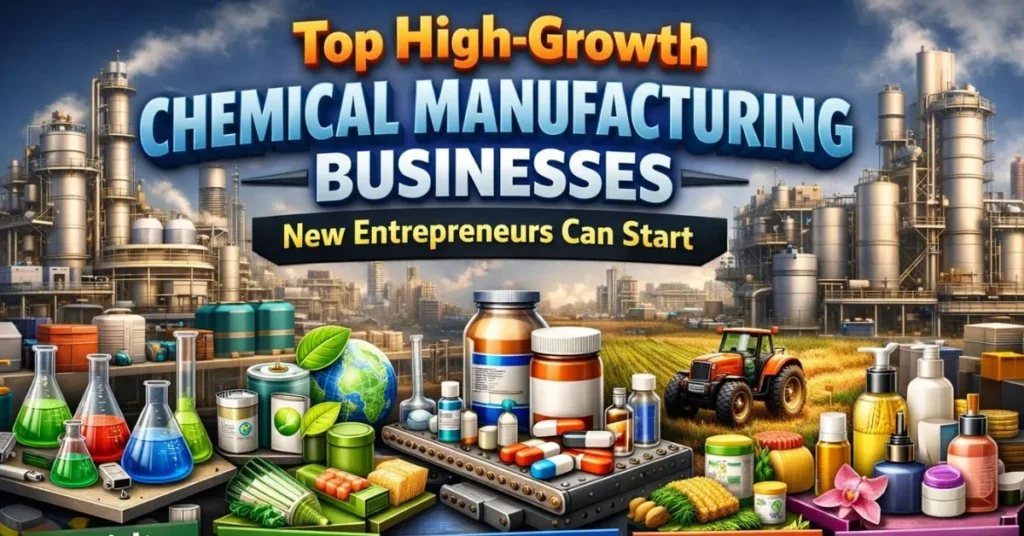
High growth chemical business, plant consultants, and industrial buyers for long enough and one truth becomes obvious. In the chemical manufacturing industry, demand is never a guarantee of success. Many projects with strong market demand fail as feasibility assumptions, working capital requirements, quality consistency, or compliance costs are under-estimated. The chemical and petrochemical industry is therefore attracting first-generation entrepreneurs who are willing to build systematically and not chase trends. The quiet power of chemicals in agriculture, pharmaceuticals, packaging, automobiles, construction, textiles, paints, detergents and infrastructure. This multi-sector dependence gives them a stability that is hard to match for other manufacturing industries. Why the Time Is Right for New Chemical Manufacturing Ventures Chemical manufacturing currently enjoys structural demand but not speculation. High capacity utilization across multiple segments suggests that buyers are actively sourcing in an effort to keep their operations running, not on an experiment basis with new suppliers. When downstream manufacturers have strong utilization, it is by design that they have alternative vendors to mitigate the company’s supply risk. Among the signals that are important to new entrepreneurs are three: Demand is already created and replicable Dependency of buyers on reliable suppliers is growing The ecosystem backs MSME participation by means of skilled manpower, vendors and logistics Together, these things make chemical manufacturing a lot more accessible than it was ten years ago.(high growth chemical business) Read More: Modern Technology of Industrial Chemicals How First Time Entrepreneurs Should Choose the Right Chemical Project Many first-time founders decide what to found based on popularity or short-term margins. Both approaches may be dangerous. Popular products face intense competition among their prices and niche high-margin products are often accompanied by complicated buyer approvals and regulatory hurdles. The typical common features of high-growth chemical projects are five in number: Raw materials are available through transparent and stable supply channels Product quality can be ensured in a reliable process control Cash cycles are predictable and do not tie up capital in receivables or inventory Capacity can be added in stages without redesigning the entire plant Environmental and safety compliance is manageable at MSME scale Projects that meet these criteria require some discipline and patience over time.(high growth chemical business) Specialty Chemical Blends & Performance Additives Specialty chemical blends are among the best entrepreneur-friendly breaks into chemical manufacturing. These products are widely used in plastics, rubber, paint, coating, adhesive, construction chemicals and textile process. Buyers in these industries do not really buy on price alone. Instead, they appreciate consistency, stability of shelf life and technical reliability. The primary reasons that make this segment scalable for first-time founders are: Strong repeat ordering once a formulation is approved High stickiness of suppliers as a result of process dependency at the customer end Scalability by means of additional blending capacity, not heavy capex Margins come in specialty blends from formulation discipline and quality assurance, not from commodity pricing power.(high growth chemical business) Read More: Industrial Chemicals Technology Hand Book Polymer Processing Inputs & Plastic Intermediates The petrochemical value chain is massive, but first-time entrepreneurs are better placed at the downstream end, as opposed to the capital-intensive upstream end. Polymer processing inputs and intermediates permit participation in large volume markets without excessive financial risk. This segment usually consists of: Special compounds of polymer for automotive and electrical applications Additive masterbatches – Colour and additive masterbatches Reinforced grades or flame-retardant grades of polymers Moulding Compounds Used by OEMs and Ancillaries Due to the standard specifications and good shelf life of polymer-based products, they also provide a natural path for exports once quality systems are instituted.(high growth chemical business) Formulation Based Agrochemicals and Cleaning Chemicals in the Industrial World Formulation-led chemical businesses enable manufacturers to develop both production and market. The cycles of agrochemical formulations are seasonal, but are predictable and repeated year after year. Under the conservative management of inventory levels and receivables, profitability improves considerably. Industrial and institutional cleaning chemicals are used in factories, hospitals, hotels, food plants and logistics centres. Buyers in this segment often have a preference for long-term supply relationships which leads to stable demand and healthier cash flows. Some of the most important operational advantages in formulation businesses include: Lower capital intensity than bulk chemical manufacturing Ability to differentiate through packaging, branding and service Repeat demand driven by consumption not one-time projects Read More: Project Reports & Profiles Water Treatment and Chlor-Alkali Downstream Chemicals While chlor-alkali production itself requires heavy investment, the downstream ecosystem offers a number of MSME friendly opportunities. Water treatment chemicals, effluent treatment formulations, pH control products and industrial salts are ongoing requirements for consumption because of regulatory and operational requirements. This segment is increasing steadily because: Demand is based on compliance and not trends in the market Industrial buyers do not prefer frequent change of suppliers Quality consistency is more important than lowest price As a result of this, disciplined manufacturers benefit from long term customer retention.(high growth chemical business) Rubber and Elastomer Compounding Inputs Rubber and elastomer compounding falls somewhere between design technical complexity and production scale. Automotive parts, industrial hoses, belts, gaskets, and footwear manufacturers rely on the uniformity of compounding materials. A common growth path for this segment includes: Starting off with a small range of products Qualifying with Local OEMs or Ancillary Units Expanding of SKUs after process stabilization Strengthening lab and testing capability Gradually entering into export markets This step-by-step expansion helps to control the risk, while building credibility.(high growth chemical business) Read More: How to Start a Pesticides and Insecticides (Agrochemicals) Manufacturing Business Why Industrial Clusters Are More Important than Product Choice Chemical manufacturing almost never works alone. Plants function more efficiently when they are part of a larger industrial ecosystem. Chemical parks and industrial clusters offer common utilities, waste treatment facilities, logistics facilities, and a pool of skilled manpower that are ready for employment. For the first-time entrepreneurs, cluster-based locations help to reduce: Delay in approval and compliance Utility reliability issues Raw material and dispatch logistics cost Early stage operational uncertainty In many
Top Rail-Based EXIM in India: 6 Profitable Export Business Opportunities for MSMEs
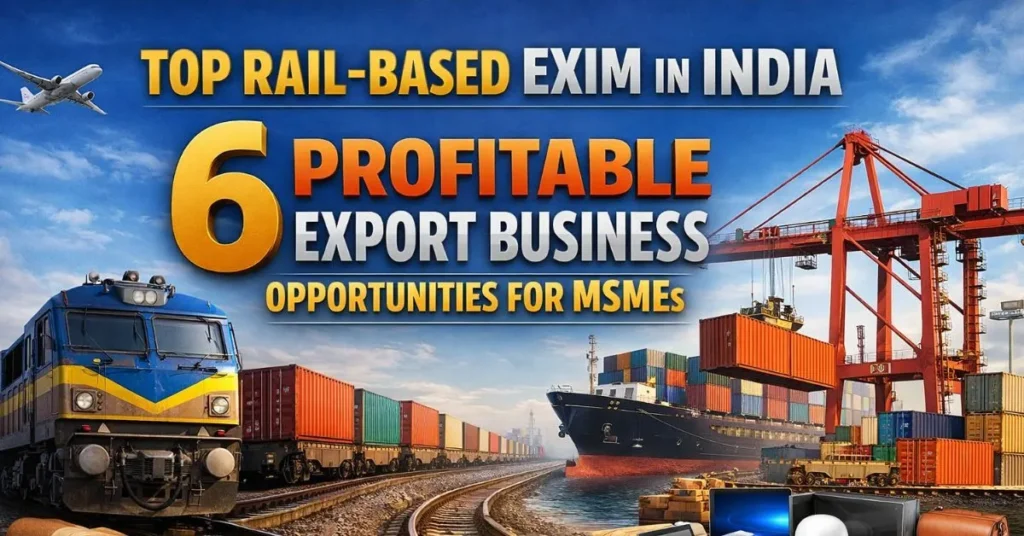
Introduction: rail based export business India For decades, Indian exports had been concentrated mostly around coastal manufacturing clusters. Businesses with a location near a port enjoyed natural logistical benefits and inland manufacturers were hindered by increased freight costs, unreliable transport schedules, and longer delivery times. That geography is changing fast. Rail-based EXIM logistics is changing the landscape of export in India by expanding global access of the market deep into the hinterland. With the growth in Dedicated Freight Corridors (DFC), Inland Container Depot (ICD), private freight terminals and PM Gati Shakti infrastructure initiative, railways have emerged as a strategic enabler of international trade. In 2023-24, over 63 million tonnes of EXIM container traffic was transported using rail-linked systems. Total freight commodity transported 1,588 million tonnes, which fetched earnings of Rs. 1,65,880 crore. These numbers are indicative of a structural transformation – not a temporary spike. For MSMEs and startups, this means one thing with power: You can conduct an export-oriented business without being located close to a port. Read More: Our Books The Structural Transformation in the Indian Trade Logistics Indian Railways has gone beyond the conventional method of freight movement. It is now a unified logistic backbone linking production centres with global gateways. Three major developments are leading to this transformation: Expansion of Inland Container Depots (ICDs) A number of intermodal publications in the SRI Library: – Operationalization of Dedicated Freight Corridors Multi-modal integration under Gati Shakti ICDs enable exporters to do their customs clearance nearer to their factories. Containers are then sent directly to ports by rail, avoiding congestion and delays. Dedicated Freight Corridors enhance the speed and reliability of transit by separating freight traffic from passenger lines. This adds predictability – and that is a key issue in export commitments. The Gati Shakti initiative ensures improved coordination between the rail, road and port infrastructure which makes the supply chains more efficient and cost-effective. For the inland states such as Uttar Pradesh, Madhya Pradesh, Rajasthan, Jharkhand and Chhattisgarh, this connection is opening up unprecedented export opportunities.(rail based export business India) Get Detailed Insights from This Book: Just For Starters: How To Start Your Own Export Business Why Rail Based EXIM Is Strategic Advantage for MSMEs Export success requires a high level of logistics efficiency. Many businesses are not unsuccessful because their products are not of quality, but because their supply chain is not stable. Rail based EXIM logistics has the following strategic advantages: Reduced per tonne transport cost of bulk and semi-bulk goods Predictable transit schedules Reduced risk of road congestion Better inventory planning Access to a number of ports from inland locations For MSMEs, this reduces uncertainty of operation and enhances pricing competitiveness in the international markets. Read More: Business Plans / Project Profiles High Potential Export Sectors Applicable to Rail Logistics Rail-based EXIM naturally services the industries that deal with heavy, bulk, or semi-bulk goods. Below are the most promising sectors for startup and small manufacturers. 1. Steel Products and Fabricated Structures Steel is weight intensive and also volume driven, so rail transport is ideal. Inland steel producers now have access to ports without having to move to coastal areas.(rail based export business India) Promising export segments are: Structural steel sections Fabricated beams and frames Pre-engineered building components Infrastructure related steel parts Rail connectivity is a great step to make exports cost viable. 2. Cement and Clinker Based Products India transports more than 150 million tonnes of cement every year on rail. Clinker exports to Africa and the Middle East are still increasing. Important export products in high demand include the following: Cement clinker Dry-mix mortars Precast concrete products Pavers and construction blocks Rail transport makes inland freight cheaper, thereby making price-sensitive exports competitive.(rail based export business India) 3. Agricultural and Processed Food Products Containerized rail movement has boosted bulk agricultural exports. With cold-chain improvement at terminals, value-added products are gaining ground. Export-ready products include: Rice and cereals Pulses and grains Dehydrated vegetables Food processing ingredient For Agri-MSMEs who are located away from ports, rail logistics opens up a major barrier.(rail based export business India) Read More: Project Reports & Profiles 4. Fertilizers and Argo-Chemical mixtures Nearly 59 million tonnes of fertilisers are moved by rail every year. Bulk rail logistics improves the viability of export for: NPK blends Specialty fertilisers Micronutrient formulations Cost efficiency is very important in this sector and rail offers that advantage.(rail based export business India) 5. Engineering Goods and Industrial Components Engineering exports are one of the best performing segments in India. Many parts are heavy and wouldn’t be transported over long distances on the road.(rail based export business India) High-potential exports are: Machinery components Industrial fasteners Electrical enclosures Fabricated assemblies Rail-to-port movement allows for international buyers to be more reliable in their delivery. 6. Chemicals and Industrial Intermediary Railways are used to transport chemicals in bulk and containerized forms. Organized handling systems minimize the risk of compliance and maximize safety. Export opportunities are available in: Specialty chemicals Dyes and pigments Industrial resins Additives and intermediates With proper planning, chemical MSMEs can go global.(rail based export business India) The Dual Model: Import Substitution Plus Export Many successful railway linked manufacturers use a two-stage approach. They start by replacing imports in their domestic markets. Once production stabilizes they look for export opportunities of surplus or value-added variants. There are several advantages to this approach: Better capacity utilization Reduced dependency on a single market Improved financial stability Rail logistics supports both domestic distribution as well as export movement over the same network of infrastructure. Read More: Railway Infrastructure Boom: Manufacturing Business Opportunities for New Entrepreneurs Why Is The Perfect Time Of Investment There are a number of macroeconomic and infrastructural factors that make this the right time to enter railway-linked export manufacturing: Dedicated Freight Corridors that are operational and expanding Inland container depots are growing in capacity Multi-modal logistic parks are being developed The move to diversify supply chains by global buyers Indian manufacturing policy is highly supportive of exports Entrepreneurs that
Solar Cell Manufacturing in India 2026: Market Size, Investment Cost & Profitability Analysis
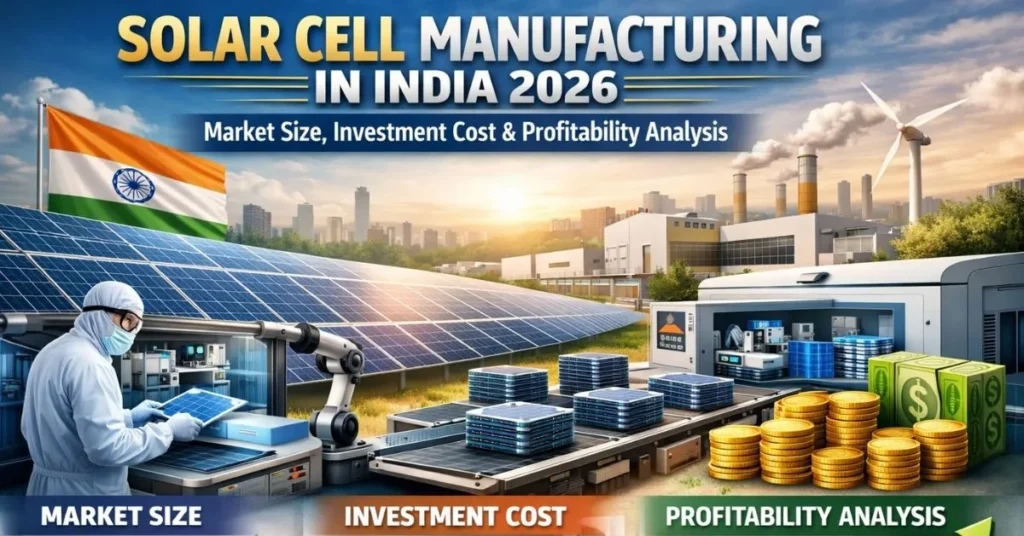
Introduction: Solar Cell Manufacturing in India India’s renewable energy transformation now has entered a decisive phase with solar energy emerging as the core of India’s clean energy strategy. Over the past 10 years, India’s installed solar capacity has risen from under 3 GW to over 135 GW, one of the fastest growing markets in the world. Under the policy direction of the Ministry of New and Renewable Energy (MNRE), not only is India getting installations moving forward, it is ramping up domestic solar manufacturing. With some ambitious renewable targets, strategic trade policies and financial incentives, solar cell manufacturing is becoming a high growth industrial sector. This report offers in-depth outlook for the solar cells market size, share, growth drivers, technology trends, investment and future opportunities in India for 2026. Read More: Solar PV Power and Solar Products Handbook India Solar Cells Market Size in 2026 India’s solar industry is growing at an industrial level. The country has already over crossed 135 GW of installed solar capacity and is aiming to reach 500 GW of non-fossil fuel energy capacity by 2030 with solar contributing close to 300 GW. Existing Manufacturing Capacity Overview Solar Module Manufacturing Capacity: ~100 GW Solar Cell Manufacturing Capacity: ~35 – 40 GW Wafer Manufacturing Capacity: Limited and growing Import Dependence: Heavy import dependency on wafers & select high efficiency cells The massive difference between the module and cell manufacturing capacity shows there is high potential for investments. As domestically the cell production starts to grow, India can not only reduce imports, but also achieve energy security and become an export-oriented manufacturing base. By 2026, India’s solar cell market is anticipated to grow at a healthy CAGR, backed by policy support, local demand, and global diversification of the supply chain.(Solar Cell Manufacturing in India) Important Growth Factors of Indian Solar Cells Industry 1. Government Incentives and Policy Support The main force which drives solar manufacturing expansion in India operates through the Production-Linked Incentive (PLI) scheme. The program provides rewards to companies based on their domestic value creation and their use of advanced technology that delivers better results. The Approved List of Models and Manufacturers (ALMM) policy ensures that government projects must select certified local manufacturers as their primary suppliers. The requirement of increased local production for solar cells and modules leads to heightened demand for their manufacturing. The import duty that applies to solar cells and modules creates advantages for local manufacturers because it improves their ability to compete with international products. 2. Rapid Growth in Power Demand The industrial growth and urban development of India has created a substantial rise in electricity requirements. Businesses in both industrial and commercial sectors use rooftop solar systems as a method to cut electricity expenses while meeting their environmental, social, and governance (ESG) requirements. The demand for advanced manufacturing technologies to produce rooftop solar installations exists because high efficiency cells require Mono PERC and Topcon production methods.(Solar Cell Manufacturing in India) 3. Utility-Scale Solar Parks States such as Rajasthan and Gujarat have developed into major solar centers because they possess optimal land resources and excellent solar energy potential and established handling facilities. Large-scale solar parks are generating predictable procurement pipelines into the multiple gigawatt range, year after year. This consistency makes the demand for solar cells visible in the long term and ensures demand visibility for solar cell manufacturers.(Solar Cell Manufacturing in India) Read More: India Solar Glass Market 4. Global Supply Chain Diversification With the international markets eager to find alternatives to single-country dependency, India has become a creditable manufacturing destination. Western countries are diversifying more and more in sourcing, and it is opening up opportunities for export for Indian solar cell producers. Manufacturers who have international certifications and high efficiency production lines stand to benefit greatly from this shift.(Solar Cell Manufacturing in India) Technology Trends Impacting Solar Cell Market Technology choice is important in competitiveness and profitability. 1. Mono PERC (Passivated Emitter And Rear Contact) Mono PERC has become the reference technology for high efficiency production technology in India. It provides better efficiency than traditional multi-crystalline cells and still has a manageable capital investment requirement. 2. Topcon (Tunnel Oxide Passivated Contact) Topcon technology is receiving rapid adoption because of its higher efficiency and improved performance in large-scale solar projects. It enables manufacturers to charge premium prices especially in export markets. 3. Heterojunction (HJT) HJT cells offer very high efficiency at the expense of higher capital expenditure and special equipment. While still emerging in India, HJT is the next stage of premium solar manufacturing. 4. Emerging Perovskite Tandem Cells Although still in the development stage, perovskite tandem technology can promise great efficiency improvements. Investment in R&D partnership by Indian manufacturers might provide early mover advantages in this segment.(Solar Cell Manufacturing in India) Competitive Landscape India’s solar manufacturing ecosystem has large conglomerates and specialized players. Read More: GOOD OPPORTUNITY IN SOLAR POWER PLANT – Manufacturing Plant, Detailed Project Report, Profile, Business Plan, Industry Trends, Market Research, Survey, Manufacturing Process, Machinery, Raw Materials, Feasibility Study, Investment Opportunities Major Industries Participants Adani Solar Reliance Industries Vikram Solar Warre Energies The companies pursue aggressive capacity expansion plans, while several companies implement a strategy to control their production process from wafer manufacturing through to module creation.(Solar Cell Manufacturing in India) Competitive Strategies Successful manufacturers are usually focused on: Large scale capacity for cost advantages Technology upgrades to keep up efficiency leadership Vertical integration to better margins Export diversification Strong domestic distribution networks New companies face challenges when they attempt to provide affordable products because they struggle to compete on that factor. The company should choose to focus on three specific areas which include niche market segments and product excellence and comprehensive service delivery according to the target market needs.(Solar Cell Manufacturing in India) Investment Requirements and Profitability Study Solar cell production is capital intensive. Estimated Investment The cost of establishing a 1 GW solar cell manufacturing facility depends on the chosen production technology which requires a substantial financial investment. The primary cost elements consist
India’s Rising Steel Imports: 10 High-Profit Steel Manufacturing Business Ideas for Startup Entrepreneurs
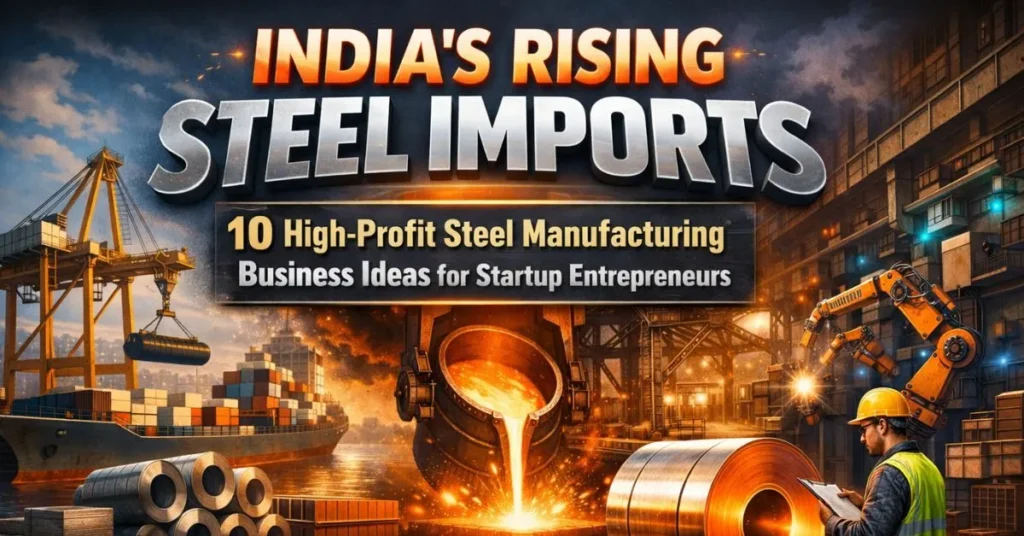
Introduction: Steel manufacturing startup India The steel industry in India is currently expanding because three factors are driving the growth of infrastructure and manufacturing capacity and domestic demand for steel. According to information by the Ministry of Steel, between April and December 2024, India has imported more than 7.4 million tonnes of finished steel, indicating a robust demand and the current production gaps. While the shortage of supplies is evident from imports, there are also tremendous opportunities for entrepreneurs to build profitable manufacturing enterprises as well. Startups are able to enter high-demand segments once again-primarily specialty steel, fabrication, recycling and value-added components, which can capture markets currently dependent on imports. This SEO optimised guide looks at 10 high potential steel manufacturing business ideas that combine with current industry demand, policy incentives and future infrastructure projects.(Steel manufacturing startup India) Read More: The Complete Technology Book on Hot Rolling of Steel (2nd Edition) 1. Specialty Steel Production Specialty steel is one of the largest import dependent segments in India. High-performance grades such as electrical steel, automotive steel and corrosion-resistant alloys are still sourced from overseas suppliers. Why it’s a strong opportunity: Government incentives in Production Linked Incentive (PLI) schemes High demand from EVs, renewables and advanced manufacturing Production of transformers and motors increasing Startup Ideas: Electrical steel for power transformers and motors High strength automotive steel components Manufacturing units of tool steel and alloy steel Entrepreneurs who have expertise in quality standards and advanced metallurgy can compete directly with imported items.(Steel manufacturing startup India) 2. Cold Rolled Steel Products, Coated Steel Products Cold-rolled sheet and coated steel are used extensively in appliances, automobiles, construction and industrial machinery. Demand is still increasing with the rising infrastructure sector in India. Business Opportunities: Colour-coated roofing sheets Galvanized steel panels Industrial production of cold rolled sheet Small and medium manufactures can begin with downstream processing units instead of the full steelmaking operations, which reduces the risk of investment.(Steel manufacturing startup India) Read More: Steel Rolling Technology Handbook (2nd Revised Edition) 3. Steel Scrap Processing and Recycling (Green Steel Opportunity) Sustainability is changing the steel industry. Recycling helps lower emissions as well as aligns India’s green steel roadmap. High-Demand Areas: Scrap shredding and segregation plants End-of-life vehicle dismantling centres Ferrous scraps supply to induction furnace operators Recycling businesses have lower capital requirements than primary steelmaking and have the advantage of increasing environmental regulations.(Steel manufacturing startup India) 4. Pellet Production from Low-Grade Iron Ore India produces large volumes of iron ore but a significant part of this is low grade. This is then pelleted into an efficient raw material for steel plants. Startup Advantages: Strong demand by sponge iron and integrated steel producers Possibility to operate in the vicinity of mining clusters Reduced transportation costs if it is strategically located Pellet plant can become essential suppliers as steel plant focus on efficiency and cost reduction. Read More: Steel Re-rolling Mill – Manufacturing Plant, Detailed Project Report, Profile, Business Plan, Industry Trends, Market Research, Survey, Manufacturing Process, Machinery, Raw Materials, Feasibility Study, Investment Opportunities, Cost and Revenue 5. Fabricated Steel Structures and Pre Engineered buildings (PEB) India’s infrastructure expansion including high ways, logistics parks, metro rail, and renewable energy projects has led to a demand for fabricated steel structures. Segments of Products That Generate Profit: Pre-engineered building components Transmission towers – Telecommunication structures Solar mounting systems Industrial Warehouses and Modular Buildings Fabrication companies stand to gain rapid growth by partnering with EPC contractors and infrastructure development companies.(Steel manufacturing startup India) 6. Steel Wire and Fastener Production High-precision steel wire products can be imported on a large scale in light of strict quality requirements. Manufacturing Opportunities: Wire drawing And Heat Treating Units Galvanized agricultural fencing wire Industrial springs and fasteners Power transmission cables and reinforcement mesh Precision engineering and quality control can also aid in new manufacturers moving into export markets. Read More: Steel and Iron Handbook 7. Consumer and Industrial Products of Stainless Steel Increasing urbanization and lifestyle changes are driving the increase in demand for stainless steel products in the construction and consumer market. Business Opportunities: Stainless steel pipe and tubes Kitchenware and utensils Architectural fittings and railings Modular kitchen components High grade stainless steel manufacturing helps in reducing the dependence on imports while catering to the domestic demand.(Steel manufacturing startup India) 8. Foundry Products Made From Pig Iron Foundry products such as cast iron products are needed in automotive, machinery and pump manufacturing. Potential Business Areas: Cast iron automotive parts Industrial valves and pump housings Agricultural Machinery Components Foundries may serve both the domestic industries as well as to export markets in Asia and the Middle East markets.(Steel manufacturing startup India) 9. Long Products Investment: MSME Driven Induction Furnace Units Induction furnace technology enables smaller manufactures to produce structural steel products with relatively low capital investment. High-Demand Products: TMT bars for construction Angles, beams, and channels Rural and semi-urban construction Steel Faster growing towns have local markets to be serviced by a regional mini-mill. Read More: Top 20 Steel Products Manufacturing Business Ideas 10. Industrial Machinery and Equipment used in Steel Plants As the steel capacity increases, so does the demand for localised machinery and automation systems. Business Ideas: Material handling systems, conveyors. Pollution control equipment Plant automation and robotics Engineering and EPC support services Supplying equipment to steel manufacturers presents recurring revenue opportunities. Inspiration from the Steel Industry Leaders of India Entrepreneurs who are looking to get into the steel industry can learn from iconic steel industry leaders: Ratan Tata turned Tata Steel into a globally focused technology company. Sajjan Jindal grew JSW Steel by innovation and strategic expansion Lakshmi Mittal built ArcelorMittal to one of the largest producers of steel in the world. Their journeys show that innovation, efficiency and global thinking are the keys to being successful in the steel business. Read More: India’s Steel Scrap Recycling Policy: 15 Growing Avenues in Auto-Scrapping, Metal Recovery, and Urban Mining How Consulting & Feasibility Planning Can Help Before setting up a manufacturing business, entrepreneurs
Top 3 Profitable Manufacturing Business Ideas in India: (Tapioca Glue, Coconut Milk, and Iodophor Solution)
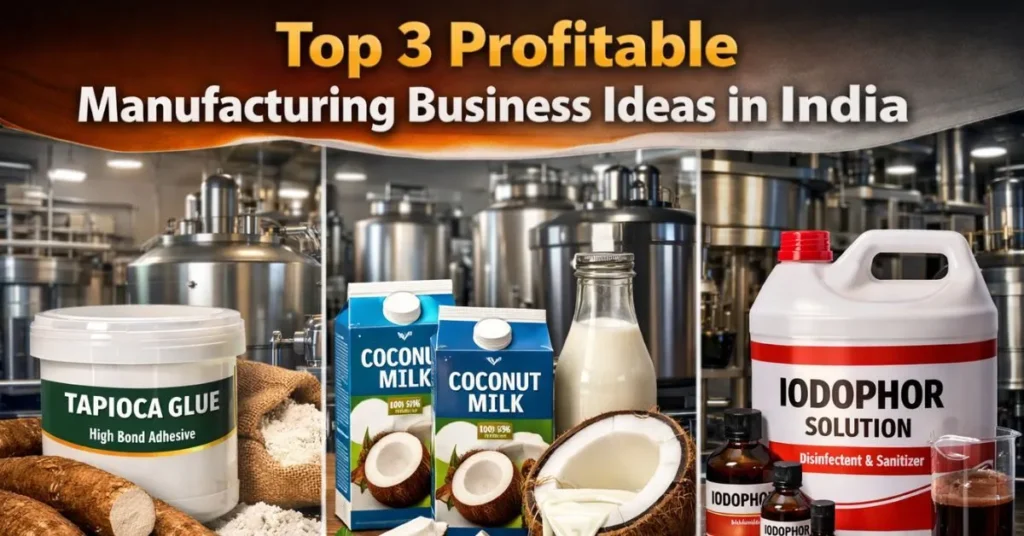
Introduction: Profitable Manufacturing Business Ideas in India India’s manufacturing sector is in powerful growth stage driven by growth in domestic demand, import substitution, sustainability trends and excellent policy support for MSMEs. For entrepreneurs and 1st generation manufacturers, opportunities today are not necessarily big industrial plants but demand-driven products that address everyday business and consumer problems. Three manufacturing segments are highlighted for their scalability and fairly manageable investment levels: tapioca starch-based glue, coconut milk processing, and iodophor disinfectant solution. The products represent different industrial clusters which currently experience fast growth because they create eco-friendly adhesives and plant-based food processing products and institutional hygiene chemicals. The article examines three manufacturing opportunities through its analysis of market potential and manufacturing process and demand drivers and profitability outlook to assist entrepreneurs in making investment decisions.(Profitable Manufacturing Business Ideas in India) Read More: The Complete Book on Coconut & Coconut Products (Cultivation and Processing) 1. Tapioca Starch Glue Manufacturing: A Sustainable Industrial Adhesive Enterprise Product Overview Tapioca starch glue is a bio-based glue made from cassava starch. It is used extensively in the manufacture of corrugated boxes, paper bonding, bookbinding, textile sizing and plywood lamination. With the industries moving away from petroleum based chemicals, starch adhesives are gaining good acceptance. The product is valued for its non-toxicity, biodegradability, fast bonding properties and cost advantage over synthetic alternatives. Growing e-Commerce and FMCG packaging demand has seen a big rise in consumption of corrugated boxes – indirectly leading to growth in adhesive demand.(Profitable Manufacturing Business Ideas in India) Manufacturing Process The production process is relatively simple and can be done in MSME scale units: Gelatinisation of tapioca starch by controlled heating Mixing with water and chemical additives Addition of preservatives to ensure shelf stability Viscosity control & packaging Typical plant capacity is between 1 and 5 tonnes per day, which enables gradual expansion. Capital investment is medium and energy consumption is not prohibitive. Raw Materials and Supply Chain Primary raw material: Tapioca starch (mostly sourced from Tamil Nadu and Andhra Pradesh). Secondary inputs include borax, caustic soda and stabilizers. Maintaining a consistent starch quality is the key to product reliability.(Profitable Manufacturing Business Ideas in India) Market Demand and profitability Industries that drive demand are: Manufacturers of corrugated packaging Notebook and stationery manufacturers Textile processing units Veins and plywood industries Bio-based adhesives market is expanding faster than the traditional adhesives and small units often get healthy operating margins due to steady repeat orders. Read More: White Phenyl – Manufacturing Plant, Detailed Project Report, Profile, Business Plan, Industry Trends, Market Research, Survey, Manufacturing Process, Machinery, Raw Materials, Feasibility Study, Investment Opportunities, Cost and Revenue, Plant Economics 2. Coconut milk processing: A High Growth Food Manufacturing Opportunity Product Overview Coconut milk has gone from being a regional item to an international food item. It is extensively used in ready-to-eat meals, vegan beverages, desserts, sauces and bakery applications. Increasing awareness among people about health and a growing demand for dairy alternatives have fueled great growth in this segment.(Profitable Manufacturing Business Ideas in India) In India rising urbanization and plant-based dietary trends are increasing the domestic market, whereas export demand is high in Europe, the Middle East and Southeast Asia. Manufacturing Process Coconut milk production consists of: Dehusking and shell removal Extracting and grinding kernel Pressing and filtration Thermal processing and homogenisation Packaging (pasteurised or aseptically) Units can start small – processing 5,000 to 10,000 coconuts per day – and work up to export grade production. Raw Material Sourcing Mature coconuts are largely coming from Kerala, Karnataka and Tamil Nadu. Price fluctuation is a significant issue, dealt with often by forming long-term supplier agreements or partnership with farmers. Standards of cleanliness, fat content and shelf stability are important, particularly for institutional buyers and the international market.(Profitable Manufacturing Business Ideas in India) Read More: The Complete Book on Coconut & Coconut Products (2nd Edition) Market Demand, Profitability Demand segments include: FMCG companies operating in curries and ready meals Hotels, restaurants, cloud kitchens Vegan and health food brands Export distributors In order to increase profitability, manufacturers can use by-products such as coconut oil and coconut residue. 3. Iodophor Solution Making: A High Trust Chemical Company Product Overview Iodophor solution is an iodine-based disinfectant that is widely used in dairy farms, food processing plants, breweries, pharmaceutical manufacturing and hospitals. The product delivers comprehensive antibacterial defines while releasing iodine at controlled rates which makes it appropriate for areas that require strict hygiene standards.(Profitable Manufacturing Business Ideas in India) The food sector and healthcare sector both experience rising demand for institutional disinfectants because sanitation regulations become more stringent. Manufacturing Process The process of production involves: Dissolving iodine using non-ionic surfactants Controlled mixing and stabilisation, Dilution with purified water Quality Testing and Packaging The project needs moderate funding yet it requires organizations to follow strict safety measures and complete regulatory obligations.(Profitable Manufacturing Business Ideas in India) Read More: Unlock Huge Profits With These Coconut Business Opportunities Raw Materials and Operational Factors The manufacturing process depends on iodine and surfactants and acids and purified water as its main components. The business needs reliable sources of iodine and secure chemical storage facilities to ensure its daily activities run smoothly. Market Demand and Profitability Primary demand comes from: Dairy and poultry farms Food processing industries Pharmaceutical manufacturers sani pairs to institutional sanitation services The organization establishes long-term relationships with customers through its continuous institutional order process which generates predictable revenue streams. Key Lessons of Indian Manufacturing Success Stories Successful Indian industrialists prove that it is more important to execute with discipline than to expand fast. Entrepreneurs who pay attention to the stability of supply chains, quality control and targeted markets tend to build more resilient businesses.(Profitable Manufacturing Business Ideas in India) Backward integration into raw materials helps in reducing cost volatility. Export orientation, good compliance systems and consistent product quality create customer trust for the long term – especially within chemical and food manufacturing industries. Read More: The Role of Tapioca Starch Glue in Sustainable Manufacturing Policy Support for
Top 3 Profitable Manufacturing Businesses in India (Silicon, ABS & Bentonite)
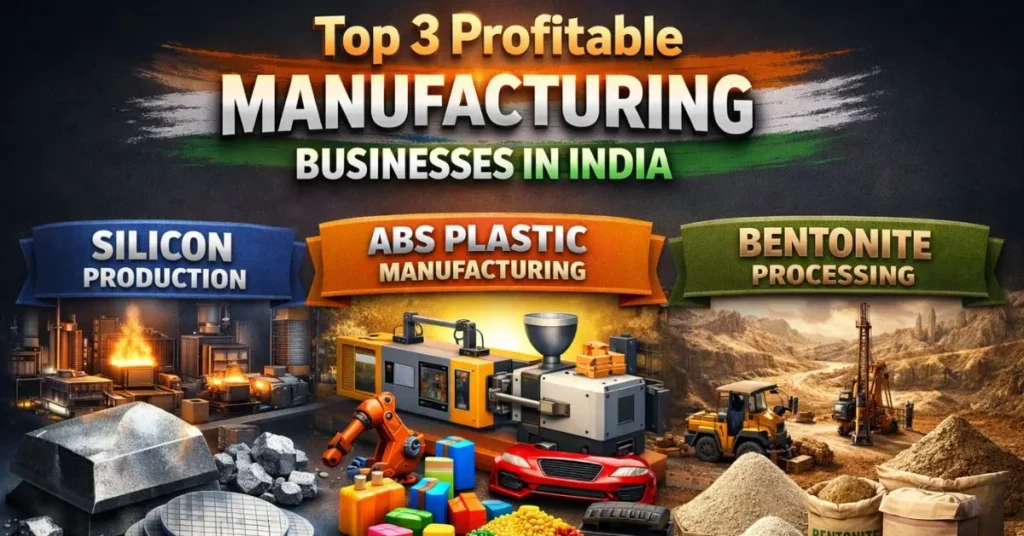
Introduction: Profitable manufacturing businesses in India India’s manufacturing sector is in a powerful phase of growth based on domestic demand, the modification of global supply chains, and government initiatives in support of industrial production. Many entrepreneurs are chasing digital trends, but manufacturing is one of the surest paths to building long-term wealth with tangible assets, repeat demand and scalable operations. Material-based manufacturing businesses are also attractive because they cater to many industries at the same time. From electronics to renewable energy resources, consumer goods to pet care products, raw material processing remains in constant and strong demand. This article discusses three promising manufacturing opportunities in India – Silicon Crystals, Acrylonitrile Butadiene Styrene (ABS) engineering plastic and Bentonite-based Cat Litter. Each of them represents a different level of investment and business model, and hence is suitable for large industrial investors as well as emerging MSME entrepreneurs.(Profitable manufacturing businesses in India) Read More: The Complete Book on Resins (Alkyd, Amino, Phenolic, Polyurethane, Epoxy, Silicone, Acrylic), Paints, Varnishes, Pigments & Additives (Surface Coating Products with Formulae)(3rd Revised Edition) 1. Silicon Crystals Manufacturing – Powering Electronics and Renewable Energy What Are Silicon Crystals? Silicon crystals are highly purified materials that are used in semiconductor wafers, solar panels, power electronics, and industrial sensors. Although they are not the products that consumers see, they are the backbone of modern technology. Every single smartphone, solar installation and industrial automation system is based on silicon-based parts.(Profitable manufacturing businesses in India) India’s dedication to electronics production together with its commitment to renewable energy has created an increased need for domestically produced silicon materials. Government incentives to solar energy and semiconductor manufacturing also strengthen the long-term growth potential. Overview of the Manufacturing Process The road of manufacturing starts with quality quartz or silica sand. Through carbothermic reduction in electric arc furnaces, silicon in metallurgical grade is produced. The process begins with material transformation into polysilicon through purification which uses Czochralski as a specialized crystallization method. Silicon manufacturing plants need: High capital investment Reliable energy supply Strict quality control Controlled production environments The existing plants need high capital investment yet they maintain their operation through extended supply agreements which secure steady income for extended periods. Read More: BENTONITE PROCESSING & PULVERISING – Manufacturing Plant, Detailed Project Report, Profile, Business Plan, Industry Trends, Market Research, Survey, Manufacturing Process, Machinery, Raw Materials, Feasibility Study, Investment Opportunities, Plant Layout Demand Factors and Market Potential The major industries which need silicon crystals for their operations include the following sectors: Solar panel manufacturing Semiconductor fabrication Electric vehicle power electronics Industrial automation systems The growth of domestic Electronics production in India creates new opportunities for businesses to replace imported products. Businesses that have the financial resources and engineering knowhow to operate in silicon production will achieve sustainable profits throughout their business lifecycle.(Profitable manufacturing businesses in India) 2. ABS Plastic Manufacturing: Engineering Thermoplastic of High Demand Understanding ABS Plastic Acrylonitrile Butadiene Styrene (ABS) is an engineering-grade thermoplastic that is known for its impact resistance, durability, and great molding properties. The material finds extensive application across various sectors including automotive interior construction and electrical equipment production and medical device manufacturing and toy creation and luggage design.(Profitable manufacturing businesses in India) As opposed to basic commodity plastics, ABS commands a better price based on its performance characteristics, and thus is profitable for manufacturers. Read More: Bentonite Processing – Manufacturing Plant, Detailed Project Report, Profile, Business Plan, Industry Trends, Market Research, Survey, Manufacturing Process, Machinery, Raw Materials, Feasibility Study, Investment Opportunities, Cost and Revenue Production and Manufacturing Process ABS, made by the polymerization of acrylonitrile and styrene in the presence of polybutadiene. This process requires controlled temperature and chemical handling systems. Commonly, manufacturers will produce ABS granules which are supplied to the injection molding companies and OEM manufacturers. A typical ABS plant is concerned with: Consistent formulation High-quality polymerization processes Efficient supply chain managemen Demand and Growth Prospects for the Market India’s burgeoning automobile industry and growing appliances manufacturing industry is a key growth driver for ABS. Increasing consumer expenditures on longer lasting goods like refrigerators, washing machines and electronics also contributes to rising demand. Major industries using ABS are: Automotive manufacturing Consumer electronics Medical equipment Household appliances The MSME sector offers business opportunities through three different paths which include niche development of ABS grades and compounding activities and partnerships with molded product manufacturers.(Profitable manufacturing businesses in India) 3. Bentonite Cat Litter Making Business: Low Investment, High Growth Product Overview Bentonite cat litter is a clumping absorbent litter that is made from natural clay. While it doesn’t come across as a very popular industry, India’s pet care market is rapidly growing and there’s a good demand for high-quality litter products. Additionally, bentonite has industrial applications in foundries, drilling fluids, and absorbents to provide diversified revenue streams.(Profitable manufacturing businesses in India) Read More: High-Capital Manufacturing Business Opportunities in India: Silicon Metal, Iron Ore Crushing, and MIBK Manufacturing Manufacturing Process Compared to the manufacture of chemicals or semiconductors, bentonite manufacturing is relatively easy and inexpensive. The process of production is as follows: Mining or sourcing of bentonite clay Drying and crushing Granulation and screening Optional fragrance or additives blending Packaging and branding Due to the moderate technology requirements, the segment is particularly suitable for first generation entrepreneurs and MSMEs.(Profitable manufacturing businesses in India) Market Opportunities and Profitability Urban pet ownership in India is rapidly growing, and there is a high demand for high-end pet products in the country. Retail expansion and e-commerce channels further enhance access in the market for new brands. Benefits of bentonite cat litters manufacturing include: Low capital investment Faster break-even period Branding opportunities Dual (industrial and consumer) markets This business segment provides entrepreneurs who want to start a manufacturing company with a production method which allows them to expand their operations.(Profitable manufacturing businesses in India) Key Lessons of Effective Indian Manufacturing Leaders Industrial leaders in India stress on process discipline, integration and long-term thinking. Companies that control both the source of raw materials and downstream products often have
Container, Trailer & Flatbed Manufacturing Business in India: High-Profit MSME Opportunity
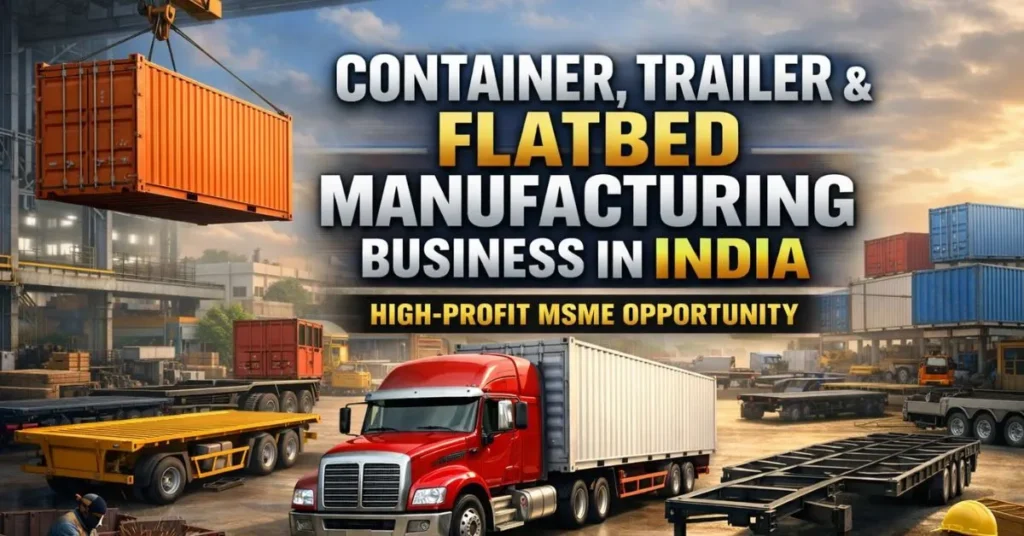
Introduction: Container manufacturing business in India In the logistics industry, profits are rarely made during the actual transportation process – they are made in the interface between goods being transported from road to rail, from rail to port, and from inland waterways to port. Containers, trailers and flatbeds are the backbone of these transitions as they allow for seamless cargo movement whilst reducing delays and handling costs. For MSME entrepreneurs and industrial investors, intermodal equipment manufacturing is a rare combination of stability and scalability. The advanced transportation equipment requirements of India increase as the country develops new freight corridors and multimodal logistics parks and export facilities. The industry functions according to permanent structural requirements because goods movement will always exist and organizations will continuously need equipment for their operations. This article delves into manufacturing opportunities, market potential, investment logic, processes and risks – to help entrepreneurs understand why containers, trailers and flatbeds are becoming strategic industrial investments.(Container manufacturing business in India) Read More: Our Books Market Demand Drivers: Infrastructure Supports Manufacturing India’s logistics ecosystem is in a process of structural transformation. Government initiatives like dedicated freight corridors, port modernization, inland waterways development and industrial corridors are adding a lot of capacity to the freight.(Container manufacturing business in India) For every kilometer of new freight infrastructure there is demand for transport equipment. As freight volume increases, logistics operators enlarge fleets, upgrade aging assets and invest in specialized equipment. This produces a strong feedback loop: Infrastructure investment helps to increase freight movement Higher freight volumes mean higher utilization of equipment Utilization increases the rate of replacement Manufacturing demand increases steadily For the MSME manufacturers, this translates to long-term institutional demand as opposed to fragmented retail buyers. The logistics companies together with EPC contractors and exporters and industrial fleet operators establish themselves as returning clients who generate steady income for the business. Understanding the Product Segments 1. Containers: Standardized Worldwide Assets Containers are the basis of modern intermodal logistics. ISO containers, high-cube containers, refrigerants, and specialized cargo boxes exist as worldwide standards which allow for simple international trade operations. Container manufacturing demands financial resources for steel production and stringent quality assessment procedures, yet standardization enables manufacturing at scale and international trade capabilities. With global supply chains looking for diversification in sourcing outside of traditional hubs, Indian manufacturers are having a growing export potential.(Container manufacturing business in India) 2. Trailers: Volume Domestic Opportunity Trailers are the link between the infrastructure and flexible road transportation. Skeletal trailers, container carriers & multi-axle logistics trailers are experiencing a high demand with the increasing e-commerce and industrial production and freight mobility. For MSMEs, trailer manufacturing is often the easiest gateway to get into the market because it can have relatively lower CAPEX and can offer faster order cycles. Fleet operators often expand and upgrade trailers, which assures repeat business. Read More: Business Plans / Project Profiles 3. Flatbeds: Customisation with Increased Margins Flatbeds function as transportation platforms which carry oversized goods that include machinery and steel structures and infrastructure components. The production of flatbeds results in fewer total units compared to trailers yet flatbeds generate higher profits because of their requirement for custom engineering work and their specific load handling methods.(Container manufacturing business in India) Together, these products constitute an interrelated manufacturing ecosystem that shares manufacturing infrastructure and engineering capabilities. Manufacturing Process: Engineering Discipline Over Complication Intermodal equipment manufacturing is not as much about innovation, but more about precision and process discipline. The manufacturing workflow usually consists of: Cutting steel plates and profiles on CNC plasma or laser machines Forming structural elements using hydraulic presses and roll forming Welding using Heavy Fabrication Techniques with Fixtures and Manulators Structural assembly using jigs to ensure dimensional accuracy Surface treatment – shot blasting and Corrosion resistant coating Final assembly and quality testing Success relies greatly on the quality of the weld, the load distribution, the alignment of the axles and the durability of the coating. Plants focusing on process consistency are beating those investing heavily in unnecessary automation. Read More: Project Reports & Profiles Machinery Needed in MSME Manufacturing Units Typical key equipment includes: CNC plasma or laser cutting machine for steel processing Hydraulic presses and roll forming machines Heavy welding set and fabrication fixtures Shot blasting lines, industrial painting lines Overheads and material handling equipment Instead of investing in cosmetic automation, MSMEs should prioritize machines that provide a better tolerance accuracy, throughput and production efficiency.(Container manufacturing business in India) Investment Logic and Profitability Factors Consultants are assessing intermodal manufacturing projects based on asset productivity and not simply profit margin. Important metrics include: Output per fabrication bay Equipment utilization rates Steel yield & scrap management Working capital cycle with logistics buyers After-sales services e.g. repair and refurbishment Manufacturers who integrate production with lifecycle services are often able to have better long-term cash flows. Refurbishment and retrofit services create recurring revenue and better customer retention.(Container manufacturing business in India) Read More: Steel Containers: Key Role of Cargo Containers in Global Trade Export Opportunities, Global Demand Transport equipment is internationally traded with a good export potential. The Indian manufacturers can target: International logistics fleet Coastal shipping operators EPC Contractors carrying out overseas infrastructure projects Markets in Africa, South East Asia and the Middle East Export participation does not always entail shipping full vehicles. Components, sub-assemblies and knock-down kits are possible entry strategies that minimize the complexity of logistics and open up global revenue streams. Strategic Lessons of Indian Industrial Leaders The transport manufacturers in India offer valuable insights: Tata Motors, put a focus to design the products not on technical specification, but to the operational use of the vehicle. Ashok Leyland developed robust fleet-centric service networks, which demonstrated that lifecycle value is more important than upfront pricing. Larsen & Toubro combined heavy engineering and infrastructure projects, proving the concept of how manufacturing increase relates to the growth of the nation. Intermodal equipment manufacturing employs similar strategic principles — durability, scalability and customer-focused engineering.(Container manufacturing business in India) Emerging MSME Project Opportunities Multiple
Port-Based Steel Manufacturing in India: Business Opportunity, Cost Advantages & Growth Potential
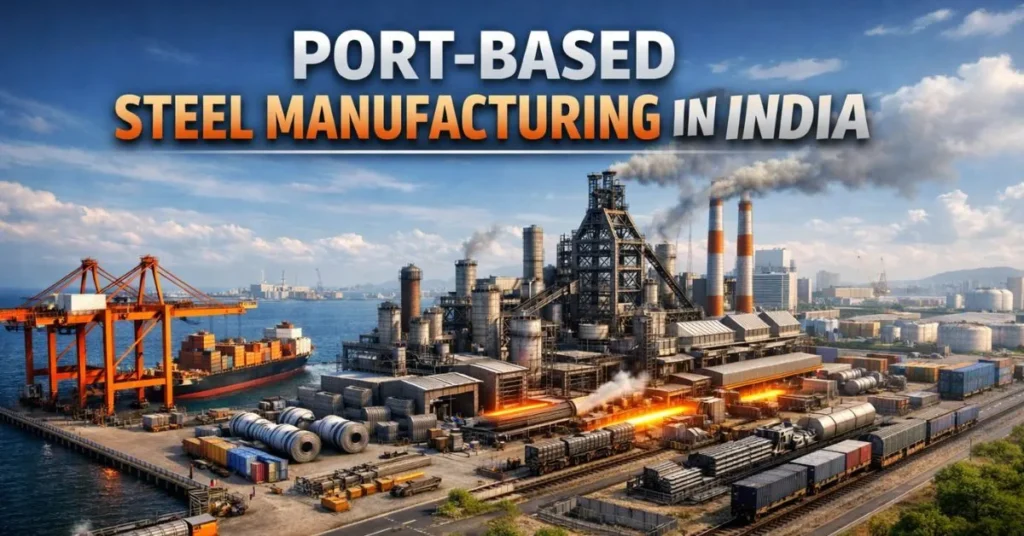
Introduction:Port-Based Steel Manufacturing in India Port-Based Steel Manufacturing in India is transforming the manufacturing sector through improved infrastructure, stronger global trade connections, and advanced logistics systems. The establishment of port-based manufacturing clusters has created integrated industrial ecosystems around major seaports, enabling businesses to enhance production efficiency, streamline transportation operations, and significantly boost export performance. In industries like steel and heavy fabrication, geography is increasingly becoming a strategic advantage, as opposed to just a logistical consideration. Port-based locations provide businesses with efficient access to both essential raw materials and international markets and institutional buyers which improves their ability to operate efficiently. For entrepreneurs, investors, and MSMEs looking for long term sustainability, steel manufacturing nearby ports is an attractive opportunity. The implementation of port-centric manufacturing models enables businesses to enhance their operational efficiency through two main methods which include reducing supply chain complexity and fulfilling their regular production needs. Read More: The Complete Technology Book on Hot Rolling of Steel (2nd Edition) The Concept of Ports Based Manufacturing Clusters Port-based manufacturing clusters are integrated industrial zones where production facilities are working in the close proximity to maritime infrastructure. These clusters create a complete system which combines all essential elements for manufacturing and logistics operations because they include facilities for production and storage and customs processing and distribution to international markets.(Port-Based Steel Manufacturing in India) The system creates an efficient value chain which enables direct port access to raw materials and requires minimal handling time to deliver finished products worldwide. Manufacturers benefit from reduced logistics expenses and faster delivery times and improved supply chain reliability. India’s increasing focus on the economic zones along its coast, port modernization and dedicated freight corridors has spurred the growth of such clusters. Ports are also evolving from transit points into more full-fledged industrial locations which facilitate long-term growth of manufacturing. Why Steel Manufacturing is the Perfect fit for Port Locations Steel production and fabrication are inherently logistics heavy activities. The industry depends on large raw materials such as iron ore, scrap metal and coal, while final products – everything from its structural components to its heavy equipment – also need efficient transportation. Port-based manufacturing solves these challenges by compressing the supply chain: raw materials may be acquired from anywhere in the world and transported directly to production facilities.” Finished steel products can be exported without the costly inland trucking requirement. Inventory storage requirements are reduced because of accelerated shipping cycles. Goods handling and material transfer costs are reduced to a great extent. For manufacturers, these advantages mean better margins and more constant operating expenses. In competitive markets where freight costs are often a major element in profitability, close proximity to ports can be a winning advantage.(Port-Based Steel Manufacturing in India) Read More: Steel Rolling Technology Handbook (2nd Revised Edition) Demand Stability through Institutional Buyers A high strength of the port-based manufacturing is found in its access to institutional and industrial buyers. Ports are complex environments of operation that need constant upkeep, infrastructure upgrade and equipment replacement. The primary factors which drive demand for this service include: Shipping lines & container operators Mariner Engineering and EPC Contractors Logistics and transportation companies Export-oriented manufacturers Infrastructure and maintenance agencies The institutional procurement process uses contract-based operations which operate differently from consumer markets that experience changes based on trends and economic fluctuations. The manufacturing process can create stable production schedules because the system produces consistent demand patterns which help manufacturers achieve constant machine operation throughout their production period. The current business environment assists MSMEs and mid-sized fabrication businesses to decrease their sales risk while they enhance their ability to predict their financial results.(Port-Based Steel Manufacturing in India) Steel Product Segments Most Suitable for Port Clusters Not all steel products have equal benefits from the proximity to the coast. The most successful categories have the following characteristics in common: they have high weight, they have an export orientation, and there is a continuous institutional demand.(Port-Based Steel Manufacturing in India) Read More: Steel Fabrication Industry Container and Container Component Production Shipping containers, corrugated panels and structural frames are directly related to port operations. Manufacturing these components in the vicinity of deployment areas curtails the turnaround time and allows for quicker servicing.(Port-Based Steel Manufacturing in India) Marine and Port Infrastructure Fabrication Ports require constant maintenance of safety and structural equipment such as bollards, fenders, access platforms, railings, crash barriers, etc. Replacement cycles create constant recurring demand. Structural Steel for Export Projects Prefabricated steel structures, which are used in international infrastructure projects, have the advantage of immediate access to the ports. Reduced shipping delay and logistics cost gives coastal fabrication units a strong competitive edge.(Port-Based Steel Manufacturing in India) Manufacturing of Logistics Equipment Trailers, skeletal carriers and cargo handling structures suffer intensive use within port ecosystems. Local manufacturing enables fast maintenance support and customer relationship building in the long run.(Port-Based Steel Manufacturing in India) Read More: Top 20 Steel Manufacturing Business Ideas Economic Benefits and Profitability Apricots, Avocados and Apples Port-based steel manufacturing has some structural advantages that lead to long-term financial soundness: Predictable Logistics Costs: With shorter transportation distances, there is less exposure to volatility and fuel price risk in freight. Improved Payment Discipline: Institutional clients tend to adhere to structured procurement cycles and contracts, resulting in more predictable payment schedules. Export Pricing Opportunities: Manufacturers who access international markets can use international pricing standards as their benchmark instead of competing only within their local markets through price wars. Consistent Production Utilization: A constant demand from industrial activities in setback offers better asset performance at low idle time. Instead of being at the mercy of volatile market spikers, manufacturers within port clusters tend to enjoy steady margin of EBITDA supported by operation efficiency. Infrastructure Development Building a Demand Flywheel The extensive Indian investments in logistics and coastal infrastructure development create more attractive opportunities for port-based manufacturing operations. Key developments include: Expansion of Coastal Shipping Networks Dedicated freight corridors between industrial regions Inland Waterway Connectivity projects Modernized systems of cargo handling and containerization The
How India’s New Budget Is Creating a Billion-Dollar Container Manufacturing Opportunity for MSMEs
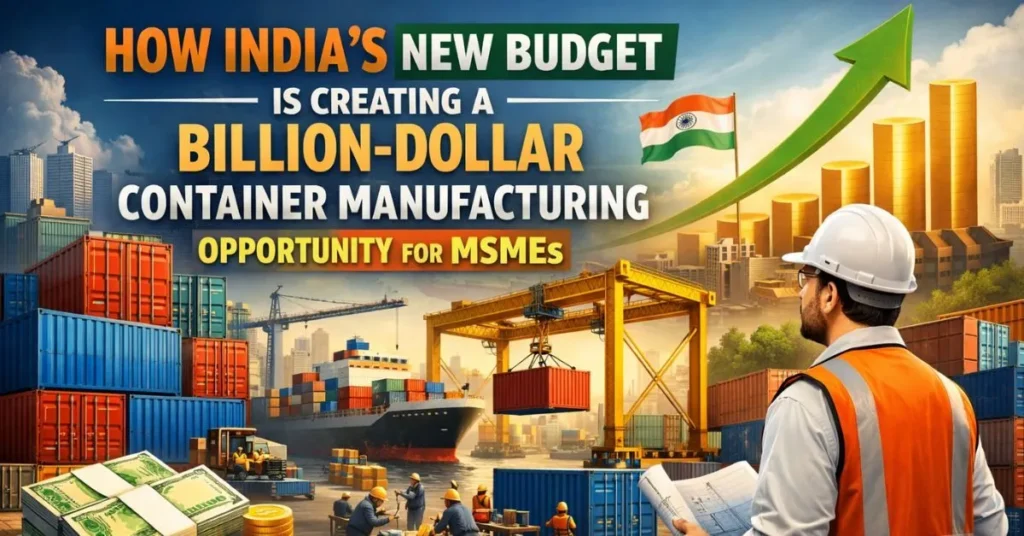
Introduction: Container Manufacturing Opportunity in India India’s latest Union Budget has quietly set up one of the most promising manufacturing opportunities for entrepreneurs – seaworthy container manufacturing. With a dedicated government scheme, heavy investments in logistics infrastructure, MSME credit reforms and a growing emphasis on decreasing import dependency, the sector is progressing from a niche industrial activity to a strategic national priority. Shipping containers are no longer merely metal boxes used for the transportation of goods. The present day infrastructure functions as an essential system that supports international trade operations and military supply chains and coastal shipping activities and rail freight transportation and multimodal freight systems. India’s policy push is a sign that it is looking at building domestic capacity rather than heavily relying on imports from countries such as China in the long term.(Container Manufacturing Opportunity in India) For MSME founders, engineers and industrial entrepreneurs, this change presents a rare chance to get into a manufacturing sector that is supported by robust policy support, structural demand growth and financing incentives. Read More: Plastic Battery Containers Manufacturing Business Government Policy Push: What’s Driving Growth on Container Manufacturing The Indian government has launched a Scheme for Container Manufacturing as part of the advanced manufacturing and strategic sector schemes. This puts container production on par with industries such as electronics, semiconductors and infrastructure equipment manufacturing.(Container Manufacturing Opportunity in India) A number of policy reforms make the business environment more attractive: Increased public capital expenditure on freight corridors, ports, logistics parks and water ways. Dedicated Freight Corridors linking mineral areas with industrial ports. Expansion of children’s coastal cargo and inland waterways transportation. The implementation of digital single window customs clearance systems aims to decrease export processing times. The MSME financing system provides funding through three channels which include SME Growth Funds and credit guarantees and TReDS invoice discounting. The initiatives provide entrepreneurs with three essential resources which include demand visibility and operational risk assessment and financial market access to launch their container manufacturing facilities.(Container Manufacturing Opportunity in India) Why Seaworthy Containers is a Strategic Manufacturing Sector The logistics industry in India experiences rapid growth which exceeds normal expansion rates. With the increase in the volume of trade and government investment in multimodal transport networks, it is likely that the demand for containers will grow substantially.(Container Manufacturing Opportunity in India) Major reasons why containers are now strategic infrastructure are: Growth in export import trade that requires standardized transport solutions. Expansion of rail freight and inland waterways. Coal transport is valuable for boosting trade. Around the world, the maritime sector has been impacted in the past three quarters by multiple events that had a positive influence on container liner companies. As India’s aims to be a global manufacturing hub, domestic container production will play a major role in improving the supply chain resilience and reducing the imports. Read More: Business Plans / Project Profiles Business Logic: Why Container Manufacturing Makes Financial Sense 1. Localization Advantage and Demand Growth Historically, container manufacturing was dominated by China because of scale and cost. However, India has a new policy framework which aims to reduce this gap through incentives, cluster-based manufacturing, and better logistics infrastructure.(Container Manufacturing Opportunity in India) Entrepreneurs now have an advantage from: Reduced inland logistics cost. More rapid port turnaround time. Government procurement preferences. Increasing domestic demand of logistics companies and shipping operators. 2. Opportunities for Profitable Product Mix The container manufacturing plant can fulfill product diversification through its capacity to manufacture different product types: The plant produces standard 20ft and 40ft dry containers because they meet the needs of high volume customers. The company generates higher profits through its production of high cube and refrigerated containers. The company produces specialized containers that include three different types flat-rack tank and open-top containers. Custom containers for defence, infrastructure and coastal cargo. Focusing on higher levels of manufacturing technology, such as automated welding, corrosion-resistant coatings, and smart containers enabled with RFI can help greatly improve value addition and profitability.(Container Manufacturing Opportunity in India) Read More: Our Books 3. MSME Friendly Industrial Clusters Government plans to revive legacy industrial clusters give rise to an ecosystem in which container manufacturing units can benefit from: Shared fabrication infrastructure. Skilled welding and engineering man-power Complete access to ancillary suppliers for doors, locks, coatings and hardware. Lower capital investment through the sharing of resources within a cluster. This approach gives the MSMEs an opportunity to start with mid-scale operations and grow gradually as the demand grows.(Container Manufacturing Opportunity in India) Read More: Detailed Project Profiles on Hi-Tech Plastic Products (2nd Revised Edition) Important Business Models That Entrepreneurs Can Explore Standard Container Manufacturing Plants A high-throughput plant which produces ISO-standard containers for logistics companies, rail operators and coastal shipping companies. Success requires the efficient procurement of steel, good buyer relationships, and production scalability. Specialised Container Manufacturing Units Plants that focussed on high margin customised containers for inland waterways or project cargo or hazardous materials. Technical expertise is the differentiator instead of scale alone. Container Refurbishment and Leasing Centres With the growing circulation of containers, much of the rehearsal, repair, and leasing of containers are interesting recurring revenue opportunities. These facilities can also recycle used containers into modular offices, site camps or retail structures.(Container Manufacturing Opportunity in India) Integrated Fabrication Facilities Entrepreneurs can consider manufacturing the containers as well as fabricating the trailers, cargo equipment or steel structures so the machinery can be used better and income can be diversified. Financial Assistance and MSME Incentives The budget provides various financial advantages to container manufacturing MSMEs through its multiple funding mechanisms: SME Growth Funds for equity support of expansion. TReDS platforms for invoice discounting and better cash flow. Credit ensures the minimization of financing risks. Digital customs systems reducing export delays and working capital cycles. These measures are important in enhancing the viability of capital-intensive manufacturing activities. Read More: Empowering Indian Enterprises: The New MSME Definition Explained (2025) Risks That Are Essential for Entrepreneurs to Consider Despite the best of opportunities, promoters should plan for:
Profitable Semiconductor Business Opportunities in India Under ISM 2.0 (Startup & MSME Guide)
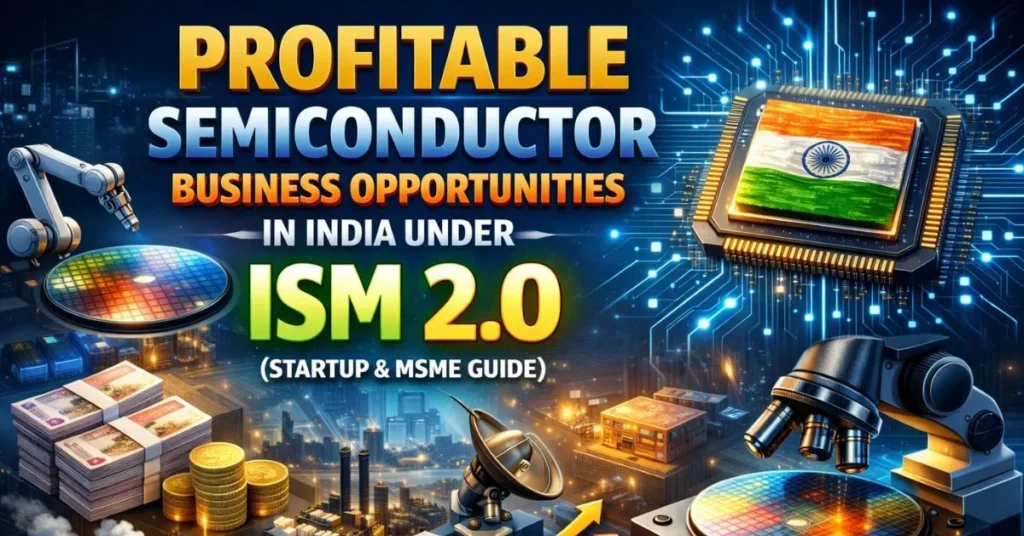
Semiconductor business opportunities in India are expanding rapidly as the industry moves beyond capital-intensive fabrication plants that once required billions of dollars in investment. However, the Union Budget of India 2026–27, along with the expansion of the India Semiconductor Mission (ISM) 2.0, is changing this narrative. The government’s focus has shifted toward building a complete semiconductor ecosystem, opening the door for startups and MSMEs to participate in one of the world’s most strategic industries. Rather than competing head-on with global chipmakers, Indian entrepreneurs can enter the semiconductor manufacturing supply chain. Incentives such as capital goods duty exemptions, bonded warehousing provisions, deferred duty payments and export facilitation have lowered entry barriers. As a result, startups now have practical possibilities in manufacturing support systems, materials, services and specialised logistics. India’s effort to minimize dependence on imports and increase electronics manufacturing is driving persistent demand for domestic suppliers. Businesses that are about quality, technical capability and disciplined growth can build strong, defensible businesses in this new ecosystem.(Semiconductor business opportunities in India) Read More: Our Books Why ISM 2.0 Is a Real Opportunity for Startups Semiconductors are now one of the strategic manufacturing sectors in India, which translates into long-term policy support and structural support. The latest budget initiatives are aimed at enhancing the financial feasibility and efficiency of operation in industrial ventures. Demand visibility is on the upswing as domestic fabs and electronics manufacturers are interested in local suppliers to minimize the risk and supply chain delays.(Semiconductor business opportunities in India) Startups have several policy benefits that make manufacturing more viable: Duty exemptions on capital goods reduce initial costs of investment Bonded warehousing – inventory storage free of duty payments Deferred duty systems help in reducing the working capital pressure Export facilitation measures ease the international shipping Together these reforms provide a more favourable environment for entrepreneurs who are willing to invest in specialised manufacturing or services. Ancillary Manufacturing: The Hidden Workhorse of Semiconductor Production Ancillary manufacturing is one the easiest ways to enter the semiconductor ecosystem. Fabrication and backend facilities rely on the use of thousands of precision components and consumables which must comply with strict technical and cleanliness standards. These products may not be glamorous, but they are important for daily operations.(Semiconductor business opportunities in India) Because of this tendency among fabs not to switch approved vendors, the ancillary suppliers often have the benefit of long term repeat orders. Profitability, not due to high-volume production, but to consistent quality and process discipline. Typical ancillary manufacturing areas are: Precision machined components for vacuum and process systems Wafer carriers, trays, and handling accessories ESD-safe packaging and cleanroom-compatible products Automation fixtures, enclosures, and thermal management solutions Startups that concentrate on one market segment achieve better results than businesses that try to develop multiple products simultaneously. Read More: Business Plans / Project Profiles Tooling and Equipment: Innovation in Engineering Brings Growth The semiconductor manufacturing process requires various equipment components combined with automated systems. The advanced chipmaking machines used by international companies run the market yet they require specialized tools and support equipment. Indian startups with good engineering skills have the ability to solve specific operational challenges that semiconductor facilities face. The focus of the Union Budget on domestic capital goods manufacturing makes for a robust business case for domestic tooling companies. Import delays and high prices make manufacturers seek out domestic suppliers who can deliver faster and provide technical support.(Semiconductor business opportunities in India) In this segment, success is often achieved through a build-create-qualify-repeat scale. A startup may well start with a single product or engineering solution. Once qualified by a customer, the equipment becomes part of the manufacturing process, which creates stable and long-term revenue opportunities. Examples of possible areas for tooling focus would include automation systems, precision alignment tools, environmental monitoring devices and specialised sub-fab equipment. The main thing is to solve one problem extremely well before going into additional products. Read More: Project Reports & Profiles Chemicals and Materials: Strategic and Technically Demanding The chemicals and materials segment is one of the most sensitive areas of semiconductor manufacturing. Production processes rely on ultra-pure substances and materials with high technology where even the smallest contamination can cause a production failure. As India looks to decrease dependency on imported materials, the local manufacturing of the same is gaining importance.(Semiconductor business opportunities in India) Startups moving into this sector will need to focus on: High level quality control systems Advanced laboratory testing and process validation Strict regulatory compliance & certifications Constant research and product development Although the barrier to entry is high, the rewards are high. Once a material supplier is approved, customer relationships are often long term since fabs are reluctant to switch validated suppliers. Companies that manage to gain credibility in specialty chemicals or advanced products can typically enjoy good margins and stable growth.(Semiconductor business opportunities in India) Testing, Packaging and Semiconductor Logistics: Growth Path Available The backend semiconductor ecosystem provides one of the most realistic places for new businesses to start. Testing and packaging services earn revenue from long-term service contracts instead of huge investments in manufacturing. Because electronics manufacturing in India is growing at a fast rate, the need for reliable backend support is rising further. Testing businesses can specialise in functional testing, reliability testing or failure analysis. Packaging services are adding value by the use of high-tech assembly and chip finishing processes. These segments have higher skill demands and lower capital investment requirements than fabrication facilities.(Semiconductor business opportunities in India) Logistics is another very important part of the semiconductor supply chain. Components need specialised handling to prevent them from being damaged by electrostatics and contamination. Budget reforms like bonded warehousing safe harbour and electronic export sealing are making things much more feasible for logistics startups with semiconductor clients at the centre of their business.(Semiconductor business opportunities in India) Read More: Handbook on Electroplating with Manufacture of Electrochemicals (2nd Edition) Import Substitution and Export Expansion India’s reliance on import of semiconductor inputs opens up immediate opportunities for Indian manufacturers. Startups