
How to Start a Betel Nut Processing Business – Supari Business in 2026
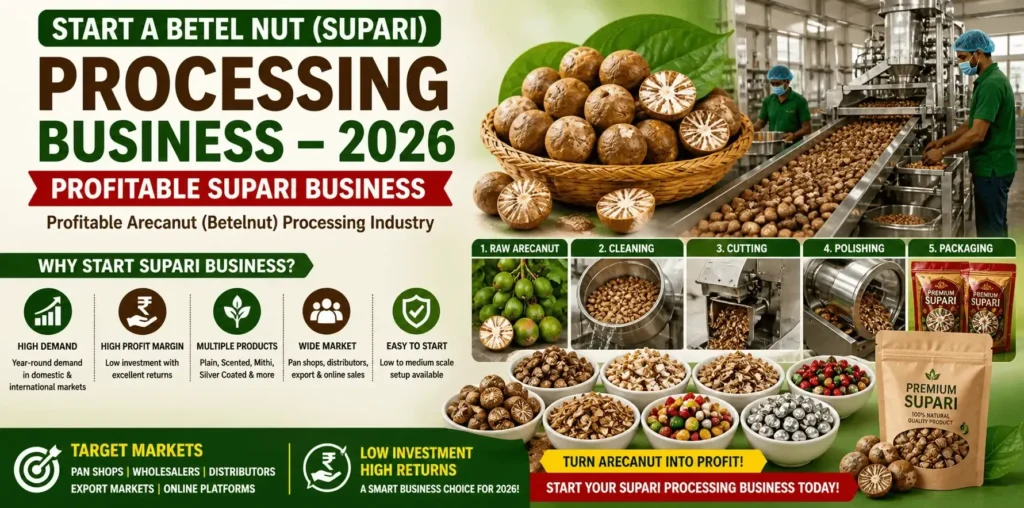
If you’re looking to enter a traditional and profitable agro-based industry, it’s time to start a Betel Nut Supari Processing Business. Betel Nut, also known as areca nut, is widely consumed in India and Southeast Asia in various processed forms – supari, scented supari, gutkha base, and pan masala mix. With a consistently high demand in both rural and urban areas, entrepreneurs can start a Betel Nut processing business to generate sustainable income while adding value to a readily available raw agricultural product. Understanding the Betel Nut Market The decision to start a Betel Nut processing business is backed by the product’s deep cultural roots and high consumption rate in India, Bangladesh, Nepal, and parts of Southeast Asia. India is one of the largest producers and consumers of Betel Nut, making it an ideal base for setting up processing units. As the nut is used in various forms—raw, boiled, dried, flavored, and roasted—it offers scope for product variety, regional customization, and brand development. The demand for premium-quality processed supari is growing in urban markets, where packaging, hygiene, and flavor profile make a big difference in consumer choice. This allows entrepreneurs to position their brand differently even in a saturated market. Types of Betel Nut Processing When you start a Betel Nut processing business, you can choose from several processing methods: 1. Boiled Supari: Nuts are boiled and dried to enhance shelf life and create a soft chewable texture.2. Dried Supari (Chali): Sun-dried whole nuts are cut into thin slices and packed raw or roasted.3. Flavored Supari: Processed slices are coated with sugar, menthol, spices, or cardamom for use in pan masala.4. Masala Supari: Prepared by mixing with saffron, silver leaf (varak), or special aromatic blends.5. Roasted Supari: Dried slices are roasted for enhanced taste and shelf life. Each variant caters to different regional tastes and age groups, offering wide market penetration if you start a Betel Nut processing business with a diverse product line. Raw Materials and Machinery Required To start a Betel Nut processing business, you need access to quality raw areca nuts sourced from Kerala, Assam, Karnataka, or North-Eastern states. In addition, you’ll require: Betel Nut cutting machines (manual or automatic) Roasting pans or driers Flavor mixing drums Polishing and grading machines Weighing and sealing machines Hygienic packaging material (pouches, jars, boxes) A small unit can be start with basic machinery under ?5 lakhs, while an automated plant may require ?10–25 lakhs depending on scale and quality expectations. Processing Flowchart Here’s a simplified workflow to start a Betel Nut Supari processing business: Procurement of raw nuts Cleaning and sorting Cutting into uniform pieces Drying or roasting Flavor mixing (optional) Polishing and grading Packing and labeling The process can be modified based on your product line—raw, flavor, or premium aromatic supari. Regulatory and Legal Considerations Before you start a Betel Nut Supari processing business, obtain the following: FSSAI license (Food Safety and Standards Authority of India) GST registration Factory license or Udyam registration (for MSME benefits) Trademark for brand protection Pollution control board NOC (if required) Ensure hygiene and food safety compliance to gain trust and scalability in both wholesale and retail markets. Target Market and Distribution Strategy Your target audience includes: Retail pan shops Wholesale grocery traders Pan masala manufacturers Online customers through e-commerce platforms Institutional buyers like hotels, wedding caterers, and snack companies A strong regional distribution network combined with smart packaging and branding can help your products reach Tier 1 and Tier 2 cities. Once your unit gains traction, you can start a Betel Nut Supari processing business with multiple product categories and premium offerings. Profitability and ROI The profit margin in the Betel Nut Supari processing business ranges from 20% to 35% depending on scale and processing type. Raw dried supari has lower margins but high volumes, while flavored or premium supari has higher margins and branding potential. On average, small units can recover investment within 12–18 months. Branding and Product Innovation With growing health awareness, customers are shifting to hygienic and well-packaged alternatives. If you start a Betel Nut Supari processing business with a focus on cleanliness, attractive design, and varied flavors, your brand can command higher retail prices. You can also experiment with: Sugar-free supari for diabetic consumers Herbal or ayurvedic variants Paan flavor infusions Gift packs for festivals and weddings Export Potential Processed Betel Nut has strong export demand in Nepal, Bangladesh, Myanmar, UAE, and other countries with Indian diaspora. You can register with APEDA, get IEC (Import Export Code), and connect with global buyers via platforms like Alibaba or IndiaMART to take your products global. Conclusion To Nut or Supari processing business is to invest in a time-tested, culturally ingrained, and consistently profitable agro-processing venture. With low capital requirements, scalable infrastructure, and strong demand across regions, this business is ideal for entrepreneurs looking to enter the FMCG and agro-based sector with minimal risk. References and Useful Government / Institutional Links The following official government and institutional resources are recommended for further reading and for direct application to the schemes discussed in this article. Startup India – Official Portal –https://www.startupindia.gov.in/ Ministry of Micro, Small & Medium Enterprises (MSME) –https://msme.gov.in/ Udyam Registration Portal –https://udyamregistration.gov.in/ Department for Promotion of Industry and Internal Trade (DPIIT) –https://dpiit.gov.in/ Small Industries Development Bank of India (SIDBI) –https://www.sidbi.in/ MUDRA / PMMY Official Portal – https://www.mudra.org.in/ CGTMSE Official Portal –https://www.cgtmse.in/ Ministry of Micro, Small & Medium Enterprises –https://msme.gov.in/ JanSamarth Portal (Government Loan Schemes) –https://www.jansamarth.in/ Niir Project Consultancy Services (NPCS) –https://www.niir.org/ Contact Us
Business Investment Opportunities in Bentonite
The growing demand for natural minerals has created exciting business investment opportunities in Bentonite, a versatile clay with applications across multiple sectors. Bentonite, primarily composed of montmorillonite, exhibits remarkable properties such as water absorption, swelling, viscosity, and binding—making it a valuable component in drilling fluids, foundry sands, animal feed, cosmetics, construction, and pharmaceuticals. With rising consumption in both domestic and global markets, the business investment opportunities in Bentonite are increasingly attracting attention from entrepreneurs, exporters, and industrial manufacturers seeking profitable ventures in the mineral-based industry. Why Invest in the Bentonite Business? The business investment opportunities in Bentonite are backed by rising global demand, diverse industrial use-cases, and an abundant raw material supply—especially in countries like India, China, and the USA. As industries move toward more sustainable and cost-effective raw materials, Bentonite is becoming a preferred natural mineral due to its multifunctional benefits and relatively low processing cost. Whether you’re looking to start a small beneficiation unit, a full-fledged processing plant, or an export business, Bentonite provides scalable and sustainable investment potential. Applications Driving Bentonite Demand Oil and Gas Drilling One of the largest consumers of Bentonite is the oil and gas industry, where it’s used in drilling fluids to maintain borehole stability, cool drill bits, and carry rock cuttings to the surface. This usage presents huge business investment opportunities in Bentonite, especially for processors producing high-grade sodium Bentonite. Iron Ore Pelletizing In the steel industry, Bentonite is used as a binding agent for iron ore fines. With growing steel production worldwide, especially in India, China, and the Middle East, the demand for pellet-grade Bentonite is climbing steadily. Foundry Applications Bentonite serves as a critical binder in green sand molds for metal casting. Foundries across automotive and heavy engineering sectors rely on it for smooth casting processes. Entrepreneurs can tap this demand with a specialized Bentonite blend for foundry use. Construction and Civil Engineering In construction, Bentonite slurry is used for pile foundation boring and tunneling. It is also a preferred sealing material in geotechnical applications and waterproofing membranes. Agriculture and Animal Feed Processed Bentonite is used as a soil conditioner and detoxifying agent in animal feed. This opens doors for investment in agri-grade and feed-grade Bentonite, especially in rural markets. Cosmetics and Pharmaceuticals Cosmetic-grade Bentonite is valued for its ability to cleanse, detoxify, and absorb oil. With the growth of herbal and natural skincare products, there’s rising demand for purified Bentonite in the wellness and cosmetic sectors. Key Business Models in Bentonite Sector Mining and Raw Bentonite Supply Investors can start with the acquisition or leasing of Bentonite-rich land, especially in regions like Gujarat (India), Wyoming (USA), or Turkey. Raw Bentonite can then be sold directly to processors or exported. Processing and Beneficiation Plant A mid-scale business model involves setting up a Bentonite processing unit with machinery for drying, grinding, micronizing, and packaging. This adds value and allows segmentation into different grades (API, foundry, agriculture, cosmetics). Export Business Countries like Indonesia, UAE, Japan, and several African nations import processed Bentonite for multiple industries. With proper certifications, exporters can supply customized Bentonite grades internationally. Private Labeling and Packaging Entrepreneurs can invest in small-scale packaging of cosmetic and wellness products using cosmetic-grade Bentonite. Bentonite face masks, healing clay powders, and detox packs are trending in e-commerce platforms. Machinery and Setup Requirements For a standard processing unit catering to the business investment opportunities in Bentonite, the following infrastructure and machinery are essential: Jaw crushers and hammer mills (for primary crushing) Rotary or fluid bed dryers (for moisture reduction) Grinding mills (Raymond or ball mills) Pulverizers and micronizers (for fine mesh output) Rotary screens or vibratory sieves Weighing, mixing, and packing units Dust collectors and safety systems Factory space of around 10,000 to 20,000 sq. ft. is sufficient for a medium-scale setup. Investment and Profitability A small-to-medium scale Bentonite processing plant requires an initial investment ranging from ?50 lakhs to ?3 crores depending on capacity and product specialization. With growing demand and value addition at every stage (raw ? processed ? packaged), a processor can expect gross profit margins of 25%–35%, especially when catering to specialized grades or export markets. Return on investment (ROI) is achievable within 18–24 months under efficient operational management and market outreach. Regulatory and Compliance Factors To operate in the business investment opportunities in Bentonite, ensure you meet the following: Environmental clearances for mining or mineral handling Bureau of Indian Standards (BIS) certification for industrial grades APEDA or DGFT licenses for export-oriented units FDA or cosmetic safety certifications for skincare products GST registration and pollution control board approvals Having an in-house testing lab can greatly enhance product credibility, especially when dealing with pharmaceutical or cosmetic sectors. Marketing and Distribution Strategy Building a strong distribution network is key to succeeding in the Bentonite industry. Recommended channels include: B2B platforms like IndiaMART, TradeIndia, and Alibaba Government e-marketplaces (GeM) for domestic orders Direct partnerships with foundries, drilling companies, and agri-input suppliers Export agents and international distributors White labeling for wellness and skincare startups Additionally, digital marketing, technical datasheets, product samples, and case studies will help you win long-term industrial clients. Future Trends and Innovation Potential The business investment opportunities in Bentonite will continue to grow as industries seek natural and efficient materials for various applications. Future growth areas include: Nano-Bentonite formulations for advanced oil drilling Organic-certified Bentonite for agro and cosmetic use High-purity Bentonite for pharmaceutical suspensions Ready-to-use Bentonite-based skincare products Eco-friendly Bentonite waterproofing and insulation products Investing in R&D and quality enhancement will keep your business future-proof and allow entry into premium markets. Conclusion The business investment opportunities in Bentonite offer an ideal mix of sustainability, scalability, and profitability. Whether you aim to mine, process, export, or manufacture value-added products, the versatility and high demand of Bentonite make it a smart industrial investment. With growing global awareness toward sustainable raw materials, backed by strong industrial usage and local availability, Bentonite provides a low-risk, high-reward business opportunity for both new and seasoned investors. Niir Project Consultancy Services An ISO 9001:2015 Company 106-E,