
Defence Manufacturing Business Ideas for MSMEs and Startups in India: The 2026 Opportunity Guide
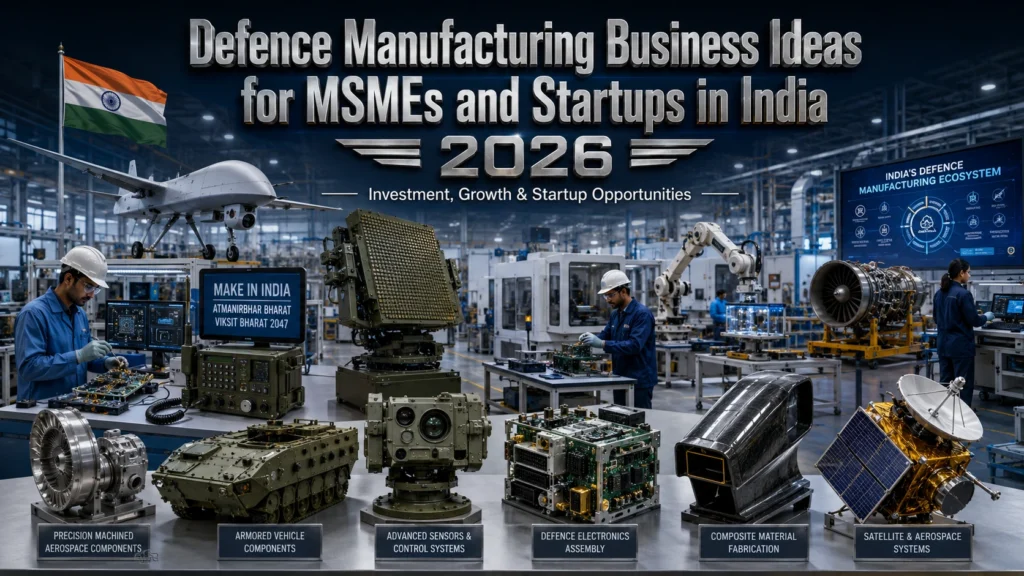
Defence Manufacturing Business Ideas in India 2026 India’s path of Defence is now different. Over the years, the country became the world’s biggest importer of arms. This is completely different now in New Delhi. During the National Defence Industries Conclave 2026, the Minister of State for Defence announced that MSMEs and startups have now become a key driver towards India becoming a global defence manufacturing hub. Businesses ideas which are available in this sector now, would have been unimaginable just 10 years ago. The Union Budget 2026–27 has allocated ₹7.85 lakh crore to defence, the highest ever, which is an increase of 15.19% year-on-year, according to the Ministry of Defence. The volume of Defence production has just touched new heights and the message to small manufacturers is loud and clear: The gates of one of India’s most protected industries have opened! The Gap Nobody Talks About The paradox at the core of India’s defence build-up. Large Defence Public Sector Undertakings (DPSUs) and a few big private companies seem to be in the news but they cannot do everything themselves. There are tens of thousands of parts in one fighter aircraft! From precision-machined valves and special cables to fasteners, castings, forgings, rubber gaskets and electronic sub-assemblies, all are necessary for a warship. The DPSUs are supposed to do their business on the clear directive of the government to boost outsourcing to Indian vendors. In the meantime, thousands of items have been added to the Positive Indigenisation Lists and no longer can be imported into this country. The actual number of MSMEs working in the defence sector is about 16000 but the number of registered, qualified MSME vendors in defence sector is far less than the actual requirement, according to IBEF. That disparity is the opportunity. Why 2026 Is the Inflection Point Various forces have converged at one time and 2026 is the most apt time for MSME defence suppliers of India in the history of the country. Reflect on change: All-time high defence budget: The defence budget in the Union Budget 2026–27 is the highest ever, and approximately ₹1.39 lakh crore has been allocated for procurement from domestic industry only. Capital Acquisition funds are now mostly assigned to Indian companies with close to 75% of the budget dedicated to them. Indigenisation lists: Thousands of components and sub-systems are reserved for Indian manufacturers under the Positive Indigenisation Lists of the Ministry of Defence and DPSUs. More than 34,000 items are listed on the SRIJAN portal, of which over 10,000 have already been indigenised. iDEX grants: Startups and MSMEs working on defence prototypes can avail of a grant of not less than ₹1.5 crore under the SPARK scheme and up to ₹25 crore under the ADITI scheme from the iDEX (Innovations for Defence Excellence) framework. Up to 676 startups, MSMEs and innovators are part of the iDEX ecosystem as of early 2026. Defence corridors: Two dedicated Defence Industrial Corridors in Uttar Pradesh (Aligarh, Agra, Jhansi, Kanpur, Chitrakoot, Lucknow) and Tamil Nadu (Chennai, Coimbatore, Hosur, Salem, Tiruchirappalli) offer plug-and-play infrastructure, land incentives, and state subsidies. Defence exports have improved: India’s defence exports are estimated at a record ₹23,622 crore during FY 24–25, which is more than 34 times the figure in the previous decade. According to PIB, private players like MSMEs contributed to the increasing share of defence exports, and the number of defence exporters grew by 17.4% during a single year. Related Article: India’s Defence Manufacturing Boom: A $15 Billion Opportunity for MSMEs and Startups Entry Routes: Where a Small Manufacturer Fits It is not necessary to create a missile in order to be in defence manufacturing. The realistic and practical entry points for an MSME or start-up are clearly defined: Tier-2/Tier-3 vendor: Register with the DPSUs like HAL, BEL, BDL, GRSE, Mazagon Dock and seven new corporatised ordnance units. Each has a vendor registration portal, as well as regular publications of outsourcing needs. Private prime supply chain: Provide parts for the large prime vendors like L&T, Tata Advanced Systems, Bharat Forge, Adani Defence, etc. who do their own prime assembly. Innovation route: Address problem statements from iDEX/ DISC with working prototype. Meaningful de-risking of the whole trip is achieved through grant support and guaranteed first customer – the military. Direct procurement: Items like Protective equipment, Drone Components, Batteries, Optics, Simulation Software, MRO consumables and Ground Support Equipment are being purchased through the GeM portal and defence tenders available for MSMEs. These are all different risk/reward scenarios. Tier 2/Tier 3 vendor work is stable and repeat order. The innovation route will have higher margins and will provide IP ownership. The majority of successful MSME defense suppliers start their business with build to print vendor products and then move on to product development. The high-potential ideas for businesses are the Products Segments for MSMEs. The table below provides an overview of eight categories of products in which MSMEs can realistically and commercially participate. These are the best business concepts for engineers, electronics, chemicals or textile entrepreneurs: Product Segment Why It Suits MSMEs Indicative Investment Precision machined components (CNC) Recurring DPSU/prime orders; existing job-shops can upgrade ₹1.5 – 5 crore Cable harnesses & connectors Labour-intensive, low capital; AS9100/defence specs achievable ₹75 lakh – 2 crore Drone frames, propellers & sub-systems Fast-growing UAV ecosystem; iDEX-friendly ₹1 – 4 crore Rubber & polymer parts (seals, gaskets, mounts) Indigenisation list items; moderate technology barrier ₹1 – 3 crore Defence-grade fasteners & springs High-volume consumables across platforms ₹1 – 2.5 crore Ballistic protection & technical textiles Body armour, helmets, camouflage nets; export demand ₹2 – 6 crore Batteries & power systems Soldier systems, UAVs, communication sets ₹2 – 8 crore EMI/EMC shielding & enclosures Electronics-heavy platforms need certified enclosures ₹1.5 – 4 crore All items on this list are found on the government’s Positive Indigenisation Lists, thus encouraging import-substitution. In fact, Goldman Sachs estimates the earnings growth of private defence companies in India at a steady 32% from FY25 to FY28, with the very areas MSMEs cater to
10 Creative Small Business Ideas in Bahrain for 2026 | Profitable Opportunities with Investment Costs and Profit Margins
Startup Costs | Profit Margins | Licensing | Fintech | E-Commerce | Wellness | EdTech | 2026 Market Guide Bahrain is quietly emerging as one of the profitable destinations for creative small business ideas in Bahrain 2026. While most entrepreneurs focus on Dubai or Saudi Arabia, Bahrain offers something that’s hard to find in the Gulf: low startup costs, a digitally progressive regulatory environment, zero personal income tax and a market where high-quality service businesses face limited competition. Bahrain is different from other countries in the area because it has a good system for new businesses to start and grow. The government is investing in areas like technology and healthcare which is creating opportunities for businesses. The country also has a location, which makes it a great place to start a business that wants to sell to other countries in the area. The Kingdoms Vision 2030 is actively investing in fintech, technology, healthcare, e-commerce, education and sustainability. Creating real market gaps that entrepreneurial businesses can fill profitably. Whether you are a first-time founder, a professional already based in Bahrain or an overseas investor looking to enter the GCC this guide covers the 10 most creative and profitable small business ideas in Bahrain for 2026. With real investment figures, profit margins and licensing requirements for each. All 10 Business Ideas at a Glance Use this table to compare startup investment, revenue potential, and time to profit before diving into the details of each idea: Business Idea Min. Investment Monthly Revenue Profit Margin Time to Profit Fintech / Digital Wallet BHD 5K–20K BHD 3K–15K 35–60% 12–24 months E-Commerce / Hyperlocal Delivery BHD 2K–8K BHD 1K–6K 20–40% 12–18 months Healthtech / Wellness Clinic BHD 8K–25K BHD 4K–12K 25–45% 18–30 months EdTech / Tutoring Platform BHD 500–3K BHD 800–3K 40–65% 6–12 months Eco-Friendly / Green Products BHD 2K–8K BHD 1K–4K 30–50% 12–24 months Digital Marketing Agency BHD 500–2K BHD 1.5K–6K 35–60% 6–12 months Indian Restaurant / Cloud Kitchen BHD 3K–12K BHD 1.5K–5K 20–35% 18–30 months Event Management BHD 1.5K–5K BHD 1K–6K 20–40% 12–18 months AI Automation / Tech Consulting BHD 1K–4K BHD 2K–10K 40–65% 6–12 months Manpower / Staffing Agency BHD 1.5K–5K BHD 1K–4K 30–50% 12–18 months Note: BHD = Bahraini Dinar. 1 BHD = approximately INR 225 (June 2026). Figures are estimates based on current market conditions. Why Bahrain Is the Right Market for Creative Business Ideas in 2026 Before exploring individual business ideas, it is important to understand what makes Bahrain structurally different from other Gulf markets in 2026. And why these differences make it particularly well-suited for creative, tech-forward small businesses. Advantage What It Means for Your Business 2026 Relevance Zero income tax Keep 100% of your personal profit Every GCC country now competes on this — Bahrain was first Fintech sandbox (CBB) Test financial products with regulator support Only licensed crypto in MENA launched here (Rain) 100% foreign ownership No local sponsor needed in most sectors Significantly simpler than pre-2022 UAE rules Fast digital registration Company live in 1–2 weeks via Sijilat Lower friction = faster revenue Tamkeen funding support Wage support, training grants, loan guarantees Reduces early-stage burn significantly 5G and IoT infrastructure Enables tech, logistics, and health-tech businesses Ahead of most regional peers GCC market gateway Bahrain = access point to Saudi, UAE, Kuwait Strategic for scale-up after Bahrain launch 10 Creative and Profitable Small Business Ideas in Bahrain for 2026 1. Fintech, Digital Wallets, and BNPL Services Bahrain’s Central Bank (CBB) is one of the most forward-thinking financial regulators in the MENA region. The Regulatory Sandbox allows startups to test financial products with real customers under regulatory oversight. Eliminating the main risk that kills fintech startups elsewhere. The success of Rain (the first licensed crypto exchange in the Middle East) and Tarabut Gateway (the GCC’s open banking leader) proves that Bahrain’s regulatory environment genuinely works for fintech founders. Creative fintech business ideas with strong market fit in Bahrain for 2026: BNPL (Buy Now, Pay Later) platform targeting Bahrain’s retail and e-commerce sector — currently underserved by existing players Digital wallet for expatriate remittances — the Indian, Pakistani, and Bangladeshi communities send billions in remittances annually AI-powered financial advisory platform for SMEs — helping small businesses manage cash flow and access credit Sharia-compliant micro-investment platform — strong demand from Bahraini Muslim-majority population Startup Investment: BHD 5,000–20,000 (technology build + regulatory filing + CBB sandbox application) Monthly Revenue Potential: BHD 3,000–15,000 once user base reaches 500+ active accounts Profit Margin: 35–60% — software businesses have very low marginal cost per user Key Support: Apply to Flat6Labs Bahrain accelerator or Brinc MENA for seed funding and mentorship NPCS provides market research reports covering fintech demand in the GCC, competitive landscape analysis, and financial feasibility studies for technology startups seeking investor capital. 2. E-Commerce Store and Hyperlocal Delivery Service E-commerce in Bahrain accelerated dramatically during 2020–2022 and has maintained its growth trajectory into 2026. Bahraini consumers now expect same-day or next-day delivery for groceries, electronics, and everyday essentials — but the market is still dominated by a small number of players, leaving significant room for niche operators. The most creative and profitable e-commerce opportunities in Bahrain for 2026 are in underserved niches that large platforms ignore: Indian and South Asian specialty grocery store — 320,000+ Indians in Bahrain; currently poorly served online Eco-friendly and sustainable products marketplace — growing fast with Bahrain’s under-35 environmentally conscious demographic Local artisan and handcrafted products platform — Bahraini pearl jewellery, pottery, and traditional crafts have unmet global demand Hyperlocal dark store model — 30-minute grocery delivery within specific Manama neighbourhoods Startup Investment: BHD 2,000–8,000 (Shopify store, inventory, delivery vehicle, WhatsApp Business API) Monthly Revenue Potential: BHD 1,000–6,000 depending on niche and order volume Profit Margin: 20–40%; Indian specialty products carry 30–50% margin Platform Strategy: List on Talabat, Noon, and Careem simultaneously — do not rely on a single platform 3. Healthtech, Telemedicine, and Wellness Business Healthcare is Bahrain’s second-fastest growing sector in 2026. Government investment in health infrastructure, combined with a