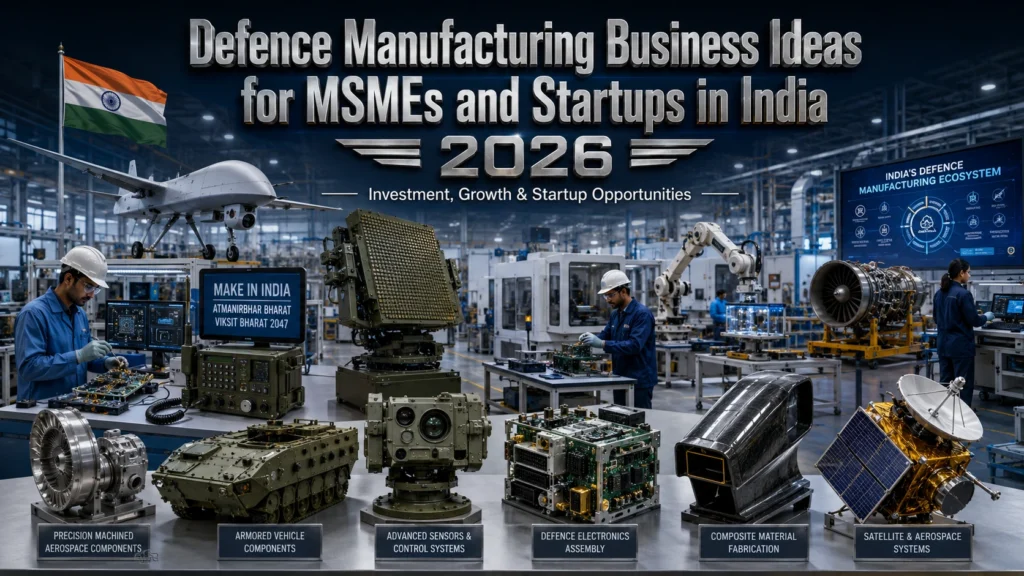

Defence Manufacturing Business Ideas in India 2026
India’s path of Defence is now different. Over the years, the country became the world’s biggest importer of arms. This is completely different now in New Delhi. During the National Defence Industries Conclave 2026, the Minister of State for Defence announced that MSMEs and startups have now become a key driver towards India becoming a global defence manufacturing hub. Businesses ideas which are available in this sector now, would have been unimaginable just 10 years ago. The Union Budget 2026–27 has allocated ₹7.85 lakh crore to defence, the highest ever, which is an increase of 15.19% year-on-year, according to the Ministry of Defence. The volume of Defence production has just touched new heights and the message to small manufacturers is loud and clear: The gates of one of India’s most protected industries have opened!
The Gap Nobody Talks About
The paradox at the core of India’s defence build-up. Large Defence Public Sector Undertakings (DPSUs) and a few big private companies seem to be in the news but they cannot do everything themselves. There are tens of thousands of parts in one fighter aircraft! From precision-machined valves and special cables to fasteners, castings, forgings, rubber gaskets and electronic sub-assemblies, all are necessary for a warship.
The DPSUs are supposed to do their business on the clear directive of the government to boost outsourcing to Indian vendors. In the meantime, thousands of items have been added to the Positive Indigenisation Lists and no longer can be imported into this country. The actual number of MSMEs working in the defence sector is about 16000 but the number of registered, qualified MSME vendors in defence sector is far less than the actual requirement, according to IBEF. That disparity is the opportunity.
Why 2026 Is the Inflection Point
Various forces have converged at one time and 2026 is the most apt time for MSME defence suppliers of India in the history of the country. Reflect on change:
- All-time high defence budget: The defence budget in the Union Budget 2026–27 is the highest ever, and approximately ₹1.39 lakh crore has been allocated for procurement from domestic industry only. Capital Acquisition funds are now mostly assigned to Indian companies with close to 75% of the budget dedicated to them.
- Indigenisation lists: Thousands of components and sub-systems are reserved for Indian manufacturers under the Positive Indigenisation Lists of the Ministry of Defence and DPSUs. More than 34,000 items are listed on the SRIJAN portal, of which over 10,000 have already been indigenised.
- iDEX grants: Startups and MSMEs working on defence prototypes can avail of a grant of not less than ₹1.5 crore under the SPARK scheme and up to ₹25 crore under the ADITI scheme from the iDEX (Innovations for Defence Excellence) framework. Up to 676 startups, MSMEs and innovators are part of the iDEX ecosystem as of early 2026.
- Defence corridors: Two dedicated Defence Industrial Corridors in Uttar Pradesh (Aligarh, Agra, Jhansi, Kanpur, Chitrakoot, Lucknow) and Tamil Nadu (Chennai, Coimbatore, Hosur, Salem, Tiruchirappalli) offer plug-and-play infrastructure, land incentives, and state subsidies.
- Defence exports have improved: India’s defence exports are estimated at a record ₹23,622 crore during FY 24–25, which is more than 34 times the figure in the previous decade. According to PIB, private players like MSMEs contributed to the increasing share of defence exports, and the number of defence exporters grew by 17.4% during a single year.
Related Article: India’s Defence Manufacturing Boom: A $15 Billion Opportunity for MSMEs and Startups
Entry Routes: Where a Small Manufacturer Fits
It is not necessary to create a missile in order to be in defence manufacturing. The realistic and practical entry points for an MSME or start-up are clearly defined:
- Tier-2/Tier-3 vendor: Register with the DPSUs like HAL, BEL, BDL, GRSE, Mazagon Dock and seven new corporatised ordnance units. Each has a vendor registration portal, as well as regular publications of outsourcing needs.
- Private prime supply chain: Provide parts for the large prime vendors like L&T, Tata Advanced Systems, Bharat Forge, Adani Defence, etc. who do their own prime assembly.
- Innovation route: Address problem statements from iDEX/ DISC with working prototype. Meaningful de-risking of the whole trip is achieved through grant support and guaranteed first customer – the military.
- Direct procurement: Items like Protective equipment, Drone Components, Batteries, Optics, Simulation Software, MRO consumables and Ground Support Equipment are being purchased through the GeM portal and defence tenders available for MSMEs.
These are all different risk/reward scenarios. Tier 2/Tier 3 vendor work is stable and repeat order. The innovation route will have higher margins and will provide IP ownership. The majority of successful MSME defense suppliers start their business with build to print vendor products and then move on to product development.
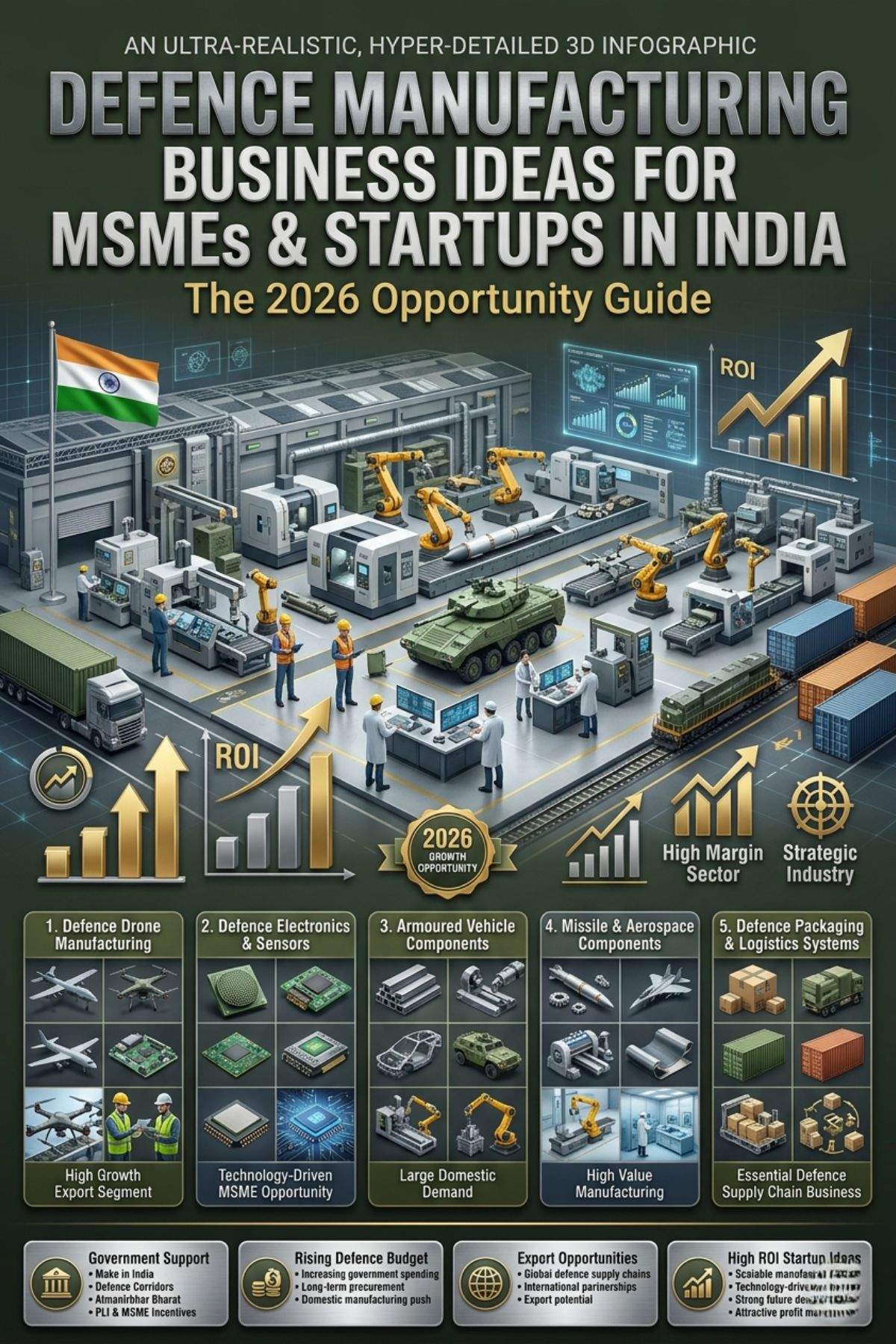
The high-potential ideas for businesses are the Products Segments for MSMEs.
The table below provides an overview of eight categories of products in which MSMEs can realistically and commercially participate. These are the best business concepts for engineers, electronics, chemicals or textile entrepreneurs:
| Product Segment | Why It Suits MSMEs | Indicative Investment |
| Precision machined components (CNC) | Recurring DPSU/prime orders; existing job-shops can upgrade | ₹1.5 – 5 crore |
| Cable harnesses & connectors | Labour-intensive, low capital; AS9100/defence specs achievable | ₹75 lakh – 2 crore |
| Drone frames, propellers & sub-systems | Fast-growing UAV ecosystem; iDEX-friendly | ₹1 – 4 crore |
| Rubber & polymer parts (seals, gaskets, mounts) | Indigenisation list items; moderate technology barrier | ₹1 – 3 crore |
| Defence-grade fasteners & springs | High-volume consumables across platforms | ₹1 – 2.5 crore |
| Ballistic protection & technical textiles | Body armour, helmets, camouflage nets; export demand | ₹2 – 6 crore |
| Batteries & power systems | Soldier systems, UAVs, communication sets | ₹2 – 8 crore |
| EMI/EMC shielding & enclosures | Electronics-heavy platforms need certified enclosures | ₹1.5 – 4 crore |
All items on this list are found on the government’s Positive Indigenisation Lists, thus encouraging import-substitution. In fact, Goldman Sachs estimates the earnings growth of private defence companies in India at a steady 32% from FY25 to FY28, with the very areas MSMEs cater to — exports and indigenisation — expected to perform the best.
Discover business ideas that actually make money
Step-by-Step Setup Guide for MSME Defence Entrepreneurs
Setting up a defence-oriented MSME unit requires more preparation than a typical industrial enterprise. However, the pathway is well-mapped. Follow these steps in order:
Step 1: Select Your Niche
Pick a product family aligned to your existing capability — machining, electronics, polymers, or textiles. Study the Positive Indigenisation Lists and SRIJAN portal carefully for matching items. Narrow focus accelerates vendor qualification.
Step 2: Formalise the Business
Register the enterprise on Udyam, obtain GST, and incorporate as an LLP or private limited company. Credibility with large primes and DPSUs depends heavily on the formal structure of your entity.
Step 3: Build Quality Systems
Defence work demands AS9100 (aerospace quality management), ISO 9001, and often NADCAP certification for special processes. Budget for quality systems from day one. Certifications are not an afterthought; they are the entry ticket.
Step 4: Apply for Vendor Registration
Apply for vendor registration with two or three DPSUs and at least two private primes simultaneously. The timelines typically run 6–12 months, so parallel applications save a full year of calendar time. Do not wait for one approval before starting another.
Step 5: Choose Your Location Strategically
Locate within or near a node of the Defence Industrial Corridor, if feasible. Capital subsidies by State governments, waiver on stamp duty and availability of common testing facilities, are significant. Existing occupied industrial parks are operational in both UP and TN corridors.
Step 6: Secure Finance
Use CGTMSE-backed collateral-free loans for plant and machinery. If your product involves meaningful innovation, iDEX grants can fund prototype development before a single rupee of revenue arrives. The SIDBI MSME financing schemes also offer targeted credit lines for manufacturing enterprises.
Step 7: Win Your First Order
Start with build-to-print orders (manufacturing to the buyer’s drawings). Establish a quality track record over the first 12–18 months, then progressively move toward build-to-spec work and, eventually, proprietary products with your own IP.
Get Detailed Insights from This Book: Our Books
Financial Snapshot: Model CNC Precision Components Unit
Let’s take an example to explain the economics of a real MSME defence supplier. Imagine a precision CNC machining unit in a DIC node:
| Parameter | Indicative Value |
| Land & building (leased, corridor node) | ₹40 lakh (deposit + fit-out) |
| Plant & machinery (3 CNC machines, CMM, tooling) | ₹2.4 crore |
| Quality systems & certification (AS9100) | ₹18 lakh |
| Working capital margin | ₹45 lakh |
| Total project cost | ₹3.4 crore (approx.) |
| Capacity utilisation (Year 3) | 70% |
| Expected revenue (Year 3) | ₹4.5 – 5.5 crore |
| EBITDA margin (steady state) | 18 – 24% |
| Break-even | Year 2 – 3 |
Note: Figures are indicative and for guidance only. Actual costs vary by location, machine configuration, and order mix. A bankable Detailed Project Report (DPR) is essential before committing capital. EBITDA margins in defence-grade machining tend to be structurally higher than commercial job-shop work because of the technical qualification barriers that limit competition.
Get Detailed Project Report (DPR): Project Reports & Profiles
How NPCS Can Help
With over 40 years in industrial consultancy and over 8,000 Detailed Project Reports (DPR) in its repository, Niir Project Consultancy Services (NPCS) helps budding and established entrepreneurs set up new or expand existing units in precision engineering & defense related manufacturing industries. NPCS offers complete project handholding, including techno-economic feasibility analysis and market research, to sourcing of plant & machinery and a bankable DPR ready for loan approval by banks & financial institutions. More project reports on CNC Machining, Technical Textiles, Drone components, Batteries and allied defense industries can be found at www.niir.org or www.entrepreneurindia.co.
Frequently asked questions
Q1. Can micro enterprises actually supply to the defense industry?
Yes. According to public procurement norms micro and small enterprises are given a priority and DPSUs have explicit MSME outsourcing goals. Typically, such enterprises enter as a tier-3 supplier providing simple machined or fabricated components, then they develop from this base.
Q2. Do I need an industrial license to manufacture components in the defense industry?
Only manufacturers of complete weapons systems, ammunition and other prescribed goods need to obtain an industrial license according to the Arms Act. However component and sub-assembly manufacturers do not generally need this. This is the exact reason the manufacture of components becomes a natural MSME entry point. There is minimal regulatory burden while the market for components is massive.
Q3. How soon can I expect my first order?
Realistically 12-24 months between setting up the venture and receiving the first order is expected. This period is necessary for vendor registration, samples’ approval and trial orders. The defense industry is a patient capital business, but when you are certified and qualified, the relationship tends to become stable, and the supply order duration long.
Q4. What is iDEX and who can apply?
IDEX is a program floated by the Ministry of Defence in order to support startups and MSMEs to build prototypes in response to stated problem-statements by armed forces, which it then funds. Grants of ranging from 1.5crore to 25 crore and a direct procurement pathway without tendering are made available if the project is deemed successful.
Q5. Which state is best for incentives in the defense industry MSME space?
Uttar Pradesh and Tamil Nadu have two Defense Industrial Corridors that both receive capital subsidy and shared infrastructure facilities. Nevertheless, Karnataka, Telangana, Maharashtra and Gujarat are not far behind with specific Aerospace and Defense policies. They offer favorable incentives and financial packages to interested investors.
Q6. Are working capital requirements a concern for defense suppliers?
It can be, given that payment terms from the government are usually 60-90 days. However, the MSMED Act includes specific clauses meant to aid MSMEs and TReDS invoice discounting mechanisms and CGTMSE collateralized credit lines can cover shortfalls. Careful consideration must be given to the working capital needs prior to receiving your first order.
The Window Is Open — But Not Forever
Defence modernization in India is not a one-time affair. It is a structural, multi-decadal transformation driven by the highest defence budget ever in Indian history and a policy framework explicitly aimed at drawing in MSMEs into the defence production ecosystem. The business ideas in defence manufacturing now-from precision CNC components and drone sub-systems to technical textiles-are tangible, commercially viable, and capitalised by government funds.
The twelve to twenty-four-month vendor qualification timelines mean that the right time to begin is now. Entrepreneurial ventures that will commence their formalisation, certification and vendor registration process in 2026 will likely receive their first defence orders when the highest volume of demand occurs within the current procurement cycle. Vendors who delay this process may find the easier to enter vendor slots already filled.
The gates are open. Will you choose to walk through them?