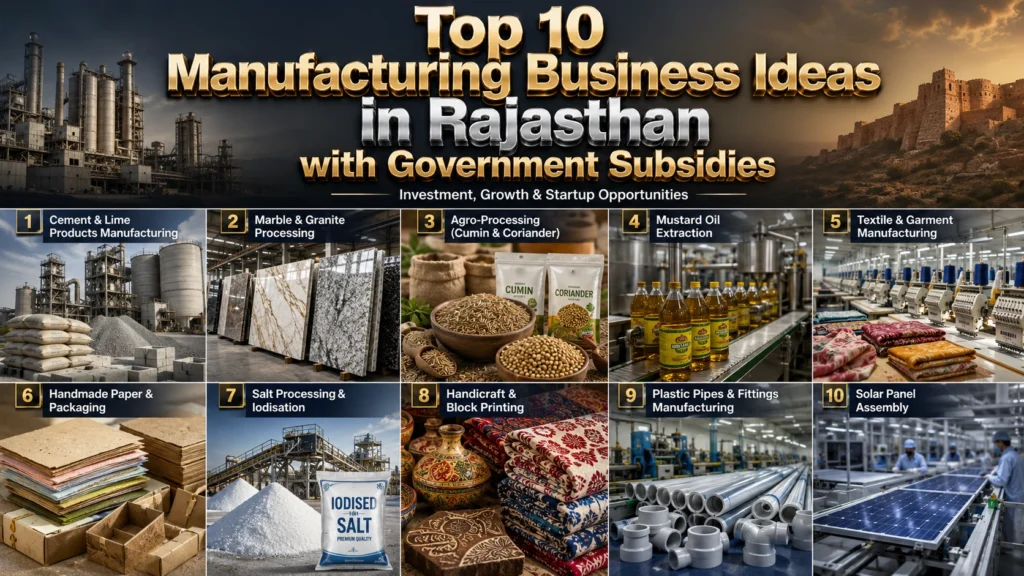

Manufacturing Business Ideas in Rajasthan
Rajasthan Manufactures More Than Marble — And Most Entrepreneurs Still Don’t Know It
About ₹10,000 crore are lost in the mineral-based manufacturing sector every year due to the lack of operational manufacturing units in less than 12% of the industrial plots registered with RIICO (Rajasthan State Industrial Development and Investment Corporation) in the state. This is not an indication of an absence of opportunity. It’s a lack of information.
The State accounts for 10.4 % of the total area of India, has the largest deposits of minerals after the State of Jharkhand and is the source of more than 90 % of the marble and emeralds in India. It is a source for the entire food processing chain of the country with its base of agriculture cumin, coriander, mustard, guar. In recent years, the Rajasthan government has been implementing the Industrial Incentive Schemes of the Rajasthan Investment Promotion Scheme (RIPS) that provide capital subsidy, power tariff relief, and stamp duty exemption to new manufacturing units.
For those who are first generation entrepreneurs, and want to start a business where they can manufacture more cost-efficiently with government grants, Rajasthan is one of the most underrated states of India to set up a business. In this article, the top 10 manufacturing enterprises that are available — now — where the raw material, the market demand, and the subsidy access is available are all there.
Get Detailed Project Report (DPR): Guide to Business Opportunities and Startup Projects in Rajasthan
The Supply Gap No One Talks About
The value of finished mineral products, processed agro commodities, and specialty textiles imported into India is more than ₹1.2 lakh crore per year, and this can be replaced by local production in raw material-rich states such as Rajasthan. Rajasthan’s contribution to the overall manufacturing GSDP of India is less than 5% as per the Department for Promotion of Industry and Internal Trade (DPIIT), which is significantly lower than what the dependence of mineral and agricultural base should be able to provide.
Try using processed cumin (jeera). Rajasthan and Gujarat account for more than 70% of world’s supply of cumin. However, the value-added cumin products (cleaned, graded, packaged and exported) are controlled by a few big processors. More than 60 percent of the cumin that leaves the Nagaur, Barmer and Pali districts of Rajasthan is still used as raw material without processing, thus foregoing processing margins. The situation is similar with marble also, Kishangarh has more than 3,000 traders for marble but less than 400 processing unit with proper CNC machine.
Another underutilized industry is textile. Rajasthan is a major cotton, wool and silk producing state with the bulk of the products being exported as raw fibre. The Rajasthan Small Industries Corporation (RSIC) has reported that textile and apparel exports in the state are under ₹8,000 crore per year, which is less than the export in Gujarat and Maharashtra, both of which are under ₹32,000 crore per year. Manufacturing facilities, skilled workforce and raw material available. What is lacking is an organized well-capitalised MSME processing unit.
TABLE 1: Top 10 Manufacturing Business Ideas in Rajasthan — Overview
| # | Business Idea | Investment (INR) | Govt Scheme | Net Margin |
| 1 | Cement & Lime Products | ₹40–80 lakh | PMEGP, MSME Rajasthan | 14–18% |
| 2 | Marble & Granite Processing | ₹25–60 lakh | RIPS, MSME Clusters | 20–28% |
| 3 | Agro-Processing (Cumin/Coriander) | ₹15–35 lakh | PMEGP, SFURTI | 18–24% |
| 4 | Mustard Oil Extraction | ₹12–30 lakh | PMEGP, MUDRA | 16–22% |
| 5 | Textile & Garment Manufacturing | ₹20–50 lakh | PLI Textiles, ASPIRE | 15–20% |
| 6 | Handmade Paper & Packaging | ₹10–25 lakh | SFURTI, PMEGP | 22–30% |
| 7 | Salt Processing & Iodisation | ₹8–20 lakh | PMEGP, NSIC | 18–25% |
| 8 | Handicraft & Block Printing | ₹5–15 lakh | SFURTI, Stand-Up India | 25–35% |
| 9 | Plastic Pipes & Fittings | ₹35–75 lakh | CGTMSE, RIPS | 14–20% |
| 10 | Solar Panel Assembly | ₹50 lakh–1.2 cr | PLI Solar, KUSUM | 12–18% |
Source: Ministry of MSME (msme.gov.in), RIICO Industrial Data, Entrepreneur India Research
Get Detailed Insights from This Book: Solar PV Power and Solar Products Handbook
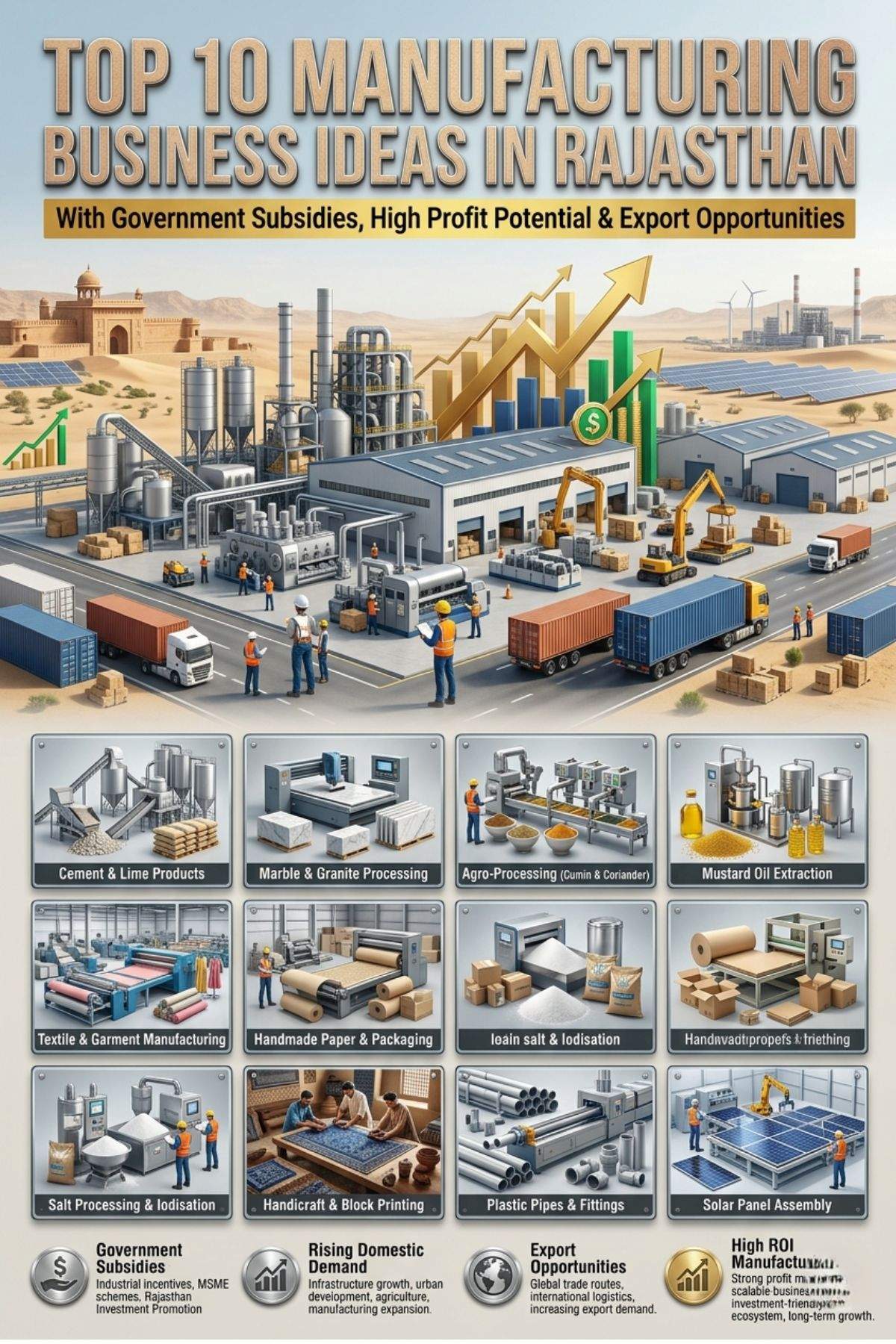
Why This Is the Right Window to Enter
There are three policy changes right now which are creating good tailwinds for the first time manufacturers in Rajasthan.
The first step is that the Production Linked Incentive (PLI) Scheme is being expanded to 14 sectors including textiles, food processing, and solar PV. The PLI is tiered and thus provides 4-6% on incremental sales for the next 5 years for the small manufacturers having investment ranging from ₹50 lakh to ₹2 crore.
Second, the industrial policy of the State of Rajasthan, called ‘Rajasthan Industrial Policy (RIPS)’ has been updated to focus on MSME clusters in Tier-2 and Tier-3 towns in the State. In some districts such as Jodhpur, Bikaner, Ajmer, Kota etc., industrial areas have been identified with pre-laying of infrastructure facilities which cuts the infrastructure cost by 20-30% for the new industrial units as compared to the greenfield industrial set up in non-notified areas.
Third, Khadi and Village Industries Commission (KVIC), under the control of the central government provides capital subsidy of 25-35% for manufacturing units with project cost up to ₹25 lakh. The subsidy is increased to 35% for SC/ST/women entrepreneurs or rural units. PMEGP is open to first-time business founders, as they don’t have to have experience in a business for it.
There are other schemes that are relevant, such as MUDRA (collateral-free loans up to ₹50 lakh under the Tarun category), CGTMSE (credit guarantee for loans up to ₹2 crore without collateral), SFURTI (cluster development grants for rural artisan and agro-processing units), and Stand-Up India (bank loans of ₹10 lakh to ₹1 crore for SC/ST and women entrepreneurs starting their first manufacturing venture).
How to Set Up a Manufacturing Unit in Rajasthan: Step-by-Step
The following is an explanation of the set-up guide, covering the case of a processing unit that uses marbles as a product, which is one of the most easily accessible and high return manufacturing entries in Rajasthan. The process broadly applies to agro-processing and mineral-based manufacturing as well.
Step 1 — Business Registration and Licences
- Apply for Udyam Registration (required for MSME registration and subsidy eligibility) at udyamregistration.gov.in (free and completed within 24 hours).
- GST Registration — It applies when the turnover is more than ₹40 lakh (₹20 lakh in case of services).
- Factory Licence — Must be obtained under the Factories Act if over 10 workers with power or 20 workers without. Fill an application with the Rajasthan Labour Department.
- Pollution Control NOC — from Rajasthan State Pollution Control Board (RSPCB). Small scale processing of marble and agro-processing industries get clearance within 30-45 days.
- In the cement, electricity, and some food products, BIS certification is required. Does not have to be used for marble processing or garments.
- FSSAI Licence — mandatory for any agro-processing, food manufacturing, or packaging unit.
Step 2 — Land and Infrastructure
The minimum space requirements for a small stone processing unit are 2,000-3,000 square feet of covered shed and 5,000 square feet of open yard for stone storage and loading. RIICO industrial plots in Kishangarh and Jodhpur are priced at ₹900 to ₹1800 per sq ft and renting an already established industrial shed is also an economical choice for the initial 18-24 months.
Step 3 — Machinery and Equipment
- Marble slab cutting machine: Gang Saw / Bridge Saw (for cutting marble slabs) – ₹4-12 lakh (depending on capacity)
- Marble Polishing Machine (Auto/Semi Auto): ₹3-8 lakh
- Material handling equipment (trolleys, cranes): ₹1.5-3 lakh
- Power back up (generator): ₹1–2 lakh
Agro processing machinery for cleaning, grading and packing cumin or coriander, and automatic packing machine; core machinery — ₹10 to 22 lakh from the suppliers in Rajkot, Gujarat and Coimbatore, Tamil Nadu.
Step 4 — Raw Material Sourcing and Team
The marble blocks are directly obtained from the marble mining belts of Makrana, Rajsamand and Udaipur.Marble blocks are sourced directly from the marble mining belts of Makrana, Rajsamand and Udaipur, which are the three main marble mining belts in India. Cumin is bought at the mandis of Nagaur and Jodhpur. A typical start-up team for either unit will consist of 6-10 workers, one quality supervisor and one sales/accounts person.
Step 5 — Timeline from Registration to First Production
- Month 1: Company/proprietorship registration, Udyam, GST, bank account
- Month 2–3: Site finalisation, Pollution NOC, bank loan application
- Month 3–4: Machinery procurement, civil work
- Month 5: Trial production, workforce training
- Month 6: Commercial production begins
Discover business ideas that actually make money
TABLE 2: Investment Breakdown — Marble Processing Unit (Representative Case)
| Cost Head | Small Unit | Medium Unit | % of Total |
| Land & Civil Construction | ₹6,00,000 | ₹14,00,000 | 12–18% |
| Cutting & Polishing Machinery | ₹12,00,000 | ₹28,00,000 | 30–35% |
| Material Handling Equipment | ₹3,00,000 | ₹7,00,000 | 8–10% |
| Electrical & Utility Setup | ₹2,00,000 | ₹5,00,000 | 6–8% |
| Working Capital (3 months) | ₹5,00,000 | ₹12,00,000 | 15–18% |
| Pre-op Expenses / Contingency | ₹2,00,000 | ₹4,00,000 | 5–7% |
| TOTAL | ₹30,00,000 | ₹70,00,000 | 100% |
Source: NPCS Project Reports, RIICO Industrial Data, Primary Market Research
ENTREPRENEUR SPOTLIGHT
Ramesh Lal Sharma, Marble Processing Unit in Kishangarh, Rajasthan
Ramesh had invested ₹28 lakh in the small unit of processing marble slabs in Kishangarh, the stone capital of Asia, and had availed a subsidy of ₹7 lakh from PMEGP. In four years, he managed to achieve an annual turnover of ₹1.8 crore and became a supplier of cut-to-size marble to builders in cities such as Bengaluru, Delhi and Mumbai. One thing he learned, don’t strive for variety at the start of your business — learn the one product size, one quality grade, and one reliable buyer. He says that is what separated the men from the boys and distinguished him from the dead in Year 1 and enabled him to build a business.
Financial Snapshot: What the Numbers Actually Look Like
The figures hereunder have been taken from the medium size marble processing unit having total investment of ₹50 lakh in Kishangarh or Rajsamand. The return profile of agro-processing units at ₹25 lakh scale is similar.
- Capital Expenditure (CapEx): ₹30-70 lakh for the size of the unit and the specifications of the machinery
- Monthly Operating Cost: ₹3.5–6 lakh (raw material 55%, wages 20%, power 12%, overheads 13%)
- Sales at 60% capacity, revenue from ₹8 to 12 lakh per month
- Revenue at 100% capacity: ₹14–22 lakh/month
- Gross Margin: 38-45% (marble processing); 30-38% (agro-processing)
- Net Margin: 18-28% at full capacity after debt service
- Payback Period: 2.5–4 years for units that have PMEGP subsidy absorbed
These estimates are based on the prevailing market prices monitored by Agricultural & Processed Food Products Export Development Authority (APEDA) for agro-processing units and market bulletins published by Rajasthan Minerals Limited for stone-based units. When direct export contracts or B2B contracts are set up in the first year of operation, margins improve significantly.
Related Article: Top Mineral-Based Business Opportunities in Rajasthan: Cement, Zinc & Fertilizer Investment Guide
TABLE 3: Government Schemes Available for Rajasthan Manufacturing Units
| Scheme | Nodal Agency | Loan/Grant Limit | Key Benefit | Eligibility |
| PMEGP | Ministry of MSME | Up to ₹25 lakh | 25–35% subsidy on project cost | Individuals, SHGs, institutions |
| MUDRA – Tarun | Ministry of Finance | ₹10–50 lakh | Collateral-free term loan | Micro enterprises |
| CGTMSE | SIDBI + Govt of India | Up to ₹2 crore | Credit guarantee, no collateral | MSMEs, women entrepreneurs |
| RIPS (Rajasthan) | RIICO / State Govt | Project-based | Capital subsidy 5–7%, power tariff relief | Industries in notified zones |
| PLI – Textiles | Ministry of Textiles | ₹10 cr minimum | 4–6% incentive on incremental sales | MMF/technical textile units |
| SFURTI | Ministry of MSME | ₹10 lakh–3 cr | Cluster dev. grant for artisans & agro | Rural clusters, SC/ST enterprises |
| Stand-Up India | SIDBI | ₹10 lakh–1 cr | Bank loan for SC/ST/women greenfield | First-time entrepreneurs |
Source: Ministry of MSME (msme.gov.in), SIDBI, KVIC (kvic.gov.in), Ministry of Finance
Where to Get the Project Report and Feasibility Study
One of the oldest plant consultancy services in India, Niir Project Consultancy Services (NPCS) is very popular among entrepreneurs for providing them with detailed financial, plant layout, list of machinery vendors and techno-economic feasibility studies before they approach a bank or apply for loan under PMEGP/CGTMSE. NPCS is a repository of Detailed Project Reports (DPRs) in over 45 years of project advisory background on diverse manufacturing projects from the mineral processing to agro-based projects, textiles, chemicals, renewable energy etc. that typically banks and government scheme administrators need. Their reports can be found at the website niir.org and business opportunity guides and feasibility frames for first time entrepreneurs can be made accessible through Entrepreneur India. NPCS has project reports with input cost data specific to Rajasthan for the following manufacturing industries: Marble and Granite Processing, Spice Processing, Textile Manufacturing and Mineral based products.
The Decision in Front of You
The manufacturing opportunity in Rajasthan is not “theoretical” but real. The raw materials are mined here. The mandis are in use. The RIICO plots are in existence. The PMEGP subsidy is available, but it’s not for the person who waits for the perfect opportunity, it’s for the person who applies.
This is the one thing you should do this week: narrow down the list of manufacturing ideas, eliminating two ideas that do not agree with your location, capital access and your previous experience. Next, get the detailed project reports from niir.org for each or have a custom feasibility study prepared by NPCS. Bring the documents to the nearest bank or KVIC district office and start the PMEGP pre-screening process. The window of opportunity is wide open. Plots are available in the industrial areas. The next great manufacturing success story is not a coincidence, it’s a choice.
Frequently Asked Questions (FAQ)
Q1: What’s the minimum amount I need to start a manufacturing unit in Rajasthan?
For small scale projects like salt processing, handmade paper, or cumin cleaning, a minimum practical investment would be 8-15 Lakh. For larger scale units like marble processing or plastic pipes it would be around 25-50 Lakh. Under PMEGP, units costing up to 25Lakh are eligible for a 25-35% capital subsidy which could effectively reduce your own equity to 5-10% of the total project cost.
Q2: Which licenses are essential before I can begin production?
As a minimum you would need Udyam Registration (for MSME status), GST Registration, Pollution Control NOC from RSPCB and Factory License from Rajasthan Labour Dept (if employing more than 10 laborers). Food & agro-processing units would also need FSSAI License and certain specific product types require BIS certification like cement, electrical fittings, etc. All of these would take an average of 45-60 days to procure provided the required documents are in order.
Q3: Where can I find local raw materials in Rajasthan?
Marble & granite would be directly sourced from the stone quarrying sites at Makrana, Rajsamand & Udaipur (for white, pink, and green marble respectively). Cumin & coriander frommandiesat Nagaur, Jodhpur & Barmer, mustard from NAFED accredited mandies in Alwar, Bharatpur & Kota, and salt from the Sambhar Lake. Raw wool would be procured from Bikaner & Jaisalmer and cotton from Hanumangarh for the textile industries.
Q4: Are the mentioned profit margins for each segment reliable?
Yes, the margins for marble processing (18-28% net) and agro-processing (16-24%) at 80-100% utilization is attainable by the second or third year of operations based on current input costs and wholesale prices. If there are direct relationships established between you and buyers such as construction companies, export agents, food companies etc, margins are much higher compared to that of middle agents. Good working capital management, minimizing overstockage would be the key deciding factor in reaching these margins.
Q5: Which government scheme is most easily available to first-time Rajasthan manufacturers?
The most readily available government scheme for a first-time manufacturer in Rajasthan is PMEGP which has no prior business experience or collaterals for loans up to 25Lakh and can be applied from your nearest KVIC district office or online from kviconline.gov.in. CGTMSE offers credit guarantee cover on bank loans (for projects 25Lakh to 2 Crore) allowing it to be secured without collaterals while RIPS (Rajasthan Investment Promotion Scheme) offers further capital subsidies and power tariff concessions on projects set up in defined industrial zones. This would require your unit to be registered as an industrial unit. Check eligibility on industries.rajasthan.gov.in.
Q6: Can NPCS help me create a project report for submission to the bank?
NPCS (NIIR Project Consultancy Services) provides all necessary ready-to-use Detailed Project Reports (DPRs) that can be used for loan and subsidy purposes in all segments like Marble processing, agro processing, minerals and textiles, containing details such as plant capacity, machinery with prices from suppliers, site plan, Raw materials consumed, financial forecast and ROI analysis. These are accepted at nationalised banks, SIDBI, SFC’s, and KVIC offices. You can select from available reports on niir.org or request for a custom DPR. For further queries call 106-E, Kamla Nagar, New Delhi.