
5 Green Chemical Business Ideas in Odisha That Can Generate ₹2 Cr+/Year
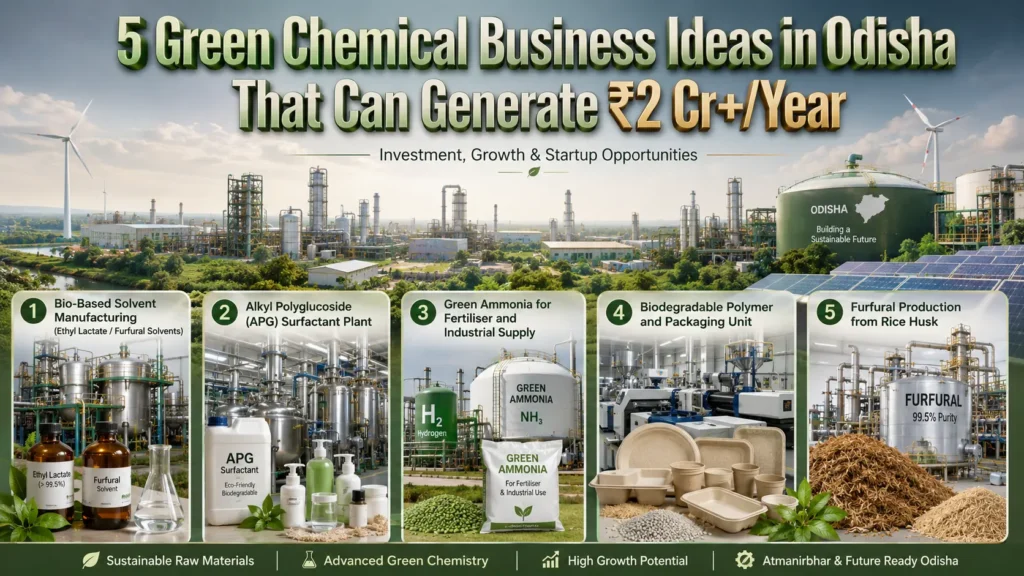
Green Chemical Business in Odisha The Green Chemistry Opportunity India Cannot Afford to Miss The size of India’s green chemicals market is now over USD 15 billion and it’s expanding by more than 10% annually. However, most chemical business owners are still trying to find a business concept that involves the same sort of products that were created 30 years ago. That is a big error! Green chemistry—biodegradable, bio-based and low-carbon specialty chemicals—is the next 10 years of Indian specialty chemicals, consumer demand and preference, and regulatory requirements of global buyers. The advantage that Odisha, which is located on a world class port, huge agricultural biomass and has a government supported petrochemical anchor at Paradip, is unparalleled in the eastern part of the country. There is no question about the growth of the green chemicals market. But who will construct it first? Why Green Chemicals — and Why Odisha? Sustainability is a hard trend. It is difficult to do this as a hard rule. Bio content for cleaning and personal care products is required for all products sold in 27 EU countries under European Union’s Green Deal requirements. Methanol and ammonia are being replaced with green alternatives by shipping lines. Exporters of pharmaceuticals to the US FDA and EMA are increasingly being encouraged to use bio-based solvents as a result of the laws and regulations concerning solvent usage in India. As the laws and regulations pertaining to solvent usage in India are moving more towards bio-based solvents, the pharmaceutical exporters are increasingly encouraged to use it for export to US FDA and EMA. All Indian manufacturers have to go green otherwise they have to lose the business in these markets. Among the three, Odisha has three attributes, which make it uniquely suited for green chemical manufacturing. The first plant, Indian Oil Paradip Petrochemical Complex, will manufacture all the key intermediates used in green formulation chemistry (IPA, phenol, MEG) with an investment of ₹61,077 crore. Second, the rice husk and agricultural biomass produced in Odisha is in millions of tonnes each year, which is the raw material for making bio-based chemicals. Third, Paradip Port has been officially named one of the three Green Hydrogen Hubs under the National Green Hydrogen Mission, which provides a policy and infrastructure benefit that no landlocked port can offer. Source: Invest India – Chemicals Sector Get Detailed Insights from This Book: The Complete Book on Biomass Based Products (Biochemicals, Biofuels, Activated Carbon) Government Policies Supporting Green Chemical Manufacturing The Union Budget has specifically provided money for the Ministry of Chemicals and Fertilizers. It has also launched three chemical parks based on clusters on a plug-and-play basis, which were developed specifically to boost specialty and green chemical manufacturing. Furthermore, the PCPIR policy in Paradip provides shared effluent, power and jetty facilities, and this significantly decreases the project setup costs. The National Green Hydrogen Mission (NGHM) offers financial incentives and financial grants to the manufacturers of green ammonia and green methanol. The SIGHT Scheme provides government offtake guarantees which lowers the risk of the revenue stream for the green chemical projects of the first movers. Another positive lever is the Production Linked Incentive (PLI) scheme for specialty chemicals. Moreover, the MSME and Large Industry policy of Odisha also offers capital subsidy of 15–25%, duty waiver on electricity for 5 years and exemption from stamp duty for qualified manufacturing unit. Source: DPIIT – PCPIR Policy Framework Source: MNRE – National Green Hydrogen Mission Green Chemical Business Ideas for Startups in Odisha Business Idea 1: Bio-Based Solvent Manufacturing (Ethyl Lactate / Furfural Solvents) VOC regulations, and buyer demand, are driving the replacement of toluene, xylene, and methyl ethyl ketone in pharmaceuticals, coatings, electronics cleaning and more with bio-based solvents. The one green solvent in this category that is most versatile is ethyl lactate which is made from lactic acid and ethanol. A small-scale ethyl lactate manufacturing plant in Odisha, using locally available broken rice to produce lactic acid and then esterifying it with bio-ethanol, could generate income of ₹80-250 per kg of ethyl lactate, whereas petro-chemical based ethyl lactate can generate income of only ₹25-35 per kg. The Paradip Pharma cluster is an indigenous buyer. The export potential for such solvents to Europe—the region where these solvents are required for pharmaceutical production — is significant. The investment required for setup is in the range of ₹15 crore to ₹50 crore, depending on the scale. Related Article: Bio-Based Chemical Business Idea: Furfural Plant Cost, Profit and Market Demand in India Business Idea 2: Alkyl Polyglucoside (APG) Surfactant Plant APG surfactants are bio-based; they are made from glucose and fatty alcohols. They’re the highest quality in personal care products – baby shampoos, personal luxury products hand washes, and sulphite-free products. They are 100% biodegradable and can be used under EU Ecolabel. There are no major APG production units in the East India. A manufacturer setting up an APG unit at or close to the port of Paradip has direct access to fatty alcohol through coastal shipping from Tamil Nadu, Andhra Pradesh and to glucose from the starch industry in Odisha. APG is priced 40-80% higher than “traditional” surfactants, and European personal care companies continue to demand it steadily making this one of the highest margin green chemical business opportunities in the country today. Capital requirement: ₹30–100 crore. Business Idea 3: Green Ammonia for Fertiliser and Industrial Supply ACME Group has already pledged a green methanol plant of capacity 200,000 TPA in Odisha. SECI will also provide ACME with 370,000 MT per year green ammonia supply under an 10-year offtake agreement to Indian fertiliser companies through its SIGHT Scheme. This indicates that the infrastructure for green ammonia offtake in Odisha is already in place. For the entrepreneur who is looking to enter this area at a smaller level of 20,000 to 100,000 TPA, the opportunities include the industrial refrigeration market, ammonium nitrate for mining chemicals, specialty nitrogen applications for agriculture, etc. By designating the port as a green hydrogen hub, it ensures
Microbial Inoculants Market 2026: Global Size, Growth Drivers, and Investment Opportunities for MSMEs
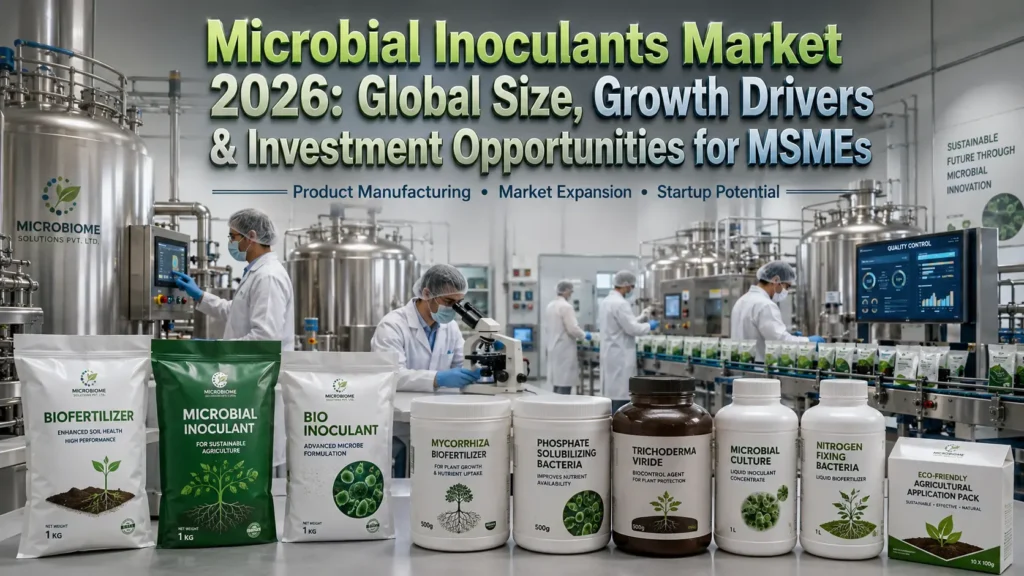
Microbial Inoculants Manufacturing Business in India The global agricultural system is changing in its very foundations from a synthetic chemical dependence to an agriculture with active organic and biologically sustainable crop nutrition. Microbial inoculants are at the heart of the transition. They are seed treatments or root dips based on live beneficial microorganisms (bacteria, fungi or mixtures) that improve nutrient uptake, stimulate root growth, inhibit pathogens in the soil and can decrease by more than 50% the need for chemical fertilizers. Microbial inoculants are one of the most commercially interesting and technically achievable verticals in the agri-input business for potential investors or first-generation entrepreneurs. It’s evolved from a specialty agronomic technique into a multi-billion-dollar worldwide business. Market intelligence for the 2021-2032 forecast period predicts that global production value of microbial inoculants will be steeply rising, as a result of regulatory pressure to use fewer chemicals, increases in organic farms and deeper understanding of how soil microbiome’s function. Soil biodiversity is a key element for sustainable agricultural systems, as constantly emphasized by the Food and Agriculture Organization (FAO), thereby directly supporting the commercial rationale behind the use of microbial inoculants worldwide. This market can be divided into three segments: bacterial inoculants, fungal inoculants, and composite inoculants. They are each used for different agronomic purposes. The most commercially mature segment is based on the use of bacterial inoculants, such as legume rhizobium, Azospirillum, Bacillus and Pseudomonas strains in legume and cereal production. Mycorrhizal fungi-based fungal inoculants are becoming very popular in specialty horticulture and high value vegetable crops. The fastest growth product type is composite inoculants containing multiple microbial species with multi-functional agronomic benefits in a single product. Related Article: 5 Smart Food Manufacturing Business Ideas That Can Generate ₹50 Lakh/Year in India Competitive Landscape: Who Dominates the Global Microbial Inoculants Industry? The global microbial inoculants market is moderately fragmented at the tier-1 level and a few multi-national companies have their production volumes and distribution network. The key players are Bayer, DuPont, Novozymes, BASF, Monsanto (now a part of the crop science division of Bayer), Becker Underwood, Premier Tech, Verdesian Life Sciences, Advanced Biological, GreenMax AgroTech, MBFi, Compost Junkie and EMNZ. These companies make up a major portion of value of global output for the 2021-2026 base period. Novozymes is a world-leader in industrial and agricultural biologicals with large-scale fermentation facilities and a huge strain portfolio. Biologicals are a key part of Bayer’s expansion strategy, which has been aggressive in the field through strategic acquisitions. BASF’s biologicals business has focused its R&D efforts on building its pipeline of next generation inoculant formulations that have longer shelf life. Premier Tech and Becker Underwood have established competitive moats based on proprietary peat-based and liquid carrier technologies that deliver superior microbial viability across the range of climatic conditions. Table 1: Global Microbial Inoculants — Key Player Market Positioning (Illustrative Tier Structure) Tier Representative Players Estimated Market Share Core Strength Tier 1 Bayer, Novozymes, BASF, DuPont ~55–60% Global scale, diversified strain portfolio Tier 2 Premier Tech, Becker Underwood, Verdesian Life Sciences ~20–25% Specialty formulations, regional expertise Tier 3 Advanced Biological, GreenMax AgroTech, MBFi, EMNZ, Compost Junkie ~15–20% Niche products, emerging markets, local distribution Source: Global Microbial Inoculants Market Report, 2026 | Compiled by Research Division Strategic alliances such as mergers and acquisitions and joint ventures are becoming more significant in the competitive landscape. The acquisition of several tier-2 and tier-3 players by bigger agri-chemical players to expand their biological’s portfolio is an example of the changing landscape of ‘chemical-to-bio’ shift in crop protection and crop nutrition. The top consolidation results in white space for new market entrants in different regional, customised and organic product segments. Regional Production Dynamics and the India Opportunity Historically, North America and Europe have been the largest producers of microbial inoculants, primarily due to the presence of well-developed biotechnology sectors, higher levels of funding for microbial inoculants research and development, and favorable government policies for biologically derived crop inputs. But the growth frontier is clearly Asia Pacific, Latin America and Sub Saharan Africa – where smallholder farmer density is highest and dependence on costly synthetic fertilisers is the greatest, where the need for more affordable biological alternatives can be seen. India has a special role to play in this regional narrative. The Government of India has prioritised the use of biofertilisers and microbial inoculants as policy instruments because of the huge subsidy burden associated with chemical fertilisers in the country, estimated to be in the tens of thousands of crores per annum. The Ministry of Agriculture & Farmers Welfare has actively promoted the use of biofertiliser with the introduction of National Mission for Sustainable Agriculture (NMSA) and Paramparagat Krishi Vikas Yojana (PKVY). The Fertiliser Control Order (FCO), which sets the standards for the biofertiliser quality, has been continuously modified to include more microbial strains as a signal for regulatory thinking for manufacturers and investors in their product go-to-market strategies. The production of domestic microbial inoculants has increased in India, but it is still far below the market demand as estimated by the cultivated area and the government’s emphasis on integrated nutrient management efforts in the country. Based on industry estimates, less than 15% of the total Indian farmland that consumes fertiliser is using any microbial inoculant/biofertiliser and this translates to more than 85% addressable market. Application Segments: Cereals, Oil Crops, Fruits & Vegetables The microbial inoculants are used in four main crop groups – cereals, oil crops, fruits and vegetables, and others (which includes pulses, legumes, fodder crops and plantation crops). The growth curve of each segment is different with its own agronomic needs. 1 Cereals — The Volume Segment The volume of application of cereals (wheat, rice, maize and sorghum) is the biggest. Even marginal use of microbial inoculants is a huge tonnage of marketable cereal. The workhorses here are the Azospirillum and Bacillus based inoculants which stimulate nitrogen fixation, phosphate solubilisation, and the production of growth hormones which are measurable and result in increased yields. The cereal segment is