
Products from Rice Husk and Rice Husk Ash: Business Ideas, Manufacturing Process, and Project Opportunities
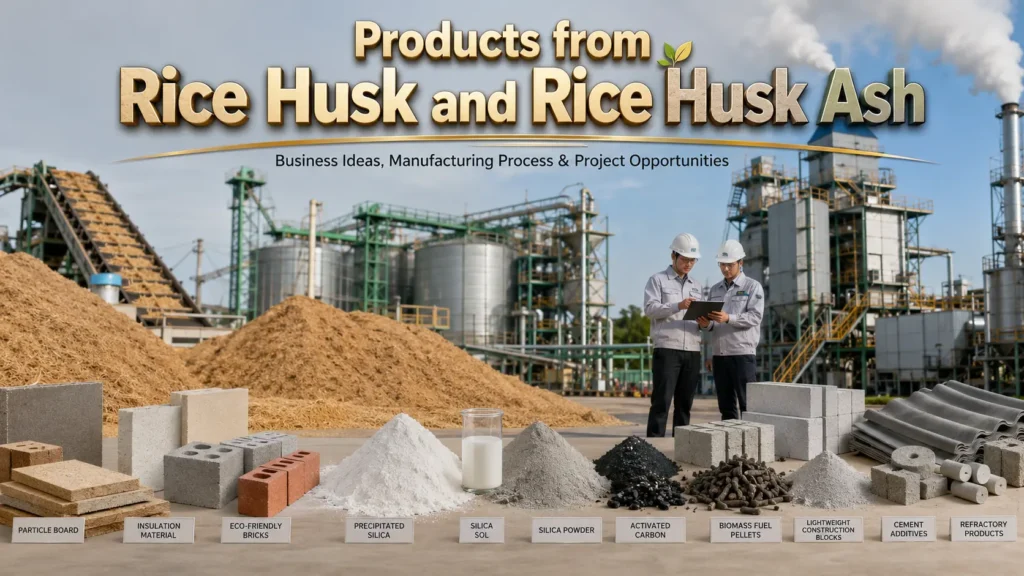
Rice Husk Products Business Ideas Why Rice Husk Is One of India’s Most Undervalued Industrial Raw Materials The one thing that most business people fail to consider when they start a business based on agricultural waste is that the raw materials are nearly free. Rice husk, the sheathing of paddy is just such an opportunity. India is the second largest rice producer, producing around 12 million tonnes of rice husk as a by-product of the milling process every year. Most of this husk was used as fuel for boiler generation of steam in rice mills until recently, but was accompanied by particulate pollution. What entrepreneurs are finding is that rice husk is not only a fuel, but also a chemical feedstock, construction material, and an industrial input that is much more valuable than its fuel value. Rice husk is about 20% silica in a highly amorphous and reactive form. Ash from the controlled combustion known as Rice Husk Ash (RHA) is about 85-92% amorphous silica. This silica is used as a raw material in the production of precipitated silica, sodium silicate, activated carbon, cement additives and refractory materials. The business is real and proven and can be done by the MSME entrepreneurs with an understanding of the processing. Get Detailed Insights from This Book: Manufacture of Value Added Products from Rice Husk (Hull) and Rice Husk Ash (RHA) Top 10 Products from Rice Husk and Rice Husk Ash 1. Precipitated Silica Precipitated silica is produced by reacting RHA with caustic soda to produce sodium silicate solution, and then precipitating silica by acidification with sulphuric acid. The white powder produced is used as a rubber tyre reinforcement, a flow aid in toothpaste, an anti-caking agent in animal feed and a tablet excipient in pharmaceuticals. India is now importing so many materials from China and Germany. The cost of a 5 TPD unit is Rs. The investment requirement for this is about 80 lakh to 150 lakh and has the potential to create Rs. The annual net profit lies in the range of 40-60 lakh at market price of Rs. 35,000–70,000 per tonne depending on grade. 2. Sodium Silicate (Water Glass) Sodium silicate can be obtained by melting RHA with soda ash at high temperature or by dissolving RHA in caustic soda at high pressure. It is used for making detergents, paper adhesives, foundry core binding, textile processing and water treatment. There is a big domestic market in India. In the case of a 10 TPD plant, the investment costs are: 30–80 lakh. It is easy to process and there is a reliable industrial buyer base for the product. 3. Activated Carbon Rice husk activated carbon is obtained when the rice husks are carbonised at 500-700°C and then activated with steam or CO₂ at 800-950°C. Surface areas of 800-1200 m2/g are used for water purification, air filtration, decolourisation in pharmaceuticals, food processing and gold recovery. The cost of a 3 TPD unit is around Rs. Investment required is 60 to 120 lakh and the revenues earned are Rs. Depending on application grade between 50000 and 1,50,000 per tonne. 4. Rice Husk Particle Board Particle board is made from rice husk, Urea Formaldehyde or isocyanate binders and is hot pressed into panels that are used for furniture, partition and low-cost housing. The boards have termite resistance and moisture stability. The cost of a 5,000 m³/year plant is Rs. 1.5–3 crore. Clients are furniture makers, government housing schemes, interior fit out companies etc. Get Detailed Project Report (DPR): Rice Husk, Rice Hull, Rice Husk Ash (Agricultural Waste) Based Projects 5. Rice Husk Briquettes and Pellets The biomass fuel of dense quality with calorific value of 3200 – 3600 kcal/kg is produced by compressing the rice husks under high pressure, without using binders. These briquettes are used in industrial boilers of the food processing, textile, ceramic and brick industries as an alternative to coal. Investment: Rs. 25–60 lakh. Renewable energy requirements around the world are increasing, and so are European and South Korean demands on biomass fuel exports. 6. RHA as Cement Pozzolan The rice husk ash contains a large amount of amorphous silica ash, which has excellent pozzolanic activity, when the rice husk is burned at 600–700°C. RHA can be used as a substitute for 10 – 25% of the Portland cement used in concrete, enhancing durability and reducing carbon footprint. As per contract, RHA is supplied to cement companies at the rate of for 2,000-5,000 per tonne, only investment for collection and quality control is required. It is a low-cost product with 10 to 25 lakh customers and low processing cost. 7. Refractory Products High-silica RHA used in the refractory bricks and castable for industrial furnace, which has high resistance to temperature above 1,600℃, is suitable for steel ladles, foundry furnaces, ceramic kilns, etc. The niche, higher margin product is well-balanced with an industrial buyer base. The price of a small refractory unit begins at Rs. 50–100 lakh. 8. Oxalic Acid Rice husk cellulose is treated with alkaline water at high temperature and pressure to produce oxalic acid which is further acidified to produce oxalic acid. Currently it is imported for use in the textile industry, in leather manufacturing and in the synthesis of pharmaceuticals as well as in metal surfaces. The cost of a 2 TPD unit is Rs. 40–80 lakh. RHA is a cost competitive alternative to imported production. 9. Silicon Metal (Advanced Application) High-temperature carbothermic reduction is being used commercially to provide a source of high purity silicon for electronic and solar cell applications for RHA. India and abroad there are several pilot and commercial plants. This requires a lot of capital (Rs.). The selling price of silicon metal is Rs. 10 lakh – 50 lakhs (10 – 50 crore). The rice husk has the highest value-addition of Rs 1.5–3 lakh per tonne. Discover business ideas that actually make money 10. Cellulosic Ethanol (2G Biofuel) Rice husk is rich in cellulose (35-40%) and hemicellulose (25-30%) which can be fermented
How to Start a Crumb Rubber Powder Plant: ₹1.5 Crore Investment, ₹6 Crore Revenue
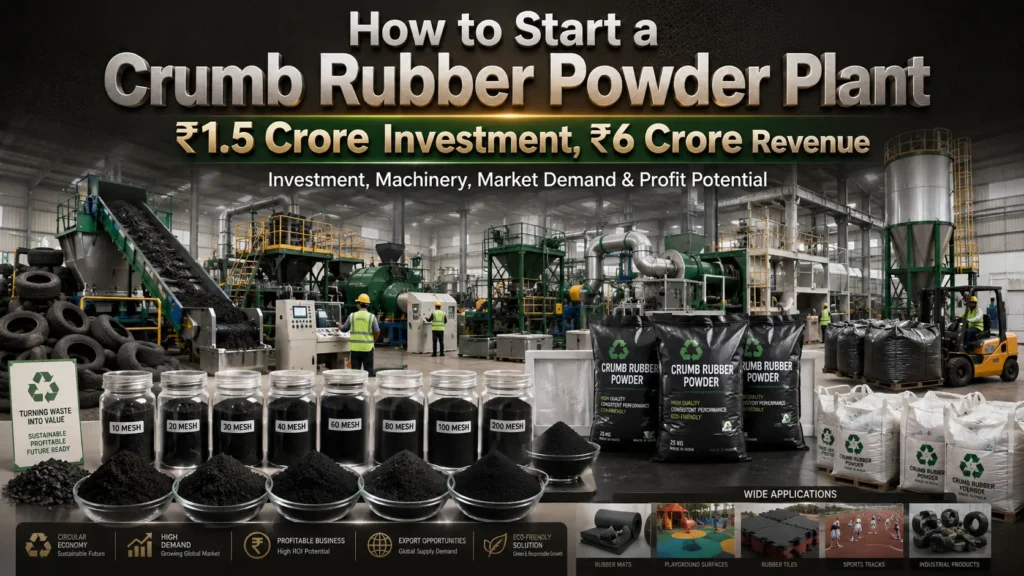
Crumb Rubber Powder Plant in India A Business Idea the Recycling Economy Is Crying Out For In the field of environmental-friendly manufacturing, a crumb rubber powder plant is one of the most missed out business ideas in India for a simple reason, waste tyres are everywhere and the demand for manufactured rubber granules is increasing rapidly. Entrepreneurs who know this are entering a business with solid profit margins, abundant raw material supplies and government tailwinds rolling down the road ahead. Not a niche opportunity — it’s a real industrial play with a real scalability. The Ministry of Environment, Forest and Climate Change numbers show that India produces more than 1.1 million metric tonnes of end-of-life tyres every year. The majority of this rubber is deposited in uncontrolled dump sites, thereby not only posing a threat to the environment, but also creating a raw material that could not be used. This waste is transformed at a crumb rubber powder plant into a high-value industrial input: used in roads, sports surface, automotive component and construction material. The economic arguments are strong. The total project investment is around ₹1.5 crores and a well-managed plant can yield an annual revenue of anywhere between ₹5–6 crore, which means first-generation entrepreneurs and MSME investors will get a handsome return on their investment. Get Detailed Insights from This Book: The Complete Book on Rubber Processing and Compounding Technology Why This Sector Is Growing Fast The crumb rubber industry is a dynamic area of business poised at the crossroads of two trends: the circular economy and the wave of infrastructure expansion. An increasing number of industries are experiencing a surge in demand for crumb rubber powder (also known as recycled rubber granules). Road construction accounts for the greatest use. Rubberised bitumen (with crumb rubber as a modifier) provides an extended service life, improved skid resistance and reduced maintenance costs for pavements. The National Highways Authority of India (NHAI) has issued orders for several NH projects to use rubberised bitumen, taking the demands away from the processors. On the other hand, sports infrastructure, which includes artificial turf, running tracks, playgrounds etc., is booming in tier-2 and tier-3 cities. A lot of crumb rubber infill is needed for each installation. Demand is also on the rise for exports, especially to South Asia and Middle East, where there is not enough tyre recycling facility. So entrepreneurs who are coming in to this industry are not only going to benefit from domestic consumption; they are investing in export revenues as well. The raw material side is also very good. The amount of end-of-life tyres is large, low cost and increasing. Tyres are produced every day by steel mills, transportation companies, logistics companies and municipalities. Since it is an expense to dispose of, many suppliers would be willing to sell scrap tyres at close to zero cost. It helps to lower input costs and maintain solid profit margins, even during recessions. Government Policies and Incentives Supporting This Business Extended Producer Responsibility (EPR) and Waste Tyre Regulations The Central Pollution Control Board (CPCB) has issued notification of EPR rules for Hazardous and Other Wastes Management Rules relating to waste tyres. Tyres must be passed through registered tyre recyclers and processors under these regulations. As a result, tyre Original Equipment Manufacturers (OEMs) are actively looking for authorized crumb rubber processors. For new plants, it is the formalisation of raw material linkages right from the beginning, which gives them a major competitive edge over unorganised players. MSME Credit and Subsidy Schemes MSME Ministry has launched a collateral-free loan facility for MSMEs for manufacturing projects with the Credit Guarantee Trust for Micro and Small Enterprises (CGTMSE) scheme, which offers loans of up to ₹2 crore. The scheme reduces the financing costs of an investment project worth ₹1.5 crore to a great extent. Moreover, the Government offers capital subsidy of 15-35% under its Prime Minister’s Employment Generation Programme (PMEGP) scheme for manufacturing MSME based on the category and geographical area. These should be investigated by new business owners before they approach the banks directly. Make in India (DPIIT) also facilitates green manufacturing projects by having single window clearance systems and facilitation cells in most states. Some of the state governments such as Rajasthan, Gujarat and Maharashtra provide extra subsidy on land cost and rebate on power tariff for recycling units and green manufacturing units. Environmental Clearance and Registration Crumb rubber plants come under the category of Orange Environmental Regulation and are to be gotten proper Consent to Establish (CTE) and Consent to Operate (CTO) from the State Pollution Control Board. The registration procedure is not complicated but is streamlined for small units. Planning for environmental clearances for a new plant takes 60-90 days, so this should be added to the project schedule. Get Detailed Project Report (DPR): Crumb Rubber Powder from Waste Tyre Manufacturing: A Promising Venture for Startups Multiple Business Ideas Within the Crumb Rubber Powder Sector 1. Standard Crumb Rubber Powder Manufacturing Unit The entry point is the most direct – a standard crumb rubber powder making plant, which processes the old tyres into granules with different mesh sizes such as 10-mesh chips, 40-mesh granules, 80-mesh powder etc. Ambient temperature processing mechanical shredding line is used in the unit. Main equipment refers to a primary shredder, secondary granulator, cryogenic or wire separator, and a vibrating sieve classifier. An entrepreneur can have a plant installed for commissioning which will have a capacity of 5–8 tonne per day for a ₹1.5 crore investment. The key is product diversification, however, and selling 10-40 mesh granules to sports surface installers, 40-60 mesh to automotive sealing product manufacturers and fine 60-80 mesh to paint and coating manufacturers. The combination of these product lines optimises the revenue per tonne and lessens the reliance on a single customer segment. 2. Cryogenic Crumb Rubber Processing for Premium Applications The tyres are frozen in a cryogenic tank with liquid nitrogen prior to size reduction, which results in a cleaner, more uniform crumb rubber particle