
10 Manufacturing Business Ideas Under ₹25 Lakh Eligible for PMEGP Subsidy
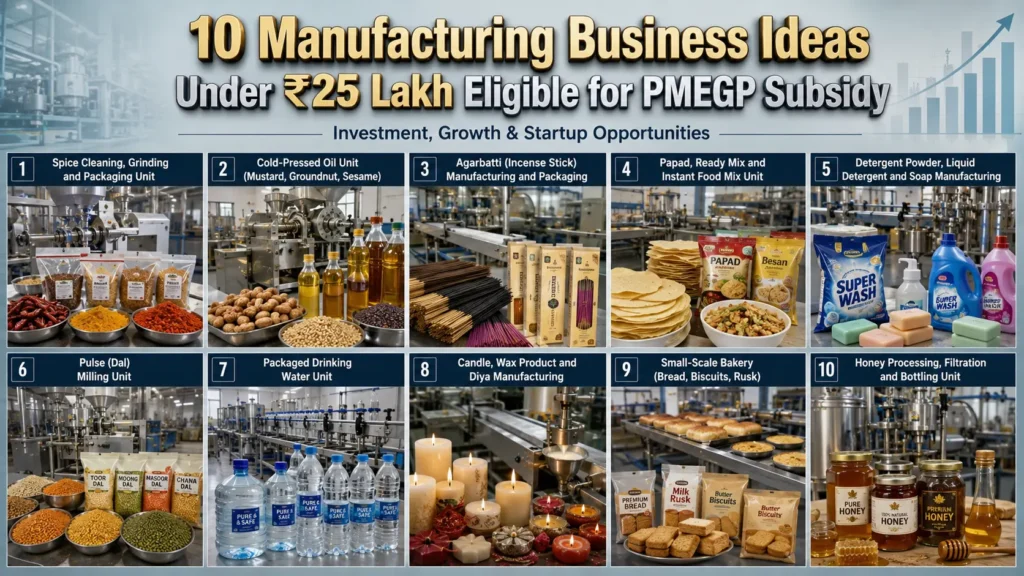
Ten manufacturing units that fit comfortably within PMEGP’s project cost framework, with realistic cost ranges and the subsidy math worked through PMEGP Manufacturing Business Ideas Under 25 Lakh A supportive middle ground for planning PMEGP is ₹25 lakh. It is not too large to be able to establish a medium sized a medium scale unit with the proper machinery, but sufficiently small that the entrepreneur’s contribution of 5 to 10 percent (depending on type) is easily manageable for most first-time applications. The ten ideas below have been selected because they have three common features: The machinery and set-up cost is within or less than ₹25 lakh; The raw material is not limited to a specific geographical area but is available in most parts of India; They are categories that are seen by PMEGP-implementing banks and KVIC offices frequently, and not in an unusual way. Production using a spice processing unit, which involves cleaning, drying, grinding, blending and packaging, requires around ₹15 to 25 lakh investment — one of the lowest capital-intensive avenues into food manufacturing, with India being the world’s leading producer of spices, ensuring a consistent raw-materials supply. 1. Spice Cleaning, Grinding and Packaging Unit The spice processing industry is one of the most viable small-scale manufacturing sectors in India due of its status as the largest producer and exporter of spices in the world. A unit which purchases raw turmeric, chilli, coriander or blends of spices from various regions, cleans and dries the raw spices, grinds the raw spices to the desired fineness and packs them in a packaging line with simple machinery, can be established for Rs. 15 lakhs to 25 lakhs. Value addition makes the economics much better, a packaged, branded masala blend is worth a much higher price than lose ground spice sold to a wholesaler, and the extra cost of packaging is low compared to the price increase. The manufacturing cost ceiling is well within the boundary of this trade category and the profile of the trade is well known with respect to PMEGP because this is one of the more commonly approved trades. View Full Project Details: Spices and condiments, Indian Kitchen Spices, Masala Powder 2. Cold-Pressed Oil Unit (Mustard, Groundnut, Sesame) A small cold pressed or expeller-based oil unit, processing mustard, groundnut, sesame or coconut, depending on availability, usually involves the use of an expeller machine, filtration machine and storage and packing plant, the total investment for a small unit (might be ₹10-22 lakh) being a daily capacity of around 10 tons. Today, with the shift to oils that are cold pressed and free from chemicals, there is a retail premium for these oils that didn’t exist ten years ago, especially in the urban markets. This can be made around a producing cluster for the selected oilseed, reducing raw material cost in a significant manner and often, the higher subsidy rates of PMEGP coincide with such type of siting. 3. Agarbatti (Incense Stick) Manufacturing and Packaging Although Agarbatti manufacturing is one of the simplest industries on this list, the basic rolling machines, drying racks and perfuming and packaging set-up can be acquired for ₹5-15 lakh, depending on the level of automation and the technology used. Demand is steady and is not quite cyclic, as the product is consumed every day for religious and ritualistic purposes all over India. This is also a category that can see a significant boost in output for a small unit without a commensurate proportionate increase in the number of staff working on the machine, especially in the unit economics part of the equation after the initial setup period. 4. Papad, Ready Mix and Instant Food Mix Unit Instant food mixes (dhokla, gulab jamun, pakora mixes and others), papad and idli/dosa batter mixes are a category that has significant retail demand in the urban markets and is growing in sales. These can be manufactured in a unit which can be setup in ₹10-20 lakh with mixing, rolling/extrusion and packaging equipment, FSSAI registration is the primary regulatory requirement. This category is attractive to a PMEGP applicant because the production cycle is relatively short and the recognition of the market is possible without having to invest in significant new machines each time a new product is added to the production line. 5. Detergent Powder, Liquid Detergent and Soap Manufacturing Units involved in detergents production, dishwashing liquid and bathing / laundry soap etc remained very common among the categories approved by PMEGP due to the proven technology for making detergents, established chemical supply chain for raw materials and year-round demand for these products during the recession. The basic unit with mixing vessels, simple soap-cutting/detergent-mixing line with packaging can be set up at ₹8-20 lakh. This is a field that the author has explored in great depth in the Soaps, Detergents and Disinfectants Technology Handbook published by NPCS, which explains how to formulate the product, how to test the product quality and how to choose the machinery needed to produce the soap that performs as well as the established product. These are the areas where a first-time entrepreneur in this field is most likely to need guidance to make the product that performs as well as the established product. Find the most profitable startup for your investment range 6. Pulse (Dal) Milling Unit For the small-scale daily capacity, a small dal milling unit which consists of dehusking, splitting, polishing and grading of pulses fits in between the price of ₹20 to ₹25 lakh and the core of the equipment comprise of dehusking machine, polishing drum and grading equipment. India is a vast consumer of pulses, with much of its production being ground in the country, near its consumption areas, a structural advantage which export dependent categories have not. The unit is best suited close to a pulse producing belt, both for the raw material cost and the fact that the by-products (husk, broken grain) are also sold; one such outlet is to poultry feed manufacturers, which increases the unit economics. Related
Products from Brewery Spent Grain and Distillery By-Products: Manufacturing Guide and Business Opportunities
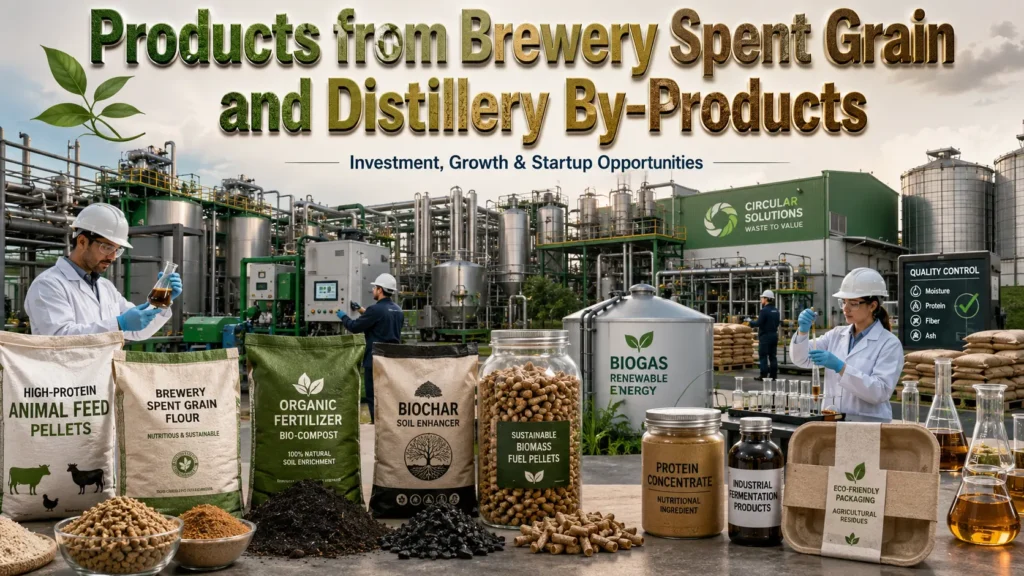
Brewery Spent Grain Business in India Beer and Spirits in India has experienced a tremendous growth in the last 10 years. The Indian market is now the second biggest in the world for whisky and 8–10% of the population are drinking beer every year. This growth equates to increasing amounts of processing waste, such as brewer’s spent grain (BSG) from the brewing industry and distillery spent wash from alcohol production. BSG is the barley malt and adjunct grain used to make the wort that is left over from the brewing processes. About 20kg of wet BSG is produced for every 100 liters of beer produced. The wet BSG is produced by a large Indian brewery (1 lakhs liters per month) and is sold/donated as cattle fodder at Rs. 200 per ton. 1,000–3,000 per ton. BSG is 25–30% protein, 15–25% dietary fiber and has a high content of B vitamins and antioxidants. With the rise in market demand for high fiber, high protein food ingredients like protein bars, sports nutrition, functional foods, food enrichment, there is scope for processing BSG into food grade ingredients which fetches high price of Rs. 100–250 per kg versus Rs. 1- 3 per kg feed as wet cattle feed. The distillery spent wash is a by-product of the alcohol distillation process that contains high levels of BOD (50,000-100,000mg/l) and is rich in potassium, nitrogen and organic compounds useful as crop fertilizers. However, the regulatory pressure (i.e. effluent discharge prohibition) and fertilizer requirement creates a business structure for valorization of spent wash. Top 8 Products from Brewery and Distillery Waste 1. Brewer’s Spent Grain Protein Flour Dried (drum dryer or spray dryer) spent grain after centrifuge and ground to fine flour has a protein content of 25-30% and a fibre content of 15% (dietary fibre). Protein enriched bread, crackers, pasta and health food products use food grade BSG flour. It sells at Rs. 80–150 per kg versus Rs. 1–3 per kg wet. A BSG drying and milling unit will cost Rs. 60–150 lakh. 2. Dried Distillers Grain (DDG) for Animal Feed Dried and pelletised distillery grain residue (corn, sorghum or barley based) is high in protein (26–30%), high in metabolisable energy and high in fat (9–11%) making it a premium animal feed ingredient. DDG can be used in rations for dairy cattle, poultry and swine as a protein-energy source at a competitive price. DDG is a product of large grain-based distilleries and smaller operations can be given the chance to complement their facility with drying and pelletising. Get Detailed Project Report (DPR): Business Plan for Starting Animal Feed Production 3. Spent Wash Potash Fertiliser (Bio-Composted) Distillery spent wash (after multi-effect evaporation) is mixed with agricultural biomass (bagasse, press mud) and forms an organic manure containing 2-3% K₂O, 1.5-2% N and 1% P₂O₅. The Fertiliser Control Order allows spent wash compost as an acceptable organic fertiliser. The cost of the spent wash treatment by composting plant is Rs. It is able to save 50-150 lakh and also addresses the effluent compliance. 4. Biogas from Spent Wash Amongst all industrial effluents, spent wash generates the most energy efficient biogas from high-rate reactors such as UASB and CSTR with 25-35 m³ of gas per m³ of spent wash. The biogas is fired in boilers in place of biomass or coal. A number of large Indian distilleries (United Spirits, Radico Khaitan, Allied Blenders) have installed biogas plants from spent wash. Cost of 1 million litre/day distillery spent wash biogas plant is Rs. 3–8 crore. Get Detailed Insights from This Book: Handbook on Biogas and Its Applications 5. Protein Supplement for Aquaculture Feed Dried and pelletised with balanced amino acid profile, Brewer’s spent grain protein is accepted in tilapia, rohu, catla and shrimp aquafeed at inclusion levels of 10-20%. In the context of the rising production in Andhra Pradesh, West Bengal and Odisha, the demand for plant-based protein feed alternatives to fishmeal is increasing. The price of BSG protein supplement is Rs. 40,000–70,000 per tonne in the aquafeed market. 6. Yeast Extract (from Surplus Brewing Yeast) Protein-rich by-product of the brewing process, surplus brewer’s yeast can be lysed (heated or treated with enzymes) before spray drying into yeast extract, a savory flavour ingredient found in processed soups, sauces, seasoning blends and pet food. The price of yeast extract is Rs. It is imported at present, and costs 200–500 per kg. The cost of a yeast extract production unit is Rs. 1–3 crore. 7. Biosorbent (Spent Grain for Heavy Metal Removal) Chemical processed (acid washed and crosslinked) spent grain is used to make a biosorption material that is efficient in the removal of heavy metals (lead, cadmium, chromium) from industrial effluents. A specialty, niche chemical application for the ETP industry. The cost of a specialty biosorption preparation unit is Rs. 40–100 lakh. 8. Compostable Packaging Material Dried and compressed BSG fibre with starch binders, can be used to create rigid compostable packaging trays, plates and containers. These products are in competition with bagasse and wheat bran moulded packaging products — the single-use plastic alternative market. The cost of a BSG moulded packaging unit is Rs. 80–200 lakh. Discover business ideas that actually make money Investment and Market Summary Product Investment (Rs.) Price Key Buyer BSG Protein Flour (Food Grade) 60–150 lakh Rs. 80–150/kg Health Food, Bakeries DDG Animal Feed Pellets 40–100 lakh Rs. 25–40/kg Dairy, Poultry, Aquafeed Spent Wash Compost 50–150 lakh Rs. 4,000–8,000/MT Organic Farmers Biogas from Spent Wash 3–8 crore Fuel Cost Saving Self-Consumption, OMC Yeast Extract 1–3 crore Rs. 200–500/kg Food Flavour, Pet Food Related Article: Strategic Role of Zinc and Copper in Animal Nutrition: Why Every Feed Formulation Must Include Trace Elements Raw Material Contracts with Breweries and Distilleries Formal contracts must be signed with breweries and distilleries to assure supply of BSG and spent wash including agreed delivery dates, quality data (moisture, protein content), and price. In addition, large breweries are willing to outsource the entire BSG logistics to a processor, even if they have to pay