
These African Manufacturing Business Has 300% Demand Growth – And Almost Nobody Is Entering It
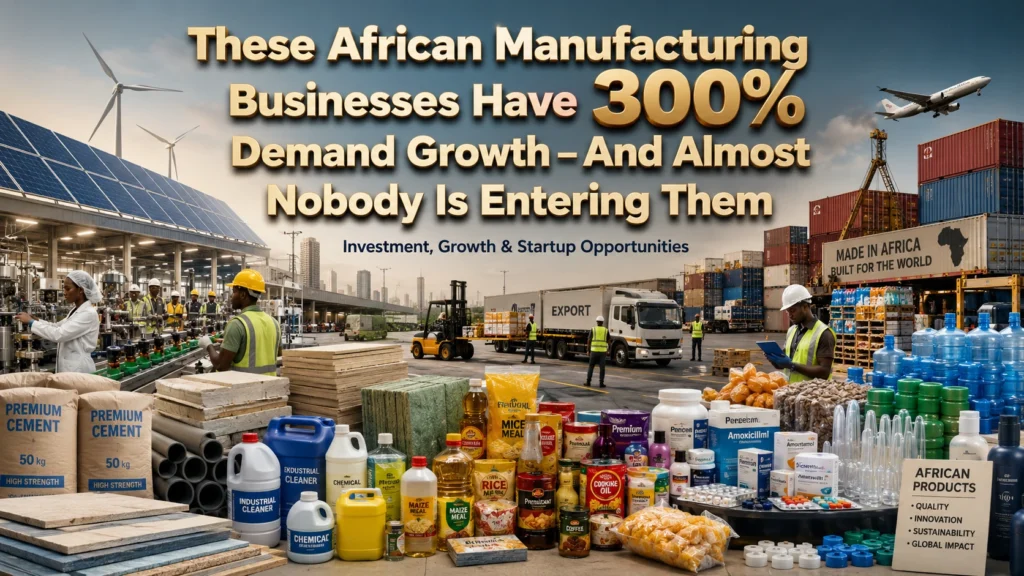
Manufacturing Business Ideas in Africa The African frontier has become more than a frontier market; it is one of the most strategically interesting places to manufacture on the planet. The continent boasts a wellspring of aspiring entrepreneurs with a combined GDP surpassing $3 trillion, a young and rapidly urbanising population of over 1.4 billion, and a historic change in its economic structure to reduce reliance on raw commodity exports. The business ideas that are discussed in this article are not just theoretical business opportunities. They are built on real market opportunities, consumer demand, and production economics that are scalable — that first-generation founders and MSME investors can now leverage with an investment of USD $100,000 to USD $200,000. The African Continental Free Trade Area (AfCFTA), which is already in operation for 54 member countries, has altered the investment equation altogether. No longer do manufacturers have to focus on just one country. This little Rwanda plant can legally export to Kenya, Uganda and Tanzania, and the DRC. Nigeria can access Senegal, Ghana and Côte d’Ivoire through a food-processing unit. This transborder flow and the long-neglected manufacturing industry in the continent has built a unique business environment in which supply remains far behind demand. The article offers an academic analysis of 20 practical manufacturing business ideas that align to this investment level, including market logic, business operational insights, export potential, policy support, and lessons learned from entrepreneurs who have succeeded on the ground. Why Africa Is the Right Manufacturing Destination Right Now The manufacturing sector is still less than 15% of GDP in most African economies, while in most East Asian economies, it accounts for more than 25% of GDP. This structural void is not a vulnerability, it’s a chance. Demand for basic manufactured goods (packaged food, construction materials, hygiene products and energy products, animal feed) is outpacing domestic supply chains. Import costs and availability are still high, and imports are becoming less popular for African governments that want to establish local manufacturing capability. In the meantime, the input costs are relatively low. Labour in EA and WA is cheap and has an improving skill level. There are more than ample supplies of raw materials in the form of agricultural produce, mineral, timber and natural fibre throughout the continent. Although still in its infancy, the energy sector has made tremendous strides with the implementation of solar and off-grid electrification programmes. In combination, these factors make a manufacturing environment that is competitive on the margin—even in more crowded Asian markets—when planned appropriately. AfCFTA and Government Policy: Structural Tailwinds for New Manufacturers The African Continental Free Trade Area is the most significant policy development for manufacturing in Africa over the past 40 years. AfCFTA provides for a single market of goods, the scale of which is unprecedented, as the participating nations have agreed to phase out 90% of tariffs on goods over time. This is what it means for a manufacturer to have the ability to create production capacity for Africa from scratch, rather than simply one country. In addition to AfCFTA, there are multiple incentives at the country level. African Development Bank (AfDB) is proactively supporting industrial SMEs through facilities such as the Africa SME Programme and the Affirmative Finance Action for Women in Africa (AFAWA). Kenya Industrial Estates (KIE) in Kenya provides small-scale manufacturers with factory shells, preferential financing and business development assistance. The government of Ethiopia has created special industrial park zones in which it has offered light industrial manufacturers a package of incentives for land use. The Industrial Development (Income Tax Relief) Act of Nigeria provides for pioneer industries tax holiday. The Special Economic Zones (SEZs) are available to provide infrastructure, tax reliefs and streamlined licensing for Rwanda. The African Union’s Industrialisation Strategy in Agenda 2063 prioritises manufacturing as a sector in the continent’s development agenda and is providing funding and technical assistance for just these sorts of projects. 20 Manufacturing Business Ideas for Africa (USD $100K–$200K) The selection of the following ideas has been made based on the market demand data, availability of raw materials, feasibility of production at small-scale and calculable profitability in a two-to-three-year period. They are all good examples of areas in which there is a high level of import reliance in Africa and where production is lacking or is very limited. 1. Processed Cassava Products (Starch, Flour, Chips) Cassava is the most widely grown food crop in Africa – but Africa imports billions of dollars’ worth of cassava starch and cassava flour derivatives that it could produce itself. A small-scale cassava processing plant (drying, milling and packaging) can be built for $150,000 to $180,000 to be utilized by food manufacturers, textile starch producers and export buyers all at once. There is growing demand from food companies, bakeries and industrial users, with Nigeria, Ghana and DRC being the biggest producers of cassava. The main competitive edge for a new player is the ability to add value to the cassava crop, which is not just raw cassava but clean cassava, packaged cassava, specification grade starch, and/or high quality HQCF (High Quality Cassava Flour). 2. Vegetable Oil Refinery (Small-Scale Edible Oil) Urbanisation is driving up Africa’s consumption of edible oils at a significant clip, but the domestic edible oil refining capacity is severely constrained. Raw quantities of palm oil, groundnut oil, sesame oil and sunflower oil are produced on a large scale throughout the continent but are not generally refined to retainable standards in the region. A small-scale expeller and refinery unit can be set up at a cost of $160,000-$200,000 and can supply refined, bleached and deodorised edible oil for retail packing and institutional food services. As by-products from refinery activities, soap manufacturing is an adjacent revenue stream that can be used to enhance margin usage. Refined edible oil has very high demand-supply mismatch in the West African markets, especially in Nigeria, Ghana and Cameroon. Access Complete Business Plan: Edible Oils, Non-Edible Oils, Fats & Vegetable Oils Projects 3. Solar Panel Assembly Unit Access to energy