
How to Start a Boxing and Martial Arts Equipment Manufacturing Export Business in India
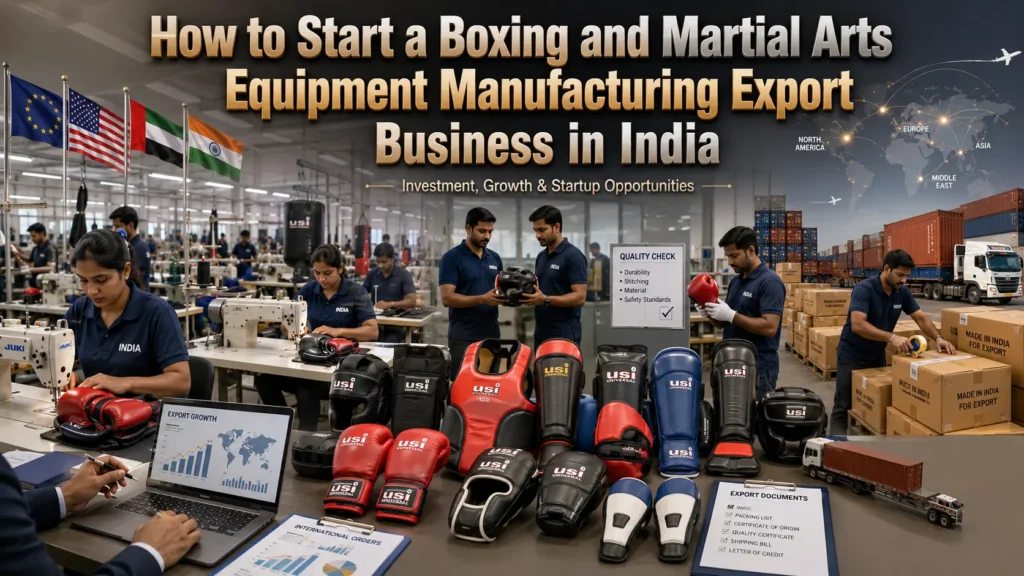
Boxing and Martial Arts Equipment Manufacturing Boxing and martial arts equipment exports is one of the fastest emerging business ideas for the sports goods industry in India. The global combat sports industry – which covers boxing, MMA (Mixed Martial Arts), kickboxing, muay Thai, judo, karate, taekwondo and Brazilian jiu-jitsu – is booming with the UFC’s mainstream entertainment success, Olympic combat sports’ rising participation and a global fitness culture which has embraced functional training and self-defence. Boxing gloves, punching bags, protective gears and martial arts training equipment have become the forte of sports goods manufacturing clusters in India, especially Jalandhar and Meerut, where the leather processing capabilities and competitive manufacturing costs in India have helped them become capable of making these products. The Sports Goods Export Promotion Council (SGEPC) is also in support of exporters of combat sports equipment’s and the market opportunity in the world is more than ever. Why Combat Sports Equipment Export Is a High-Growth Opportunity The UFC (Ultimate Fighting Championship) has made fighting a sport as popular as any other and a huge entertainment spectacle that hundreds of millions of people around the world can enjoy. The UFC has produced pay-per-view boxing shows, Netflix MMA specials, and popular boxing, MMA, and combat sports social media events which have brought awareness to the masses and interest in combat sports participation to the world. Boxing gyms are becoming more popular in the United States, the United Kingdom, the European Union, the Gulf and Southeast Asia, as well as for fitness purposes rather than for boxing competition. The global market for combat sports equipment is greater than $8 billion a year, and expanding at a rate of 6% to 9% each year. Boxing Gloves, Punching Bags, Speed Bags, Focus Bags, Hand Wraps, Mouthguards, MMA Equipment, and Headgear are all considered part of a large and growing product line. India’s legacy of leather craftsmanship, which has been used in cricket protective goods manufacturing and footwear manufacturing, can be directly adapted to leather manufacturing of boxing gloves and protective equipment, where leather quality, stitching quality, and other factors directly influence the performance and durability of products. Read the Complete Book Here: Our Books SGEPC and Government Policy Support The Sports Goods Export Promotion Council (SGEPC) caters to the boxing and martial arts equipment manufacturers via RCMC registration to avail export benefits from DGFT and facilitates market development and provides support for combat sports trade channels, and facilitates international trade fairs like ISPO Munich, Combat Sports trade fairs in USA and Europe. The DGFT RoDTEP Scheme offers export tax rebate on exports of boxing and martial arts equipment. In addition to SGEPC RCMC, these rebates will lower the actual cost of export and enhance the export competitiveness over Thai, Pakistani and Chinese boxing equipment manufacturers in the target markets. The DGFT EPCG Scheme is applicable to boxing equipment manufacturing machinery which includes Leather Die Cutting Machine, Multi-Layer Glove Pressing Equipment, Automated Stitching Systems for Fight Gloves and Foam Padding Moulding Equipment. The quality of the items used to make gloves is directly related to the quality of the gloves themselves and their durability – which is of great importance to a serious boxer and martial arts practitioner. The Ministry of MSME offers technology upgradation and credit guarantee support for small boxing equipment manufacturers under CGTMSE and CLCSS, which will help to lower the capital requirement for the new entrants in sporting goods manufacturing industry. Business Ideas in Boxing and Martial Arts Equipment 1. Premium Boxing Gloves Manufacturing Boxing Gloves are the iconic and highest valuable product of combat sports equipment. The category with high quality perception and premium pricing is the professional boxing gloves category, which consists of genuine leather outer shells, multi-layer foam padding systems and quality stitching. Indian leather boxing gloves are also competing with other boxing glove manufacturers like Thai (Fairtex, Twins Special) and Pakistani (Cleto Reyes OEM) manufacturers in the global boxing glove market at premium levels. Boxing Glove Manufacturing Unit Investment is between ₹25 lakh to ₹80 lakh, which includes leather die-cutting, foam padding making, multi-layer manufacturing, stitching and quality testing. The export price of premium genuine leather boxing gloves varies between ₹ 2,500 to 8,000 per pair to the international boxing equipment distributors. For the European market, CE marking for protective equipment is required for applications as a part of professional training. 2. MMA Gloves and Grappling Equipment MMA-specific gear, such as open-finger MMA gloves, grappling gloves, MMA shorts, rash guards, and shin guards is the fastest-growing part of the combat sports industry. With the resurgence of MMA in the mainstream thanks to UFC, ONE Championship, and Bellator, there is a demand for the training gear of all experience levels from mass consumers around the globe. The cost of investment in an equipments manufacturing unit is anywhere between ₹20 lakh and ₹60 lakh. Beyond leather, synthetic leather and neoprene are used in MMA equipment as well, which provide additional options in material sourcing as compared with leather. MMA export markets are the U.S., the UK, Australia, Brazil and Southeast Asia. Get Detailed Project Report (DPR): Project Reports & Profiles 3. Punching Bags and Training Equipment The combat sports equipment category is squarely heavy bags, speed bags, double end bags, uppercut bags, free-standing bags and wall mounted training bags, a category of equipment which is a high volume, low margin market. Consistent institutional and consumer demand is generated by gyms, commercial fitness centres, schools, and home fitness users. It costs ₹15 lakh to ₹50 lakh to invest in a punching bag manufacturing unit, which includes canvas/leather outer shell production, filling system (sand, water or foam), hardware fittings, and packaging materials. The main wholesale buyers are US and UK fitness equipment importers. Other channel access is through direct-to-consumer sales via Amazon Global Selling and fitness equipment e-commerce platforms. 4. Martial Arts Uniforms and Protective Gear Judogi (judo uniforms), karate gi, taekwondo doboks, BJJ (Brazilian jiu-jitsu) gis, MMA training shorts, and protective gear for contact martial arts—shin guards, headgear,
Is Made-in-India Really Cheaper Than China? The Honest Answer for Manufacturers
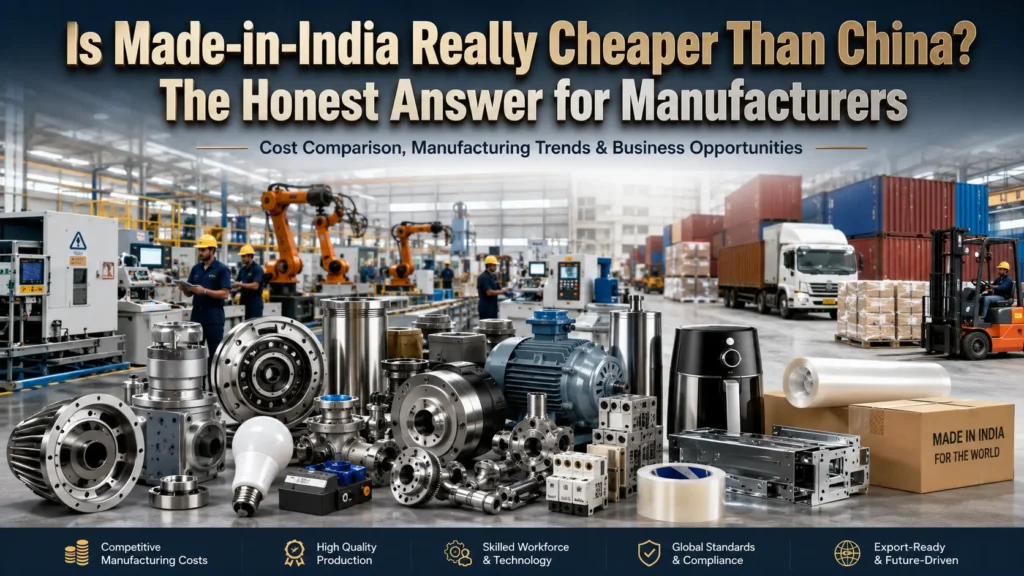
India vs China Manufacturing Cost Comparison The manufacturing fraternity in India creates a new momentum every few months. Glossy headlines herald factories moving, FDI soaring and a new day of industrial self-reliance. The prospect is alluring: India’s labor cost is less than China’s, government is providing incentives, and the geopolitical winds are favouring us. This is the story that is compelling to start-up founders who are considering manufacturing business ideas, and often is incomplete. The real answer is more complicated. India may be more cost-effective for a wise choice of product, scale and supply chain setup when compared to China. But for a lot of categories, the hidden inefficiencies, logistics, infrastructure, and lead time for manufacturing in India still heavily compete with China. That’s closing. However, it has not yet closed. This article cuts through the clutter. It looks at India’s cost advantage, its remaining disadvantage and what considerations manufacturers should make before making a decision on sourcing and/or investment. The Labour Cost Advantage Is Real — But Overstated Let’s talk about India’s strengths first. Average manufacturing wages in India are still much lower than the Chinese counterparts. Data collected by the International Labour Organisation (ILO) and trade bodies like CII shows that factory workers in labour-intensive industries in India are earning approximately 30–45% less than their Chinese counterparts in the same job. That’s a lot of benefit on the books, at least. The industries that benefit most from such an advantage are primarily the clothing, leather, footwear, simple assembly, and some agro-processing industries. For these items, labour represents 35-60% of the total cost. India thus has a defensible cost advantage. It is for this reason that global apparel firms are moving orders to Tiruppur, Surat and Noida. The Confederation of Indian Industry (CII) keeps a close watch on this trend and observes the increasing competitiveness in labour intensive manufacturing. But there are other inputs than labour. Many new startups begin by focusing on labor expenses for manufacturing and neglecting to factor in other expenses. It is not. In capital-intensive or precision manufacturing, labour may only be 10-20% of the cost. Related Article: India vs China Manufacturing: Best Business Opportunities, High Profit Sectors & Startup Ideas in India Where India’s Cost Advantage Gets Eroded Logistics and Inland Infrastructure The Pearl River Delta is a marvellous logistics machine in China. Factories are located within 60-100 km of ports with millions of containers moving through them each month. The roads are of excellent quality. Rail freight operates at high speed. All cold chains, warehouses and last mile are scaled. India’s logistics cost to GDP is in the range of 13-14%, whereas China’s logistics cost to GDP is 8-9% and in developed nations 6-8%. This gap is recognized straight by the Ministry of Commerce and Industry and the National Logistics Policy. The result: manufacturers are paying an additional 4–6% to cover inefficiencies, such as road conditions, port delays and broken cold chains. This one feature can cost the exporter his/her labour cost savings. Power and Utilities The power tariffs for industries are significantly different across states in India, but on average are higher than in China. Power cost is the most important variable input in highly energy consuming industries such as steel processing, chemicals, aluminium, ceramics and glass. In these areas, China’s energy subsidy system and integrated utility system provides a structural cost advantage which India is still trying to catch up with. The Bureau of Energy Efficiency (BEE), under the Ministry of Power, has launched a number of initiatives aimed at enhancing the energy productivity of MSMEs. However, most States still face a tariff deficit against the Chinese industrial zones, and PAT (Perform, Achieve and Trade) cycles and energy audits have helped. Raw Material Supply Chains In part, China developed its manufacturing power by clustering together raw material processing, component production, and final assembly. Shenzhen for electronics. Foshan for ceramics. Small goods in Yiwu. India is building similar clusters, such as textile parks, pharma SEZs and electronics PLI hubs, but the level of depth in the ecosystem is still not matching. India still imports high volumes from China for manufacturers that rely on precision components, speciality chemicals or electronic sub-assemblies. This makes the situation a little paradoxical – a manufactory which seems to be “made in India” can have a partly Chinese supply chain. Government Policies and the PLI Push Indian government has acknowledged these deficits. The Production Linked Incentive (PLI) scheme is implemented through DPIIT and line ministries, and has a total allocation of more than ₹1.97 lakh crore in 14 sectors. They range from mobile phones, pharmaceuticals, medical devices, food processing, textiles, white goods to specialty chemicals. The goal is to push the overall disadvantage of the output side towards direct output-based cash payments. The Ministry of MSME provides credit guarantee scheme (CGTMSE) for MSMEs, capital subsidy on technology upgradation (CLCSS), and the Udyam registration framework which unlocks priority-sector lending for MSMEs. Besides, there’s a Make in India portal (Make in India) which collates information regarding incentives under state and central schemes. It is perhaps the most effective structural intervention, the PM Gati Shakti National Master plan. It plans and manages road, rail, port and utility infrastructure at an integrated level. If fully operational, Gati Shakti has the potential to bring down India’s logistics cost differential by 3-4 percentage points, thus changing the competitiveness landscape. Business Ideas Where India Already Beats China 1. Labour-Intensive Garment and Textile Manufacturing Today, India offers a real cost benefit to entrepreneurs, who are considering their business options in the apparel industry. A well-managed garment unit in Gujarat or Tamil Nadu can compete with the Chinese mills on product categories which are basic and mid-range as the labour cost is 35-40% cheaper compared to the Chinese mills. Additional output incentives are given under PLI scheme for textiles. The success is to establish effective cutting-sewing-finishing lines, to obtain OEKO-TEX or GOTS certification for export markets, and to establish direct buyer-seller relationship without depending on trading