
How to Start a Spice Export Business in India: APEDA, Spices Board & Investment Guide
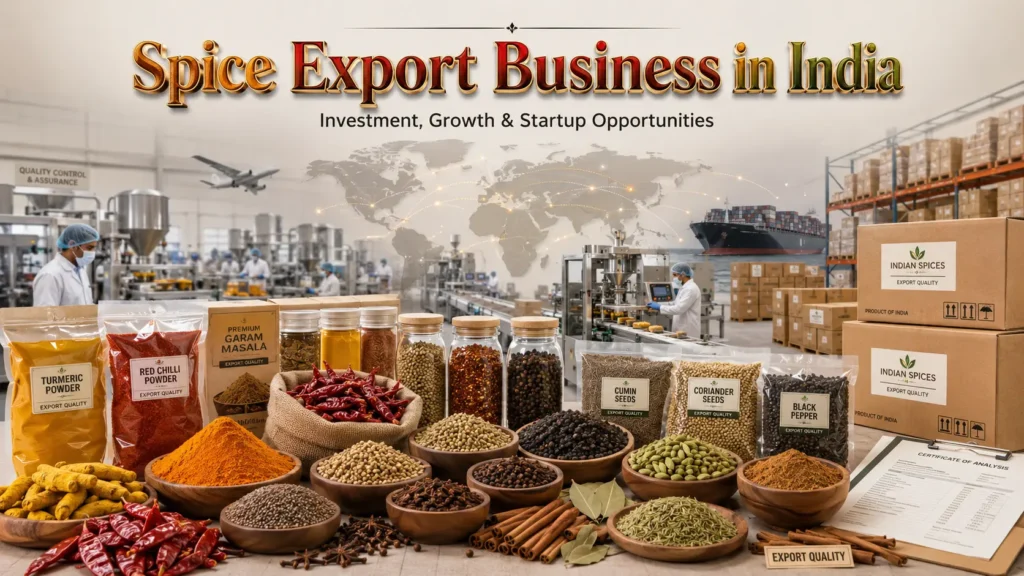
Spice Export Business in India The spice industry is a unique one in the Indian food culture and is an industry which, for the aspiring entrepreneurs with serious business ideas in the agricultural exports, has a significant opportunity both in terms of heritage and a present-day business opportunity of Rs.20 Crore Spice Exports Business. The Ministry of Commerce has established the Spices Board of India to oversee the entire spice export development ecosystem and provides subsidies on spice processing infrastructure, quality testing equipment and organic certification expenses. India is the world’s biggest producer, consumer and exporter of spices. However, the benefit that the Indian exporters are able to reap is limited to bulk commodity exports and not on premium branded exports, which can be tapped by organised entrepreneurs having appropriate processing and certification facilities. Why India’s Spice Export Sector Is a Global Opportunity The demand for genuine Indian spices has been rising worldwide, especially in North America, Europe and the Gulf, where ethnic cuisine has become increasingly popular — and so has the demand for authentic Indian spices in the organic, premium, and culinary specialty categories. Spices Board of India keeps a close watch on export statistics that have been showing positive double-digit growth in value added spices export. The European Union’s food safety standards have made buyers prefer certified Indian exporters who can certify pesticide residue compliance, creating a quality barrier in favour of organised Indian exporters as compared to unorganised traders. In the west, the functional food trend has made turmeric, ginger and black pepper superfood status, forming new food segments beyond traditional food buyers. Read the Complete Book Here: Handbook on Spices Government Schemes Supporting Spice Export The Spices Board of India (SBI) offers subsidies for the installation of spice processing infrastructure, quality testing equipment, and costs of organic certification. APEDA organises buyer-seller meets, export pavilions at international trade fairs and market intelligence reports of particular country requirements for the export of spices. Ministry of Commerce has given a framework for the export of value-added spice products under the name of Agriculture Export Policy with the identification of agri-export zones in the spice producing states. There is farm level support in the form of spice boards from Kerala, Karnataka and Andhra Pradesh states. DGFT’s RoDTEP scheme will help exporters get back domestic taxes which are hidden in export goods, making them more competitive in the international markets. Top Business Ideas in Spice Export at Rs.20 Crore Scale Certified Organic Spice Processing and Export Organic certified spices (such as turmeric, chilli, cumin, coriander, ginger and cardamom) sell at a premium of 50-200% in markets in Europe and North America. A Rs.20 Crore organic spice processing industry is using farmer network aggregation and advanced processing technologies such as steam sterilisation, colour sorting, grinding and blending along with certified organic cultivation. The organic promotion scheme by the Spices Board gives partial refund on the certification cost. NPOP and EU Organic certification are the main export certifications, apply through an APEDA accredited certification body. Steam Sterilised Spice Powder for Retail Export The technology investment for Indian spice exporters to comply with the European and American food safety standards on microbial limits is steam sterilisation (microbial elimination) of spice powders. A state-of-the-art Rs.20 Crore plant equipped with modern steam sterilisation technology and extensive quality testing, can deliver high quality spice powders that comply with the most rigorous import standards. FSSAI lays down the standards for spice quality and the Spices Board offers technical assistance to the processors aiming at upgrading to the steam sterilisation technology. Access Complete Business Plan: Curcumin Manufacturing, Extraction & Turmeric Processing Value-Added Spice Products: Cooking Pastes, Blends, and Extracts Moving beyond raw and powdered spice to value added products (oleoresins and essential oils) in flavour and fragrance industries captures much more value in the same raw materials. The price of spice oleoresins and essential oils is much higher than the price of food-grade spice powder in an industrial level. A solvent extraction/steam distillation technology is available to an entrepreneur for spice oils and oleoresins at Rs.20 Crore. The Spices Board has a list of oleoresin exporters, and it also supplies information on the world markets for spice extracts. Import-Export Opportunity Analysis India ships spices to more than 180 countries and the largest buyers are USA, China, Vietnam, Bangladesh and UAE. Export data is published by Spices Board of India on an annual basis, based on the product and country exported. The EU’s market need for organic spices, especially as part of the EU Farm to Fork Strategy, is a long-term positive trend for Indian exporters. In fact, regulatory environment is propping the quality-oriented Indian exporters as they are reducing the competition from the unorganised players in the market due to the updates of MRLs by EU. Early Registration with APEDA and Spices Board for export promotion benefits. Indian MSME Success Stories in Spice Export MDH Spices: Building India’s Most Recognised Spice Brand Established by Dharampal Gulati in Delhi, MDH (Mahashian Di Hatti) started as a small spice shop in Old Delhi and is one of the most popular spice brands in India today, both nationally and internationally. They had an international distribution network established in the UK, USA and Canada, with their own grocery stores from the Indian people, which provided an international income stream without an export setup. MDH illustrates how brand consistency – same taste, same packaging – every time is the key to a spice export business that stands the test of time. Related Article: MDH Masala Story: How Dharampal Gulati Built a Spice Empire Synthite Industrial Chemicals: Spice Extracts Export Pioneer Synthite Industrial Chemicals, Kerala, is one of the world’s biggest manufacturers of oleoresins and essential oils of spices and exports to the flavour houses of USA, Europe and Japan. The Company’s competitive edge was created through its perpetual investments in extraction technology and direct technical relationships with international flavour and fragrance firms, led by K.V. Jose. The success of Synthite has proven
Pharma Manufacturing Business Telangana: Bulk Drug Park Guide
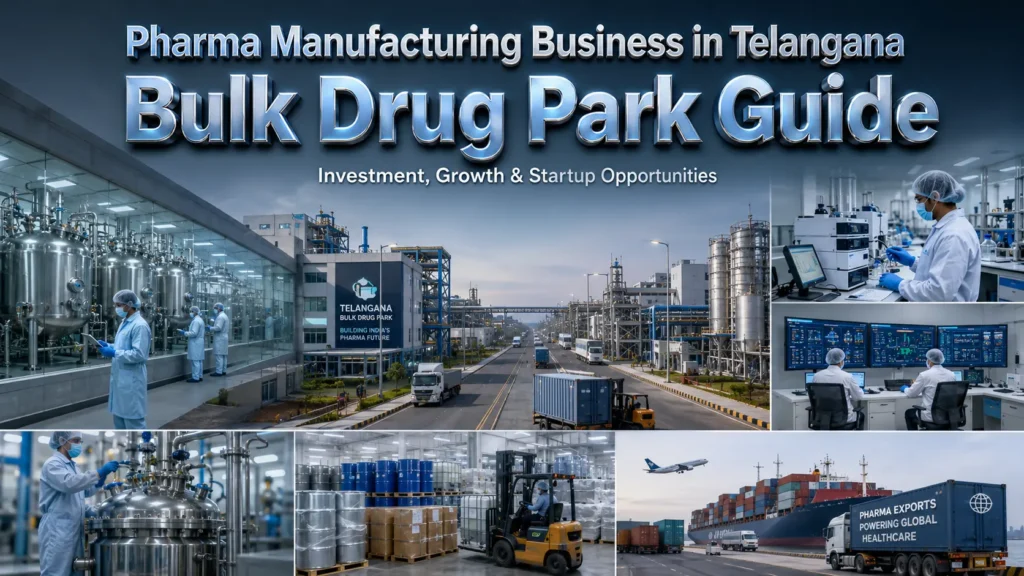
Pharma Manufacturing Business Telangana The Hyderabad alone produces about one third of India’s output of bulk drugs and APIs, with the core of these activities being Genome Valley and a pharma manufacturing base, which has been created over 30 years. It’s actually this concentration that makes the pharma manufacturing business that the Telangana entrepreneurs think about today appear daunting from the exterior: Dr. Reddy’s, Divi’s Laboratories and Hetero already possess the cake. But the state’s own Bulk Drug Park initiative, which has been aided by capital subsidy from the central government, has been created because the policy makers have realised that there is a room for new and specific players in the market, apart from the giants who are already working on a large scale. It is not an opportunity for a founder looking for a product for which every other unit in Hyderabad is doing business. It’s an invitation for one trouble-prone founder to focus on a single facet — one intermediate, one niche API, one contract manufacturing partnership — within a regulatory framework, a workforce, and a buyer base that other states take years to develop. Read the Complete Book Here: Business Ideas for Startup in Drugs & Pharmaceutical Industry with Project Profiles Why Telangana’s Pharma Cluster Is a Genuine Opening Get started with talent density. An advantage for Hyderabad over the pharma companies that have not built their capacity with API and formulation manufacturing in the city, is that a new startup can easily find experienced process chemists, regulatory affairs personnel and quality control staff, without having to import them from across the country. Add to this the government’s support. The special Bulk Drug Park developed with central PLI linked capital subsidy and allotted through Telangana State Industrial Infrastructure Corporation has plug and play infrastructure with shared effluent treatment specifically for API and intermediate manufacturing thereby reducing capex and approval time for the units to be located inside the park. The state’s own industrial policy with a focus on the pharmaceutical sector has another layer of capital and power tariff benefits that sit on top of central schemes implemented through the Ministry of Micro, Small and Medium Enterprises. The basic intermediate manufacturing unit costs start around fifteen to two dozen crore rupees for two hundred to three hundred tonnes per year, while API manufacturing for regulated markets is thirty to fifty crore rupees based on stringent quality and validation regulations. It takes around 10-14 months for the Telangana State Pollution Control Board to approve licenses and the Central Drugs Standard Control Organisation for drug manufacturing to approve infrastructure, specifically Bulk Drug Park. Business Selection Logic The margin structure is as elsewhere in the bulk drug industry in India: commodity intermediates, which a handful of existing firms in Hyderabad produce, trade at 12 to 18% margins, while specialty intermediates or niche APIs that cater to a single innovator molecule trade at 25 to 35%. The pharma cluster in Telangana is scalable because of the presence of well established buyers. A founder can launch with one multipurpose batch reactor, test one or two products with a local formulation company that doesn’t have to look far to find a qualified supplier, and then expand when repeat orders are received and the product has been proven to be in demand. The same risks identified in bulk drug manufacture in the country, such as regulatory clearance timelines and buyer concentration, apply in Telangana, however, the buyer search risk that the founders of companies in less pharma-dense states face is significantly less in Telangana due to the high concentration of buyers of bulk drugs in the state. Get Detailed Project Report (DPR): Business Opportunities in Telangana – Startup & Entrepreneurship Guide Product and Project Opportunities Worth Evaluating Antibiotic and Antiviral Intermediates Antibacterial and antiviral intermediates are being used by Hyderabad’s formulation units all the time and also the volume of customers within the state is such that if a new intermediate manufacturer wants to find a customer, they have to look within 50 km of Hyderabad. The capex for a plant of 150-250 tonne per annum is 18-25 crore rupees. The margins range from eighteen to twenty-two percent after the quality certification process with a formulation buyer is completed, which is quicker in Telangana than states with lesser concentration of pharma buyers because of their prior understanding of the qualification of suppliers. Contract Manufacturing for Global Innovator Companies With its proven regulatory track record, Telangana is a logical base for the CRAMS approach of contract manufacturing, offering global innovator pharma companies to explore India as a production partner for complex intermediates. A separate unit – one with capex of 12 to 20 crore rupees – enters into multi-year supply contracts instead of looking for volumes in the spot market. The margins are 22-28 per cent and the existing standing that Hyderabad has with the regulatory authorities is a good advantage in terms of trust building for the buyer than if the founder was coming from a lesser- established pharma hub. Niche API Manufacturing for Regulated Export Markets The best chance for a founder to carve out a niche in the Telangana pharma market is niche APIs which are molecules with a small number of qualified global manufacturers. A dedicated facility, the capex is in the range of Rs. 30 to 40 crore, which takes into consideration quality and validation infrastructure requirements, directly targets export formulation buyers in regulated markets. Once a Drug Master File (DMF) is filed and approved, the margins are twenty-eight to thirty-five percent, but the filing of a DMF takes between twelve to twenty-four months. Related Article: India’s ₹27,000 Crore API Import Problem Is Your Biggest Business Opportunity Pharma Packaging and Ancillary Component Manufacturing In addition to direct drug production, Telangana’s pharma density ensures a consistent demand for such special packaging and blister components, as well as ancillary manufacturing that every formulation and API unit in the state will need. The dedicated line requires capes expenditure of Rs 8-12