
The Government Will Pay 35% of Your Factory Setup Cost. Most People Don’t Know.
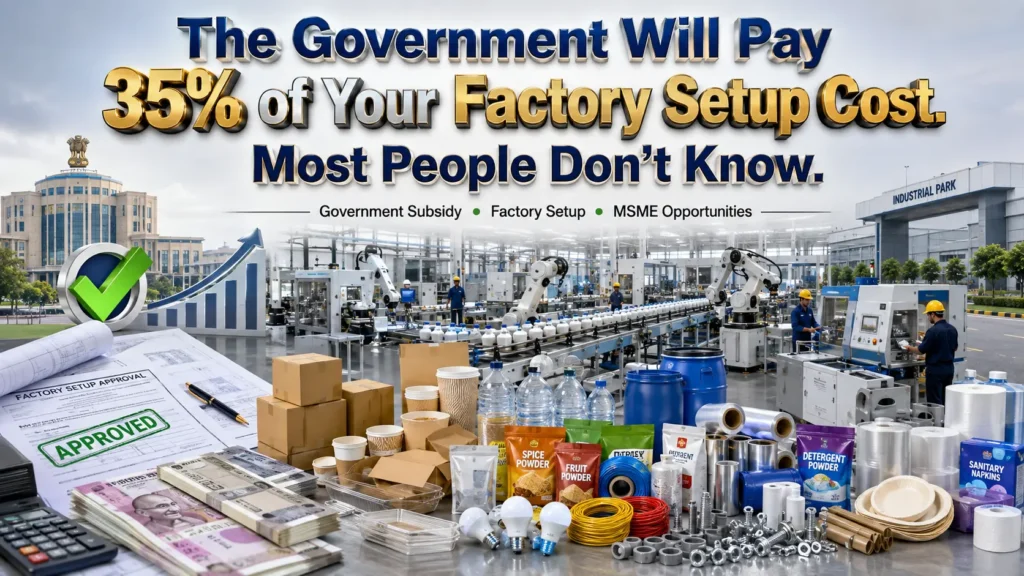
Government Pays 35% Factory Cost India has one of the world’s most untapped pool of manufacturing business ideas and startup capital, and a significant portion of it is from the Government. Thousands of entrepreneurs are investing their savings, borrowing from relatives or borrowing money on high interest rates to establish a factory and do not know that the Prime Minister’s Employment Generation Programme (PMEGP) provides up to 35% of the project costs as a direct capital subsidy. This works out to be a sum of ₹17.5 lakh of free government money for a manufacturing unit, valued at ₹50 lakh. However, many of the first-generation entrepreneurs have either never heard of it, or think they can’t be part of it. This article explains how the scheme works, who’s eligible to use it and which manufacturing business ideas have the greatest potential for success — with the government lining up on your side. Why Manufacturing Remains the Smartest Business Entry Point in India India is on the verge of witnessing the biggest change in decades for the manufacturing sector. The government has bitten off more than it can chew: it has set itself the ambitious target of increasing the contribution of manufacturing to GDP from 17% to 25%. All its policies, from tax breaks to investments in infrastructure, are geared toward this goal. This is an unusual confluence of circumstances: high demand, government support, export opportunity, and lower competition for the entrepreneur and investor. Additionally, the Make in India initiative has been successful in not only securing investments in Indian supply chains but also in creating and expanding premium procurement chains involving domestic component manufacturers. This means that the window of opportunity for a first-generation manufacturer has been greater than ever before. The initial cost of setup in the factory is still competitive. Availability of raw material is good. The domestic middle class keeps on consuming manufactured goods faster than any other economy in the world. Furthermore, with import substitution becoming a national priority, the government is actively encouraging local production under various overlapping schemes. If an entrepreneur really grasps this policy stack, he can significantly reduce his actual capital requirement by 35% to 50% prior to manufacturing even the first unit. Government Policies That Can Fund 35% of Your Manufacturing Business Setup PMEGP – The 35% Capital Subsidy You Are Missing The Prime Minister’s Employment Generation Programme (PMEGP) is the flagship programme for manufacturing start-ups in India. It is the direct capital subsidy offered by Khadi and Village Industries Commission (KVIC), Ministry of MSME, for 15% to 35% of the project cost. The general category entrepreneurs in urban areas get 15% and the special category entrepreneurs (women, SC/ST, minorities, ex-servicemen, differently abled) in rural areas get 35% of the subsidy. Manufacturing Businesses – The maximum eligible project cost is ₹50 lakh. Importantly, the funding from the applicant represents a small percentage (5-10%) of the total project cost. The remaining amount is financed by the bank. This translates to a capable businessman can establish a manufacturing business with ₹50 lakh with a mere investment of ₹2.5 lakh of his own funds. The bank finances ₹30 lakh and the government finances ₹17.5 lakh. That’s a capital efficiency ratio that hardly any private investment structure can beat. Production Linked Incentive (PLI) Scheme for Scale Businesses The Production Linked Incentive (PLI) Scheme provides performance-based financial incentives of up to 14 key sectors with 4% to 6% of incremental sales over a fixed base year for the entrepreneurs who are willing to scale up. PLI covers sectors like electronics, pharmaceuticals, food processing, textiles, automobiles and specialty steel. As of November, of the previous reported year, invested amount in committed PLI projects was ₹1.61 lakh crore which resulted in production and sales of around ₹14 lakh crore, and generated direct and indirect employment creation of 11.5 lakh. CLCSS and CGTMSE – Technology and Credit Support The Credit Linked Capital Subsidy Scheme (CLCSS) offers a capital subsidy of 15% on institutional finance received for technology upgradation in 51 specified sub-sectors with a maximum limit of ₹1 crore. At the same time, the Credit Guarantee Fund Trust for Micro and Small Enterprises (CGTMSE) has been introduced to provide collateral-free loans of up to ₹5 crore to MSMEs, which is a significant benefit for first-generation entrepreneurs who may not have an asset base. Manufacturing Business Ideas for Startups: High-Profit Units You Can Start With PMEGP 1. Food Processing and Packaging Unit Among all the business ideas in India, food processing is still one of the most resilient and least volatile businesses. The food processing industry has continued to grow in India, and the Ministry of Food Processing Industries is keen to encourage new food processing units by offering several capital and grant schemes. A start-up unit for grinding spices, milling pulses or manufacturing packaged snacks can be set-up in a project cost of Rs 30 lakh – Rs 50 lakh which falls within the project manufacturing limit of PMEGP. The operational economics are also favourable for the entrepreneur as there is a ready availability of raw materials, a developed distribution system and increasing demand for Indian food products in foreign markets. This is one of the financially most approachable avenues in manufacturing for the women entrepreneurs who start rural food processing units receiving the full subsidy of 35% under PMEGP. Get Detailed Project Report (DPR): Food & Beverage Packaging 2. Agarbatti (Incense Stick) and Dhoop Manufacturing The manufacture of agarbatti is one of those few business ideas, where the demand is huge in the country, export market is good and the government is encouraging production in the country. India is the world’s major importer as well as exporter of incense products. The SFURTI Scheme (Scheme of Fund for Regeneration of Traditional Industries) is particularly supporting the agarbatti clusters with infrastructure and technology support. The cost of setting up a basic mechanised agarbatti unit is in between ₹10 lakh to ₹20 lakh, which is perfect for first-time entrepreneurs to avail
Stop Waiting for the Perfect Business Idea. Start With This One
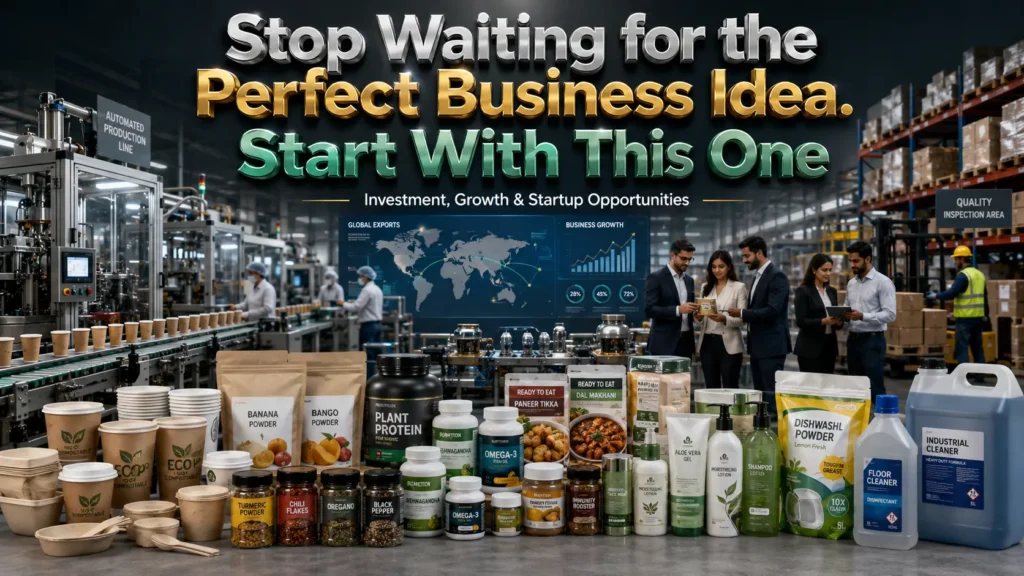
The first-time entrepreneurs start their own business, they wait years for the one “perfect” idea that’s risk-free, endlessly scalable and completely original. Meanwhile, thousands of smart manufacturing ideas quietly generate steady income, create jobs and build generational wealth for those who paused, and just took action. But the reality is, the Indian market does not honor the creative idea finder. It can pay off the one who can implement a successful concept with discipline and proper planning. The manufacturing industry is at a tipping point in India. The opportunity is not merely theoretical; it is structural and has an impact on nearly 30% of GDP and 45% of total exports through more than 7.5 crore MSMEs. The government policy, credit access and trade infrastructure is aligned to actually favour new manufacturers. The issue isn’t this time around whether to establish a manufacturing venture. The challenge now is to choose the idea and to do it smartly. Stop guessing—choose the right business with confidence Why Manufacturing Business Ideas Are Winning Right Now India’s expansion to become a viable option to the Chinese led supply chains has generated real demand deficits in a wide range of product categories. The MNCs are on the lookout for suppliers from India. The growth of domestic consumption is picking up pace in Tier 2 and Tier 3 cities. But e-commerce has created distribution channels that would have needed a lot of capital to reach before. In addition, India’s local manufacturing production is steadily increasing. Government data shows that the contribution of the MSME industry to overall manufacturing is 36%. In a recent reporting period, the credit growth in MSME sector has expanded by 19.6% YoY, which signifies the growing demand for new businesses as well as the rise of lender confidence. Today, 2/3rd of Indian MSMEs is digitally prepared and can manage procurement, sales and export documentation without having to hire a large support team for the new founder. The fact that it is a combination of rising domestic demand, export pull, government-backed credit, and robust digital infrastructure, makes manufacturing business ideas truly accessible for first-generation entrepreneurs rather than well capitalised conglomerates. Government Policies That Are Actually Helping New Manufacturers Manufacturing policy in India is now more pro-startup than ever. There are now multiple schemes layered on top of each other, thereby providing an actual capital advantage to new entrants. Production Linked Incentive (PLI) Scheme Under PLI Scheme, there are 14 priority sectors and cash incentive from 4% to 20% on increment sales over the base year. The actual investment made under PLI has surpassed ₹2.40 lakh crore, which has created more than 14 lakh direct and indirect employment. The secret to the PLI opportunity, for an MSME founder, is to be not only eligible to enter the fray but also be able to cater to the need of large manufacturers who are registered with PLI, a B2B play that most new entrepreneurs are not focusing on. PMEGP — The First-Generation Entrepreneur’s Launchpad The Ministry of MSME runs the Prime Minister’s Employment Generation Programme to provide credit linked subsidy for establishing micro manufacturing units. The subsidy for the general category applicants is 15% in urban areas and 25% in rural areas. For SC/ST and women entrepreneurs it is up to 35%. This will lead to a reduction in the breakeven risk for a new founder and the maximum government subsidy that could be availed will be between ₹6.25 lakh and ₹8.75 lakh for the manufacturing unit costing ₹25 lakh. CGTMSE and Collateral-Free Lending Credit Guarantee Fund Trust for Micro and Small Enterprises (CGTMSE) is a scheme between Ministry of MSME and SIDBI to provide banks with loans for micro and small manufacturers without requiring collateral. That’s very important for people who are first-generation entrepreneurs without property assets to put up as collateral. Having access to MUDRA loans for working capital, an MSME founder can easily start their business without needing to provide a single rupee of traditional collateral. Startup India and DPIIT Recognition Registered Startups under Startup India are offered with income tax exemption for three consecutive years, patent fee concessions and simplified exit norms. The Department for Promotion of Industry and Internal Trade (DPIIT) also eases the way for manufacturing startups by providing for fast-track regulatory clearances, thereby eliminating the typical delays that manufacturing entrepreneurs might face. Manufacturing Business Ideas for Startups: Where to Actually Begin The following business ideas are not dream concepts. They are current government policy priorities and categories of products that have proven to have market demand, viable startup economics, and documented. These are concepts that the market is talking about you, you just have to respond. 1. Food Processing and Value-Added Agricultural Products India is one of the world’s biggest producers of fruits, vegetables, dairy and spices; however, a considerable amount of the agricultural produce is wasted because of lack of processing infrastructure in the country. This vacuum is one of the lucrative and scalable manufacturing business ideas that aspiring entrepreneurs have these days. A food processing unit can commence with a specific product, such as dehydrated vegetables, spice blends, ready to eat snacks or packaged pulses and generate sales both from domestic retail markets and export markets. The investment cost starts from ₹10 lakh for micro processing unit to ₹40 lakh for mid-scale units. The Food Safety and Standards Authority of India (FSSAI) offers a clear regulatory roadmap and there are PLI incentives for several processed food categories. The average margin is 18-35% depending on the product and its value added. In addition, the Ministry of Food Processing Industries provides incentive for cold chain development to the sector. Explore This Book: Handbook on Fruits, Vegetables & Food Processing with Canning & Preservation 2. Herbal and Ayurvedic Product Manufacturing The Indian herbal and wellness product market is booming with increasing health awareness among Indians and people around the world. The cost of setting up a small-scale herbal manufacturing unit, where one produces hair oils, immunity supplement, skin care products,