
8 High-Barrier Technical Manufacturing Business Ideas That Engineering Graduates Can Build Into Dominant Ventures

Technical Manufacturing Business Ideas India produces over 1.5 million engineering graduates every year. The majority of them become employed; either in IT or manufacturing companies or in the public sector. However, large numbers are taking advantage of their technical education and have started manufacturing enterprises which most non-engineers can’t easily duplicate. They are business ideas that have high barriers to entry. The barriers are not only monetary, they’re knowledge-based, precision-based, and technical. That’s what makes them worth. If a product has a niche customer base and only a few companies can enter the market, then the existing companies in the market will have a better price, higher profit and able to maintain a longer customer relationship. This is the time when engineering graduates in India can turn their degree into a business that creates sustainable competitive edge. Why Technical Manufacturing Is the Best Path for Engineering Graduates The Indian engineering graduate who is starting a technical manufacturing business has an in-built moat which others don’t have: Domain knowledge. Knowing metallurgy, polymer science, circuit design, chemical engineering or mechanical systems is not something a competitor can learn in a single day. Where the consequences of product failure are real, as in the manufacturing industry, buyers want suppliers they know are aware of the technical requirements of what they are manufacturing. That’s why engineering-based MSMEs providing automotive OEMs, defence, chemical companies and electronics manufacturers keep customers for years and decades. It is clear from the PLI scheme for Advanced Chemistry Cell batteries, the PLI for Electronics and White Goods as well as India’s semiconductor mission that the country’s industrial future is being built around technical manufacturing and that engineering graduates are best suited to do that. Government Support for Technical MSMEs The momentum of technical manufacturing in India has been created by the policy of government. Make in India Manufacturing sector initiative has been introduced to encourage manufacturing of defence, electronics, aerospace and advanced materials, which are all engineering-intensive. The DPIIT’s Production Linked Incentive schemes offer cash incentives to manufacturers in 14 sectors, such as the telecom sector, pharmaceuticals, textiles, and food processing, based on production targets, yielding substantial revenue uplift for small manufacturers. The Atal Innovation Mission’s ARISE programme explicitly supports research and innovation-based MSMEs (directly applicable for the technically differentiated products of engineering undergraduate entrepreneurs). According to Invest India’s data on sectors, Electronics system design and manufacturing is one of the top growing sectors attracting FDI — providing opportunities for downstream supply chain businesses for technically skilled MSMEs. The IBEF electronics sector report forecasting India’s electronics market to reach $300 billion, offers small technical manufacturers the opportunity to carve out significant spaces in this market. 8 Technical Manufacturing Business Ideas for Engineering Graduates 1. Precision CNC Machined Components Manufacturing CNC (Computer Numerical Control) is used to manufacture highly accurate automotive, aerospace, defence and industrial machinery parts. Manufacturing process transforms the digital design (CAD) into real metal/polymer part within micron tolerance. Mechanical and production engineers have a natural understanding of the programming, tooling, material selection and quality control necessary. A small CNC job shop, from just one or two machines, can provide components to local OEM, engineering workshops and export-oriented manufacturing businesses. This is a high barrier business, because it’s a precision business; buyers don’t work with suppliers who can’t maintain a consistent precision. That knowledge barrier excludes casual competitors and means that clients who find a reliable precision supplier are loyal customers for the long haul. 2. Industrial Automation and Control Panel Manufacturing The manufacturing ecosystem in India is advancing towards automation at a significantly rapid pace, owing to various factors including labour cost, quality standards and the need for Industry 4.0 from the multinational clients. Many factories in industries such as automotive, pharmaceuticals, food processing and chemical require control panels, SCADA systems, PLC-based automation solutions or custom control enclosures. A person who is an electrical/electronics engineer and knows programming PLCs (Siemens, Allen Bradley, Mitsubishi) can start a control panel fabrication and integration company. It’s a project business, that is, each order is tailored to the individual; premiums are charged to technically able manufacturers. Indian market for automation is expanding at more than 12% per year, and the Indian government’s electronics manufacturing initiative Make in India is being promoted by manufacturing of control systems in India. 3. Chemical Synthesis and Specialty Chemical Manufacturing The margins for specialty chemicals, such as pharmaceutical intermediates, agrochemical active ingredients, industrial process chemicals and surface treatment chemicals are significantly higher than those of commodity chemicals. But they must have an understanding of chemistry to produce safely and reliably. An engineering graduate trained in chemical engineering or applied chemistry can install a specialty chemical synthesis plant that produces chemicals for a particular product type, such as a pharmaceutical intermediate now in demand or a water treatment chemical that is a substitute for an imported product. The technical barrier is high – Regulatory compliance (CPCB, PESO, factory inspectorate), hazardous material handling and precise reaction control; skills that untrained operators cannot handle. This is the kind of expertise that is the barrier to unskilful competition at established small chemical businesses. Get Detailed Insights from This Book: The Complete Technology Book on Chemical Industries 4. Electronic PCB Assembly and Testing Printed Circuit Board (PCB) assembly for consumer electronics, industrial controls, medical devices and telecom equipment provides a high growth manufacturing segment. As India’s electronics manufacturing landscape grows rapidly, driven by the PLI scheme and the semiconductor mission, the need for secure local PCB assembly services is outpacing the supply. A surface mount technology (SMT) assembly line can be set up by an electronics engineer using automated pick-and-place machines, reflow soldering, automated optical inspection, and functional testing. This keeps the market away from generalist manufacturers, because of the technical expertise needed for component selection, soldering profile management, conformance to IPC standards and functional testing. Medical, defence, and industrial segments are specific clients that require clients to own and operate their assembly vendors. Get Detailed Project Report (DPR): Printed Circuit
How Salaried Professionals Can Build a Manufacturing Business Without Resigning — Real Business Ideas That Work
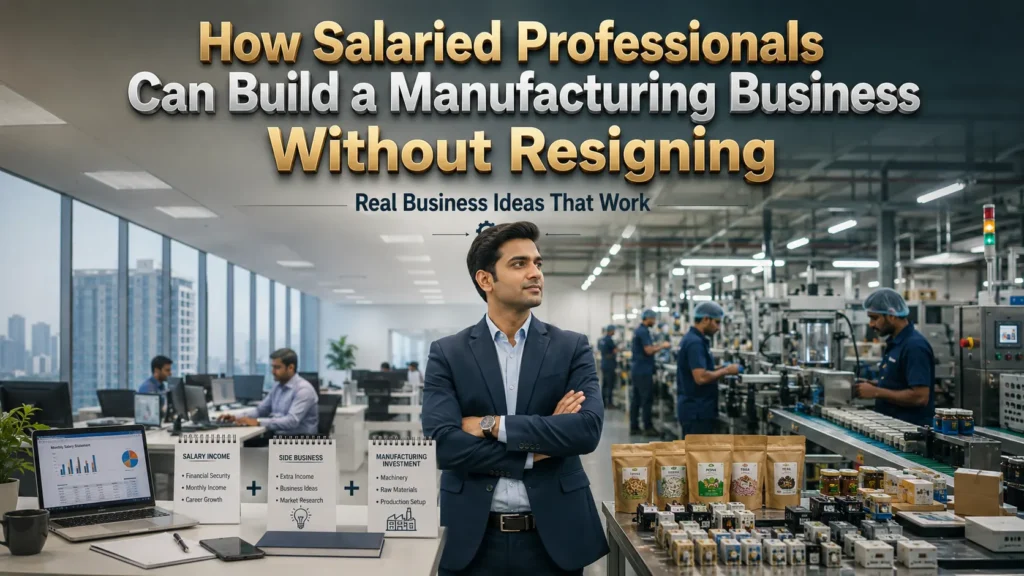
Manufacturing Business for Salaried Professionals Most salaried professionals think that they have to leave their jobs, gamble their money, and take a leap on their first day in business, to start a manufacturing enterprise. That’s incorrect. The Indian business landscape today is evolving and a lot of working people are pursuing a side business of making a profitable manufacturing venture without giving a single day a break from their jobs. Not side jobs that make pocket change. These are organized business concepts that can be developed into standalone businesses with the proper business models, management delegation and funding plan. In fact, there are a number of business models available that can work well in an absentee-owner business model (where the entrepreneur invests, manages, and runs, but is not in the business all day). Why Manufacturing Is Ideal for a Salaried Investor-Entrepreneur There are several significant differences between the business model of manufacturing and service. If the manufacturing unit is set up properly, then it can run without the owner with a supervisor and skilled workers, and there is an SOP for production. The owner’s responsibilities shift to the strategic ones: sourcing raw materials, connection to sales, quality control, and finance. These are activities that a salary earner can do during his/her leave, late nights or at weekends. Additionally, an employer who has founded his business during his working time has a financial buffer. The salary keeps on paying the personal needs of the entrepreneur and EMIs, and the business continues to grow with its earnings. Many businessmen who are successful in India as MSMEs have followed exactly the same model, especially in chemical, food processing, auto components, and packaging industries. Government Policies That Support Part-Time Entrepreneurs This permit is not required if the salaried employee is not in conflict with the terms of the employer (you may always need to check with HR or legal counsel) but can be required to run a manufacturing MSME. Support for setting up a new manufacturing enterprise is available to the owner, whether or not they are working elsewhere. The MSME Ministry’s Priority Sector Lending guidelines also provide for a specific percentage of banks’ loan portfolios that banks are required to put towards MSME business, giving credit to first-time manufacturing entrepreneurs. The CGTMSE scheme will offer collateral-free credit guarantee facilities to MSME loans, thereby eliminating the major challenge for the salaried professionals who might not have the property to offer as loan security. Employed persons can avail of the tax benefits and ease in regulatory compliances as the recognition of DPIIT’s Start-Up India is applicable even for the manufacturing start-ups. The IBEF MSME sector report validates the MSME sector’s systemic significance and the government’s long-term commitment to the growth of the same, such as being responsible for about 30% of GDP and 49% of exports. 7 Manufacturing Business Ideas Suited for Salaried Professionals 1. Plastic Injection Moulding Component Manufacturing Plastic injection moulding is an excellent business for the supervisor because once the machine and processes are set up, it is a high-precision high demand business. The business manufactures plastic parts for automotive, electronics, packaging and other consumer goods companies that demand dependable and consistent supply from small parts makers. An engineering or industrial professional who is paid can establish the moulding unit, recruit skilled machine operator and supervisor, and oversee orders, quality and procurement in a part-time capacity. The cash flow is predictable because repeat business from industrial clients makes up the “core” of the revenue. The PLI scheme for chemicals and petrochemicals and the automotive PLI creates downstream demand for plastic components across the supply chain. Get Detailed Project Report (DPR): Plastic Injection Moulding for Auto Parts 2. Chemical Blending and Specialty Products Manufacturing India’s chemical specialty industry is expanding at a fast pace due to import substitution, China plus one sourcing and the demand from domestic industries. There are many chemical blending and formulation companies that are manufacturing cleaning solutions, industrial lubricants, water treatment chemicals, construction chemicals or agro-chemicals that do not need to be operated on a 24/7 basis. After standardisation of formulation, manufacturing process is essentially repeatable by trained personnel with SOPs. Chemistry and chemical engineering professionals with a salary background are well suited to start a speciality chemical manufacturing company. It can be operated in a small rented building using a few employees, with production of an order, for industrial customers. Specialty chemicals have generally much wider margins than commodity chemicals, and switching costs for industrial buyers result in customer retention. Get Detailed Insights from This Book: The Complete Technology Book on Chemical Industries 3. Packaged Food Manufacturing Under Contract The contract production model in packaged food manufacturing enables an expert to create a food brand without operating a food factory. The model is as follows: the entrepreneur creates the product recipe, brand and packaging, while a licensed contract manufacturer (co-packer) manufactures the product, the entrepreneur concentrates on marketing and distribution of the product. There are a lot of small food brands in India working like this — sourcing production from an FSSAI-licensed plant and emphasizing on branding. With an increase in volumes, the entrepreneur can set up their own manufacturing unit. But if the professional is more interested in having the product in his or her own hands from the start, a small production unit for a single SKU (a specific snack, condiment or packaged ingredient) can be operated by a production supervisor who is employed. The food processing schemes registered under MSME gives capital subsidy for exactly this kind of model. Explore This Book: Food Packaging Technology Handbook 4. LED Lighting and Electronic Products Assembly The LED Lighting market has witnessed exponential growth in India due to the government’s UJALA scheme and the BEE standards that are promoting the transition from traditional lighting. There are a number of types of LED drivers, downlights, streetlights and panel lights which are produced during an assembly process and once standardised, these are engineered little if at all. With the