
Manufacturing Business for Salaried Professionals
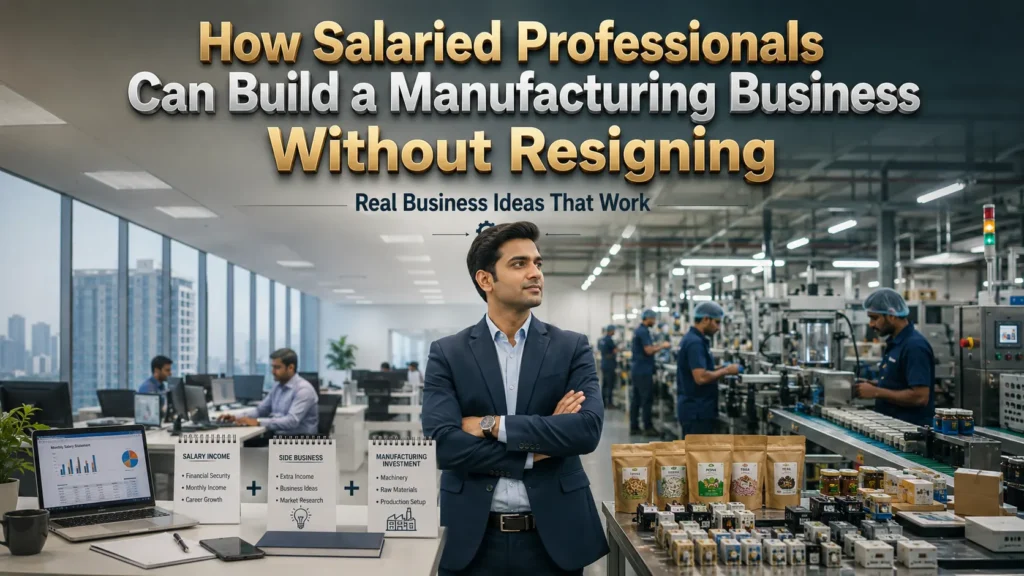
Most salaried professionals think that they have to leave their jobs, gamble their money, and take a leap on their first day in business, to start a manufacturing enterprise. That’s incorrect. The Indian business landscape today is evolving and a lot of working people are pursuing a side business of making a profitable manufacturing venture without giving a single day a break from their jobs. Not side jobs that make pocket change.
These are organized business concepts that can be developed into standalone businesses with the proper business models, management delegation and funding plan. In fact, there are a number of business models available that can work well in an absentee-owner business model (where the entrepreneur invests, manages, and runs, but is not in the business all day).
Why Manufacturing Is Ideal for a Salaried Investor-Entrepreneur
There are several significant differences between the business model of manufacturing and service. If the manufacturing unit is set up properly, then it can run without the owner with a supervisor and skilled workers, and there is an SOP for production. The owner’s responsibilities shift to the strategic ones: sourcing raw materials, connection to sales, quality control, and finance. These are activities that a salary earner can do during his/her leave, late nights or at weekends.
Additionally, an employer who has founded his business during his working time has a financial buffer. The salary keeps on paying the personal needs of the entrepreneur and EMIs, and the business continues to grow with its earnings. Many businessmen who are successful in India as MSMEs have followed exactly the same model, especially in chemical, food processing, auto components, and packaging industries.
Government Policies That Support Part-Time Entrepreneurs
This permit is not required if the salaried employee is not in conflict with the terms of the employer (you may always need to check with HR or legal counsel) but can be required to run a manufacturing MSME. Support for setting up a new manufacturing enterprise is available to the owner, whether or not they are working elsewhere.
The MSME Ministry’s Priority Sector Lending guidelines also provide for a specific percentage of banks’ loan portfolios that banks are required to put towards MSME business, giving credit to first-time manufacturing entrepreneurs. The CGTMSE scheme will offer collateral-free credit guarantee facilities to MSME loans, thereby eliminating the major challenge for the salaried professionals who might not have the property to offer as loan security. Employed persons can avail of the tax benefits and ease in regulatory compliances as the recognition of DPIIT’s Start-Up India is applicable even for the manufacturing start-ups.
The IBEF MSME sector report validates the MSME sector’s systemic significance and the government’s long-term commitment to the growth of the same, such as being responsible for about 30% of GDP and 49% of exports.
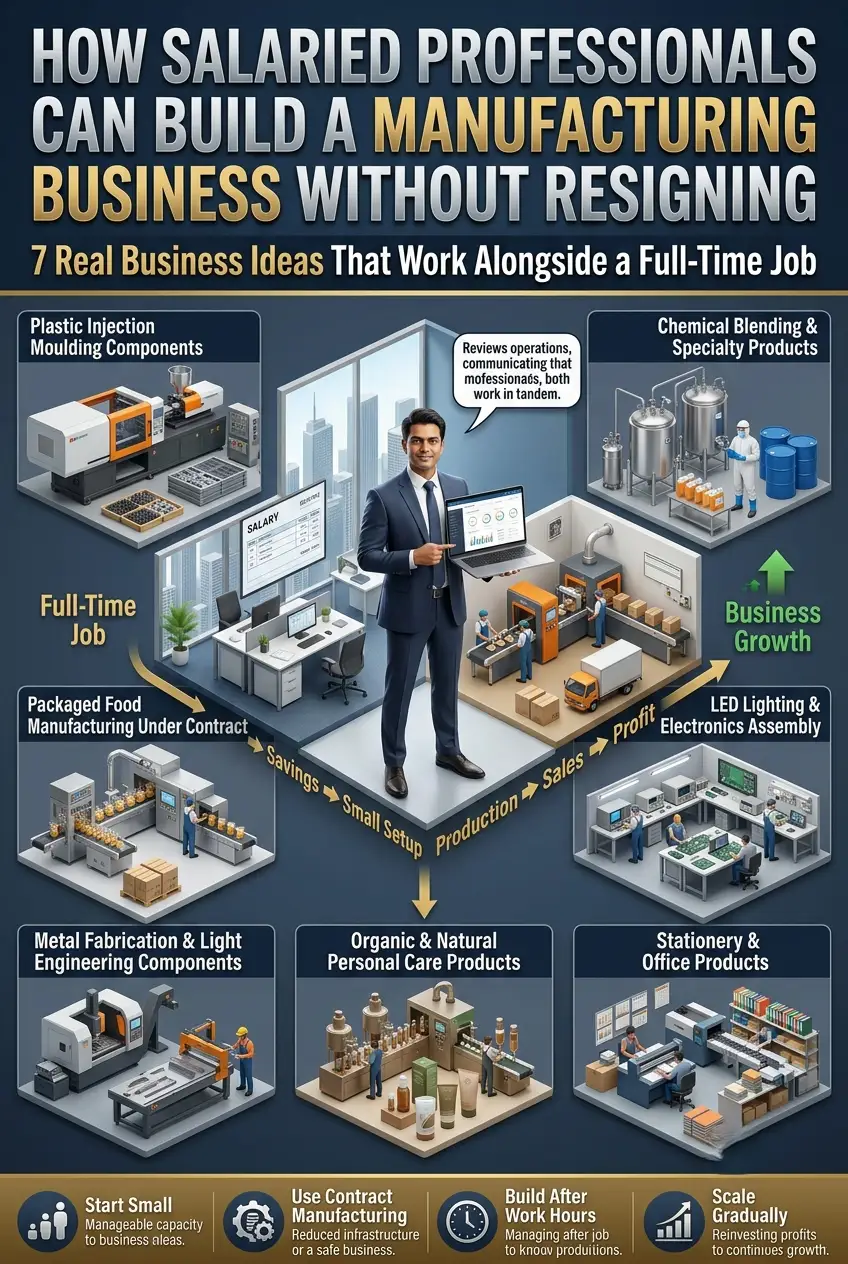
7 Manufacturing Business Ideas Suited for Salaried Professionals
1. Plastic Injection Moulding Component Manufacturing
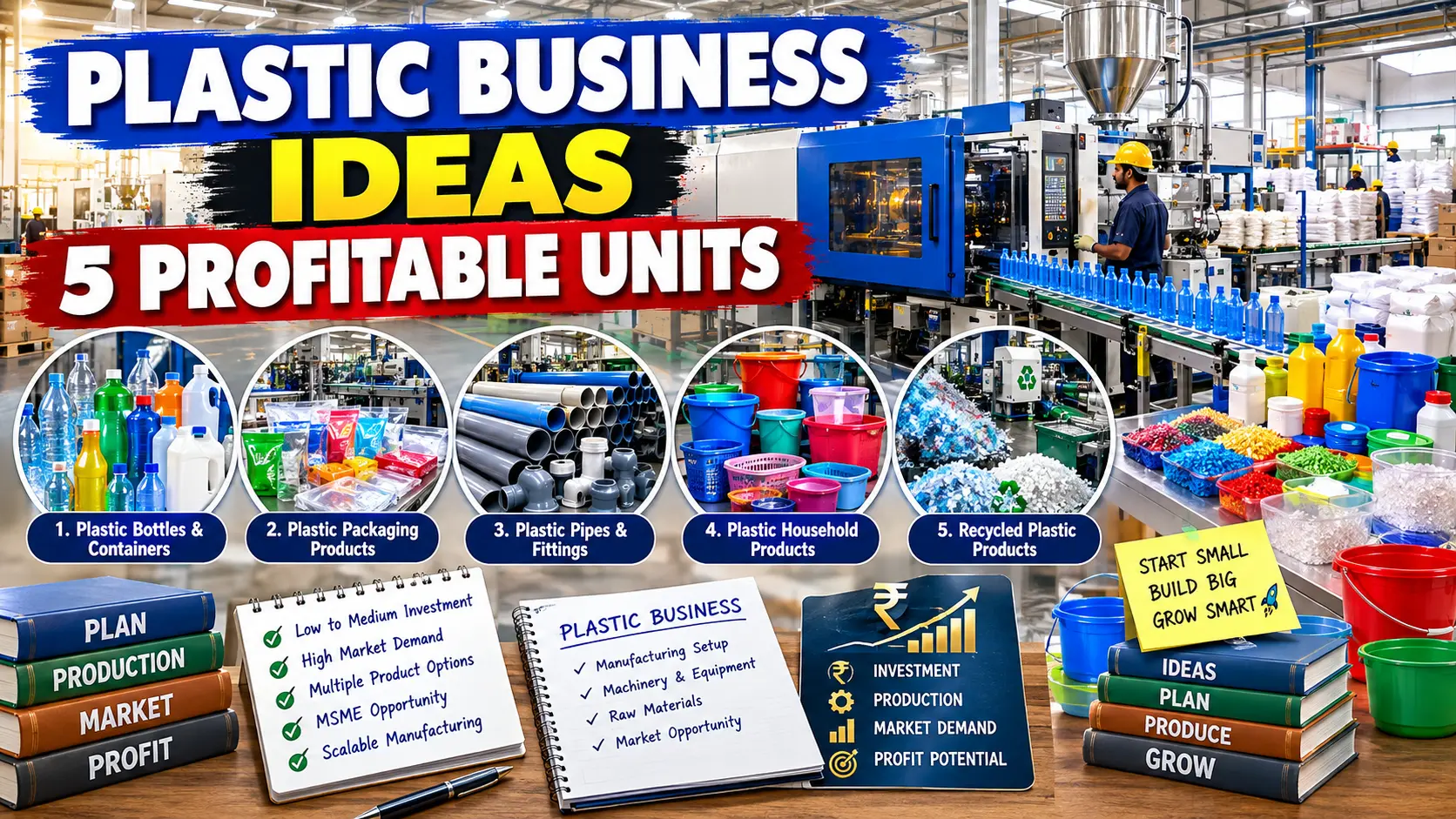
Plastic injection moulding is an excellent business for the supervisor because once the machine and processes are set up, it is a high-precision high demand business. The business manufactures plastic parts for automotive, electronics, packaging and other consumer goods companies that demand dependable and consistent supply from small parts makers. An engineering or industrial professional who is paid can establish the moulding unit, recruit skilled machine operator and supervisor, and oversee orders, quality and procurement in a part-time capacity. The cash flow is predictable because repeat business from industrial clients makes up the “core” of the revenue. The PLI scheme for chemicals and petrochemicals and the automotive PLI creates downstream demand for plastic components across the supply chain.
Get Detailed Project Report (DPR): Plastic Injection Moulding for Auto Parts
2. Chemical Blending and Specialty Products Manufacturing
India’s chemical specialty industry is expanding at a fast pace due to import substitution, China plus one sourcing and the demand from domestic industries. There are many chemical blending and formulation companies that are manufacturing cleaning solutions, industrial lubricants, water treatment chemicals, construction chemicals or agro-chemicals that do not need to be operated on a 24/7 basis. After standardisation of formulation, manufacturing process is essentially repeatable by trained personnel with SOPs.
Chemistry and chemical engineering professionals with a salary background are well suited to start a speciality chemical manufacturing company. It can be operated in a small rented building using a few employees, with production of an order, for industrial customers. Specialty chemicals have generally much wider margins than commodity chemicals, and switching costs for industrial buyers result in customer retention.
Get Detailed Insights from This Book: The Complete Technology Book on Chemical Industries
3. Packaged Food Manufacturing Under Contract
The contract production model in packaged food manufacturing enables an expert to create a food brand without operating a food factory. The model is as follows: the entrepreneur creates the product recipe, brand and packaging, while a licensed contract manufacturer (co-packer) manufactures the product, the entrepreneur concentrates on marketing and distribution of the product. There are a lot of small food brands in India working like this — sourcing production from an FSSAI-licensed plant and emphasizing on branding. With an increase in volumes, the entrepreneur can set up their own manufacturing unit.
But if the professional is more interested in having the product in his or her own hands from the start, a small production unit for a single SKU (a specific snack, condiment or packaged ingredient) can be operated by a production supervisor who is employed. The food processing schemes registered under MSME gives capital subsidy for exactly this kind of model.
Explore This Book: Food Packaging Technology Handbook
4. LED Lighting and Electronic Products Assembly
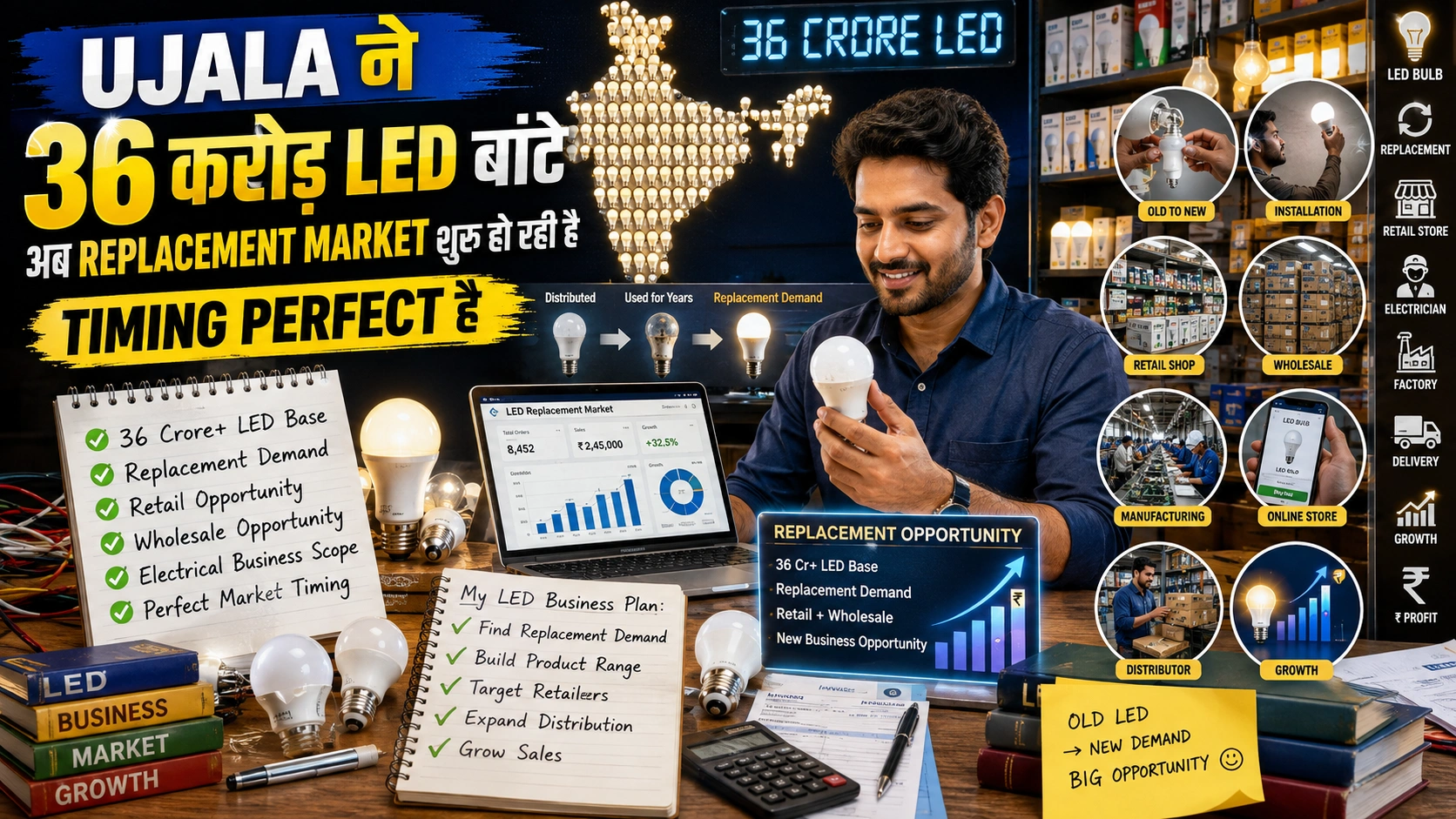
The LED Lighting market has witnessed exponential growth in India due to the government’s UJALA scheme and the BEE standards that are promoting the transition from traditional lighting. There are a number of types of LED drivers, downlights, streetlights and panel lights which are produced during an assembly process and once standardised, these are engineered little if at all. With the help of a person with an electronics or electrical background, a small assembly unit of LEDs can be established with a production supervisor managing the day-to-day operations. Quality testing, vendor management and sales are possible remotely.
MSME manufacturers benefit from stable income sources as a result of the bulk procurement orders made by the government via the EESL and GeM portal. This business also is well-suited to the incentives provided by the PLI scheme for White Goods and Electronics that encourages domestic electronics production.
Access Complete Business Plan: LED Light Manufacturing Business Guide
5. Metal Fabrication and Light Engineering Components
Metal fabrication for industrial application — making brackets, enclosures, precision components, frames, or sub-assemblies — is an established MSME business with steady B2B demand. For a salaried professional in mechanical engineering, manufacturing, or industrial management, this is a natural extension of domain expertise. The key is to target a specific niche within fabrication — such as food processing equipment parts, elevator components, or switchgear enclosures — where specifications are standardised and repeat orders are common.
A skilled fabrication team managed by a supervisor can operate the unit daily, while the owner focuses on client acquisition and quality assurance. Revenue is generated from job orders placed by OEMs, EPC contractors, and industrial buyers — all of whom prefer consistent, reliable suppliers over large factories for small-batch requirements.
6. Organic and Natural Personal Care Products
The natural and organic personal care market in India is one of the fastest-growing consumer segments. Products like organic face creams, herbal hair oils, natural lip balms, and Ayurvedic skincare formulations command premium margins and can be produced in batch format by a small team. A salaried professional — particularly one with a pharmacy, chemistry, or food science background — can develop formulations, register the brand, and set up a small manufacturing unit. FMCG distribution networks, e-commerce platforms, and D2C marketing channels allow brands to reach consumers without the manufacturer being involved in day-to-day operations once systems are in place. The natural personal care market’s consistent growth trajectory makes this a business idea with strong long-term fundamentals.
Related Article: Personal Care Products Manufacturing: Key Considerations for Aspiring Entrepreneurs
7. Stationery and Office Products Manufacturing
Notebooks, file folders, envelopes, sticky notes, and office supply products are manufactured by thousands of MSMEs across India. The manufacturing process is mechanical, repetitive, and suitable for supervisor-led operation. Demand is consistent — driven by schools, offices, and institutions — and procurement through the Government e-Marketplace (GeM) provides a direct channel to government buyers. A salaried professional can set up a stationery manufacturing unit, obtain GeM registration, and supply to government schools and institutions without the need for daily physical presence. This is a low-glamour but high-volume business with predictable demand, particularly in Tier 2 and Tier 3 cities where local manufacturers have a natural competitive advantage over distant suppliers.
Import–Export Opportunity Analysis
Many of the manufacturing categories above have active export markets. Chemical specialty products, LED components, metal fabrications, and natural personal care products all have established export demand — particularly from Middle East, Africa, and Southeast Asian markets. Invest India’s sector briefs provide detailed market intelligence on export opportunities for Indian manufacturers in chemicals, electronics, and industrial goods. The key for salaried-professional entrepreneurs is to target industrial export buyers who need consistent, long-term supply partners — relationships where quality and reliability matter more than price alone.
Indian MSME Success Stories Built by Employed-Turned-Entrepreneurs
Havells India was founded by Qimat Rai Gupta, who began his entrepreneurial journey as an electrical goods trader while having a full-time livelihood commitment. His transition to manufacturing — initially through acquiring a struggling electrical goods brand — demonstrates how an employed professional with domain knowledge can build a manufacturing empire through strategic, step-by-step execution. Astral Poly Technik was built by Sandeep Engineer, who left his salaried career to start CPVC pipe manufacturing after identifying a genuine market gap — but his early years involved managing production with a small team while personally handling sales, a model that mirrors what a salaried entrepreneur must do during the transition phase. The lesson: domain expertise plus patient capital building equals durable manufacturing businesses.
Explore proven business ideas with high success potential
How NPCS Supports Salaried Professionals Starting Manufacturing
We at Niir Project Consultancy Services (NPCS) provide professional consulting for the preparation of Market Survey cum Detailed Techno-Economic Feasibility Reports (DPRs) for setting up new industries or businesses. Our reports include detailed manufacturing processes, market research and demand analysis, process flow diagrams, product mix and capacity planning, machinery and raw material details, and complete project financials with profitability analysis. Our objective is to help entrepreneurs evaluate feasibility, profitability, and long-term scalability before investing. For salaried professionals with limited time for research, our DPRs provide the critical feasibility intelligence needed to make confident investment decisions.
Manufacturing Business Models for Salaried Professionals — Data Overview
| Business | Management Model | Technical Skill Needed | Revenue Type |
| Plastic Moulding | Supervisor-led | Mechanical/Industrial | Job orders, B2B |
| Chemical Blending | Supervisor-led | Chemistry preferred | Industrial clients |
| Packaged Food | Contract + own brand | Food science | Retail, online |
| LED Assembly | Supervisor-led | Electronics | GeM, institutional |
| Metal Fabrication | Supervisor-led | Mechanical | OEM, EPC |
| Personal Care | Batch production | Pharmacy/Chemistry | D2C, retail |
| Stationery | Machine-operated | Any | GeM, institutional |
Conclusion — Your Salary Is Your Seed Capital, Not Your Ceiling
The salaried professional’s greatest asset when starting a manufacturing business is financial stability. The salary pays the personal bills. The savings finance the venture. The professional network seeds the first clients. And the domain expertise shapes the product. None of these require resigning. Many of India’s most successful MSME manufacturers started exactly this way — employed by day, building a business by evening, and transitioning to full-time entrepreneurship only when the numbers justified it. The seven manufacturing business ideas in this article offer precisely this kind of patient, structured pathway. Choose the one that fits your skills, your capital, and your risk appetite — and start building today. Your employment is not an obstacle. It is your competitive advantage.