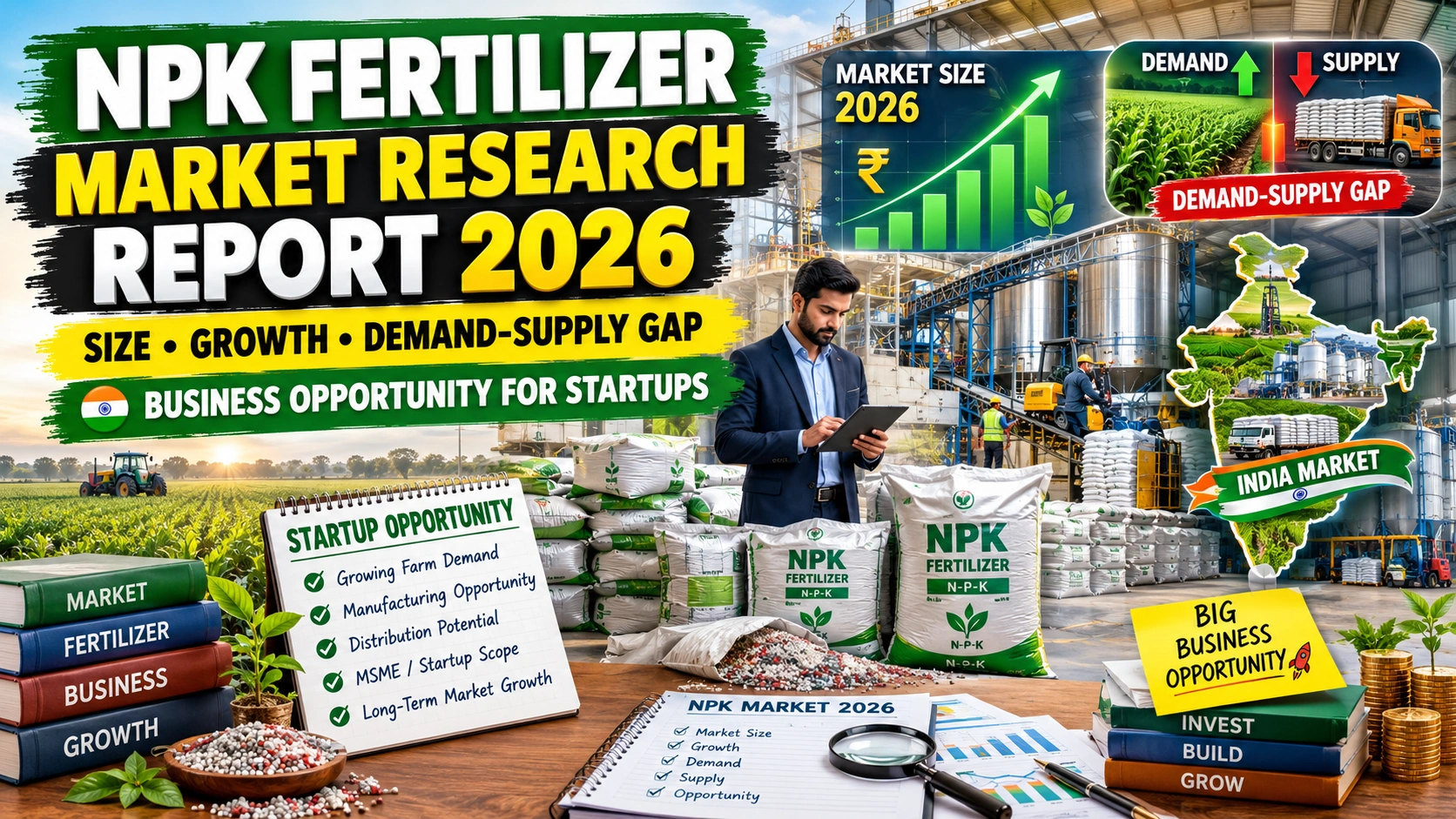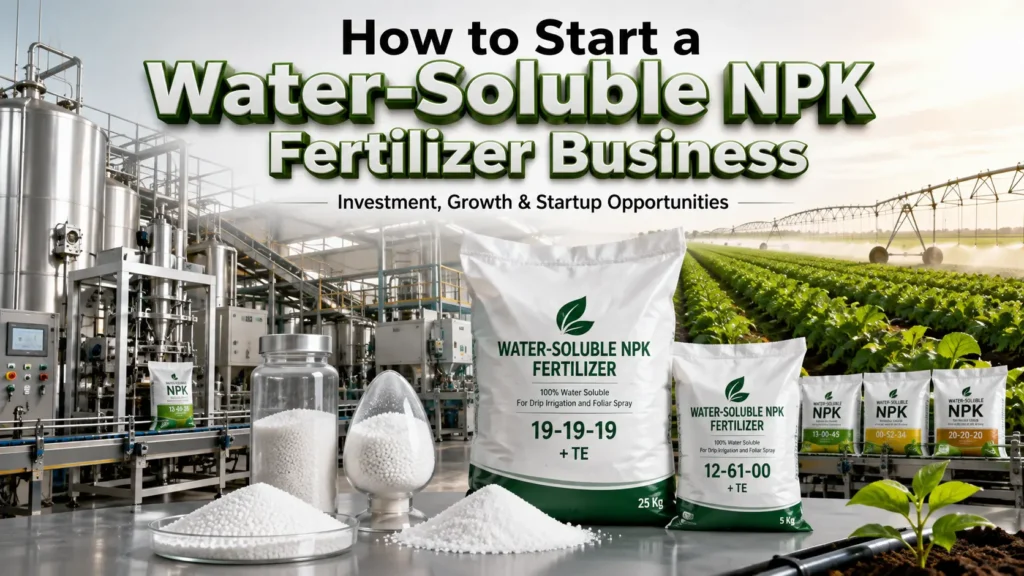

This book will provide a practical and consultant style approach of making the Water Soluble NPK Fertilizer Manufacturing in India, market logic, government support, business ideas and practical feasibility steps.
Currently, water soluble NPK fertilizer has become one of the most attractive manufacturing opportunities in India in a stealth manner. Farmers today are expecting rapid nutrient uptake and drip irrigation is gaining a sudden momentum in Maharashtra, Gujarat, Karnataka etc. This change is creating solid business opportunities for somebody with chemistry, timing and knowledge of government support in mind.
It isn’t simply a matter of mixing together the correct proportions of NPK solution. It’s all about getting the demand signals right and creating a business that will evolve with the changing Indian farm economy. In this article, you’ll follow the logic of the market, the schemes you know of, some real business ideas, and some foundational work you should do before putting money into any business.
Get Detailed Project Report (DPR): Fertilizers & NPK Manufacturing
Why This Sector Is Growing Fast
The water-soluble fertilizer market in India is estimated to be USD 425 million recently, and will hit the mark of USD 650 million within a couple of years. This translates to a growth rate in excess of 7 percent per year. However, the Indian NPK fertilizer market is already in the USD 12 billion mark and continues to rise. That isn’t an educated guess. They truly represent a ground-level change.
The Shift From Bulk Urea to Specialty Nutrition
The Indian agriculture has been functioning on bulk urea and subsidized granular urea for decades. But now horticulture has reached a level of production of over 3.5 crores tonnes per year, and high value crops like grapes, pomegranates and vegetables require accurate and quick nutrition. As a result, farmers cultivating these crops are shifting to fertigation and foliar feeding, for which 100% water soluble grades are essential. As a result of the government-sponsored schemes, there has been a further expansion of micro-irrigation, and of course this is attracting more farmers to soluble fertilizers as drip systems will not work with granular material.
Profitability Logic Behind Water-Soluble Grades
The prices of water-soluble NPK fertilizers are generally not subject to the statutory price control regime in place for bulk urea. This has allowed manufacturers to price their products according to quality and formulation instead of a specific subsidy slab. This one thing completely alters the new competitor’s profitability equation. Margins on water-soluble grades with branding, fortification or micronutrients generally are much higher than margins on standard granular grades. In this way, a well-managed small unit can offer competitors quality and service, as well as price, and thus compete on more than just price.
Government Policies Supporting New Businesses
A new entrepreneur is not required to use his own capital to finance all activities. The policy landscape for MSMEs in India has come a long way and there are various schemes that are applicable to a fertilizer manufacturing start-up.
MSME Registration and Credit Support
The first step for every founder should be Udyam Registration, an online platform set up by the Ministry of MSME which is free of cost for the founders. After registration, a unit can avail of loans up to ₹1 crore without any collateral under the Credit Guarantee Fund Trust for Micro and Small Enterprises or CGTMSE. Besides, the Credit Linked Capital Subsidy Scheme (CLCSS) provides subsidy for the machinery upgrade and the Prime Minister’s Employment Generation Programme (PMEGP) provides margin money subsidy ranging from 15% to 35% as per the scheme category and area. These schemes, together, can significantly reduce the initial investment for a new fertilizer plant.
Fertilizer-Specific Regulatory and Support Framework
Each fertilizer company has to register under the Fertilizer Control Order (FCO) with the Department of Fertilizers that prescribes quality criteria for NPK grades. On the demand side, the Pradhan Mantri Krishi Sinchayee Yojana continues to expand the scope of micro-irrigation, directly expanding the addressable market for soluble fertilizers. In addition, state governments in Maharashtra and Gujarat provide major subsidy on drip irrigation capital cost for the smallholder farmers, thereby indirectly encouraging the demand for fertigation friendly nutrients. Entrepreneurs can also avail Make in India resources on export facilitation and manufacturing incentives available to them in the agri-input segment.
Get Detailed Insights from This Book: Fertilizers Manufacturing Handbook
Profitable Business Ideas in This Water-Soluble Fertilizer Sector
Here are some business ideas that can be implemented in this space. They are geared toward different customer segments and should be chosen based on the founders’ capital, location, and market access.
1. Fully Water-Soluble NPK Powder for Fertigation
This is the big opportunity, the one that provides a lot of value. A unit manufactures crystalline or powder pellets (NPK) that will dissolve in the irrigation water, such as 19:19:19 or 13:40:13. Quality consistency is of huge importance, as these grades are directly connected to the drip system, and any insoluble residue can ruin a farmer’s trust by clogging emitters. Sizing and purifying the particles are critical for repeat orders and require investment at an early stage in the manufacturing process for a founder entering this segment. This model has a quick path to actual revenue, as the farmers obtain it through agri-input dealers in horticulture belts, especially in Maharashtra, Karnataka and Andhra Pradesh.
2. Foliar Spray Grade Fertilizer for Export Crops
Foliar sprays are used on crops intended for export including grapes, pomegranates and cut flowers where there are requirements for buyers to see good quality and compliance with residues. A mini unit focused on foliar grade formulations can command a higher price because these products address a specific issue – correction of nutrient deficiencies during a critical growth phase. Relationships with the export market are best established with the farmer producer organisation (FPOs), rather than with general retailers, as the latter prefer consistency and technical support over the lowest price.
3. Micronutrient-Fortified NPK Blends
For high value horticulture, plain NPK may not be sufficient. Therefore, the fortified blends with chelated zinc, chelated iron or chelated boron have higher margins and establish a better brand loyalty. This concept is a little more technically involved, especially with regards to chelation chemistry and stability testing, but it also provides significant difficulty for easy copying. If the founder is equipped with a good formulation chemist, regardless of whether it is on a consultative basis, he or she can help the product rise above the “commodity range” and take it away from price competition.
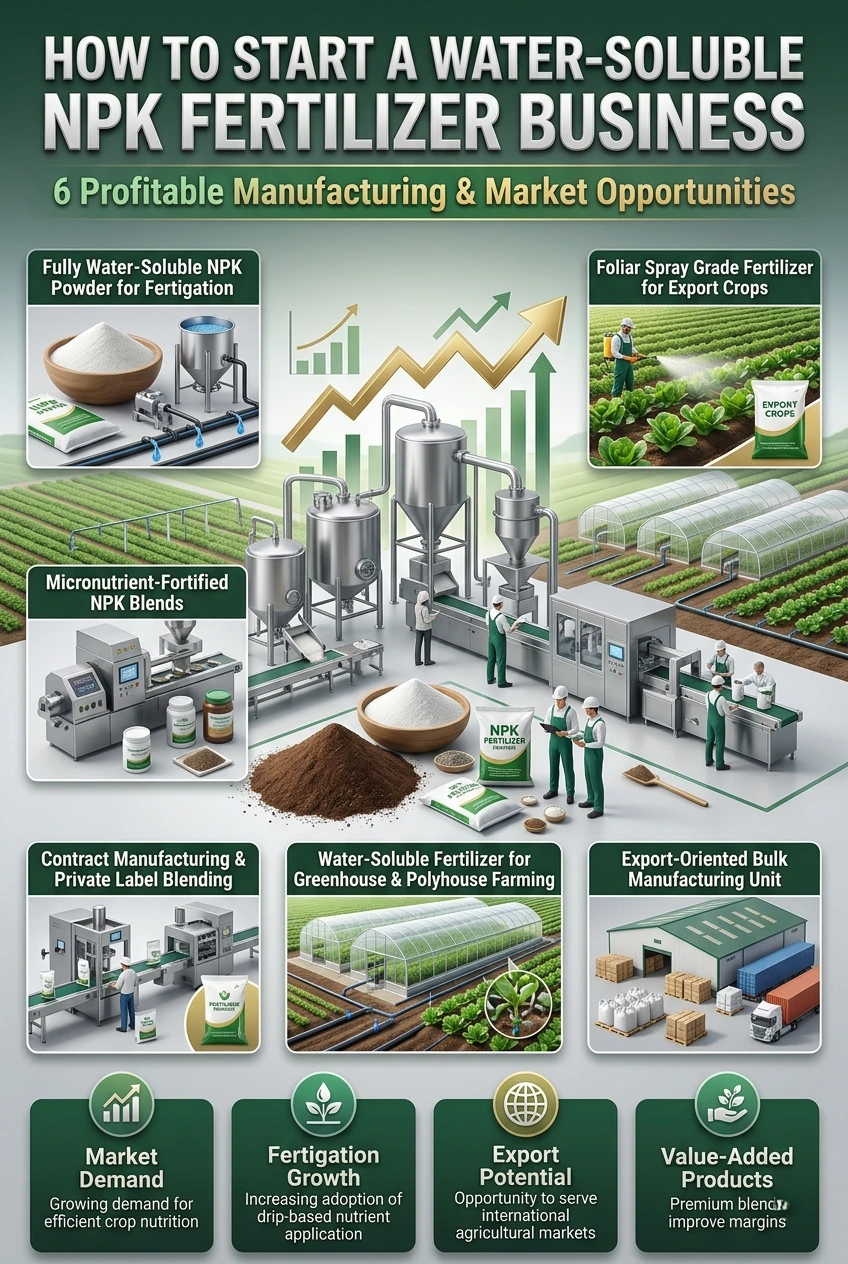
4. Contract Manufacturing and Private Label Blending
There are a number of mid-sized agri-input companies that don’t want to spend money on their own blending facilities. Rather, they would like to have the manufacturing done in a compliant facility registered by FCO and market it under their brand name. The founder has the possibility to create this business by providing flexible batch sizes, quality documentation and fast turnaround. While margins per unit are typically lower than branded sales, the advantage of the model is that it significantly lowers marketing risk, since the contracting brand takes care of distribution and demand generation.
5. Water-Soluble Fertilizer for Greenhouse and Polyhouse Farming
Protected cultivation, especially the polyhouses and greenhouses, is gradually growing around the metro cities where high priced vegetables and flowers are sold. These growers generally have automatic fertigation systems and require a perfectly balanced, food-grade-clean water-soluble fertilizer on a reorder schedule. A founder company should be mindful of the following features: Smaller package sizes; Clear dosage charts; After-sales agronomy support; This type of grower is technically-minded as opposed to the traditional field grower, and expects a service relationship rather than a product transaction.
6. Export-Oriented Bulk Manufacturing Unit
The cost of manufacturing in India is still attractive vis-à-vis many other developed countries, making the export of water-soluble NPK grades a reality. An expanded facility with export documentation and international quality certification, can export to markets throughout the Middle East, Africa and South-East Asia where local fertilizer production remains modest. While it requires more initial investment and wait for customers to accept, the potential payoff is significantly greater with this kind of operation than with a purely domestic one.
Import-Export Opportunity Analysis
Domestic potash reserves are limited, and India continues to import a significant proportion of raw materials used to make NPK fertilizers, especially rock phosphate. This leaves manufacturers with a real need to factor in this dependency into their planning, either by tying up with existing local companies or by importing.
The export situation is more promising, however, on the export side. With the price competitiveness of India’s manufacturing base and the increasing demand for water soluble fertilizer in Africa, Middle East and South-East Asia, the exporters of water-soluble fertilizer have a golden opportunity in the Indian market. Businesses intending to export should register with Agricultural and Processed Food Products Export Development Authority (APEDA) and remain abreast of international quality standards as the importing countries are increasingly looking for nutrient content and residue-free formulations with certification. For this reason, export-minded founders who map out export compliance from the outset are more likely to reap higher margins sooner than those who just sell domestically.
Related Article: How to Start a Biofertilizer Manufacturing Business and Organic Farming
Indian MSME Success Stories Worth Studying
Coromandel International — The Murugappa Group
Coromandel International was established in 1961 as a joint venture between E.I.D. Parry of Murugappa and international partners, just when India was in dire need of phosphatic fertilizer plant. Over the years, Murugappa’s management steadily acquired its foreign partners and technology was fully localised. This patient strategy ultimately resulted in Coromandel becoming the country’s biggest private sector phosphatic fertilizer producer, and subsequently the firm took a measured and progressive route into specialty nutrients and water-soluble grades with the changing preferences of farmers. The take-home message for new entrepreneurs is that fast growth is not the key to a long-lasting manufacturing enterprise; rather, it’s about long-term capital discipline.
Deepak Fertilisers and Petrochemicals — The Mehta Family
Deepak Fertilisers and Petrochemicals Corporation was founded in 1979, essentially India’s first private ammonia manufacturer, by Chimanlal Mehta. His son Sailesh Mehta expanded the business from just one product ammonia to manufacture of fertilizers, mining chemicals and petrochemicals under the renowned Mahadhan brand. The decision logic was interesting: instead of trying to be all things to all people, the Mehta family first developed depth in the nitrogen area and branched out into surrounding, technically connected product lines. If one was to join the water-soluble fertilizer market, the same strategy could be used; learn one category of formula before branching out.
IFFCO — The Farmer-Owned Cooperative Model
Indian Farmers Fertiliser Cooperative (IFFCO) went in a different direction, and it was a farmer society-driven cooperative instead of a private shareholder. Long-serving leadership has compelled IFFCO to invest in research and ultimately it was able to develop Nano Urea, a true global innovation, which garnered international patents. The size of the cooperative also enabled it to expand more quickly than a lot of private companies into the nano and soluble nutrient segment. IFFCO’s experience reveals that apart from manufacturing technologies, a good distribution network, established with the farmers over the years of trust is equally important for a new entrepreneur.
Getting Your Feasibility Numbers Right Before You Invest
All of the above business ideas make sense in theory, but it is in the feasibility planning phase that it will prove to be the real test of their validity. Our experts at Niir Project Consultancy Services (NPCS) draft comprehensive Market Survey cum Techno-Economic Feasibility Reports for the entrepreneurs in the process of establishing new industries such as water-soluble NPK fertilizer units. The reports usually include the manufacturing process, market and demand analysis, process flow diagrams, product mix and capacity planning, the requirement for the machinery and raw materials, and the complete financials for the project with profitability analysis.
In a technology intensive business such as fertilizer production, a well-thought out feasibility report is not a luxury, but the one document that distinguishes a knowledgeable investor from a costly guess.
Stop guessing—choose the right business with confidence
Market and Cost Snapshot
The table below summarises key figures an entrepreneur should keep in mind while planning a water-soluble NPK fertilizer unit.
| Parameter | Estimated Figure | Notes |
| India water-soluble fertilizer market (current) | ~USD 425 Million | Growing at over 7% CAGR |
| India water-soluble fertilizer market (projected) | ~USD 650 Million | Within the next few years |
| Global water-soluble NPK fertilizer market | ~USD 14 Billion | Projected to nearly double over time |
| India overall NPK fertilizer market | ~USD 12+ Billion | Steady mid-single-digit annual growth |
| Indicative small-unit capital investment | ₹25 Lakh – ₹1.5 Crore | Depends on capacity and automation level |
| Typical small-unit installed capacity | 500 – 3,000 MT per annum | Scalable in phases |
| Key raw materials | MAP, MOP, Urea Phosphate, Micronutrients | Partly import-dependent |
| Collateral-free credit limit (CGTMSE) | Up to ₹1 Crore | Available to Udyam-registered units |
Conclusion
The production of water-soluble NPK fertilizers is not a business idea that is being hyped up. It is actually a real and genuine opportunity that came about in response to India’s transition towards fertigation, horticulture and export farming. Those who can develop the formulation chemistry, a sound feasibility plan, and a good sense of available government assistance can construct a viable manufacturing company in this area. Just like in any business enterprise, a heady investor is generally outdone by a prudent one who has first read the market. Finally, this industry offers much more value to patience, technical sophistication, and quality control than to rapid scale-up.