Technical Manufacturing Business Ideas
India produces over 1.5 million engineering graduates every year. The majority of them become employed; either in IT or manufacturing companies or in the public sector. However, large numbers are taking advantage of their technical education and have started manufacturing enterprises which most non-engineers can’t easily duplicate. They are business ideas that have high barriers to entry. The barriers are not only monetary, they’re knowledge-based, precision-based, and technical.
That’s what makes them worth. If a product has a niche customer base and only a few companies can enter the market, then the existing companies in the market will have a better price, higher profit and able to maintain a longer customer relationship. This is the time when engineering graduates in India can turn their degree into a business that creates sustainable competitive edge.
Why Technical Manufacturing Is the Best Path for Engineering Graduates
The Indian engineering graduate who is starting a technical manufacturing business has an in-built moat which others don’t have: Domain knowledge. Knowing metallurgy, polymer science, circuit design, chemical engineering or mechanical systems is not something a competitor can learn in a single day. Where the consequences of product failure are real, as in the manufacturing industry, buyers want suppliers they know are aware of the technical requirements of what they are manufacturing. That’s why engineering-based MSMEs providing automotive OEMs, defence, chemical companies and electronics manufacturers keep customers for years and decades.
It is clear from the PLI scheme for Advanced Chemistry Cell batteries, the PLI for Electronics and White Goods as well as India’s semiconductor mission that the country’s industrial future is being built around technical manufacturing and that engineering graduates are best suited to do that.
Government Support for Technical MSMEs
The momentum of technical manufacturing in India has been created by the policy of government. Make in India Manufacturing sector initiative has been introduced to encourage manufacturing of defence, electronics, aerospace and advanced materials, which are all engineering-intensive. The DPIIT’s Production Linked Incentive schemes offer cash incentives to manufacturers in 14 sectors, such as the telecom sector, pharmaceuticals, textiles, and food processing, based on production targets, yielding substantial revenue uplift for small manufacturers. The Atal Innovation Mission’s ARISE programme explicitly supports research and innovation-based MSMEs (directly applicable for the technically differentiated products of engineering undergraduate entrepreneurs).
According to Invest India’s data on sectors, Electronics system design and manufacturing is one of the top growing sectors attracting FDI — providing opportunities for downstream supply chain businesses for technically skilled MSMEs. The IBEF electronics sector report forecasting India’s electronics market to reach $300 billion, offers small technical manufacturers the opportunity to carve out significant spaces in this market.
8 Technical Manufacturing Business Ideas for Engineering Graduates
1. Precision CNC Machined Components Manufacturing
CNC (Computer Numerical Control) is used to manufacture highly accurate automotive, aerospace, defence and industrial machinery parts. Manufacturing process transforms the digital design (CAD) into real metal/polymer part within micron tolerance. Mechanical and production engineers have a natural understanding of the programming, tooling, material selection and quality control necessary. A small CNC job shop, from just one or two machines, can provide components to local OEM, engineering workshops and export-oriented manufacturing businesses. This is a high barrier business, because it’s a precision business; buyers don’t work with suppliers who can’t maintain a consistent precision. That knowledge barrier excludes casual competitors and means that clients who find a reliable precision supplier are loyal customers for the long haul.
2. Industrial Automation and Control Panel Manufacturing
The manufacturing ecosystem in India is advancing towards automation at a significantly rapid pace, owing to various factors including labour cost, quality standards and the need for Industry 4.0 from the multinational clients. Many factories in industries such as automotive, pharmaceuticals, food processing and chemical require control panels, SCADA systems, PLC-based automation solutions or custom control enclosures. A person who is an electrical/electronics engineer and knows programming PLCs (Siemens, Allen Bradley, Mitsubishi) can start a control panel fabrication and integration company.
It’s a project business, that is, each order is tailored to the individual; premiums are charged to technically able manufacturers. Indian market for automation is expanding at more than 12% per year, and the Indian government’s electronics manufacturing initiative Make in India is being promoted by manufacturing of control systems in India.
3. Chemical Synthesis and Specialty Chemical Manufacturing
The margins for specialty chemicals, such as pharmaceutical intermediates, agrochemical active ingredients, industrial process chemicals and surface treatment chemicals are significantly higher than those of commodity chemicals. But they must have an understanding of chemistry to produce safely and reliably. An engineering graduate trained in chemical engineering or applied chemistry can install a specialty chemical synthesis plant that produces chemicals for a particular product type, such as a pharmaceutical intermediate now in demand or a water treatment chemical that is a substitute for an imported product.
The technical barrier is high – Regulatory compliance (CPCB, PESO, factory inspectorate), hazardous material handling and precise reaction control; skills that untrained operators cannot handle. This is the kind of expertise that is the barrier to unskilful competition at established small chemical businesses.
Get Detailed Insights from This Book: The Complete Technology Book on Chemical Industries
4. Electronic PCB Assembly and Testing
Printed Circuit Board (PCB) assembly for consumer electronics, industrial controls, medical devices and telecom equipment provides a high growth manufacturing segment. As India’s electronics manufacturing landscape grows rapidly, driven by the PLI scheme and the semiconductor mission, the need for secure local PCB assembly services is outpacing the supply. A surface mount technology (SMT) assembly line can be set up by an electronics engineer using automated pick-and-place machines, reflow soldering, automated optical inspection, and functional testing.
This keeps the market away from generalist manufacturers, because of the technical expertise needed for component selection, soldering profile management, conformance to IPC standards and functional testing. Medical, defence, and industrial segments are specific clients that require clients to own and operate their assembly vendors.
Get Detailed Project Report (DPR): Printed Circuit Board Manufacturing Guide

5. Advanced Polymer and Composite Materials Processing
These materials are used in aerospace, automotive lightweighting, wind energy, and infrastructure, and include fibre-reinforced plastics (FRP), carbon fibre composites, glass-reinforced polymers and high-performance thermoplastics. These materials have to be transformed into finished or semi-finished products like body panels, structural parts, pipes, tanks, or enclosures, where knowledge of materials engineering is needed, but most manufacturers do not have it. Materials science, mechanical or chemical engineering graduates are well suited for this industry.
The advanced composites industry is growing in India due to the development of wind energy, metro rail and defence indigenisation and the domestic market is growing. Process know-how, specialised equipment requirements, and quality certification requirements are all factors which create high entry barriers, which in turn provides long-term competitive advantages for those companies who get in first.
Check Out This Recommended Book: Modern Technology of Plastic & Polymer Processing Industries
6. Water Treatment Equipment and RO System Manufacturing
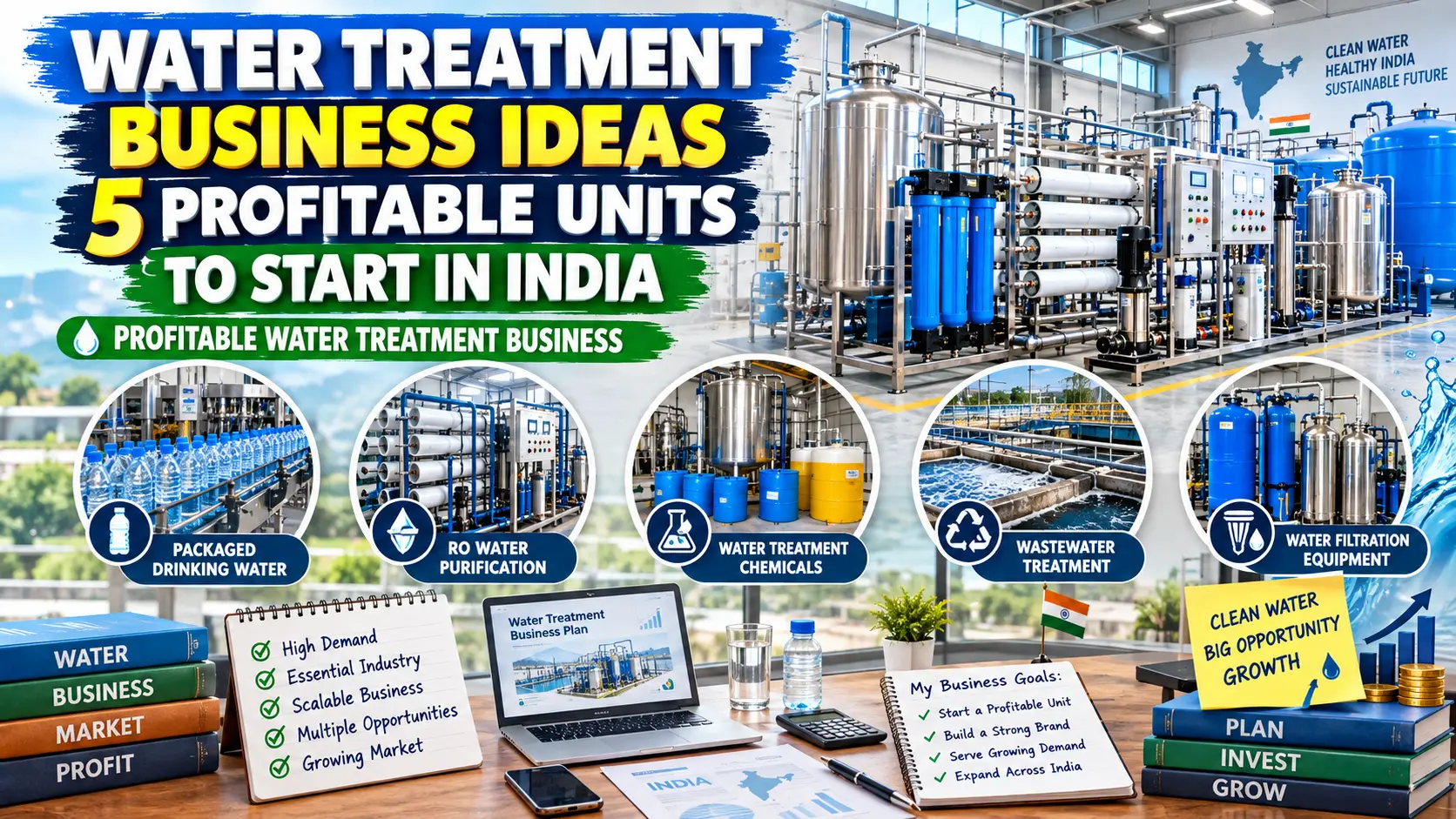
The growing demand for water treatment solutions is exploding in many industrial, commercial and residential applications where water scarcity and contamination is becoming an issue. The MSME segment is growing and producing RO (Reverse Osmosis) membrane systems, UV disinfection units, iron removal filters, and industrial effluent treatment plants, with widely varying technical quality.
If you’re a graduate of environmental or chemical engineering, and you’ve got a solid grasp of the technical fundamentals (membrane size, size of pressure vessels, chemical dosing calculations), you will always outperform the majority of the water equipment manufacturing industry, who are simply putting together purchased components without any depth of understanding. There is a regulatory driven demand for effluent treatment in industries as per the directives of the Central Pollution Control Board (CPCB) which is nearly recession proof.
View Full Project Details: Water Treatment Chemicals Manufacturing
7. Medical Device and Diagnostic Equipment Manufacturing
India’s medical device sector is growing rapidly, driven by rising healthcare spending, import substitution push, and the government’s PLI scheme for medical devices. Engineering graduates with biomedical, electronics, or mechanical engineering backgrounds are well-positioned to manufacture diagnostic equipment, monitoring devices, physiotherapy equipment, surgical instruments, or hospital furniture. Medical device manufacturing requires regulatory compliance with CDSCO (Central Drugs Standard Control Organisation) and ISO 13485 quality management — creating significant entry barriers that protect established MSME manufacturers. The Ministry of Health’s medical device policy and PLI scheme actively promote domestic manufacturing, and hospitals increasingly prefer locally made, service-backed products over imports.
Related Article: Indian Medical Devices Industry
8. Renewable Energy Components Manufacturing
The growth of renewable energy in India is pushing towards a target of 500 GW, creating a surge in demand for solar mounting structures, wind turbine components, inverter enclosures, battery management systems, and energy storage components. Faculty of engineering, such as Electrical, Mechanical or Electronics can produce specific parts related to the renewable’s energy supply chain. The beauty of component manufacturing is that orders are often in large volumes, repeatable and based on specifications — once your product is qualified as OEM you have a steady long-term revenue stream. Indian component manufacturers are given a preferential boost through various policies such as manufacturing incentives by the Ministry of New and Renewable Energy and domestic content policy in solar tenders.
Explore This Book: Solar PV Power and Solar Products Handbook
Import–Export Opportunity Analysis
The current global geopolitical situation offers India technical manufacturing businesses limitless export potential. Indian technical MSMEs with export quality certifications are now getting an unprecedented number of enquiries from worldwide buyers in search for suppliers in China. Invest India’s sector pages for electronics and chemicals show that foreign firms are investing in India to find manufacturing partners. Early access to export markets that most MSMEs in India do not get, is possible for engineering graduates who already receive ISO, CE, FDA, IATF certification for their businesses.
Indian MSME Success Stories in Technical Manufacturing
Bharat Forge is India’s largest forging company and the world’s leader in precision engineering and it was founded on the exact same principle – technical depth creates enduring competitive advantage. Chairman Baba Kalyani took a family company with a few employees to multibillion dollar company through relentless technical upgradation. The Minda family’s Minda Industries established itself as a big automotive component business out of a tiny workshop, and how it engineered precision and built OEM relationships to gain compounding advantage over time. A.S. Bhathena’s vision of an industrial equipment manufacturing company – with an engineering first culture – took off from a small manufacturing unit into a globally respected company in the field of industrial equipment for energy and environment.
Build a profitable business with the right idea
How NPCS Supports Engineering Entrepreneurs
At Niir Project Consultancy Services (NPCS) we offer professional Services related to Market Survey cum Detailed Techno-Economic Feasibility Reports (DPRs) for new Industry or Business Set-up. Our reports contain all the manufacturing processes, market research and demand analysis, process flow diagrams, product mix and capacity planning, machinery details, raw material details, complete project financials and profitability analysis. NPCS DPRs are ideal for engineering graduates who have technical ideas but expertise in business planning is limited.NPCS DPRs are suited for engineering graduates who have technical ideas but lack business planning experience and need market validation, financial modelling, and investor ready documentation to start their business with confidence.
Technical Manufacturing Business — Entry Barrier Analysis
| Business | Primary Skill Needed | Regulatory Barrier | Market Demand | Entry Barrier Level |
| CNC Precision Machining | Mech/Production Engg | Low-Moderate | Very High | High |
| Control Panel Manufacturing | Electrical/Electronics | Moderate | High | High |
| Specialty Chemicals | Chemical Engg | High | Very High | Very High |
| PCB Assembly | Electronics Engg | Moderate | Very High | High |
| Composite Materials | Materials/Mech Engg | Moderate | High | Very High |
| Water Treatment Equip | Env/Chemical Engg | Moderate | Very High | High |
| Medical Devices | Biomedical/Electronics | Very High | Very High | Very High |
| Renewable Energy Components | Electrical/Mech Engg | Low-Moderate | Very High | Moderate-High |
Conclusion — Your Engineering Degree Is a Manufacturing License
The Indian engineering graduate who decides to go into manufacturing instead of work is not taking a chance — he or she is making a well-informed bet on a country that is doing everything it can to develop its manufacturing sector. All of the 8 technical manufacturing business ideas featured in this article have one thing in common; they require a certain amount of technical knowledge to get into. That hardship is your safeguard. Develop technical ability, select niche, obtain certification, and deliver absolute quality discipline services to clients.
These businesses have high barriers to entry, which is what will prevent other businesses from being able to compete with the company. The more you know in manufacturing, the more you know. Begin creating yours now!