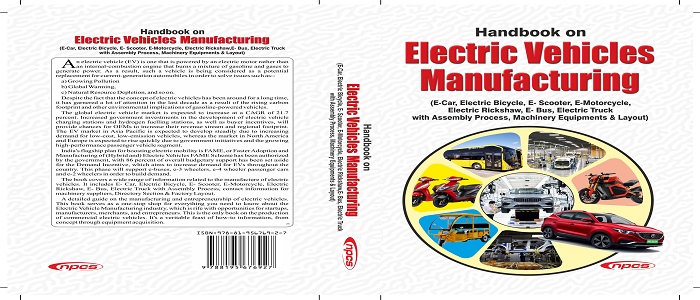

As the world shifts toward cleaner, more sustainable transportation, electric vehicles (EVs) are no longer a futuristic concept—they are a present-day revolution. India, driven by government initiatives like FAME (Faster Adoption and Manufacturing of Hybrid and Electric Vehicles) and increased environmental awareness, is experiencing a surge in electric vehicle adoption. For entrepreneurs, manufacturers, and investors, this evolving sector offers an enormous opportunity. Whether you aim to manufacture electric two-wheelers, cars, buses, or EV components, this handbook on electric vehicle manufacturing will guide you through the key steps, infrastructure needs, and strategic decisions involved in building an EV business.
Visit this Page for More Information: Start a Business in Electric Vehicle Industry
Contents
- 1. Understanding the EV Manufacturing Ecosystem
- 1.1. 1. Types of Electric Vehicles to Manufacture
- 1.2. 2. Core Components of EV Manufacturing
- 1.3. 3. Manufacturing Setup and Investment
- 1.4. 4. Licensing, Certification & Compliance
- 1.5. 5. Sourcing and Supply Chain Management
- 1.6. 6. Testing, Quality Control & R&D
- 1.7. 7. Branding, Distribution & After-Sales Service
- 1.8. 8. Government Incentives and Financial Support
- 2. Final Thoughts
Understanding the EV Manufacturing Ecosystem
The electric vehicle manufacturing industry isn’t just about assembling cars—it’s an ecosystem comprising battery technology, power electronics, motor production, software integration, and charging infrastructure. Each component offers a business opportunity. From building a full-fledged EV assembly line to supplying batteries, motors, or software systems, this sector allows entry at multiple levels based on budget and expertise.
Read Similar Articles: E- Vehicle Projects
1. Types of Electric Vehicles to Manufacture
Depending on market demand and your investment capacity, you can choose to manufacture one of the following types:
Electric Two-Wheelers (E-Scooters, E-Bikes): High in demand due to affordability and lower regulatory hurdles.
Electric Cars: A capital-intensive segment requiring advanced R&D and safety compliance.
Electric Commercial Vehicles (Buses, Trucks): Often government-backed with larger profit margins.
Three-Wheelers (E-Rickshaws, Cargo Loaders): Popular in urban and semi-urban logistics.
Each segment has its own target customer base, technology requirements, and compliance norms.
Read our Books Here: Electric Vehicles Manufacturing
2. Core Components of EV Manufacturing
To manufacture an electric vehicle, you need to integrate multiple sub-systems, each of which plays a critical role:
a. Battery Pack
The battery is the heart of any EV. Lithium-ion batteries dominate the market due to high energy density. Key factors include:
Cell Sourcing (local or imported)
Battery Management System (BMS) design
Thermal management for safety
Swappable battery architecture (for 2-3 wheelers)
b. Electric Motor
Motors convert electrical energy into mechanical motion. Common types include:
Brushless DC (BLDC) motors – used in scooters and bikes
Induction motors – used in larger vehicles
Permanent Magnet Synchronous Motors (PMSM) – efficient but expensive
Related Feasibility Study Reports: E- Vehicle, E-Rickshaw
c. Controller & Inverter
These components regulate the power supply from battery to motor and influence vehicle speed, efficiency, and safety.
d. Chassis & Body Design
You can design your own chassis or use existing templates. Materials range from aluminum alloys to reinforced plastics.
e. Software Systems
Includes dashboard displays, mobile app integration, vehicle diagnostics, and battery monitoring.
Download PDF: Handbook on Electric Vehicles Manufacturing
3. Manufacturing Setup and Investment
Setting up an EV manufacturing plant involves:
Location selection (industrial area with logistics support)
Land and building cost
Machinery: welding units, painting booths, assembly lines, testing equipment
Tooling and fixtures
R&D and testing labs
Labor and automation
Estimated investment:
?1–2 crore for small-scale e-bike or e-rickshaw manufacturing
?10–50 crore for mid-sized car or commercial vehicle manufacturing
Government subsidies and state-level EV policies can reduce initial capital requirements
A detailed guide on Handbook on Electric Vehicles Manufacturing
4. Licensing, Certification & Compliance
Manufacturing EVs in India requires adhering to several standards:
Central Motor Vehicle Rules (CMVR)
ARAI or ICAT certification (for safety, emission, and performance)
Pollution Control Board clearance
FAME-II Subsidy Compliance (for accessing incentives)
BIS certification for battery and electronic components
Additionally, you’ll need:
GST registration
Udyam MSME registration
Factory and labor law compliance
5. Sourcing and Supply Chain Management
The EV manufacturing ecosystem depends heavily on both domestic and imported components. Key supply chains include:
Battery cells and electronics – mostly imported from China, Korea, or Japan
Motors and controllers – can be sourced from Indian OEMs or built in-house
Plastic and fiber body panels
Wiring harnesses, tires, and lighting systems
To reduce dependency and costs, many companies are now investing in localizing component manufacturing under the “Make in India” initiative.
6. Testing, Quality Control & R&D
EVs must undergo rigorous testing for:
Battery performance
Vehicle safety
Crash testing
Range, charging time, thermal management
Setting up an in-house R&D facility or collaborating with certified labs like NATRiP, ARAI, or ICAT can enhance product quality and credibility.
7. Branding, Distribution & After-Sales Service
Once your EV is ready for market, strong branding and distribution networks are critical. You can:
Sell via dealerships or franchise models
Set up exclusive experience centers
Leverage e-commerce for two-wheelers
Partner with fleet operators or delivery companies
After-sales service is a key differentiator. Offering warranty, battery replacement, and remote diagnostics can increase customer trust.
8. Government Incentives and Financial Support
India offers several incentives to promote Handbook on Electric Vehicles:
FAME-II subsidies for manufacturers and buyers
State EV policies offering tax exemptions, capital subsidies, and land allotments
PLI Scheme for ACC batteries and auto components
Interest subsidies and soft loans via SIDBI, NABARD, and EV-focused NBFCs
Staying updated with policy changes can help in cost planning and expansion.
Final Thoughts
Electric vehicle manufacturing is not just a business—it’s a transformation. With increasing demand, supportive government schemes, and global environmental urgency, this is the perfect time to step into the EV sector. Whether you’re an established manufacturer looking to pivot or a startup founder passionate about clean mobility, EVs offer a sustainable, profitable path forward.
This handbook on electric vehicles manufacturing is just the beginning. Success lies in strategic planning, quality control, and a deep understanding of both technology and market needs. With the right vision and execution, you can become a key player in India’s electric revolution.
See More Links:
- Start a Business in Asia
- Start a Business in Potential Countries for Doing Business
- Best Industry for Doing Business
- Business Ideas with Low, Medium & High Investment
- Looking for Most Demandable Business Ideas for Startups
- Startup Consulting Services
- Start a Business in Africa
- Start a Business in India
- Start a Business in Middle East
- Related Videos
- Related Books
- Related Projects
- Related Market Research Reports
NIIR PROJECT CONSULTANCY SERVICES, DELHI
An ISO 9001:2015 Company
ENTREPRENEUR INDIA
106-E, Kamla Nagar, Opp. Mall ST,
New Delhi-110007, India.
Email: npcs.ei@gmail.com
Tel: +91-11-23843955, 23845654, 23845886
Mobile: +91-9097075054, 8800733955
Website: https://www.entrepreneurindia.co
https://www.niir.org