
India is one of the largest producers of agricultural produce in the world of fruits, vegetable, cereals, pulses, dairy etc. Yet, less than 10% of this produce is formally processed, and thus a huge potential for entrepreneurs and MSME investors. Setting up a food processing unit not only adds value to raw agricultural products but also cuts down on waste, meets surging domestic and international demand and provides a lucrative business model.
The food processing industry in India is quite unique as it gives the businesses scope to produce value-added products through branding, packaging, and distribution. Combined with government incentives and a secure supply of raw materials, the sector is a scalable opportunity for startups and investors.
Contents
- 1. Why Food Processing Is a Profitable Business Venture
- 2. Designating Your Food Processing Unit
- 3. Choosing the Correct Food Processing Segment
- 4. Licenses and Compliance With Regulations
- 5. Government Schemes & Incentives
- 6. Lessons from Leaders in the Industry
- 7. Conclusion
- 8. Commonly Asked Questions (FAQs)
Download the Full Guide: Handbook on Fruits, Vegetables & Food Processing with Canning & Preservation (3rd Edition)
Why Food Processing Is a Profitable Business Venture
Several factors contribute that food processing is a very lucrative industry in India:
- Increasing Urbanization and Changing Lifestyles: More knowledge about hygiene, safety of food, and nutritional values has resulted in the demand of high-quality processed foods.
- Growing Awareness of Food Safety and Nutrition: More knowledge about hygiene, safety of food, and nutritional values has resulted in the demand of high-quality processed foods.
- Export Potential: Indian processed foods is exported to more than 100 countries such as the Middle East, Southeast Asia, the US and Europe.
- Government Focus: The Indian government has a target of increasing the volume of processed food, which is a good indicator of strong structural demand for investments in the processed food sector.
Designating Your Food Processing Unit
A successful food processing business begins with Techno-Economic Feasibility Report (DPR). This report is important for investors, banks, and your project team. A good DPR should cover:
- Market Demand and competition analysis
- Raw material Sourcing and supplier networks
- Machinery, utilities and production processes
- Capital costs, operating costs and revenue projections
- Financial ratios such as IRR, NPV and payback period
Investing time into a well-crafted DPR reduces risks, eases the execution phase of the project as well as the chances for bank loans or government subsidies.
Access Complete Business Plan: Food Processing Unit (Pulses & Dates) Project Report
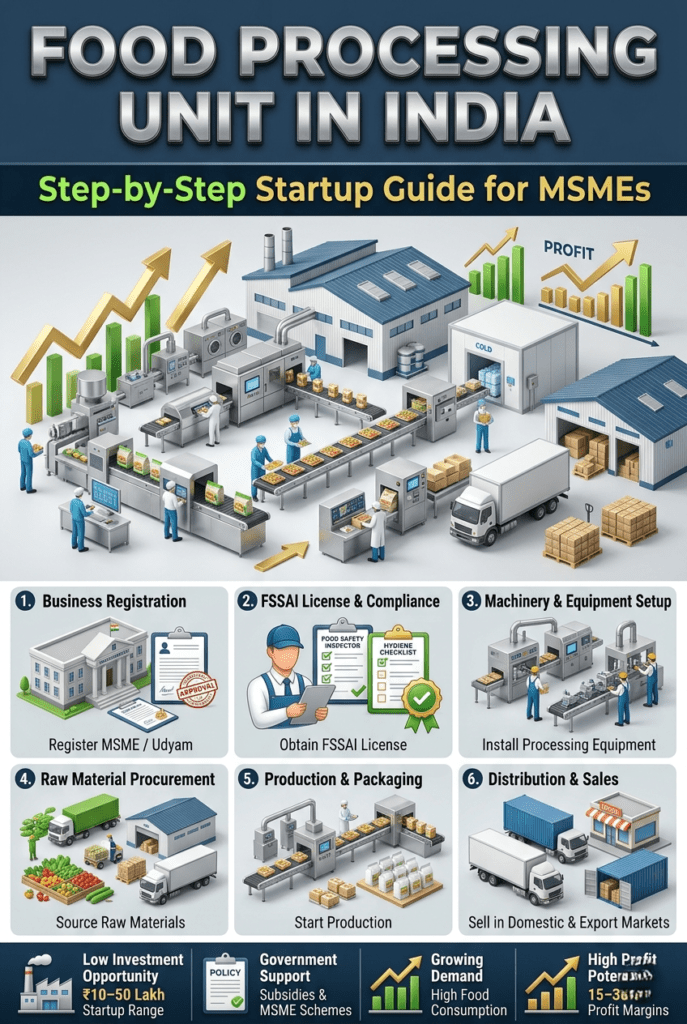
Choosing the Correct Food Processing Segment
Investment, operations, and market reach are impacted by the choice of the right product segment. Promising options include:
- Fruit and Vegetable Processing
- Products: Mango pulp, tomato paste, dehydrated garlic, pickles
- Investment: Small to medium scale units would need an investment of 20-50 lakh
- Advantages: High domestic and export demand Moderate capital investment
- Dairy Processing
- Products: Cheese, paneer, flavoured milk, whey protein.
- Investment: Rs. 50Lacs-2Crore (depending upon scale).
- Advantages: Urban demand, QSR (Quick Service Restaurants) chains; Cold chain infrastructures are necessary.
- Spice Processing and Blending
- Products: Spices (ground), packaged blends, masalas
- Victoria Marine Science Institute has noted that “fossil fuel use can be avoided through alternative technologies and processes that use alternative energy sources to perform the same function.”
- Advantages: India has a reputation for authentic spices; high margin segment
- Edible Oil Refining
- Products: Mustard oil, sesame oil, cold pressed oils
- Investment: The investment in small-scale units starts at₹50 lakh
- Advantages: Specialty oils command high prices; quality control is important
- Ready-to-Eat Foods
- Products: Breakfast cereals, instant soups, packaged khichadi, curry bases
- Investment: 1-5 crores rupees, based on scale of production & export potential
- Advantages: Urban convenience market; small-batch production – allows testing the market
Licenses and Compliance With Regulations
Compliance functions as an essential requirement for organizations that seek to operate their business activities legally while gaining access to different markets. The main licenses required for operation include the following:
- FSSAI Registration or License: This is mandatory for all food business
- APEDA Registration: Required, if it is export oriented units
- Original or Implementation of: Product-specific Certifications: EIC (marine products), AGMARK (agricultural products), ISO 22000 (quality management)
- Factory License: Under the Act of State Factories
- Environmental Clearance: Needed for large units and specific products
The organization should estimate all compliance expenses and required time periods before starting work because this process enables them to manage their project schedule and budget more effectively.
Government Schemes & Incentives
The Indian government is very supportive of food processing startups with subsidies, concessional loans, and incentive schemes:
- Pradhan Mantri Kisan Sampada Yojana (PMKSY): 35-50% subsidy for capital expenditure on processing units
- Production Linked Incentive (PLI) Scheme: Cash incentives for incremental sales of innovative products, organic and ready-to-eat products
- Food Processing Fund (NABARD): Concessional financing to infrastructure such as Mega Food Parks
- Start-up India & State Schemes: Tax exemptions, interest subvention, and capital subsidies
These schemes greatly lessen the financial burdens of startups as well as increase the rate of success.
Related Article: Top Government Schemes Driving India’s Food Processing Growth
Lessons from Leaders in the Industry
Successful entrepreneurs emphasise the importance of quality, branding and distribution:
- Kishore Biyani (Future Group): Harnessed the advantage of retail access and private-label food brands along with manufacturing excellence
- Nandita Hegde (ID Fresh Food): Being focussed on freshness, authenticity and cold chain discipline, commanding a premium pricing even in price sensitive markets
The takeaway: a sound market and distribution plan is as important as the quality of the product.
Conclusion
The establishment of a food processing unit in India serves as a business venture which enables entrepreneurs to create positive impacts on agriculture while they generate employment opportunities and deliver high-quality nutrition products. The entrepreneurs need to create a business plan which includes a detailed project report and needs to follow regulations while using their market approach to develop export-ready food operations.
The combination of increased domestic consumption, exports, government incentives, and planned approach makes food processing one of the most promising sectors for startups and MSME investors in India today.
Commonly Asked Questions (FAQs)
How much investment will it require the least?
Small scale spice or pulp of fruits unit starts from Rs. 20 – 50 lacs. Dairy and oil refining generally cost from Rs. 50 lakh – 2 crore. Ready-to-eat foods having export potential may require an investment of Rs. 1-5 crores.
How long does it take to go into production?
Typically, 12 – 24 months from concept to commercial production (includes DPR preparation, approvals, construction, machinery installation, and trial production).
What is the best export potential segment?
Spices, organic foods, processed rice, fruits, vegetables, and dairy products are the highest demand in the international market.
Is a DPR Required for Bank Financing?
Yes. Banks and financial institutions use DPRs as a measure of technical feasibility, financial projections and promoter credibility.
Can startups take part in government PLI schemes?
Yes, if they achieve minimum investment and incremental sales targets. Professional guidance increases chances of approval.