Furfural Alcohol Manufacturing Business in India
India’s specialty chemicals industry is approaching a powerful growth phase, backed by increased industrial demand, environmental regulations and global shift towards sustainable manufacturing. Among the new opportunities in this sector, the production of furfural and furfuryl alcohol has made one of the most lucrative business options for entrepreneurs and MSME investors who are looking to invest in a long-term industrial business.
Unlike consumer products, these chemicals work behind the scenes in important industries, including automotive, construction, pharmaceuticals and metal casting. Their demand is very much related to industrial production and infrastructure development so the business is relatively stable in comparison to many retail-based businesses. As India continues to build on manufacturing capacity and go further from imports, the possibility of domestic production of furfural and furfural derivatives is becoming more appealing.
Contents
- 1 What is Furfural and Furfuryl Alcohol?
- 2 Market Demands and Growth Potential
- 3 Raw Material Availability: India's Natural Advantage
- 4 Investment Requirements and Financial Viability
- 5 Support and Policy Environment of the Government
- 6 Opportunities in the Downstream Value Chain
- 7 Export Potential and Global Market Opportunities
- 8 Why Furfural Production Is High Potential Business in 2026
- 9 Frequently Asked Questions (FAQ)
Read More: Handbook On Chemical Industries (Alcohol Based)
What is Furfural and Furfuryl Alcohol?
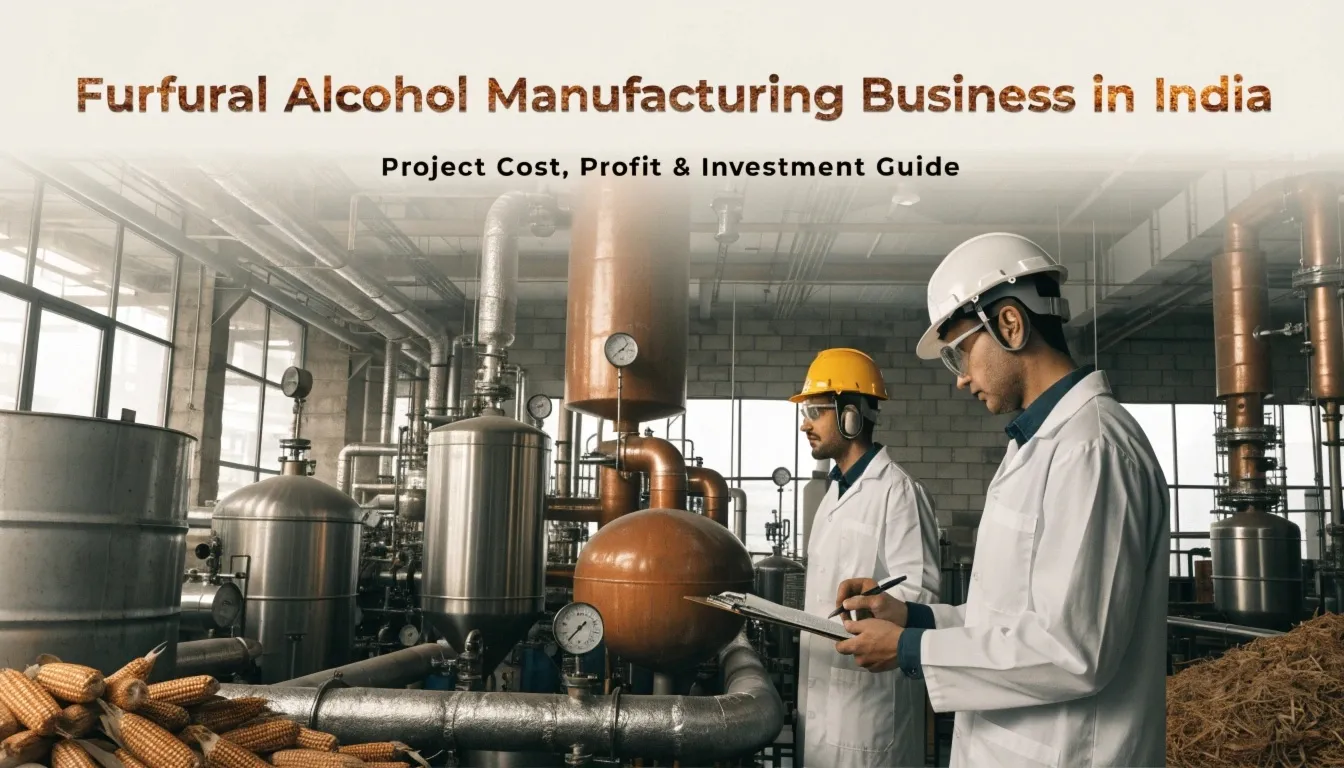
Furfural is an industrial chemical that is made from agricultural waste materials, which can include corncobs, sugarcane bagasse, and rice husk. These residues contain some natural compounds that can be converted into valuable chemicals by a controlled chemical process. The main derivative of furfural, however, is furfuryl alcohol which is widely used in the manufacturing of resins and industrial binders.
This process is especially relevant to India as the country produces huge amounts of agricultural biomass on a yearly basis. The waste material can be converted into a valuable industrial product through advanced processing methods which prevent its disposal by incineration or landfill. All financial gains of the business operation together with its commitment to environmental conservation practices make the business appealing to investors and environmental protection authorities.
Common uses of furfural and furfuryl alcohol are:
- Foundry Resins for Metal Casting
- Corrosion resistant coatings
- Pharmaceutical intermediates
- Agrochemical production
- Industrial Solvents and Specialty Chemicals
- Biofuel additives and green chemicals
These applications guarantee that demand in various sectors is maintained.
Read More: Polyvinyl Alcohol Manufacturing Guide
Market Demands and Growth Potential
The global market of furfural and furfuryl alcohol is steadily growing with the rise in industrial activity rate and the shift towards bio-based chemicals. While the growth rate is moderate the demand is consistent and reliable, which tends to be more important to manufacturing businesses than rapid but unpredictable growth.
India is an especially good opportunity because a large part of domestic demand is still being met with imports. This means that new manufacturers can get into the market with an existing customer base and not have to wait for demand to develop. Industries such as automotive manufacturing, infrastructure development and heavy engineering depend to a large extent on casting and moulding processes, which are directly dependent on furfuryl alcohol.
Key demand drivers include:
- Expansion of infrastructure and constructions
- Growth of the automobile and engineering industries
- Increasing demand for environmentally friendly chemicals
- Government focus on domestic manufacturing
- Increasing export opportunities
Since such drivers are linked with long-term industrial growth, the market outlook is bright.
Raw Material Availability: India's Natural Advantage
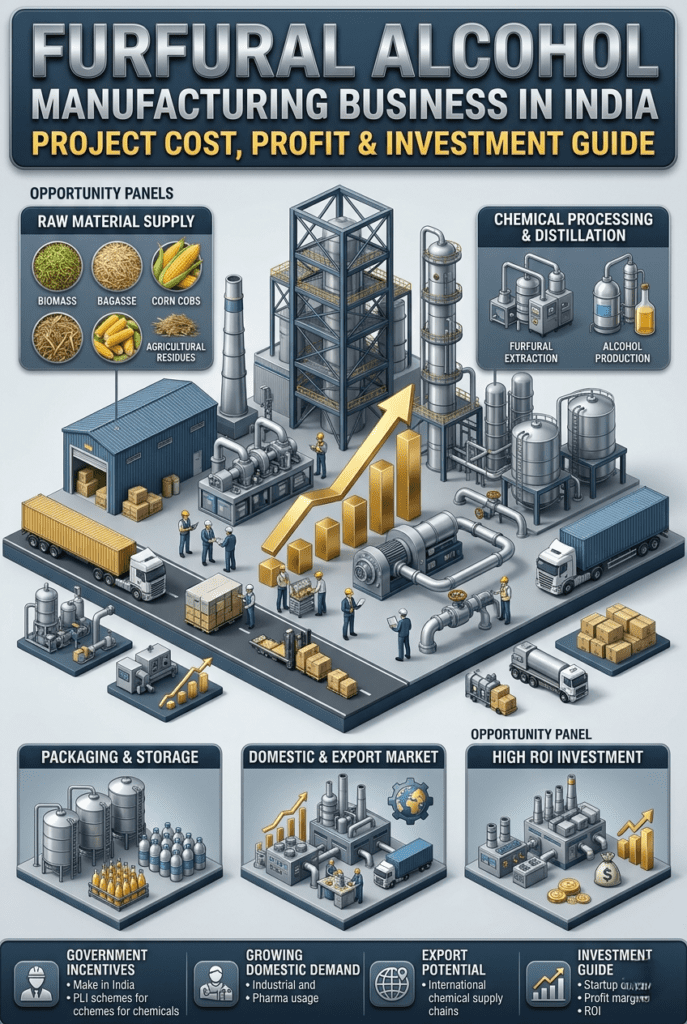
One of the most powerful reasons for launching a furfural manufacturing business in India is the availability of low-cost raw material. Agricultural residues are widely available in rural and semi-urban areas and at often considerably lower prices than international benchmarks. This results in a natural advantage in cost for local manufacturers and better profitability.
Plant establishment requires optimal conditions that exist in areas which produce large quantities of agricultural products. Locating the facility near farms or sugar mills cuts down on transportation costs and ensures a constant supply of raw materials all year round.
Best raw materials used for furfural production:
- Corncobs
- Sugarcane bagasse
- Rice husk
- Wheat straw
- Agricultural biomass
States where sugarcane and maize are being grown on a large scale are especially suited for such business as they provide the availability of raw materials as well as the supportive industrial infrastructure.
Read More: Alcoholic and Non-Alcoholic Beverages
Investment Requirements and Financial Viability
The investment level to set up a furfural manufacturing plant depends on the production capacity, choice of technology and integration degree. A small scale unit can be set up with moderate capital investment whereas larger integrated plants need high capital investment with more profitability.
In general, total project cost incorporates project costs pertaining to land, machinery, utilities, and working capital. Of these components, plant and machinery make up the largest portion of the investment as chemical manufacturing involves using special equipment and safety systems.
Read More: Startup Selector
Typical range of investment for various plant sizes:
- Small scale plant: Rs. 8 crores to Rs 15 crores
- Medium-scale plant -₹15 crore to ₹35 crore
- Integrated plant with furfuryl alcohol production: Rs 30 crores to Rs 60 Crores
From the financial point of view, the business is said to be stable and predictable when efficiently managed. Profit margins are generally healthy because of the low price of raw materials, and industrial demand.
Support and Policy Environment of the Government
Government policy has become more favourable for industries that consume waste from agriculture and encourage domestic manufacturing. The financial assistance programs together with infrastructure development projects of the MSME framework provide support to new manufacturing units. The programs work to establish new businesses while they also develop India’s manufacturing capabilities.
The central government provides various initiatives which state governments supplement by offering tax breaks and reduced land and electricity costs for industrial projects. Businesses that help the environment are often rewarded for their contributions to the cause, so the manufacture of furfural is especially appealing from a policy point of view.
Common forms of government support are:
- Capital investment subsidy
- Low-interest loans
- Tax benefits and exemptions
- Land and infrastructure support –
- Export promotion incentives
These incentives can take a big toll off in the first stages of the business.
Opportunities in the Downstream Value Chain
Another important benefit of going into the furfural business is the large number of products that can be developed from the base chemical. This flexibility gives the entrepreneurs an opportunity to expand their operations gradually and increase profitability over time. Instead of being limited to one product, manufacturers can branch out into several areas of the chemical industry.
Some of the major downstream products of furfural are:
- Furfuryl alcohol
- Furan resins
- Tetrahydrofuran (THF)
- 2-Methylfuran
- Furoic acid
Each of these products provides for different industries, which helps to lower the business risk and stabilize the revenue.
Export Potential and Global Market Opportunities
India’s competitive production costs make furfural and furfuryl alcohol attractive export products. Many developed countries are moving towards bio-based chemicals because of new environments regulations, opening new opportunities for manufacturers in developing countries. With the right quality standards and reliable supply chains, Indian companies can effectively compete in international markets.
Exporting also offers financial benefits over and above direct sales revenue. Business growth receives support from government incentives and international sales revenue which together increase overall business profitability. Most manufacturers begin their export operations within three years after establishing their companies because they maintain consistent production standards.
Why Furfural Production Is High Potential Business in 2026
The industry has received increased attention because three factors which include economic and environmental and technological elements are currently affecting it. Industrial demand is strong, raw materials are plentiful and government policies are conducive. The global market currently moves toward renewable and sustainable chemical solutions which provide long-term business growth potential.
Main reasons for entrepreneurs are coming into this area :
- Stable industrial demand
- Low-cost raw materials
- Incentives and subsidies from the government
- Export potential
- High scalability
- Environment-friendly production
These factors combined make furfural production one of the best industrial businesses for new entrepreneurs.
Frequently Asked Questions (FAQ)
How much does it cost to set up a furfural manufacturing business?
The minimum investment required is normally between -8 Crore to 15 Crore for a small scale plant based on capacity and location.
Is it profitable to manufacture furfural in India?
The business can achieve profit margins between 15% and 30% when the organization uses efficient management practices and purchases raw materials at market prices.
What raw materials are used in the production of furfural?
The most common raw materials are corncobs, sugarcane bagasse, rice husk and other agricultural residues.
So, which state is best to start a furfural manufacturing plant?
The states of Uttar Pradesh and Maharashtra and Karnataka and Bihar and Madhya Pradesh constitute ideal regions because they possess both strong agricultural output and developed industrial systems.
How long does it take to build a furfural plant?
The full process of setup typically takes between 18 and 24 months, including approvals, construction and equipment installation.