
A Profitable Industry Hidden in Waste
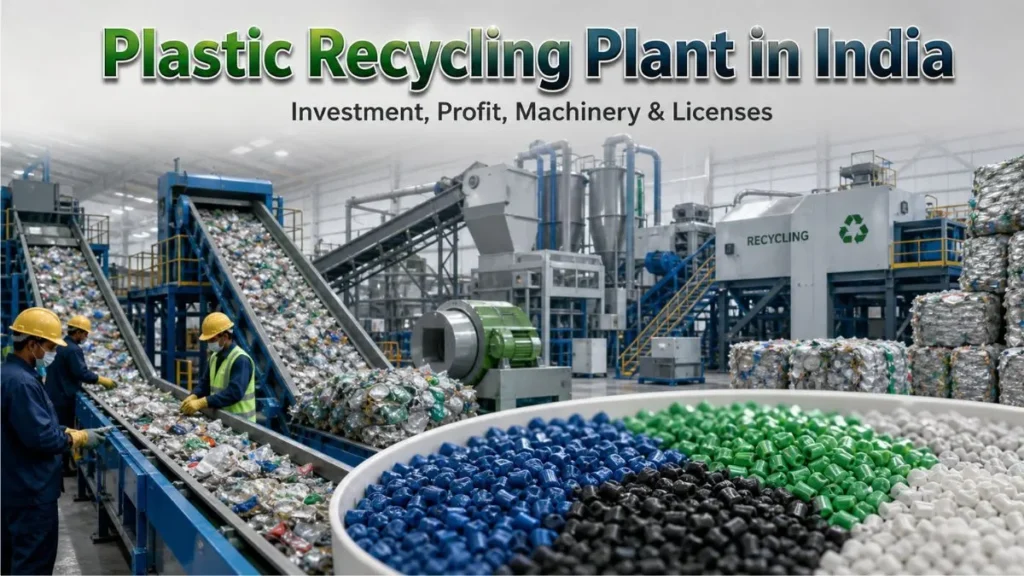
Plastic recycling plant in India has become one of the most viable and future oriented manufacturing ventures. Millions of tonnes of plastic waste are generated in India annually, yet much of it continues to go unprocessed or informally managed. Meanwhile, recycled plastic is now a legal requirement of the industries because of the environmental policies, such as Extended Producer Responsibility (EPR).
This discrepancy between the production of waste and industrial need has provided a good business opportunity. Entrepreneurs no more deal with the garbage: they are constructing lucrative manufacturing plants that transform plastic scrap into industrial raw material.
A properly designed recycling facility can bring about constant revenue every month and growth over time with moderate investment.
Download the Full Guide: Medical, Municipal and Plastic Waste Management Handbook
Why Plastic Recycling Is Growing Rapidly in India
There are three key reasons as to why the plastic recycling demand in India is on the rise. To begin with, the consumption of plastics is increasing annually because of the growth of the packaging, e-commerce, and FMCG. Second, recycling facilities are not well developed. Third, companies are being compelled by government regulations to use recycled plastic.
The important drivers are:
- Stringent EPR (Extended Producer Responsibility) policies.
- Rising demands on rPET, rHDPE and rPP in industries.
- Lack of qualified recycling facilities.
- Growing export of recycled granules.
Due to these reasons, recycled plastic is now a stable industrial good and not an act of waste management.
Types of Plastic Recycling Plants You Can Start
The first thing to do before initiating it is the selection of the appropriate kind of plastic recycling business. All the categories vary in terms of machinery requirements, level of investment and profit margins.
The most popular option is PET recycling as it transforms bottles into flakes or granules that can be utilized in the textile and packaging industries. Recycling of HDPE is also applied to the recycling of products such as pipes, containers and industrial packaging. Automobile parts and molded plastic products are recycled through PP.
The types each have their benefits, although the majority of small entrepreneurs choose PET or HDPE due to the stable demand and simplified operations.
Get Detailed Project Report (DPR): Plastic Waste Recycling Plant
Investment Required to Start the Business
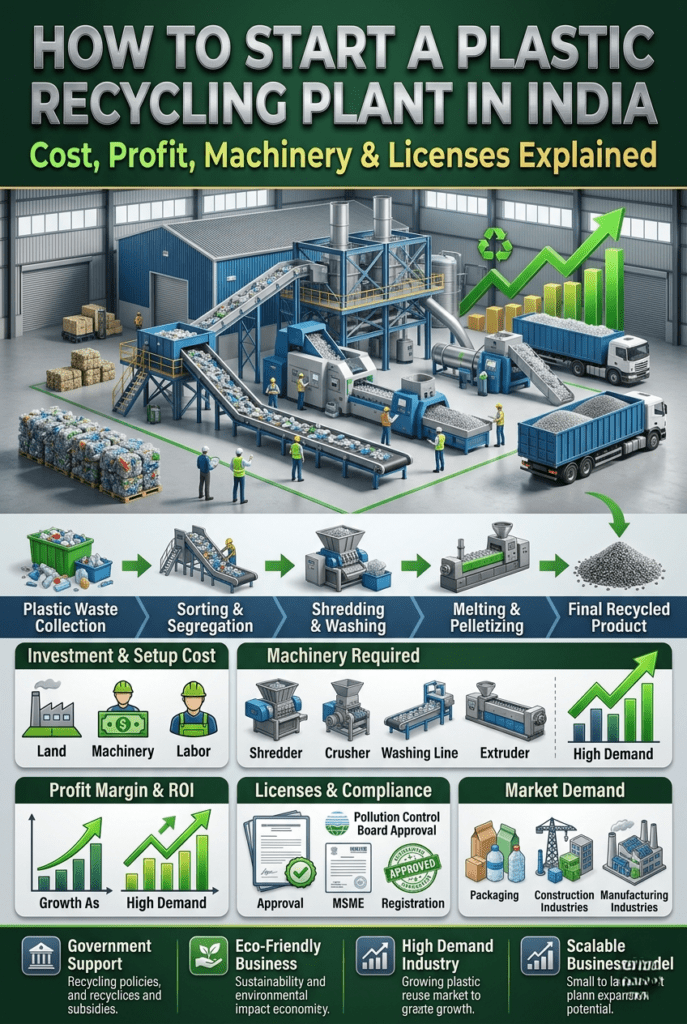
The investment is based on the size of production and level of automation. About 500 kg per day is a small recycling plant that needs ₹25 lakh to ₹40 lakh. The medium-scale plant may cost ₹70 lakh to 1.1 crore.
The key items of cost are machinery, infrastructure, working capital, and compliance establishment. A great number of entrepreneurs begin by leasing industrial sheds to take the edge off the start-up cost.
Machinery and Production Process
The process of a plastic recycling plant has a basic yet organized production system. It starts with the collection and sorting of plastic waste to eliminate undesired materials. The plastic is sorted and then the granulator machine is used to shred the plastic into small pieces.
Then the substance is thoroughly washed to get rid of dirt, labels and impurities. After cleaning it is dried with mechanical or thermal dryers. The plastic is then melted using an extruder machine to form long strands of the dry plastic. Such strands are sliced into minute pellets, and they are the end product.
Main machinery used in a recycling plant includes:
- Shredder or granulator
- Washing line (float sink tank and friction washer)
- Dryer system
- Extruder machine
- Pelletizer unit
This arrangement is the main component of the whole recycling process.
Raw Material Supply Strategy
One of the most significant aspects of this business is raw material. No efficient production is possible without a constant supply of plastic waste.
Plastic waste is generally obtained through:
- City garbage collection systems.
- Scrap traders (kabadi networks)
- Industrial plastic waste
- FMCG packaging waste.
- EPR-based corporate contracts
Among them, EPR agreements are the most consistent as the companies are legally obliged to guarantee recycling goals. This establishes a relationship in the long run between recyclers and brands in terms of supply.
Build a profitable business with the right idea
Licenses and Legal Requirements.
The establishment of a plastic recycling plant must have appropriate legal approvals in order to be in line with environmental and industrial regulations. The important registrations are MSME Udyam registration, GST registration, factory license and pollution control board clearance.
Also, you will need to be registered as a plastic waste processor under the EPR regulations when you intend to deal with big corporate clients.
Approval may require a few weeks or few months based on the state and quality of the documentation.
Profitability and Business Potential
Recycling of plastics is a good manufacturing enterprise due to the steady demand and steady prices.
Prices of recycled plastic granules range between 40 and 90 per kg, based on the quality and type. A small plant can earn monthly between 10 lakh and 7 lakh rupees when running at 60 percent capacity and with full capacity, the plant can earn much more.
The average profit margins are 18-25 percent. Profitability is further enhanced when it is added to EPR credit income.
When the business is maintained effectively, it tends to gain back initial investment in 2.5 to 4 years.
Government Support and Financial Assistance
Indian government encourages recycling companies in its sustainability initiatives. There are a number of schemes that relieve entrepreneurs of financial load.
The major support systems are PMEGP subsidies, CGTMSE collateral-free loans, and MUDRA financing of small units. Most states also have other incentives such as electricity subsidies, tax incentives and industrial land support to green industries.
With such schemes, first time entrepreneurs are now able to venture into the recycling business with ease.
Related Article: How to Start Pulp-Based Beverage Packaging Unit in India (Plastic Ban Opportunity)
Role of NPCS in Setting Up the Plant
NIIR Project Consultancy Services (NPCS) is significant to assist entrepreneurs in establishing plastic recycling facilities in India. It is a reputable consultancy firm that prepares elaborate project reports and feasibility studies in manufacturing firms.
NPCS offers systematic advice which entails financial planning, machinery choice, plant layout, and investment analysis. Banks and other financial institutions extensively use their reports in granting business loans.
This is particularly helpful in the case of new entrepreneurs as it minimizes the errors of planning and provides a clear picture on the viability of the project before capital is invested in it.
Future of Plastic Recycling in India
The future of recycling of plastic in India is very bright. The regulation of the government is getting tougher whereby industries are now obliged to use greater recycled material. Simultaneously, businesses are embracing the concept of sustainability and this raises the need of using recycled plastic.
It is one of the most stable manufacturing sectors in India with recycled plastic demand projected to soar by 2030.
Conclusion
The business of establishing a plastic recycling facility in India is a good business prospect with a combination of profitability and sustainability. This industry has a potential of long-term stability and growth with growing demand, and stringent environmental rules and regulations, as well as government support.
By doing due planning, having good machinery and with professional advice of organizations such as NPCS, any entrepreneur can develop a successful and expandable recycling company in India.
Frequently Asked Questions (FAQ)
Q1. What is the estimated cost of setting up a plastic recycling facility in India?
A small plant will cost 25-40 lakh depending on the capacity and machines.
Q2. Is recycling of plastic a profitable business?
Yes, it has predictable profit margins ranging between 18 and 25 with other EPR income opportunities.
Q3. Which is the greatest challenge of this business?
The biggest issue here is to maintain steady supply of raw materials and quality of the products.
Q4. Am I required to have government approvals?
Yes, pollution control permission, MSME registration, GST and factory license is expected.
Q5. What is NPCS?
NPCS is a consultancy firm that offers project reports, feasibility studies and technical advice on the establishment of manufacturing companies in India.