
All – Time Profitable Manufacturing Businesses with Low & Medium Investment
Starting a business can be both exciting and overwhelming, especially for beginners looking to enter the manufacturing sector. While large-scale manufacturing may demand significant investments and complex infrastructure, there are several small to medium-scale profitable manufacturing ideas that can be launched with limited capital and basic resources. With the right business plan, raw materials, and market strategy, even beginners can establish successful manufacturing enterprises. Top Profitable Manufacturing Ideas to Start Small and Grow Fast The manufacturing industry remains a strong pillar of any economy, offering excellent opportunities to those who want to produce goods instead of simply trading them. Whether you’re setting up a plant at home or a small workshop, several ideas offer low-risk, high-profit potential and can be scaled up as your business grows. Below are some of the most profitable manufacturing ideas tailored for new entrepreneurs. 1. Candle Manufacturing Candle production is a low-investment manufacturing idea with good profit margins. Candles are no longer used only for lighting but have become a lifestyle product used for decoration, aromatherapy, religious purposes, and gifting. You can start with basic molds, wax, scents, and dyes, and expand by offering designer or customized candles. Profit Factors: Low setup cost High demand during festive seasons Suitable for home-based manufacturing 2. Agarbatti (Incense Stick) Making Agarbatti manufacturing is a simple and highly profitable manufacturing business. It requires minimal machinery and raw materials like bamboo sticks, aromatic compounds, charcoal powder, and binders. With high usage in religious and spiritual practices, agarbatti has a steady market throughout the year. Key Points: Manual or semi-automatic machines available Huge domestic and export potential Government schemes support small-scale units 3. Handmade Soap Manufacturing Handmade or organic soap making has gained popularity due to the rise in eco-conscious and chemical-free lifestyles. This business is not only profitable manufacturing but also allows creativity in design, fragrance, and packaging. Entrepreneurs can start small, selling through local markets or online platforms. Why It’s Profitable: Increasing demand for organic personal care Customization adds value Requires only basic ingredients like oils, lye, and herbs 4. Paper Bag Manufacturing With the ban on plastic bags in many areas, paper bags have become a necessary alternative. Manufacturing paper bags is a sustainable and profitable manufacturing venture, especially for beginners looking to combine social responsibility with business. A small unit can produce bags for groceries, fashion outlets, food delivery, and more. Profit Drivers: Growing environmental awareness Recyclable product with wide applications Easy to automate for scaling 5. Disposable Paper Plate & Cup Production Disposable tableware like paper plates and cups is always in demand for events, street food vendors, and institutions. These are produced using hydraulic machines that press paper into various shapes. The materials used are cheap and easily available, making this an excellent profitable manufacturing choice for newcomers. Advantages: High consumption in rural and urban areas Quick ROI due to high turnover Machines are compact and affordable 6. Detergent Powder Manufacturing Detergent powders are a daily-use product across households. This industry offers one of the most profitable manufacturing opportunities because of its consistent demand. You can start with basic mixing equipment, ingredients like soda ash, LABSA, and sodium silicate, and then move towards more sophisticated formulations. Highlights: Established demand across all income groups Easy raw material sourcing Small units can produce multiple variants (laundry, dishwashing) 7. Packaging Box Manufacturing Every product that gets manufactured needs packaging. The demand for sturdy and attractive packaging has made box manufacturing a strong contender in the profitable manufacturing segment. You can specialize in corrugated boxes, gift boxes, or customized e-commerce packaging. Reasons to Start: Used across all industries (food, pharma, electronics, fashion) Opportunity to tie up with local brands Automation possible at a moderate scale 8. Spice Powder Production India is one of the largest spice producers, and there’s a constant need for processed spice powders. Starting a small profitable manufacturing unit to grind and package spices like turmeric, chili, and coriander can cater to local and global markets. Hygiene, taste, and brand trust play a big role in consumer preference. Profit Potential: High usage in every household Export possibilities Easy to scale with local farmer sourcing 9. LED Bulb Assembly LED lighting has replaced traditional lighting solutions due to energy efficiency and long lifespan. Beginners with some technical interest can venture into LED bulb assembly. Kits and training are available, making it a practical profitable manufacturing business for tech-savvy individuals. Benefits: Green energy focus fuels demand Scope for B2B and government tenders Margins improve with bulk production 10. Pickle and Jam Production Pickles and jams are traditional food products with high emotional value and regional taste. This business allows the use of local fruits and vegetables, preserving them using simple techniques. A home kitchen can be your initial factory for this profitable manufacturing idea. Reasons It Sells: Easy to enter with local recipes Relatively low startup costs Popular on online platforms for homemade goods Getting Started with Profitable Manufacturing Before jumping into any business, beginners should take time to do market research, understand legal requirements, and draft a business plan. Here’s how to begin: Research and Select a Niche – Analyze what’s in demand locally or online. Choose a product with consistent market needs. Create a Small Budget Plan – Most of the mentioned businesses can start under ?1–5 lakhs. Arrange Licenses and Compliance – Register your business, get necessary licenses (FSSAI, GST, MSME Udyam), and follow safety norms. Choose the Right Equipment – Start with semi-automatic or manual equipment to reduce costs. Market Your Product – Use digital platforms, exhibitions, and local events to promote your goods. Optimize for Profit – Focus on reducing production costs, sourcing raw materials locally, and minimizing waste. Final Thoughts Starting a profitable manufacturing business as a beginner is not just possible, it’s highly achievable with the right approach and dedication. Many successful entrepreneurs began from small home-based setups and scaled into full-fledged factories. The key is to choose a product that aligns with market demand, your budget, and your long-term
How to Start a Betel Nut Processing Business – Supari Business in 2026
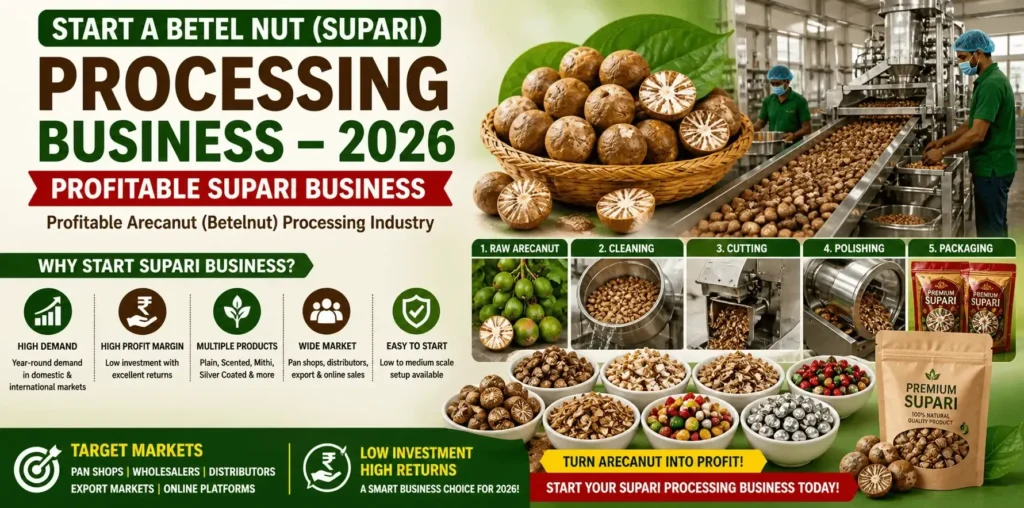
If you’re looking to enter a traditional and profitable agro-based industry, it’s time to start a Betel Nut Supari Processing Business. Betel Nut, also known as areca nut, is widely consumed in India and Southeast Asia in various processed forms – supari, scented supari, gutkha base, and pan masala mix. With a consistently high demand in both rural and urban areas, entrepreneurs can start a Betel Nut processing business to generate sustainable income while adding value to a readily available raw agricultural product. Understanding the Betel Nut Market The decision to start a Betel Nut processing business is backed by the product’s deep cultural roots and high consumption rate in India, Bangladesh, Nepal, and parts of Southeast Asia. India is one of the largest producers and consumers of Betel Nut, making it an ideal base for setting up processing units. As the nut is used in various forms—raw, boiled, dried, flavored, and roasted—it offers scope for product variety, regional customization, and brand development. The demand for premium-quality processed supari is growing in urban markets, where packaging, hygiene, and flavor profile make a big difference in consumer choice. This allows entrepreneurs to position their brand differently even in a saturated market. Types of Betel Nut Processing When you start a Betel Nut processing business, you can choose from several processing methods: 1. Boiled Supari: Nuts are boiled and dried to enhance shelf life and create a soft chewable texture.2. Dried Supari (Chali): Sun-dried whole nuts are cut into thin slices and packed raw or roasted.3. Flavored Supari: Processed slices are coated with sugar, menthol, spices, or cardamom for use in pan masala.4. Masala Supari: Prepared by mixing with saffron, silver leaf (varak), or special aromatic blends.5. Roasted Supari: Dried slices are roasted for enhanced taste and shelf life. Each variant caters to different regional tastes and age groups, offering wide market penetration if you start a Betel Nut processing business with a diverse product line. Raw Materials and Machinery Required To start a Betel Nut processing business, you need access to quality raw areca nuts sourced from Kerala, Assam, Karnataka, or North-Eastern states. In addition, you’ll require: Betel Nut cutting machines (manual or automatic) Roasting pans or driers Flavor mixing drums Polishing and grading machines Weighing and sealing machines Hygienic packaging material (pouches, jars, boxes) A small unit can be start with basic machinery under ?5 lakhs, while an automated plant may require ?10–25 lakhs depending on scale and quality expectations. Processing Flowchart Here’s a simplified workflow to start a Betel Nut Supari processing business: Procurement of raw nuts Cleaning and sorting Cutting into uniform pieces Drying or roasting Flavor mixing (optional) Polishing and grading Packing and labeling The process can be modified based on your product line—raw, flavor, or premium aromatic supari. Regulatory and Legal Considerations Before you start a Betel Nut Supari processing business, obtain the following: FSSAI license (Food Safety and Standards Authority of India) GST registration Factory license or Udyam registration (for MSME benefits) Trademark for brand protection Pollution control board NOC (if required) Ensure hygiene and food safety compliance to gain trust and scalability in both wholesale and retail markets. Target Market and Distribution Strategy Your target audience includes: Retail pan shops Wholesale grocery traders Pan masala manufacturers Online customers through e-commerce platforms Institutional buyers like hotels, wedding caterers, and snack companies A strong regional distribution network combined with smart packaging and branding can help your products reach Tier 1 and Tier 2 cities. Once your unit gains traction, you can start a Betel Nut Supari processing business with multiple product categories and premium offerings. Profitability and ROI The profit margin in the Betel Nut Supari processing business ranges from 20% to 35% depending on scale and processing type. Raw dried supari has lower margins but high volumes, while flavored or premium supari has higher margins and branding potential. On average, small units can recover investment within 12–18 months. Branding and Product Innovation With growing health awareness, customers are shifting to hygienic and well-packaged alternatives. If you start a Betel Nut Supari processing business with a focus on cleanliness, attractive design, and varied flavors, your brand can command higher retail prices. You can also experiment with: Sugar-free supari for diabetic consumers Herbal or ayurvedic variants Paan flavor infusions Gift packs for festivals and weddings Export Potential Processed Betel Nut has strong export demand in Nepal, Bangladesh, Myanmar, UAE, and other countries with Indian diaspora. You can register with APEDA, get IEC (Import Export Code), and connect with global buyers via platforms like Alibaba or IndiaMART to take your products global. Conclusion To Nut or Supari processing business is to invest in a time-tested, culturally ingrained, and consistently profitable agro-processing venture. With low capital requirements, scalable infrastructure, and strong demand across regions, this business is ideal for entrepreneurs looking to enter the FMCG and agro-based sector with minimal risk. References and Useful Government / Institutional Links The following official government and institutional resources are recommended for further reading and for direct application to the schemes discussed in this article. Startup India – Official Portal –https://www.startupindia.gov.in/ Ministry of Micro, Small & Medium Enterprises (MSME) –https://msme.gov.in/ Udyam Registration Portal –https://udyamregistration.gov.in/ Department for Promotion of Industry and Internal Trade (DPIIT) –https://dpiit.gov.in/ Small Industries Development Bank of India (SIDBI) –https://www.sidbi.in/ MUDRA / PMMY Official Portal – https://www.mudra.org.in/ CGTMSE Official Portal –https://www.cgtmse.in/ Ministry of Micro, Small & Medium Enterprises –https://msme.gov.in/ JanSamarth Portal (Government Loan Schemes) –https://www.jansamarth.in/ Niir Project Consultancy Services (NPCS) –https://www.niir.org/ Contact Us
Production of Tissue Paper from Recycled Paper. Recycling of Waste Paper to Tissue Paper
sTissue paper is an essential product used in homes, offices, hospitals, restaurants, and countless other places around the world. Its popularity has steadily increased thanks to its convenience, softness, and hygienic qualities. However, the large-scale manufacturing of tissue paper using virgin pulp contributes to deforestation and environmental degradation. As a result, many eco-conscious entrepreneurs and small-scale manufacturers are exploring how to make tissue paper from recycled paper as a sustainable alternative. Recycling paper to make tissue paper not only conserves natural resources but also helps reduce waste and promotes a circular economy. The Sustainable Process of Making Tissue Paper from Recycled Paper In this comprehensive article, we will explore in detail how to make tissue paper from recycled paper, highlighting each crucial step in the production process, the equipment needed, and the environmental benefits. Whether you are an aspiring entrepreneur, an eco-friendly craft enthusiast, or a sustainability advocate, understanding how to make tissue paper from recycled paper will empower you to make a positive environmental impact. Understanding Tissue Paper and Its Uses Tissue paper is a lightweight, soft, and absorbent paper product that can be used for a variety of purposes including hygiene (toilet paper, facial tissues, paper towels), wrapping, packaging, and crafts. Its demand has grown exponentially with urbanization and rising living standards. Traditionally, tissue paper was produced from virgin wood pulp, but with increased environmental awareness, recycled paper has emerged as a preferred raw material. By repurposing discarded office paper, newspaper, or other post-consumer waste, manufacturers can significantly reduce their environmental footprint while satisfying the growing need for tissue products. Collecting and Sorting Waste Paper The first step in learning how to make tissue paper from recycled paper is collecting appropriate raw materials. Generally, waste paper is collected from households, offices, schools, and commercial establishments. However, not all waste paper is suitable for tissue paper manufacturing. It is crucial to sort the waste paper to remove materials coated with plastic, heavy ink, or adhesives, as these can negatively affect the softness and absorbency of the final product. High-quality white waste paper, like old office printing sheets, is ideal for making tissue paper. Once collected, the waste paper is manually or mechanically sorted to eliminate contaminants such as staples, pins, or plastic bindings. Proper sorting ensures that the recycled pulp will be of high enough quality for hygienic and soft tissue paper production. Pulping the Waste Paper After sorting, the next step in how to make tissue paper from recycled paper is pulping. The sorted waste paper is fed into a pulper, which is a large machine equipped with water and mechanical agitation to break down the paper fibers. During this process, water is added to the waste paper, and the mixture is vigorously agitated to break down the paper into a fibrous slurry called pulp. At this stage, various chemicals may be added to the pulper to help de-ink the fibers, brighten the pulp, and improve fiber separation. Enzymes or eco-friendly de-inking agents can be used instead of harsh chemicals to make the process more environmentally friendly. The pulping process usually takes a few hours, depending on the quality of the waste paper and the desired softness of the tissue paper. Cleaning and Refining the Pulp Once the pulp is formed, it is transferred to a cleaning and refining stage. Here, screens and centrifugal cleaners remove any remaining large contaminants such as bits of plastic, metal, or sand. Additionally, flotation tanks or washing systems are used to remove ink particles and other fine impurities. For tissue paper production, the pulp often undergoes a bleaching stage to improve its whiteness. If you want a more eco-friendly tissue paper, you can opt for Totally Chlorine Free (TCF) or Process Chlorine Free (PCF) bleaching methods, which are safer for the environment and human health. The refined pulp is then adjusted for consistency, with water content regulated to create the right slurry for paper formation. Forming the Tissue Paper Sheet After cleaning, the pulp is pumped onto a paper machine’s forming section, which includes a moving wire mesh belt. The thin pulp slurry is evenly spread onto this belt, where water is rapidly drained by gravity and suction, forming a continuous wet sheet. This sheet passes through a press section to remove excess water and then moves to the drying section, where heated cylinders or air hoods dry it further. To achieve the desired softness and lightweight feel, the tissue sheet is usually creped. Creping involves scraping the semi-dry tissue sheet off a drying cylinder with a doctor blade, which causes the paper to wrinkle slightly and increases its bulk and flexibility. This is a signature property of high-quality tissue paper. Converting and Finishing Once the tissue sheet is formed, it is wound into large jumbo rolls. These rolls are then transferred to converting machines, which cut, fold, emboss, and package the tissue paper into the final product—whether facial tissues, toilet rolls, or napkins. Embossing is often done to improve the product’s softness and strength while also giving it an attractive look. For instance, many branded tissue papers feature decorative embossing patterns that make them visually appealing and more absorbent. Finally, the finished tissue paper products are packed, labeled, and prepared for distribution. Environmental Benefits of Recycling Paper into Tissue One of the most important reasons to learn how to make tissue paper from recycled paper is the positive environmental impact. Conventional virgin pulp production contributes to deforestation, uses large amounts of energy and water, and creates chemical pollutants. In contrast, recycled paper tissue manufacturing: Reduces demand for virgin wood pulp, conserving forests Uses less energy and water than virgin pulp processes Diverts waste paper from landfills Lowers greenhouse gas emissions Promotes a circular economy By embracing recycled tissue paper production, you are contributing to a more sustainable and responsible manufacturing process. Setting Up a Tissue Paper Production Unit Entrepreneurs must carefully plan their tissue paper production unit using recycled paper for commercial-scale manufacturing. A typical recycled tissue paper manufacturing unit
21 New Manufacturing Industries Expected to Grow in the Next 10 Years in India
India is steadily transforming into a global manufacturing hub, with technological innovation, sustainability goals, and demographic shifts creating a fertile ground for new industries. As India aims to achieve a $5 trillion economy and beyond, many emerging sectors are poised to drive the next wave of industrial growth. These opportunities are not just about producing goods but about reshaping the future of manufacturing itself. Here is a deep dive into 21 emerging manufacturing sectors that will shape India’s industrial future by 2035. India’s 21 Emerging Manufacturing Sectors for 2035 1. Electric Vehicle (EV) Manufacturing As the country targets net zero emissions by 2070, electric vehicles are expected to lead the transportation revolution. From batteries to EV components and charging infrastructure, this sector is attracting billions in investment. The government’s FAME-II scheme and state-level incentives will drive mass-scale EV production, creating enormous opportunities for local manufacturers. 2. Green Hydrogen Production Equipment India has set its eyes on becoming a global leader in green hydrogen. As hydrogen emerges as a clean energy carrier, the equipment and components manufacturing industry around electrolysers, storage tanks, and fuel cells will thrive, helping industries decarbonize. 3. Semiconductor Manufacturing The chip shortage during COVID-19 highlighted the need for semiconductor independence. India’s semiconductor mission and new chip fabrication projects in states like Gujarat and Tamil Nadu will drive local manufacturing of high-end chips, powering industries from electronics to defense. 4. Drone and UAV Manufacturing Drones will revolutionize agriculture, defense, logistics, and disaster management. With relaxed drone rules and PLI (Production-Linked Incentive) schemes, India is pushing for local design and assembly of UAVs, creating a promising future in this emerging manufacturing sector. 5. Renewable Energy Components India has an ambitious target of 500 GW of renewable energy capacity by 2030. Manufacturing solar panels, wind turbine parts, inverters, and associated balance-of-system equipment will be crucial, fostering a complete green manufacturing ecosystem. 6. Advanced Battery Manufacturing Beyond EVs, advanced batteries will power everything from home energy storage to grid-scale applications. Lithium-ion, solid-state, and newer chemistries will attract massive investments, encouraging both startups and established players to enter this domain. 7. Biotechnology and Biomanufacturing The post-pandemic world has created opportunities for biotech-based manufacturing, including vaccines, enzymes, and fermentation-based industrial products. India’s skilled scientific workforce will help this sector emerge as a global force. 8. Robotics and Automation Systems As labor costs rise and precision requirements grow, robotics will transform Indian factories. From industrial cobots to AI-driven assembly lines, manufacturing these systems locally will cut costs and build technological independence. 9. Aerospace Components India’s expanding defense and space programs will create a vast demand for aerospace components manufacturing. High-precision parts, avionics systems, and composite materials are expected to see a surge in local production. 10. 3D Printing and Additive Manufacturing Additive manufacturing is revolutionizing prototyping, spare parts, and even medical implants. As 3D printers become more sophisticated and affordable, Indian manufacturing will see significant adoption across industries, reducing turnaround times and increasing customization. 11. Textile Recycling and Circular Fashion With global customers demanding sustainable apparel, textile recycling and circular fashion manufacturing will take off in India. Technologies to recycle polyester, cotton, and blended fabrics will create a whole new circular economy within textiles. 12. Medical Devices Manufacturing India has been importing a large portion of its high-end medical devices, but with the PLI scheme, local manufacturing of diagnostic equipment, implants, and surgical tools is growing. This will reduce import dependence and make healthcare more affordable. 13. Agro-Processing Equipment India’s food processing industry is expected to double in value by 2030. This requires new-age agro-processing equipment — from smart sorters to automated packaging lines — creating opportunities for manufacturers to modernize India’s food value chain. 14. Defence Equipment Manufacturing With a growing defence budget and “Make in India” push, India is ramping up local manufacturing of military equipment, small arms, ammunition, and surveillance systems. The sector is expected to see steady growth, with the potential to become a significant exporter. 15. Water Purification and Wastewater Recycling Systems Given India’s water stress, manufacturing advanced water treatment, desalination, and greywater recycling equipment will be critical. This sector is set to grow rapidly as industries and municipalities adopt cleaner water practices. 16. Smart Consumer Electronics India is becoming one of the largest consumer electronics markets in the world. Smart TVs, wearables, IoT-enabled devices, and connected appliances will create fresh opportunities for domestic manufacturing, reducing import reliance. 17. Chemical Recycling Facilities Plastic waste is a global menace, and chemical recycling is a promising solution. India’s manufacturers can create plants and machinery to chemically break down plastics into reusable feedstocks, contributing to a circular plastics economy. 18. Specialty Chemicals Manufacturing With China’s slowdown in specialty chemicals, India can capture this market. Sectors like pharma intermediates, agrochemicals, and coatings will see new manufacturing clusters emerge, supporting exports. 19. Smart Grid Equipment India’s power infrastructure is modernizing rapidly. Manufacturing smart meters, intelligent transformers, and grid automation systems will be vital to enable efficient energy distribution and renewable integration. 20. Construction Tech and Green Building Materials As urbanization soars, sustainable and prefabricated construction materials will be in high demand. From green cement to advanced insulation, manufacturers will see a boom in these eco-friendly solutions. 21. Quantum Computing Hardware Though still nascent, India is investing in quantum technologies. Manufacturing quantum processors, cryogenic systems, and related hardware can position India on the frontlines of next-generation computing. Why These Emerging Manufacturing Sectors Matter The rise of these 21 emerging manufacturing sectors is a reflection of India’s evolving policy framework, skilled workforce, and a rapidly digitizing economy. Traditionally, India’s manufacturing was dominated by textiles, steel, and automobiles. But the next decade will be defined by sustainability, automation, and technology-led industries, leading to higher value addition and job creation. The government’s push through policies like “Atmanirbhar Bharat” and Production-Linked Incentive schemes has strengthened the confidence of global and local investors. Sectors like semiconductor manufacturing and advanced batteries are receiving special focus to cut import dependence and boost domestic capabilities. In addition, India’s growing domestic market ensures
Production of PROM Fertilizer (Phosphate Rich Organic Manure) in India, Complete Guide of 2026
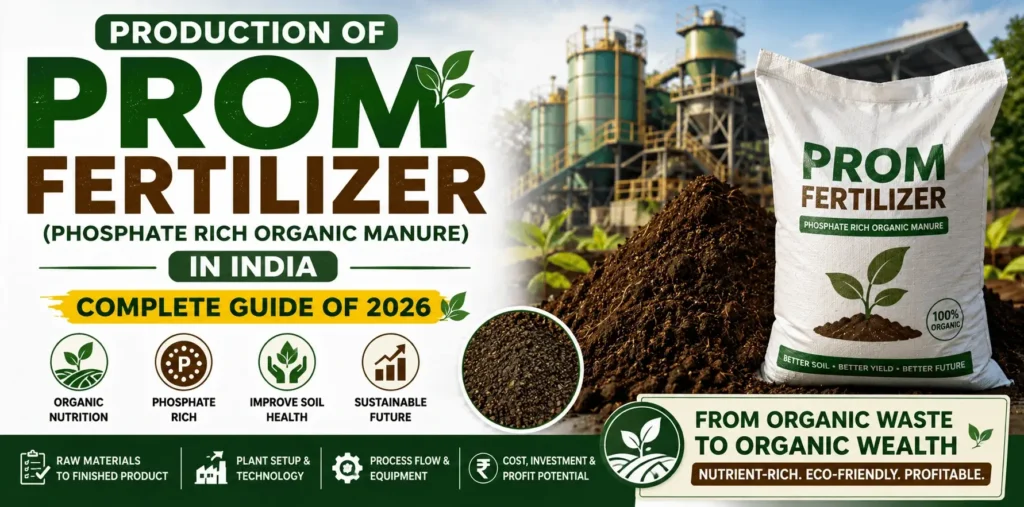
India’s agriculture sector is at a turning point, with increasing awareness about sustainable farming practices and the importance of nutrient-rich fertilizers. Among various organic and biofertilizers, Phosphate Rich Organic Manure (PROM) is emerging as a smart and scalable solution for modern farming needs. As a substitute for conventional phosphate fertilizers like DAP and SSP, PROM is both eco-friendly and cost-effective. The increasing demand for sustainable and efficient PROM fertilizer has opened smart investment opportunities in PROM production—especially at scale. Understanding PROM Fertilizer and Its Role in Agriculture PROM, or Phosphate Rich Organic Manure, is an eco-friendly fertilizer that provides essential nutrients, especially phosphorus, to plants. It is made by enriching organic manure (such as compost, press mud, or farmyard manure) with rock phosphate. This process enhances the bioavailability of phosphorus to plants and significantly improves soil health over time. PROM fertilizer not only helps reduce dependency on chemical fertilizers but also addresses the issue of phosphorus fixation in Indian soils, making it an ideal option for sustainable agriculture. Its use leads to better crop yields, improved soil texture, and a reduced carbon footprint—aligning with the goals of climate-resilient farming. For entrepreneurs and agribusiness investors, entering the PROM fertilizer production industry presents smart investment opportunities because of rising awareness, government support, and the growth of organic and natural farming in India and globally. Step-by-Step Process to Produce PROM Fertilizer at Scale To build a sustainable and scalable PROM fertilizer business, a clear understanding of the production process is essential. Here’s a simplified yet detailed overview: 1. Raw Material Procurement To produce PROM fertilizer, the primary raw materials required are: Organic base material (compost, cow dung, press mud, poultry litter) Rock phosphate (minimum 18% P?O? content) Microbial inoculants (phosphate-solubilizing bacteria) Optional: Additional minerals (neem cake, biochar) and stabilizers Organic matter should be well-decomposed to ensure microbial activity and easy mixing with rock phosphate. Rock phosphate should be finely ground (typically 100 mesh) for better assimilation. 2. Material Mixing and Blending Mixing is a critical stage in PROM fertilizer production. Use a horizontal mixer or ribbon blender to mix the organic base with rock phosphate in a specific ratio (generally 70:30 or 60:40, depending on desired phosphorus levels). Uniform mixing ensures even distribution of nutrients. Microbial inoculants are added during or after mixing to enhance phosphate solubilization. This bio-activation process is what differentiates PROM from conventional phosphate fertilizers. 3. Curing and Maturation After blending, the material is left to cure in windrows or aerated piles for about 30 to 45 days. During this period: Microbial activity solubilizes phosphate Temperature rises due to decomposition Regular turning (every 4–5 days) maintains aeration Moisture is maintained at 40–60% for optimum microbial growth This step is crucial for stabilizing the product and improving nutrient availability. 4. Drying and Sieving Once curing is complete, the PROM fertilizer is dried either under sunlight (for small operations) or using mechanical dryers (for large-scale units). After drying, it is sieved using vibrating screens to achieve a uniform particle size (typically 1–4 mm granules). Uniformity in size is essential for easy application and packaging. It also enhances the marketability of the product. 5. Granulation (Optional) For better handling and commercial appeal, many producers choose to granulate PROM fertilizer. Granulation can be done using a pan granulator or drum granulator. This step adds value to the final product and allows for precise nutrient control. Binders like molasses or bentonite clay are used during granulation to ensure proper shape and strength of the granules. 6. Packaging and Distribution The final PROM fertilizer is packed in HDPE or laminated bags (25kg or 50kg sizes), labeled with nutrient content, production batch, and compliance details. A well-branded product builds credibility and trust among farmers. Distribution strategies include: Direct sale to farmers Collaboration with agri-input dealers Online marketplaces Bulk supply to cooperatives and state departments Key Business Considerations for Scaling PROM Fertilizer Production To tap into smart investment opportunities in PROM fertilizer manufacturing, entrepreneurs must carefully assess key operational and strategic aspects: A. Land and Infrastructure Land requirement: Minimum 1 acre for a medium-scale plant Infrastructure: Shed, mixer units, curing area, storage, drying space Power & water supply: Continuous power and water availability is critical B. Machinery and Equipment Organic shredder and mixer Belt conveyors Curing platforms or windrow turners Sieving machine Granulation unit (optional) Weighing and packaging machines An investment of ?25–50 lakh can set up a mid-level plant with a 3–5 ton/day capacity. Government subsidies under the Fertilizer Control Order (FCO) and MSME schemes reduce the financial burden for new entrants. C. Manpower and Expertise PROM fertilizer production requires both skilled and unskilled labor: Skilled: Chemist or soil scientist, production supervisor Unskilled: 10–15 workers for handling, mixing, turning, and packaging Training in organic farming practices, composting, and microbial handling is essential for quality control. Regulatory Compliance and Licensing PROM fertilizer is regulated under the Fertilizer Control Order (FCO) in India. Before production begins, obtain: FCO certification from the State Agriculture Department BIS standards compliance (if applicable) Pollution Control Board clearance (for large plants) GST registration and MSME Udyam Registration Proper documentation and compliance enhance brand trust and facilitate bulk sales to government schemes and cooperatives. Market Trends and Smart Investment Opportunities With India aiming to double farmers’ income and reduce chemical inputs, the demand for organic and biofertilizers like PROM is rising fast. Here’s why investing in PROM production is a smart investment opportunity: Policy support: Subsidies for organic inputs and compost Market demand: Rise in organic farming, export-oriented agriculture Low competition: Still a developing niche compared to chemical fertilizers Environmental benefit: Carbon credits and sustainable certifications Scalability: Easy to expand with modular equipment and partnerships Investors can also diversify into vermicomposting, liquid biofertilizers, and integrated nutrient management services alongside PROM production for better ROI. Challenges and Risk Mitigation Like any Agri-based industry, PROM fertilizer production faces some challenges: Raw material availability (especially rock phosphate) Awareness among farmers Seasonal demand fluctuations Quality assurance and trust-building To address these risks: Build local supply chains for organic
Senegal, West Africa – Profitable Project Ideas for Starting Business.
Senegal, a West African nation with a steadily growing economy and a young, dynamic population, is emerging as a hotspot for entrepreneurial opportunities. With increasing urbanization, digital transformation, and government support for small and medium enterprises (SMEs), the country presents a fertile ground for innovation and business development. Whether you are a local aspiring entrepreneur or an investor from abroad, understanding the profitable startup projects in Senegal can help you tap into the market effectively. Emerging Sectors Fueling Startup Growth in Senegal One of the main drivers of economic activity in Senegal is its youthful population. With over 60% of its citizens under the age of 25, the demand for modern services, digital platforms, and employment-generating ventures is high. This demographic advantage, combined with Senegal’s strategic position as a gateway to West Africa, makes it a compelling destination for launching startups. Let’s dive into some profitable startup projects in Senegal that are trending in 2025: 1. Agritech and Sustainable Agriculture Startups Agriculture remains the backbone of Senegal’s economy. However, traditional farming practices often result in inefficiencies and low yields. Startups that introduce smart farming technologies such as drip irrigation, mobile platforms for market access, weather prediction tools, and organic farming solutions are increasingly profitable. Entrepreneurs can collaborate with local farmers to provide training, access to micro-loans, and supply chain support. By solving real problems and enhancing productivity, these startups not only turn a profit but also contribute to food security and rural development. Why it’s profitable: There’s a high demand for modern solutions, and the government supports agricultural innovation through grants and subsidies. 2. Renewable Energy Solutions Senegal experiences abundant sunlight year-round, making solar energy one of the most promising sectors. Startups focusing on off-grid solar solutions for rural areas, solar-powered irrigation, and home lighting systems are gaining traction. As the country aims to achieve universal access to electricity by 2030, energy startups are in a prime position to benefit from public-private partnerships and international climate funding. Why it’s profitable: High electricity demand, government incentives, and environmental concerns drive growth in this sector. 3. Digital Education and E-Learning Platforms Access to quality education remains a challenge in many parts of Senegal. In response, edtech startups that provide remote learning, vocational training, and language learning platforms are rapidly expanding. Entrepreneurs can create platforms in French and local languages, targeting students, professionals, and even farmers seeking agricultural training. Leveraging mobile accessibility makes these ventures inclusive and scalable. Why it’s profitable: High smartphone penetration and demand for skill-based education fuel continuous growth. 4. Mobile Fintech Solutions Financial inclusion is a major challenge in Senegal, especially in rural communities. Fintech startups that offer mobile banking, micro-loans, savings platforms, and mobile payment gateways are bridging the gap. A startup providing secure, user-friendly apps for peer-to-peer transfers, digital wallets, or cooperative savings groups can attract a massive user base. Why it’s profitable: Millions of unbanked citizens need access to digital finance, and the market is still unsaturated. 5. Waste Management and Recycling Businesses With increasing urbanization comes the challenge of managing waste. Startups involved in recycling plastics, turning organic waste into compost, or offering waste collection services in urban areas are solving critical problems. Social enterprises in this space can work with local municipalities and NGOs to scale their impact. Why it’s profitable: High environmental need, potential government contracts, and access to carbon credit schemes make this sector attractive. 6. Tourism and Cultural Experience Platforms Senegal is home to UNESCO heritage sites, rich music traditions, and beautiful coastal regions. As global travel rebounds, tourists are seeking unique, local experiences. Startups offering eco-tourism packages, cultural immersion tours, or platforms for local artisans to showcase and sell their crafts online can capitalize on this trend. Why it’s profitable: Strong tourism potential, especially from Europe and the diaspora community, drives consistent demand. 7. Healthtech and Telemedicine Startups Healthcare accessibility in remote areas remains limited. Healthtech startups offering teleconsultation, mobile diagnostics, and digital health records are reshaping the healthcare system. Additionally, affordable health insurance solutions for informal workers can be developed using mobile platforms. Why it’s profitable: A growing middle class and increasing smartphone use make digital health solutions both viable and essential. 8. Local Fashion and Textile Brands Senegal has a strong cultural identity tied to clothing and fashion. Startups that promote locally-made garments, African prints, and sustainable fashion are thriving. Creating an online marketplace for Senegalese designers or launching a brand that blends tradition with modern style can attract both local and international buyers. Why it’s profitable: There’s global interest in African fashion, and local artisanship is rich and under-marketed. 9. Urban Mobility and Delivery Services In urban centers like Dakar, traffic congestion and poor public transport create a demand for efficient mobility solutions. Startups offering e-scooter rentals, bike-sharing, or ride-hailing tailored to local conditions can thrive. Similarly, last-mile delivery services for groceries, medicine, and e-commerce products are booming post-COVID-19. Why it’s profitable: Rising urban population and e-commerce growth create consistent demand for these services. 10. Eco-Friendly Construction and Real Estate As cities grow, sustainable housing becomes essential. Startups that use eco-friendly materials, offer low-cost modular homes, or provide green building consulting are set to thrive. This aligns with global environmental goals and provides long-term value for developers and homeowners alike. Why it’s profitable: Real estate is always in demand, and sustainability attracts both consumers and investors. Final Thoughts on Profitable Startup Projects in Senegal As Senegal transitions into a knowledge-driven and digital economy, the opportunities for innovative entrepreneurs are boundless. The key to success lies in identifying real problems, crafting sustainable solutions, and leveraging government and international support systems. Among the profitable startup projects in Senegal, those that align with digital innovation, sustainability, and inclusivity are particularly promising in 2025. From agriculture to fintech, education to fashion, every sector offers a niche waiting to be tapped. To maximize impact and profits, aspiring entrepreneurs should invest time in understanding local needs, partnering with communities, and building scalable solutions. As more success stories emerge from the Senegalese startup
55 Most Profitable Food & Agri Startup Ideas for Micro, Small, Medium Scale Food Processing (Processed Food)
India, with its rich agricultural heritage and booming food sector, offers vast opportunities for small and medium-sized enterprises (MSMEs). Entrepreneurs are increasingly exploring food & agri startup ideas that promise both profitability and sustainability. With growing consumer demand for healthier options, organic produce, and innovative food services, this sector is ripe for innovation. From farm to fork, there are countless niches in Food & Agri Startup Ideas waiting to be tapped by creative minds who want to make a difference and build scalable businesses. Exploring the Best Food & Agri Startup Ideas for MSME 2026 The 2026 market is defined by three pillars: Transparency, Technology, and Taste. Today, food & agri startup ideas aren’t just limited to traditional farming or food stall, they include value-added products, agri-tech platforms, supply chain optimization, and export-focused manufacturing units. Consumers now demand to know exactly where their food comes from and how it was processed. This shift has expanded the scope of Food & Agri Startup Ideas beyond the field and into agri-tech platforms, eco-friendly manufacturing, and hyper-local supply chains. Below is a curated list of 55 high-impact ideas designed to inspire the next generation of Indian entrepreneurs. 1. Category 1: Modern Agricultural Farming & Precision Agriculture , 1. Organic Vegetable Farming High demand from urban consumers makes organic farming a profitable idea. Use compost-based fertilizers and cater to local organic stores and supermarkets. 2. Hydroponic Farming A modern technique where plants grow without soil, hydroponics is ideal for space-constrained urban areas and yields faster crops. 3. Mushroom Cultivation Low investment and high returns define this niche. Oyster and button mushrooms are especially popular in restaurants and homes. 4. Vertical Farming Utilize small urban spaces efficiently by growing crops in vertical layers. A great solution to the lack of farming land. 5. Beekeeping and Honey Production Natural honey is always in demand. Beekeeping is sustainable and helps in crop pollination, boosting the ecosystem. 6. Fish Farming (Aquaculture) Fish like Rohu and Catla are widely consumed in India. With proper setup and care, this business offers excellent returns. 7. Goat Farming Goat meat has a steady market. Start with a small herd and scale based on demand and grazing area. 8. Poultry Farming Egg and meat production are core elements of India’s food economy. Focus on hygiene and automation for better productivity. 9. Dairy Farming With rising milk consumption, small-scale dairy setups with 10–15 cows or buffaloes are viable and expandable. 10. Cold Storage Units India loses a large portion of its produce due to lack of cold storage. Setting up a small facility can support local farmers and food businesses. 11. Packaged Millet Products Millets are rich in nutrients and ideal for health-conscious consumers. Sell them as ready-to-cook packs or flour. 12. Tomato Processing (Puree/Ketchup) A small tomato processing plant can yield ketchup, puree, and sauces, which are popular in Indian and international markets. 13. Fruit Juice Manufacturing Fresh juices from mango, orange, or pineapple can be sold under a local brand name with organic or preservative-free tags. 14. Pickle Manufacturing Unit India’s pickle varieties have loyal fans. Explore regional recipes and package them in eco-friendly jars. 15. Papad & Namkeen Making Home-based or small units can produce these snacks, especially with automated rollers and frying machines. 16. Organic Tea & Herbal Infusions Tulsi, lemongrass, and moringa teas are trending globally. A small unit can create blends for niche markets. 17. Spice Powder Production Turmeric, chili, coriander, and more—buy from farmers, grind, and package under your brand. 18. Rice Mill with Packaging Buy paddy, mill it into rice, and sell it in branded bags. Target local or urban supermarkets. 19. Nut & Seed Butter Manufacturing Almond, peanut, and sesame seed butters are in high demand among fitness lovers. 20. Ready-to-Eat Meal Packs Create meal kits or frozen curries targeting working professionals, hostel students, and travelers. 21. Baby Food Manufacturing Parents seek organic, preservative-free baby foods. Make fruit and cereal-based products to meet this demand. 22. Gluten-Free Food Products Serve a niche market with celiac-friendly products—bread, snacks, and ready mixes. 23. Plant-Based Protein Snacks Pea protein chips, lentil-based puffs, and soy protein bars are ideal for gym-goers and athletes. 24. Vegan Cheese & Dairy Alternatives Use nuts, oats, or soy to make cheese and milk alternatives for lactose-intolerant or vegan customers. 25. Edible Cutlery Manufacturing An eco-friendly innovation—spoons, forks, and cups made from rice or wheat flour that can be eaten or composted. 26. Solar-Powered Food Dryers Build or supply units that help farmers or small processors dehydrate fruits, herbs, or vegetables with solar heat. 27. Organic Fertilizer Production Compost waste, add microbes, and package as organic fertilizer. An eco-conscious agri startup with recurring demand. 28. Drip Irrigation System Setup Provide design and installation services to small farmers looking to save water and increase crop output. 29. Mobile Soil Testing Kits Develop a mobile app + kit that helps farmers test soil quality and get fertilizer recommendations instantly. 30. AI-Based Crop Monitoring Tools Build AI systems using drones and cameras to monitor crop health, pest invasion, and yield projections. 31. Farm-to-Home Delivery Platforms Directly connect farmers with urban consumers, eliminating middlemen and boosting farmer incomes. 32. Local Farmer’s Market Franchise Set up or franchise weekend organic markets where small farmers sell directly to city dwellers. 33. Farm Equipment Rental App Allow farmers to rent tractors, harvesters, or drip kits via mobile apps—like Uber for farm tools. 34. Agricultural Drone Services Use drones for pesticide spraying, seed dropping, or yield mapping, helping large farms optimize operations. 35. Contract Farming Service Provider Bridge brands and farmers. You provide training, inputs, and buy-back guarantees to farmers under contracts. 36. Cattle Feed Manufacturing Blend corn, grain, and protein additives into nutritious cattle feed for dairy and poultry farmers. 37. Food Waste Composting Solutions Develop community-level composting systems using restaurant and household waste. 38. Culinary Herb Farming Grow herbs like rosemary, basil, oregano, and thyme for restaurants and premium food brands. 39. Indoor Microgreens Cultivation Microgreens have short growth
List of Profitable Business Ideas in Rubber Processing and Rubber Products Manufacturing Industry.
Rubber products manufacturing has emerged as a highly promising industrial sector due to its wide application across automotive, construction, healthcare, consumer goods, and industrial machinery. With the ever-growing demand for flexible, durable, and cost-effective materials, rubber-based products have become an essential component in modern production systems. The global shift towards sustainable and eco-friendly materials also opens up new avenues for biodegradable and recycled rubber products, making this industry ripe for innovation and entrepreneurship. Exploring Profitable Avenues in Rubber Products Manufacturing The rubber products manufacturing industry offers numerous profitable opportunities for entrepreneurs and small manufacturers. These opportunities range from daily-use household items to high-performance components for industrial use. Here’s a comprehensive look at some of the most profitable and scalable ideas in this sector: 1. Rubber Gaskets and Seals Rubber gaskets and seals are extensively used in automotive, plumbing, aerospace, and machinery sectors. These products help prevent leaks, maintain pressure, and reduce vibration. Manufacturing rubber gaskets involves precision molding and often requires specialized dies, but the investment is relatively moderate. Given their consistent demand across multiple industries, these products can be a steady source of revenue. Gasket and seal production in rubber products manufacturing is a long-term, scalable business that can expand with minimal added costs by diversifying into different shapes, sizes, and custom designs. 2. Rubber Floor Mats and Tiles With the rising focus on safety, hygiene, and aesthetics in both residential and commercial spaces, rubber flooring products have gained immense popularity. Gym mats, anti-fatigue mats, playground tiles, and industrial rubber flooring are examples of high-margin products in this category. The best part about this idea is the potential to use recycled rubber—particularly from old tires—making it not only cost-effective but also environmentally responsible. These floorings are durable, slip-resistant, and easy to clean, which enhances their utility and market appeal. 3. Automotive Rubber Parts Rubber products manufacturing in the automotive sector is a lucrative niche. Items such as rubber bushings, engine mounts, weather stripping, belts, hoses, and pedal covers are critical to vehicle performance and safety. With the growth of electric vehicles and two-wheelers, especially in developing markets, the demand for durable and efficient rubber parts is growing exponentially. The startup investment may include mold creation, high-precision machinery, and industry compliance certifications, but the returns are long-term and sustainable. Partnering with automobile OEMs (Original Equipment Manufacturers) or tapping into the aftermarket segment can amplify profits. 4. Rubber Bands and Latex Products Rubber bands, though simple, are used in large volumes across offices, industries, households, and agriculture. The manufacturing process is semi-automated and requires natural or synthetic latex. Similarly, latex gloves, balloons, and rubber tubing are essential products in the healthcare, education, and laboratory sectors. The global demand for latex-based rubber products manufacturing spiked during the pandemic and continues to remain strong due to hygiene awareness. Setting up a small-scale rubber band or glove manufacturing unit can yield impressive ROI with minimal investment. 5. Rubber Pipes and Hoses Rubber hoses and flexible piping solutions are indispensable in the agricultural, chemical, mining, and automotive industries. They transport fluids, gases, and slurries safely and efficiently. The types include hydraulic hoses, garden hoses, industrial hoses, and food-grade rubber hoses. Though the machinery and quality control standards are relatively stringent, the demand is consistent and less prone to market fluctuations. Investing in durable, high-pressure hose manufacturing with value-added features like UV resistance or chemical compatibility can set your product apart. 6. Reclaimed Rubber and Recycled Rubber Products One of the fastest-growing segments in rubber products manufacturing is the recycling and reprocessing of used rubber materials. Old tires, industrial rubber waste, and latex scraps can be reclaimed and turned into a variety of products like crumb rubber, rubber tiles, speed breakers, and mats. This business not only supports the circular economy but also qualifies for green manufacturing subsidies in many regions. With environmental regulations tightening globally, recycled rubber goods are increasingly sought-after, especially in eco-conscious markets. Reclaimed rubber businesses can also supply raw material to other rubber products manufacturing units, further diversifying income streams. 7. Rubber Bushings and Shock Absorbers Used heavily in the automotive, railways, and industrial machinery segments, rubber bushings and shock-absorbing mounts reduce vibration, enhance performance, and increase equipment lifespan. These components are generally manufactured through compression molding or injection molding techniques. The technical requirements are slightly advanced, but once the production setup is complete, manufacturing becomes streamlined. There is also a consistent aftermarket demand for replacement parts, making it a high-potential business within the rubber products manufacturing domain. 8. Medical and Surgical Rubber Products This niche includes items such as catheters, surgical gloves, rubber sheets, teats, enema kits, and stoppers. These products require medical-grade rubber and adherence to strict regulatory standards such as FDA, CE, or ISO certifications. However, the margins in this category are considerably higher due to the critical use and value-add of the products. Demand from hospitals, clinics, and diagnostic labs continues to rise globally, and local manufacturing can help reduce import dependency. Specialized medical rubber manufacturing can also open up export opportunities, especially for high-quality, sterilized items. 9. Footwear and Soles Rubber soles, flip-flops, and safety boots are essential in both urban and rural markets. With increasing awareness about comfort, style, and foot health, rubber footwear manufacturing offers an excellent business opportunity. India and many Southeast Asian countries have already become global hubs for rubber footwear exports. A small to medium-scale unit for rubber sandals or molded soles can be profitable if combined with creative branding and low-cost distribution. This model works particularly well in countries with a young demographic and strong retail penetration. 10. Rubber Toys and Teething Products This is a niche yet emerging field in rubber products manufacturing, particularly focused on child-safe and pet-friendly products. Natural rubber is preferred for making teething toys, squeaky toys, and stress balls. The market is growing among eco-conscious parents and pet owners looking for non-toxic, biodegradable alternatives. With the right designs, certifications (like BPA-free, FDA-approved), and branding, rubber toy manufacturing can target premium customers and even export markets.
List of Profitable Business Ideas in Wood and Wood Products Manufacturing Industry.
Wood has been one of the oldest and most versatile materials used by humankind, from the construction of homes to the creation of household items, art, and industrial components. In 2025, as sustainability and eco-consciousness take center stage in consumer behavior, the demand for eco-friendly and durable wooden products continues to grow globally. With modern tools, efficient production methods, and increasing export potential, wood product manufacturing is among the most promising and profitable sectors for entrepreneurs. This industry not only supports traditional craftsmanship but also integrates modern aesthetics and green design thinking. Why Start a Wood Product Manufacturing Business in 2025? There are several reasons why venturing into wood product manufacturing in 2025 makes business sense. First, the push towards sustainability has increased the demand for biodegradable and renewable materials, especially in construction, décor, furniture, packaging, and daily-use products. Second, the rising middle class in developing countries and the trend toward minimalist living in developed nations create a broad market for high-quality wooden products. Finally, governments across the world are supporting forest-based and MSME industries with subsidies, tax benefits, and technical support, making it an opportune time for startups. Below is a list of some of the most profitable wood product manufacturing ideas that can be started with varying levels of investment: 1. Wooden Furniture Manufacturing Furniture manufacturing continues to dominate the wood product manufacturing sector due to consistent demand across residential, commercial, and hospitality sectors. From beds and tables to modular kitchen cabinets and ergonomic office chairs, the scope is vast. Startups can specialize in custom-designed furniture, smart furniture with in-built tech, or eco-friendly bamboo-based alternatives. Profit Tip: Focus on sustainable wood like rubberwood, reclaimed wood, or engineered wood to tap into the green consumer market. 2. Wooden Packaging Products As the world turns away from plastic, wooden crates, pallets, boxes, and bins are becoming increasingly popular for logistics and export. Wooden packaging products are especially in demand in industries like agriculture, electronics, chemicals, and machinery, where strength and durability are essential. Low-Cost Entry: You can start with manual tools and scale gradually by investing in automation and precision cutting machines. 3. Handcrafted Wooden Home Décor Handmade wooden décor items like candle holders, carved mirrors, photo frames, wall art, and nameplates are witnessing high demand on platforms like Etsy, Amazon Handmade, and Flipkart. These products cater to a global audience interested in rustic, eco-friendly, or culturally rich interior accents. Export Potential: These items are small, lightweight, and ideal for e-commerce shipping, making them great for international markets. 4. Wooden Toys and Educational Kits The global resurgence of interest in Montessori education, STEM toys, and toxin-free playthings has pushed the popularity of wooden toys. Parents are moving away from plastic and opting for safer, more durable options. Educational kits made of wood are also popular among schools and homeschooling communities. Key Advantage: Low competition in niche designs and high emotional value make wooden toys a lucrative business idea. 5. Engineered Wood Products Engineered wood products like plywood, MDF (Medium Density Fiberboard), particle board, and laminated veneer lumber (LVL) are in great demand for use in construction, furniture, and modular interiors. This segment of wood product manufacturing is capital-intensive but highly profitable if scaled effectively. Tech Angle: Use automation and chemical treatment processes to produce moisture-resistant, termite-proof engineered wood variants. 6. Wooden Flooring and Wall Panels With rising demand for elegant interiors and eco-conscious architecture, wooden flooring, ceiling beams, and wall panels are gaining popularity in both residential and commercial spaces. Many modern builders and interior designers prefer using pre-finished wooden planks and panels for a luxurious, natural look. Niche Tip: Specialize in reclaimed wood flooring or thermally treated wood for added environmental value. 7. Wooden Kitchenware and Tableware Spoons, bowls, cutting boards, coasters, and spice boxes made of wood are increasingly preferred over metal or plastic in urban kitchens. Consumers love the aesthetic appeal, warmth, and sustainability of wooden utensils, especially when paired with minimalistic or rustic kitchen themes. Market Trend: Products made with neem or bamboo wood are popular due to their antibacterial properties and natural finish. 8. Custom Wooden Signage and Corporate Gifts Corporate and small businesses often order customized signage, engraved plaques, trophies, and wooden desk accessories for branding, events, or gifting. Laser-cutting and CNC machines allow entrepreneurs to offer intricate and personalized products at a premium price. Bonus Opportunity: Collaborate with branding agencies or event planners to get consistent orders. 9. Wooden Garden and Outdoor Products Wooden planters, benches, gazebos, birdhouses, and garden fences are ideal for homes, cafes, resorts, and public parks. This market is thriving due to urban gardening trends and a rising emphasis on outdoor aesthetics. Treated wood that can withstand outdoor conditions is particularly valuable. Revenue Strategy: Offer seasonal catalogs and combo packages for landscaping firms or housing societies. 10. Prefabricated Wooden Houses and Cabins Although high in investment, prefabricated wooden homes are becoming a viable business idea in regions with eco-tourism potential, hill stations, and off-grid living enthusiasts. These are easy to assemble, cost-effective, and blend well with nature, making them ideal for vacation rentals or resorts. Growth Insight: In India and Southeast Asia, glamping sites and resorts are turning to prefab wooden cottages for both aesthetics and convenience. How to Start a Wood Product Manufacturing Business Starting a wood product manufacturing venture in 2025 will require the right mix of planning, investment, technical knowledge, and marketing. 1. Identify Your Niche Select a product category based on your budget, skills, and target market. It’s wise to start small, validate the idea, and then scale production. 2. Legal Registration and Licensing Register your business as a sole proprietorship, partnership, or private limited company. Obtain licenses such as GST registration, factory license (if applicable), and pollution control clearance for larger units. 3. Setup and Machinery Depending on your chosen product, you will need cutting tools, sanding machines, polishing units, carving tools, or CNC routers. For handcrafted products, initial investment can be modest. 4. Sourcing Wood Ensure ethical and legal sourcing of raw
List of Profitable Business Ideas in Waste Management, Disposal and Recycling Industry.
In an era of rapid urbanization, rising consumerism, and climate consciousness, waste management has emerged as a critical issue as well as a lucrative business opportunity. As cities grow and consumption patterns change, the volume of waste generated — from households, industries, and agricultural activities — continues to rise. According to various studies, India alone generates more than 62 million tonnes of waste annually, with the number expected to double by 2047. While improper disposal of waste leads to serious environmental and health concerns, it also opens avenues for businesses that can turn waste into wealth. Entrepreneurs with vision and responsibility can tap into this growing sector through innovative models and sustainable practices. Top 10 Profitable Waste Management Business Ideas 1. Recycling Plant Setup Starting a recycling plant is one of the most profitable ideas under waste management. You can choose to recycle paper, plastic, e-waste, or metal, depending on the local availability of waste and the demand for recycled products. For instance, paper recycling can reduce deforestation while plastic recycling reduces pollution and creates reusable materials. With proper machinery, licensing, and logistics, recycling businesses can become long-term revenue generators. The key is to ensure high-quality segregation, efficient collection, and consistent supply chains. 2. E-Waste Collection and Disposal With the explosion of gadgets and electronic items, e-waste has become a growing concern globally. Devices like phones, computers, TVs, and appliances become obsolete within a few years, ending up in landfills where they release toxic substances. A business in e-waste management involves collection, dismantling, refurbishing, and safe disposal of electronic components. Valuable metals like gold, copper, and palladium can be extracted and resold, adding to profitability. Governments are increasingly supporting e-waste handling initiatives, making this business both ethical and rewarding. 3. Organic Composting Units Another eco-friendly and high-potential waste management business is composting. Organic waste from kitchens, gardens, and food markets can be processed into rich compost or vermicompost. These products are in high demand among farmers, gardeners, and organic food producers. Setting up small-scale composting units requires minimal investment and space, making it ideal for rural or semi-urban settings. Entrepreneurs can also create packaged compost products under a brand, increasing market value and outreach. 4. Waste Collection & Segregation Services Urban areas struggle with the first step of waste management: collection and segregation. You can build a business model around providing door-to-door garbage collection with proper segregation (wet, dry, recyclable). This service can be offered to residential societies, restaurants, commercial offices, and more. By partnering with local municipalities or recycling companies, you can streamline the transfer of waste to the appropriate treatment facilities. This model requires good logistics and employee management but can be scaled rapidly across neighborhoods and cities. 5. Plastic Waste to Fuel Conversion Innovative technologies now allow plastic waste to be converted into synthetic fuel such as diesel or gasoline through pyrolysis. This concept has picked up in various countries and is slowly entering the Indian market. Setting up such a plant involves some technical and environmental approvals, but the returns are promising. As the world looks for sustainable energy alternatives, this form of waste management presents dual benefits — reducing plastic pollution and providing clean energy. 6. Biogas Production from Organic Waste Food waste, animal manure, and agricultural waste can be used to produce biogas — a renewable source of energy that can replace LPG and electricity in rural areas. Establishing biogas plants can serve villages, dairy farms, and agro-based industries. The byproduct of this process, slurry, is also a good organic fertilizer. With increasing government support for clean energy, biogas production is becoming an attractive waste-to-energy business. Moreover, it encourages local employment and community involvement. 7. Upcycling and Waste Art Products Turning waste into functional or decorative products — also known as upcycling — is gaining popularity in urban markets. Old clothes, tires, bottles, cans, and scrap materials can be creatively repurposed into furniture, fashion items, showpieces, or home décor. This niche waste management idea not only reduces landfill pressure but also has high marketing appeal. Eco-conscious consumers prefer upcycled products that tell a story and reflect creativity. The business can be scaled through online stores or tie-ups with interior designers and handicraft shops. 8. Hazardous Waste Disposal Services Industries that deal with chemicals, paints, batteries, and medical equipment often generate hazardous waste. Such waste cannot be handled like regular trash and requires specialized treatment and disposal. Setting up a hazardous waste management service involves investment in safety equipment, trained manpower, and regulatory compliance. However, due to the lack of adequate services in many regions, this business can enjoy high margins and long-term contracts with industrial clients. 9. Textile and Fabric Waste Recycling With the rise of fast fashion and textile industries, fabric waste has become a major contributor to landfill pollution. You can start a business collecting leftover textile materials from garment manufacturers, tailor shops, or households. These fabrics can be shredded and used for making insulation materials, rugs, industrial rags, or even paper. Additionally, some startups focus on recycling fabric to create sustainable fashion. As awareness about sustainable fashion grows, this waste management niche can become highly profitable. 10. Medical Waste Management Hospitals, clinics, and diagnostic centers generate biomedical waste that poses serious health and environmental risks if not handled correctly. Starting a medical waste management service requires coordination with healthcare institutions, proper waste categorization, and adherence to biohazard safety norms. It’s a high-responsibility business, but due to stringent laws, the demand for reliable services is consistent. Investment in incineration or autoclaving units may be needed, but once established, it ensures steady and regulated income. Why Waste Management Business Makes Sense in 2025 The growing urban population and consumerist lifestyle mean waste is not going away anytime soon. Government policies are increasingly pushing for sustainability and extended producer responsibility (EPR), creating favorable ecosystems for entrepreneurs. Whether it is recycling, upcycling, composting, or energy conversion, waste management provides immense opportunities that align with both profit and purpose. Moreover, many of these businesses contribute