
How to Prepare a Techno-Economic Feasibility Report for a Bank Loan
Techno Economic Feasibility Report for Bank Loan The Rejection That Wasn’t About the Business In India, about 70% of MSME loan applications may be rejected not due to the strength of the business idea but because of the project documents. That number, often quoted in the Reserve Bank of India’s financial inclusion reports, is an unfortunate paradox – India has the capital, and the ideas are brought to the table by the nation’s entrepreneurs, but the paperwork doesn’t. Techno-Economic Feasibility Report (TEFR) is the document that forms the basis of all possible bank sanction processes. If you ask any MSME relationship manager from Punjab National Bank, Bank of Baroda or SIDBI, they will all reply the same: MSME feasibility report. It’s not about the entrepreneur’s enthusiasm. Not the opportunity pitch for the market. The report. In India, most first-generation entrepreneurs, who are rice mill owners in the state of Chhattisgarh, garment manufacturing in Tiruppur, cold storage investor in Agra, etc., take months to choose the equipment and negotiate land, and invest just two days in the report. That’s the exact opposite ratio. Poorly written TEFR will sink an otherwise good project. With a proper structure a one can sanction a ₹5 crore in 8 weeks. Here’s the inside scoop on what a bank-grade TEFR includes, how to assemble each section, and what sets it apart from the rejected documents that languish in a credit manager’s rejection bin. Related Article: Detailed Project Report (DPR) Consultants in India: How to Get Bank Loan and Government Subsidy for Your Business Why Most Project Reports Fail at the Bank Counter The formal banking system consisting of public sector banks, private banks and development finance institutions (DFIs) such as SIDBI have together allocated more than ₹22 lakh crore to support MSME loans as per their respective priority sector policies. However, penetration of credit into micro and small businesses is still very low. The shortage is not due to the lack of money. It is caused by poor quality project documentation. One of the most consistent findings in the Reserve Bank of India’s annual report on MSMEs is that ‘inadequate financial data’ and ‘insufficient technical details’ are the main reasons for the MSME applications to be rejected. There are many applicants that present what they term a ‘project report’ which is actually a simple spreadsheet with projected revenues and a quotation from a supplier pasted into it. A structured document which contains three layers of analysis is called a Techno-Economic Feasibility Report: Analysis of the technical aspects — what is to be produced, how it is to be produced, and what infrastructure is required for the production. Economic analysis — will the unit be able to produce cash sufficient to pay back the loan and to show a profit? Risk evaluation – what can go wrong and have they done something to minimise the risk? The TEFR is used by banks in India as a report for Due Diligence Input Report (DDIR) before the credit sanction committee meeting. The credit officer has nothing to go on but the entrepreneur’s past, if there is a credible TEFR. As per the Ministry of MSME’s Udyam registration portal, there are more than 4.6 crore MSME’s in India registered with the ministry. Only a small proportion of these have sought formal bank finance. One of the reasons is the quality of documentation – which is 100% fixable. Table 1: Common TEFR Deficiencies and Their Impact on Loan Applications TEFR Deficiency Section Affected Bank’s Concern Rejection Risk No break-even analysis Financial Projections Can the unit survive a bad quarter? High Missing pollution NOC reference Regulatory Compliance Will the plant face shutdown orders? High Equipment cost without quotations Capital Cost Estimate Is the capex realistic or inflated? Medium-High No raw material sourcing plan Technical Feasibility Supply disruption risk unquantified Medium Promoter contribution not shown Funding Pattern Is the promoter committed? High No sensitivity analysis Risk Assessment What if revenue falls 20%? Medium Generic market study, no India data Market Feasibility Is there real demand for this product? Medium-High Missing working capital estimate Financial Projections How will day-to-day operations run? High The Window That Policy Has Opened The credit scenario for MSMEs manufacturing has significantly improved in India. There are now several policy instruments that reduce the risk on bank lending to units that provide a credible feasibility plan. Collateral free loan guarantees up to ₹5 crore have been introduced for micro and small enterprises through the Credit Guarantee Fund Trust for Micro and Small Enterprises (CGTMSE) run by Government of India and SIDBI. Banks are much more likely to make loans through CGTMSE — and a decent TEFR is the most important document needed to activate the guarantee. PMEGP (Prime Minister’s Employment Generation Programme) is administered by KVIC, which provides capital subsidy ranging from 15% to 35% of the project cost for the first-generation entrepreneurs for the setting up of manufacturing units. Subsidy shall be disbursed based on the Detailed Project Report (DPR) – which is equivalent to a TEFR. Production Linked Incentive (PLI) schemes in 14 sectors (food processing, specialty chemicals, electronics, etc.) mandate for larger investments demand techno-economic documents to be submitted when claiming incentives. Some states such as Gujarat, Tamil Nadu, Karnataka and Telangana have state-level MSME investment policies which require a feasibility report for disbursement of incentives. Having a well-balanced TEFR is more than just a business case for bank loans. A well-formulated report is also a: Rationale for the application of CGTMSE guarantee Requests for refinancing by SIDBI will be handled technically by the technical input The main exhibit in an equity investment or joint venture talks The compliance documents required for availing the MSME incentive from the state governments. According to SIDBI’s MSME Pulse report, credit is available at lower interest rates and with faster sanctioning periods at MSMEs with structured techno-economic documentation (6–10 weeks) as compared to the undocumented ones (18–24 weeks). Get Detailed Insights from This Book: Select & Start Your Own Industry
Hidden Charges in MSME Bank Loans That Are Eating Your Profit Without You Knowing

Hidden Charges in MSME Bank Loans The Loan You Got Is Not the Loan You Signed Up For As part of the process, thousands of MSME entrepreneurs in India each year look into business concepts, secure fundings and approach banks for borrowing, only to realize months later that the amount they had to pay for the loan was far more than the interest rate quoted. Sanction letters with embedded processing fees. Embedded processing fees in sanction letters. Buried in a 40-page agreement, clause 18 contained pre-payment penalties. No single conversation required for insurance premiums to be bundled. These are not simple errors. They are the inherent characteristics of business lending in India — and not many MSME founders can identify them. It’s not just a financial disaster. It is informational. When a small manufacturing or trading business is run by a first-generation entrepreneur, it is highly unlikely that he/she will have a CFO to read the loan papers line by line. They are going to trust the relationship manager. What the relationship manager will likely not mention is the true cost of a loan — post all the fine print. The Reserve Bank of India (RBI) mandates banks to show the Annual Percentage Rate (APR) of loans (which includes all charges). But there is limited adherence to this disclosure standard, and even the majority of borrowers are not educated on how to read and understand APR data. It leads to a systematic mismatch between what MSMEs believe they’re paying, and what they actually are. Why MSME Borrowing Is a High-Stakes Game MSME is the backbone of India’s economy. The Ministry of Micro, Small and Medium Enterprises estimates that it contributes almost 30% of the GDP and employs more than 11 crore people. The demand for credit in the sector is enormous – and expanding. However, the average MSME borrower is still not well educated financially, and is especially sensitive to the types of loans that yield the highest profits for the lender. Consider the math. A manufacturing MSME takes loan of ₹50 lakh at a nominal interest rate of 11% per annum. The interest that has to be paid annually is ₹5.5 lakh on paper. However, once you factor in the processing fee (1.5%), the bundled insurance (1.2% per annum), documentation charges (₹15,000) and penal interest incurred during a cash crunch of two months, the annual cost is easily more than 16% to 18%. That’s a huge amount. And it eats into the razor-thin profit margins most MSMEs have. Thus, it’s not a financial literacy exercise to just understand these hidden charges. It’s a must learn skill for every MSME founder in the competitive environments of today. Related Article: DPR for Bank Loan: Format, Example & Step-by-Step Guide for MSME Loan Approval What the Regulatory Framework Says — And Where It Falls Short The RBI’s Fair Practices Code for Lenders says that banks and NBFCs must clearly and simply write down all charges related to their loan in the first place. Further, the MSME Samadhaan platform enables MSMEs to lodge any complaints related to payment. But disclosures of pre-disbursement charges are not enforced very well. There has been some progress made by the government. Pradhan Mantri Mudra Yojana (PMMY) is an initiative by the government to provide collateral-free loans. There are three schemes namely Shishu, Kishore, and Tarun with comparatively transparent fee structures. The Credit Guarantee Fund Trust for Micro and Small Enterprises (CGTMSE) scheme minimizes the requirement for collateral and to a certain degree, insurance bundling. But, none of these schemes has gone to the extent of resolving the issue of undisclosed charges in conventional term loans and working capital facilities provided by the commercial banks. It is also worth noting that the DPIIT has created a Startup India portal with grievance redressal and financial advisory tools for the benefit of the startup entrepreneurs to help them better understand lender disclosures. Furthermore, the Federation of Indian Chambers of Commerce and Industry (FICCI) has been highlighting hidden lending charges as a structural impediment in expanding the MSME growth in India. The Major Hidden Charges That Are Costing MSMEs Dearly 1. Processing Fee: The First Hidden Blow Most founders know of the processing fee, but very few realize just how big it can be. This fee will be deducted from the sanctioned loan amount and is generally 0.5% to 2% of the sanctioned amount. If you apply for a loan of ₹50 lakh, and the processing fee is 1.5%, you’ll receive ₹49.25 lakh, but you’ll be charged interest on the entire amount of ₹50 lakh. It’s a structural feature that results in your effective interest rate starting higher than what it purports to be on the first day. 3. Prepayment and Foreclosure Penalties: The Exit Tax This is where most of the MSMEs really get taken aback. During a boom time, once the business gets better and cash flows are available, the natural inclination is to settle the loan before the time, which helps in reducing interest payments. But a lot of bank loans are subject to prepayment penalties of anything from 2 per cent to 4 per cent of the outstanding principal. A few lenders may have a lock-in requirement of 12 to 24 months, meaning you can’t make a single payment at all. This is effectively locking a borrower in to a high-cost loan when they are able to pay it off. This means that the actual price of borrowing is more expensive than any apparent interest rate comparison might indicate. Your investment deserves the right opportunity 3. Bundled Loan Insurance: The Silent Premium This is probably the most obscure of all the hidden fees. Credit life insurance or loan protection insurance is offered by many banks, especially public sector banks, as a part of the loan disbursement process. This is the premium which is levied on the loan at the rate of 0.5% to 1.5% per annum either as a lump sum or as an additional payment
Drone Manufacturing in India: Startup Opportunity & Defence Linkage

Drone Manufacturing Business in India The Number That Should Make Every MSME Founder Stop Scrolling India relies on almost 100% of its components for drones, such as circuit boards, sensors, motors, and gimbals, from China. This is in a market that is already worth around ₹13,200 crore and growing at a CAGR of more than 20%. As per the ministry of Defence, the defence establishment has been placing procurement orders with startups and MSMEs under iDEX programme worth of ₹2,326 crore. And the government has now made it a point to ban the import of fully-fledged drones, with every drone sold in the country now being assembled in the country. That’s an expenditure agenda worth ₹2,326 crore for procurement of Indian products which are yet to be produced in large numbers. Reflect on that for a while. The demand is guaranteed. The Buyer, in this case the Indian Armed Forces, is the most credit worthy buyer in the Country. But what is lacking is manufacturing capacity on the ground. It is that space that is the opportunity. This is no prediction of the future. Ten months ago, in May, Operation Sindoor was a live battle field exercise that proved the need of indigenous drones for India’s national security. The government’s response was prompt – the spending on drones will be tripled in the next 12-14 months, says Drone Federation of India, which has more than 550 member companies. One of the most real opportunities that are available right now to the first-generation entrepreneurs and MSME founders who have even basic precision assembly capacity. Related Article: Camera Drone Manufacturing: A Comprehensive Business Guide for Entrepreneurs and Industry Leaders The Gap: 80% Imported, Zero Room for Complacency As of early this year, the Directorate General of Civil Aviation (DGCA) has registered 29,501 drones in India. Delhi accounted for 4,882 units, Tamil Nadu 3,689 units, Maharashtra 2,516, Haryana 1,928 and Karnataka 1,928. Delhi led with 4,882 units followed by Tamil Nadu with 3,689, Maharashtra with 2,516, Haryana with 1,928 and Karnataka with 1,928. These are the states where the demand for drone is highest and no coincidence that these states are home to the industrial and defence clusters. The problem is structural. While the government has banned import of fully-knitted drones from (effective from February 2022, per the Directorate General of Foreign Trade), India still has a small registered drone fleet and a projected increase in this number, which is not sufficient to support the country’s domestic production of enough drone components. Propulsion systems, flight controllers, LiDAR sensors and high-resolution cameras continue to be received from Chinese and Taiwanese sources as separate components. The import duty on parts of drones is in between 28% to 35% on HS Code 8806 (Central Board of Indirect Taxes and Customs). It drives up the costs for all Indian assemblers. The dependence is critical for defence purposes. Surveillance drones are required for India’s land border of 15,106 kms and its coastline of 7,516 kms. Currently, the Indian army has drones from Israeli, American and domestic manufacturers, but with the political and strategic momentum going in favor of the post Operation Sindoor efforts, the army would like to have a large number of indigenous supplies. It’s at the component level where the MSME opportunity exists. Precision motor coils, polycarbonate frames, ESCs (electronic speed controllers) and payload enclosures are the components that can be produced in a 2,000/5,000 sq ft plant with an investment of ₹30/60 lakh in machines and equipment that makes news in the finished-drone market. TABLE 1: State-wise Drone Demand, Registered Units & Key Industrial Clusters State Registered Drones Key Demand Sector Industrial Cluster Delhi / NCR 4,882 Surveillance, Logistics Manesar, Noida Electronics Tamil Nadu ~3,200 Agri, Defence, Inspection Chennai Aerospace Corridor Maharashtra ~3,100 Industrial, Film, Agri Pune, Nashik Defence Hub Haryana 3,689 Agri, Border Security Gurugram Tech & MSME Zone Karnataka 2,516 IT-Drone Integration, R&D Bengaluru Aerospace SEZ Telangana 1,928 Agri, Pharma Delivery Hyderabad Drone Corridor Gujarat 1,338 Port, Energy, Industrial Surat, Ahmedabad Mfg Belt Uttar Pradesh ~1,200 Agri, Border Use Lucknow, Kanpur Defence MSME Source: DGCA Digital Sky Platform; Drone Federation of India (dronefederation.in) The Opportunity: Policy Wind, Defence Demand, and ₹2,000 Crore Waiting Indian manufacturers have found a fine but potent entry window at the confluence of three factors. The initial PLI scheme for drones and drone components had an outlay of ₹120 crore for a period of 2025-28 as per the Ministry of Civil Aviation, Press Information Bureau, and has been extended with a 20% incentive on value addition and minimum value addition of 40%. The minimum turnover threshold for MSMEs is as low as ₹20 lakh per annum. It’s really accessible. Second, under the iDEX (Innovations for Defence Excellence) programme, grants are offered under the SPARK programme (and under the ADITI programme for deep-tech) for prototypes up to ₹1.5 crore. More than 400 procurement contracts have been inked with startups & MSMEs. The Defence Ministry has sanctioned orders worth ₹2,400 crore this year with iDEX firms, which is actual tendered value, and not estimates. Third, the rate of GST on drones has been reduced to 5% (from 18–28%). This lowers the tax burden for consumers and makes domestic drones cost competitive with smuggled or grey market drones. DGCA has also enabled BVLOS (Beyond Visual Line of Sight) corridors in Telangana, Ladakh and Andhra Pradesh and has enabled delivery and survey work cases using a commercial drone. In the case of the MSME entrepreneur, it is easy to see that the available entry points are the agricultural spraying drone, the defence-grade surveillance frames, the drone component sub-assemblies (which are available from larger OEMs) and the drone servicing and repair networks. All these need to be different levels of capital and skill. The most cost-effective approach is to build a small-batch drone assembly and component manufacturing facility as outlined in the sections below. Get Detailed Insights from This Book: Handbook on Electric Vehicles Manufacturing TABLE 3: Applicable Government Schemes, Eligibility & Benefit
From Slum to Supply Chain: How a Mumbai Street Vendor Built a ₹25 Crore Cold Chain Logistics Business
Cold Chain Logistics Business in India The Gap That Makes Millionaires Almost one third of the fruits and vegetables that are grown in India don’t reach the consumers. They decompose from the farm and up to the city market. Not due to its poor farming. This is not due to poor roads. The cold chain in India is where it lacks — at the last mile. The National Horticulture Board (NHB) reports that the installed capacity of cold storages in India is about 37 million metric tonnes. Which is large until you realise that more than 70% of that is in five states: Uttar Pradesh, West Bengal, Punjab, Gujarat and Maharashtra, and virtually no portion is temperature-controlled transport. Cold rooms are present. The refrigerated trucks have been removed. One man from Dharavi discovered his fortune in that space between warehousing and wheels. Ramesh Gaikwad started selling vegetables from a pushcart in Dadar in the late 1990s. He saw something that no logistics consultant had ever thought to write down: there were warm produce and no one owned a last-mile refrigerated van for small packs, in the hotel kitchens in South Mumbai. He took a loan of ₹3 lakh from the chit fund and started hiring a small cold van, making a firm commitment to one hotel for the same-day delivery of chilled produce. After 12 years, Ramesh’s company owns 22 cars with refrigeration and has two cold storage units in Navi Mumbai and Bhiwandi with an annual turnover of ₹25 crore. The business doesn’t spend money on advertising. All of the clients were referred. His is not a unique case. Repeatable — if you just know where to find it and how to make it. Access Complete Business Plan: Cold Chain, Temperature Controlled Supply Chain Projects India’s Cold Chain: Numbers That Should Embarrass Us The Ministry of Agriculture & Farmers Welfare estimates that India produces more than 320 million tonnes of horticulture produce every year, which is the second largest in the world. The estimated losses in the post-harvest sector from 10 years of losses by the National Centre for Cold-chain Development (NCCD) are approximately worth ₹92,651 crore annually. The nodal body on cold chain policy the NCCD estimates the demand of India at 61,000 reefer vehicles when less than 12,000 are available. This is a 80% deficit. The difference isn’t large in large cities. It’s in tier-2 towns, mandis and farm clusters in the states like Bihar, Madhya Pradesh, Assam, Odisha and Chhattisgarh. The pharmaceuticals add to the issue. According to the Pharmaceuticals Export Promotion Council of India (Pharmexcil), India exports more than USD 25 billion worth of pharma products every year. This is increasing proportionately for vaccines, biologics and temperature-sensitive APIs, which must be handled under 2°C to 8°C conditions from the factory to the airport. But only about 15% of Indian airports have dedicated pharma cold zones leaving exporters to last mile, which is fragmented. This was highlighted during the rollout of the COVID-19 vaccine where the government had to make do with blood banks, ice cream freezers, and improvised refrigeration at district health centres. The lesson has since led to serious investment by the government and private demand. It is two sectors which are seeing the greatest need across the country: processed food (11% growth per year) and pharma cold chain (14% growth per year). The last mile delivery is problematic in both the sectors. TABLE 1: State-Wise Cold Chain Demand, Infrastructure Gaps & Key Opportunity Clusters State Hort. Produce (MT/yr) Cold Storage Gap (%) Reefer Van Deficit Key Opportunity Clusters Uttar Pradesh 55 Million 28% ~9,000 vans Agra, Lucknow, Varanasi — potato, mango, milk Bihar 18 Million 67% ~4,200 vans Muzaffarpur, Patna — litchi, vegetables, pharma Maharashtra 22 Million 31% ~5,800 vans Nashik, Pune, Mumbai — grapes, onion, hospitality Madhya Pradesh 14 Million 54% ~3,600 vans Indore, Jabalpur — soybean, tomato, pulses West Bengal 19 Million 22% ~2,900 vans Kolkata, Siliguri — fish, vegetables, flower exports Assam 8 Million 72% ~2,100 vans Guwahati, Dibrugarh — tea, vegetables, fish Rajasthan 9 Million 48% ~2,400 vans Jaipur, Jodhpur — dairy, vegetables, tourism supply Get Detailed Insights from This Book: Handbook on Fruits, Vegetables & Food Processing with Canning & Preservation Why This Decade Belongs to Cold Chain Operators The cold chain business is one of the most poised logistics segments in India at present, thanks to three factors. The first one is the retail transformation. The app of quick commerce like Blinkit, Zepto, Swiggy Instamart have made it a consumer expectation to order food products in just 10 minutes. There is a need for a fresh produce delivery twice a day to every dark store in Tier-1 or Tier-2 cities from cold chain supplier. These platforms do not have the “last mile” themselves. They contract it out. The contracts are guaranteed to volume and multi-year. Second, regulation tightening by the pharma industry. Strengthening of Schedule M requirements for storage and transport of pharmaceuticals by CDSCO (Central Drugs Standard Control Organisation). The UK healthcare sector has been impacted by the transition to non-controlled environments; those that have already done so will now have to meet the requirements of becoming a controlled environment or risk suspension of their licence. This means that there is legal demand for certified cold chain operators, not merely discretionary demand. Third, government push. Under PM Kisan Sampada Yojana, the Indian government has pledged to establish an integrated cold chain network, budgeting a total of ₹2,000 crore for cold chain development initiatives nationwide. NABARD provides financing for the construction of cold storage through its development programme Rural Infrastructure Development Fund (RIDF) at subsidised interest rates. Under the Integrated Cold Chain and Value Addition Infrastructure scheme, 35% is the capital subsidy that is available from the Ministry of Food Processing Industries (MoFPI) — with the scheme, if you invest ₹1 crore, the government will write you a cheque of ₹35 lakh. NABARD Cold Chain Subsidy Scheme: Provides subsidy of up to 35% of the capital
Scrap Dealer to Solar Entrepreneur: The Telangana Story That Belongs in Every Business School

Solar Installation Business in India A man who didn’t have a formal education read the renewable energy boom right, and made his way to 20 MW projects under MSME finance The Man Who Sold Scrap and Bought the Sun Ravi Shankar Reddy was an uneducated person. He went into the business of buying old transformers, old machinery and industrial waste to run a scrap metal yard in Nizamabad, Telangana. His understanding of the metal was more than just a knowledge of its weight and grade; it extended to its market value. Little did he know that this skill would help him to become one of the most successful solar installation entrepreneurs in the Deccan belt someday. The surprising reality about the Indian solar industry is that the largest profits aren’t being generated by IIT engineers backed by VC investment. It is being produced by solar channel partners, contractors and former electricians who got it right from the off: the channel partner model in solar is just like the distribution model in FMCG. You don’t manufacture. The panels are not your property. You bring buyers and installers together, deal with the paperwork with DISCOMs and earn a margin for every kilowatt installed. Within 4 years of his first installation, Reddy had crossed the ₹12 crore annual revenue mark. He never took a rupee from a venture capitalist. The funding was provided by IREDA, an Indian Renewable Energy Development Agency, and a loan from a cooperative bank in Karimnagar from the CGTMSE scheme to the tune of ₹50 lakh. He’s not the only one who had a story. It is a blueprint. Read the Complete Book Here: Solar PV Power and Solar Products Handbook The Gap That’s Still Wide Open India has made a pledge to achieve 500 GW of non-fossil fuels electricity generation. The installed solar power is about 90 GW as per data from the Ministry of New and Renewable Energy (MNRE). The country must increase the supply of electricity by about 400 GW — in a decade or so. The math alone will give you the opportunity. It’s not about utility-scale solar farms in Rajasthan. It is the unmet demand in small and medium industrial estates in Telangana, Maharashtra, Gujarat, Tamil Nadu and Madhya Pradesh. The industrial parks accommodate 200-500 MSMEs each with heavy machinery running on the grid at a cost of ₹8-11 per unit. With 25 years’ cost, Rooftop Solar can reduce this cost to ₹3.50 – 4.50 per unit. Nearly 25% of the total electricity consumption in India is used by MSME sector as per the Bureau of Energy Efficiency (BEE). However, the penetration of rooftop solar on the MSME sector is still around 8%. The answer is not price — it’s economics that make it the reason. The obstacle is the awareness of the entrepreneur, the trust of the vendors and working capital for the entrepreneur who starts the installation business. States such as Telangana, Andhra Pradesh, Karnataka and Rajasthan have been very aggressive with their state solar policies, providing faster DISCOM approvals and net metering policies. Rooftop solar is set for 2,000MW capacity for the residential and commercial segment in Telangana. At the present, only less than 400 MW are installed. The gap is 1,600 MW and actively seeking channel partners to fill. TABLE 1: State-wise Solar Opportunity — Rooftop & Industrial Captive Power State State Solar Target (MW) Current Installed (MW) Gap (MW) Key Industrial Clusters DISCOM Approval Timeline Telangana 2,000 ~400 ~1,600 Patancheru, Bollaram, Nacharam 45–60 days Andhra Pradesh 10,000 ~4,200 ~5,800 Visakhapatnam, Tirupati, Chittoor 30–45 days Karnataka 8,000 ~3,800 ~4,200 Peenya, Bommasandra, Hubli 30–60 days Gujarat 30,000 ~14,000 ~16,000 Surat, Rajkot, Anand, Vapi 21–30 days Rajasthan 40,000 ~18,500 ~21,500 Bhiwadi, Jodhpur, Alwar 30–45 days Maharashtra 12,000 ~5,200 ~6,800 Pune, Nashik, Aurangabad, Nagpur 45–75 days Why This Is the Right Window — And It Won’t Stay Open Forever The opportunity window is narrowing thanks to three policy tailwinds. Firstly, the PM Surya Ghar Muft Bijli Yojana is promoting rooftop solar in residential demand by offering up to ₹78,000 per household as central subsidy. This is building a pipeline of trained installers and familiar customers for channel partners to upsell to commercial and industrial customers. Secondly, the Production Linked Incentive (PLI) scheme for the solar module has begun to decrease the reliance on Chinese solar panels. There have been a lot of changes in the price of domestic modules, but the PLI is building a supply chain that will ensure a stable supply price in coming years, thereby providing installation companies with more predictable input costs. Thirdly, the IREDA financing structure explicitly identifies MSME solar installers and small-scale project developers as a priority lending segment. IREDA has established competitively 10 – 11 per cent per year term loan rates for solar projects and provided a moratorium of up to 12 months — a much-needed breathing space for a business which takes 3 – 6 months to commission its first project. On the finance side, the MSME (Credit Guarantee Fund Trust for Micro and Small Enterprises) enables solar channel partners with no tangible assets to pledge to avail loans up to ₹2 crore for their first-generation entrepreneurs. The PMEGP scheme of KVIC offers a capital subsidy of 25% to 35% in the manufacturing or service unit to the solar installation companies who are registered in the rural areas or semi-urban. One of the biggest structural hurdles that most potential solar entrepreneurs overlook – vendor empanelment with state DISCOMs is a real entry barrier – but good news for those who are successful. If a vendor is on Telangana’s DISCOM approved vendor list or on Karnataka’s BESCOM empanelled list, then the vendor will have a recurring pipeline which the new vendors will not get for 6 months to 18 months. This is the moat for which Ravi Shankar Reddy fought a long battle. View Full Project Details: Renewable Energy Sector: Green Power & Sustainable Technologies How to Set Up a Solar Installation Business in
Top 10 Manufacturing Business Ideas in Rajasthan with Government Subsidies
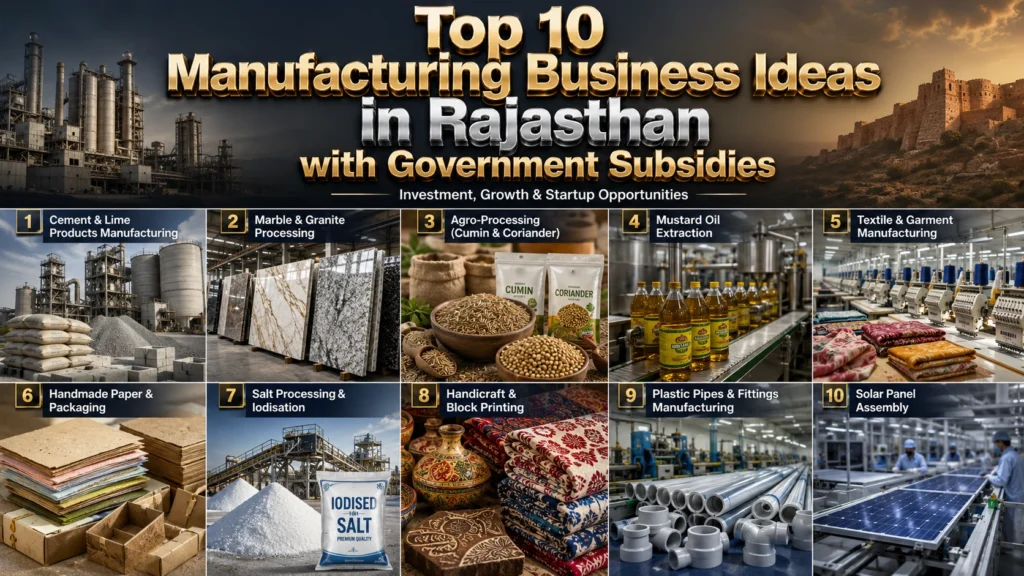
Manufacturing Business Ideas in Rajasthan Rajasthan Manufactures More Than Marble — And Most Entrepreneurs Still Don’t Know It About ₹10,000 crore are lost in the mineral-based manufacturing sector every year due to the lack of operational manufacturing units in less than 12% of the industrial plots registered with RIICO (Rajasthan State Industrial Development and Investment Corporation) in the state. This is not an indication of an absence of opportunity. It’s a lack of information. The State accounts for 10.4 % of the total area of India, has the largest deposits of minerals after the State of Jharkhand and is the source of more than 90 % of the marble and emeralds in India. It is a source for the entire food processing chain of the country with its base of agriculture cumin, coriander, mustard, guar. In recent years, the Rajasthan government has been implementing the Industrial Incentive Schemes of the Rajasthan Investment Promotion Scheme (RIPS) that provide capital subsidy, power tariff relief, and stamp duty exemption to new manufacturing units. For those who are first generation entrepreneurs, and want to start a business where they can manufacture more cost-efficiently with government grants, Rajasthan is one of the most underrated states of India to set up a business. In this article, the top 10 manufacturing enterprises that are available — now — where the raw material, the market demand, and the subsidy access is available are all there. Get Detailed Project Report (DPR): Guide to Business Opportunities and Startup Projects in Rajasthan The Supply Gap No One Talks About The value of finished mineral products, processed agro commodities, and specialty textiles imported into India is more than ₹1.2 lakh crore per year, and this can be replaced by local production in raw material-rich states such as Rajasthan. Rajasthan’s contribution to the overall manufacturing GSDP of India is less than 5% as per the Department for Promotion of Industry and Internal Trade (DPIIT), which is significantly lower than what the dependence of mineral and agricultural base should be able to provide. Try using processed cumin (jeera). Rajasthan and Gujarat account for more than 70% of world’s supply of cumin. However, the value-added cumin products (cleaned, graded, packaged and exported) are controlled by a few big processors. More than 60 percent of the cumin that leaves the Nagaur, Barmer and Pali districts of Rajasthan is still used as raw material without processing, thus foregoing processing margins. The situation is similar with marble also, Kishangarh has more than 3,000 traders for marble but less than 400 processing unit with proper CNC machine. Another underutilized industry is textile. Rajasthan is a major cotton, wool and silk producing state with the bulk of the products being exported as raw fibre. The Rajasthan Small Industries Corporation (RSIC) has reported that textile and apparel exports in the state are under ₹8,000 crore per year, which is less than the export in Gujarat and Maharashtra, both of which are under ₹32,000 crore per year. Manufacturing facilities, skilled workforce and raw material available. What is lacking is an organized well-capitalised MSME processing unit. TABLE 1: Top 10 Manufacturing Business Ideas in Rajasthan — Overview # Business Idea Investment (INR) Govt Scheme Net Margin 1 Cement & Lime Products ₹40–80 lakh PMEGP, MSME Rajasthan 14–18% 2 Marble & Granite Processing ₹25–60 lakh RIPS, MSME Clusters 20–28% 3 Agro-Processing (Cumin/Coriander) ₹15–35 lakh PMEGP, SFURTI 18–24% 4 Mustard Oil Extraction ₹12–30 lakh PMEGP, MUDRA 16–22% 5 Textile & Garment Manufacturing ₹20–50 lakh PLI Textiles, ASPIRE 15–20% 6 Handmade Paper & Packaging ₹10–25 lakh SFURTI, PMEGP 22–30% 7 Salt Processing & Iodisation ₹8–20 lakh PMEGP, NSIC 18–25% 8 Handicraft & Block Printing ₹5–15 lakh SFURTI, Stand-Up India 25–35% 9 Plastic Pipes & Fittings ₹35–75 lakh CGTMSE, RIPS 14–20% 10 Solar Panel Assembly ₹50 lakh–1.2 cr PLI Solar, KUSUM 12–18% Source: Ministry of MSME (msme.gov.in), RIICO Industrial Data, Entrepreneur India Research Get Detailed Insights from This Book: Solar PV Power and Solar Products Handbook Why This Is the Right Window to Enter There are three policy changes right now which are creating good tailwinds for the first time manufacturers in Rajasthan. The first step is that the Production Linked Incentive (PLI) Scheme is being expanded to 14 sectors including textiles, food processing, and solar PV. The PLI is tiered and thus provides 4-6% on incremental sales for the next 5 years for the small manufacturers having investment ranging from ₹50 lakh to ₹2 crore. Second, the industrial policy of the State of Rajasthan, called ‘Rajasthan Industrial Policy (RIPS)’ has been updated to focus on MSME clusters in Tier-2 and Tier-3 towns in the State. In some districts such as Jodhpur, Bikaner, Ajmer, Kota etc., industrial areas have been identified with pre-laying of infrastructure facilities which cuts the infrastructure cost by 20-30% for the new industrial units as compared to the greenfield industrial set up in non-notified areas. Third, Khadi and Village Industries Commission (KVIC), under the control of the central government provides capital subsidy of 25-35% for manufacturing units with project cost up to ₹25 lakh. The subsidy is increased to 35% for SC/ST/women entrepreneurs or rural units. PMEGP is open to first-time business founders, as they don’t have to have experience in a business for it. There are other schemes that are relevant, such as MUDRA (collateral-free loans up to ₹50 lakh under the Tarun category), CGTMSE (credit guarantee for loans up to ₹2 crore without collateral), SFURTI (cluster development grants for rural artisan and agro-processing units), and Stand-Up India (bank loans of ₹10 lakh to ₹1 crore for SC/ST and women entrepreneurs starting their first manufacturing venture). How to Set Up a Manufacturing Unit in Rajasthan: Step-by-Step The following is an explanation of the set-up guide, covering the case of a processing unit that uses marbles as a product, which is one of the most easily accessible and high return manufacturing entries in Rajasthan. The process broadly applies to agro-processing and mineral-based manufacturing as well. Step 1 — Business Registration and Licences
10 Manufacturing Business Ideas in West Bengal with 12–26% Net Margins Under ₹80 Lakhs
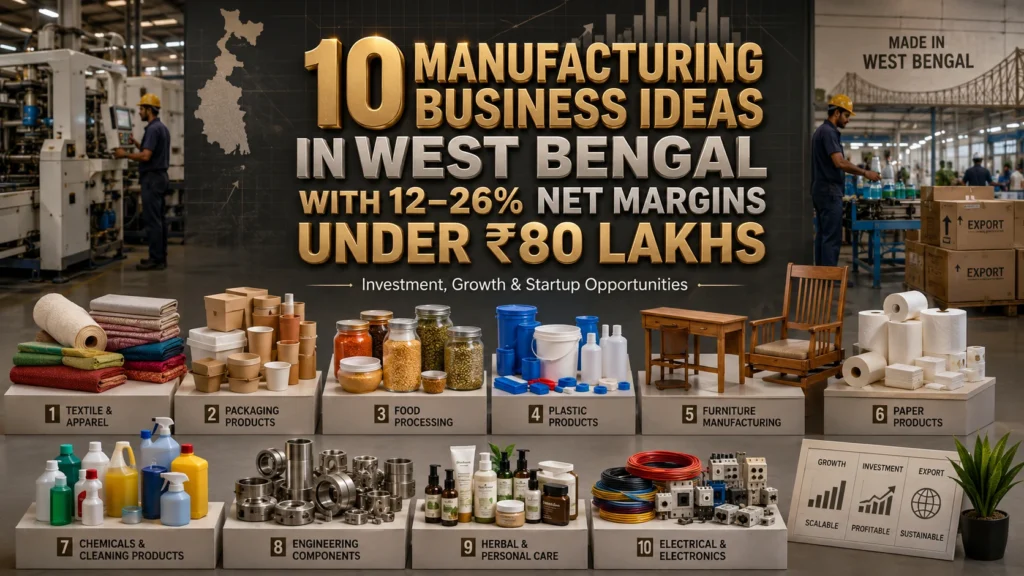
Manufacturing Business Ideas in West Bengal When it comes to the most preferred choice of location for a startup, most entrepreneurs would think of Gujarat, Maharashtra or Karnataka. There were hardly any who included West Bengal in their list of contenders. That’s a thing which has to be fixed — the state government of West Bengal currently grants capital subsidy of 15-30% on plant and machinery, power tariff rebate, stamp duty waiver and a single window clearance system which can issue 36 licences in 30 working days. No state in the eastern part of the country boasts that incentive package for the first time manufacturer. The state’s premier nodal agency, West Bengal Industrial Development Corporation (WBIDC), has developed more than 20 functional industrial parks in various districts from Howrah to Haldia to Barjora, where the land has already been pre-cleared, infrastructure has been laid out, and all the utilities are connected. Everything can be done on the Internet, including Factory Licences and Environmental NOCs on the Silpa Sathi portal. There’s another number that makes it more directly. Yet, there are only 4% industrial investments in West Bengal despite having more than 900,000 MSME units in the state, which is the third among the most important industrial hubs of the country based on the MSME Annual Report, released by the Ministry of MSME. That gap exists because of perception, not ground reality. Get Detailed Project Report (DPR): Best Business Opportunities in West Bengal What West Bengal Has That Other States Do Not The geographical location of the state gives business opportunities which are unattainable elsewhere in India. West Bengal shares its borders with another nation with 170 million people, Bangladesh, which is experiencing a growth in incomes and enormous demand for processed food, garments and consumer goods. The port of Kolkata, Syama Prasad Mookerjee, imports more than 17 million metric tonnes of cargo annually, and has direct shipping routes to the South-East Asia. The National Fisheries Development Board (NFDB) says West Bengal has an annual rice production of 15.7 million tonnes, is the biggest producer of vegetables by volume in the country and contributes almost one-third of inland fisheries production. However, food processing penetration remains at between 12-15% of overall agricultural production, which is less than the average for agricultural economies in similar countries, which is between 25-40%. Thousands of viable business units exist but have not been created, just this one. The jute narrative is as compelling. Jute crop in the state contributes 75% of the total jute production of the country, but most of this is exported as raw fibre. As part of the sustainability requirements imposed by European retailers, finished jute products (such as bags, composites and technical textiles) are in growing demand from FMCG companies. Domestic demand for jute bags has been increasing at more than 12% compounded rate according to the National Jute Board (Ministry of Textiles). A unit for jute bag manufacturing in Howrah or Hooghly can make bags for ₹18/$-22/bag and sell for ₹35/$-50/bag for corporate customers. Howrah, one of the oldest metal fabrication clusters in Asia, continues to provide the unfinished castings to customers in other states in light engineering. Moving to the value chain of “machined parts”, “precision parts”, or “finished sub-assemblies” could see revenue per tonne of produced parts treble from the same raw materials. TABLE 1: Top 10 Business Ideas in West Bengal — Sector, Investment, Schemes & Returns # Business Idea WB District / Cluster Min. Investment (INR) Applicable Scheme Net Margin Range Payback Period 1 Agro-processing & Vegetable Packaging Nadia, Murshidabad, Bardhaman ₹20–₹50 lakh PMEGP, PLI Food 14–20% 3–5 years 2 Fish Processing & Cold Storage South 24 Parganas, North 24 Parganas, Purba Medinipur ₹35–₹80 lakh PMEGP, CGTMSE, NHB 16–22% 3.5–5 years 3 Jute Bags & Eco-Packaging Manufacturing Howrah, Hooghly, North 24 Parganas ₹15–₹40 lakh PMEGP, JUTE-ICARE, SFURTI 12–18% 3–4 years 4 Ready-made Garments & Knitwear Kolkata, South 24 Parganas, Nadia ₹25–₹60 lakh PMEGP, TUFS, WB Textile Policy 10–16% 3–5 years 5 Light Engineering & Metal Fabrication Howrah, Durgapur, Kharagpur ₹30–₹75 lakh CGTMSE, WB MSME Policy 10–15% 4–6 years 6 Plastic Moulding & Packaging Components Barjora (Bankura), Durgapur ₹40–₹90 lakh PMEGP, CGTMSE 12–18% 4–5 years 7 Dairy & Milk Products Processing Nadia, Hooghly, Bardhaman ₹25–₹65 lakh PMEGP, DEDS, NHB 14–20% 3–4 years 8 Gems & Jewellery Manufacturing Kolkata (Manikanchan SEZ, Ankurhati) ₹10–₹30 lakh (artisan unit) PMEGP, GJC Schemes 15–25% 2–4 years 9 Herbal & Ayurvedic Products Jalpaiguri, Darjeeling, Alipurduar ₹20–₹50 lakh PMEGP, ASPIRE 18–26% 3–4 years 10 EV Component & Auto Parts Manufacturing Durgapur, Kharagpur, Haldia ₹75 lakh–₹2 crore PLI (Auto), CGTMSE, WB MSME Policy 12–18% 4–6 years Get Detailed Insights from This Book: Herbal Cosmetics & Ayurvedic Medicines (EOU) (3rd Revised Edition) Why Now: Policy, Infrastructure, and Market Timing The WB Government has been actively working towards building its EoDB ranking in the industrial sector. Now supported by WBIDC, the Silpa Sathi single-window system encompasses 36 pre-establishment and pre-operation approvals all online with guaranteed delivery dates. Key schemes creating an entry window right now: PMEGP: Capital subsidy of 25-35% on the project cost (upto ₹25 lakh) for manufacturing units. District level administration via KVIC and DIC offices. Capital subsidy for plant and machinery: 15–30% at state level; power tariff rebate; exemption of stamp duty on land registration—WB MSME Incentive Policy. CGTMSE: Credit cover for ₹5 crore up to 100% without collateral through scheduled banks. SIDBI’s Credit Guarantee Fund Trust for Micro and Small Enterprises. This is the crucial scheme for a first-generation founder who didn’t have property to pledge. PLI for Food Processing: 10% production linked incentive for 6 years for units with investment of ₹10 crore or above. SFURTI: Cluster development grants for jute units, khadi and handicraft units and soft loan facilities. How to Form a Company and Start a Business in West Bengal: Step-by-Step The incorporation process outlined below applies to the most usual structure for a manufacturing or trading business that is looking to scale up, and that is the Private Limited
India-Oman CEPA: The Trade Gateway Every Indian Exporter Has Been Waiting For
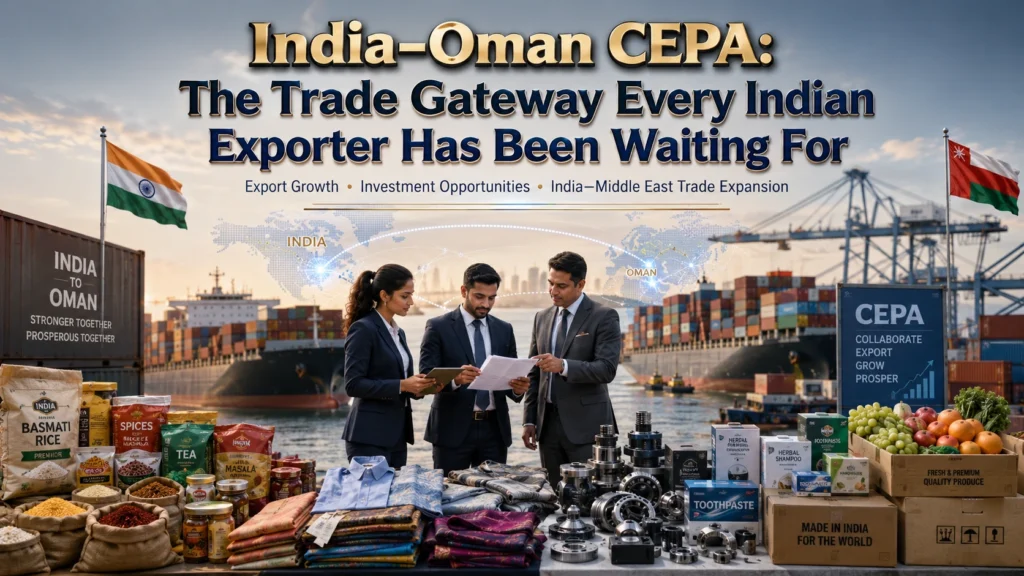
Source: Ministry of Commerce & Industry, Government of India | Press Information Bureau India Oman CEPA export opportunity MSME Until June 1st this year, there was a quiet competition between Italian jewellers, Thai seafood processors and Chinese engineering exporters for a share in the USD 28 billion import market in Oman; a market which had been dominated by Indian players. Until June 1st this year, outsiders — Italian jewellers, Thai seafood processors and Chinese engineering exporters — enjoyed a quiet lead in the USD 28 billion import market in Oman, which was dominated by Indian players. They both had the same 5% tariff. So did the Indians! This balance is now out of equilibrium. Under the new norms of India-Oman CEPA, 99.38% of India’s exports are being duty-free. Not next quarter. Today. Imagine the implications for a textile exporter in Surat, a seafood processor in Andhra Pradesh or a pharmaceutical manufacturer in Ahmedabad. From Italy, Turkey, Thailand and China, each competitor is now at a structural disadvantage in Oman because of the tariffs they still have to pay. India and Oman have also signed an all-embracing bilateral trade pact, a first for a country after the USA. This exclusivity is what creates a time-sensitive window. MSMEs and Industrial Units that are first in the queue, getting Compliant, Export Ready and connected to Oman’s Ports will grab their market share before it is too late. Oman is not a far-remote destination in the Gulf. It provides access to the broad market of the rest of the GCC and East Africa via hubs in Sohar, Duqm and Salalah. Three ports that link South Asia with some of the world’s fastest growing consumer markets. View Full Project Details: Investment Opportunities and Business Ideas in Oman (Middle East) The Gap That Has Held Indian Exporters Back Bilateral trade between India and Oman was worth USD 11.18 billion during the previous financial year as compared with USD 10.61 billion during the previous year. Impressive on paper. However, when looking carefully at sector level data, the difference is stark. Bring gems and jewellery. Oman’s total imported market for this is USD 1.07 billion per year. India’s current share? Just USD 25.78 million, less than 2.5%. The clusters, which are key suppliers of polished diamond and gold jewellery export to the world, are excluded from the market which is sitting on India’s doorsteps, as the Italian, Turkish and Thai competitors are also paying the same import duty of five per cent as the Indian exporters. Marine products tell an even more clear-cut story. Oman imported USD 35.3 million in seafood and India, despite being home to some of the biggest clusters of shrimp and fish processing in the world in Andhra Pradesh, Kerala, Tamil Nadu and Gujarat, had only imported USD 10 million of seafood. A 5% import duty on shrimp and cuttlefish was sufficient to kill the exporters’ business, operating on slim margins. Oman’s import market is worth USD 302.84 million and expanding at 6.6% CAGR in the pharmaceutical sector. Approvement delays, duplicate inspections and regulatory bumps delayed Indian generic drug makers from gaining market access and took months to approve. The USFDA, EMA or UK MHRA approved products now receive marketing authorization in Oman within 90 days. The acceleration is not just a minor bureaucratic adjustment but a structural change. In the previous financial year, India exported USD 875.83 million of engineering goods to Oman, such as machinery, electrical products, automobiles, iron and steel. The actual “total addressable market” is much bigger. The imports of electronics are only USD 1.7 billion in Oman, whereas India claims only USD 146 million. Source: Ministry of Commerce & Industry, Press Information Bureau | APEDA Export Statistics TABLE 1: Sector-wise Export Opportunity Under India-Oman CEPA Sector India’s Current Exports to Oman Oman Market Size Duty Before CEPA CEPA Duty Status Gems & Jewellery USD 25.78 mn USD 1.07 bn Up to 5% Zero (Day 1) Marine Products USD 10 mn USD 35.3 mn Up to 5% Zero (Day 1) Agriculture & Processed Food USD 552.85 mn ~USD 3.1 bn share Varies Eliminated Pharmaceuticals Growing USD 302.84 mn Varies Zero (binding) Engineering Goods USD 875.83 mn USD 1.7 bn (electronics alone) 0-5% Zero Textiles & Footwear Significant Large Varies Eliminated IT & Professional Services USD 863 mn (bilateral services) USD 12.52 bn (Oman global) Various barriers 127 sub-sectors opened Source: PIB Press Release, Ministry of Commerce & Industry, Government of India Why This Is the Right Moment to Move There are various forces in play at this moment and an alert MSME operator shouldn’t underestimate any of them. The duty removal is immediate, that’s the first. As of June 1st, the day the agreement entered into force, all concessions with a zero duty rate were to be implemented. There is no phased schedule, no waiting period, no transitional clause for the 99.38% of export lines covered. Exporters who ship now reap rewards now. Second, the NTBs have been addressed head on. Oman will now accept mandatorily, at its ports, Indian certificates from the Export Inspection Council (EIC) eliminating any duplicate testing. Both NPOP Organic and halal certification is recognised in India. This eliminates months of compliance hassles at the border for food processors, agri-exporters and organic product producers. Third, the services and professional mobility provisions open up doors which pure goods exporters do not often reach. Oman has offered 127 services sub-sectors, the most comprehensive offer to India by any GCC country. Oman has now provided legally binding certainty for IT professionals, engineers, doctors, architects and educators. Independent professionals have a time limit of up to 180 days. The Intra-Corporate Transferees are allowed to remain for a period of up to four years. Almost 6000 joint ventures between India and Oman are directly affected. There are various support mechanism provided by the government that can be utilized by the MSME manufacturers for export market. Production Linked Incentive (PLI) offers 4-6% incentive on incremental sales for sectors that are directly
Best Manufacturing Opportunities in India Under PM Modi: MSME Growth, PLI Scheme & High-Profit Sectors
Introduction: Manufacturing Business Opportunities in India India is witnessing a transformation in its manufacturing and industrial sector. The new prime minister (PM), Narendra Modi, is leading the country into a period where industry is not only concentrated in traditional centres, but is also growing at a large pace in new industrial cities and clusters in India. This time it is not just a matter of policy announcements, but also the movement of capital, establishment of new factories and expansion of supply chains. The approach toward manufacturing is now more strategic, rather than traditional. Electronics, EV components, chemicals, food processing and medical devices are all growing today in India. MSMEs are playing a pivotal role in this growth. Related Article: Industrial Opportunity in India Under PM Modi: MSME Growth, PLI Scheme & Profitable Manufacturing Businesses Policy Drivers Behind India’s Industrial Growth The acceleration in India’s industrial production is not accidental but part of specific policy reforms that are working on improving efficiency in production, infrastructure and investment friendly nature. 1. Production Linked Incentive (PLI) Scheme The government’s most influential policy is the Production Linked Incentive (PLI) scheme. The PLI scheme is different from traditional subsidies as companies are rewarded based on the actual output. This has brought a massive amount of investment into: Electronics manufacturing Pharmaceuticals Automotive components Electrical appliances (ACs, refrigerators) This scheme has helped decrease imports and strengthened Indian indigenous manufacturing. 2. PM Gati Shakti Infrastructure Program The PM Gati Shakti programme ensures the holistic infrastructure planning by integration between railways, waterways, airways and roadways along with the logistics. Key benefits include: Reduced transportation delays Lower logistics costs Improved industrial corridor development Shorter execution times This has further accelerated the competitiveness of India’s manufacturing. 3. MSME Reforms and Financial Inclusion The policy support for MSMEs has been substantial and was directed towards: Udyam registration simplification Collateral-free credit schemes Credit Guarantee Fund Trust (CGTMSE) Online payment systems such as Tred’s These programs have helped with credit availability and formalized lending. Key Sectors Driving MSME-Led Industrial Growth Industrial growth in India has been uneven as various sectors have grown at varying rates influenced by the demand from these sectors and also by the possibilities of importing the substitute goods and further export. 1. Electronics Manufacturing India is a large importer of electronic components like semiconductors, PCBs (printed circuit boards), and connectors. The huge opportunity this is creating is in: PCB manufacturing Mobile components Consumer electronics assembly India offers a potential option as the world is shifting their supply chains out of China. Get Detailed Insights from This Book: Electronic Products Handbook With Circuit Diagrams 2. Electric Vehicle (EV) Ecosystem India’s EV industry is rapidly growing. Opportunities are in: Battery assembly and recycling Charging infrastructure Motor controllers and electronics Lightweight components The growth is also being helped by government subsidies. 3. Specialty Chemicals and Pharmaceuticals India is emerging as a leading pharmaceutical manufacturing and chemical intermediates hub. Growth is driven by: Export demand China relocation of supply chains Healthy domestic demand Access Complete Business Plan: Pharmaceutical Drugs and Fine Chemical Intermediates Guide 4. Food Processing Industry India has good raw material supply for food processing industries. High-potential segments include: Millet-based products Ready-to-eat foods Packaged snacks Organic processed foods 5. Medical Devices & Healthcare Manufacturing COVID-19 exposed India’s reliance on imports for medical devices. Now, there are good opportunities in: Surgical instruments Diagnostic kits Medical disposables Hospital equipment High-Growth Manufacturing Segments (Key Opportunities) There are a few MSME-favourable segments with low barriers and high demand visibility: Electronic parts such as PCBs and connectors EV battery packs and chargers Specialty chemical intermediates Medical disposables and surgical kits Millet and processed food products Valves and castings These industries offer both opportunities for import substitution and increasing domestic demand, and so represent a good choice for entrepreneurs. How MSME Founders Should Approach Manufacturing Manufacturing business in India needs planning, not just investment. First-time manufacturers may not fully appreciate operating complexities and working capital needs. Crucially, it’s the profitability. Even though gross margins in manufacturing may be appealing, net margins can be smaller due to raw material price variability, labour, logistics and interest expenses. Key planning principles for founders: Don’t go for full capacity setup Lock in at least 1-2 key buyers Keep tight control of working capital for 90-120 days Don’t over-rely on one supplier or customer Avoid delays in approvals for regulatory and environmental requirements This increases the likelihood of survival in the first 2-3 years. Import Substitution and Export Opportunity India imports a substantial number of industrial products including components for electronics, machinery and special chemicals. This may provide a useful import substitution avenue for Indian industry. The growth of demand for exports (in particular, engineering goods, pharmaceuticals and textiles) makes the manufacturing sector vital for Indian growth. Most promise will be for those who can supply to both. Risks Entrepreneurs Must Understand However, manufacturing has risks too-which need to be managed with caution. Some key challenges include: Import dependency for some industries Time-consuming and cumbersome environmental and regulatory clearances Late payments, particularly in government contracts Exchange rate variations impacting cost of inputs Seasonal demand in cyclical sectors Enterprising entrepreneurs may minimize risks by using multiple suppliers, phased expansion and locking in buyer orders. Identify high-growth industries before others do Role of NPCS in Industrial Project Planning NPCS (Niir Project Consultancy Services) is also the key functionaries for entrepreneur’s keen on manufacturing in India. NPCS provides with Detailed Project Reports (DPRs), feasibility reports and market research so that an investor can decide beforehand whether it is a profitable venture to invest in, or not. These reports typically include: Market demand analysis Details of machinery and processes Cost and financial analysis Sourcing suggestions for raw materials Risk and sensitivity analysis This will be very important for an entrepreneur making the first investment, and avoid a sub optimal or overpriced business model. NPCS provides with the ability for entrepreneurs to take decisions based on facts. Conclusion: Manufacturing Growth Depends on Execution, Not Just Opportunity India’s
MSME Schemes in India: Complete Guide to Subsidies, Loans & Government Benefits
Introduction: MSME schemes in India One of the well-built sectors of the Indian economy is the Micro, Small and Medium Enterprises (MSME) sector. It supports almost one-third of GDP and employs millions of individuals both in the rural and urban India. Nevertheless, many entrepreneurs have one big problem namely, insufficient funds and knowledge of government programs. Interestingly, India is already well-established with a complete subsidy and credit system, but it is not used to its full potential because of the complicated procedures and absence of proper guidance. Nowadays, subsidies, loans are provided without collaterals, and state incentives allow MSME entrepreneurs to start up and grow their business at a considerably low cost. The difficult thing is to understand what scheme suits your business, and utilize it properly. Related Article: JanSamarth Loan Apply Online 2026: Complete Government Business Loan Guide for MSME MSME Classification in India It is necessary to know about MSME classification before delving into schemes. The classification of businesses is according to investment in plant and machinery as well as turnover annually. Micro enterprises: Investment up to 1 crore and turnover up to 5 crores. Small businesses: Investment less than 10 crore and turnover less than 50 crore. Medium enterprises: Investment increase of up to 50 crore and turnover increase up to 250 crore. This categorization is significant since subsidies and loans are determined by it. The majority of schemes demand Udyam Registration, the official MSME registration in India. Major MSME Schemes in India India has a number of governmental programs which assist the business owners in various phases of the business development. Read the Complete Book Here: Our Books PMEGP – Prime Minister Employment Generation Programme PMEGP is the most popular scheme among new entrepreneurs. It assists people to initiate micro enterprises by availing them with financial aid as a subsidy of margin money. In this scheme, a subsidy of 15 to 35% of the project cost would be given to eligible applicants based on location and category. It is particularly applicable to first time business people who wish to establish manufacturing or service-based businesses. MUDRA Loan Scheme MUDRA scheme is a collateral free loan scheme to the micro and small businesses. It is among the simplest financing means in India. The scheme is categorized into three: Shishu: Less than ₹50,000 to very small startups. Kishore: 50,000-5 lakh to expand businesses. Tarun: 5 to 10 lakh to existing micro units. Such loans are extended by banks, NBFCs and microfinance institutions. CGTMSE Scheme Credit Guarantee Scheme of Micro and Small Enterprises (CGTMSE) enable the enterprises to borrow money without collateral. Key benefits include: Loan up to 2 crores. Government-backed credit guarantee Less difficult bank approvals. Less risk to the lenders. The scheme is very vital to businesses which lack assets to pledge. Get Detailed Project Report (DPR): Project Reports & Profiles CLCSS – Technology Upgradation Subsidy This plan encourages companies that desire to modernize the equipment and embrace new technology. It assists in enhancing productivity and competitiveness within manufacturing industries. Gives as much as 15% capital subsidy. Maximum benefit of up to 15 lakhs. Usable on approved equipment. ZED Certification Scheme Zero Effect Zero Defect (ZED) scheme encourages quality production and sustainability. Benefits include: Reimbursement of certification cost. Export preparedness support. Promotion of environmentally friendly manufacturing. Such a plan is particularly applicable to manufacturers who have a global target. State Government MSME Schemes In addition to central government schemes, state governments provide some other incentives to MSMEs as well. There are some large-scale ones, such as: Gujarat: Subsidy of interest and lower cost of industrial land. Maharashtra: Capital subsidy on micro enterprises. Tamil Nadu: Power tariff and wage support benefits. Karnataka: MSME interest subvention. Capital subsidy on manufacturing units in Rajasthan: Uttar Pradesh: ODOP scheme in Favor of local products. Such plans are usually combined with central subsidies, with the net effect of boosting the overall benefits of entrepreneurs. How to Apply for MSME Schemes The application is easy and should be well planned and documented. The first one is that all businesses need to undergo Udyam Registration, which is free of charge and online. Most MSME schemes are obliged to register. Once registered, the next thing to do is to decide the appropriate scheme according to your business stage. As an illustration, new entrepreneurs tend to use under PMEGP and existing businesses use MUDRA or CGTMSE. Preparation of a Detailed Project Report (DPR) is one of the most crucial steps. This document includes: Business model and product information. Set up and machinery cost. Financial projections Market demand analysis Break-even estimation and profit. It is hard to get loan or subsidy approval without a powerful DPR. Lastly, applications are done via banks, DIC offices or government portals depending on the scheme. Upon verification and inspection, subsidies or funds are granted. Stop guessing—choose the right business with confidence Challenges Faced by MSME Entrepreneurs Although the government is very supportive, most of the entrepreneurs continue to encounter problems like: Inadequate knowledge regarding schemes. Poor or unsuccessful project reports. Bank delays. Lack of comprehension of eligibility requirements. Poor documentation management Such difficulties tend to lead to rejection or postponement of applications. Role of NPCS (Niir Project Consultancy Services) Professional guidance is of great importance in such a complex eco system. NPCS (Niir Project Consultancy Services) is a reputable consultancy that assists businesspeople with the planning and paperwork. NPCS offers services including: Detailed Project Reports (DPRs) Market research and feasibility studies. Cost analysis and machinery. MSME scheme guidance Investment planning support The reports will be tailored to meet bank and government standards, which further enhances the success of loan and subsidy approval. In the case of first-time entrepreneurs, NPCS serves as an intermediary between the schemes of the government and their practical application to minimize risks of rejection and save time. Conclusion The government support provided by MSME schemes in India creates a strong business development opportunity for entrepreneurs who want to establish and expand their companies. The system provides financial