
Start Small and Medium-Sized Businesses in Burkina Faso
Burkina Faso, a landlocked West African country, is gradually becoming a destination of interest for investors and entrepreneurs looking for stable and promising markets in Francophone Africa. Despite challenges in infrastructure and security, the country has shown resilience in sectors like agriculture, textiles, mining, and services. In this dynamic landscape, medium-sized businesses in Burkina Faso are playing a pivotal role in economic growth, job creation, and value generation. These businesses act as the bridge between micro-enterprises and large corporations, often spearheading innovation and regional trade in a country with evolving business dynamics. Importance of Medium-Sized Enterprises in the Burkinabé Economy Medium-sized businesses in Burkina Faso contribute significantly to GDP, employment, and diversification of economic activity. These businesses are especially critical in key sectors like food processing, textiles, renewable energy, and construction. They not only create employment for locals but also drive import substitution, reduce dependency on foreign products, and enhance regional competitiveness. As the government strengthens its support for the private sector through tax incentives, funding programs, and ease-of-doing-business reforms, the role of medium-sized businesses becomes even more crucial in building a resilient economy. Start a Business in Burkina Faso 1. Agro-Processing Units One of the most thriving segments for medium-sized businesses in Burkina Faso is agro-processing. Businesses that process agricultural produce like shea nuts, groundnuts, mangoes, sesame, or cotton into exportable or value-added products have seen remarkable growth. These enterprises supply both local and international markets while reducing post-harvest losses and creating employment, especially for women and rural communities. 2. Construction & Building Materials With rapid urbanization in Ouagadougou and Bobo-Dioulasso, the demand for infrastructure and housing is rising. Medium-sized businesses producing cement blocks, tiles, paints, doors, and other construction materials are booming. Additionally, construction service providers—ranging from engineering firms to general contractors—have become vital contributors to national infrastructure projects. 3. Textile and Garment Manufacturing The country has a strong tradition in cotton cultivation, and medium-sized businesses in the textile sector are tapping into this local advantage. Enterprises involved in spinning, weaving, dyeing, and tailoring are making strides both locally and through exports to neighboring countries. The popularity of Faso Dan Fani (traditional woven cotton cloth) presents cultural and commercial opportunities. 4. Renewable Energy Installations Given the inconsistent electricity supply and growing need for energy in rural areas, businesses involved in solar energy solutions are among the fastest-growing medium-sized businesses in Burkina Faso. These include companies that sell, install, and maintain solar panels, batteries, and inverters for homes, farms, and small enterprises. 5. Small-Scale Mining and Equipment Supply Burkina Faso is one of Africa’s leading producers of gold. Medium-scale mining businesses—especially those involved in gold buying, refining, and equipment leasing—are playing a central role in the value chain. These businesses support thousands of artisanal miners while also benefiting from global demand for precious metals. Start a Business in Africa 6. ICT Services and Software Solutions With the expansion of mobile and internet access, ICT firms have emerged to serve businesses and public sector needs. Medium-sized enterprises offering software development, digital payment solutions, IT maintenance, and cloud-based services are rapidly gaining ground in urban centers. 7. Water Bottling & Beverage Production In response to increasing demand for safe drinking water and beverages, many medium-scale businesses have established water bottling plants and local juice production units. These businesses reduce reliance on imported drinks and promote local fruits like baobab, mango, and hibiscus. 8. Logistics and Transportation Landlocked Burkina Faso depends heavily on overland logistics. Medium-sized transport companies that offer freight services to and from ports in Côte d’Ivoire, Ghana, and Togo are vital for the flow of goods. Also, local courier services within cities are becoming increasingly important in the digital commerce space. 9. Education and Vocational Training Medium-sized private schools, colleges, and vocational training centers are meeting the growing demand for quality education. These institutions focus on skills like mechanics, tailoring, IT, and agribusiness—preparing the youth for a more competitive job market. 10. Hospitality and Tourism Despite periodic security concerns, medium-sized businesses in Burkina Faso continue to invest in guesthouses, mid-range hotels, travel agencies, and local tour services. Cultural tourism—centered around the Mossi heritage and music festivals—is an area with untapped potential, especially in relatively safe regions. 11. Printing and Publishing In cities like Ouagadougou, printing and publishing businesses—especially those offering corporate branding, packaging, textbooks, and marketing materials—are essential service providers. These medium-sized businesses serve NGOs, schools, government agencies, and the private sector. 12. Healthcare Clinics and Pharmacies With a growing urban population, private healthcare facilities are rising. Medium-sized businesses operating clinics, diagnostic labs, and licensed pharmacies fill gaps left by the public health sector and cater to the middle-class demographic. 13. Car and Motorcycle Dealerships As vehicle imports rise, medium-sized dealerships that sell new or used cars and motorbikes are multiplying. These businesses often provide value-added services like insurance facilitation, spare parts sales, and maintenance—making them integral to urban mobility. 14. Waste Management and Recycling Environmental consciousness is increasing, and so is the business opportunity in waste collection and recycling. Some businesses now process plastics, paper, and metals into reusable materials. Waste-to-energy projects are also under development, providing green solutions to urban problems. 15. Retail Supermarkets and Wholesale Distribution Medium-sized retail chains and wholesalers are expanding in both urban and peri-urban areas. These businesses stock food, beverages, toiletries, and household goods, creating jobs and improving access to essential products for growing communities. Final Thoughts The development of medium-sized businesses in Burkina Faso is essential for bridging the gap between subsistence trade and industrial growth. These businesses offer not only local employment but also opportunities for innovation, regional trade, and sustainable development. As investment climates improve and digital tools become more accessible, medium enterprises will continue to play a key role in Burkina Faso’s transformation into a self-reliant and inclusive economy. Entrepreneurs who can combine local insight with scalable strategies will find long-term success in this dynamic West African nation. Watch Video: Startup Business Opportunities in Africa See More Links: Related Projects Start a Business in Potential Countries
Best Business Ideas to Make Money. Profit-Making Projects for Entrepreneurs, Startups.
In today’s rapidly evolving industrial landscape, entrepreneurs are continuously seeking high-margin business ideas that combine innovation, demand, and sustainability. Two such standout opportunities are HDPE pipes manufacturing and menthol crystals production. While one is rooted in the infrastructure and construction sector, the other is deeply embedded in pharmaceuticals and consumer goods. Despite their distinct industries, both represent profitable ventures with scalable growth potential for new and seasoned entrepreneurs alike. Exploring the Profit Potential in HDPE Pipes and Menthol Crystals Understanding HDPE Pipes: A Backbone of Infrastructure HDPE (High-Density Polyethylene) pipes are known for their strength, durability, and flexibility. They are widely used in sectors such as water supply, gas distribution, sewage systems, agricultural irrigation, and telecommunications. Their resistance to corrosion, low maintenance needs, and long lifespan (over 50 years in some cases) make them a superior alternative to traditional piping materials like steel or concrete. The global demand for HDPE pipes is rising due to ongoing urbanization, government infrastructure projects, and increased agricultural mechanization. Especially in countries like India, where rural development and urban smart city projects are booming, the HDPE pipe industry is witnessing unprecedented growth. By 2030, the market is expected to cross USD 25 billion globally. For entrepreneurs, setting up an HDPE pipe manufacturing plant can yield high ROI due to strong domestic demand, low raw material costs (mainly petroleum by-products), and access to recycling technologies that further reduce expenses. Menthol Crystals: Tiny Flakes with Huge Profits While HDPE pipes offer profits through scale, menthol crystals provide high margins even on a small scale. Extracted from mint oils, menthol crystals are used across industries – from pharmaceuticals to cosmetics, food, and even tobacco products. Their applications include cold relief balms, lozenges, toothpaste, mouthwash, chewing gum, perfumes, and cooling gels. India is one of the largest producers and exporters of menthol crystals. With rising demand in global markets like the U.S., China, and Europe, the opportunity for domestic production and export is massive. The price of menthol crystals fluctuates based on global mint oil production and seasonal factors, but profit margins often remain robust due to high demand and relatively low input costs. A small unit producing menthol crystals requires basic equipment for crystallization and filtration, along with mint oil as the key raw material. This makes it an accessible and highly rewarding business idea, especially for entrepreneurs looking to start with moderate capital investment. Key Advantages of Entering the Menthol Crystals Business 1. Wide Application Spectrum Menthol crystals are used in a wide array of industries. This multipurpose demand ensures that producers can target multiple sectors and adapt their products accordingly. From pharma giants to local FMCG companies, everyone uses menthol crystals in some form, making it a resilient and lucrative business. 2. Export Opportunities Menthol crystals are in high demand in international markets due to their purity, potency, and aroma. Indian producers often enjoy a cost advantage over competitors in other countries. Exporting menthol crystals can exponentially increase revenue and build long-term foreign clients. 3. Low Operational Costs Setting up a menthol crystal manufacturing unit doesn’t require heavy machinery or a massive workforce. With proper extraction and crystallization techniques, even small units can consistently produce high-purity crystals. This keeps operational costs low and profits high. 4. Sustainable and Eco-Friendly Menthol crystals come from natural mint oil, making it an eco-conscious product. With increasing global focus on sustainability, products derived from natural sources are gaining preference over synthetic substitutes. Steps to Start a Menthol Crystals Manufacturing Unit Step 1: Conduct Market Research Before investing, analyze the demand in your target market – whether domestic, export-focused, or both. Identify your customer base such as pharmaceutical companies, cosmetic brands, or herbal product retailers. Step 2: Choose a Suitable Location Choose a location close to mint oil suppliers or areas with easy logistics access. Proximity to raw material suppliers and transportation hubs will reduce costs and ensure timely delivery. Step 3: Invest in Equipment The basic machinery required includes: Stainless steel containers Cooling chambers Crystallizers Centrifugal filters Dryers Packaging machines You can start small and gradually scale as demand increases. Step 4: Comply with Regulatory Standards Menthol crystals fall under chemical and food-grade classifications in some jurisdictions. Ensure your unit follows local safety, hygiene, and quality regulations. Get necessary certifications such as FSSAI, ISO, or export licenses depending on your target audience. Step 5: Marketing and Branding Branding plays a crucial role in this business. Position your product based on purity, aroma, and consistency. You can market through B2B platforms, participate in trade fairs, or directly approach pharmaceutical and cosmetic manufacturers. Comparing Both Ventures: HDPE Pipes vs Menthol Crystals Factor HDPE Pipes Menthol Crystals Initial Investment High Moderate Market Demand Infrastructure projects, agriculture Pharma, FMCG, cosmetics Export Potential Moderate High Profit Margins Medium High Setup Complexity Requires more capital and space Simpler process Scalability High Medium to High Sustainability Focus Recyclable plastic Natural product Each business has unique advantages. Menthol crystals offer quicker returns and simpler operations, while HDPE pipes provide long-term stability and scale in a government-backed sector. Entrepreneurs can choose based on capital availability, industry familiarity, and long-term vision. Tips for Maximizing Profitability in Menthol Crystals Business 1. Focus on Purity and Quality High-quality menthol crystals are always in demand. Invest in quality control systems and ensure consistency across batches. Superior quality enables premium pricing and customer loyalty. 2. Use Smart Packaging Packaging plays a crucial role in brand perception. Invest in moisture-proof, tamper-proof, and eco-friendly packaging to ensure the product reaches clients in pristine condition. 3. Diversify Product Lines Apart from menthol crystals, consider producing mint oil derivatives, peppermint oil, or menthol flakes to diversify revenue streams and utilize raw materials efficiently. 4. Build Export Relationships Reach out to foreign buyers via online B2B platforms, trade commissions, and embassies. Offering free samples and certifications can help in building long-term partnerships. 5. Adopt Technology Use automated crystallizers and digital temperature control systems to improve efficiency and reduce human error. Automation also ensures consistency and scalability. Future Outlook
Investment Opportunity in Manufacturing of IV Fluids (BFS Technology).
We, at NPCS, endeavor to make business selection a simple and convenient step for any entrepreneur/startup. Our expert team, by capitalizing on its dexterity and decade’s long experience in the field, has created a list of profitable ventures for entrepreneurs who wish to diversify or venture. The list so mentioned is updated regularly to give you a regular dose of new emerging opportunities. Contact Us
Money Making Business Ideas You Can Start from Home with Low Costs
In today’s fast-evolving economy, the idea of working from home has transformed from a convenience into a necessity—and for many, an exciting opportunity. As technology continues to advance and remote connectivity becomes stronger, home-based businesses are now more accessible than ever. Whether you’re a stay-at-home parent, a college student, or simply someone looking to escape the 9-to-5 grind, there are countless easy home-based businesses you can start today with little investment and plenty of growth potential. Why Start a Home-Based Business? There are several compelling reasons why launching a home-based business is a smart move in 2025. First and foremost, it provides flexibility. You can work around your schedule, spend more time with family, and avoid daily commuting. Secondly, it requires significantly less overhead than a traditional business setup, allowing you to start small and scale at your own pace. Finally, thanks to digital tools, e-commerce platforms, and social media, marketing and reaching customers has never been easier. Freelance Writing and Content Creation If you have a knack for storytelling, grammar, or niche expertise, freelance writing is a lucrative way to monetize your skills. Platforms like Upwork, Freelancer, and Fiverr make it easy to connect with clients globally. You can specialize in blog writing, website copy, technical writing, or even ghostwriting eBooks. With dedication, this home-based business can provide a full-time income and even turn into a small agency over time. Dropshipping and E-commerce One of the most popular home-based businesses today is dropshipping. With this model, you create an online store without holding any inventory. When a customer places an order, the product is shipped directly from the supplier. Shopify, WooCommerce, and BigCommerce are leading platforms that make launching an e-commerce store simple. Choose a niche you’re passionate about—such as eco-friendly products, tech gadgets, or pet supplies—and build your brand through social media and SEO. Virtual Assistance Businesses of all sizes are outsourcing administrative tasks to save time and focus on growth. This creates a big opportunity for virtual assistants (VAs). Services can include email management, calendar scheduling, bookkeeping, customer service, and even social media management. The demand for VAs is booming, making this one of the easiest home-based businesses for organized individuals with good communication skills. Online Tutoring and Teaching Are you skilled in math, science, languages, or music? You can teach students of all ages from the comfort of your home. Platforms like Chegg Tutors, Preply, and Teachable allow you to either join their network or create your own courses. Online tutoring is especially profitable during exam seasons and has become a stable source of income for many professionals transitioning to home-based businesses. Handmade Crafts and Art If you’re artistically inclined, platforms like Etsy and Amazon Handmade are ideal for selling unique crafts, jewelry, or artwork. This allows you to turn your passion into profit while operating entirely from home. Whether it’s resin art, candles, or embroidered clothing, there’s always a market for handmade goods. Your brand can grow significantly with good packaging, social media presence, and customer reviews. Blogging and Affiliate Marketing Creating a blog around your passion—be it travel, food, parenting, or finance—can become a reliable home-based business. With consistent high-quality content and an audience-focused approach, you can monetize your blog through affiliate links, sponsored posts, and Google AdSense. Affiliate marketing allows you to earn commissions by promoting other companies’ products on your blog or YouTube channel. Social Media Management Small and medium-sized businesses often lack the time or expertise to manage their social media presence. If you’re familiar with Instagram, Facebook, Pinterest, or TikTok marketing, you can offer content creation, community engagement, and ad campaign services. As a freelancer or agency, this home-based business offers excellent earning potential, especially when you specialize in a particular niche or industry. Print-on-Demand Business Similar to dropshipping, print-on-demand (POD) lets you design custom apparel, mugs, posters, and more, without holding inventory. Services like Printful, Redbubble, and Teespring handle production and shipping. Your job is to create attractive designs and market them. POD is one of the fastest-growing home-based businesses, requiring minimal upfront investment and offering unlimited creative freedom. Transcription and Translation Services With businesses generating hours of audio and video content, transcriptionists and translators are in demand. If you have excellent listening skills or are fluent in multiple languages, this field offers a strong income stream. You can start with platforms like Rev, GoTranscript, or TranslatorsCafe. These home-based businesses are ideal for people who prefer independent, quiet work environments. Consulting and Coaching Services If you’re experienced in business, marketing, fitness, career planning, or mental health, consider launching a consulting or coaching business. With tools like Zoom and Google Meet, you can conduct sessions from home. Position yourself as an expert by offering free advice on social media or blogs, and gradually build a paying clientele. This kind of home-based business often leads to speaking engagements, courses, or online communities. Pet Sitting and Dog Walking If you’re an animal lover, pet sitting can be a rewarding home-based business. Apps like Rover and PetBacker allow you to connect with local pet owners who need someone trustworthy to watch their pets while they’re away. If your home has a yard or is pet-friendly, you can offer pet boarding services. This business is flexible, enjoyable, and requires minimal investment. Digital Products and Templates Create and sell digital products like planners, resume templates, invitation designs, or Lightroom presets on marketplaces like Gumroad, Etsy, or Creative Market. Once created, digital products provide passive income and can scale without added time or expense. This home-based business suits those with design or organizational skills and offers excellent margins. YouTube Channel or Podcast Creating content on YouTube or through a podcast can be a long-term home-based business strategy. While growth may be slow at first, consistent effort can result in monetization through ads, sponsorships, merchandise, and affiliate links. Choose a niche you’re passionate about, whether it’s storytelling, interviews, tutorials, or comedy. Real Estate Virtual Services The real estate market has embraced digital transformation. If you’re
The Most Profitable Businesses and Industries for a New Startup
In today’s dynamic economy, the success of a business is no longer determined solely by tradition or industry monopoly. New-age entrepreneurs are looking beyond conventional methods and investing in ideas that are both innovative and profitable. One such opportunity that stands out is the razor blades business—often overlooked, yet highly scalable. Razor blades are an essential consumer product, and with increasing awareness of personal hygiene and grooming, their demand is on a sharp rise across all demographics. Whether it is daily use in urban households or commercial requirements in salons and grooming parlors, the consumption of razor blades is constant and recurring. Why Razor Blades Are a Profitable Business Idea The razor blades industry offers one of the best combinations of high demand, low product weight, and relatively simple manufacturing processes. These factors make it ideal for entrepreneurs looking for a consistent and expandable product line. Razor blades, due to their nature of being frequently replaced, generate a steady stream of repeat customers—something every business desires. This unique feature alone makes it one of the more attractive investments in the personal care segment. Moreover, unlike perishable or fashion-based products, razor blades have a predictable consumption cycle. Most users follow a fixed grooming schedule—daily, weekly, or bi-weekly—depending on their lifestyle and cultural norms. This allows for calculated projections in sales and restocking, making inventory management more efficient. As more consumers shift from traditional barbershop visits to home grooming, the razor blades market continues to widen its user base. Market Demand and Emerging Trends The global razor blades market was estimated to surpass $4 billion and is anticipated to grow at a compound annual growth rate (CAGR) of around 4-5% in the coming years. The rise in disposable incomes, coupled with increased grooming awareness among people, is contributing to this growth. Beyond the traditional male grooming sector, there’s a rapidly expanding female grooming market looking for precision blades, gentle skin contact, and reusable shaving solutions. This trend is especially strong in emerging economies like India, Brazil, Indonesia, and parts of Africa. In India alone, the increasing penetration of personal care products into rural and semi-urban markets means millions of new customers are entering the fold. Razor blades, being small in size but high in value, offer an excellent product to be distributed through a wide retail and online network. Another trend reshaping the market is the preference for eco-conscious products. Consumers today are not just concerned about utility but also about sustainability. Biodegradable or recyclable razor blades, cruelty-free manufacturing, and minimal plastic packaging are becoming selling points. Brands that understand and cater to these trends are experiencing higher engagement and loyalty. Manufacturing Process and Raw Materials Manufacturing razor blades involves a precise, technical process but is relatively manageable with the right setup. The raw materials used include high-quality stainless steel, which is known for its resistance to rust and corrosion. Other components such as polymers or biodegradable materials are used for handles and casing. The main steps in the process include: Steel Strip Sourcing: The first step is acquiring hardened stainless steel strips that form the cutting surface. Heat Treatment: The blades are heat-treated to increase hardness and durability. Grinding: Blades are ground to a fine edge at specific angles, often in multiple phases. Coating: Some blades are coated with anti-friction materials such as Teflon or chromium to ensure smooth shaving. Assembly: Multiple blades may be assembled in a single cartridge or disposable razor handle. Sterilization: Depending on the market, sterilization processes may be added for safety. Packaging: Blades are then packaged in sets and sealed for retail or bulk distribution. This process can be semi-automated or fully automated depending on the level of investment. Small and medium-scale entrepreneurs can begin with manual quality checks and upgrade as they scale. Investment Requirements and Business Setup Setting up a razor blade manufacturing unit does not necessarily require massive capital. A small-scale unit can be established with an investment of ?20–?30 lakhs (approx. USD 25,000–35,000). The major costs will include: Machinery and equipment for grinding, coating, and assembling Raw materials like steel strips, plastic/bio-based handles Rent or land purchase for factory setup Skilled labor and training Initial branding and marketing efforts Licenses and certifications For entrepreneurs on a limited budget, leasing machinery or working on a contract manufacturing model is an alternative. Government support, subsidies under MSME (Micro, Small, and Medium Enterprises) schemes, and startup grants can also help reduce the burden during the initial phases. Marketing and Branding Tactics Even the best razor blades need effective marketing to reach their target audience. Since the product is part of a daily personal care routine, branding must evoke trust, reliability, and hygiene. Strategies that can help include: Highlighting Product Benefits: Stress on smoothness, sharpness, skin safety, and eco-friendliness. Packaging Design: A sleek, clean look attracts customers, especially if it’s minimalist and recyclable. Digital Advertising: Use platforms like Instagram and YouTube for grooming tips, influencer reviews, and testimonials. Subscription Model: Monthly blade kits or grooming boxes can ensure continuous customer engagement. Retail Partnerships: Tie up with supermarkets, salons, barbershops, and pharmacy chains. Your razor blades brand should also consider having a dedicated online store to tap into India’s booming e-commerce space. Razor Blade Subscription Services The subscription-based model has revolutionized the personal grooming industry. By offering monthly or quarterly deliveries of razor blades and related grooming products, businesses can lock in customers and reduce their reliance on retail competition. Consumers love the convenience of auto-renewal and customized delivery schedules. A successful example is Dollar Shave Club, which transformed a simple product into a billion-dollar brand using this very model. To implement this in India or similar markets, focus on affordability, flexibility, and strong logistics. A user-friendly website or app can further boost adoption, especially among tech-savvy millennials. Environmental Impact and Sustainability Solutions Traditional razor blades contribute heavily to global plastic and metal waste. With over 2 billion disposable razors discarded each year globally, the environmental impact is significant. Forward-thinking entrepreneurs can turn this into a
Best Business Ideas You Can Start To Make Money and Grow Your Income.
Establishing an oxygen or paracetamol plant is not only a timely and necessary venture but also a highly lucrative business opportunity in the current healthcare-driven market. With growing demand due to increased healthcare awareness and medical emergencies, investing in this sector ensures both societal value and impressive financial returns. Whether you aim to manufacture medical-grade oxygen or pharmaceutical-grade paracetamol, understanding the technical, legal, and economic aspects is vital. Understanding the Market Potential of Oxygen and Paracetamol Manufacturing Both oxygen and paracetamol serve as essential medical resources. Oxygen is a life-supporting gas critical in hospitals, especially in intensive care units, emergency rooms, and during surgeries. On the other hand, paracetamol is a widely used antipyretic and analgesic available over-the-counter globally. The COVID-19 pandemic highlighted the urgent need for uninterrupted oxygen supply and the constant demand for fever-reducing medications like paracetamol. 1. Legal & Regulatory Framework To set up an oxygen or paracetamol plant, compliance with health, safety, and environmental regulations is essential. Below are mandatory licenses and approvals: Drug Manufacturing License (For paracetamol): Issued under the Drugs and Cosmetics Act, 1940. NOC from Pollution Control Board Factory License from the respective state authority BIS Certification for oxygen manufacturing ISO Certification for quality management GMP Compliance: Especially critical for pharmaceutical-grade paracetamol A detailed project report (DPR) is often required for loan applications or government incentives. Consult with a legal expert familiar with pharma and industrial gas plant laws. 2. Required Infrastructure and Machinery For an oxygen plant, the core setup involves: Air Separation Units (ASU) for cryogenic oxygen production PSA (Pressure Swing Adsorption) Plants for smaller-scale or non-cryogenic production Compressors, storage tanks, and cylinders Filling stations and purity monitoring systems For a paracetamol plant, major equipment includes: Reactors and Blenders for synthesis Dryers, Granulators, and Compressors Coating Machines and Packaging Units Quality Control Lab Equipment Both types of plants require well-ventilated and sanitized areas, robust water supply, and power backup systems. 3. Investment and Financial Planning The investment for setting up a medium-scale oxygen plant ranges from ?2 to ?10 crores depending on production capacity and technology used. For paracetamol production, the cost varies between ?1.5 to ?6 crores, influenced by whether you’re producing APIs (Active Pharmaceutical Ingredients) or finished tablets. Key expenditures include: Land acquisition or lease Machinery and equipment purchase Installation and commissioning Working capital (raw materials, labor, utilities) Compliance and license fees Consider government schemes like the Production Linked Incentive (PLI) for pharmaceuticals or medical gases to subsidize costs. 4. Sourcing Raw Materials Raw materials for oxygen production are mainly atmospheric air, which is filtered and processed. However, maintenance materials like zeolite molecular sieves (for PSA plants), filters, and lubricants are recurring requirements. For paracetamol, the main raw materials include: P-Aminophenol (precursor) Acetic anhydride Catalysts and solvents Establishing relationships with bulk chemical suppliers and maintaining a consistent supply chain is critical for uninterrupted production. 5. Human Resource Requirements A skilled workforce is crucial to ensure safety, compliance, and quality: Plant Manager with technical expertise Chemical Engineers and Pharmacists Quality Assurance (QA) and Quality Control (QC) staff Machine Operators Sales and Logistics Personnel Training programs on Good Manufacturing Practices (GMP) and Standard Operating Procedures (SOPs) must be regularly conducted. 6. Production Process Overview Oxygen Manufacturing Process (PSA Method): Ambient air intake and filtration Compression and removal of moisture and impurities Use of zeolite beds to separate nitrogen from oxygen Oxygen storage and cylinder filling Quality and purity checks Paracetamol Manufacturing Process: Chemical synthesis of paracetamol from P-Aminophenol Reaction control under specific temperatures Crystallization and drying Powder blending and granulation Tablet compression and coating Packaging and quality assurance testing Both processes require continuous monitoring to maintain product quality and compliance with health standards. 7. Marketing and Sales Strategy The success of your oxygen or paracetamol plant relies heavily on targeted marketing and reliable distribution: Oxygen: Partner with hospitals, clinics, emergency services, and industrial clients. Leverage government tenders and supply agreements. Paracetamol: Build relationships with pharma distributors, chemists, online medicine platforms, and hospitals. Invest in a strong brand image, ensuring packaging meets pharmaceutical norms. Highlight certifications, quality, and reliability in marketing collateral. Digital presence through websites, SEO, and B2B platforms like IndiaMART, TradeIndia, and Justdial also plays a key role in lead generation and customer acquisition. 8. Quality Control and Assurance Quality cannot be compromised in either domain: Implement real-time monitoring systems for gas purity. Ensure batch-wise testing of paracetamol for potency, impurities, and dissolution rate. Maintain detailed Standard Operating Procedures (SOPs) and Batch Manufacturing Records (BMRs) Conduct regular internal audits and inspections Obtaining certifications like ISO 9001, ISO 13485, and GMP Compliance helps in gaining credibility and expanding to international markets. 9. Risk Management and Safety Measures Both plants deal with potentially hazardous materials. Thus, install safety systems such as: Gas leakage detectors and alarms Automatic shut-off valves Fire extinguishers and sprinkler systems Emergency medical kits and evacuation plans Employee safety training Insure the plant, equipment, and workforce against possible damages, liabilities, and occupational hazards. 10. Profitability and ROI A fully operational oxygen or paracetamol plant can recover initial investments within 2–4 years depending on operational efficiency and market access. Factors contributing to high ROI include: High demand and low shelf-life (oxygen) OTC nature and repeat purchases (paracetamol) Long-term supply contracts Export opportunities Margins are generally higher in bulk supply and institutional sales. Strategic cost control, automation, and volume-based production drive better profitability. Conclusion Launching an oxygen or paracetamol plant is a high-impact and financially rewarding enterprise that supports the healthcare infrastructure of any nation. With precise planning, legal compliance, quality assurance, and effective marketing, businesses can create a lasting footprint in this ever-relevant industry. Whether you choose to focus on industrial oxygen supply or life-saving medications, your contribution can drive both public health improvements and commercial growth. Visit the page Select and Choose the Right Business Startup for You for sorting out the questions arising in your mind before starting any business and know which start-up you can plan. We, at NPCS, endeavor to make business selection a simple
What are the best manufacturing business ideas?
In today’s rapidly growing industrial landscape, India is witnessing a boom in demand for medium-scale manufacturing setups. Entrepreneurs with a budget of up to ?3.5 crore are actively exploring viable opportunities in the plant & machinery sector. Investing in such businesses not only ensures good returns but also plays a key role in supporting industrial infrastructure. With government support, incentives under schemes like “Make in India” and an evolving ecosystem, this sector has become a hotspot for medium-scale investors. Promising Plant & Machinery Business Ideas to Start Under ?3.5 Crore When starting a plant & machinery business within a reasonable budget, several factors such as market demand, return on investment, scalability, and government regulations need to be evaluated. Below are some of the most profitable ideas to consider: 1. Mini Cement Plant Setup A mini cement plant with a capacity of around 50 to 100 tons per day can be established within the ?3.5 crore budget. The demand for cement is evergreen, driven by infrastructure and housing development across the country. With localized production, logistics costs are minimized, ensuring competitive pricing in regional markets. Equipment required includes crushers, rotary kilns, ball mills, and packing units. Why it’s viable: High demand in both urban and rural areas Return on investment in 3–5 years Scope for government construction contracts 2. Packaged Drinking Water Bottling Unit The packaged water industry is growing at a phenomenal pace, especially in tier-2 and tier-3 cities. With modern machinery like reverse osmosis systems, UV treatment units, bottle blowing machines, and automatic bottling and labeling lines, a fully automated plant can be started under ?3.5 crore. Market Advantage: High demand due to rising health awareness Institutional clients like hotels, hospitals, offices Quick scalability 3. Solar Panel Manufacturing Unit As renewable energy continues to gain traction, solar panel manufacturing is becoming one of the most attractive plant & machinery businesses in India. With the right technology, a small-scale plant to produce solar modules and cells can be launched with the allocated investment. This includes assembly lines, testing equipment, lamination machines, and soldering stations. Pros: Government subsidies and green energy incentives Growing demand across sectors (residential, commercial, agriculture) Export potential 4. Plastic Recycling Plant With the pressing environmental need to reduce plastic waste, starting a plastic recycling unit is a sustainable and profitable venture. The machinery required includes plastic shredders, washers, extruders, and granulators. The processed output (recycled granules) is used in various industries including packaging, furniture, and automotive. Business Strengths: Raw material easily available Strong demand for recycled plastic Eco-friendly model 5. Ready-Mix Concrete (RMC) Plant The construction sector heavily relies on ready-mix concrete for time-efficient and consistent building material. An RMC plant equipped with batching systems, conveyors, cement silos, and truck mixers can be set up within ?3.5 crore. These plants are ideal for projects in cities or industrial zones. Key Benefits: Demand in real estate and infrastructure Repetitive orders from contractors Fast ROI if located strategically 6. Detergent & Cleaning Chemical Manufacturing Plant With hygiene becoming a priority, cleaning products like detergents, floor cleaners, and disinfectants have seen explosive demand. A semi-automated plant for liquid and powder-based cleaners, mixers, reactors, and packing lines can be set up within the target budget. Highlights: High margin industry Bulk orders from institutions and retailers Low labor dependency with automation 7. Flour & Spices Processing Plant Food processing, especially in staple commodities like flour and spices, is a low-risk, high-reward business. You can invest in a modern flour mill or spice grinding unit with machinery like grinders, blenders, destoners, sieving units, and packing machines. Branding and packaging can add value for retail channels. Advantages: Huge domestic consumption Seasonal and festive sales spikes Export potential for branded products 8. Fly Ash Bricks Manufacturing Plant Fly ash bricks are widely used in construction as an eco-friendly substitute for traditional clay bricks. The plant & machinery required include pan mixers, hydraulic presses, and curing systems. These bricks are in demand for government housing schemes and real estate projects. Why invest: Cheaper than red bricks Promotes environmental compliance High bulk orders from builders 9. LED Bulb Assembly Plant The LED lighting industry is rapidly replacing conventional lighting. Setting up a small assembly unit for LED bulbs, panel lights, and street lights involves SMT machines, aging machines, reflow ovens, and soldering equipment. The business requires limited space and trained labor. Business Potential: Growing need for energy-efficient lighting B2B and retail distribution channels Government procurement schemes 10. Agricultural Equipment Manufacturing India’s large agrarian economy demands modern agricultural implements like power tillers, seeders, ploughs, and sprayers. A mid-sized plant & machinery unit can be set up under ?3.5 crore to manufacture these tools, targeting rural markets and agri-dealers. Opportunity Scope: Subsidies for farmers purchasing equipment Year-round demand Export scope to African and Asian countries Key Considerations Before Launching a Plant & Machinery Business When setting up a business in this sector, it is crucial to take the following factors into account: Location Selection: Proximity to raw materials and markets can reduce costs. Choose industrial zones or SEZs for benefits like tax rebates. Government Schemes: Leverage subsidies from MSME, NSIC, SIDBI, and state policies. Machinery Sourcing: Buy from reputed Indian or global vendors, focusing on after-sales support and spare part availability. Skilled Labor: Hiring trained operators and engineers ensures process quality and operational efficiency. Licensing & Compliance: Get pollution clearance, factory licenses, GST registration, and safety certifications. Conclusion The plant & machinery business sector offers a wealth of opportunities for entrepreneurs looking to invest up to ?3.5 crore. From green energy solutions like solar panel manufacturing to sustainable options like plastic recycling, the choices are diverse and future-ready. Strategic investment in quality machinery, efficient processes, and a strong distribution network will lead to long-term profitability and growth. This sector not only generates substantial revenue but also contributes significantly to the Make in India movement and employment generation. If you’re ready to step into the manufacturing world, these ideas can be your gateway to a successful entrepreneurial journey. Let
Startup Business Opportunities with Investment of 3.5 Crore (Machinery).
India’s rapidly growing industrial ecosystem has opened the doors to a plethora of startup opportunities for entrepreneurs with significant capital at their disposal. Among the promising investment brackets is the ? 3 – 5 crore machinery investment category, which offers a sweet spot between small-scale and large-scale industrial setups. This range is ideal for high-potential manufacturing units, semi-automated processes, and scalable technologies. With the Indian government encouraging MSMEs, industrial corridors, and Make in India initiatives, investing in mid-sized machinery ventures can deliver robust returns and long-term sustainability. Top Startup Opportunities for ?3–5 Crore Machinery Investment A well-planned ?3–5 crore machinery investment can open the door to several profitable industries ranging from manufacturing to green tech. Below are some of the most viable options: 1. Food Processing Unit India’s food processing industry is booming, driven by rising consumption and demand for packaged foods. A mid-scale setup for processing and packaging fruits, vegetables, dairy, or ready-to-eat meals fits perfectly into this investment range. The capital can be used for procurement of semi-automatic machinery, cold storage, sterilization equipment, and automated packaging lines. Why it works: Ever-growing domestic and export demand Government incentives under PMFME and AIF Margin-rich segment with brand-building potential 2. Sanitary Napkin or Diaper Manufacturing Plant With increasing awareness of hygiene in rural and urban India, sanitary products are witnessing steep demand. A ?3–5 crore machinery investment can establish a fully functional, semi-automated unit for diapers or sanitary napkins, with machinery sourced from India or international vendors. Key highlights: Social impact along with profitability Low operational costs with high margins Room for government contracts and CSR tie-ups 3. Plastic Recycling & Granule Manufacturing With increasing focus on sustainability and the ban on single-use plastics, the recycling industry is experiencing growth. Setting up a plastic recycling plant with sorting, washing, shredding, and granule-making machines falls under this investment bracket. Advantages: Eco-friendly business model with regulatory support High demand for recycled plastic in packaging and construction Low input costs from scrap material 4. Biofuel/Biodiesel Manufacturing A sustainable fuel alternative, biodiesel has growing demand in transport and agriculture sectors. A ?3–5 crore machinery investment can fund the setting up of a biodiesel unit with transesterification reactors, oil extraction machinery, blending systems, and laboratory testing units. Industry potential: Niche but expanding market Government mandates on blending biodiesel with diesel Rural sourcing of raw materials like used cooking oil or non-edible seeds 5. Pharmaceutical Formulation Unit India is a major hub for generic drugs and pharmaceuticals. With this capital, entrepreneurs can establish small-scale pharma formulation plants to produce tablets, capsules, ointments, or syrups. Compliance with GMP (Good Manufacturing Practices) is necessary, and machinery includes mixers, granulators, and blister packaging lines. Why it’s lucrative: Steady demand globally and locally High margin with scalable product line Export-oriented business potential 6. Precision CNC Machine Components Manufacturing Automobile, aerospace, and industrial equipment sectors have growing demand for precision components. Setting up a CNC machine shop using advanced turning centers, milling machines, and CAD/CAM systems can yield profitable returns on a ?3–5 crore machinery investment. Market opportunities: Automotive and EV industries need precision parts High value-added production Export partnerships with OEMs (Original Equipment Manufacturers) 7. Solar Panel Assembly Unit As India accelerates its renewable energy push, solar panel manufacturing and assembly becomes a viable option. With this budget, an entrepreneur can invest in tabbing machines, lamination systems, and solar cell testers to create a panel assembly line. Benefits: Green tech business with long-term future Government subsidies and incentives Growing demand from residential, commercial, and agricultural users 8. Ayurvedic or Herbal Cosmetic Manufacturing The Indian Ayurvedic sector is not only traditional but is becoming globally recognized. With a ?3–5 crore machinery investment, one can establish a cosmetic manufacturing unit to produce creams, oils, powders, and wellness products using Ayurvedic ingredients. Why it works: Natural products gaining popularity Strong export demand in the US, UAE, Europe Potential for online D2C branding 9. Automated Bakery or Snacks Manufacturing Plant India’s bakery and snacks sector has evolved from homegrown units to automated factories. Entrepreneurs can set up units with dough mixers, extrusion lines, baking ovens, and packaging machines for mass production of chips, biscuits, or baked snacks. Success drivers: Mass-market demand Branding opportunities through retail or e-commerce Export-friendly products 10. Glass Bottle and Packaging Unit Beverage and pharmaceutical industries need high-quality glass packaging. With a budget of ?3–5 crore, one can invest in semi-automatic glass molding machines, annealing lehrs, and polishing systems. Growth indicators: Recyclable and sustainable packaging solution High growth in perfume, liquor, and health supplement sectors Value-added packaging can command premium pricing Factors to Consider Before Investing Before diving into a ?3–5 crore machinery investment, consider the following: a. Market Demand & Scalability Choose sectors with increasing domestic and international demand. Products should be scalable and customizable as per market needs. b. Raw Material Availability Ensure consistent and affordable access to raw materials. Proximity to suppliers and logistic ease plays a key role. c. Regulatory Compliance Some sectors (like pharma, food, and energy) require strict certifications like FSSAI, ISO, GMP, or pollution control board approvals. Budget for these during the planning phase. d. Technology & Automation Choose machinery that supports future automation or AI integration. Semi-automatic lines help balance cost with operational efficiency. e. Skilled Workforce Availability of trained manpower to handle technical machinery is crucial. Invest in training if needed to reduce downtime and waste. f. Location & Infrastructure Industrial zones or SEZs often offer tax benefits, better logistics, and shared infrastructure. Select your plant location wisely. Funding Options for Machinery-Based Startups Even if you have the capital for a ?3–5 crore machinery investment, leveraging other financial sources can boost working capital and improve ROI. Key options include: MSME Loans from Banks/NBFCs SIDBI Term Loans Startup India Seed Fund Scheme PMEGP (Prime Minister’s Employment Generation Programme) Equipment Financing via Lease or EMI Marketing and Sales Strategy Once production is ready, ensure a robust go-to-market strategy: Develop B2B tie-ups: Approach distributors, wholesalers, and retailers Build a strong brand: Create digital presence, social
Best Businesses to Start with ?3.5 Crores Investment in Plant & Machinery
In today’s rapidly growing industrial economy, investing in the Plant & Machinery sector has become a profitable and sustainable opportunity for entrepreneurs. With an investment of around ?3.5 crore, aspiring business owners can tap into various segments of manufacturing, automation, and heavy engineering. India, with its Make in India initiative, PLI schemes, and growing demand for localized production, offers fertile ground for such ventures. This capital level allows for the establishment of mid-scale to large-scale production units with proper infrastructure, high-end machinery, and skilled workforce. Profitable Plant & Machinery Business Ideas in India With ?3.5 crore in hand, it’s important to identify business models that offer high ROI, sustainable demand, and scalability. Here are several high-potential Plant & Machinery business ideas you can explore: 1. Plastic Recycling Plant Plastic waste is one of the biggest environmental challenges today. Starting a plastic recycling plant & machinery setup can serve dual purposes—environmental sustainability and profit-making. With the allocated investment, you can acquire advanced sorting, washing, and shredding machines, along with extrusion and pelletizing units. Profit Potential: HighRequired Space: 10,000 to 15,000 sq. ft.Market Demand: Increasing across packaging, textiles, and construction industries. 2. Mini Cement Plant Cement is a critical component in infrastructure development. With ?3.5 crore, you can establish a mini cement manufacturing plant. This involves procuring crushers, rotary kilns, grinding units, and bagging machinery. Key Requirements: Limestone source, electricity supply, and regulatory approvals.Growth Scope: High, especially in Tier II & Tier III cities where construction is booming.Main Keyword Use: A mini cement plant falls under the core scope of a plant & machinery investment, delivering long-term returns. 3. Flour Mill with Packaging Unit Food processing is an evergreen industry. Starting a large-scale flour mill with an automatic packaging unit can cater to both domestic and export markets. Investment can be used to buy roller mills, sifters, grading machines, and automated packaging systems. Target Market: Supermarkets, bakeries, FMCG companies.Technology Advantage: Automation reduces manpower needs and increases consistency.Profit Margin: Moderate to high depending on scale and branding. 4. Sanitary Napkin Manufacturing Plant With growing awareness around menstrual hygiene, this sector offers immense potential. Your investment can fund automated pad manufacturing machinery, sterilization units, packing machines, and branding. Market Demand: Strong support from NGOs, CSR programs, and government.Regulatory Compliance: Need to follow health safety standards.Main Keyword Use: Establishing a sanitary napkin unit requires precision-engineered plant & machinery for quality output. 5. Solar Panel Assembly Plant India’s focus on renewable energy makes solar panel manufacturing a lucrative opportunity. You can use your ?3.5 crore investment to set up an assembly line for PV modules, including tabbing and stringing machines, lamination machines, framing equipment, and testing setups. Industry Growth: Government subsidies and rising demand.Skill Requirement: Need for trained technicians and engineers.Environmental Impact: Positive; adds to your brand’s CSR reputation. 6. Bottled Water Production Unit Packaged drinking water is in high demand across urban and rural areas. This business requires blow molding machines, RO purification units, bottle rinsers, fillers, cappers, and labelers. Branding Opportunity: High with proper quality and hygiene measures.Licensing: BIS certification, FSSAI, and pollution control clearance.Main Keyword Use: A water bottling plant is a solid choice when investing in plant & machinery with fast turnover. 7. AAC Block Manufacturing Plant Autoclaved Aerated Concrete (AAC) blocks are replacing traditional bricks in modern construction due to their lightweight and insulation properties. Setting up an AAC block plant & machinery unit involves autoclave units, mixers, molders, and cutting machines. Construction Sector Need: Preferred by builders and developers.Government Push: Often included in green building initiatives.Profit Projection: 20–30% ROI per year after stabilization. 8. Pharmaceutical Formulation Unit With pharma exports on the rise, setting up a small-scale formulation unit (tablets, syrups, or capsules) is highly promising. ?3.5 crore allows investment in blending machines, coating pans, capsule fillers, blister packaging, and cleanroom setups. Quality Assurance: Adherence to WHO-GMP, ISO standards.Market Scope: Domestic retail + export.Main Keyword Use: A pharmaceutical unit is an excellent example of a high-value plant & machinery business model. 9. Agro Machinery Manufacturing Unit You can venture into manufacturing agri-equipment like power tillers, weeders, and harvesters. This involves casting, forging, assembling, and painting machinery lines. Target Audience: Farmers, agri-startups, state cooperatives.Innovation Potential: High scope for indigenizing and reducing import reliance.Investment Justification: ?3.5 crore helps set up a workshop with CNC machines, hydraulics, and test labs. 10. Paper Bag Manufacturing Plant In the eco-conscious era, paper bag demand is surging. With semi-automatic and fully automatic paper bag machines, printing units, and cutting machines, you can start a high-capacity plant. Client Base: Malls, food outlets, garment stores.Production Scale: 25,000–50,000 bags/day possible.Main Keyword Use: A paper bag unit qualifies as light-duty plant & machinery investment with fast breakeven. Things to Consider Before Starting a Plant & Machinery Business Location: Ensure good connectivity for raw material procurement and product distribution. Industrial zones with subsidies or SEZs offer advantages. Licensing & Compliance: Every sector—whether food, pharma, or construction—requires specific regulatory clearances. Technology Upgradation: Invest in automation and quality control tools to reduce production cost and human error. Workforce: Train and retain skilled operators, technicians, and engineers to ensure quality output and minimal downtime. Raw Material Source: Secure a reliable and consistent raw material chain. Prefer local sources to reduce logistics costs. Market Research: Understand your target market size, pricing models, and competitors before launching. Scalability: Choose a business idea that allows for vertical or horizontal expansion over time. Why ?3.5 Crore is the Ideal Starting Capital A ?3.5 crore investment places you in a sweet spot between micro-units and large-scale enterprises. It allows: Purchase of quality plant & machinery Setup of proper infrastructure (land, power, water) Working capital for 6–12 months Hiring of skilled staff and marketing Compliance and certifications Unlike smaller budgets that limit automation and expansion, this capital gives you the leverage to compete effectively and establish a scalable model. Final Thoughts Starting a plant & machinery business with a ?3.5 crore investment can pave the way to a successful industrial enterprise. The key is to choose a segment aligned
Production of Urea Formaldehyde Concentrate UF85
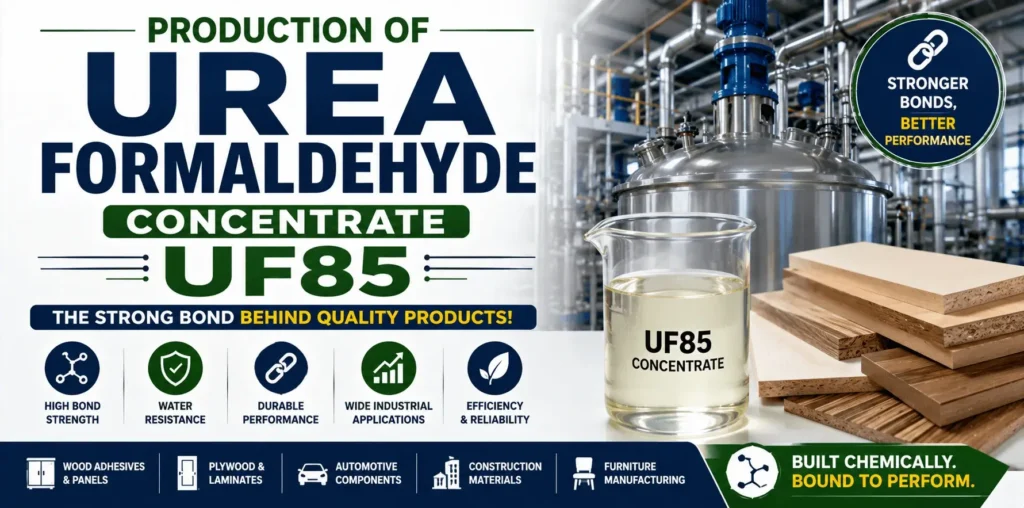
The production of Urea Formaldehyde Concentrate UF85 typically involves a controlled chemical reaction between urea and formaldehyde in the presence of a catalyst. This process is executed under precise conditions of temperature, pH, and reaction time to achieve the desired molecular weight and physical characteristics of UF85 resin. Growing demand from furniture manufacturing, construction materials, and industrial resin sectors continues to drive the global UF85 market. Urea Formaldehyde Concentrate UF85 is one of the most commonly used thermosetting resins, widely used in the production of thermosetting resins, adhesives, plywood, particle boards, MDF boards, laminates, textile finishing chemicals, and fertilizer additives. Due to its excellent bonding strength, high solid content, and cost-effectiveness, UF85 has become one of the most commonly used resin intermediates in the wood-processing and chemical industries. It has extensive use in industrial and commercial applications, understanding the production process of Urea Formaldehyde UF85 is crucial for manufacturers, engineers, and researchers in the field of polymer chemistry. What is Urea Formaldehyde Concentrate UF85? Urea Formaldehyde Concentrate UF85 is a viscous liquid intermediate containing approximately: 60% formaldehyde 25% urea 15% water It is commonly used as a raw material for manufacturing urea formaldehyde resins, adhesives, laminates, and slow-release fertilizers. UF85 is valued for its high reactivity, long storage stability, and strong bonding characteristics in industrial manufacturing applications. Production Process of Urea Formaldehyde Concentrate UF85 Let’s break down the steps involved in producing Urea Formaldehyde UF85. Step 1: Selection and Preparation of Raw Materials The two key raw materials required for manufacturing Urea Formaldehyde UF85 are: Urea (CO(NH?)?): A colorless, crystalline organic compound widely used as a nitrogen-release fertilizer and a base for resins. Formaldehyde (CH?O): A pungent-smelling, colorless gas that is commercially available in aqueous solution (formalin). A typical molar ratio used in the process is between 1:1.6 to 1:2 (urea to formaldehyde). This excess of formaldehyde ensures better cross-linking during polymerization and enhances the resin’s bonding properties. Step 2: Initial Methylolation Reaction The first chemical reaction in the production of Urea Formaldehyde UF85 is methylolation. This step involves mixing urea with formaldehyde at a temperature of about 50–60°C and an alkaline pH (typically 7.5 to 9). A base catalyst like sodium hydroxide (NaOH) is added to initiate the reaction. During methylolation, hydroxymethyl ureas are formed: Urea + Formaldehyde ? Mono-, Di-, and Tri-methylolureas These hydroxymethyl derivatives serve as intermediates for further polymerization. The concentration and time of the reaction at this stage determine the number of methylol groups, which directly influence the curing speed and final resin properties of UF85. Step 3: Condensation Reaction (Polymerization) Once methylolation is complete, the pH is adjusted to acidic conditions (typically pH 4.0 to 5.0) using formic acid or acetic acid, and the temperature is raised to 80–90°C. Under these conditions, the hydroxymethyl groups undergo a condensation reaction, forming methylene and dimethylene ether bridges. Condensation reaction: Hydroxymethylureas ? Linear and Branched Oligomers ? Crosslinked Polymer This step transforms the liquid monomers into a viscous polymeric resin. The degree of polymerization is closely monitored to achieve the specific viscosity and molecular structure characteristic of Urea Formaldehyde UF85. The timing is critical; if the reaction proceeds too far, the resin becomes too thick and unusable. Step 4: Stabilization and pH Adjustment After the desired level of polymerization is achieved, the reaction is stopped by neutralizing the pH back to 7–7.5 using sodium hydroxide or ammonia. This halts the condensation process and stabilizes the resin. At this point, stabilizers and modifiers may also be added to improve shelf life, reduce free formaldehyde content, and fine-tune the resin properties for different applications. Stabilization ensures that Urea Formaldehyde UF85 maintains its performance over time, especially during storage and transportation. Step 5: Concentration and Filtration The UF85 resin is then concentrated to the required solids content, typically 60–65%, through vacuum evaporation or distillation. Filtration is performed to remove any impurities or unreacted materials, ensuring a clean and consistent final product. The resulting viscous liquid is the commercial-grade Urea Formaldehyde UF85. Some manufacturers may further dry the resin into a powdered form depending on the end-use application. Step 6: Quality Testing and Packaging Once the resin is ready, it undergoes stringent quality control tests including: Viscosity Solids content Free formaldehyde content Gel time pH The manufacturer packages the Urea Formaldehyde UF85 resin into drums or containers only after it meets all specified standards, then delivers it to industries like wood panel production, textile finishes, and automotive interior manufacturing. Machinery Used in UF85 Production Major equipment used in the production of Urea Formaldehyde Concentrate UF85 includes: stainless steel reactors condensers vacuum evaporators agitators cooling systems filtration units storage tanks pH control systems packaging machines Modern automated process-control systems help maintain product consistency, quality, and production efficiency. Applications of Urea Formaldehyde UF85 Urea Formaldehyde UF85 is used in numerous applications across various industries: Wood adhesives: For particle board, MDF, and plywood Molded objects: Electrical fittings, buttons, and kitchenware Textiles: As a finishing agent to enhance wrinkle resistance Paper industry: For surface strengthening and gloss The choice of UF85 over other resins is often due to its cost-effectiveness, high reactivity, and favorable mechanical properties. Advantages of UF85 Some of the notable benefits of using Urea Formaldehyde UF85 include: High bond strength Fast curing time Economical production Low color and odor Customizable viscosity and solids content These features make UF85 a preferred material for large-scale industrial applications requiring reliable and consistent resin performance. Environmental and Safety Considerations Despite its advantages, Urea Formaldehyde UF85 does present environmental and health concerns primarily due to the release of formaldehyde gas. To mitigate this: Manufacturers add formaldehyde scavengers such as urea, melamine, or ammonia to reduce free formaldehyde levels. Manufacturers use closed reactor systems and maintain efficient ventilation during production. Workers must follow safety protocols and use personal protective equipment (PPE) during handling and processing. Manufacturers also focus on developing low-emission UF85 variants that comply with environmental regulations such as CARB (California Air Resources Board) and E1 European standards. Global Market Trends and Innovations The demand for