
List of Profitable Plastic Products Manufacturing Business.
Plastic has become an indispensable part of our lives, finding its way into nearly every industry from packaging and construction to electronics and healthcare. As global demand continues to surge, the plastic products manufacturing sector stands out as a profitable opportunity for aspiring entrepreneurs. With innovations in technology, recycling methods, and biodegradable alternatives, the industry offers numerous entry points for both small-scale and large-scale ventures. Why Plastic Products Manufacturing is a Smart Investment The global plastic industry is valued in the hundreds of billions of dollars, and it’s projected to grow steadily over the coming decades. Despite growing environmental concerns, the demand for plastic materials in automotive, construction, consumer goods, and medical devices continues to rise. New-age materials such as biodegradable plastics and recycled resins are creating a parallel demand that complements the traditional plastic industry. By entering the profitable plastic products manufacturing business, entrepreneurs can capitalize on this expanding market while also contributing to sustainable development through eco-friendly alternatives. Types of Plastic Products Manufacturing Businesses Before diving into the business, it’s essential to understand the various sub-sectors within the plastic products manufacturing industry. Each segment has unique raw material requirements, machinery needs, investment sizes, and market demand: Plastic Bag and Pouch ManufacturingOne of the simplest and most common ventures, plastic bag and pouch production requires limited capital and basic extrusion and sealing machines. With proper market targeting—such as grocery stores, packaging vendors, and food chains—this can yield quick profits. Injection Molding ProductsThis process is used to create intricate plastic components like bottle caps, containers, toys, and electronic housings. Though it requires a higher investment in molds and machines, injection molding offers high-volume production and scalability. PVC and HDPE Pipe ManufacturingPipes made from plastics like PVC or HDPE are widely used in agriculture, construction, and water supply systems. This sub-sector demands a medium to high investment but offers stable, long-term returns due to continuous demand. Plastic Furniture ProductionWith a growing market for lightweight, durable, and low-cost furniture, especially in developing nations, plastic furniture manufacturing offers great profitability. Chairs, stools, and tables can be molded in bulk and sold wholesale to retailers and contractors. Recycled Plastic Product ManufacturingSustainability-focused ventures can explore the recycling domain—converting waste plastic into usable items like floor tiles, park benches, or packaging materials. This not only minimizes environmental impact but also reduces raw material costs significantly. Biodegradable Plastic ManufacturingWith increasing regulatory pressure against single-use plastics, manufacturing compostable and biodegradable plastic alternatives is a forward-looking business idea. Although this field involves more technical expertise and higher R&D costs, it appeals to a growing eco-conscious customer base. Market Research and Business Planning Every successful plastic products manufacturing business starts with comprehensive market research. Understanding the demand, local regulations, competitors, pricing strategies, and supply chain is vital. Your business plan should include: Executive SummaryA brief overview of the business concept, mission, and goals. Market AnalysisEvaluate your target market, potential customers, and competition. Products and ServicesClearly define your product range—are you making utility items, construction materials, or custom parts? Operations PlanDescribe your manufacturing process, location, sourcing of raw materials, and machinery. Marketing StrategyDetermine how you will promote your products—digital marketing, distributors, or direct-to-retail. Financial ProjectionsInclude capital requirements, revenue forecasts, breakeven analysis, and ROI estimates. Legal Compliance and Registration Registering your plastic manufacturing unit involves several steps: Business Entity Formation: Choose a structure like sole proprietorship, partnership, LLP, or Pvt Ltd. Factory License: Obtain a license under the Factories Act if employing workers and using machinery. Pollution Control Board Clearance: Since plastic is environmentally sensitive, you must secure a No Objection Certificate (NOC) from your local State Pollution Control Board. GST Registration: Mandatory for tax compliance and interstate sales. Trademark Registration: Protect your brand name and product identity. Machinery and Raw Materials Required Depending on your product type, your plastic manufacturing unit will require different machines and raw materials. Common equipment includes: Extrusion Machines: For producing plastic films, pipes, and sheets. Injection Molding Machines: For mass production of molded products. Blow Molding Machines: For creating plastic bottles and containers. Recycling Machines: For cleaning, shredding, and repurposing used plastics. Mixers and Cutters: For coloring, shaping, and cutting plastic granules. Typical raw materials used in plastic production include: Polyethylene (PE) Polypropylene (PP) Polyvinyl Chloride (PVC) High-Density Polyethylene (HDPE) Additives and Colorants Raw materials can be sourced from petrochemical companies or imported if specialty resins are required. Investment and Profitability Starting a small-scale plastic manufacturing business can require an investment ranging from ?10 lakhs to ?50 lakhs (USD 12,000 to 60,000), depending on the product type and machinery. Medium and large-scale units may need crores of rupees in investment. Your profitability depends on: Efficient production Low cost of raw materials Bulk sales Minimum wastage High market demand For example, a small plastic bag manufacturing unit can earn ?1 lakh to ?3 lakhs per month after expenses, depending on scale and location. Return on investment can often be realized within 2–3 years. Sustainability and the Future of Plastics While plastic is essential, its environmental impact cannot be ignored. Governments across the world are tightening regulations on single-use plastics. Hence, it’s vital for new entrants in plastic manufacturing to explore greener options: Use recyclable and biodegradable materials Implement closed-loop recycling processes Reduce production waste Partner with waste management services The demand for bio-based plastics is expected to grow at over 10% CAGR globally. Innovations in corn-starch-based PLA (Polylactic Acid), PHA (Polyhydroxyalkanoates), and other biodegradable materials present enormous opportunities. Marketing and Sales Strategies To thrive in the competitive plastic manufacturing market, you must adopt smart marketing and sales tactics: Bulk Contracts: Partner with wholesalers, supermarkets, or institutions for long-term contracts. Online Sales: Use B2B platforms like IndiaMART, TradeIndia, Alibaba, or Amazon Business. Direct Marketing: Attend trade fairs, exhibitions, and expos to showcase your products. Branding: Establish a strong brand identity with logos, product labeling, and quality assurance. Digital marketing—SEO, email outreach, and social media ads—can help you reach niche clients such as eco-conscious brands or local retailers looking for reliable plastic product suppliers. Challenges and Risk Mitigation
Start Your Own Craft Brewery or Distillery (Startup).
In recent years, the demand for craft beer & microbrewery ventures has seen a remarkable upswing across the globe. With changing consumer preferences leaning toward artisanal flavors, local brewing practices, and community-centric pubs, the idea of launching your own brewery is more promising than ever. Whether you’re a passionate homebrewer or an entrepreneur looking for a profitable and creative venture, the craft beer & microbrewery business offers an exciting blend of culture, craft, and commerce. Starting Your Own Craft Beer & Microbrewery: Key Considerations and Business Models Before diving headfirst into the world of hops and barley, it’s essential to understand the various business models available in the craft beer & microbrewery space. There are typically four primary models you can consider: Brewpub – A hybrid model where beer is brewed on-site and sold directly to consumers through an attached restaurant or bar. Microbrewery – Small-scale brewing operations focusing on local or niche markets, often supplying beer to bars, restaurants, or directly to customers. Contract Brewing – Here, the entrepreneur outsources production to an established brewery, ideal for those focused more on branding and marketing. Taproom Brewery – A small-scale brewery with an on-site taproom where customers can enjoy fresh beer, often accompanied by events or food trucks. Each of these models caters to a different market, scale, and capital investment requirement. Brewpubs and taprooms offer high margins but require licenses and real estate. Contract brewing, on the other hand, lowers operational complexity but gives you less control over the brewing process. Market Research and Trends According to recent industry reports, the craft beer & microbrewery sector is expected to grow at a compound annual growth rate (CAGR) of over 10% through 2030. The rise is largely attributed to increased consumer demand for unique, high-quality brews that tell a story — a stark contrast from the generic appeal of mass-produced lagers. Millennials and Gen Z consumers are driving this demand. They’re not just buying beer; they’re buying an experience — flavors that reflect local ingredients, sustainable brewing processes, and compelling brand narratives. This makes marketing and product differentiation key pillars in a successful business plan. Creative Startup Ideas for Your Craft Beer & Microbrewery Let’s explore some creative and viable business ideas within the craft beer & microbrewery ecosystem: 1. Theme-Based Microbrewery Develop a brewery based around a specific cultural or experiential theme — medieval tavern, steampunk, space-themed bar, or regional folk culture. These types of breweries create immersive experiences that boost customer loyalty and encourage social sharing. 2. Farm-to-Mug Brewery Use locally sourced ingredients from regional farms — organic hops, heirloom grains, seasonal fruits — and highlight sustainability and transparency. This appeals to environmentally conscious consumers and helps foster local partnerships. 3. Mobile Craft Brewery (Beer Bus) A modified truck or van that acts as a roving taproom. Perfect for private events, corporate gatherings, or food festivals. The initial investment is lower than a physical brewery, and mobility allows wider market reach. 4. Nano-Brewery with Subscription Boxes Start very small (1-3 barrels) and deliver freshly brewed beer directly to consumers through a subscription model. Ideal for testing new flavors and building a loyal customer base before scaling up. 5. Women-Centric Brewery Craft beer has often been male-dominated, but there’s a growing movement to make the space more inclusive. A female-focused craft beer & microbrewery could target women’s preferences in flavors, design, and atmosphere, while supporting women brewers and local artisans. 6. Sustainable, Zero-Waste Brewery An eco-conscious brewery that recycles its own waste, uses renewable energy, and offers beer in reusable or biodegradable packaging. Use spent grain to make dog treats, compost, or baked goods for added revenue. 7. Experimental Brewery Lab Focus on producing small experimental batches — chili-infused ales, coffee stouts, herb beers — and invite customers to be part of the testing process. This creates community engagement and encourages word-of-mouth promotion. Legal Requirements and Licensing Entering the craft beer & microbrewery industry requires navigating a detailed web of regulations and licenses, which can vary by country and region. In India, for example, you must obtain a microbrewery license from the state excise department. Additional permits include: FSSAI (Food Safety and Standards Authority of India) license GST registration Pollution Control Board clearance Trade license from the local municipal corporation Additionally, breweries must comply with health, safety, and zoning regulations. Consulting a legal expert or business consultant familiar with alcohol laws is strongly recommended. Equipment and Setup Costs The major cost components of setting up a craft beer & microbrewery include: Brewing equipment (fermenters, boilers, chillers, storage tanks) Real estate (rent or purchase) Interiors and furnishings (if opening a brewpub) Raw materials (malts, hops, yeast, water) Utilities (especially water and electricity) Staffing and training Licensing and legal expenses Branding and marketing The setup cost for a nano-brewery in India may start from ?20–25 lakhs, while a full-scale brewpub could require ?1–2 crore depending on location and scale. Marketing Your Craft Beer Brand The competition in the craft beer & microbrewery segment is fierce, making marketing a critical part of your strategy. Here are some tips: Brand Identity: Create a compelling logo, slogan, and packaging that reflects your brand’s story and values. Social Media: Use Instagram and Facebook to post high-quality visuals, behind-the-scenes videos, and customer reviews. Collaborations: Partner with local restaurants, event organizers, and influencers. Loyalty Programs: Offer discounts or free tastings to repeat customers. Beer Tasting Events: Organize small tasting sessions and brewery tours to build brand recall. Remember, your beer is only as good as the story you tell around it. Profitability and Break-Even Timeline A well-run craft beer & microbrewery can achieve break-even within 2–3 years. Profit margins on craft beer are significantly higher than commercial beer, especially if you’re selling directly through a taproom or brewpub. Factors that influence profitability include: Volume of production and sales Cost of raw materials and logistics Location and footfall Operational efficiency Customer retention rate Expanding into merchandise (glassware, apparel, gift boxes) or offering private-label brewing services can further
List of Profitable Projects on Pipe & Tubes Production.
The global demand for infrastructure, construction, and industrial machinery is fueling rapid growth in the pipe & tube manufacturing sector. With a wide array of applications across oil and gas, automotive, construction, agriculture, and water management industries, pipe and tube products are essential components in modern development. As 2025 unfolds, new technologies, sustainability trends, and increased government spending on infrastructure projects are creating significant opportunities for entrepreneurs and investors in the pipe & tube manufacturing domain. Growth Prospects of Pipe & Tube Manufacturing in 2025 The year 2025 is expected to be a milestone for the pipe & tube manufacturing industry. The global market size for pipes and tubes is projected to reach over USD 200 billion by 2025, driven by factors such as urbanization, smart city initiatives, and clean water distribution systems. Emerging economies, especially in Asia and Africa, are rapidly expanding their infrastructure, thereby increasing demand for steel, plastic, and composite pipes. Furthermore, industries are looking for lightweight, corrosion-resistant, and high-performance tubing solutions, opening doors for innovation. One of the significant drivers in 2025 is the resurgence of manufacturing activity globally. As economies recover from past slowdowns and geopolitical shifts, there’s a strong push to localize production. This not only reduces supply chain vulnerabilities but also supports domestic industries. The pipe & tube manufacturing sector stands to gain as both public and private sector investments are poured into energy pipelines, agricultural irrigation systems, and residential water supply networks. Types of Pipes and Tubes in Demand In pipe & tube manufacturing, it’s crucial to identify and specialize in a product segment that matches market needs and capital availability. Some of the most demanded categories include: Steel Pipes and Tubes: Used in oil and gas, automotive, heavy machinery, and structural applications. They offer strength, durability, and high resistance to pressure. PVC and CPVC Pipes: Preferred for plumbing and drainage due to their lightweight and corrosion-resistant properties. These are commonly used in both residential and industrial plumbing systems. HDPE Pipes: High-density polyethylene pipes are gaining popularity in irrigation, sewage, and potable water systems because of their flexibility and environmental friendliness. Copper Tubes: Often used in refrigeration, air conditioning, and medical gas systems. Though more expensive, they offer excellent heat resistance and antimicrobial properties. Aluminum Tubes: Used in aerospace, electrical, and certain construction applications where weight and corrosion are concerns. Choosing the right material and production technology is critical for the success of any pipe & tube manufacturing business. Investment Requirements and Setup Setting up a pipe & tube manufacturing plant involves moderate to high capital investment, depending on the scale and type of pipes being produced. Key components of setup include: Land and Infrastructure: Requires space for production units, storage yards, and administrative offices. Machinery and Equipment: Includes extruders, cutting machines, welding equipment, dies and molds, galvanizing systems (for metal pipes), and testing units. Raw Materials: Steel, plastic granules (PVC, HDPE), copper, aluminum, and other metals or polymers depending on the product. Labor and Skilled Workforce: Machine operators, quality control specialists, and engineers are essential for smooth operations. Licensing and Compliance: Industry-specific licenses, pollution control certifications, and ISO standards may be required. Most small to medium enterprises can start with plastic pipe manufacturing, which requires comparatively lower investment than steel or copper-based plants. Market Segments and Customer Base The pipe & tube manufacturing industry serves a diverse customer base, making it less vulnerable to sector-specific downturns. Key end-users include: Real Estate and Construction: Pipes are used for plumbing, drainage, and HVAC systems. Oil & Gas Sector: Steel pipes are used in drilling, exploration, and transport pipelines. Agriculture: Irrigation systems and borewell tubes are essential in rural infrastructure. Water Supply and Sewage: Governments are heavily investing in sanitation and water access programs. Automotive and Aerospace: Tubes are used in fuel systems, cooling systems, and structural frames. Strategic partnerships with contractors, builders, and government agencies can ensure long-term demand and stable cash flow for a pipe & tube manufacturing business. Emerging Trends in Pipe & Tube Manufacturing Innovation and technology adoption are transforming the pipe & tube manufacturing space. Here are some trends shaping 2025: Automation and Smart Manufacturing: Use of robotics, IoT, and AI for quality control, predictive maintenance, and real-time monitoring. Recyclable and Sustainable Materials: Bioplastics and recycled materials are being introduced, especially in drainage and irrigation pipe manufacturing. Corrosion-Resistant Coatings: New chemical coatings enhance the durability of metal tubes in harsh environments. Customization and Modular Manufacturing: Clients demand tailor-made solutions—flexible sizing, colored pipes, and pre-fabricated modules. 3D Printing of Fittings: Additive manufacturing is being explored to create pipe joints and components at lower costs and lead times. Adapting to these innovations will help new entrants differentiate their offerings in an otherwise competitive pipe & tube manufacturing market. Challenges and How to Overcome Them While the opportunities are numerous, certain challenges remain: Raw Material Volatility: Prices of metals and polymers fluctuate due to global supply chains. Solution: Develop local supplier networks and lock in rates via contracts. Regulatory Hurdles: Environmental norms can delay project approvals. Solution: Invest in eco-friendly technology and seek expert guidance on compliance. High Competition: Domestic and international manufacturers often compete on price. Solution: Focus on quality, niche products, or customized solutions. Logistics and Distribution: Bulky products like pipes can be expensive to transport. Solution: Set up manufacturing units near demand hubs or use regional warehouses. By addressing these concerns with a proactive strategy, a pipe & tube manufacturing business can scale efficiently. Government Support and Schemes in 2025 Governments in India and other developing countries are providing strong support for manufacturing businesses through schemes like: PM Gati Shakti: Infrastructure development to boost logistics and industrial parks. PLI Scheme for Steel Sector: Offers incentives for production and export of high-grade steel pipes and tubes. Startup India and MSME Schemes: Provide easy loans, subsidies, and tax benefits for small pipe & tube manufacturing setups. Jal Jeevan Mission: Massive government initiative to provide drinking water through pipelines—creating demand for millions of kilometers of pipes. Understanding and tapping into these
List of Profitable Manufacturing Business Ideas in Pharmaceutical Industry.
India’s pharmaceutical industry has emerged as one of the top contributors to the global drug market. The country not only supplies over 50% of the world’s vaccines but also is a key player in producing affordable generic medicines. With supportive government policies under initiatives like Pharma Vision 2025, increasing healthcare awareness, and rising demand for affordable drugs globally, starting a pharma manufacturing business in 2025 could be a highly profitable venture for entrepreneurs and investors. Overview of the Pharma Manufacturing Business in 2025 Pharma manufacturing involves the production of medicines and drugs in various forms such as tablets, capsules, syrups, ointments, and injectables. In 2025, the industry is expected to continue its upward trajectory, driven by digitalization, AI-based R&D, contract manufacturing opportunities, and rising global demand post-COVID. India’s pharma market, valued at over $65 billion in 2024, is expected to touch $130 billion by 2030. Before diving into the manufacturing process, understanding the entire ecosystem is essential. Pharma manufacturing is a highly regulated field that requires licensing, strict quality control, adherence to international standards (like GMP, WHO-GMP, US FDA), and proper infrastructure. Step-by-Step Guide to Start a Pharma Manufacturing Business 1. Choose the Type of Pharma Manufacturing Unit Before initiating any formalities, decide the kind of manufacturing you plan to start: General Allopathic Drug Manufacturing Ayurvedic/Herbal Medicine Manufacturing Nutraceuticals Manufacturing Injectables/IV Fluids Production API (Active Pharmaceutical Ingredients) Manufacturing Contract Manufacturing/Third-party Manufacturing Each type has different levels of investment, technology needs, and regulatory compliance. 2. Market Research & Business Plan Development In 2025, competition is intense in pharma manufacturing. Thorough market research is crucial to identify niche opportunities. Focus on: Types of drugs in high demand (anti-diabetic, cardiovascular, cancer, lifestyle, etc.) Export potential for regulated and semi-regulated markets Demand in government tenders, hospitals, and institutional buyers Create a detailed business plan covering: Product list Market strategy SWOT analysis Financial forecasts Licensing roadmap Investment plan Risk mitigation strategy 3. Legal & Regulatory Requirements The pharma sector is heavily regulated to ensure consumer safety. You will need several licenses and clearances before manufacturing drugs. Company Registration – Private Limited, LLP or Proprietorship Drug Manufacturing License – Apply to the State Drug Control Department GMP Certification – Good Manufacturing Practices compliance NOC from Pollution Control Board Factory License under Factory Act Trademark & Brand Registration Import/Export Code (IEC) – if planning international trade GST Registration You must also comply with the Drugs and Cosmetics Act, 1940 and the Pharmaceutical Inspection Co-operation Scheme (PIC/S) norms if exporting. 4. Location & Infrastructure Setup Location selection depends on state-specific pharma parks, incentives, and pollution norms. Prefer areas like Baddi (Himachal), Hyderabad, Sikkim, Gujarat, and Pune which offer tax incentives and pharma clusters. Facility requirements: Built-up area of 2,000 to 10,000+ sq. ft. depending on scale Dedicated production zones for different drug forms Quality control & assurance labs Storage rooms with temperature control Water treatment plant HVAC system Effluent Treatment Plant (ETP) Warehousing space The infrastructure should strictly adhere to Schedule M of the Drugs and Cosmetics Rules. 5. Procurement of Machinery and Equipment Select machinery based on your production line: Tablet punching machines Capsule filling machines Liquid filling lines Coating and granulation machines Sterilizers (for injectables) Blenders and mixers Packaging machines Quality control instruments In 2025, manufacturers are investing in automated production lines and Industry 4.0 technologies like IoT-enabled monitoring and robotic packing. 6. Hiring Skilled Workforce The success of your pharma manufacturing business depends on qualified manpower. Key roles include: Production chemists Quality Assurance (QA) executives Regulatory compliance officers Microbiologists and Pharmacists Plant managers and Machine operators You must appoint a “competent technical staff” (as per D&C Act) with B.Pharm/M.Pharm degrees for obtaining your manufacturing license. 7. Product Development and R&D Creating formulations that comply with therapeutic efficacy, patient safety, and affordability is critical. You may start with existing generics or collaborate with R&D labs for innovation. Standard Operating Procedures (SOPs) must be established. Stability testing and bio-equivalence studies (for exports) are essential. In-house or outsourced R&D may be required for dosage optimization and clinical data. 8. Quality Control & Regulatory Compliance Every batch of medicine must undergo rigorous quality control before it reaches the market. In 2025, regulatory scrutiny has intensified, especially for exporters. Establish an in-house quality control lab. Maintain batch records, test reports, and compliance documents. Follow ICH Guidelines, USFDA standards, or EU-GMP depending on target market. Implement a computerized system for batch tracking and documentation. 9. Branding, Marketing & Sales Brand-building plays a vital role in gaining market share in pharma manufacturing. Launch under your own brand or engage in third-party manufacturing. Use digital marketing, doctor outreach, medical representatives, and hospital networks. Participate in pharma expos and trade shows for B2B deals. Register your products with pharmacy chains, hospitals, and government procurement agencies. 10. Funding and Investment Options Starting a pharma manufacturing business involves high capital investment (?50 lakh to ?10 crore+ depending on scale). Funding sources: Bank loans under MSME/Startup India schemes SIDBI assistance for pharma units Venture capital for export-based businesses State subsidies under pharma park schemes PLI (Production Linked Incentive) Scheme support Make sure your financial model accounts for 6–12 months of working capital, machinery loans, marketing expenses, and R&D costs. Key Challenges in Pharma Manufacturing Despite being profitable, the pharma manufacturing industry in 2025 faces several challenges: Complex regulatory landscape Competition from large players and imports Fluctuating raw material costs (especially APIs from China) Need for continuous R&D and innovation Rising cost of compliance and environmental controls Addressing these challenges with robust strategy, automation, and quality differentiation is essential for success. Future Scope of Pharma Manufacturing Business The future of pharma manufacturing in India and globally looks bright due to: Increasing lifestyle diseases and chronic health conditions Rising demand for personalized medicine Contract manufacturing opportunities from global brands Emergence of biotech and biosimilars Adoption of AI and data science in drug discovery India is poised to be a global leader in affordable and innovative drug production. By leveraging government policies, new technology, and global demand, even new
List of Business Ideas for Production of Petroleum and Petroleum Products.
The petroleum industry continues to be one of the most vital sectors of the global economy. Despite the growing emphasis on renewable energy, petroleum remains indispensable for transportation, manufacturing, and even agriculture. In 2025, the petroleum industry is undergoing a phase of transformation, opening new windows of opportunity for investors and entrepreneurs. From core refining operations to the commercialization of by-products like bitumen, waxes, lubricants, and grease, this sector offers diverse avenues for business growth. As the world balances between traditional fossil fuels and alternative energy sources, those venturing into innovative petroleum-based businesses stand to benefit greatly. Business Potential in the Petroleum Industry in 2025 The petroleum industry is not just about oil extraction and fuel production; it includes a comprehensive network of downstream businesses that convert crude oil into thousands of useful products. With rising demand in developing countries and strategic government incentives to promote private investments in refining and petrochemical ventures, the business environment is ripe. Entrepreneurs can explore opportunities in refining, by-product processing, lubricant manufacturing, retail distribution, and more. Refining and Processing Ventures Refineries are the backbone of the petroleum industry, converting crude oil into usable fuels like petrol, diesel, kerosene, and jet fuel. However, setting up a refinery involves high capital expenditure, complex regulatory approvals, and advanced technical knowledge. Instead of building large-scale plants, many entrepreneurs now invest in modular refineries or collaborate with government-backed mini-refinery projects in resource-rich regions. These smaller-scale operations reduce risk while maintaining profitability. Governments in countries like India, Nigeria, and Indonesia are actively seeking private investment in this area due to local fuel demand and import substitution goals. By-Product-Based Businesses One of the most profitable segments within the petroleum industry is the by-product sector. Refineries produce numerous secondary products, many of which have high industrial and commercial value. Some lucrative by-product opportunities include: Petroleum Coke (PetCoke): Used as a fuel in cement kilns and power plants. Bitumen: Essential for road construction and roofing industries. Paraffin Wax: Applied in candles, cosmetics, pharmaceuticals, and packaging. Sulfur: Widely used in fertilizers and chemical manufacturing. Entrepreneurs can establish processing units that refine these by-products for specific markets. For instance, bitumen refining plants targeting government infrastructure projects can generate steady revenue. Similarly, paraffin wax processing units that cater to the cosmetic and candle-making industries are in growing demand. Grease and Lubricant Manufacturing Another promising niche within the petroleum industry is the manufacture of industrial grease and automotive lubricants. As the number of vehicles and industrial machines increases globally, so does the need for high-quality lubrication solutions. Lubricant production is a technically viable business that requires blending base oils with additives. Small and medium-scale grease manufacturing plants can be set up with moderate investment and cater to sectors such as: Automotive (engine oil, gear oil) Manufacturing (hydraulic and compressor oils) Agriculture (tractor and pump grease) Marine and aviation (specialized lubricants) Moreover, with the growth of electric vehicles (EVs), there is an emerging market for specialized lubricants for EV motors, axles, and thermal management systems. Retail and Distribution Networks With increasing fuel consumption and rising vehicle sales, the downstream fuel retail sector is also expanding. Setting up a fuel retail outlet (petrol pump) in collaboration with government-authorized oil companies (like Indian Oil, HPCL, BPCL, etc.) remains a viable and profitable venture in India and other fuel-importing countries. In addition to fuel, petroleum-based retail businesses include: Engine oil and grease dealerships LPG and CNG distribution Mobile fuel delivery services Industrial lubricant supply chains Thanks to digitization and logistics innovation, entrepreneurs can now run app-based fuel delivery platforms or centralized distribution models, improving customer access and margins. R&D and Technical Services The modern petroleum industry is increasingly driven by data, automation, and technical innovation. There is significant demand for businesses offering specialized services such as: Refinery efficiency audits Environmental compliance consulting Oilfield digitalization (IoT & AI integration) Maintenance and servicing for pipelines, valves, and storage tanks Engineers, scientists, and tech-driven entrepreneurs can offer research-backed solutions to help refineries optimize processes, reduce emissions, and improve product quality. This is especially relevant as governments enforce stricter environmental and safety regulations across the globe. Greener Solutions Within Petroleum Even as the petroleum industry contributes to carbon emissions, there is room for sustainable practices. Businesses focusing on cleaner technologies, recycling, and emission control are gaining traction. Some eco-aligned petroleum business ideas include: Used oil recycling plants Solvent extraction and recovery Carbon capture and storage (CCS) services Grease trap waste treatment Bio-based lubricant formulation These solutions not only help reduce the environmental footprint of oil-based operations but also qualify for green subsidies and carbon credits in many countries. Export-Oriented Opportunities Exporting petroleum products and by-products presents another profitable venture. Many regions with oil refineries export surplus by-products like waxes, lubricants, and bitumen. Establishing a specialized export company that handles regulatory compliance, packaging, and logistics can generate substantial returns. Target markets for export businesses include: Africa and Southeast Asia (bitumen and lubricants) Latin America (paraffin wax) Middle East (specialty greases) To succeed, entrepreneurs must build strong supplier networks, understand international regulations, and invest in quality control and packaging. Training & Manpower Development Another side of the petroleum industry that often gets overlooked is skill development. The complexity of the industry requires trained workers, technicians, and engineers. Starting training centers that provide certification in refinery operations, grease formulation, petroleum product handling, or HSE (health, safety, environment) compliance is a meaningful and revenue-generating business. With the support of industry bodies and government initiatives like the Skill India Mission, such training ventures can gain fast traction. Final Thoughts In 2025, the petroleum industry is evolving—not vanishing. Despite the global energy shift, petroleum remains critical to infrastructure, transportation, and manufacturing. This enduring relevance opens doors to various business opportunities beyond the traditional scope of fuel extraction. From by-products like bitumen and waxes to grease manufacturing, eco-friendly recycling ventures, and digital oilfield solutions, the landscape is full of possibilities. However, success in this industry depends on thorough technical knowledge, adherence to safety and environmental standards, and staying updated with market
List of Profitable Projects on Paper and Paper Products Manufacturing Industry Production of Paper
Starting a business in the paper products manufacturing sector can be a highly rewarding venture, especially in a world that increasingly favors eco-friendly and biodegradable alternatives over plastic. The demand for paper-based products such as tissue paper, paper bags, napkins, cups, notebooks, and packaging materials is surging due to growing environmental awareness, government regulations against single-use plastics, and rising urbanization. With a reasonable investment, sound planning, and an efficient production setup, entrepreneurs can establish a successful business in this thriving industry. Why Start a Paper Products Manufacturing Business? The paper products manufacturing business offers a wide range of opportunities for new entrepreneurs. One of the major advantages is the variety of items that can be produced – from household essentials like tissue papers and kitchen rolls to industrial products like corrugated boxes and paper tubes. This diversity allows manufacturers to tap into different markets and diversify revenue streams. Additionally, paper is recyclable and biodegradable, making it a preferred choice for packaging, which adds to the market’s long-term potential. Market Potential and Demand The demand for paper products has shown consistent growth over the years. With the rise in e-commerce, there’s an increasing need for sustainable packaging solutions. Educational institutions, offices, hotels, restaurants, and households also contribute to the high consumption of paper goods. According to recent market reports, the global paper products market is projected to grow steadily, driven by a shift from plastic to eco-friendly materials. The Indian market specifically has seen growth due to urban expansion, lifestyle changes, and the digital commerce boom. Types of Paper Products You Can Manufacture When entering the paper products manufacturing space, it’s essential to identify your niche. Some common and profitable options include: Tissue paper and napkins – Widely used in households and the hospitality sector. Toilet paper and kitchen rolls – Everyday household items with consistent demand. Paper bags – Replacing plastic bags due to environmental regulations. Disposable paper cups and plates – Especially popular in food delivery and catering. Notebooks, diaries, and office stationery – Continues to have strong demand from the education sector. Corrugated cardboard and boxes – Essential for shipping and logistics industries. You can start with one or two products and expand gradually based on market demand and business capacity. Required Licenses and Registrations To start a paper products manufacturing business in India, certain licenses and regulatory approvals are necessary. These include: Business registration – Register your firm as a sole proprietorship, partnership, LLP, or private limited company. Factory license – Mandatory if the unit uses power and employs workers. GST registration – Required for tax purposes. Trade license – Issued by local municipal authorities. Pollution control certificate – From the State Pollution Control Board (especially if chemical processing is involved). Udyam Registration (MSME) – Helps avail government schemes and subsidies. Ensure you comply with all the legal norms to operate smoothly and avoid penalties. Machinery and Equipment The machinery required depends on the type of product you intend to manufacture. For example: Tissue paper making machine – Used for converting jumbo reels into facial tissues or toilet paper. Bag making machine – For manufacturing paper carry bags. Notebook manufacturing machine – To cut, stitch, and bind papers into notebooks. Printing and cutting machines – For labeling, branding, and shaping the paper. Packaging machines – For packing the finished products. Automated and semi-automatic machines are available depending on your budget and production scale. Investing in quality machinery improves productivity and minimizes wastage. Raw Materials Required The primary raw material in paper products manufacturing is paper. Depending on your niche, the type of paper you use will vary. For example: Virgin paper or recycled paper – For tissue and napkins. Kraft paper – For paper bags and packaging boxes. Cardboard sheets – For diary and notebook production. Adhesives, printing inks, stitching wire – Based on your product specifications. You can source paper locally or from wholesale paper mills. Opting for recycled paper also aligns with sustainable manufacturing practices. Manufacturing Process Here is a general overview of the steps involved in paper products manufacturing: Material Preparation – Procure and inspect raw materials for quality. Cutting and Shaping – Raw paper is cut and shaped using specific machines. Printing (if applicable) – Logos or designs are printed onto the paper products. Binding or Stitching – For notebooks and diaries, pages are stitched and bound. Folding and Packaging – Tissue paper, napkins, and similar items are folded and packed. Quality Control – Each batch is checked to ensure it meets quality standards. Storage and Dispatch – Finished products are stored in hygienic conditions and dispatched to distributors or retailers. Cost of Starting the Business The initial investment required for setting up a paper products manufacturing unit can vary depending on scale, product type, and automation. Here’s a rough estimate: Small scale unit: ?5 to ?15 lakhs Medium scale unit: ?20 to ?50 lakhs Large scale unit: ?50 lakhs and above Expenses typically include: Machinery purchase or lease Factory setup and infrastructure Raw material procurement Labor costs Marketing and distribution Utility bills and contingency fund Availing MSME loans or government subsidies can reduce your financial burden. Marketing and Sales Strategy An effective marketing plan is crucial for establishing a foothold in the competitive paper products manufacturing market. Here are some strategies: Online presence – Create a website, list products on e-commerce platforms, and run ads on Google and social media. B2B tie-ups – Approach supermarkets, wholesalers, stationery shops, schools, hotels, and packaging firms. Product branding – Offer eco-friendly, hygienic, and attractively packaged products. Attend trade fairs and exhibitions – A great way to network and showcase your product range. Offer samples and discounts – Especially in the initial phase to gain customer trust. Word-of-mouth marketing and consistent product quality will further enhance your brand image. Profit Margin and Growth Scope The profit margin in paper products manufacturing ranges between 10% to 25%, depending on the product type, quality, and distribution channels. For instance, luxury or custom-printed products fetch better prices compared
Paint and Coatings Manufacturing Industry.
Starting a paint and coating manufacturing business in today’s construction and industrial landscape can be highly lucrative. With growing infrastructure projects, real estate development, automotive production, and industrial growth, the demand for decorative, protective, and industrial paints is at an all-time high. If you’re planning to set foot in this vibrant sector, understanding the foundational steps and regulatory environment is critical. This article walks you through a comprehensive roadmap for launching a successful paint and coating venture. Understanding the Paint and Coating Manufacturing Market The paint and coating manufacturing industry includes a wide range of products used for various applications—automotive paints, decorative paints, industrial coatings, waterproofing solutions, and specialty protective layers. The Indian market alone is expected to grow at a CAGR of over 8% during the next five years. Globally, eco-friendly and water-based coatings are gaining traction due to increasing environmental awareness and stringent regulations. 1. Market Research and Business Planning Before jumping into production, conduct in-depth market research to understand current trends, market demand, consumer preferences, and competition. Identify your niche—decorative paints, industrial coatings, anti-rust coatings, heat-resistant paints, or eco-friendly paints. Once your research is complete, prepare a detailed business plan including: Executive summary Product range and applications Target audience Capital requirement Equipment list SWOT analysis Marketing and sales strategy This business plan will not only guide you during startup but also serve as a foundation when approaching investors or banks for funding. 2. Choosing the Right Business Model There are three primary models in the paint and coating manufacturing industry: Independent Brand Manufacturer: You manufacture and sell under your own brand name. Contract Manufacturer: You produce paints for third-party brands. Franchise Model: Partner with an established brand to use their name and formula in return for royalties. Each model has its pros and cons. Independent manufacturing provides full control and higher profits, while contract manufacturing ensures consistent orders without marketing burdens. 3. Legal Formalities and Licenses Establish your firm legally as a sole proprietorship, partnership, LLP, or Pvt. Ltd. company. Depending on the nature of your business and your scale of operations, apply for the following: GST registration Factory license from local authorities Pollution Control Board NOC Fire and Safety approvals Trademark registration for brand protection BIS certification for certain products (optional but preferred) Paint production involves chemicals, solvents, and flammable materials. Hence, compliance with environmental and safety regulations is crucial. 4. Location and Infrastructure Choose an industrial location that is compliant with environmental laws and is away from residential areas. A space of 3,000 to 10,000 sq. ft. is usually required depending on your production volume. Your infrastructure should include: Raw material storage Production area Quality testing lab Packaging section Administrative office Waste disposal facility Install ventilation systems, fire extinguishers, and storage racks for chemical safety. 5. Machinery and Raw Materials The core of any paint and coating manufacturing setup is the right machinery and raw material procurement strategy. Commonly used machinery includes: High-speed dispersers Ball mills Mixers and agitators Sand mills Filtration and filling machines Packing and labeling units Key raw materials include: Resins (alkyd, acrylic, epoxy) Solvents (turpentine, xylene, toluene) Pigments and extenders Additives (driers, anti-settling agents, thickeners) Packaging materials (cans, drums, pouches) Tie up with reliable suppliers or importers to ensure the consistency and quality of materials. 6. Paint Formulation and R&D Formulating your own paint recipes or coating blends is essential to stand out in the competitive market. You may hire a chemical engineer or consultant specializing in paint chemistry to help you develop formulations based on industry needs. Investing in a small R&D lab can help you continuously innovate—especially for anti-fungal paints, fire-resistant coatings, odorless paints, or eco-friendly water-based emulsions. Quality testing parameters should include: Viscosity Drying time Color consistency UV resistance Gloss level Adhesion strength 7. Hiring Staff and Building a Team The size and experience of your team depend on your business scale. Key roles include: Chemist/formulation expert Machine operators Quality control staff Packaging and logistics workers Sales and marketing team Accountants and admin staff Proper training in chemical handling and safety protocols is necessary for smooth and safe operations. 8. Branding, Packaging, and Marketing In the paint and coating manufacturing business, branding and packaging are equally as important as quality. Choose vibrant, easy-to-remember branding with clear labeling and usage instructions. Packaging should be tamper-proof, leak-resistant, and in compliance with industry norms. Promote your brand through: Distributor and dealer networks Painter loyalty programs Trade exhibitions and industry expos Online marketing and B2B platforms Social media and influencer campaigns Print and outdoor advertising Offer sample kits, bulk discounts, or custom formulation options to attract B2B clients like real estate companies and contractors. 9. Setting Up Distribution Channels To ensure a wide reach, set up multi-layered distribution: Direct dealers/distributors in cities and towns Retail outlets for smaller packs Online marketplaces for ready orders Institutional tie-ups with builders and interior designers Government tenders for public sector coatings Timely delivery, consistent supply, and competitive pricing will help you build strong distributor relationships. 10. Investment and Profitability The initial investment in a paint and coating manufacturing unit varies between ?25 lakh to ?1 crore depending on your scale, automation level, and product range. Major cost heads include: Machinery setup Licensing and compliance Raw materials Salaries and training Branding and marketing Working capital Profit margins typically range from 15% to 30%. High-value specialized coatings can command even greater margins, especially if you own proprietary formulas. Break-even can be achieved within 12–18 months with proper planning and consistent sales. 11. Challenges and Risk Factors While this business has tremendous potential, it also carries certain risks: Fluctuating raw material prices Environmental regulations and fines Quality consistency issues High competition from established brands Logistic issues with flammable materials Mitigating these risks requires constant innovation, good supplier relationships, trained staff, and a compliance-first mindset. 12. Future Trends in Paint and Coating Manufacturing Keep an eye on emerging trends that can impact or benefit your business: Demand for low-VOC (volatile organic compound) and odorless paints Smart coatings (temperature-sensitive, self-cleaning)
Best Mineral Based Industries for Starting a Business.
India is one of the richest countries in the world in terms of mineral resources. From metallic minerals like iron ore, copper, and zinc to non-metallic minerals such as limestone, gypsum, and marble, the country holds vast untapped reserves. As demand rises for construction, manufacturing, electronics, and renewable energy, the mineral-based industry has emerged as a promising sector for entrepreneurs and investors alike. Whether you’re considering mining, processing, or value-added products, this industry offers a wide range of profitable opportunities with long-term growth prospects. Lucrative Projects List to Start a Mineral-Based Industry Starting a mineral-based industry requires in-depth planning, understanding of raw material availability, investment capacity, and regulatory clearances. Below are some of the most viable and high-return projects in this sector: 1. Cement Manufacturing Unit Cement is a crucial component of the construction industry, and its demand continues to rise with infrastructure development. Limestone, the primary raw material, is abundantly available across various Indian states. Setting up a cement plant involves mining limestone and processing it with other ingredients like gypsum and clay. Mini cement plants can be a great starting point with a manageable investment. The domestic market and export opportunities make this a highly profitable venture in the mineral-based segment. 2. Marble and Granite Processing India is globally recognized for its marble and granite reserves, especially in Rajasthan, Tamil Nadu, and Andhra Pradesh. A business focused on mining, cutting, polishing, and exporting granite and marble slabs is capital-intensive but yields excellent returns. Products are used in flooring, wall cladding, monuments, and countertops. With proper technology and skilled labor, this mineral-based industry can generate significant profits from both domestic and international markets. 3. Feldspar and Quartz Grinding Unit Feldspar and quartz are essential minerals used in the ceramics, glass, and paint industries. Establishing a grinding and pulverizing plant to convert these minerals into fine powder is a lucrative opportunity. These minerals are found in abundance in states like Rajasthan and Gujarat. With a consistent supply chain and good market linkage, entrepreneurs can establish a low-risk, medium-investment business under the umbrella of the mineral-based industry. 4. Silica Sand Processing Unit Silica sand is another valuable resource used in glass-making, foundry molds, and even in the semiconductor industry. With the increasing demand for solar panels and fiberglass, silica sand processing has gained attention. A unit that washes, grades, and processes silica sand can fetch high margins. Target markets include real estate developers, solar manufacturers, and precision equipment makers. It’s a clean and relatively eco-friendly option within the mineral sector. 5. Gypsum Board and Plaster Manufacturing Gypsum is a soft sulfate mineral extensively used in cement production, plaster, and drywall panels. With the booming real estate and interior design industry, setting up a gypsum board or plaster of Paris manufacturing plant is a sustainable and profitable idea. Raw gypsum is mined and processed into fine powder or boards, depending on the product type. The demand for lightweight and fire-resistant construction materials further boosts the prospects of this mineral-based industry. 6. Iron Ore Pelletization Plant Iron ore is one of the most abundant minerals in India. However, rather than exporting it in raw form, setting up an iron ore pelletization plant adds value and opens up high-margin markets like steel manufacturers. This process involves agglomerating fine iron particles into pellets, which are then used in blast furnaces. The steel industry is a major consumer, and with global prices fluctuating, value-added processing gives better price stability and profits. 7. Bauxite and Alumina Processing Unit India holds substantial bauxite reserves, mainly in Odisha, Gujarat, and Jharkhand. Bauxite is the primary ore for aluminum production. A plant that converts raw bauxite into alumina and then into aluminum can serve both domestic demand and export markets. Though capital-intensive, the return on investment can be exceptional, especially if you target sectors like packaging, transportation, and electrical components. Key Considerations Before Starting a Mineral-Based Industry Starting a mineral-based industry is not as straightforward as launching a conventional business. It involves several regulatory and operational considerations: Raw Material Availability: Always assess the proximity of mineral deposits to your plant site. Transport costs significantly affect profitability. Licensing and Permissions: Mining and processing require environmental clearances, mining leases, and pollution control approvals. Technology and Equipment: Modern equipment enhances efficiency and reduces wastage. Invest in automation and energy-efficient technologies. Labor and Skills: Skilled technicians and labor are essential, especially in processing and value addition. Market Linkages: Establish a strong distribution network to sell your products domestically and explore export opportunities. Environmental Compliance: Sustainable practices are crucial. Adhering to waste management and emission norms is both a legal and ethical requirement. Government Support for Mineral-Based Industries The Indian government has identified the mineral-based industry as a priority sector and offers various incentives: Mining Reforms: Faster clearances and auction processes have made mineral extraction easier. Make in India: This initiative supports domestic manufacturing of mineral products with subsidies and tax benefits. Cluster Development: MSMEs in mineral-rich areas can benefit from industrial clusters and common facility centers. Startup India: Offers funding support and incubation for innovative mineral processing technologies. States like Chhattisgarh, Jharkhand, and Odisha offer additional incentives such as concessional land rates, power subsidies, and capital investment subsidies. Emerging Trends in the Mineral-Based Sector The future of the mineral-based industry is being reshaped by innovation and sustainability. Here are some emerging trends: Green Mining: Eco-friendly extraction processes, dust suppression systems, and water recycling are becoming industry standards. Digitalization: Use of AI, drones, and remote sensors for exploration and mining management is on the rise. Recycling and Reuse: Scrap metals and industrial by-products are being recycled, reducing the dependence on fresh mineral extraction. Battery Minerals: With the electric vehicle boom, minerals like lithium, cobalt, and nickel are in high demand, opening new business verticals. Carbon Credits and ESG Compliance: Environmentally responsible businesses stand to gain from carbon trading and higher investment interest. Final Thoughts The mineral-based industry in India is vast, varied, and filled with opportunities for those willing to invest time, research, and
How to Start Natural Rubber Latex Condom Manufacturing 2026 | Plant Setup to Finished Product Opportunities
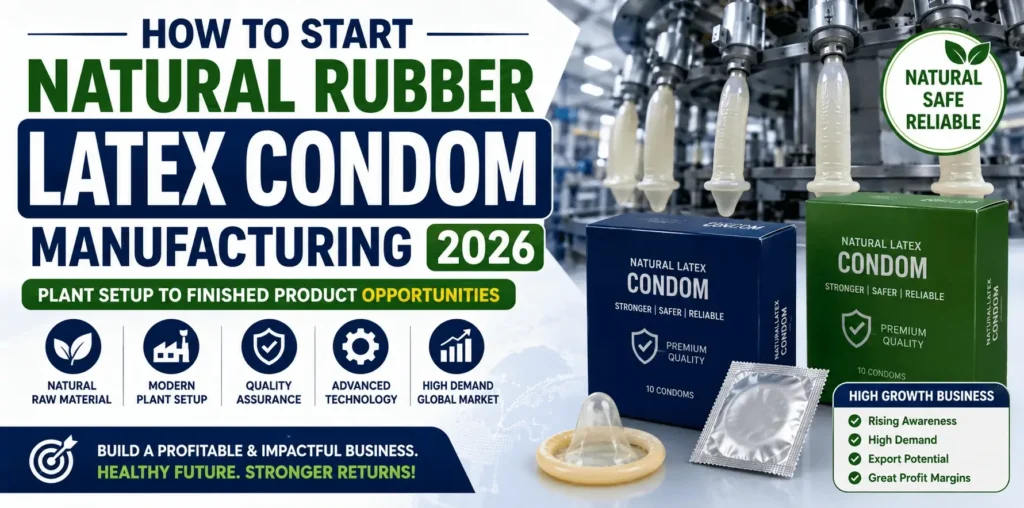
The Latex Condom Manufacturing Business is emerging as a high-potential opportunity in the healthcare and personal wellness industry due to increasing awareness of safe sex practices, rising population health initiatives, and growing global demand for contraceptive products. Natural rubber latex condoms continue to dominate the market because of their affordability, flexibility, durability, and effectiveness. India is becoming an important hub for latex condom manufacturing due to expanding healthcare infrastructure, government awareness programs, export demand, and advancements in automated production technologies. Entrepreneurs entering the condom manufacturing business can benefit from rising domestic consumption, NGO procurement programs, eCommerce growth, and international supply opportunities. This guide explains the complete latex condom manufacturing business setup process including machinery, manufacturing technology, raw materials, quality standards, licensing requirements, investment cost, and profitability analysis. What is Latex Condom Manufacturing? Latex condom manufacturing is an industrial process that produces natural rubber latex condoms through dipping, vulcanization, electronic testing, lubrication, and sterile packaging processes for healthcare and personal protection applications. Why Latex Condom Manufacturing is Growing in India Include: awareness programs government healthcare initiatives export demand eCommerce growth STI prevention awareness NGO procurement population control programs Understanding the Latex Condom Manufacturing Industry Latex condom manufacturing is part of the broader sexual wellness and healthcare segment. The product, made from natural rubber latex, undergoes a highly sensitive production process involving dipping, vulcanization, testing, and packaging. With increasing global concern over sexually transmitted infections (STIs), HIV/AIDS, and population control, the demand for quality condoms is growing, especially in developing nations. India, China, Brazil, and parts of Africa are considered high-potential markets for expansion. Governments and NGOs have made substantial investments in distributing free or subsidized condoms, which adds to the demand. Furthermore, the social taboo surrounding condom usage is diminishing due to awareness campaigns, which enhances the prospects for new players in the latex condom manufacturing industry. Step-by-Step Guide to Starting a Latex Condom Manufacturing Business 1. Market Research and Business Planning Before investing in machinery or infrastructure, conduct a detailed market analysis. Study regional and global demand, consumer behavior, competitor strategies, and potential distribution channels. Identify whether you’ll cater to the premium segment (flavored, textured, ultra-thin) or standard products. Create a business plan covering: Business objectives Target market Investment and financial projections Production scale Pricing and distribution model Compliance and certifications A solid plan will help attract investors and secure loans or grants from health-oriented funding agencies. 2. Legal Compliance and Licensing Given that condoms are classified as medical devices in many countries, manufacturing them requires stringent regulatory adherence. In India, approval from the Drug Controller General of India (DCGI) and registration with CDSCO (Central Drugs Standard Control Organization) is mandatory. Other global certifications include: ISO 4074:2015 (International standard for natural rubber latex condoms) CE Marking (European market) WHO Prequalification (for global NGO supply) GMP guidelines WHO quality standards Medical device regulations Quality testing protocols Apart from that, you’ll also need: Company registration GST or other local tax registration Factory license Pollution control and fire safety certificates Compliance helps ensure product safety, international acceptance, and eligibility for government and NGO procurement programs. 3. Location and Factory Setup Choosing the right location is essential. The ideal site should have good connectivity, access to skilled labor, and reliable water and electricity supply. The factory layout should consist of the following: Raw material storage Production and dipping area Drying and curing rooms Electronic testing section Packing and storage rooms The facility should follow GMP (Good Manufacturing Practices) and hygiene protocols to prevent contamination. 4. Machinery and Equipment Investing in high-quality automated machinery ensures efficiency and product consistency. Major equipment includes: Latex dipping machines Coagulum tanks Vulcanization oven Electronic testing equipment Packaging machines Conveyor belts and air compressors Automated machines improve output, reduce manual errors, and maintain hygiene. Depending on the production capacity, the machinery cost can range from ?1 crore to ?5 crore. 5. Raw Material Procurement The main raw material in latex condom manufacturing is natural rubber latex, sourced from rubber plantations or vendors. Other materials include: Coagulant solution Lubricants (silicone or water-based) Corn starch or talc (for dusting) Foils or wrappers (for packaging) Flavoring agents (for specialty condoms) Ensure that all materials are of medical-grade quality and comply with health regulations. 6. How are Latex Condoms Manufactured? The standard latex condom manufacturing process generally includes: Latex Compounding: Mixing raw latex with chemicals to improve elasticity and durability. Former cleaning and Dipping: Cleaned glass or ceramic molds are dipped in coagulant and then into the latex solution to form the condom layer. Vulcanization: Condoms are cured at high temperatures to strengthen the rubber. Leaching and Washing: The product is thoroughly washed to remove residual chemicals and proteins. Drying and Testing: Condoms are electronically tested for holes, strength, and elasticity. Electronic pinhole testing: Lubrication and packaging: Each piece is lubricated, sealed in foil wrappers, and then packed into boxes. Sterility and quality inspection The entire process must be handled in a contamination-free environment using sterilized equipment. 7. Quality Control and Testing Quality assurance is a vital component of latex condom manufacturing. International standards dictate rigorous testing, including: Electronic pinhole testing Air burst and tensile strength test Water leak test Lubricant quantity test Random samples are taken from each batch to ensure consistency and safety. If a batch fails any of the tests, it must be discarded. 8. Branding and Marketing Strategy Create a compelling brand identity that reflects trust, safety, and innovation. Use discreet yet bold packaging to attract consumers. Focus on: Health campaigns and CSR collaborations Social media marketing targeting youth and urban areas Online marketplaces and pharmacy tie-ups Government supply contracts and tenders Brand ambassadors, health influencers, and digital ads can help break taboos and promote acceptance. 9. Distribution Channels Condoms are widely sold through: Pharmacies and drugstores E-commerce platforms Supermarkets and convenience stores NGOs and health agencies Clinics and hospitals Partner with logistics companies that specialize in sensitive goods. Maintain an efficient supply chain to ensure consistent product availability. 10. Cost and Profitability Analysis Starting a latex condom manufacturing
List of Profitable Business Ideas for Production of Industrial & Engineering Products.
Industrial engineering is a multidisciplinary field that focuses on optimizing complex systems, processes, and operations. It blends engineering principles with business acumen to increase efficiency, productivity, and profitability across various industries. As businesses strive to become more competitive and resource-efficient, the demand for industrial engineering solutions is growing. Entrepreneurs who tap into this field can find numerous lucrative opportunities that cater to manufacturing, supply chain management, automation, and beyond. Exploring Business Potential in the Industrial Engineering Landscape The evolution of Industry 4.0, digital manufacturing, lean systems, and sustainability goals has created fertile ground for innovative ventures rooted in industrial engineering. From consultancy to automation solutions, the applications are vast and impactful. Let’s delve into some of the most profitable industrial engineering business ideas that aspiring entrepreneurs can explore in 2025 and beyond. 1. Lean Manufacturing Consultancy Lean manufacturing is one of the core areas in industrial engineering. Companies across the globe aim to minimize waste and improve efficiency without compromising quality. Starting a consultancy that specializes in implementing lean techniques—like Six Sigma, Kaizen, or 5S systems—can be highly profitable. This business idea involves helping clients redesign processes, optimize workflows, and reduce production costs, which aligns directly with the core objectives of industrial engineering. As a lean consultant, you can serve industries such as automotive, electronics, pharmaceuticals, and food processing. Offering training sessions, audits, and certifications can also become additional revenue streams. 2. Industrial Automation Solutions With the surge in smart factories and the integration of robotics, industrial automation has become a booming sector. Launching a business that provides automation services—including PLC programming, robotics integration, and SCADA systems—can yield substantial returns. This opportunity is closely aligned with industrial engineering, as it involves designing systems that boost productivity while reducing human error and operational costs. A company focusing on automating assembly lines, packaging units, or quality control processes can cater to mid-size and large manufacturing firms looking to upgrade their facilities. 3. Supply Chain Optimization Services Efficient supply chains are vital for business success, and industrial engineering plays a critical role in their design and management. Entrepreneurs can start a service-oriented business that helps companies improve their logistics, reduce lead times, manage inventories, and select optimal transportation modes. By leveraging tools such as simulation software, data analytics, and predictive modeling, this business can help clients streamline operations. Sectors such as e-commerce, retail, and logistics will greatly benefit from such expertise. 4. Energy Efficiency and Sustainability Consulting Environmental responsibility is a growing concern, and companies are under pressure to reduce their carbon footprint. Industrial engineering solutions can drive sustainable practices by enhancing energy efficiency, recycling waste, and optimizing resource usage. A consultancy that offers energy audits, green certifications, process redesign, and carbon tracking services can generate income while supporting global environmental goals. Many governments offer incentives for energy-efficient practices, making this industrial engineering business model even more attractive. 5. Custom ERP Development for Manufacturing Enterprise Resource Planning (ERP) software is essential for managing business operations—especially in manufacturing. While many generic ERPs exist, they often don’t meet the specific needs of individual factories. This presents an opportunity for entrepreneurs to create tailored ERP solutions for different industrial niches. As an industrial engineering expert, you can bridge the gap between software developers and factory managers by designing ERP modules that enhance production scheduling, inventory tracking, and workflow analysis. This hybrid business combines technical knowledge with digital innovation. 6. 3D Printing and Prototyping Services 3D printing has transformed the way industries approach product design, testing, and manufacturing. A business focused on rapid prototyping and custom part fabrication can serve a wide array of sectors including automotive, aerospace, healthcare, and consumer electronics. With an industrial engineering background, you can ensure your services focus on design optimization, cost control, and material efficiency. Offering design-to-delivery solutions will give you a competitive edge in this fast-growing niche. 7. Industrial Equipment Design and Fabrication Designing and fabricating specialized machinery or tools for specific industries can be a highly profitable venture. Industrial engineers are well-equipped to understand the technical and operational requirements of different production environments. Whether it’s conveyor belts, lifting equipment, material handling systems, or custom fixtures, this business has high potential, especially when offering tailor-made solutions. Additionally, offering post-installation support, maintenance contracts, or upgrades can add long-term value and recurring revenue to your business. 8. Warehouse Design and Optimization As online shopping continues to grow, so does the demand for efficient warehousing. Industrial engineering provides tools and techniques for designing optimal warehouse layouts, implementing automated storage and retrieval systems (AS/RS), and reducing material handling costs. Entrepreneurs can offer consulting services for warehouse setup, layout simulation, material flow analysis, and performance monitoring. Target clients could include e-commerce giants, logistics companies, and FMCG businesses. 9. Quality Control and Assurance Services Quality is non-negotiable in today’s competitive markets. Offering quality control and assurance services can be a successful industrial engineering business. This can include process audits, compliance testing, statistical process control (SPC), and ISO certification assistance. With a data-driven approach, your business can help manufacturers maintain high product standards and regulatory compliance, thereby reducing recalls and customer complaints. 10. Training and Skill Development Centers With industrial engineering rapidly evolving, there is a growing need for skilled professionals. Starting a training center that offers courses in lean manufacturing, automation, process improvement, and supply chain management can be highly profitable. You can collaborate with educational institutions or offer corporate training programs tailored to industry needs. Providing certification programs or online learning modules will increase your reach and scalability. Final Thoughts Industrial engineering is a gateway to numerous business opportunities, many of which are future-ready and technology-driven. Whether you aim to offer consulting, develop products, or implement advanced automation, the scope is wide and the rewards can be substantial. Starting a business in this field not only leverages your technical expertise but also contributes to the advancement of industries by making them more efficient and sustainable. Entrepreneurs who understand the value of optimization and systems thinking inherent in industrial engineering will find themselves at the