Plastic has become an indispensable part of our lives, finding its way into nearly every industry from packaging and construction to electronics and healthcare. As global demand continues to surge, the plastic products manufacturing sector stands out as a profitable opportunity for aspiring entrepreneurs. With innovations in technology, recycling methods, and biodegradable alternatives, the industry offers numerous entry points for both small-scale and large-scale ventures.
Contents
- 1. Why Plastic Products Manufacturing is a Smart Investment
- 1.1. Types of Plastic Products Manufacturing Businesses
- 1.2. Market Research and Business Planning
- 1.3. Legal Compliance and Registration
- 1.4. Machinery and Raw Materials Required
- 1.5. Investment and Profitability
- 1.6. Sustainability and the Future of Plastics
- 1.7. Marketing and Sales Strategies
- 1.8. Challenges and Risk Mitigation
- 1.9. Final Thoughts
- 2. Frequently Asked Questions (FAQs)
- 2.1. FAQ 1: What is plastic products manufacturing and why is it a profitable business?
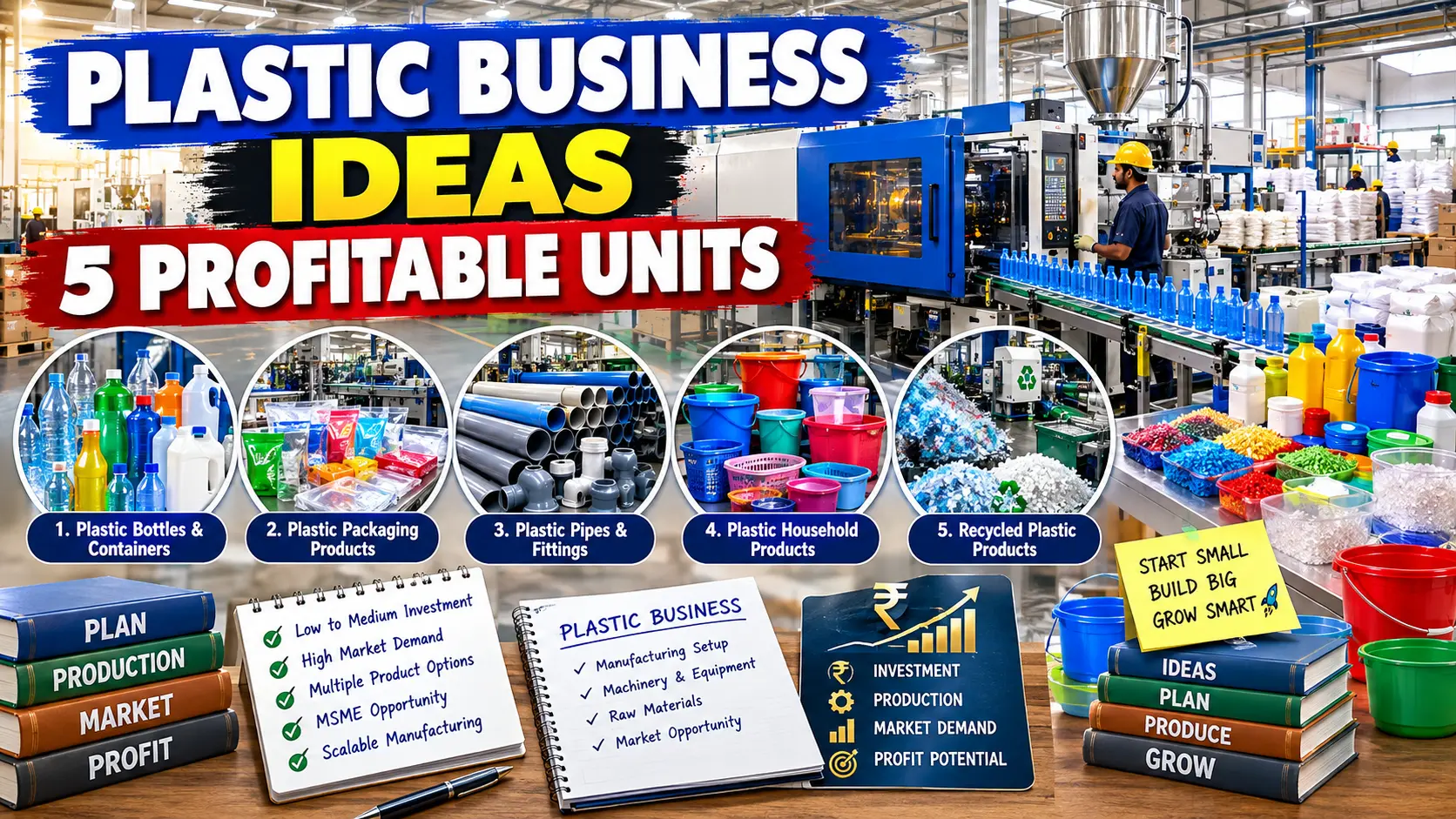
- 2.2. FAQ 2: What are the most profitable plastic products manufacturing ideas?
- 2.3. FAQ 3: What is the minimum investment required for a plastic manufacturing business?
- 2.4. FAQ 4: What machinery is required for plastic manufacturing?
- 2.5. FAQ 5: What raw materials are required for plastic manufacturing?
- 2.6. FAQ 6: What certifications and licenses are required for plastic manufacturing?
- 2.7. FAQ 7: How profitable is the plastic manufacturing business?
- 2.8. FAQ 8: What are the target markets for plastic products?
- 2.9. FAQ 9: What are the different types of plastic manufacturing processes?
- 2.10. FAQ 10: What are the challenges in plastic manufacturing and how can I overcome them?
- 2.11. FAQ 11: What is the future growth potential for plastic manufacturing?
- 2.12. FAQ 12: Can I start a plastic manufacturing business with government support?
- 2.13. FAQ 13: How can I market my plastic products effectively?
- 2.14. FAQ 14: What are the eco-friendly practices in plastic manufacturing?
- 2.15. FAQ 15: Why should I invest in a plastic manufacturing business?
- 2.16. Ready to Start Your Plastic Manufacturing Business?
- 2.17. Frequently Asked Questions
Why Plastic Products Manufacturing is a Smart Investment
The global plastic industry is valued in the hundreds of billions of dollars, and it’s projected to grow steadily over the coming decades. Despite growing environmental concerns, the demand for plastic materials in automotive, construction, consumer goods, and medical devices continues to rise. New-age materials such as biodegradable plastics and recycled resins are creating a parallel demand that complements the traditional plastic industry. By entering the profitable plastic products manufacturing business, entrepreneurs can capitalize on this expanding market while also contributing to sustainable development through eco-friendly alternatives.
Types of Plastic Products Manufacturing Businesses
Before diving into the business, it’s essential to understand the various sub-sectors within the plastic products manufacturing industry. Each segment has unique raw material requirements, machinery needs, investment sizes, and market demand:
Plastic Bag and Pouch Manufacturing
One of the simplest and most common ventures, plastic bag and pouch production requires limited capital and basic extrusion and sealing machines. With proper market targeting—such as grocery stores, packaging vendors, and food chains—this can yield quick profits.Injection Molding Products
This process is used to create intricate plastic components like bottle caps, containers, toys, and electronic housings. Though it requires a higher investment in molds and machines, injection molding offers high-volume production and scalability.PVC and HDPE Pipe Manufacturing
Pipes made from plastics like PVC or HDPE are widely used in agriculture, construction, and water supply systems. This sub-sector demands a medium to high investment but offers stable, long-term returns due to continuous demand.Plastic Furniture Production
With a growing market for lightweight, durable, and low-cost furniture, especially in developing nations, plastic furniture manufacturing offers great profitability. Chairs, stools, and tables can be molded in bulk and sold wholesale to retailers and contractors.Recycled Plastic Product Manufacturing
Sustainability-focused ventures can explore the recycling domain—converting waste plastic into usable items like floor tiles, park benches, or packaging materials. This not only minimizes environmental impact but also reduces raw material costs significantly.Biodegradable Plastic Manufacturing
With increasing regulatory pressure against single-use plastics, manufacturing compostable and biodegradable plastic alternatives is a forward-looking business idea. Although this field involves more technical expertise and higher R&D costs, it appeals to a growing eco-conscious customer base.
Market Research and Business Planning
Every successful plastic products manufacturing business starts with comprehensive market research. Understanding the demand, local regulations, competitors, pricing strategies, and supply chain is vital. Your business plan should include:
Executive Summary
A brief overview of the business concept, mission, and goals.Market Analysis
Evaluate your target market, potential customers, and competition.Products and Services
Clearly define your product range—are you making utility items, construction materials, or custom parts?Operations Plan
Describe your manufacturing process, location, sourcing of raw materials, and machinery.Marketing Strategy
Determine how you will promote your products—digital marketing, distributors, or direct-to-retail.Financial Projections
Include capital requirements, revenue forecasts, breakeven analysis, and ROI estimates.
Legal Compliance and Registration
Registering your plastic manufacturing unit involves several steps:
Business Entity Formation: Choose a structure like sole proprietorship, partnership, LLP, or Pvt Ltd.
Factory License: Obtain a license under the Factories Act if employing workers and using machinery.
Pollution Control Board Clearance: Since plastic is environmentally sensitive, you must secure a No Objection Certificate (NOC) from your local State Pollution Control Board.
GST Registration: Mandatory for tax compliance and interstate sales.
Trademark Registration: Protect your brand name and product identity.
Machinery and Raw Materials Required
Depending on your product type, your plastic manufacturing unit will require different machines and raw materials. Common equipment includes:
Extrusion Machines: For producing plastic films, pipes, and sheets.
Injection Molding Machines: For mass production of molded products.
Blow Molding Machines: For creating plastic bottles and containers.
Recycling Machines: For cleaning, shredding, and repurposing used plastics.
Mixers and Cutters: For coloring, shaping, and cutting plastic granules.
Typical raw materials used in plastic production include:
Polyethylene (PE)
Polypropylene (PP)
Polyvinyl Chloride (PVC)
High-Density Polyethylene (HDPE)
Additives and Colorants
Raw materials can be sourced from petrochemical companies or imported if specialty resins are required.
Investment and Profitability
Starting a small-scale plastic manufacturing business can require an investment ranging from ?10 lakhs to ?50 lakhs (USD 12,000 to 60,000), depending on the product type and machinery. Medium and large-scale units may need crores of rupees in investment.
Your profitability depends on:
Efficient production
Low cost of raw materials
Bulk sales
Minimum wastage
High market demand
For example, a small plastic bag manufacturing unit can earn ?1 lakh to ?3 lakhs per month after expenses, depending on scale and location. Return on investment can often be realized within 2–3 years.
Sustainability and the Future of Plastics
While plastic is essential, its environmental impact cannot be ignored. Governments across the world are tightening regulations on single-use plastics. Hence, it’s vital for new entrants in plastic manufacturing to explore greener options:
Use recyclable and biodegradable materials
Implement closed-loop recycling processes
Reduce production waste
Partner with waste management services
The demand for bio-based plastics is expected to grow at over 10% CAGR globally. Innovations in corn-starch-based PLA (Polylactic Acid), PHA (Polyhydroxyalkanoates), and other biodegradable materials present enormous opportunities.
Marketing and Sales Strategies
To thrive in the competitive plastic manufacturing market, you must adopt smart marketing and sales tactics:
Bulk Contracts: Partner with wholesalers, supermarkets, or institutions for long-term contracts.
Online Sales: Use B2B platforms like IndiaMART, TradeIndia, Alibaba, or Amazon Business.
Direct Marketing: Attend trade fairs, exhibitions, and expos to showcase your products.
Branding: Establish a strong brand identity with logos, product labeling, and quality assurance.
Digital marketing—SEO, email outreach, and social media ads—can help you reach niche clients such as eco-conscious brands or local retailers looking for reliable plastic product suppliers.
Challenges and Risk Mitigation
Every business has challenges, and plastic manufacturing is no exception. Key risks include:
Regulatory Issues: Sudden bans on certain plastic types can affect business continuity.
Volatile Raw Material Prices: Petrochemical prices fluctuate based on global oil trends.
Environmental Pressure: Activist campaigns and customer resistance to plastic may impact sales.
High Capital Requirement: Medium to large-scale ventures require significant investment and credit access.
Mitigation strategies include product diversification, staying informed about policy changes, adopting recyclable processes, and building strong supplier relationships.
Final Thoughts
The plastic manufacturing industry presents a profitable and scalable business opportunity for entrepreneurs in 2025 and beyond. Whether you focus on daily-use items, industrial applications, or eco-friendly alternatives, there’s ample room for innovation and growth. With the right planning, compliance, and market strategy, you can turn plastic into profits—while also paving the way for a more sustainable future.
Let this be your sign to step into the world of plastic manufacturing—where durability meets demand, and smart manufacturing meets market need.
Frequently Asked Questions (FAQs)
FAQ 1: What is plastic products manufacturing and why is it a profitable business?
Plastic products manufacturing involves converting raw plastic materials (like PE, PP, PVC, HDPE) into finished products through processes like extrusion, injection molding, and blow molding. These products range from packaging materials and pipes to furniture and automotive components.
Why it is profitable:
Global plastic industry valued in hundreds of billions of dollars
Growing demand across packaging, construction, automotive, and healthcare
Diverse product range with multiple entry points
Scalable from small to large-scale operations
Emerging opportunities in biodegradable and recycled plastics
With continuous demand and technological innovations, plastic manufacturing offers excellent returns on investment.
FAQ 2: What are the most profitable plastic products manufacturing ideas?
Here are the most profitable plastic manufacturing business ideas:
| Business Idea | Key Advantage |
|---|---|
| Plastic Bag and Pouch Manufacturing | Low investment, quick profits, high demand |
| Injection Molding Products | High-volume production, diverse applications |
| PVC and HDPE Pipe Manufacturing | Stable demand from agriculture and construction |
| Plastic Furniture Production | Lightweight, durable, cost-effective |
| Recycled Plastic Product Manufacturing | Low raw material cost, eco-friendly |
| Biodegradable Plastic Manufacturing | Future-ready, growing eco-conscious market |
| Plastic Bottles and Containers | High demand from FMCG and beverage sectors |
| Plastic Packaging Materials | Essential for e-commerce and retail |
| Automotive Plastic Components | High-value products for automobile industry |
| Plastic Toys and Consumer Goods | High-volume, scalable production |
Each idea aligns with current market trends and offers strong growth potential.
FAQ 3: What is the minimum investment required for a plastic manufacturing business?
The investment for plastic manufacturing varies widely:
| Scale | Estimated Investment |
|---|---|
| Small-Scale (Bags, Pouches) | ₹10 – 50 lakhs |
| Medium-Scale (Pipes, Furniture) | ₹50 lakhs – 2 crore |
| Large-Scale (Injection Molding, Biodegradable) | ₹2 crore and above |
Key Cost Components:
Machinery (extruder, injection molder, blow molder)
Raw materials (PE, PP, PVC, HDPE granules)
Land and infrastructure
Licensing and compliance
Working capital
Government subsidies and MSME loans can help reduce the initial financial burden.
FAQ 4: What machinery is required for plastic manufacturing?
The machinery required depends on the product type:
| Product | Required Machinery |
|---|---|
| Plastic Bags/Pouches | Extrusion machine, sealing machine, cutting machine |
| Injection Molding Products | Injection molding machine, mold sets, cooling systems |
| PVC/HDPE Pipes | Extruder, vacuum sizing tank, haul-off, cutter, belling machine |
| Plastic Bottles | Blow molding machine, extruder, cooling system |
| Plastic Furniture | Injection molding machine, compression molding machine |
| Recycled Products | Shredder, washing line, granulator, extruder |
| Biodegradable Plastics | Specialized extruder, compounding line |
Investing in semi-automatic or fully automatic machines improves efficiency and product quality.
FAQ 5: What raw materials are required for plastic manufacturing?
Common raw materials for plastic manufacturing include:
| Raw Material | Application |
|---|---|
| Polyethylene (PE) | Bags, films, bottles, containers |
| Polypropylene (PP) | Furniture, automotive parts, packaging |
| Polyvinyl Chloride (PVC) | Pipes, fittings, cables, profiles |
| High-Density Polyethylene (HDPE) | Pipes, bottles, containers |
| Additives and Colorants | For strength, color, UV resistance |
| Recycled Plastic Granules | Eco-friendly products |
Raw materials can be sourced from petrochemical companies or imported if specialty resins are required.
FAQ 6: What certifications and licenses are required for plastic manufacturing?
To operate a plastic manufacturing business legally, you need:
| License/Certification | Purpose |
|---|---|
| Company Registration | Legal entity structure (LLP, Pvt Ltd, Proprietorship) |
| GST Registration | Tax compliance |
| Udyam/MSME Registration | Access to subsidies and benefits |
| Pollution Control Board NOC | Environmental clearance |
| Factory License | Compliance with factory regulations |
| BIS Certification | For specific products like pipes, packaging |
| Trade License | From local municipal corporation |
| Trademark Registration | Brand protection |
Since plastic is environmentally sensitive, securing Pollution Control Board clearance is mandatory.
FAQ 7: How profitable is the plastic manufacturing business?
The plastic manufacturing business offers attractive profitability:
| Financial Metric | Small-Scale | Medium-Scale |
|---|---|---|
| Monthly Revenue | ₹1 – 5 lakhs | ₹10 – 50 lakhs |
| Profit Margins | 10 – 20% | 15 – 25% |
| ROI Timeline | 2 – 3 years | 3 – 5 years |
Key Factors Influencing Profitability:
Efficient production processes
Low raw material wastage
Bulk sales and long-term contracts
Product diversification
Strong distribution network
With proper planning and cost control, this business delivers excellent returns.
FAQ 8: What are the target markets for plastic products?
The customer base for plastic manufacturing is diverse:
| Customer Category | Products Required |
|---|---|
| Packaging Industry | Bags, pouches, films, bottles, containers |
| Construction Sector | Pipes, fittings, profiles, sheets |
| Agriculture | Pipes, films, irrigation products |
| Automotive Industry | Components, interior parts, bumpers |
| FMCG Sector | Bottles, caps, containers, packaging |
| Healthcare | Medical devices, packaging, syringes |
| E-Commerce | Packaging materials, bubble wrap, tape |
| Retail and Hospitality | Furniture, storage bins, disposables |
Building relationships with these industries ensures recurring business.
FAQ 9: What are the different types of plastic manufacturing processes?
The main processes in plastic manufacturing include:
| Process | Application |
|---|---|
| Injection Molding | Intricate components (caps, toys, housings) |
| Extrusion | Pipes, films, sheets, profiles |
| Blow Molding | Bottles, containers, tanks |
| Compression Molding | Large parts, furniture, automotive panels |
| Thermoforming | Trays, containers, packaging |
| Rotational Molding | Large hollow products (tanks, bins) |
| Recycling/Reprocessing | Eco-friendly products from waste plastic |
Each process requires specific machinery and technical expertise.
FAQ 10: What are the challenges in plastic manufacturing and how can I overcome them?
| Challenge | Solution |
|---|---|
| Raw Material Price Volatility | Bulk contracts, diversify suppliers, maintain buffer stock |
| Regulatory Restrictions | Stay updated on policies, adopt eco-friendly practices |
| Environmental Pressure | Use recyclable materials, implement closed-loop recycling |
| High Capital Requirement | Explore MSME loans, partnerships, government subsidies |
| Competition | Focus on quality, BIS certification, and branding |
| Skilled Labor Shortage | Provide training and competitive wages |
| Power Interruptions | Install backup generators or UPS systems |
Diversifying products and staying informed about policy changes can mitigate risks.
FAQ 11: What is the future growth potential for plastic manufacturing?
The plastic manufacturing industry has strong growth potential:
| Growth Driver | Impact |
|---|---|
| Packaging Demand | E-commerce and FMCG sector growth |
| Construction Boom | Rising demand for pipes, fittings, profiles |
| Automotive Growth | Increasing use of lightweight plastic components |
| Healthcare Expansion | Growing demand for medical devices and packaging |
| Sustainable Plastics | Bio-based and biodegradable plastics market |
| Recycling Innovation | Circular economy initiatives |
The demand for bio-based plastics is expected to grow at over 10% CAGR globally.
FAQ 12: Can I start a plastic manufacturing business with government support?
Yes, the Indian government offers several schemes:
| Scheme | Benefit |
|---|---|
| MSME/Udyam Registration | Access to subsidies and benefits |
| PMEGP | Financial assistance for micro-enterprises |
| MUDRA Loans | Loans for small businesses |
| CGTMSE Scheme | Collateral-free loans |
| SIDBI Support | Financial and technical assistance |
| Make in India | Policy support and investment facilitation |
| State-Level Subsidies | Power subsidies, land benefits, tax exemptions |
Applying for these schemes can significantly reduce the initial financial burden.
FAQ 13: How can I market my plastic products effectively?
Effective marketing strategies for plastic manufacturing include:
| Channel | Strategy |
|---|---|
| B2B Portals | List on IndiaMART, TradeIndia, Alibaba, Amazon Business |
| Bulk Contracts | Partner with wholesalers, supermarkets, institutions |
| Government Tenders | Apply for public procurement contracts |
| Direct Sales | Engage with manufacturers and retailers |
| Trade Shows | Participate in industry expos and conferences |
| Digital Marketing | SEO-optimized website, social media presence |
| Branding | Logo, product labeling, quality assurance |
A strong brand identity and quality certifications build trust with clients.
FAQ 14: What are the eco-friendly practices in plastic manufacturing?
Green practices in plastic manufacturing include:
| Practice | Benefit |
|---|---|
| Using Recycled Materials | Reduces raw material cost and waste |
| Biodegradable Plastics | Compostable alternatives to single-use plastics |
| Closed-Loop Recycling | Minimizes production waste |
| Energy-Efficient Equipment | Reduces carbon footprint |
| Water Conservation | Reusing cooling and washing water |
| Waste Management | Proper disposal and recycling systems |
Eco-friendly practices not only ensure compliance but also attract environmentally conscious buyers.
FAQ 15: Why should I invest in a plastic manufacturing business?
Investing in plastic manufacturing offers multiple advantages:
| Reason | Benefit |
|---|---|
| Consistent Demand | Essential across packaging, construction, healthcare, and automotive |
| Multiple Entry Points | Can start small with bags or scale to injection molding |
| Attractive Profit Margins | 10–25% depending on product |
| Scalable Operations | Start small and expand |
| Government Support | Eligible for subsidies and incentives |
| Export Potential | Growing international demand |
| Innovation Opportunities | Biodegradable and recycled products |
| Essential Industry | Plastic is indispensable in modern life |
With proper planning, quality control, and efficient operations, a plastic manufacturing business can become a highly profitable and sustainable industrial venture.
Ready to Start Your Plastic Manufacturing Business?
The plastic manufacturing industry offers limitless opportunities for entrepreneurs. From packaging and construction to automotive and healthcare, plastic products are everywhere—and demand is only growing. Whether you want to start with plastic bags or scale to injection molding, there has never been a better time to invest.
Visit the page Select and Choose the Right Business Startup for You for sorting out the questions arising in your mind before starting any business and know which start-up you can plan. We, at NPCS, endeavor to make business selection a simple and convenient step for any entrepreneur/startup. Our expert team, by capitalizing on its dexterity and decade’s long experience in the field, has created a list of profitable ventures for entrepreneurs who wish to diversify or venture. The list so mentioned is updated regularly to give you a regular dose of new emerging opportunities.