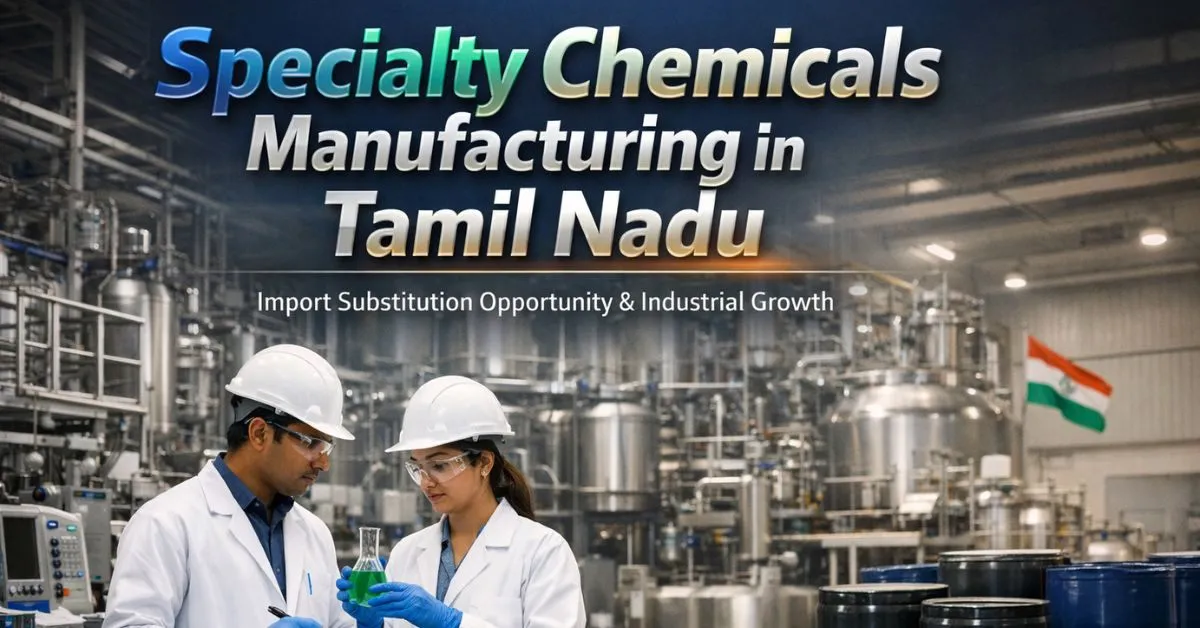
Specialty Chemicals Manufacturing in Tamil Nadu
India is a contradiction within the chemical industry. Although the country is one of the major manufacturers of basic chemicals including caustic soda, soda ash and sulphuric acid, the country is greatly reliant on imports of high-value specialty chemicals. Hyderabad pharmaceutical firms depend on imported solvents, Bengaluru electronics firms are importing precision etching agents and Tirupur textile units are importing performance dyes. These specialty segments are dominated by major players such as China, Germany, the United States and Japan and this creates a widening gap among Indian entrepreneurs.
Tamil Nadu is the perfect place to take advantage of this opportunity among the Indian states. Tamil Nadu has a fully developed chemical manufacturing ecosystem, access to industrial consumers, modern ports and favourable government policies, which makes it a strategic platform to manufacture specialty chemicals.
Contents
- 1 Understanding Specialty Chemicals
- 2 Why Tamil Nadu is the Best Choice.
- 3 Potential Specialty Chemical Segments that are high.
- 3.1 Read More: Business Plans / Project Profiles
- 3.2 1. Textile Processing Chemicals
- 3.3 2. Water Treatment Chemicals
- 3.4 3. Construction Chemicals
- 3.5 Read More: Inorganic Fertilizers and Nutrient Management: NPK, SSP, Urea and DAP
- 3.6 4. Agrochemical Intermediates
- 3.7 5. Specialty Surfactants and Green Chemistry.
- 3.8 Read More: Startup Selector
- 4 Lessons from Indian Industrial Leaders
- 5 Government Subsidies on Producers.
- 6 The way NPCS Assists Business Starters.
- 7 Risks and Challenges
- 8 Export Potential
- 9 Conclusion
- 10 Frequently Asked Questions
Understanding Specialty Chemicals
Bulk commodity chemicals are different as compared to specialty chemicals. They are not characterized by the cost of raw material only but by functionality, performance and value. These chemicals are usually manufactured in low quantities and have particular industrial uses and are required to be of high quality.
Key characteristics:
- Performance determines the price and not the cost of raw materials.
- Manufactured in low quantities as opposed to commodity chemicals.
- Industry-specific (textiles, electronics, construction, and water treatment).
India is currently estimated to have a specialty chemicals market worth USD 32-35 billion and it is expected to grow to USD 60-65 billion in 5-7 years. Although this has increased, 30-40 percent of the high-value specialty chemicals are imported, which presents a profitable domestic market.
Why Tamil Nadu is the Best Choice.
The industrial geography of Tamil Nadu in favor of various specialty chemical sectors:
- Textile Belt: The dyeing and processing units in Tirupur, Coimbatore, and Erode are highly concentrated and absorb specialty textile auxiliaries.
- Automobile Corridor: Specialty Coatings, lubricants and metalworking chemicals are in demand in Chennai-Hosur region.
- Electronics manufacturing: Sriperumbudur and the surrounding region is the source of demand of electronic grade chemicals.
- Water Treatment: Due to the industrial estates and municipal projects, there is always a demand on treatment chemicals.
Proximity to buyers saves on logistics expenses, working capital stress and time-to-market and is defensibly competitive among startups.
Potential Specialty Chemical Segments that are high.
Read More: Business Plans / Project Profiles
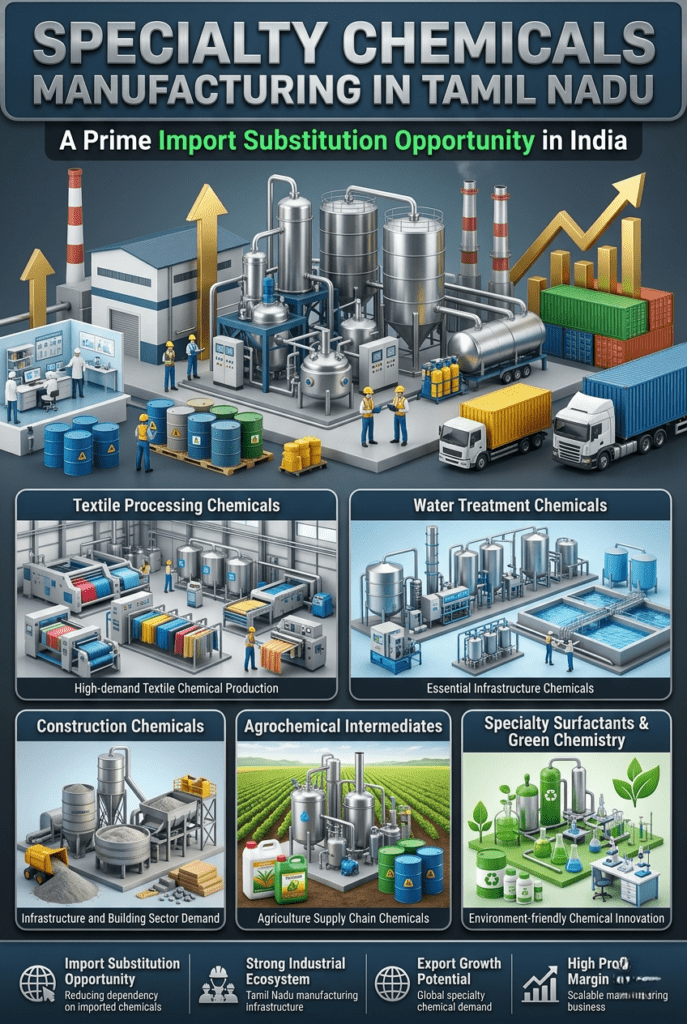
1. Textile Processing Chemicals
A natural fit of the Tamil Nadu based manufacturers is textiles. A large portion of the specialty softeners, fixing agents and optical brighteners are imported, although they can be manufactured domestically with moderate investment in mid-scale plants. Textile experienced entrepreneurs can use the available customer base to acquire early adopters.
Investment range: ₹1.5–3 crore.
2. Water Treatment Chemicals
Water treatment chemicals represent a rapidly expanding segment due to more stringent regulations and the increased city programmes. Technologies are available, the buyer is heterogeneous, and the potential of import substitution is great. The properly designed plant may be commercialized in 18-24 months.
Investment range: ₹1–4 crore.
3. Construction Chemicals
Growth in infrastructure provides impetus to the consumption of products such as superplasticizers, waterproofing compounds, repair mortars and protective coatings. This has a fragmented domestic supply, where startups can differentiate by producing high-quality and reliable products.
Investment range: ₹2–5 crore.
4. Agrochemical Intermediates
These have high margins but they have to strictly adhere to regulations. The ports and infrastructure in Tamil Nadu support local delivery and exports. Entrepreneurs will be able to focus on manufacturers in India and the other places particularly the US, Brazil and Europe.
Investment range: ₹5–15 crore.
5. Specialty Surfactants and Green Chemistry.
The world is increasingly demanding bio-based surfactants, green solvents and enzyme-based formulations that find application in textiles, food processing, and cleaning of industries. Environmentally friendly products attract local and international consumers and this is the future segment.
Investment range: ₹3–8 crore.
Read More: Startup Selector
Lessons from Indian Industrial Leaders
Good Indian industrialists offer a model to specialty chemical projects:
- Kiran Mazumdar-Shaw (Biocon): Began with one fermentation product and used the advantages of raw materials to expand incrementally.
- Narayana Murthy (Infosys): Showed that disciplined processes and quality certifications made a difference among companies over time.
- Aarti Industries: Leadership based on systematically replacing imports, backward integration, and experimenting export markets.
Similar strategies can be used by specialty chemicals startups: specialize in one defensible product, focus on quality, and grow gradually.
Government Subsidies on Producers.
The central and state policies in India contribute to feasibility:
- Central Initiatives: PLI Scheme, CGTMSE collateral-free loans and MUDRA loans decrease barriers to initial investment.
- State-Level Infrastructure: SIPCOT estates offer ready-to-use plots, whereas TIDCO offers bigger plots.
- Export Assistance: CAPEXIL and APEDAS make it easy to access the markets.
This kind of support will reduce the risk and ensure a fast entry into the market.
The way NPCS Assists Business Starters.
Niir Project Consultancy Services (NPCS) offers end to end advice in specialty chemicals manufacturing:
- Market survey and demand analysis.
- Techno-economic feasibility reports (DPRs).
- Production, equipment and sourcing of raw materials.
- Financial models including profitability and ROI.
- Export strategy and regulatory compliance.
Using NPCS expertise, entrepreneurs reduce risk, plan capital effectively, and confirm market demand prior to risking their money.
Risks and Challenges
Entrepreneurs should strategize on:
- Raw Material Volatility: The prices of petrochemical feedstocks may vary.
- Regulatory Compliance: There are the environmental clearance, hazardous waste management as well as labor laws that are obligatory.
- Technology Access: Proprietary processes can be subject to licensing particularly agrochemical and electronic grade products.
Some mitigation measures involve the selection of convenient product categories, licensing technologies, and establishment of strategic alliances.
Export Potential
The international demand of specialty chemicals produced by Tamil Nadu is very high:
- Agrochemical intermediates: USA, Europe, Brazil.
- Textile processing chemicals: Bangladesh, Vietnam, Middle East.
- Water treatment chemicals, Africa, South Asia.
- Green specialty surfactants → Europe, USA, Japan.
Tamil Nadu is a great export hub due to its proximity to other ports such as Chennai and Ennore.
Conclusion
The Indian specialty chemicals industry currently provides an excellent chance to generate profits because 30 to 40 percent of its valuable products continue to be imported. The state of Tamil Nadu presents itself as the perfect location for business startups because it provides necessary infrastructure together with customer access and skilled employees and government financial support. Businesses can achieve growth and profitability through three main activities, which include maintaining high standards, choosing suitable business segments, and establishing operational plan.
The first movers who combine disciplined execution, customer focus, and export-oriented strategy will capture the maximum value in this rapidly growing market.
Frequently Asked Questions
What is the minimum investment required?
Formulation units: Rs. 1.5–4 crore; intermediate/reactor-based units: Rs. 5 crore+. Include 3–4 months of working capital.
Do I need a chemistry background?
Not mandatory for formulation units. Hiring chemists and investing in quality systems is essential.
How do I find initial buyers?
Target local clusters. In textiles, reach out directly to dyeing units; in construction, approach project management consultants; for water treatment chemicals, engage environmental service providers.
Which approvals are needed?
TNPCB consent, factory license, trade license, GST registration, Udyam registration, compliance with hazardous waste rules, and Import Export Code for exports.
Are industrial plots available in Tamil Nadu?
Yes. SIPCOT estates such as Cuddalore, Gummidipoondi, Hosur, and Ranipet provide ready infrastructure. TIDCO facilitates larger land allocations.