
Mahua Oil and Country Liquor production business
The Mahua tree (Madhuca longifolia), native to the Indian subcontinent, holds tremendous economic potential due to its diverse applications. Its flowers are widely used for the production of Mahua liquor, a traditional alcoholic beverage, while the seeds are processed to extract Mahua oil, a non-edible oil used in soaps, biofuel, and as a lubricant. The rich tribal heritage surrounding this tree has turned it into a lucrative opportunity for entrepreneurs who wish to explore agro-based businesses. With proper licensing, processing techniques, and branding, Mahua Oil & Liquor production can become a high-margin business. Understanding the Scope of Mahua Oil & Liquor Production Mahua has long been a sacred tree in many parts of India, primarily in Madhya Pradesh, Jharkhand, Chhattisgarh, Odisha, and Maharashtra. While traditionally limited to forest-dwelling communities, today, large-scale commercialization is possible due to demand for ethanol-based liquor and plant-derived oils. The dual-use of the Mahua flower and seed allows us to diversify income streams and minimize raw material wastage. From the perspective of tribal welfare and sustainable practices, the Mahua Oil & Liquor industry also receives government support and policy attention in tribal and forested regions. Licensing and Legal Compliance Before starting production, the first step is to obtain legal permissions. For liquor production: State Excise License: Required to manufacture and sell alcohol. Pollution Control Certificate: From the State Pollution Control Board. FSSAI License: For ensuring food-grade safety during fermentation. GST Registration: For proper taxation compliance. For oil extraction: Factory License under the Factories Act. SSI/MSME Registration for subsidies and schemes. Pollution Control NOC for machinery-based operations. Trademark Registration to secure your brand identity. Ensure that your plant location complies with local zoning laws. In forest regions, permissions from Gram Sabhas or local tribal panchayats may also be needed. Raw Material Procurement To ensure smooth production, you will need: Mahua Flowers: Harvested from March to April, they are sun-dried and stored. Sourcing should be from forest cooperatives or tribal producers. Mahua Seeds: Available post-April and processed for oil extraction. Ensure that your suppliers are consistent and that quality is maintained. Building strong relationships with tribal self-help groups (SHGs) ensures sustainability and fair trade practices. Infrastructure and Machinery Setup Depending on the production scale, your setup could be: Small-scale unit (?20–50 lakhs): Manual processing with minimal automation. Mid-scale plant (?1–2 crores): Semi-automatic distillation and oil extraction. Large-scale unit (?5–10 crores): Fully automated continuous production line. Essential Machinery for Mahua Oil Production: Oil Expeller (cold press or rotary) Seed Cleaning and Dehulling Unit Filtration Unit Storage Tanks Packaging Unit Essential Equipment for Mahua Liquor Production: Fermentation Vats Distillation Unit (Copper/SS stills) Aging Tanks or Wooden Barrels Quality Testing Lab Bottling and Labeling Machine Install solar dryers and renewable energy units to reduce long-term costs. Mahua Liquor Production Process Flower Cleaning: Remove dust and debris from dried Mahua flowers. Soaking: Flowers are soaked in water for 48 hours to extract natural sugars. Fermentation: Indigenous yeasts convert sugars to alcohol. Distillation: Alcohol is distilled in copper pot stills for purity. Maturation: The liquor is aged for 3–6 months to enhance flavor. Bottling: Final product is filtered, diluted (if needed), and bottled. Maintain hygiene and consistency to create a premium craft liquor brand. Mahua Oil Extraction Process Seed Cleaning: Clean Mahua seeds to remove dirt and stones. Drying: Ensure moisture content is low for better yield. Pressing: Use mechanical or cold press method to extract oil. Filtration: Remove seed residue and impurities. Packaging: Fill in HDPE drums or bottles depending on the client. Mahua oil is bitter and non-edible but used in soap making, hair oils, and even as biodiesel in rural energy projects. Branding and Product Differentiation Your success depends on how well you brand your Mahua Oil & Liquor products. Go for: Eco-friendly packaging for a tribal, natural appeal. Storytelling: Highlight the traditional roots of Mahua. Geographic Indication (GI) Tag if regionally appropriate. Luxury Branding: Mahua liquor can be positioned as a premium craft spirit similar to tequila or sake. Certifications: Organic, ISO, or FSSAI labels boost credibility. Market Opportunities and Distribution Channels For Mahua Liquor: Tribal liquor markets under state protection. Bars and retail stores under state alcohol distribution licenses. Export opportunities to Europe, Japan, and USA (after legal clearance). For Mahua Oil: Soap and skincare brands. Ayurvedic product manufacturers. Biodiesel producers. Direct B2B sales via trade fairs or export houses. You can also launch D2C brands on e-commerce platforms like Amazon or Flipkart, with health-conscious packaging and storytelling. Financial Projections and Profit Margins Initial Investment Estimate (Mid-Scale): Land & Building: ?50 lakhs Machinery: ?1 crore Licensing & Working Capital: ?50 lakhs Expected Monthly Revenue (Mid-scale): Mahua Oil: ?6–8 lakhs Mahua Liquor: ?15–20 lakhs Profit Margins: Liquor: 35%–50% Oil: 20%–30% ROI is achievable in 18–24 months if operations and marketing are managed efficiently. Sustainability and Government Support Many state governments support Mahua-based industries under tribal development programs. You can apply for: Tribal Co-operative Marketing Development Federation (TRIFED) schemes MSME cluster development initiatives NABARD subsidies for rural food/agro-processing Startup India benefits for product innovation You can also integrate zero-waste processing by using Mahua press cake as fertilizer or cattle feed. Challenges and Risk Management While this business is lucrative, it’s important to mitigate: Seasonal availability: Limited harvesting months. Regulatory hurdles: State liquor policies can be strict. Storage issues: Dried flowers and seeds need moisture control. Public perception: Liquor from forest flowers may need image rebranding. Invest in training and SOPs to ensure consistency, and maintain a quality audit trail for regulatory and export compliance. Conclusion Starting a Mahua Oil & Liquor production business is both culturally enriching and economically promising. It leverages natural resources, supports tribal livelihoods, and opens doors to high-margin markets through thoughtful branding and quality processes. Whether you focus on traditional liquor production or oil extraction for industrial purposes, there is ample room for innovation and growth. Visit the page Select and Choose the Right Business Startup for You for sorting out the questions arising in your mind before starting any business and know which start-up
Production of Biodegradable plastic Products
In recent years, the global conversation around environmental sustainability has accelerated like never before. One major area of concern is the detrimental impact of plastic waste on ecosystems, wildlife, and human health. In this context, the emergence of biodegradable plastic as a viable alternative to conventional petroleum-based plastics has become a groundbreaking solution. If you’re considering entering a future-proof, high-demand sector with strong growth potential, starting a biodegradable plastic production business could be the perfect opportunity for you. Why Biodegradable Plastic Production Is the Future of Sustainable Industry Biodegradable plastic, as the name suggests, is capable of breaking down naturally through the action of microorganisms, heat, and moisture. Unlike traditional plastics that can take hundreds of years to decompose, biodegradable plastics degrade in a few months under the right conditions. This characteristic makes them ideal for applications in packaging, agriculture, medical devices, disposable tableware, and more. According to recent industry research, the global market for biodegradable plastics is expected to surpass USD 20 billion by 2030, growing at a compound annual growth rate (CAGR) of more than 15%. With increasing government regulations banning single-use plastics and heightened consumer awareness about environmental impact, the demand for biodegradable plastic is projected to surge. Countries like India, which are taking firm steps toward environmental reform, offer massive potential for investment in this sector. Understanding Biodegradable Plastic and Its Types To enter this industry, it’s essential to understand the core materials and types of biodegradable plastic. Generally, these plastics are made from renewable raw materials like corn starch, potato starch, sugarcane, cassava, or even algae. The two main types of biodegradable plastics include: PLA (Polylactic Acid): Derived from fermented plant starch (usually corn), PLA is widely used in food packaging, disposable utensils, and medical implants. PHA (Polyhydroxyalkanoates): These are produced by microbial fermentation and are suitable for more industrial applications, such as agricultural films and medical products. Other types include PBS (Polybutylene Succinate), starch blends, and cellulose-based plastics. Each type has unique properties, production methods, and applications. Setting Up the Biodegradable Plastic Manufacturing Plant Starting a biodegradable plastic production business requires careful planning, investment, and compliance with environmental regulations. Here is a step-by-step guide to help you get started: 1. Market Research and Business Planning Begin with thorough market research. Identify your target market—food packaging companies, retail brands, agriculture sector, or medical institutions. Assess your competitors, understand product demand, and estimate your pricing strategy. Draft a detailed business plan covering your production capacity, cost structure, target customers, marketing approach, and projected ROI. 2. Legal Structure and Regulatory Approvals Register your business entity as a Private Limited Company, LLP, or proprietorship. You will also need environmental clearance and manufacturing licenses. In India, for example, you must adhere to guidelines under the Plastic Waste Management Rules, 2016 (amended 2021), BIS certification, and get clearance from the State Pollution Control Board. 3. Land and Infrastructure You’ll need around 5,000 to 15,000 square feet of industrial space depending on production scale. Ensure proper zoning, drainage, electricity, and water supply. The location should be close to raw material suppliers and transportation hubs. 4. Raw Materials and Supply Chain Major raw materials include corn starch, sugarcane, cassava, polylactic acid resin, PHA, and biodegradable additives. Build reliable supply chains, preferably from local agro-industrial companies or import from international suppliers as per requirement. 5. Machinery and Equipment Machinery depends on your product line, but a basic biodegradable plastic manufacturing setup includes: Biopolymer Extrusion Line Plastic Injection Molding Machine Blown Film Extrusion Machine Pelletizing Unit Dryers and Mixers Cutting and Sealing Machines Packaging Units Modern setups also include automation, quality control labs, and composting units for R&D. A small to medium-scale plant may require an initial investment of ?2.5 to ?7 crore. 6. Skilled Workforce and Training Hire professionals for machine operation, chemical processing, R&D, and quality control. Additionally, employ administrative and logistics staff. Regular training on sustainability practices, safety protocols, and quality standards is necessary. 7. Quality Assurance and Testing Your biodegradable plastic products must meet ASTM D6400 or EN 13432 standards for compostability and biodegradability. Set up an in-house lab or collaborate with third-party testing labs to certify each batch before shipment. Financial Projections and ROI A medium-scale plant producing around 5,000 tonnes annually could generate ?15–20 crore in annual revenue with a profit margin of 20–30%, depending on your niche and product quality. ROI is generally expected within 3–5 years, considering increasing demand and expanding applications of biodegradable plastic across various sectors. Governments and environmental agencies also offer financial incentives, subsidies, and tax benefits for green manufacturing units. Applying for grants or availing soft loans under MSME or green-tech schemes can ease the capital burden. Marketing and Distribution Strategy Promoting a biodegradable plastic brand is more than just emphasizing eco-friendliness. Modern consumers look for functionality, design, and reliability alongside sustainability. Here are key marketing tips: Brand Identity: Build a green and conscious brand image. Certifications: Display eco-labels, compostability certifications, and biodegradability marks. Partnerships: Collaborate with e-commerce giants, food chains, hospitals, and agro suppliers. Online Marketing: Invest in digital campaigns, SEO, influencer marketing, and sustainability-driven storytelling. Export Opportunities: Countries like the US, Germany, Canada, and Australia are actively importing biodegradable products. Distribution can be handled via your own logistics team or through distributors and wholesalers. Direct B2B selling also ensures higher margins. Challenges to Consider While the biodegradable plastic business is rewarding, it’s not without challenges: High Initial Investment: Compared to conventional plastic, setup costs and raw material prices are higher. Short Shelf Life: Some biodegradable products degrade faster under humid conditions. Regulatory Hurdles: Constant updates in environmental and industry standards must be followed strictly. Awareness Gaps: Many end-users still prefer cheaper conventional plastic, making market education necessary. Strategically managing these issues through innovation, efficient sourcing, and government collaboration can help overcome barriers. The Future Outlook With increasing climate change concerns, international plastic bans, and consumer pressure, biodegradable plastic will likely become the industry standard in the next decade. Businesses entering now stand to benefit from first-mover advantage, brand loyalty,
Helmet manufacturing business
India, with its growing population of two-wheeler riders, has witnessed an exponential increase in the demand for helmets over the past decade. With strict government regulations mandating helmet usage for both riders and pillion passengers, the helmet manufacturing business in India has transformed into a highly profitable and future-proof venture. This article provides a detailed roadmap to help aspiring entrepreneurs understand how to enter the helmet manufacturing business in India and capitalize on the booming safety gear market. Market Demand and Potential for Helmet Manufacturing Business The Indian automobile industry is one of the largest in the world, and two-wheelers constitute a significant portion of this market. As per the Motor Vehicles Act, wearing a helmet is mandatory while riding two-wheelers. Furthermore, with increased awareness of road safety and the government’s focus on minimizing fatalities due to road accidents, the demand for helmets is only expected to grow. This makes the helmet manufacturing business a promising opportunity for entrepreneurs seeking to invest in a scalable and sustainable sector. Types of Helmets in Demand Before setting up your helmet manufacturing business, it’s crucial to understand the variety of helmets available in the market. These include: Full-face helmets: Provide complete coverage for the head and face. Half-face helmets: Offer partial protection, commonly used in hot climates. Modular helmets: A hybrid between full and half-face helmets, with a flip-up front. Off-road helmets: Designed for adventure sports and rough terrain. Smart helmets: Equipped with Bluetooth, GPS, and other tech features. Depending on your target market, you can specialize in one or offer a range of products. Steps to Start a Helmet Manufacturing Business in India To establish a successful helmet manufacturing business, a structured approach must be followed. Here’s a detailed step-by-step guide: 1. Market Research and Business Plan Start by conducting in-depth market research to identify customer preferences, competitive pricing, popular brands, and emerging trends such as eco-friendly or smart helmets. Based on the insights, draft a comprehensive business plan that outlines your: Product line Investment estimate Marketing strategy Operational workflow Revenue projections Break-even analysis A well-documented business plan will also help in securing funding from banks or investors. 2. Legal Registration and Compliance Register your helmet manufacturing business as a legal entity. You can choose from options like Proprietorship, Partnership, LLP, or Private Limited Company depending on the scale of your business. Additional legal steps include: Getting a GST registration Acquiring a Factory License under the Factories Act Ensuring compliance with BIS (Bureau of Indian Standards) certifications, especially ISI mark (IS 4151) for helmets Registering with MSME/Udyam for government benefits 3. Selecting Location and Infrastructure Choose a location that is well-connected by roads and has access to basic utilities like electricity and water. Industrial zones or outskirts of major cities are preferred for setting up manufacturing units due to lower land and operational costs. Infrastructure setup includes: Manufacturing floor Quality control lab Packaging area Storage warehouse Office space for administration and marketing 4. Procurement of Machinery and Equipment You will need high-quality machines and tools to manufacture helmets efficiently and maintain safety standards. Some of the essential equipment includes: Injection molding machines Trimming machines Painting booths Ventilation and drying systems Quality testing instruments Assembly tools The initial machinery cost can range from ?25 lakhs to ?1 crore depending on capacity and automation. 5. Raw Materials Required The core raw materials used in the helmet manufacturing business include: Thermoplastic (ABS, polycarbonate) or fiberglass shells EPS foam for shock absorption Visors (polycarbonate sheets) Chin straps and padding Paints, adhesives, and fittings Ensure you have reliable suppliers for consistent quality and uninterrupted production. 6. Workforce and Skilled Labor Hire skilled and semi-skilled labor for various roles in the manufacturing unit, including machine operators, quality inspectors, R&D engineers, and packaging staff. Offer them training on safety protocols, machine handling, and quality benchmarks to improve efficiency. A medium-scale helmet factory may require 20–50 workers depending on output. 7. Production Process Overview The manufacturing process typically follows these steps: Design and prototyping – CAD-based design and R&D Molding – Outer shell molded using thermoplastic or fiberglass Foam insertion – EPS foam liner is fitted for impact protection Painting and finishing – Aesthetic designs are painted or stickered Assembly – Padding, visor, and straps are assembled Testing and quality check – Drop tests, abrasion tests, and ISI compliance Packaging and dispatch – Finished products are boxed and shipped Adhering to quality and safety norms is non-negotiable in the helmet manufacturing business, as it ensures brand credibility and customer trust. 8. Branding and Marketing Strategy To succeed in this competitive market, focus on building a strong brand identity. Effective marketing strategies include: Creating a professional website and online store Using social media platforms to promote safety awareness Partnering with automotive dealerships and accessory stores Participating in trade fairs and exhibitions Offering bulk deals to wholesalers and e-commerce platforms Highlight the safety certifications, durability, and innovative features of your helmets to stand out. 9. Sales Channels and Distribution Your sales strategy should encompass both online and offline channels: Tie-ups with bike showrooms and retailers Listing products on marketplaces like Amazon, Flipkart, and Snapdeal Selling through your D2C (Direct-to-Customer) website Export opportunities to Africa, Southeast Asia, and Middle Eastern countries Franchise model for regional dealerships Building a robust distribution network will increase your product’s reach and maximize revenue. Investment and Profitability The total investment required to start a helmet manufacturing business in India can range between ?50 lakhs to ?2 crore based on scale, automation, and branding efforts. Here’s a brief breakdown: Component Estimated Cost Land and Infrastructure ?10 – ?30 lakhs Machinery and Equipment ?25 – ?100 lakhs Raw Materials ?5 – ?20 lakhs Labor and Operations ?5 – ?15 lakhs Marketing and Branding ?2 – ?10 lakhs Total ?50 lakhs – ?2 crore Profit margins typically range between 15% to 30% depending on product quality, brand value, and production efficiency. With consistent orders and branding, breakeven can be achieved within 2–3 years. Government Schemes and Support The Indian government
10 Profitable Small Scale Manufacturing Business Ideas Under ₹60 Lakhs
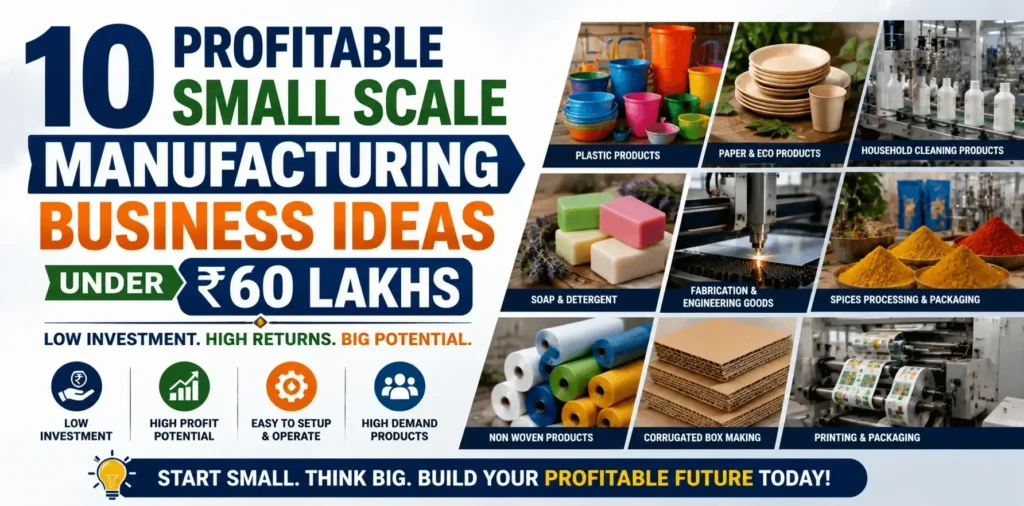
India’s growing economy, rising demand for locally manufactured products, and strong government support for MSMEs have created massive opportunities in the small scale manufacturing sector. Entrepreneurs and investors are increasingly exploring profitable small scale manufacturing business ideas that require moderate investment and offer long-term growth potential. With an investment of ₹50–60 lakhs, it is possible to establish scalable manufacturing units in sectors such as food processing, eco-friendly packaging, detergents, furniture, LED lighting, garments, and household products. These businesses benefit from rising consumer demand, low operational costs, and expanding domestic and export markets. What are Small Scale Manufacturing Businesses? Small scale manufacturing businesses are production units that manufacture products using limited capital, moderate machinery, and small operational teams. These businesses usually focus on local, regional, or niche markets while offering scalable growth opportunities. Why Small Scale Manufacturing Businesses Are Profitable in India government MSME support Make in India rising local demand export opportunities low setup costs scalable operations employment generation Home-Based Small Scale Manufacturing Business Ideas Include: candles detergents agarbatti paper bags soaps handmade foods Small Scale Manufacturing Industries with High Future Demand Include: eco-friendly products electric products organic products biodegradable packaging LED products cleaning products This guide explores some of the best small scale manufacturing business ideas in India that can be started with plant and machinery investment under ₹60 lakhs. Top Small scale Manufacturing Business Ideas with Investment of 50-60 Lakhs When thinking about small scale manufacturing, it’s crucial to focus on sectors with consistent market demand, relatively low overheads, and scalable potential. Below are some of the best business ideas under a ?60 lakh investment bracket: 1. Paper Bag Manufacturing Unit With increasing environmental concerns and a ban on plastic in many Indian states, paper bags have seen a surge in demand. A small scale manufacturing unit can produce kraft paper bags, carry bags, and customized printed paper bags for retail outlets, restaurants, and packaging suppliers. An investment of ?25–?40 lakhs can cover semi-automatic machinery, raw material, setup, and working capital. Why It’s Worth It: High demand due to eco-friendliness Government support for sustainable businesses Easy marketing to retail and wholesale clients 2. Agarbatti (Incense Stick) Manufacturing A traditional yet thriving sector, agarbatti production is a low-technology, high-demand business that aligns well with the ?60 lakh budget. The raw materials include bamboo sticks, charcoal powder, wood powder, and essential oils. With semi-automatic or fully automatic machines, one can manufacture thousands of sticks daily. Benefits: Large domestic and export markets Simple machinery and raw material procurement Fast break-even period 3. Packaged Drinking Water Plant The need for clean and safe drinking water continues to rise across India. A packaged drinking water plant typically requires filtration units, bottling machinery, labeling machines, and a basic quality control lab. For ?50–?60 lakhs, you can set up a medium-capacity unit and get the necessary BIS and FSSAI certifications. Advantages: Continuous market demand Opportunity to expand to flavored and mineral water Sell to retailers, supermarkets, and offices 4. Spice Powder Manufacturing India is a land of spices, and there is massive demand for packaged spice powders both domestically and internationally. With ?40–?60 lakhs, you can invest in grinding machines, packaging units, branding, and marketing. Raw materials like turmeric, chili, coriander, and cumin can be procured from local farmers or wholesalers. Why Choose This: Potential for strong brand identity Export opportunities Value addition with blends and organic options 5. Detergent and Cleaning Product Manufacturing Soaps, liquid detergents, and toilet cleaners are essential household items. A small scale manufacturing business producing these products can be started with an investment of ?30–?50 lakhs, covering mixing machines, formulation expertise, and packaging solutions. Perks: High repeat purchase rate Customizable formulas Brand-building potential in local and regional markets 6. LED Light Assembly Unit With a focus on energy efficiency and “Make in India” initiatives, LED lights are replacing traditional lighting solutions. An assembly unit requires tools, testing equipment, and packaging. A ?60 lakh investment allows you to hire skilled technicians and build inventory. Why It’s Profitable: Urban and rural market expansion Increasing demand for affordable LED solutions Government subsidies for energy-saving products 7. Phenyl and Floor Cleaner Production Phenyl and disinfectants are essential items used in homes, offices, schools, and hospitals. The setup requires mixers, tanks, and packaging machines and can be established within ?15–?25 lakhs. The remaining capital can be utilized for marketing and bulk production. Advantages: Large institutional buyers Low production cost Potential for creating a brand 8. Furniture Manufacturing Unit Custom and modular furniture is always in demand due to rising urbanization and housing projects. A ?60 lakh investment can set up a workshop with carpentry tools, wood polish equipment, and labor to produce beds, wardrobes, and office furniture. Highlights: Rising demand from real estate and commercial sectors Customization brings high margins Potential to supply to e-commerce furniture platforms 9. Garment Stitching and Embroidery Unit A small scale manufacturing business in garments can cater to ethnic, western, or kidswear segments. With ?50–?60 lakhs, you can set up stitching machines, embroidery units, ironing and packaging sections, and create your private label. Opportunities: Strong export potential Growth of e-commerce platforms High employment generation 10. Organic Fertilizer Manufacturing As organic farming gains popularity, so does the demand for compost-based fertilizers. A plant producing vermicompost, cow dung compost, or biofertilizers can be set up under ?60 lakhs, including compost pits, shredders, and packaging machines. Why Go Organic: Government incentives for organic farming Tie-ups with agricultural cooperatives Sustainable and eco-friendly approach Licensing and Legal Aspects Every small scale manufacturing unit must adhere to state and central regulations. Some key licenses you might require include: GST registration Udyam (MSME) registration Factory license Pollution Control Board clearance (for applicable sectors) FSSAI license (for food and water units) Early compliance helps build credibility with clients and ensures smooth operation. Funding Options for Small Scale Manufacturing In addition to personal capital, here are common sources of funding: Mudra Loan Scheme: For small business owners under PMMY SIDBI Assistance: Loans and equity support for manufacturing Startup