
Organic Food Processing Business: Setup Cost, Certification & Investment Guide for Indian Entrepreneurs
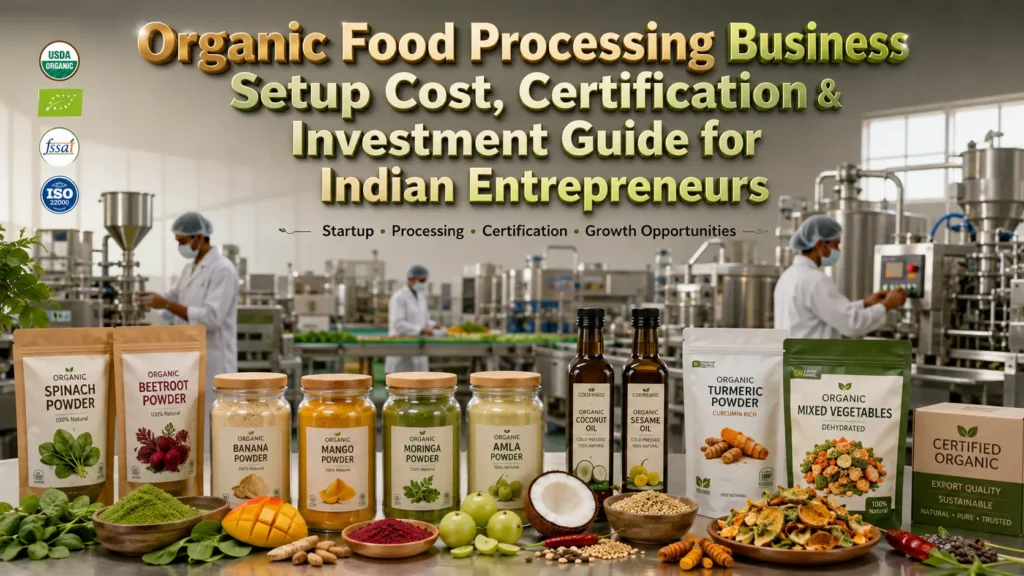
Organic Food Processing Business in India The Counter-Intuitive Truth About Organic Food in India India is exporting more than ₹5,300 crore of certified organic products annually, while it imports the processing technology to process them. Let that sink in. The nation that has over 30% of the organic produce grown in the world, the majority of which is cardamom, grown in the cardamom hills of Kerala, to the spices of the Rajasthan spice belts, are sold mostly as raw commodity. That is the profit realization, that is the packaging, that is the branded product – that goes overseas. A company from Germany imports organic turmeric powder from India and places it in a glass jar bearing a serif logo and sells it for €14. The Indian farmer received ₹42 for every kilo he sold. It is in this space between raw organic produce and finished certified organic produce that the true business is going to be. The Agriculture and Processed Food Products Export Development Authority (APEDA) has reported that demand for certified organic food has increased at the rate of 12–15% every year for the last five years in India. In the three cities, the average urban household in Bengaluru, Pune, and Delhi-NCR spends 22% more per grocery basket when shopping for organic than conventional products, on average, 5 years ago. It is not sufficiently available in the region where it is made, there is no traceability, and it is not properly certified. Get Detailed Project Report (DPR): Food Processing and Agriculture Based Projects The Supply Gap Nobody Is Filling Fast Enough India has the maximum area (36.53 lakh hectares) of certified organic farming in the world, according to the National Centre of Organic and Natural Farming (NCONAF). Less than 12% of the small and medium organic processors have been certified in India as per the minimum requirement of NPOP (National Programme for Organic Production) to be able to label a product as ‘certified organic’ for domestic retail and export market. The outcome: a deficiency in structural processing. Raw sales dominate to large aggregators, most of these who are also organic farmers sell at prices slightly higher than conventional producers. At the processed and value-added segment, less than 200 brands have a national presence with the bulk of them concentrated in Maharashtra, Gujarat and Karnataka. States such as Uttarakhand, Himachal Pradesh, Odisha and Chhattisgarh which have more than 8 lakh hectares of organic farms have virtually no processing infrastructure. The Indian Council of Food and Agriculture (ICFA) believes the India domestic organic food market has total value of around ₹9,000 crore and is estimated to reach ₹30,000 crore within a decade. Retail outlets such as the DMart, BigBasket and Nature’s Basket have admitted that there is less space for certified organic essentials priced between ₹100 and ₹500. The supply situation is even more constrained for smaller categories of organic food, such as immunity boosters, millets and cold-pressed oils. Demand from exports is just as poor. More than 85% of the certified organic exports from India are consumed by the EU, USA and the Gulf markets. Processing units that are able to ensure traceability, hygiene and NPOP or NOP (USDA Organic) certification can charge 25-40% price premium on uncertified Indian exports. TABLE 1: State-Wise Organic Demand, Key Crops & Industrial Clusters State Key Organic Crop / Product Industrial Cluster / Hub Estimated Demand Growth (Annual) Export Potential Sikkim Organic vegetables, ginger, cardamom Gangtok Agro-Processing Zone 18% High (EU, USA) Madhya Pradesh Soybean, wheat, pulses Indore, Jabalpur 14% Medium-High Rajasthan Cumin, coriander, fennel Jodhpur, Kota Spice Cluster 16% High (Middle East, EU) Uttarakhand Basmati rice, herbal extracts Rudrapur, Haridwar Food Park 12% High (USA, Japan) Maharashtra Soybeans, millets, sugarcane jaggery Pune, Nashik Agri-Zone 11% Medium Kerala Coconut oil, spices, black pepper Kochi Spice Park, Thrissur 15% Very High (Gulf, UK) Source: APEDA Organic Export Data; NCOF Annual Report; State Agriculture Department estimates Why Entry Right Now Makes Commercial Sense Organic food processing is an appealing proposition right now in three ways. First: Policy tailwinds are there and backed by cash. Organic clusters are eligible for up to ₹50,000 per hectare under the Government of India’s Parampara at Krishi Vikas Yojana (PKVY) for support in the certification process and farmer group formation. This directly lowers sourcing cost of raw material. The processors who coordinate with PKVY clusters are provided with a cost and supply benefit at the same time. Second: The demand for exports is growing faster than the supply. As per the export data from APEDA, the value of organic exports increased from ₹1,900 crore to more than ₹5,300 crore during the last decade. They are mostly made of turmeric, ginger, pulses and rice. But only part of these flows as a complete branded product. This market can be reached directly by a processing unit certified to the NPOP standards. Thirdly, the processing sector of the MSME is undercapitalized — on purpose. There has been no meaningful presence by big FMCG players in the organic sub ₹300 SKU segment. It is structurally inefficient because of their small production volumes and high marketing expenses. The price band of ₹80-250/unit is left open for agile MSME processors in this regard as it is the optimum sweet spot of the metro consumers. The Ministry of Food Processing Industries (MoFPI) has earmarked more than ₹10,000 crores for the food processing industry under the Production Linked Incentive (PLI) Scheme. Organic processors whose sales is more than ₹1 crore per year will get a 4-10% incentive on incremental sales, thus reducing the payback period by 8-12 months. The MUDRA Kishore and Tarun loan categories offer a loan of up to ₹10 lakh, which is enough for a micro-processing unit, but it does not require any collateral. The Prime Minister’s Employment Generation Programme (PMEGP) is a scheme offered by KVIC, which provides 15–35% capital subsidy based on the geographic location of the project and the type of the founder (women, SC/ST entrepreneurs receive higher subsidy). Get Detailed Insights