
Best Large-Scale Business Ideas in India: Multi-Crore Investment Opportunities
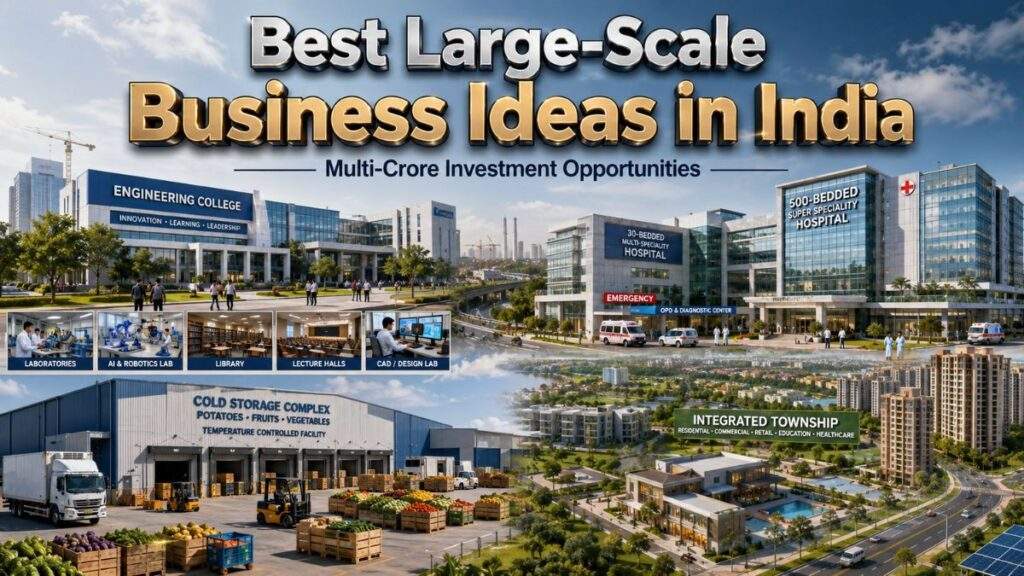
Best Large Scale Business Ideas in India Why Infrastructure Is India’s Smartest Business Canvas The story of India’s infrastructure has always revolved around steel tonnages, highway kilometres and power plant capacities. However, the more interesting narrative, one that matters to startup founders, institutional investors and first-generation entrepreneurs, is occurring at the intersection of services and built infrastructure. Engineering colleges, hospitals, cold storage places and integrated townships are not engineering play-rooms, but one of most durable businesses in today’s Indian market backed by demand, stickiness of essential services and has a scalable revenue architecture that is hard to beat in the manufacturing business. Look at the structural background: India has an over 900 million working population, governments are aggressively striving to gain access to healthcare and increase access to higher education, agricultural sector is troubled with issues of post-harvest loss, and urbanisation is happening at an incredible pace, requiring planned urban housing. All of these trends are ideal investments on their own. As a whole, they create a time in which infrastructure businesses based on true demand, not speculative capital cycles are more appealing than ever. If the entrepreneurs and investors are ready to turn away from the traditional trade and manufacturing, the four sectors analysed here are some of the most bankable, policy supported and future-proof segments of the domestic economy. Get Detailed Insights from This Book: Our Books Why Infrastructure and Services: The Investment Logic The demand visibility of infrastructure services is one of the few sectors in India that can show that kind of sustained demand visibility. Structural demand is the type of demand that does not go away during a recession, as it is with consumer products and manufacturing enterprises sensitive to input cost changes. For example, demand for healthcare in low-income countries is highly price inelastic. The demand for cold storage increases with food production and formalisation of food retailing. GDP and employment in engineering and technical education follow the curves of GDP and industrial employment with almost a perfect correlation. In recent years, it’s the financial structure of these investments that has evolved. The Government of India through various ministries from the Ministry of Education to the Ministry of Health and Family Welfare, the Ministry of Food Processing Industries and the Ministry of Housing and Urban Affairs have gradually made it easier to offer subsidies, viability gap funding, and access to institutional lending facilities. What you get is a risk adjusted return profile that performs well despite the volatility of commodity cycles and is competitive against the high growth manufacturing sector. These are some of the most defensible business architectures that exist, in the sense that they are suited to investors who have a 10-to-15-year time horizon and access to local institutional relationships and land. Government Policies and Incentive Architecture The policy context for infrastructure investments has come a long way. The Credit Guarantee Fund Trust for Micro and Small Enterprises (CGTMSE) under the Ministry of MSME offers collateral-free loans to enterprises for establishing cold storage and food processing support infrastructure facilities of up to ₹5 crore, thereby providing a strong de-risking facility to the first-generation entrepreneurs. Ayushman Bharat – Pradhan Mantri Jan Arogya Yojana (PM-JAY) et al creates a guaranteed payer base for empanelled hospitals, which would make even 30 bed secondary care hospitals in Tier-2 and Tier-3 towns have visibility of revenue! The National Cold Chain Fund (NCCF) under the Ministry of Food Processing Industries (MoFPI) provides capital subsidy of up to 35% of project cost for integrated cold chain projects with an emphasis on potato, horticulture and perishable supply chains, catering for the identified gaps in post-harvest infrastructure. In the meanwhile, the Pradhan Mantri Kisan SAMPADA Yojana (PMKSY) offers infrastructure grants for agri-logistics nodes with a critical component of cold storage. The Real Estate Regulatory Authority (RERA) framework on the whole is regulatory, but it has institutionalized the belief of the buyers, which in fact has furthered the speed at which the projects are completed and made them accessible for construction finance. The Smart Cities Mission and AMRUT schemes also provide urban local body co-financing for infrastructure in designated areas which lessen the burden on private developers. AICTE’s revised norms for approval of private engineering colleges and the National Education Policy (NEP) 2020 were also important in enhancing the commercial viability of private technical institutions, while there is a call for multidisciplinary education, which will benefit engineering education. Startups in infrastructure that are linked to MSME get tax exemption, ease of compliance, and access to government infrastructure procurement process on par with other startups, under the Startup Recognition benefits provided by the Department for Promotion of Industry and Internal Trade (DPIIT). Together these schemes take the risk “floor” for first time infrastructure entrepreneurs down considerably. Business Opportunities: Sector-by-Sector Analysis 1 Engineering College The engineering and technical education space in India has one of the lowest investments to demand (I/D) ratios among all sectors in the country. While the perception of a lack of seats exists in some of the metros, a ground level assessment of the country has revealed that there is a huge gap in the emerging corridors, especially in states such as Rajasthan, Odisha, Chhattisgarh, Uttar Pradesh and the Northeast region, where the ratio of engineering colleges to the population of 18-22 year old population is significantly lower than the national average. If a land owner with local stakeholder base wants to make an engineering college, the capital expenditure is high but it is also a business that can be banked easily due to the presence of AICTE. The capital cost of a normal College with four departments (Computer Science, Mechanical, Civil, Electronics) of 300 seats is around 15-25 crores when taking into account the land cost and construction specification. Diversification of revenue streams: tuition fees, hostel, mess operations, consultancy and training, industry sponsored labs and more and more, skill development centres under PM Kaushal Vikas Yojana (PMKVY). A good and well-managed private engineering college evolves from a capital
Manufacturing and Business Ideas in the Chemical Sector: Gallic Acid, Potassium Nitrate, Chlorinated Paraffin Wax and Zinc Sulphate
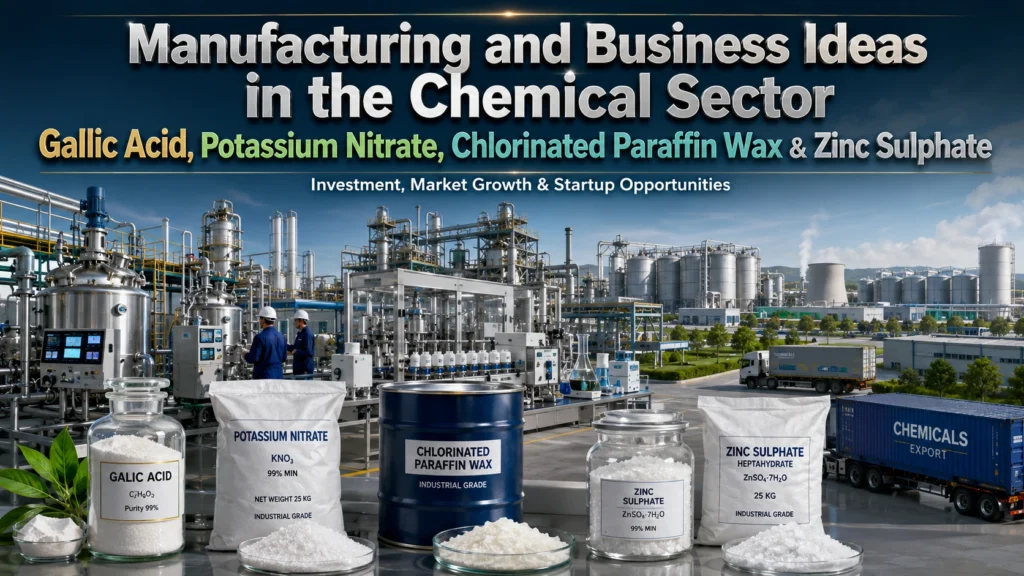
Chemical Manufacturing Business Ideas India The Indian chemical economy has morphed itself into one of the most promising business incubators for 1st generation entrepreneurs to execute without resorting to a multinational balance sheet. Over the years, I have seen hundreds of feasibility reports on small and mid-sized chemical companies and am always coming back to a few products that meet the criteria of reasonable capital investment, reasonable demand and a true import substitution rationale. There are four such opportunities that include gallic acid, potassium nitrate from tobacco waste, chlorinated paraffin wax, and a combined zinc sulphate heptahydrate–monohydrate unit. There is no glamour about them as there is about a battery gigafactory, and each are part of a supply chain that Indian industry relies on every day, be it from pharmaceuticals to leather, fertilisers to plastics to textiles. Why This Sector, Why Now Speciality and fine chemicals are in a strange situation in the Indian manufacturing industry because, although the local market is large and expanding, there has never been a significant expansion of the local production of meaningful intermediates, and so they have remained imports from China and Europe. It is here that the right kind of an MSME can fill that void. Process chemistry rewards consistency and quality control and reliable sourcing more than R&D expenditure, and that’s what the tannin derivatives, nitrate salts, chlorinated wax and zinc-based micronutrients are. The rationale for profitability is further complicated by export potential: buyers in SE Asia, the Middle East and Africa are actively seeking to de-risk their China-dependent supply chain and Indian producers offering consistent purity specifications are taking their business. The margins in this space are decent, not brilliant, and typically in the 15-25% operating range, when a plant operates at reasonable capacity utilisation, but the demand base is sticky because these are input chemicals that are used continuously by the downstream industries as opposed to discretionary purchases. Explore This Book: Handbook On Chemical Industries (Alcohol Based) Government Policies and Incentives Supporting New Entrants Business owners who move into this area do not need to give money their own way. The Ministry of MSME’s Credit Guarantee Fund Scheme and the Prime Minister’s Employment Generation Programme are loan support schemes which provide collateral-free loans for new manufacturing units, especially for chemical projects which also involve high investments in machinery. The PLI scheme for specialty chemicals, which is now being administered by the Department of Chemicals and Petrochemicals, has also created space for downstream players even if the main beneficiary of the PLI scheme is a larger integrated producer, because the demand pull from the PLI generates for ancillary/in-between suppliers. Gujarat, Rajasthan and Tamil Nadu have established industrial policies, especially for industrial clusters in these states to provide power tariff concessions and stamp duty exemption along with capital subsidy to new small-scale chemical / MSME units. Besides, time for environmental and factory licences, the biggest bottleneck for chemical start-ups, has been reduced significantly thanks to the Stand-Up India scheme and a number of state-level single-window clearance portals. A business man can check out the existing scheme information straight on the. The entrepreneurs can check the details of the schemes available at the portal of the Ministry of MSME. Multiple Business Ideas Within This Chemical Cluster 1. Gallic Acid Production from Tannic Acid Gallic acid is at an interesting crossroads of pharmaceuticals, ink making and the leather and dyeing industries and is the kind of product that demands a consultant’s eye rather than just an academic one. The major consumers of gallic acid are pharmaceutical intermediate manufacturers for trimethoprim and propyl gallate and the food industry for its use as an antioxidant preservative, which is synthesized by the acid or enzymatic hydrolysis of tannic acid (which is derived from natural material, such as tara pods, myrobalan or gallnuts). The key to the attractiveness to a new entrust for this business concept is that the basic hydrolysis work does not require any special equipment – a reasonably sized hydrolysis reactor, crystallisation and drying plant can be set up with moderate investment; the raw material – tannic acid – can be obtained locally from a number of well-established suppliers, and therefore the risk of dependence on imported raw materials is low. The realistic challenge is quality consistency: pharma-grade buyers are not only looking for production capacity but also for capability in analytical testing, for which the initial investment is the key to success for a new unit. Indian pharma intermediate manufacturers have been increasingly acquiring the necessary intermediate gamma in order to shift away from a dependence on Chinese imports and that opportunity is enough to keep a well-run plant busy. Discover business ideas that actually make money 2. Potassium Nitrate from Tobacco Waste This one’s a business concept that seems like a crazy idea until you plow through the economic math and realize that it only makes sense for there to be several well-established businesses out there making money around this concept. Tobacco waste, which is made up of stems, dust and rejected tobacco leaves from bulk tobaccos processors, contains high concentrations of potassium and nitrate, which can be extracted using a leaching/crystallisation process to create potassium nitrate, a high-value nitrate compound employed in a variety of industrial applications including fertilizer formulations, fireworks production, glass and ceramics manufacturing, and food preservation. The investment thesis here is that the raw material cost advantage: tobacco waste is usually at low or even negative cost, as the processor has to pay someone to dispose of it. The processing itself includes aqueous extraction, purification and controlled crystallisation, which is readily handled by a medium scale MSME chemical plant. For this business, location is a critical factor – the nearer they are to tobacco processing centres in Andhra Pradesh, Karnataka, Gujarat, the lower will be the cost of feedstock logistics, and so any entrepreneur looking at this opportunity should establish the location of the plant based on the availability of waste first and market access second. 3. Chlorinated