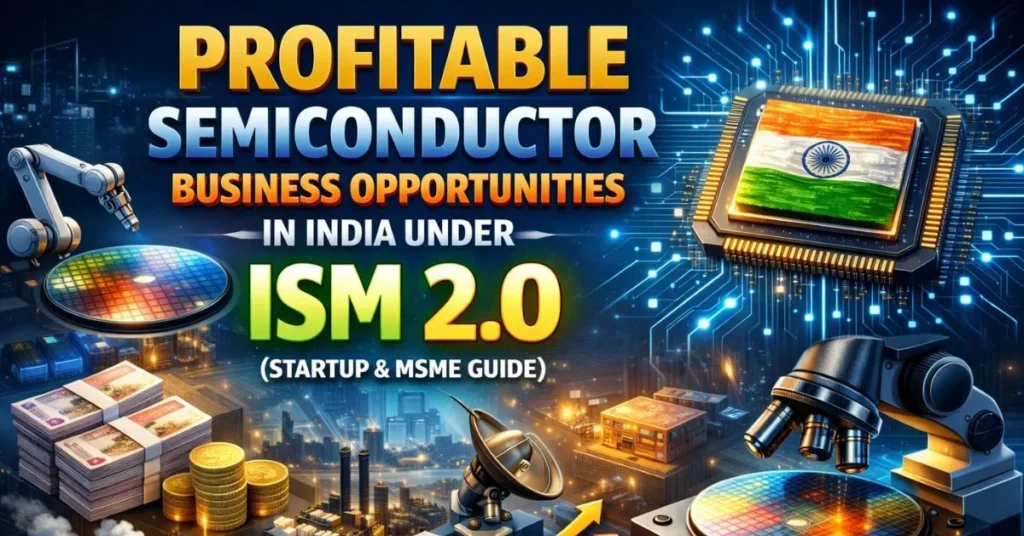

Semiconductor business opportunities in India are expanding rapidly as the industry moves beyond capital-intensive fabrication plants that once required billions of dollars in investment. However, the Union Budget of India 2026–27, along with the expansion of the India Semiconductor Mission (ISM) 2.0, is changing this narrative. The government’s focus has shifted toward building a complete semiconductor ecosystem, opening the door for startups and MSMEs to participate in one of the world’s most strategic industries.
Rather than competing head-on with global chipmakers, Indian entrepreneurs can enter the semiconductor manufacturing supply chain. Incentives such as capital goods duty exemptions, bonded warehousing provisions, deferred duty payments and export facilitation have lowered entry barriers. As a result, startups now have practical possibilities in manufacturing support systems, materials, services and specialised logistics.
India’s effort to minimize dependence on imports and increase electronics manufacturing is driving persistent demand for domestic suppliers. Businesses that are about quality, technical capability and disciplined growth can build strong, defensible businesses in this new ecosystem.(Semiconductor business opportunities in India)
Contents
- 1. Why ISM 2.0 Is a Real Opportunity for Startups
- 2. Ancillary Manufacturing: The Hidden Workhorse of Semiconductor Production
- 3. Tooling and Equipment: Innovation in Engineering Brings Growth
- 4. Chemicals and Materials: Strategic and Technically Demanding
- 5. Testing, Packaging and Semiconductor Logistics: Growth Path Available
- 6. Import Substitution and Export Expansion
- 7. Conclusion: ISM 2.0 Is an Entrepreneurial Opportunity Ecosystem
- 8. FAQ: Semiconductor Startup FAQ
Read More: Our Books
Why ISM 2.0 Is a Real Opportunity for Startups
Semiconductors are now one of the strategic manufacturing sectors in India, which translates into long-term policy support and structural support. The latest budget initiatives are aimed at enhancing the financial feasibility and efficiency of operation in industrial ventures. Demand visibility is on the upswing as domestic fabs and electronics manufacturers are interested in local suppliers to minimize the risk and supply chain delays.(Semiconductor business opportunities in India)
Startups have several policy benefits that make manufacturing more viable:
- Duty exemptions on capital goods reduce initial costs of investment
- Bonded warehousing – inventory storage free of duty payments
- Deferred duty systems help in reducing the working capital pressure
- Export facilitation measures ease the international shipping
Together these reforms provide a more favourable environment for entrepreneurs who are willing to invest in specialised manufacturing or services.
Ancillary Manufacturing: The Hidden Workhorse of Semiconductor Production
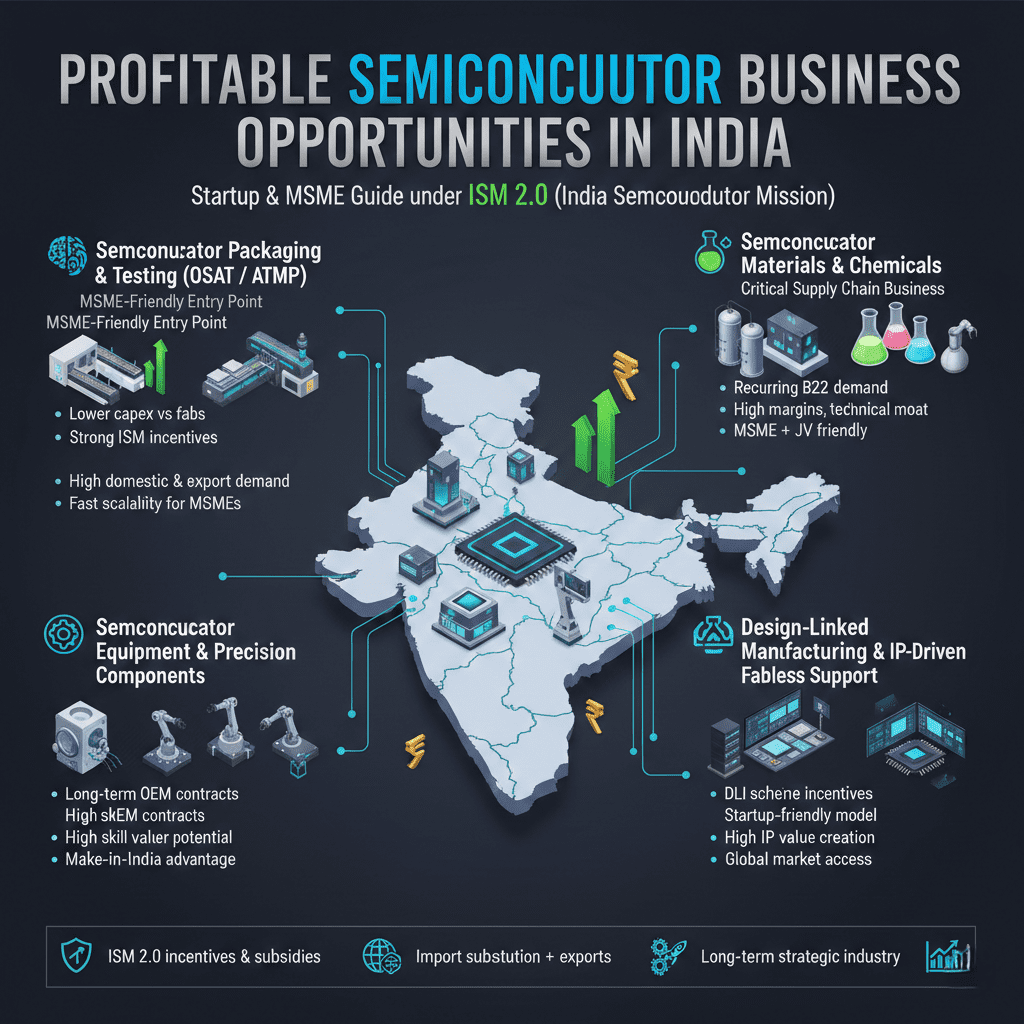
Ancillary manufacturing is one the easiest ways to enter the semiconductor ecosystem. Fabrication and backend facilities rely on the use of thousands of precision components and consumables which must comply with strict technical and cleanliness standards. These products may not be glamorous, but they are important for daily operations.(Semiconductor business opportunities in India)
Because of this tendency among fabs not to switch approved vendors, the ancillary suppliers often have the benefit of long term repeat orders. Profitability, not due to high-volume production, but to consistent quality and process discipline.
Typical ancillary manufacturing areas are:
- Precision machined components for vacuum and process systems
- Wafer carriers, trays, and handling accessories
- ESD-safe packaging and cleanroom-compatible products
- Automation fixtures, enclosures, and thermal management solutions
Startups that concentrate on one market segment achieve better results than businesses that try to develop multiple products simultaneously.
Read More: Business Plans / Project Profiles
Tooling and Equipment: Innovation in Engineering Brings Growth
The semiconductor manufacturing process requires various equipment components combined with automated systems. The advanced chipmaking machines used by international companies run the market yet they require specialized tools and support equipment. Indian startups with good engineering skills have the ability to solve specific operational challenges that semiconductor facilities face.
The focus of the Union Budget on domestic capital goods manufacturing makes for a robust business case for domestic tooling companies. Import delays and high prices make manufacturers seek out domestic suppliers who can deliver faster and provide technical support.(Semiconductor business opportunities in India)
In this segment, success is often achieved through a build-create-qualify-repeat scale. A startup may well start with a single product or engineering solution. Once qualified by a customer, the equipment becomes part of the manufacturing process, which creates stable and long-term revenue opportunities.
Examples of possible areas for tooling focus would include automation systems, precision alignment tools, environmental monitoring devices and specialised sub-fab equipment. The main thing is to solve one problem extremely well before going into additional products.
Read More: Project Reports & Profiles
Chemicals and Materials: Strategic and Technically Demanding
The chemicals and materials segment is one of the most sensitive areas of semiconductor manufacturing. Production processes rely on ultra-pure substances and materials with high technology where even the smallest contamination can cause a production failure. As India looks to decrease dependency on imported materials, the local manufacturing of the same is gaining importance.(Semiconductor business opportunities in India)
Startups moving into this sector will need to focus on:
- High level quality control systems
- Advanced laboratory testing and process validation
- Strict regulatory compliance & certifications
- Constant research and product development
Although the barrier to entry is high, the rewards are high. Once a material supplier is approved, customer relationships are often long term since fabs are reluctant to switch validated suppliers. Companies that manage to gain credibility in specialty chemicals or advanced products can typically enjoy good margins and stable growth.(Semiconductor business opportunities in India)
Testing, Packaging and Semiconductor Logistics: Growth Path Available
The backend semiconductor ecosystem provides one of the most realistic places for new businesses to start. Testing and packaging services earn revenue from long-term service contracts instead of huge investments in manufacturing. Because electronics manufacturing in India is growing at a fast rate, the need for reliable backend support is rising further.
Testing businesses can specialise in functional testing, reliability testing or failure analysis. Packaging services are adding value by the use of high-tech assembly and chip finishing processes. These segments have higher skill demands and lower capital investment requirements than fabrication facilities.(Semiconductor business opportunities in India)
Logistics is another very important part of the semiconductor supply chain. Components need specialised handling to prevent them from being damaged by electrostatics and contamination. Budget reforms like bonded warehousing safe harbour and electronic export sealing are making things much more feasible for logistics startups with semiconductor clients at the centre of their business.(Semiconductor business opportunities in India)
Import Substitution and Export Expansion
India’s reliance on import of semiconductor inputs opens up immediate opportunities for Indian manufacturers. Startups can start by displacing imported products and services, gaining credibility to local customers. Once operational maturity and quality certifications have been achieved, international markets are a natural path for expansion.(Semiconductor business opportunities in India)
Export facilitation measures introduced in Union Budget make it easier for Indian companies to serve the global supply chains. Businesses that combine domestic demand with export growth often build more resilient and scalable business models.
Conclusion: ISM 2.0 Is an Entrepreneurial Opportunity Ecosystem
India Semiconductor Mission 2.0 is a major industrial transformation. The opportunity is no longer accessible to large scale fabrication plants. Instead, there is opportunity for startups and MSMEs to build profitable businesses in the supporting layers of the semiconductor ecosystem including ancillaries, tooling, materials, testing, packaging and logistics.(Semiconductor business opportunities in India)
Entrepreneurs who come at the industry with great feasibility planning, quality discipline, and patience will discover that semiconductor manufacturing is no longer an unreachable dream. With policy support, increasing domestic demand and better export infrastructure, India is fast emerging as a competitive hub for semiconductor related businesses.
FAQ: Semiconductor Startup FAQ
Which semiconductor business segment promises more-fast break-even?
Testing, packaging and specialised logistics usually guarantee faster financial stability as they are based on service contracts and need less capital investment
Can first generation entrepreneurs succeed in semiconductor ancillaries?
Yes. Focused niche manufacturing with stringent quality management makes ancillaries very amenable for disciplined MSMEs.
Is semiconductor chemical manufacturing too risky for startups?
It is technical demanding but companies with strong quality system and compliance process can build very defensible and good business.
Do semiconductor startups need export markets right from day one?
No. Domestic customers usually provide the initial stability that is required before expanding into international markets.
What is the greatest secretive danger with semiconductor enterprises?
Qualification delays are also underestimated. Revenue usually starts only after the approval processes of customers are completed.(Semiconductor business opportunities in India)