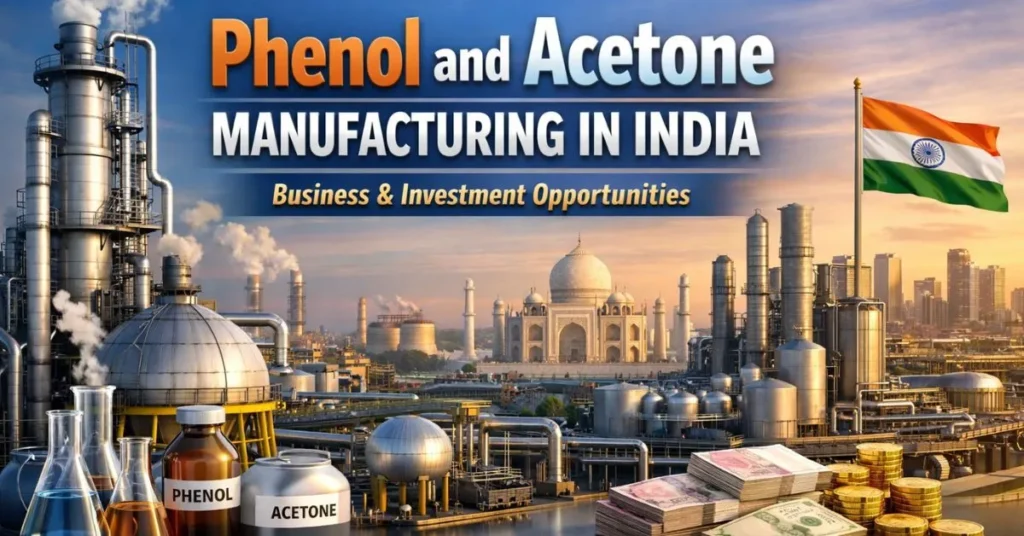

Phenol and Acetone Manufacturing
India’s chemical industry is experiencing a fast growth, but some of the strategic intermediates are significantly import-dependent. Phenol and acetone are two excellent examples of these compounds in that they are key raw materials used to produce laminates, adhesives, resins, pharmaceuticals, and polycarbonates. With domestic demand exceeding domestic production, India is a promising investment destination in phenol and acetone manufacturing – in line with the government’s Atmanirbhar Bharat initiative.
In this article, we examine the phenol and acetone scenario in India in terms of trends in production, gaps in consumption, the key players, downstream opportunities for MSMEs, and import substitution.(Phenol and Acetone Manufacturing)
Contents
- 1. What Are Phenol and Acetone?
- 2. The Domestic Manufacturing Landscape in India
- 3. Production, Consumption and Trade Trends
- 4. Demand Factors of Phenol and Acetone
- 5. Investment Opportunities for Phenol and Acetone
- 6. Government Support & Policy Initiatives
- 7. Future Outlook
- 8. Conclusion
- 9. FAQs About Phenol and Acetone Manufacturing in India
Read More: Phenolic Resins Technology Handbook (2nd Revised Edition)
What Are Phenol and Acetone?
Phenol is an aromatic organic compound which is mainly used for the making of bisphenol-A (BPA), phenolic resins and caprolactam. It is an important component in high-pressure laminates, adhesives, brake linings and electronics applications.
Acetone, one of the co-products of phenol production from the cumene process, is an industrial solvent with wide applications in the pharmaceutical, paints, coatings, nail polish removers and cosmetics sectors. Both of these chemicals are of strategic importance as they are the base for several downstream industries such as polycarbonates, epoxy resins and specialty chemicals.(Phenol and Acetone Manufacturing)
The Domestic Manufacturing Landscape in India
India’s phenol and acetone market is presently in a duopoly that is dominated by Deepak Phenolics Ltd and Hindustan Organic Chemicals Ltd (HOCL).
Hindustan Organic Chemicals Ltd (HOCL)
HOCL’s Kochi plant commissioned in 1987-88 produces phenol, acetone and hydrogen peroxide. The Rasayani facility was closed down and Kochi became the only operational unit. HOCL’s capacity is modest:
- Phenol: 40,000 tonnes per annum (tpa)
- Acetone: 24,600 tpa
Production has been volatile with the output of FY 2023-24 totalling 47,518 t phenol and 29,613 t acetone dropping to 34,874 t and 21,790 t respectively in FY 2024-25 due to market and working capital constraints.
Deepak Phenolics Ltd (DPL)
DPL, a subsidiary of Deepak Nitrite, has the largest phenol and acetone facility in India at Dahej in Gujarat:
- Phenol: 330 kta
- Acetone: 200 kta
In 2025, DPL announced a total investment of Rs 3,500 crores for the construction of a greenfield facility, with another 300 kta of phenol, 185 kta of acetone and 100 kta of isopropyl alcohol (IPA), for import substitution and a combination with polycarbonate.
Other Players
Smaller producers such as Shree Ram Chemicals and the yet to be commissioned projects of Haldia Petrochemicals and Aarti Industries contribute marginally. Despite these efforts, Deepak Phenolics holds around 57% of the domestic market and HOCL covers the remaining market.(Phenol and Acetone Manufacturing)
Production, Consumption and Trade Trends
Installed Capacity vs. Production.
- Phenol installed capacity (government-monitored): 76.8 kta
- Phenol production FY 2023-24: 47.5 kt
- Acetone installed capacity 47.1 kta
- Acetone production FY 2023-24: 29.6 kt
Capacity utilization is currently averaging 62% for phenol, and 63% for acetone – constrained by cyclical cumene availability, global price volatility, and working capital issues.(Phenol and Acetone Manufacturing)
Demand–Supply Gap
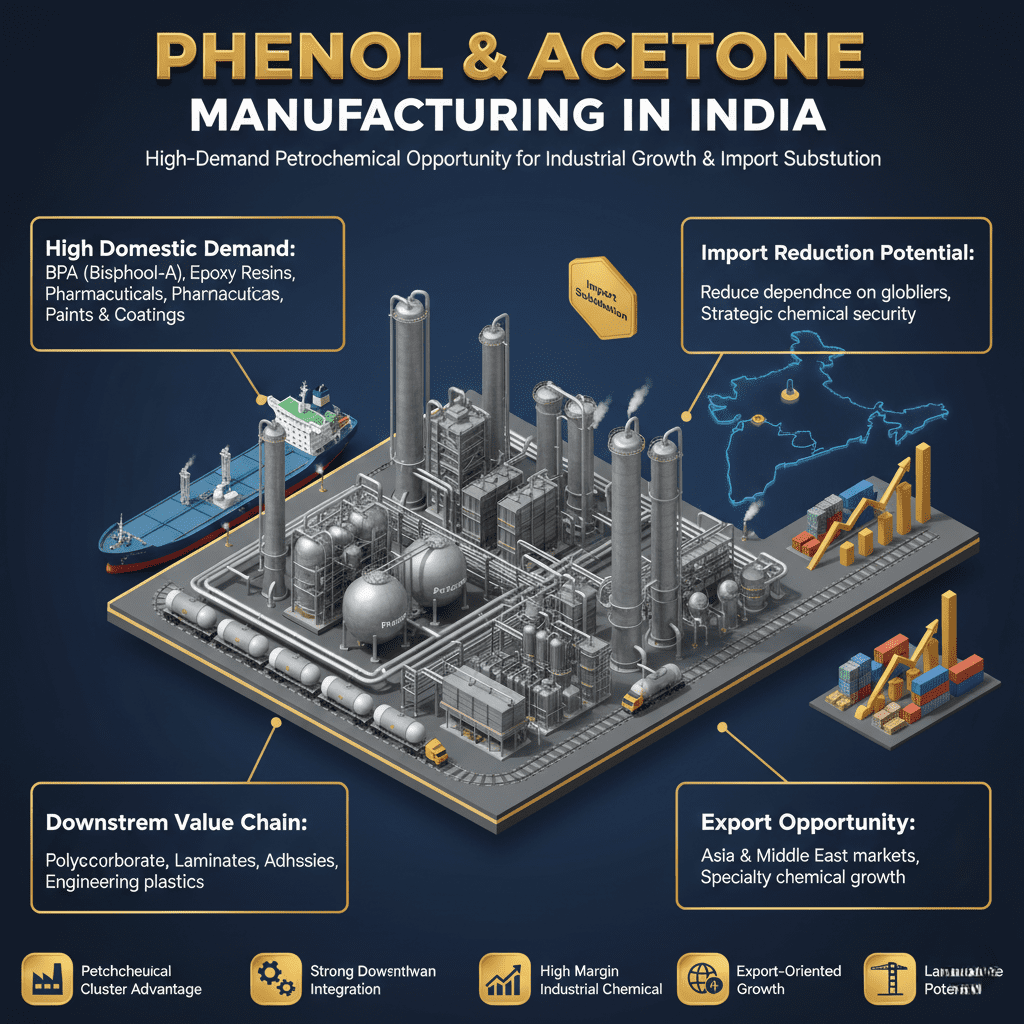
India’s phenol consumption has increased from 179.6 kt of 2019-20 to 261.1 kt in 2023-24. Acetone consumption from 97.7kt to 131.3kt happened in the same period.
- Phenol supply gap: ~213 kt
- Acetone supply gap: ~102 kt
This deficit is now covered by imports, pointing to the existence of high potential for domestic producers.(Phenol and Acetone Manufacturing)
Import Dependency
India imports a large amount of phenol and acetone:
- Phenol: Net imports worth ($1,708 crore) (FY 2023-24), mostly from Thailand, Singapore and South Korea.
- Acetone: 148.21 kt imported in 2024 at ~$147.9 million. The main sources of data are Thailand which accounts for 47.7% South Korea which provides 22.1% Singapore which contributes 5.1% and China which supplies 2.7% of the total data.
India depends on imports for over 50% of its acetone needs because the country requires acetone for its industrial operations which makes the industry vulnerable to price and supply changes.(Phenol and Acetone Manufacturing)
Read More: Project Reports & Profiles
Demand Factors of Phenol and Acetone
- Laminates & Plywood:
The phenolic resins based on phenol play a key role in high pressure laminates, marine plywood and industrial applications. India has a laminate industry that grows 8-10% a year.
- Adhesives & Coatings:
BPA and epoxy resins which manufacturers produce through phenol and acetone processing serve as essential components for coatings and adhesives and circuit boards and composite materials. The adhesive industry in India is expected to grow to USD 3 billion by 2030.
- Pharmaceuticals:
Acetone functions as a primary solvent which people use to create pharmaceuticals and vitamins and cosmetics and personal care products while the pharmaceutical industry needs acetone to support its projected growth which will reach a USD 130 billion market size by 2030.(Phenol and Acetone Manufacturing)
- Construction & Automotive:
Phenol-formaldehyde and epoxy resins for automotive brake pads, moulding compounds and lightweight EV composites. Growing in the construction and infrastructure sectors increases phenol demand.
Investment Opportunities for Phenol and Acetone
Large-Scale Manufacturing
- World scale plants (>200 kta phenol) are economically viable.
- Estimated cost for 100 kta plant: Rs 3000 to 4000 crore
- Integration with polycarbonate, BPA, or resin plants, which lowers the risk in the market.
- PCPIRs at Dahej, Paradip, Visakhapatnam and Cuddalore provide incentives & infrastructure support.
Downstream Opportunities for MSME
- Phenolic Resins & Moulding Compounds. 5,000 – 10,000 tpa plants for laminates, brake linings and foundry binders.
- Bisphenol-A & Epoxy Resins: 10,000 tpa units, potential for higher value integrated products.
- Solvent Recovery & Formulations: Acetone and phenol serve as recycling materials in the pharmaceutical and cosmetic industries.
- Polycarbonate Compounding: Providing flame retardant and glass fiber reinforced PC for automobile and electrical applications.
Read More: Top 20 Chemical Imports to India
Financial Viability
- Large-scale plants: IRR 14–18%, investment ₹3,000–5,000 crore.
- MSME resin units: 20-25% IRR, investment: 15-50 crore, payback period: 3-4 years.
- Raw materials (cumene, methanol); utilities; effluent treatment; working capital).
- PLI incentives (4 – 6% incremental sales) increase returns.
Government Support & Policy Initiatives
- Production Linked Incentive (PLI) Scheme: The promotion of specialty chemicals includes both phenol and acetone as their main components.
- Quality Control Orders (QCOs): Mandatory BIS certification for imports helps to enhance the competitive edge of domestic products.
- PCPIR Policy Infrastructure, tax breaks, and feedstock access aid in large-scale chemical projects.
- Sustainability Measures: The company uses zero-liquid-discharge plants together with waste heat recovery systems and energy-efficient processes to reduce its impact on the environment.
Future Outlook
India will need to keep importing products because domestic production cannot satisfy the increasing market needs but new initiatives from Deepak Phenolics and Haldia Petrochemicals as a possible new market participant will help decrease import needs. The downstream micro small and medium enterprises which manufacture resins and epoxy and BPA and solvent-based products will receive major benefits from the new developments.(Phenol and Acetone Manufacturing)
The phenol and acetone market in India is poised for robust growth, driven by:
- Expansion in laminates, plywood, adhesives, and coatings.
- Rapid growth of pharmaceuticals and cosmetics.
- Government initiatives supporting import substitution and domestic manufacturing.
Conclusion
The phenol and acetone industry in India provides a substantial business opportunity which benefits entrepreneurs and MSMEs and large-scale investors. The strategic chemical market allows new entrants to establish their market presence because there exists a substantial demand-supply gap and government incentives and strong downstream demand in laminates and adhesives and pharmaceuticals and polycarbonates. Businesses now view import substitution and domestic capacity expansion as more than a policy objective because they have become profitable business ventures.(Phenol and Acetone Manufacturing)
FAQs About Phenol and Acetone Manufacturing in India
Q1. What is the major production process of phenol and acetone in India?
A1. Phenol and acetone are in the main produced via the cumene process, where benzene and propylene undergo a reaction to form cumene that is further oxidized and cleaved to produce phenol and acetone.
Q2. Who are the major producers of phenol and acetone in India?
A2. The two main players are Deepak Phenolics Ltd (largest capacity in Dahej, Gujarat) and HOCL (Kochi, Kerala). There exist other smaller units manufacturing the compound, but the above are the dominant players in the market.
Q3. Why is India importing phenol and acetone when it has a domestic supply?
A3. Domestic production is short to meet growing laminates, adhesives, polycarbonates, and pharmaceuticals. Imports fill the supply gap.
Q4. What downstream products can MSMEs produce from phenol and acetone?
A4. MSMEs can produce phenolic resins, epoxy resins, BPA, acetone-based solvents, cosmetics, and polycarbonate compounding products.
Q5. What is the investment outlook for phenol and acetone projects in India?
A5. Large scale phenol/ acetone plants require ₹3,000–5,000 crore with IRR 14–18%. MSME resin or solvent projects ₹15–50 crore with IRR 20–25%.
Q6. What are the government’s supports to phenol and acetone manufacturing in India?
A6. Through PLI schemes, PCPIR infrastructure, Quality Control Orders (QCOs), and environmental regulations encouraging sustainable and competitive domestic production.