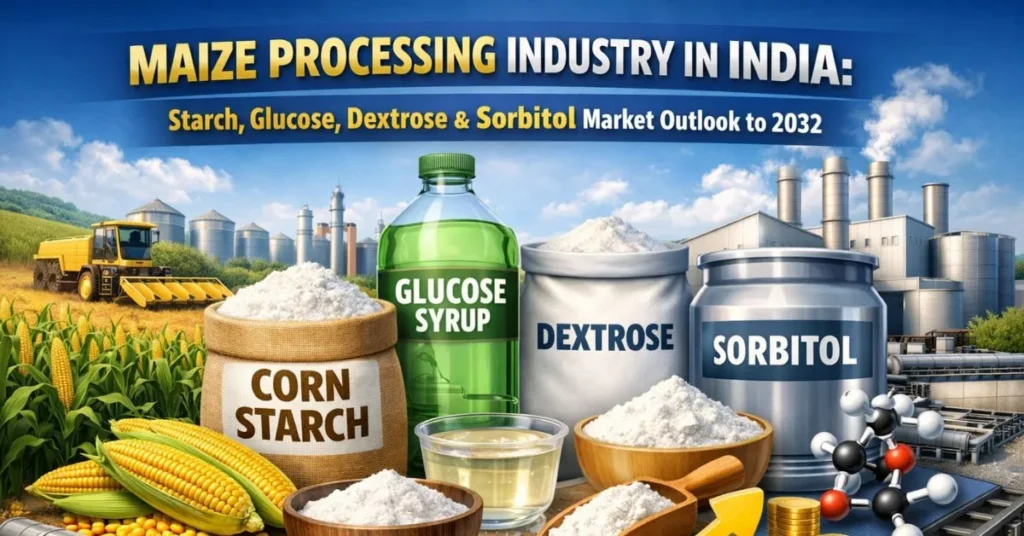

Introduction: Maize Processing Industry in India
India’s maize processing industry has seen a steady shift from the traditional grain milling operation to value-added biochemical processing industry. Today, maize-based derivatives are important in providing the raw materials for pharmaceuticals, food processing, textiles, paper industries, personal care products and fermentation industries. This transformation has been furled by rapid growth of FMCG, growing pharmaceutical production and growing domestic consumption of processed food products.
India produces over 36-38 million metric tonnes of maize per year but less than 25% is made into industrial derivatives. This low penetration of processing, coupled with growing downstream demand, leaves a large opportunity for new investments in maize-based starch and sweetener manufacturing.(Maize Processing Industry in India)
Contents
- 1. Structure of Maize Processing Industry Of India
- 2. Industrial Demand Trends and Growth Factors
- 3. Import Dependency and Market Gap
- 4. Integrated Maize Wet Milling Business Feasibility
- 5. Key Players and Competitive Scenario
- 6. Government Support and Incentives
- 7. Market Outlook and Forecast Up To 2032
- 8. Frequently Asked Questions (FAQ)
Read More: Maize (Corn) Products in India (Starch, Glucose, Dextrose, Sorbitol) Trends, Opportunities, Market Analysis and Forecasts (Upto 2030-31)
Structure of Maize Processing Industry Of India
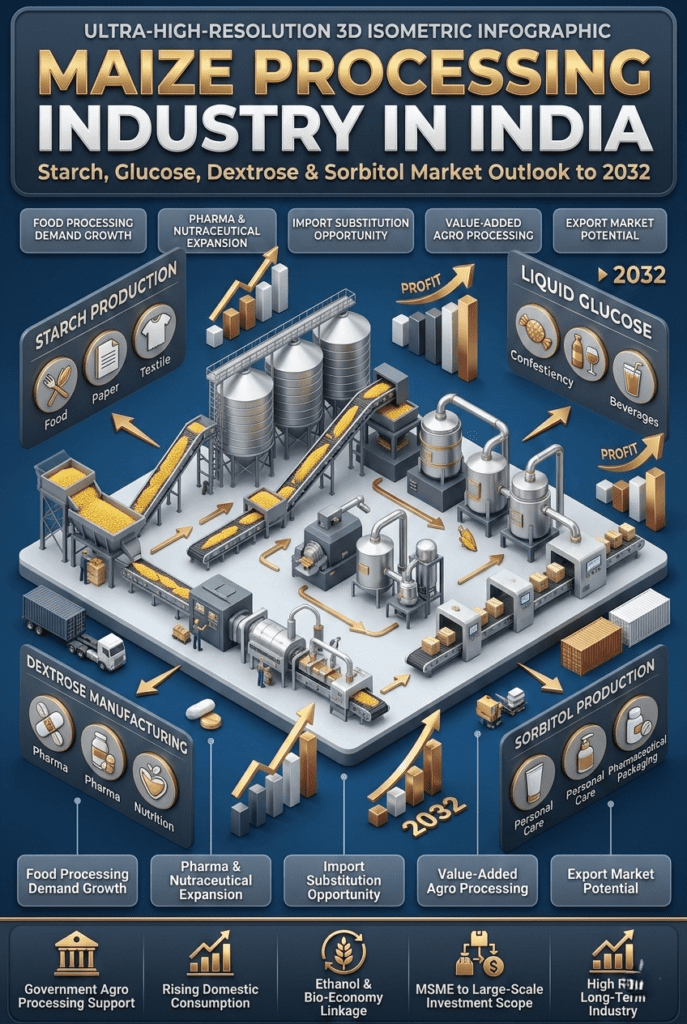
Indian maize processing industry is mainly developed around four major derivatives used by various industries:
- Maize starch, used in large amounts in textiles, paper, pharmaceuticals and food applications
- Liquid glucose syrup (consumed by confectionery, bakery and fermentation industries)
- Dextrose monohydrate, a widely used ingredient in IV fluids, ORS and nutraceutical formulations
- Sorbitol, an important ingredient in toothpaste, cosmetics and pharmaceutical syrups
These products guarantee a regular industrial demand all year round and shelter the manufacturers from seasonal fluctuations.(Maize Processing Industry in India)
Industrial Demand Trends and Growth Factors
Maize starch continues to dominate the market for starch derivatives due to the wide use in the textile sizing, paperboard manufacturing, pharmaceutical tablets binding and adhesives production. Growth in organized textiles, packaging and healthcare has ensured steady consumption through India.(Maize Processing Industry in India)
Liquid glucose demand has grown in tandem with the confectionery and bakery segments, especially due to urbanization and the changing lifestyles. Additionally, industries based on fermentation, such as antibiotics, enzymes and organic acids, are extremely dependent on glucose syrups, further reinforcing demand.
Dextrose Monohydrate has become one of the fastest growing maize derivatives because of the growing pharmaceutical manufacturing. The pharmaceutical industry alone is responsible for over 30% of total domestic dextrose consumption with strong demand coming from Gujarat, Maharashtra, Telangana and Himachal Pradesh.
Sorbitol demand has increased steadily with the growth of the oral care, personal hygiene and cosmetics industry. Domestic averment is still feeble in comparison to the high demand for the pharmaceutical grade, although it suffices as a craver from the import business.(Maize Processing Industry in India)
Import Dependency and Market Gap
Despite being a large producer of maize, India imports refined corn derivatives because of the lack of high purity processing infrastructure. This dependency makes it more costly for downstream manufacturers and exposes them to global price fluctuations.
Key gaps in the present market include:
- Shortage of pharmaceutical grade sorbitol and glucose syrups
- Limited domestic production of specialty and modified starches
- Regional imbalance in supply in South and Central India
These gaps clearly show high import substitution potential for integrated maize processing units.(Maize Processing Industry in India)
Integrated Maize Wet Milling Business Feasibility
Integrated maize wet milling plants have excellent economics because of diverse product production. In such facilities, maize is processed into starch that can be sold directly or further processed into glucose, dextrose and sorbitol.
Major benefits of integrated plants are:
- Ability to serve various industries at the same time
- Higher capacity utilization and operational flexibility
- Additional income from by-products such as maize germ oil and gluten feed
This multi-product structure helps to reduce risk to the business and helps improve long-term profitability.
Key Players and Competitive Scenario
Organised processing industry of maize in India includes some established manufacturers such as Gujarat Ambuja Exports Ltd., Sukhjit Starch & Chemicals Ltd., Riddhi Siddhi Gluco Biols Ltd. and Roquette India Pvt Ltd. These players mostly serve large FMCG and pharmaceutical clients.
However, production facilities are clustered into few regions, thus leaving gaps in supply near emerging clusters of pharmaceutical and food processing industries. This provides scope for MSME-scale decentralized units.(Maize Processing Industry in India)
Government Support and Incentives
The Government of India is actively involved in maize processing under various agro-industrial schemes. Entrepreneurs can benefit from:
- capital subsidies on plant and machinery
- Infrastructure support for integrated processing units
- Incentives at state level under industrial policies
In addition, the growth of the pharmaceutical sector under the PLI scheme is likely to generate a considerable increase in the demand for maize based excipients.(Maize Processing Industry in India)
Market Outlook and Forecast Up To 2032
India’s maize derivatives market is expected to have a steady growth until 2032, aided by the growth in pharmaceutical manufacturing, growth in processed food consumption, demand for personal care products and fermentation-based chemical manufacturing.
Important growth opportunities include:
- Import substitution in sorbitol & specialty glucose
- Drivers of manufacturing in India: – Regional cluster of manufacturing – Pharma and FMCG
- Value addition through integrated processing
Entrepreneurs who ventured into this sector with proper plan and linkage with the market will surely anticipate scalable operations and stable returns in the long run.(Maize Processing Industry in India)
Frequently Asked Questions (FAQ)
Is maize processing profitable in India?
Yes, as a result of diverse product output, good industrial demand and because of government incentives, maize processing has attractive returns.
Why is sorbitol still imported?
Due to limited domestic capacity for use of pharmaceutical grade sorbitol, which results in import dependency.
Which industries are the heaviest consumers of maize derivatives?
Pharmaceutical, food processing, textiles, paper, personal care and fermentation industries.
Are there subsidies for maize processing projects?
Yes, there are several central and state government schemes that offer financial incentives.
What is the future for maize derivatives in India?
Demand is estimated to increase continuously up to the year 2032, due to domestic manufacturing and import substitution.